


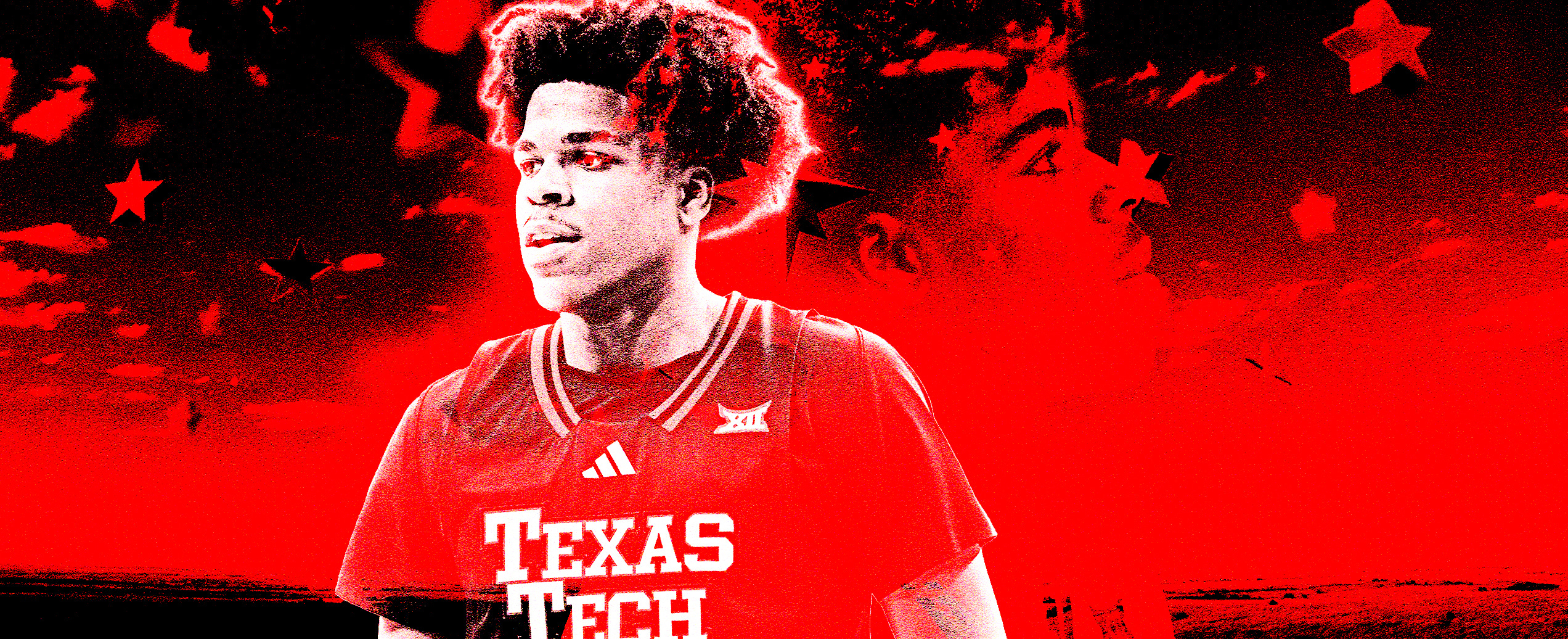
Christian Anderson doesn’t fit into a tidy box when categorizing him as an NBA prospect. Let’s get that much out of the way.
Anderson is a SPECIAL talent. I can’t emphasize that word enough. From how he’s developed since he was a freshman at high school (even before that) all the way up through where he is now as a sophomore at Texas Tech, Anderson is anything but ordinary as a player.
Now and then, we see truly unique players pass through the college ranks as they prepare to further their careers in the NBA. Sometimes, those players check all of the boxes that scouts typically look for in terms of positional size, length, and athleticism that all pop off highlight tapes and dunk reels.
Other times, they don’t always dunk the ball five times a game, or put on a show as an individual handler, dribbling the air out of the ball into step-back jumpers and hitting isolation shots ad nauseam.
To be entirely honest, those kinds of players aren’t always the ones driving winning at the next level in a meaningful way. The more I’ve talked to NBA scouts, executives, agents, players, coaches, and anyone else involved in the game of basketball, the more I’ve had to understand that the mental aspect of the game of basketball is arguably more important than raw, physical talent.
Anderson’s game is most definitely NOT devoid of athleticism in terms of body control, acceleration, and the ability to hammer the ball home when he gets a free lane. But when I evaluate Anderson and project his game to the next level, he’s so technical and fundamentally sound as a lead guard, and those are the traits that matter as the competition becomes more difficult.
The name of the game in the NBA today is dribble, pass, shoot, and give the requisite effort on defense. Not only does Anderson emphatically embody that philosophy, but he’s far better than many currently realize when you analyze how good he’s been not just this season in the Big 12, but his entire life—far before he set foot on the courts in Lubbock, TX.
Anderson isn’t just a run-of-the-mill lead guard trying to make his way to the NBA.
Christian Anderson is a STAR in plain sight.
*All stats used are as of 2.6.26 and are courtesy of Synergy Sports and Basketball-Reference*
The Priors
Anderson has been an excellent guard prospect since he was far younger than he is now in college. Years ago, when Anderson stood around 5’6”, then-Michigan head coach Juwan Howard offered Anderson a scholarship because of how prolific a scorer and shooter he was even then.
Through several years in high school and overseas in FIBA play for Germany, Anderson continued to refine his game and become not just a good shooter and scorer, but ELITE in both of those areas. In his senior season at prestigious Oak Hill Academy in Virginia, Anderson put up the following profile in the EYBL Scholastic Circuit, per Synergy Sports:
20 PPG, 3.5 RPG, 4.9 APG, 54.1/48.9/84.6 Shooting Splits
97th Percentile in Possessions + Assists
97th Percentile in Pick-and-Roll Ball-Handler Possessions As The Scorer (1.043 Points Per Possession)
91st In Transition
94th On Spot Ups
51% On All Jumpers, 52.2% On C&S 3P, 45.8% 3P Off The Dribble, 62.7% At the Rim
Those are utterly insane numbers for any guard to put up in such a talented high school league, let alone someone who has consistently been doubted because of size and athletic concerns.
In FIBA play, Anderson has been part of Germany’s youth system, competing in events over the last four years and medaling in EVERY single event, including two golds. Through four years of competition, Anderson has led Germany as a lead guard and put on showcase after showcase in terms of shooting, scoring, and playmaking for others.

Put simply, Anderson has had parking-lot range on his outside shot for years. His having an unbelievable college shooting career is nothing new to those who have scouted him and analyzed his game before he became a Red Raider.
He’s also been operating at a high level in pick-and-roll for quite some time, and that goes beyond his stellar pull-up three-point shooting.
Even in high school, Anderson was one of the most polished scorers AND shooters off the dribble that I’ve evaluated in 15 years of scouting work. The touch at absurd angles, pacing off the screen, footwork in the middle of the floor, and patience to get the best angles for his shots. These are star-level shots that I could clip for days from just his time at Oak Hill, let alone how impressive he’s been in other levels of competition even before college.
In the NBA, guards are now expected to be lethal scoring threats off the bounce. Defenses are too good, staying home and taking away other options, so players are just playing a one-on-one game every trip down the floor. Screens confuse defenders and displace them, making others react and help out of position to contain the ball-handler. Being such an incredible scorer in those possessions, even at Christian’s age in HS, opens up so many other opportunities not just for himself, but for others. And it takes real poise and quality processing ability to break defenses in pick-and-roll time after time consistently.
Whether it’s with assistance from a ball screen, on the break in transition, out of a blitz at the top, or on an island, Anderson has as much quality passing on tape as any other guard in recent memory at the high school level. His vision to see the next play despite being an unbelievable and confident shot maker goes hand-in-hand with being such an explosive offensive guard, and he showed all of those traits at Oak Hill.
Watching a lot of Christian’s best passes in high school, the quickness at which he found the next man on a lot of different hit-ahead passes in transition, and even when he got downhill in the halfcourt, impressed me the most. It’s one thing to make a pass when there’s no other option, but it’s another to recognize where one’s teammates are and deliver those strikes at such a high speed before defenders can even properly react. That sharp, quick decision-making is what drives the best players in the NBA, and Christian has had those instincts from a young age.
From playing at an incredibly high level in high school to medaling in FIBA youth events, Anderson came into college with quite a list of accolades and achievements when factoring in his statistical performance and trophy case.
But the best parts of how Anderson has developed are still yet to come, as he’s improved leaps and bounds even from where he was in two seasons as a Red Raider. The on-the-radar explosion started with the FIBA U19’s run this past summer, and is even more pronounced now during the college basketball season.
Christian Anderson At Texas Tech

It doesn’t take much to recognize that from his freshman campaign to now, Anderson has grown significantly in key areas across the board. Obviously, minutes and play volume help boost one’s numbers, as Anderson has settled into the lead guard role at Texas Tech compared to playing more off the ball in his first year of action.
Even then, Grant McCasland trusted Anderson to close games as a freshman and play key, extended minutes all the way through an Elite Eight run in last year’s NCAA Tournament. The level of shooting and decision-making Anderson provides to the backcourt is invaluable at any level of basketball, especially in college, where backcourts often determine the ceiling of a team’s success alongside excellent coaching.
But Anderson is in a different tier of guard at this point compared to where he was as a freshman when factoring in his growth—not just in the raw box score data, but how efficient he’s been as a pick-and-roll ball handler, pulling every necessary lever for Texas Tech on significant volume for a player his age.

The growth across the board is phenomenal, but it comes back to the same qualities Anderson displayed before he even got to college.
If defenses don’t pick him up the second he steps foot across half court, or double him to get the ball out of his hands, he routinely makes teams pay, especially in ball-screen actions.
There isn’t a pass Anderson can’t make out of a ball screen. He’s ambidextrous and can hit guys with pocket passes, lob passes, and cross-court skips. You name it, and he’s got it in his bag.
And if you give him space off the screen to shoot, aka go underneath the screener? I mean, massive mistake.
Anderson spends a significant chunk of time in ball-screen offense, but I don’t see that as a weakness, given how a lot of NBA guards operate at their best. As a matter of fact, I value pick-and-roll volume frequency and efficiency heavily in my evaluations of prospects because it’s the one logged play type where I can evaluate a prospect’s reading of multiple defensive levels. How does said player progress through their “decision tree” as the de facto quarterback of the offense? Does he read where the help is coming from? Can he get the ball out of double teams? How does he pace himself coming off the screen? Does he know how to snake the ball screen or get a defender on his hip?
Christian has answered those questions with a resounding yes at Texas Tech, so much so that I’d consider him the best pick-and-roll guard in this entire draft.
Scouts have questions around Christian needing screens to function meaningfully within an offense, but we’ve seen Anderson make contested shots on islands at other levels, and we’ve seen the same here in college. Just ask Cameron Boozer if Anderson has the handle and ability to lose his man and separate for jumpers off the bounce.
Does he have that elite burst to beat any man off the bounce from the top of the floor without a ball screen? I wouldn’t say he matches the type of burst that a Kingston Flemings or Labaron Philon has, that next gear that can challenge bigger matchups consistently in those situations.
But the thing about Anderson is that he doesn’t need that advantage to create offense and make the right play. Anderson consistently knows what decision to make, even if that means passing on a look to get someone else a higher-quality shot, be it dribbling back out or moving the ball around to find a more advantageous situation.
Christian’s pacing, footwork, touch, and decision-making are the ideal combination for an NBA lead guard. Every NBA team wants someone of his caliber in ball-screen offenses running a unit built around a drive-and-kick style offense.
When he’s able to get two feet in the paint or get all the way to the basket, Anderson finishes at a high level. He has soft touch on his floater, can finish at tough angles, draw fouls, or even take it all the way and throw it down if he has the lane to do so!
Defensively, Anderson will always have certain matchups that he struggles with against true size if he’s pushed deep into the paint. You can say the same about virtually any other guard in the league. But his effort level, and most importantly, understanding of where to position himself defensively, are excellent for a player whose value is tied heavily to the offensive end of the floor.
Anderson competes on defense, and that speaks volumes, given that guards who have to do so much to drive success on the offensive end aren’t always inclined to give the most effort and attention to detail on defense. I don’t see lapses in effort or awareness from Christian on the perimeter defensively. He will navigate through ball screens, rotate, switch, and contest shots as needed. And when he does get matched up with someone with a size advantage, he never just gets thrown around like a rag doll. He stands his ground and knows how to play against those matchups without fouling.
That aspect alone is one of my favorite parts of what I’ve seen from Anderson this season. He’s played roughly 96% of available minutes for Texas Tech, which is driven by two key factors. First off, he’s incredibly well-conditioned to operate that much with the ball in his hands and not tire out. The second is that he doesn’t get in foul trouble in these games. Even when defenses try to target Anderson, he keeps his hands out of harm’s way and plays defense with his feet and chest, going straight up on any contests and not biting on any tricks that opposing players throw his way.
As I’ve outlined, Anderson sits firmly at the intersection of dribble, pass, and shoot with great effort on defense. Anderson controls the ball in pick-and-roll situations, can score from all three levels, shoots it incredibly well off the catch or off the dribble, depending on how he’s being utilized offensively, and has the unselfish nature, vision, and instincts to get others involved and make the right play every trip down the floor.
All of these qualities add up to star potential in the NBA, even if the highlight reels don’t quite look the same as some of the other top talents around the league. Size, length, and athleticism are important to an extent in terms of establishing baselines for who legitimately has a chance to not only make an NBA team, but stick around for years to come. Anderson plays bigger than he’s listed, and his game is so well-rounded, polished, and mature that his combination of processing and shooting provides a much higher ceiling than some may envision for him, especially when factoring in his top-tier production across the board.
Don’t believe me? Let’s compare Anderson to where some of the best guards in the NBA were statistically during their pre-draft campaigns.
How Does Christian Stack Up Against Star NBA Guards?
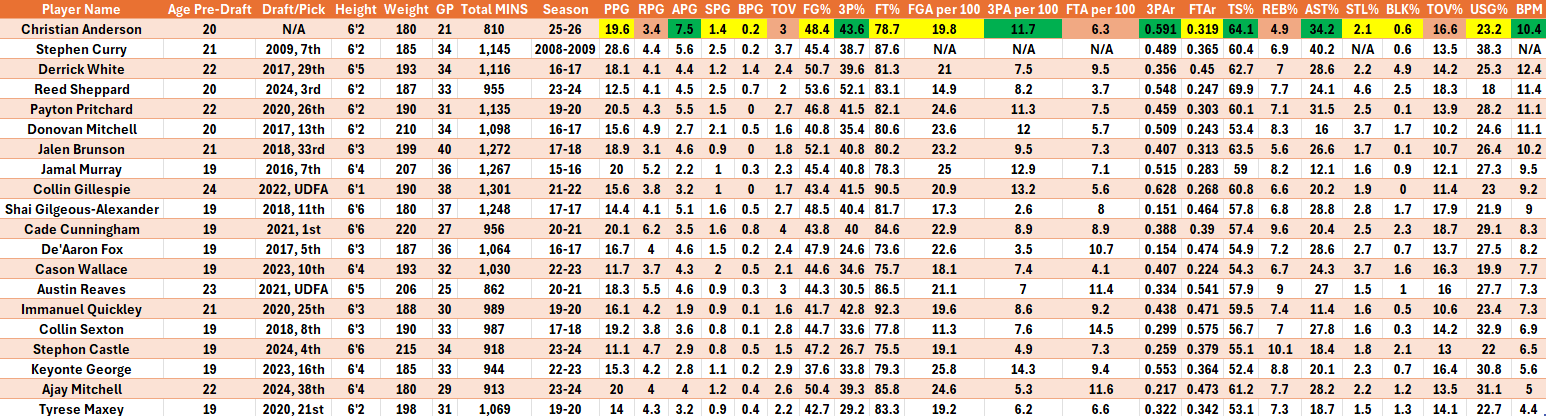
Taking key and advanced metrics into account, I’ve tabulated Anderson’s numbers with top NBA lead guards who played college basketball and, this season, are in the Top 100 in terms of box plus/minus. I’ve laid out their ages, heights, and weights during their pre-draft seasons as well as where they were ultimately selected (or not) during their respective draft years.
Using some color codes, I took each statistical category and sorted among all 20 total guards. Any number that’s in the Top 5 of this group is denoted as “green” for Anderson, any middling stat would be coded “yellow,” and any stat that was in the bottom of the group is shown in “red” on the chart.
A few notes I thought were worth pointing out about this guard group in general, for evaluation purposes:
Eleven of the 20 guards on this chart are 6’3” and under, which expands to 15 if counting those who are 6’4”. The “small guard” narrative has gotten loud in recent years; however, the list of jumbo guards, even including Luka Doncic and LaMelo Ball who aren’t on this chart, is incredibly rare. Average positional size for a guard is 6’3” and 190 pounds, so those who are around 6’2” to 6’4” and in the weight ball park are not considered “small” guards in my book.
These guards, minus Doncic and Balll, are literally the best at their position in the NBA today. Seeing how prolific of scorers they were on high volume in college is a meaningful stat to come away with, especially when factoring in the average True Shooting mark is almost 59%.
There are certainly some outliers that are more than one or two deviations from the mean in regards to steal and block rates for this group. If you eliminate those, the average steal rate drops to about 2.04%, and the average block rate sits at roughly 1.05. These are metrics I’ve seen discussed at length with perimeter players to characterize defensive output, athletic talent, court awareness, and on.
All of these guards had higher turnover rates than I expected, but it’s not a suprirse that with more usage and playmaking exposure comes more opportunity to make mistakes and succomb to defensive pressure and scheming.
Derrick White and Reed Sheppard in particular are two outliers we may not see replicated in quite some time given how efficient they were across the board with signature skills that sung on paper in college, and have translated beautifully in the NBA.
Not too many reds on the chart, huh? Most of the areas you’d expect Anderson not to show as well in are illustrated as such, most notably free-throw and rebounding rates. Turnovers are an interesting aspect of Anderson’s game, and one of the two negatives I’ve consistently noted when watching him.
Anderson will occasionally have poor dribbling or mishandle the ball in isolation. He has also thrown some passes on occasion when he’s gotten trapped or forced off his spots by the defense. These plays are not the norm for Anderson, but his turnover rates have ticked up in conference play and against higher competition this year as teams have sold out more to specifically stop him from even getting the chance to operate in ball screens. It’s most certainly an area of his game that will need to continue improving as he progresses to the next level.
The other area that’s highlighted in red amongst his soon-to-be professional peers is his free-throw numbers, both from the line and how frequently he draws contact. Anderson needs to continue developing his craft as someone who can draw the right contact to get the whistle, and also needs to make the most of those chances when he gets there. I can’t tell you how many times I’ve watched arguably the most dynamic shooter in the country miss some free throws that I can’t believe he doesn’t make. That would also be a nitpick that I’d like to see come around from him.
Those red flags aside, Anderson matches up incredibly well with star-level NBA talent across the board in terms of where they rated out in their pre-draft college seasons. His shooting numbers across the board are top-tier, and he’s really emerged as one of the better high-volume playmakers that we’ve had from the guard position in recent memory, let alone just in this 2026 NBA Draft class.
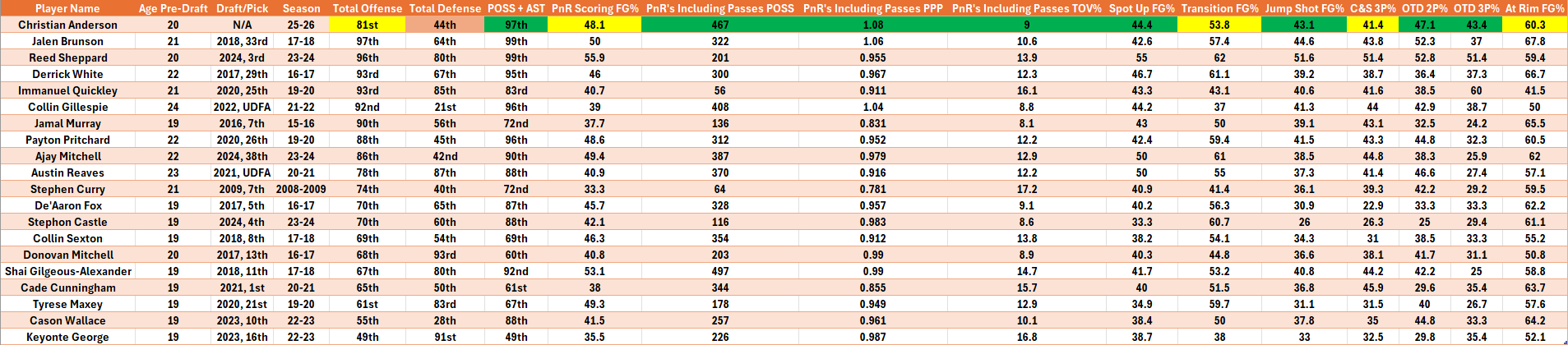
Anderson’s performance in key Synergy metrics is even better when stacking him up against that same peer group. None of these guards can match the minutes he’s playing (at the pace he is), pick-and-roll volume, and overall efficiency within those possessions as a scorer, shooter, and playmaker. We aren’t just looking at a good college guard, but rather a true outlier at the position.
This brings me back to how I started this piece in the first place. Anderson has been SPECIAL for a long time, and he isn’t even close to scratching his ceiling.
Obviously, context plays a large part in all of these guards’ statistical profiles, not just Anderson’s. Christian has a green light and full control of the offense at Texas Tech. He has arguably the most dominant big man in college basketball this year to play off of in two-man game actions in JT Toppin. And Tech has surrounded Anderson and Toppin with a bevy of lethal perimeter shooters that are ready to catch and fire once those two dance in the middle of the floor. Some of these guards in the table didn’t get the same opportunities Anderson is getting now (I mean, just take a look at where Anderson is tracking in terms of total minutes played in relation to his peers), but instead of potentially using that point against him, ask the question of why.
Why does Anderson have so much offensive freedom? How good must he be to command this level of trust from the coaching staff? And given the success Texas Tech has had with Anderson and Toppin being the primary focal point of the offense, where does that leave them amongst their peers as draft prospects? Texas Tech is the only squad that can claim wins over top prospects Cam Boozer and AJ Dybantsa this season. And Anderson was one of, if not THE, key driving forces that led the Red Raiders to victory on both occasions.
His stats in those games vs. Duke and BYU?
80 MP, 49 Points, 12 Assists, 53.5% 2P, 47.3% 3P
Anderson does all of the things well that you would want a point guard to do on the offensive end of the floor, with plenty of room to grow in specific areas. Most notably, I would expect his turnover rates to improve as NBA teams won’t be able to sell out on him in the same ways that they have tried to in college at times.
Anderson has All-Star upside in this class, but he isn’t alone at the guard position. This is the most stacked guard position group I’ve evaluated in 15 years of scouting for the NBA Draft. Which is why it’s important to compare not only Anderson’s output against some of the best guards we have in the NBA and where they were pre-draft, but to put in context just how good this entire field is, and why it’s important he’s on par with his peers in standing out.
Christian Anderson vs. 2026 NBA Draft Guard Prospects

In the above chart, you’ll see each 2026 NBA Draft guard categorized in the same ways as in the sections prior. Same focus on box score and advanced stats here, as well as in the Synergy section to come, with players slotted by statistic and ranked accordingly.
I decided to add a “score” at the end to make it simple in trying to come to some sort of statistical ranking for how this group is currently performing, and who is standing out the most. “Green” would stand for three points (top third in the group in the statistical category), “Yellow” stands for two points, and “Red” stands for just one point for being in the bottom third of the category.
At first glance, it would appear that we have some incredibly strong performers in this class, some of them even a bit underrated, such as Tyler Tanner and Ebuka Okorie. When I say this guard group runs deep, it quite literally does.
In terms of where Anderson rates out, he’s right there in the middle of the pack with lottery-level talents such as Labaron Philon, Bennett Stirtz, and Brayden Burries. In the categories I want a point guard to excel in, once again. Anderson is at the top or amongst the best in this group in playmaking, shooting, and overall efficiency. The free-throw numbers and overall shot attempts are where he falls the shortest, but to still be scoring on par with those who have significantly more attempts at volume should be telling to those who prefer players who offer the most “bang for their buck” on offense.
Anderson’s game, as I outlined above, is about making the correct decision and maximizing every possession for the sake of his team. That means he won’t be walking away every single game with 20 shot attempts. What matters is if he’s driving winning, and making a significant difference on the overall outcome of the game.
We actually have a sample game of what Texas Tech’s offense looks like with Christian off the floor, as against Kansas, Anderson sat out due to an illness. In that game, Synergy’s shot quality metric had the Red Raiders at 0.97 PPP, down from a 0.98 average on the season, BUT the expected shot making metric was quite lower, at 0.81 PPP from 1.11 on the season! Texas Tech clearly did not benefit from the TYPES of shots Anderson normally gets off the pick-and-roll and within the flow of the offense.
So when putting Anderson up against his peers, it’s clear who on their teams are expected to carry more of a scoring load. Kingston Flemings, Keaton Wagler, Darius Acuff, Labaron Philon, Bennett Stirtz, and Ebuka Okorie are all heavily dependent on putting the ball in their basket as much as controlling the levers to open up scoring opportunities for their teammates.
Perhaps the player I’ve underrated the most in this process by their statistical profile is Tanner, who really only stands out as a weaker shooter in this group, but is average-above average in every other area.
Let’s take a look at how this group rated out in Synergy categories I rate highly for point guards.

This is where Anderson really shines amongst his peers, as well as someone like Stirtz and, of course, Flemings and Wagler. These players have all been prolific shot makers in pick-and-roll and in spot-up situations. The points they’ve generated for their teams without turning the ball over and making poor decisions once they’ve gotten a screen is exceptional, and a massive reason to buy in on them as pro guard prospects.
Anderson, in particular, has an excellent profile of his own that points to star-level upside as an on-ball creator in the NBA. Guards have to have significant volumes of pick-and-roll reps in order to take over the reins of an NBA offense. Can you read those next levels of the defense? Are you a threat to score once you’ve turned the corner on that screen? If the defense chooses to blitz you, do you have the passing chops to kick and find that next man for the assist, or the hockey assist?
Anderson checks those boxes resoundingly, while still not having poor marks by any means in terms of his at-rim finishing and transition shot making, although it’s a testament to how athletic some of his peers are to have the metrics they do in those areas. Hitting 60% at the rim is a good marker for a guard, so to see so many guys above that (even hitting 70% at the rim, or converting a high percentage of looks in transition at the basket) is pretty crazy in ONE class of guards.
What I wanted to make evident from this exercise is that Christian belongs in the conversation with the best guards in this class, who I consider to be lottery-level talents. So when discussing Anderson as a potential lottery guard, regardless of where you have these players slotted on a big board, it shouldn’t be a crazy concept to unpack because he’s on par with his peers both statistically and on tape.
But why not take this exercise one step further, and open up the conversation to this class of guards against the same pros I was comparing Anderson to earlier?
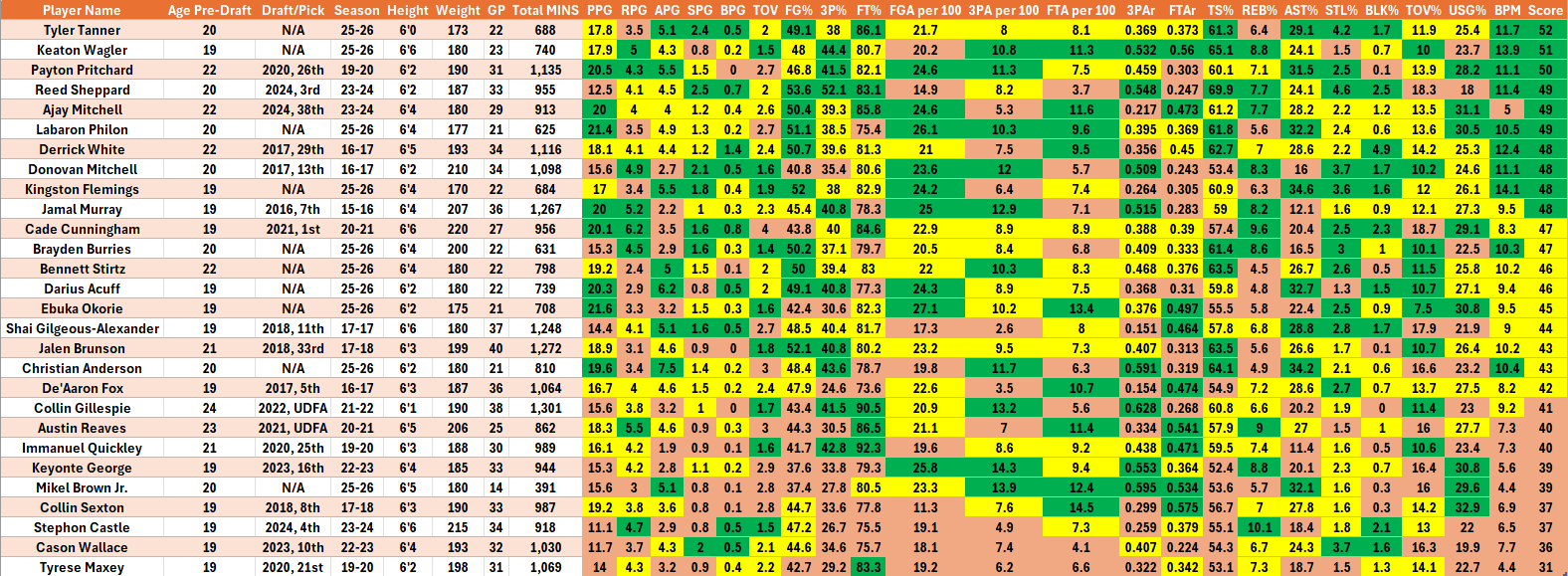
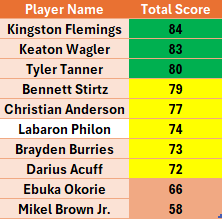
Utilizing the same scoring system, I wanted to match the 2026 guard class up against the pre-draft campaigns of some of the best guards we have in the NBA. The only player I didn’t include from earlier for scoring purposes is Stephen Curry, as some of his advanced metrics weren’t calculated out to properly grade (but trust that he likely would’ve been at the top of these rankings given volume indicators).
What should stand out is that the 2026 class is setting a high bar, and that includes Anderson. It’s fair to ask the question of just how good these guards are vs. teams that are just figuring out how to better optimize their offenses around such excellent shot makers and creators—which would reflect in their stats being noticeably higher on average than peers who have come before them over the last 15 or so seasons.
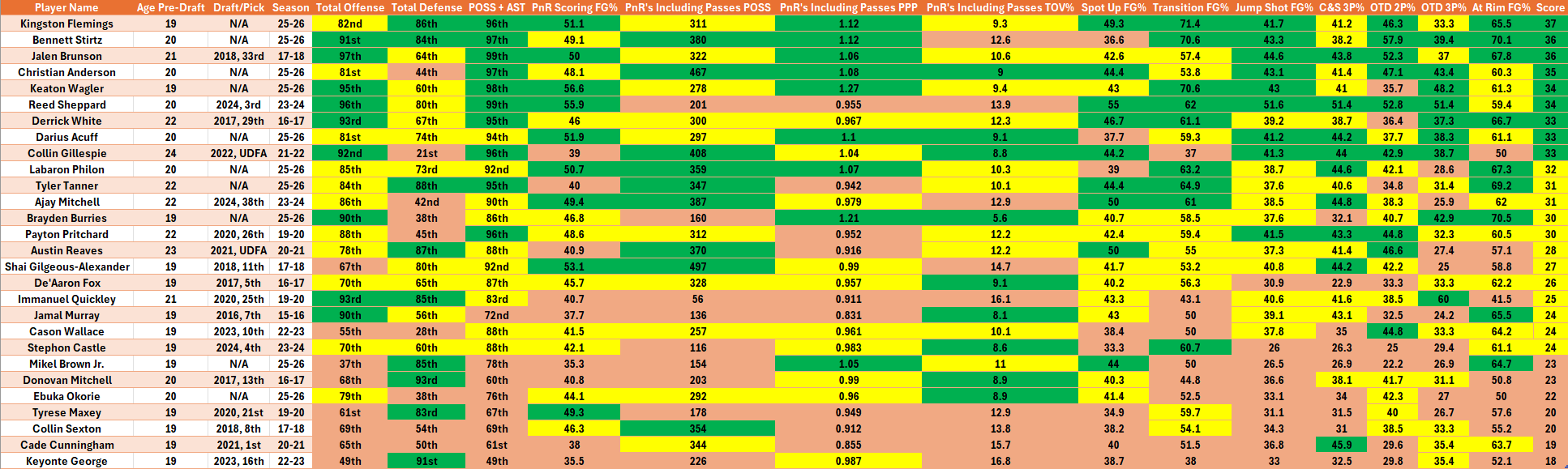
When factoring in Synergy metrics, it becomes even more evident just how well this class is prepared to handle a high volume of pick-and-roll offense at the next level, as well as how accomplished they are as jump shooters already in their careers. It’s no surprise to see Anderson near the top of this list, but as you’ll see in the scores below, Wagler has truly emerged as one of the most complete guard prospects we’ve seen in quite some time. I know this isn’t a piece about some of these other 2026 guards, but again, the fact that Anderson is not only holding his own but standing out in key areas with a group as good as this should tell you all you need to know about where he stands as a pro prospect.
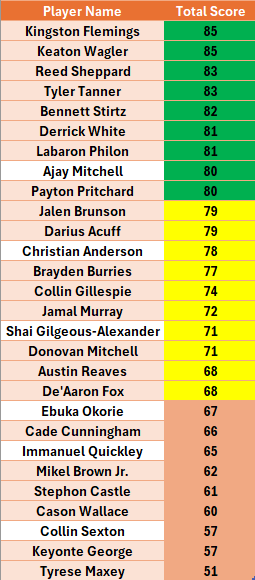
Now, rating low amongst guards in this group isn’t the end of the world, as guys like Tyrese Maxey, Cade Cunningham, and Keyonte George have developed and emerged as some of the best players we have in the NBA today. Someone like Collin Gillespie hasn’t become an NBA All-Star, BUT he was pretty clearly undervalued relative to his draft status—as were players like Derrick White and Austin Reaves.
So to see this 2026 guard class have 8 of the Top 13 players as scored out here should speak volumes as to how absurd the competition is this year to be drafted as one of those guards in the lottery.
Rank these guards as you see fit, but it’s clear to me that Anderson is well established as having significant upside at the position, especially when factoring in just how excellent he’s been when comparing him statistically against the best the game has to offer.
Favorite Christian Anderson Guard Comparison
I want everyone reading this piece to walk with me on this one and stay with me until the end.
I just spent a ton of time outlining how Christian Anderson stacks up against the best guard class we’ve seen in over a decade, on top of how he compares to All-Star and All-NBA guard peers before they were drafted. So to use this player as a comparison is going to spark many questions on its face, but hear me out.
Anderson is here to course correct Jared Butler.
For those who have been following my work as Draft Deeper since its inception in 2020, you’ll know the first full cycle I got to cover on that podcast feed was 2021. That specific season, I didn’t publish a true draft board, but tried to utilize tiers and a mock draft to most accurately reflect how I graded out prospects in that class.
That season, I had Butler as an All-Star upside player (Tier 3 in my system), and mocked him with the seventh overall pick to the Golden State Warriors in my final 2021 mock draft. So, before we even unpack the context behind Butler and why I’m using him as a comparison, let’s keep in mind how highly I valued him as a potential star guard in his class. More than anything, this is a stylistic comparison, as you’ll see Anderson pretty handily blows his pre-draft production out of the water, even in a championship season for Butler.
Now Butler’s pro career never got off and running the way most would’ve hoped. He was diagnosed with a condition that required medical clearance by the NBA in order for him to even be eligible for the draft. That was a significant setback that I’m not sure he truly ever recovered from at this point. His stock took a major hit, and he hasn’t gotten much of a chance to break out in an NBA role since then. He’s had moments with the Washington Wizards and Philadelphia 76ers where he’s looked the part of a rotational guard with perhaps more beyond that to unlock, but I can reason with and understand why his career post-Baylor hasn’t looked like what it did in college.
I am firmly in the camp that had Butler not gone through any of those trials pre-draft and into his early career due to a medical condition, that he had one of those “false ceiling” star upsides as a guard and would’ve unlocked his potential in the right situation.
Coming back to Butler’s play at Baylor, everything he did was technically sound as an offensive player. From operating in ball-screen offense to operating without the ball and relocating for open shots, Butler’s production came from reading the defense at every level and making the best decision in front of him. Butler wasn’t an explosive athlete at the position and did most of his best work on the ball, utilizing a screen at the top of the floor. But he had all of the tricks of the trade in how to manipulate defenses when working off those screens. Butler knew when to accept or reject the screen, how to snake the pick-and-roll, keep defenders on his hip, and when to turn on the burners and get to the rim.
I see all of those same tools and tricks with Anderson when he runs ball-screen offense. Anderson’s decision-making and reads within ball-screen offense are even better than Butler’s were, given his overall playmaking metrics. But even when Anderson doesn’t have the ball in his hands, he’s such a dynamic shooting threat, like Butler was for Baylor when Davion Mitchell took control of the offense. When Texas Tech is working through JT Toppin or LeJuan Watts out of the post, it’s difficult to try to double because of the shooters Tech has at its disposal to catch and shoot, most notably Anderson.
Defensively, Butler had much more of a reputation on that end than Anderson, but both compete on that end and give real effort to keeping matchups in front of them, playing defense with their chest and feet and NOT just their hands, and limiting opportunities for opposing ball handlers to get them in foul trouble. Anderson’s steal rate has steadily declined since the start of the season in non-conference play, but it’s not a negative mark for a guard. So while Butler was excellent in that regard, Anderson is no slouch while sharing the same fundamentals in terms of playing his man on the basketball.


Statistically, it’s pretty easy to tell how Anderson is a much more efficient scorer and playmaker across the board than Butler, again falling in the areas such as defensive playmaking.
Those who were lower on Butler, however, likely have the same concerns around Anderson’s perceived athletic profile. I’ve seen Anderson take off and hammer down dunks in ways I’ve never seen Butler, and I do think there’s a short-area quickness that Anderson has that Butler didn’t possess. But in terms of metrics that evaluators generally tend to lean towards when parsing through how athleticism shows up in the analytics, it’s fair to have similar questions.
Maybe I ended up being far too high on Butler despite the unfortunate circumstances behind his medical condition. Maybe even if everything had gone right for Butler and that situation never happened, he still wouldn’t have broken out in a big way in the NBA. But what if he had produced at levels equivalent to his career at Baylor? And what if Anderson is set to surpass that level of production in the NBA?
Given the foundation of where Anderson’s production comes from, along with what he’s already done in two seasons at college, I feel confident in projecting his ceiling past Butler’s, and again, I would’ve had Butler as high as potentially SEVEN on a big board back in 2021.
I’ve consistently heard Jamal Murray thrown around as a ceiling comp for Anderson as well. I don’t hate it stylistically, given how Murray has thrived in Denver alongside an incredible hand-off partner in Nikola Jokic. The space Murray creates off screens, his ability to hit shots off the bounce, and find the next read within the flow of the offense all match Anderson’s strengths as a guard.
The comp overall falls apart when factoring in Murray’s plus positional size, and how he uses his physicality to create separation on a lot of his shots inside the arc. Anderson doesn’t have those same tools to benefit from, but I can see where the comp is coming from.
Anderson has shades of several All-Star and All-NBA caliber guards, even that of the great Stephen Curry, given his ability to hit shots from all different angles and distances. But I prefer not to use those highest ceiling comps when discussing players because it’s unfair to put those types of expectations on a young player. I prefer median-low comps where possible to just offer others the idea of the player stylistically and how they could fit alongside the right personnel.
That’s why I keep coming back to Butler as a great comp in terms of play style and impact on winning. It’s not the sexiest name to throw around, but I appreciated Butler for all of the same reasons I value Christian’s game. I’ll take that type of guard on my team any day of the week.
Conclusion
There are times as an evaluator when we all become biased to a certain degree. After all, this is subjective work. There is no definitive answer to scouting players for the NBA Draft, and ALWAYS hitting on guys who have long careers in the NBA. Circumstances far beyond our control as scouts will always exist for players, and at the end of the day, it’s up to them to carve out their own paths to success, regardless of how others feel about their games.
But I will admit that I’m biased towards a guard like Anderson because he checks every box I’m looking for in an NBA guard. He’s a lethal shooter on and off the ball, he’s developed into an exceptional passer and playmaker who understands when to score and when to pass, and he isn’t the same type of target on defense as others in his class (and even in the NBA) are. He competes every possession, he’s essentially always available for his team, and he’s been winning at a high level since he was a kid.
Sometimes, part of scouting is just flat-out believing in a player’s ceiling. I’ve always prided myself on not having to walk into a room and change someone’s mind in five minutes with a pitch for a player. If I can do that, you likely didn’t have that strong of an opinion to begin with.
Rather, my goal is to present information and a case for a player or philosophical principle and allow others to really go back and THINK on where they stand as scouts. I would ask everyone who reads this piece to at least THINK about where they stand on guards in today’s NBA, and particularly in this draft.
What are the principles you value in guards? What is your philosophy on where you draft players who have All-Star caliber upside? Do you value other position groups with “safer” baseline projections based on measurables and positional value? Or are you willing to take a chance on drafting players who could very well be next in line to carry the torch as lead guards who drive winning for their NBA franchises?
That’s where I’m at with not only Anderson, but Kingston Flemings, Keaton Wagler, Darius Acuff, Labaron Philon, and Mikel Brown—even Brayden Burries, Bennett Stirtz, and Tyler Tanner behind them. We are looking at a class of guards that is special in ways I’ve never seen from one group in all my time scouting.
My bet is on Anderson to have a much higher ceiling than people think, based on what his strengths are and what they mean towards driving winning at the NBA level. But whoever your guard prospect is, be it Flemings, Wagler, Acuff, Philon, Brown, whoever it is. Are you willing to take a chance on that player and BELIEVE that there really is something special here? Or is it part of your philosophy to hit that single, take the wing or forward who may be a rotational asset for the next four-plus years, but also might not have the same path towards All-Star caliber production and impact?
Scouting for the NBA Draft is enjoyable because we all have different perspectives. When we get to come together and share our ideas and philosophies, we all grow together and learn from each other.
I hope that is what I accomplished today by highlighting a player I just truly believe in.
By the numbers, by the tape, by the trophy case…Christian Anderson is a star hiding in plain sight.
10 minutes of Christian Anderson toying with ball screen defenses 😂 legendary
welcome to the hornets!!!