


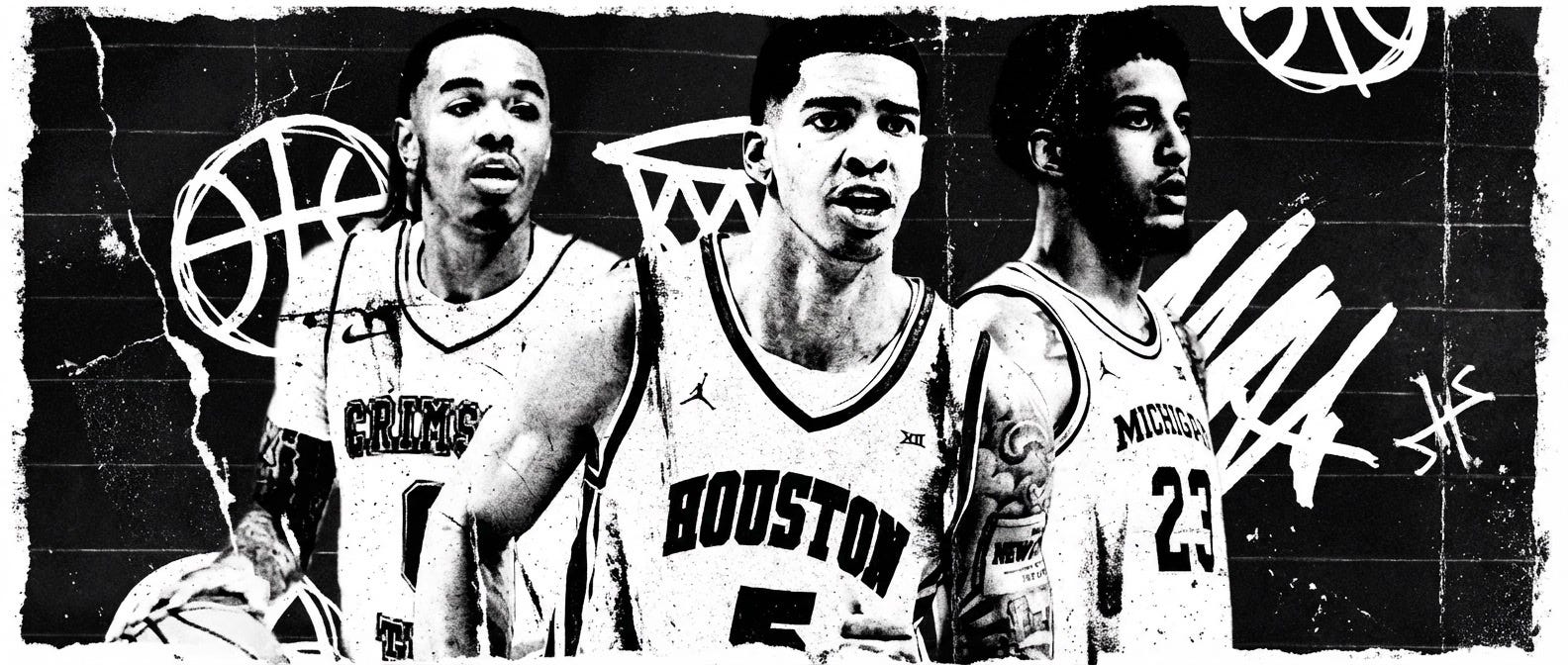
With the NBA All-Star Weekend festivities having now come and gone, the race to the top of the 2026 NBA Draft has grown even tighter. Prospects are gearing up for the conference and NCAA tournaments in the US, while international prospects are approaching the playoffs for their respective teams.
We here at No Ceilings make sure to cover not just the prospects who are likely to hear their names called early on the first night of the draft, but also second round prospects and sleeper prospects for this year’s draft and beyond. However, every year, there are players who end up falling through the cracks and don’t get as much time in the written spotlight at No Ceilings, which is even more true than ever in this absolutely loaded draft class.
I started up this Editor’s Notes concept a few years ago, but haven’t done an edition of it yet for this draft cycle. Now that the home stretch of the draft looms ever larger, though, I wanted to take this chance to talk about some of my favorite prospects who we haven’t written about as much at No Ceilings. These aren’t all sleeper picks; a couple of them may even end up in the lottery if things break right for them. Still, their lack of written focus so far this year for us gives me a chance to put my thumb on the scale a bit.
Simply put, I have some notes.
Let’s dive deep, starting with one of the arguably less-heralded bright lights in this star-studded point guard class.
*All stats are current as of 2/15/26
Labaron Philon
Whenever I see conversations about this guard class on the wider Internet, I see the deserved clamoring for the exceptionally talented and remarkably varied games of all of the freshman point guards.
They all deserve their flowers, and I’m not trying to suggest otherwise.
I just want to make sure that Labaron Philon gets his flowers as well.
Simply put, Philon has done absolutely everything that could reasonably have been asked of him after withdrawing from the 2025 NBA Draft. There were questions about his long-range shooting, and Philon has answered them pretty definitively. He has nearly doubled his volume from beyond the arc (from 3.4 3PA per game last year to 5.8 this year), and has knocked down 39.6% of those shots after connecting on 31.5% of them last year. He has managed to pull off the incredibly difficult double act of more than doubling his scoring (from 10.6 PPG to 21.3 PPG) while also being more efficient (from 45/31/77 shooting splits last year to 51/40/78 this year).
His defense hasn’t quite been as otherworldly as it was last year, but that is completely to be expected from a player who has taken on such a massive leap in offensive responsibilities. When projecting his fit at the NBA level, one would assume that he would not have a 30% Usage Rate like he does this year and that his defense would climb back up accordingly. It’s not like one of the most vicious defenders in college basketball last season has forgotten how to guard people.
Ultimately, I don’t know what else Labaron Philon could do to prove himself at this point. He has improved dramatically as a scorer both inside and outside the arc (he’s hitting a truly ridiculous 67.2% of his shots at the rim), and has continued to make the right plays as a passer. I thought about Cason Wallace as a comp for Philon a lot last season; this year is making me wonder if I should also throw Marcus Smart in that mix as a guy who was an offensive engine in college who recalibrated at the next level to be a solid offensive cog and an absolute defensive nightmare. Philon doesn’t quite have the heft of Wallace or Smart, but the NBA translation could well be similar. Philon also has the added benefit of having shown much more as a floor-spacer this year than either Wallace or Smart did in college.
At the end of the day, one or more of the exceptionally talented point guards in the 2026 NBA Draft are going to fall further than they would in any other year. Fans of certain guard-needy NBA teams might be upset if they don’t end up with their favorite of Kingston Flemings, Darius Acuff Jr., or Mikel Brown Jr. when the dust settles on the first night of the draft.
Whichever one of those teams ends up with Labaron Philon is all but guaranteed to walk away as winners of the draft when all is said and done.
Yaxel Lendeborg
Some people have expressed concern about Yaxel Lendeborg and his three-point percentage in recent weeks. He has gone ice-cold from distance over his last few games, and some people are selling their Lendeborg stock because of it.
Quite frankly, I’m willing to buy any Lendeborg stocks that people are willing to sell—and it’s not just because of the shooting.
Cold spell aside, Lendeborg has done basically everything that anyone could have wanted from him at Michigan. Anyone who was worried that his UAB numbers were a mirage has been shown quite clearly that Lendeborg can hang with the big boys; even if he’s not as historically dominant on the glass this year as he’s been in the past, he’s also playing with two other rebound-inhaling menaces in Morez Johnson Jr. and Aday Mara. Lendeborg has continued to display his dazzling passing vision; the interior passing between Lendeborg and Mara this year should be shown at big man clinics for years to come.
Oh, and there’s also his defense:
I’ve preached about small sample size issues in three-point shooting for way too long on Deep Dives episodes this year and in years past, and definitely would have done the same this year if Paige and I had covered Lendeborg in the middle of his cold spell. Sure, I would have liked to see him continue to hit 40% from deep on good volume like he was earlier in the year, but his form and 79% mark from the free-throw line over the course of his college career both give me faith in him as a shooter.
I haven’t gotten to the elephant in the room yet—and it’s for the same reason as his three-point shooting. Yes, Yaxel Lendeborg will turn 24 before he plays his first NBA game.
I don’t particularly care. As I wrote about earlier this year, a prospect’s age is certainly a factor in projecting their development, but I think it’s overblown. More to the point: players and people don’t just stop learning the instant they turn 20 years old. Lendeborg has grown from an unrecruited JuCo player to a mid-major legend to a force for one of the best teams in college basketball; that’s commitment to development that most front offices would dream of seeing from their youngsters.
Lendeborg’s clear commitment to improving as a shooter this year is encouraging in terms of future development, but Lendeborg, as he is right now, is a better basketball player than some of the younger players who will be taken before him will be by the time they turn 24. Furthermore, drafting Lendeborg at 24 guarantees that the team that drafts him will hold onto his rights through the entirety of his prime, which is an underrated positive to drafting older players.
I don’t want to make this argument into something it isn’t; obviously, it would be easier to make the case for Lendeborg if he were doing all of this at 19 years old. Seeing as he’s not, though, I think the odds of him falling in the draft are much higher than they should be. Prospect age is maybe the single easiest factor to overthink when it comes to the draft.
Yaxel Lendeborg is good at basketball; to be more specific, he’s very good at a lot of things that modern-day NBA basketball teams need their players to be very good at doing, and he’s already shown himself to be a positive outlier in terms of developing his game. Don’t overthink it with his age when he’s demonstrably shown how valuable he can be on the floor.
Chris Cenac Jr.
When Chris Cenac Jr. signed on with the Houston Cougars, I had a strange internal dilemma that I know many people across the scouting community also had to some kind of degree.
Just based on his joining up with the Cougars program and Kelvin Sampson alone, I was ready to be more bullish on Cenac long-term; being willing to sign up for a coach who would push him like that at his age showed remarkable maturity and commitment to getting better for a teenage phenom who was ranked #6 in his high school class.
However, I was also certain that his commitment to Houston would take him out of the running for being a one-and-done college player.
As the season goes on, though, and Cenac keeps accelerating his development, I’m starting to think that he might be a one-and-done guy anyway.
Let’s start with the key part of the pitch: Cenac is an incredibly gifted scorer. His shooting touch as a 6’11” big man was the key selling point heading into his college career, with his high and consistent release (albeit with a bit of a slow load-in to the shot at times)—and that hasn’t even been the most impressive part of his arsenal this season. Cenac is converting an eye-popping, double-take inducing 77.4% of his shots at the rim, ranking in the 97th percentile per Synergy. That’s mostly driven by the fact that he already has 29 dunks on the year, putting him in the 99th percentile in dunk frequency per Synergy. Normally, those are the kinds of conversion rates and frequencies that you see from DeAndre Jordan-style big men.
Cenac is a solid vertical athlete, if not DeAndre Jordan level, but the main point here is that you don’t see those kinds of numbers from players who are also drilling 37.1% of their triples on healthy volume:
All of that belies the main reason why I was so happy to hear that Cenac was going to Houston: his defense. Cenac has never been a defensive playmaker (even going back to high school, he was never a prolific shot-blocker), but his defensive improvements over the course of the season have been remarkable nonetheless. Cenac is getting better and better at moving his feet and doing everything he can to inhibit opposing scorers. He may not be sending shots into the 17th row, but opponents are shooting a paltry 47.4% at the rim when defended by Cenac this season. His mobility has always been a huge selling point, and his awareness is starting to catch up to his athleticism.
I still have a couple of concerns with Cenac offensively; while I think it’s more of a sample size issue than anything, his 58.8% mark from the free-throw line on just 1.4 FTA per game is concerning to me. I’m less concerned about this part of his game since the form looks good (especially on spot-ups) and the shots are going in, but his form off the dribble is a bit clunky/inconsistent and could use some cleaning up. Also, I am worried about his A:TO ratio being less than 1.0 (Cenac is averaging 0.9 assists to 1.0 turnovers per game). Still, none of those concerns stand out to me as much as the clear positives he’s shown out there. Even with all I’ve said about his increased odds of being a one-and-done, I wouldn’t be surprised if Cenac ran it back for another year at Houston to continue to develop while also trying to go much earlier in a less-loaded 2027 NBA Draft class.
Just don’t be surprised if he ends up hearing his name called early in this year’s draft instead.
Joshua Jefferson
Round Two for the Deep Dives heads! Joshua Jefferson was also a Paige pick for the show, which might say more than I would like it to say about my player agendas this season (although I’m still feeling pretty good about betting on Flory Bidunga).
Let’s start with the log line: Joshua Jefferson is an absurd playmaker. Jefferson is averaging 5.2 APG, good enough for seventh in the Big 12—as a 6’8” forward. It’s not just that he’s the only guy touching the ball, either—he’s doing this while playing with one of the best college point guards in the country in Tamin Lipsey and another potential 2026 draftee in Milan Momcilovic.
I don’t need to only give you the numbers, though; just take a look at his passing wizardry:
What might impress me even more than his sensational vision, his lightning-quick decision-making, and his nearly-limitless passing toolkit is how he manipulates defenses with his eyes. On multiple plays in that reel above (and plenty of other passes if you dive deep into the film), Jefferson freezes defenses just by tilting his head one way and then throwing the ball somewhere else, like a superstar quarterback looking off a safety. It’s truly remarkable to me just how many times he does that so successfully that he makes his defenders look like they’re stuck in amber.
Jefferson is more than just a ridiculously gifted offensive playmaker, though. He does his best work defensively as a help defender by shutting off opposing possessions without necessarily ending them with a steal or a block, but his 3.4% Steal Rate and 2.7% Block Rate over the course of his college career speak to the playmaking he does at the other end as well. He’s even taking and making threes at a career-best clip (39.4% from distance on 2.8 attempts per game).
Since Jefferson is a former Deep Dives prospect, I feel somewhat justified in going with one of my most-overused Deep Dives clichés. With his standout offensive skills and impressive help defense abilities, Joshua Jefferson has a ton of different avenues to playing time. Need a playmaker in the second unit? Check. Need a dirty-work forward who can switch 2-4? Check. Need a floor-spacer who can make good decisions when forced off the line? Check.
Simply put, there are players out there who can match Jefferson as a passer (though not many on that front), shooter, or defender; there aren’t many players who combine all of those skills in one package as he does. His shooting could be a fluke (given my other big cliché of being a partial free-throw shooter and his decent but not exactly impressive 72.2% career mark from the charity stripe, I don’t want to overindex on his one college season of shooting above 31.0% from deep), but his passing and his defense very much are not. He’s the kind of connective piece that every NBA team could use coming off the bench, and (stop me if you’ve heard this before, maybe in this very article) he’s likely to be available much later in the draft than his skill set would indicate because he’ll turn 23 early in his rookie year in the NBA.
I don’t want to beat a dead horse, but even if they’re older than the typical prospect, teams should try to draft good basketball players. Joshua Jefferson is one of them.
JT Toppin
JT Toppin is simultaneously one of the easiest and most difficult prospect evaluations in the 2026 NBA Draft. On the one hand, his relative lack of shooting range and questions about his status as a possible 4/5 tweener leave some evaluators cold when it comes to his NBA prospects.
On the other hand…the dude just keeps producing at an insanely high level.
Pretty much nobody stuffs the stat sheet like JT Toppin. He’s averaging 21.9 PPG, 11.0 RPG, 2.0 APG, 1.3 SPG, and 1.6 BPG. This comes on the heels of a season where he made pretty much every single All-American Second Team—and he’s all but a First Team lock this year. Despite all of that, he’s viewed as a consensus early second round pick, just like he was last season.
I’ve talked about this to death on various podcasts over the years, to the point where I’m almost sick of bringing him up myself. However, I keep going back to Jae Crowder when I think of Toppin and similar high-production players. Sure, the two have different games—Toppin is more of a big man and is vastly superior on the glass, while Crowder was a much better shooter.
The argument, though, is exactly the same. After earning Big East Player of the Year honors in his senior season as one of the clear best players in college basketball, Crowder fell to the second round, where Dallas snagged him with the 34th overall pick (ironically, the guy taken one pick later turned out to be a future Hall of Famer and could make this argument more emphatic, but that’s not the point here). I wasn’t writing about basketball at that point and was still following the game from more of a fan perspective, but I just didn’t get it. This was a guy who had size, could shoot, and made every lineup he was a part of better. Sure, he was older, and maybe not the most flashy, but he was good at basketball, and his teams played better when he was on the court. Why did none of the playoff teams picking late in the first round take a chance on a guy that seemed like one of the safest role player bets in the draft?
Sure enough, Crowder played 78 games in his rookie year and started 16 of them. While he isn’t currently in the NBA, he had a solid 13-year career in which he started in more games than he came off the bench.
I made a similar argument about Ryan Kalkbrenner in the first edition of Editor’s Notes from last year’s draft cycle; I said that I bumped him into the middle of the second round then, but I had him as a first round pick by the end of the cycle. The logic was exactly the same: in a league where most second round picks don’t make it to their second NBA contract (and a significant percentage of them never play in the NBA at all), why swing for the fences every time when the defense shifts and leaves the third base side of the infield wide-open for an all-but-guaranteed bunt single for a player who can put one down? In a more relevant analogy: unless you’re Steph Curry, why pull up for a transition three when you have a wide-open lane for a dunk?
That’s especially true in my mind for solid playoff teams that have their top-line guys and just need a few role players. Maybe the prospect with crazy tools has a better chance at becoming an All-Star, but the more-established player who’s already figured out their game can come in and contribute right away. This is even more true now, as NBA teams are churning through young players faster than ever—if a guy has no chance at cracking the roster in Year One, he’ll be out the door in Year Two. So…why not take a guy who might actually have a chance at earning playing time?
Sure, there are questions about his offensive game at the next level. Sure, there are questions about his size—even though his athletic tools are vastly superior to those of the stereotypical “good in college but has no chance at the next level” kind of undersized big man. At the end of the day, JT Toppin is now on Year Three of destroying everybody unfortunate enough to be in his way on his path to glory.
Why would that stop on Draft Night?
Some days you read something and feel it was written just for you. Each of these names have been swirling around in my mind recently. What a treat to wake up and dive in. Thanks for writing, Nick!