



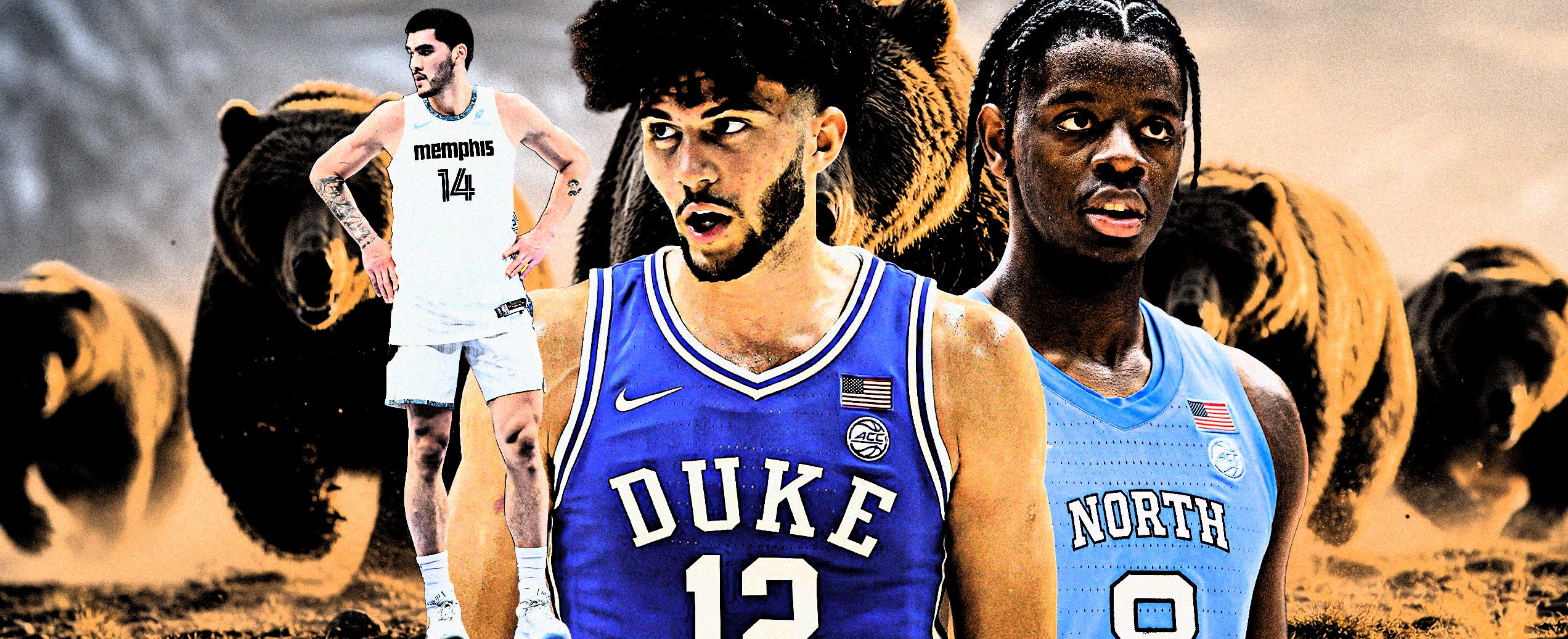
Stephen: Boy oh boy, do the Memphis Grizzlies have an interesting Summer laid out in front of them. There has already been a reckoning of sorts for the team–from the Desmond Bane trade to the Orlando Magic, to the Jaren Jackson Jr. trade to the Utah Jazz. Ja Morant is really the only remnant of the high-upside Memphis team that was once thought to be “next” in Western Conference contention. For a number of reasons, it feels like Morant will be moved off of, though nothing is imminent or for certain.
Conversely, Memphis has young talent to be hopeful for going forward! Cedric Coward looks to be a steal based on where he was selected and how he performed. Zach Edey is one of the most impactful bigs when he is on the court. Jaylen Wells has proven to be a steal. Scotty Pippen Jr., Javon Small, Cam Spencer, Ty Jerome, GG Jackson, Taylor Hendricks, and Santi Aldama: all of them are good NBA players who provide value to the team.
Now the Grizzlies have an opportunity to help add a franchise-altering player to help turn the page into a new chapter for the organization. And, with the rule changes to the NBA Draft Lottery the league has adopted for the short term, Memphis has an added layer of pressure to nail this selection.
In a way, their selection almost happens for them. It’s heavily believed that some order of AJ Dybantsa and Darryn Peterson will be drafted before the Grizzlies are on the clock with the #3 overall pick in the 2026 NBA Draft. There is a chance that Washington or Utah go with Cameron Boozer–or even Caleb Wilson–leaving one of Dybantsa or Peterson available for Memphis at three.
There have also been rumors that teams are interested in trading up to the 3rd pick. To that I say: No kidding. Of course, teams would be willing to move up in this draft. But, like I mentioned, the draft lottery changes have further cemented my opinion that the Grizzlies should keep this pick, select who they feel is best available, and begin a new phase in their franchise.
Having said all of that, Nathan, I know you have been keen on a particular legacy prospect all season long–especially for this team. Is he the only logical choice here? Also, Memphis has the 16th pick in this draft. How would you look to attack the board for the Grizzlies?
Nathan: We most certainly have to start with exactly what you laid out for the #3 overall pick in the 2026 NBA Draft: it’s determined by who goes at the first two spots. Largely, we expect AJ Dybantsa and Darryn Peterson off the board by the time the Memphis Grizzlies are picking. That means the debate goes to two prospects: Duke’s Cameron Boozer and North Carolina’s Caleb Wilson.
I want to be clear: I’ve stated for months and months that Wilson is a top-shelf prospect that should be firmly in the mix with the group of Dybantsa, Peterson, and Boozer. You don’t find forwards at his size with his jump-out-of-the-gym athleticism, motor, and competitive mean streak—especially when his skill package has continued to evolve since his days in high school, when he actually spent some time on the AAU circuit playing alongside Boozer, funnily enough.
But as you alluded to, Stephen, I’ve had one player at the top of my board this entire cycle. Boozer, by all accounts, is an elite prospect based on my scout, and I do strongly believe he would fit perfectly with how the Grizzlies are building out this current roster.
That’s not to say any of the other three prospects couldn’t work with Memphis. What the Grizzlies have now is a “clean slate,” if you will, once the widely speculated Ja Morant trade is completed. Some excellent young players in Zach Edey, Cedric Coward, Jaylen Wells, Cam Spencer, and Javon Small, among others. But there really isn’t a “guy” to carry the franchise forward and actually build an identity around. Edey has the dominating raw talent on the low block, but how available is he actually going to be moving forward, given he hasn’t even played in 50% of available games yet as an NBA player? Coward looks the part of an awesome second or third option as a two-way wing, but does he have the potential to take over an NBA offense the way a Kawhi Leonard or Paul George did?
Boozer’s best strengths would further optimize this team around him. There’s no limit to how you could utilize him on the floor offensively. Want to put him in ball-screen actions with Edey? Go ahead, I dare other teams to stop that play, given how excellent Boozer is as a passer. Throw two at the ball, and Boozer can kick it out to the open man. Fail to tag the roller in Edey, and he’s got a clean slip to the basket and a full head of steam to finish. What about in high-low situations where Boozer is at the free-throw line, and Edey is commanding full attention on the block? Boozer is an excellent entry passer if Edey has a mismatch, or he can skip the ball on the perimeter should Edey draw the double team—not to mention Boozer is a great screener in his own right, who can create open threes and driving opportunities for the other perimeter talent on the roster.
Also, perhaps one of my favorite actions for Boozer is as an inverted pick-and-roll player. Imagine Wells ghost screening for Boozer as Isaiah Evans did last year at Duke, or even Coward. Dynamic shooting threats working off actions with a player who can draw as much defensive attention as Boozer is a winning combination.
There’s been a lot of fuss about Boozer not having the talent to be considered the top player in the class because he doesn’t look the part of Dybantsa and Peterson. He’s not the first guy you think of in terms of “go get me a bucket” on the offensive end. But it’s his overall approach, processing, and decision-making that prop up his overall value, and have long before he’s set foot in the NBA. His well-rounded skill set, mental ability, and winning pedigree would put him in position to play a pivotal role for this Grizzlies franchise moving forward by making everyone around him better, and that’s what this team needs most.
I know you aren’t the biggest Boozer guy, Stephen, and we can certainly get to what Memphis should do with its non-lottery pick, but why don’t you give me the sell on potentially taking Wilson here, given that’s how your board has fallen as of late?
Stephen: In the spirit of transparency and being clear, I do respect the heck out of Cam Boozer and what he has done. I just don’t view him in the same light as AJ Dybantsa and Darryn Peterson. He and Caleb are in a tier of their own–and I like both players. But, alas, when you’re lower than consensus on a player, you’re open to being questioned. Which I welcome!
There is probably going to be some sort of “pick ‘em” regarding Boozer and Wilson. While it’s not the best or only way to decide between two prospects, I think it is worthwhile to see how they performed against each other. In early February, Wilson led the Tar Heels to a 71-68 win over Cam’s Crazy Blue Devils. Boozer put up 24 points in the game–along with 11 boards and three assists–but he had zero stocks (steals + blocks) and had four turnovers. Caleb had 23 points, four rebounds, two assists, two steals, one block, and zero turnovers as UNC won the game. It’s also worth mentioning that Caleb’s Heels beat Darryn Peterson’s Jayhawks this year, too.
Outside of the matchups of teams, Caleb works in the NBA because he is what every NBA team wants. Length for days, a non-stop motor, and criminally underdiscussed feel for the game. For all of the love that Cam Boozer gets in terms of winning and culture, Caleb brings the same things. Yes, Cam was a winner in school, but also went to a winning program. Duke went 35-4 last year with Cooper Flagg, and Boozer helped them get to 35-3 this season. UNC went 23-14 last season. Caleb Wilson injected new life into this program until he was injured, going 19-5 when he was in the lineup.
Wilson will likely spend a large portion of his time at the four–whether it be here in Memphis, or a pick later in Chicago. But he is the sort of player I would not be in a rush to put some sort of positional cap on. I’m aware that Wilson shot under 26% from deep this season, but he shot over 71% from the free-throw line–and he also shot over 44% on 108 long two-point attempts. And those shots were about as difficult as they can get at moments, with Wilson wowing us on how far back he can fade away on his turnaround middies. There are some in the scouting realm who would say that Caleb Wilson’s defense was laughable or poor. I don’t see it that way at all. I definitely felt Wilson’s defensive impact was quantified in his 4.4 Block Percentage and his 2.8 Steal Percentage. Even his fundamental line of 67 stocks forced to just 46 fouls committed shows a baseline of understanding of where to be and how to play. Sure, he wasn’t flawless, but neither was Cameron Boozer or AJ Dybantsa.
To touch on the feel of Caleb Wilson, he came into this year not really known as a passer–especially on volume. However, teaming with Henri Veesaar, Wilson really leaned into showcasing a real level of playmaking that helps his translation in the league. In the halfcourt, Wilson showed he could find teammates on the move while operating in the perimeter–as well as in the mid-post and on the block. In transition, Wilson looked awesome in those grab-n-go looks. His rim pressure really opened up passing lanes for others.
Nathan, all of this is without considering how Caleb can create the most efficient shot in all of basketball by putting his armpit in the rim. Somehow, we’ve gotten to the point where dunking the ball is met with grinding of teeth and hand-waving, but his 37 halfcourt dunks in the number of games that he played is quite impressive, and exemplifies how skilled he is and how hard he works to get to the shots that he wants. Oh, and he finished through contact well, too. His 16 And-Ones led the Tar Heels while playing nine fewer games than the other starters.
If the Grizzlies do happen to draft Cameron Boozer, I would certainly understand that pick. If Darryn Peterson should fall to the #3 overall pick, it would be a dream scenario for Memphis, and I would sprint to the podium to draft him. If they opted to select Caleb Wilson, I wouldn’t bat an eye at the pick. In fact, I might buy my first-ever NBA jersey.
How was that, Nathan? Budge you at all?
You touched on it earlier, but the Grizz also have the 16th pick in the 2026 NBA Draft. I, for one, still love the names on the board that still figure to be there. That’s without the eventual fall of some player that we’re not expecting. Let me throw you a two-parter here:
Who is your bet to be the surprise fall to 16 for Memphis?
Let’s say the draft goes the way of consensus. Who are some interesting names to look out for here?
Nathan: I can almost promise there will be enticing guard options on the board at #16 overall, just given how many lead options there are in this class, along with teams wanting to prioritize size and length after seeing the physicality in these playoffs.
However, are we sure that skilled ball-handlers shouldn’t be targeted as often as possible if the upside warrants it? With teams getting longer and more aware of how to defend the gaps, you need skilled handlers who can navigate in traffic and actually pass/shoot through tight windows. Several guards have those skill sets that should be on the board in this range for the Grizzlies in any combination of Labaron Philon, Christian Anderson, Bennett Stirtz, and Ebuka Okorie. If Memphis drafted any of those options, I’d say that, plus a top-tier selection at #3, would warrant a high grade from me on draft night.
Let’s also zoom out a bit and remember what Memphis currently has on the roster in terms of backcourt optionality. This is a team that has routinely found guards in unheralded markets and parts of the draft. Scotty Pippen Jr., Cam Spencer, Javon Small, Ty Jerome. The Grizzlies trade and sign these types of players all the time, which is astounding first and foremost but also assuring to the fanbase that even without Ja Morant after a projected trade, there are enough soldiers in the backcourt to battle next season alongside a talented group of wings and bigs.
So IF that’s the case and Memphis continues to roster several of those aforementioned guards, then is there pressure to draft another one with a valued first round pick, or could the Grizzlies target bolstering the depth at another position?
Karim Lopez has massive buzz as a lottery selection in the draft, but to your initial question about who could “fall” in this class, it’s not out of the question for him to drop a bit based on where I’ve graded him on my board. He presents intriguing upside as a power forward who can put the ball on the deck a bit, score in different ways, and rebound with a good motor. But how does that translate to the NBA level? If he’s not a consistent shooter from the outside or off-ball defender at his position, does he have as much utility as his projection states? If he’s on the board for the Grizzlies, I could see this team falling in love with a player like him.
What about a guy like Allen Graves, who has drawn considerable buzz after a freshman season that lit up analytics models like a Christmas tree? Could he be a great fit at the forward spot behind someone like Cameron Boozer or Caleb Wilson? He’d provide more shooting from that position, with another high/low option around the free-throw line area.
Perhaps the most surprising player I could see falling on the board would be Yaxel Lendeborg. By my board, he should be gone long before the Grizzlies pick again. But if the NBA is going to prioritize youth for as long as possible in the lottery, it’s entirely possible that a player who will be 24 during his rookie season falls outside the lottery and is on the board to be drafted in the middle of the first round.
Also, there are other targets like Chris Cenac and Dailyn Swain who project to be available in that area of the draft. If I were the Grizzlies, I’d take some phone calls from teams who may want to move up out of the 20s to get a player they like while also continuing to take back future assets. If no such deal materialized that suited my future needs, I’d stick and pick the best overall player on the board regardless of position. If it were a frontcourt player that graded out higher than any of the projected available lead guards, I wouldn’t hesitate to take that guy like a Lopez, Lendeborg, Graves, or even a center. But Grizzlies fans would be thrilled no matter what with any of those guard options.
Take us home, Stephen. What would you look to do with the #16 pick for the Grizzlies?
Stephen: There were a lot of great names mentioned there, Nathan, and I see a lot of those really working out with Memphis.
Like you, I have Karim Lopez closer to the 16th spot in the 2026 NBA Draft by my board, and I do quite like his fit with Memphis. Admittedly, I am a little more on the side of being able to see him operate on the perimeter a little bit more than consensus. BUT, with the Grizz, Lopez playing the power forward position seems like something they would value. He is a very strong rebounder, does well handling physical play, and does show some pretty promising playmaking feel. The biggest question with him is the jumper. He did improve there this season, but he still has some work to do to make NBA defenses respect it.
I also really liked the shout out for Allen Graves. It’s more likely that one of Cameron Boozer or Caleb Wilson is the third pick to Memphis–but it wouldn’t be the craziest thing in draft history for Memphis to have taken Darryn Peterson, depending on what Utah does. In that world, selecting Graves would give the team some facsimile of what Boozer offers a team. Floor spacing, rebounding, positional playmaking, and defensive playmaking. Memphis walking away with Darryn and Graves would be an exciting outcome.
You kind of broke my heart by mentioning Yaxel Lendeborg as a potential faller, but you’re on to something there. We’ve seen that it is hard for NBA teams to ignore age. The Dalton Knecht effect could be lingering in the minds of some front offices, and cause teams to be willing to let other organizations find out if he dominated college simply because he is older. The Grizzlies have shown a greater tolerance for going with older prospects, drafting Zach Edey as a senior with the ninth pick. They took Cedric Coward in a trade with the Portland Trailblazers–leveraging their 16th pick to take the Senior. Even their Second Round picks of Javon Small and Jaylen Wells were upperclassmen. Yaxel would be one of the oldest rookies in recent memory, but he has the sort of versatility that Memphis traditionally values.
I’m in line with you on them taking a guard, given the guards they have. They like, play, and trust a number of those players, and I’m not sure that they would just take another one even if they are the best available player. A couple of more names to consider here: Hannes Steinbach and Jayden Quaintance. Quaintance would be more of a fall due to medicals. Without knowing the facts and going off of what I have seen and heard, JQ being available at 16 wouldn’t be the craziest thing in the world. Michael Porter Jr. went from being a Top 3 pick in his class to being drafted at 14 due to back issues. Jayden could be available at 16, and could give Memphis some much-needed depth behind Edey, given his bouts with injury. Hannes could do the same thing, but provide a much different look. Steinbach is one of the best rebounders in this class–if not the best. He has solid passing feel, and has shown the willingness to improve as a floor spacer. On defense, he isn’t quite as impactful, but there are encouraging signs of footwork. Maybe he can be a “charge guy” in the mold of a Jaylin Williams type of player.
The biggest thing that Memphis Grizzlies fans should take away from this is that there are many pathways for them to take big steps in the right direction.