


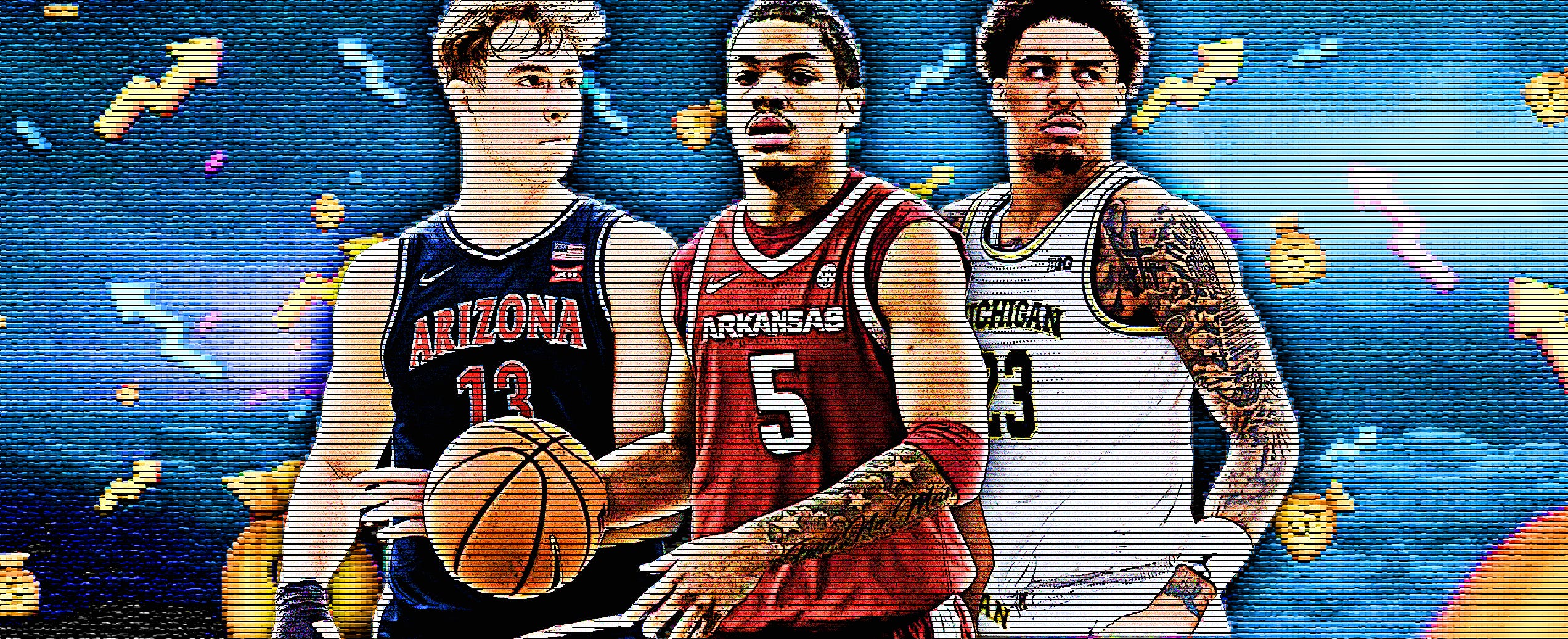
Whether we like it or not, narratives drive the dialogue around NBA prospects during this time of year.
March Madness isn’t just a postseason competition. It’s as competitive a setting for scouts, executives, and even team owners to see prospects up close and personal on the biggest of stages.
As a scout, I try to have roughly 80% of my “work” done by this time of year. I was taught by scouts and executives not to let the tournament influence your draft board in significant ways. Can performances in the postseason change one’s perception of a prospect in minor ways? Absolutely. But a prospect shouldn’t plummet down a board because of a first-weekend loss.
And yet, that’s just not reality. These games can burn thoughts into the heads of those who are, at their best, providing opinions about what they’ve seen. Those opinions can spin narratives about players, for better or worse. And when you put enough of those opinions into the echo chamber for everyone to constantly hear, no matter which way they turn, it can make even the best of scouts second-guess their own evaluations up to this point.
Again, of course, we as evaluators should be above the watercooler-level discourse surrounding prospects. Betting on or against small samples is an easy way to get lost in an evaluation and make critical mistakes about human beings who likely shouldn’t be judged off a bad game or two, but rather an entire body of work.
But anyone reading this piece knows that narratives are a strong part of what makes sports so engaging amongst fans, media members, and hired personnel alike. So with that being said, I’m here to highlight those very narratives that could drive conversation around the NCAA Tournament’s best draft prospects.
Which players have the most to gain and/or lose throughout the tournament? Given how deep the 2026 NBA Draft projects in terms of player pool, that makes some of these races much tighter competitions. And in the eyes of those inside the game and out, each game matters for better or worse.
So let’s dive into the storylines that are likely to be woven into the tapestry of this year’s NCAA Tournament, starting with the draft prospects with most to gain from their respective play!
MOST TO GAIN
The Race For Number One: Cameron Boozer, AJ Dybantsa, Darryn Peterson
There hasn’t been a more competitive race for the first overall pick in an NBA Draft in quite some time. But this trio of prospects in Cameron Boozer, AJ Dybantsa, and Darryn Peterson isn’t like several trios we’ve seen in the past.
All three of these prospects are having historic seasons in terms of production and impact in some form or fashion. Even Peterson, who has played the fewest games/minutes of the bunch, has shot the lights out of the ball on crazy volume from three—not to mention that he boasts great defensive impact metrics for a combo guard.
Boozer is the most accomplished prospect the NBA has seen since Luka Doncic, and far longer than that if we’re only including domestic prospects in the discussion.
Dybantsa is a bona fide scorer who has also been able to make everyone else around him better through his passing and offensive command from the middle of the floor.
But who will be remembered out of this group for making the deepest run in the NCAA Tournament? If Dybantsa or Peterson were to take lesser-seeded teams deep into March Madness and possibly into a Final Four, it could cement either of them as the top pick in the 2026 draft.
If Boozer takes Duke to a Final Four, let alone actually win a championship, there would be little to debate in terms of accomplishments pre-NBA for a player who has essentially won everything possible since he’s been in high school.
There’s far more that goes into the selection of talent, between athletic testing, workouts, and player interviews. But the tape and analytics support all three of these players as can’t-miss prospects. Whichever of these three can accomplish the most in the tournament will have a narrative leg up over the others when it comes to discussion on who should actually be taken first in the draft.
Personally, I’ve had Boozer as the top overall pick this entire season, and given how the bracket has broken, I would be fairly surprised if Duke lost before the Elite Eight, with a Final Four berth entirely possible despite a region with UConn, Michigan State, and Peterson’s Kansas team in the mix, along with St. John’s. BYU and Kansas could very well lose before the end of the first weekend, with potential second-round matchups with St. John’s and Gonzaga, respectively.
Rarely can freshmen drive a team to a national championship. This tournament is about experience, depth, and most importantly, coaching. But if there was a freshman who could defy those odds and join a small list of players who have actually pushed teams into the Final Four, one of these three would be a relatively strong bet to do so (and my money would be on Boozer).
Darius Acuff, Arkansas
There hasn’t been a more electric guard in college basketball over the last month than Darius Acuff. What he’s done for this Arkansas team, to power his squad through the SEC and win the SEC Championship and SEC Player of the Year Award, is nothing short of spectacular.
The 6’3” guard has put himself firmly in the territory of a lottery pick in the 2026 NBA Draft, but many scouts are already thinking that he stands to go much higher than even Top 10 in the draft.
Acuff could cement his case as one of the most sought-after prospects in this upcoming draft if he can put this Arkansas team on his back and make a deep run in the NCAA Tournament. Easier said than done, as Arkansas is in a region with Purdue, Gonzaga, and Arizona as the other top seeds. All of these teams pose significant defensive advantages over the Razorbacks, each having a backcourt that can target and attack Acuff defensively.
There’s a lot of guard talent that Acuff is fighting with, but none of them have the accolades that he’s been able to collect in just one season of college basketball. No player in NCAA history has matched his scoring, assist, and three-point percentage output in terms of averages. Acuff’s production echoes his all-around skill set as a guard. He can score from all three levels, shoot off the catch, on the move, and off the dribble. Acuff’s passing has been some of the best in the country as he’s continued to improve as a skip passer and lob thrower.
Acuff’s gravity as a scoring/playmaking guard is nearly unmatched in college basketball at this point. He has a strong case as the best guard in this draft and a Top 5 pick. All eyes will be on Arkansas to see just how well Acuff can play, and everything is on the table for him to go very, very high in the 2026 draft with even more stellar postseason play.
Christian Anderson, Texas Tech
There are few, if any, that expect Texas Tech to make a run in the postseason without JT Toppin. Despite Tech’s early success shortly after Toppin’s season-ending ACL injury, the Red Raiders team has struggled to match the physicality and interior play of its opponents, especially in the Big 12 Tournament against Iowa State.
All of that being said, Texas Tech still has a major difference-maker on the roster. Christian Anderson has been a leader at the point guard position since before he stepped foot onto the Red Raiders court in Lubbock, TX.
A medalist for Germany in the FIBA program and a successful lead guard for Oak Hill Academy, Anderson has been a prolific shooter AND scorer for years, even before his growth spurt in high school that now has him around 6’3” tall. Anderson has unlimited range as a shooter, and he can get his shot off whenever he wants. If defenses give him even an inch of space, his lightning-quick release can burn opposing teams within a split second.
Where Anderson was questioned heading into this season was just how good of a playmaker he could be for others, as he primarily played off the ball in his freshman season. As a sophomore, Anderson created more points than any other point guard in the country between scoring and assisting. His mastery of the pick-and-roll, even without Toppin in the middle of the floor, has created high-quality looks for one of the most dynamic shooting teams in the country.
Anderson, like Darius Acuff, can get hot as a scorer, but also create windows of opportunity for others that even the defense doesn’t see. He’s that good of an overall lead guard. If he can get Texas Tech on a run that many aren’t expecting to happen, it could significantly bolster his draft stock and propel him even higher in conversations than many have him.
Turnovers have been the story with Anderson in terms of key weaknesses he’ll need to sure up to ensure the Red Raiders come out on top in the NCAA Tournament. He’s faced as much pressure (if not the most) from defenses compared to any of the top guard prospects I’ve watched not named Acuff. Defenses consistently key in on Anderson and attempt to blitz/trap him to get the ball out of his hands. When he’s in single coverage and able to create the mismatch he wants in pick-and-roll, he can dissect and dice even the best defenses.
If Anderson can control the ball and maintain his strong balance as a scorer and distributor, I still believe in Texas Tech as a true dark horse in March.
Motiejus Krivas, Arizona
Motiejus Krivas has been a hot name of conversation amongst draft circles for quite a while now, and for good reason.
The 7-footer from Lithuania has had his most productive season yet for Arizona, a legitimate national title contender as a top seed in the NCAA Tournament.
This Wildcats team is loaded with talent, from Jaden Bradley and Brayden Burries in the backcourt to Tobe Awaka and Koa Peat in the frontcourt. Ivan Kharchenkov has even put himself on draft radars because of his dynamic play on the wing defensively.
But this team’s defensive identity is formed first and foremost through Krivas. He’s an excellent rebounder, and he has incredible footwork for a player his size. He’s light on his feet, and he can show help in ball-screen coverages while having the ability to sprint and cover the middle of the floor to take away rollers or driving lanes. Even when a guard finds that opportunity for a pocket pass, Krivas has great hands to deflect the ball and challenge those passes, making those windows even tighter and harder to hit.
At the rim, Krivas challenges everything and is a stalwart against other opposing bigs. He has plus positional size at the center position, and uses his frame and length to bother those who try to go into his body or post him up.
Krivas isn’t the most dominant finisher inside the arc, as he’s not shooting 65-70% on his twos. But he’s flashed more offensive potential by the game, and has the ability as a roller/cutter/transition threat to finish plays and make the most of the easy opportunities.
When I evaluate centers, I want them to be good at the things I expect bigs to excel in. That means setting screens, protecting the rim, cleaning the glass, and finishing everything around the basket. The more I watch Krivas, the more I can trust he understands his role and plays to the best of his ability every time he sets foot on the floor.
If Arizona can make the deep run many expect, it will no doubt be because Krivas stepped up in a massive way to captain what I believe to be the best defense in the country. Krivas could hear his name called as the first true center off the board, which means he’s not only a first-round talent, but a potential Top 10 pick in the draft.
Don’t underestimate how much NBA teams love players with Krivas’s size, feet, and hands.
Subscribe to No Ceilings on YouTube
MOST TO LOSE
Darryn Peterson, Kansas
Peterson remains the most controversial player on this list, as he can both gain the most but also lose the most relative to preseason expectations.
Peterson was the consensus name at the top of most big boards and mock drafts in the preseason leading up to the 2026 NBA Draft. Since then, he’s seen his stock not completely fall out, but certainly leave more room for debate with AJ Dybantsa and Cameron Boozer. It seems every day Dybantsa gains more ground on Peterson and has potentially even overtaken him as the top player in this class. And Boozer just finished up a dominant regular season en route to likely winning National Player of the Year.
If Peterson is unable to step up and at least assert himself as the most talented player on the floor in one of these tournament games for Kansas, and the Jayhawks lose before the first weekend is done, then it will only add fuel to the narrative fire that Peterson may not be the easy choice at the top of the draft. Even more so, he may fall behind both Dybantsa and Boozer on more boards and mock drafts, driving the story that’s been peddled all season by those observing the college landscape.
Again, narratives don’t make draft picks. Scouts and executives will have access to more information than anyone in the public on Peterson’s health and any other factors that contributed to a bizarre stretch of the season at Kansas. I’ve gone back to the high school tape to study Peterson’s game before he set foot at Kansas, and he was a dynamic high-flying shooting guard that could get nearly any shot he wanted while also playing a much healthier brand of pick-and-roll basketball than he’s had the chance to for the Jayhawks.
If executives lean on those priors, and acquire the information they’ve wanted to affirm Peterson as an excellent choice in the draft, then he can still overcome any potential dud performances in the postseason. But the pressure is on for Peterson to still come out, play the length of the game, and produce at a high level in the ways many would expect from a top pick. Or else he could lose significant ground to the draft’s other top candidates in Dybantsa and Boozer.
Kingston Flemings, Houston
We’re a few months removed from Kingston Flemings being discussed as the next guy behind the top of the draft’s “Big Three” and North Carolina’s Caleb Wilson. All of a sudden, that narrative has shifted in favor of a few other dynamic guards who have asserted themselves in conference play.
Keaton Wagler of Illinois has had a remarkable freshman season seemingly out of nowhere, given the lack of preseason recognition by RSCI rankings. Darius Acuff won SEC Player of the Year and carried the Arkansas Razorbacks to an SEC Conference Championship.
While Flemings has been one of the best guards in the country on one of the best teams in the country, he still has some question marks about his game that could haunt him in the tournament should another defense be able to exploit them.
Flemings relies a lot on his ability to get that quick step on a defender, break into the middle of the floor, and hit that pull-up jumper of his at the free-throw line area. If defenses take the ball out of his hands, or force him into contested shots, he hasn’t proven himself to be the level of jump shooter as some of the other top guards available in the 2026 draft. Should Flemings go through a shooting slump and fail to impact the game past making shots in the NCAA Tournament, it could leave a worse impression on scouts, especially if a guard like Acuff continues to make everything he looks at from the perimeter while also making all of the necessary passing reads in front of him.
Flemings has the edge over both of these guards as a defender, and that could be the key to him keeping his stock steady even through a poor shooting performance or loss in the tournament. He can create offense from his ability to hound opposing guards in one-on-one coverage or play passing lanes to create steals that lead to transition buckets. There are ways for Flemings to step up as one of the best leaders in the country even when his shot isn’t falling, but will he be able to do that on a high enough level to keep Houston afloat?
Yaxel Lendeborg, Michigan
There shouldn’t be any stock drop for Yaxel Lendeborg, likely runner-up to Cameron Boozer for National Player of the Year. Lendeborg has helped captain the ship for a Michigan team that won the Big Ten and finished with only TWO losses on the season.
Lendeborg is as versatile a forward prospect as they come. He can legitimately dribble, pass, and shoot (even if the three-point shot is a little streaky). Lendeborg wasn’t known as anything close to a shooter before this season, but percentages be damned, Lendeborg tripled his volume and hit some big-time shots down the stretch to help Michigan walk away with a Big Ten Conference Championship. Not to mention he’s a very smart defender who can cover a lot of ground and even guard multiple positions if needed.
Here’s the thing with Lendeborg, though: he’s on the older side for a draft prospect, as he’ll be turning 24 before the 2026-27 NBA season even starts. That’s not exactly the age of a player you hear drafted in or near the lottery all that often. And we’ve seen several cases where players who enter the league at 22 or 23 years old don’t quite pan out in ways those drafting them would’ve hoped with one of those higher picks.
I’m on the side of Lendeborg breaking that mold and turning out to be an important starter and rotational asset for an NBA team because his versatility is perfect for what the league requires in modern times. But there’s inherent risk with taking an older forward who hasn’t proven himself as a knockdown shooter.
If Lendeborg and the Michigan Wolverines were to suffer an upset in the tournament, with Lendeborg in particular not looking as impressive as his regular season numbers suggest, it could leave a sour taste in the mouths of decision makers looking at Yaxel as a draft prospect.
The questions were already there last cycle, when Lendeborg chose to come back to school and transfer instead of remaining in the 2025 draft. If teams valued Lendeborg as a no-brainer lottery-level talent, he would’ve been taken with a decent first round pick last year. Lendeborg decided to get paid for one more season and prove to scouts he still had avenues where he could develop and improve his draft stock.
Lendeborg is one of the most skilled frontcourt players in the draft, but last impressions are just as important as first impressions in this day and age of sport. Lendeborg needs to capitalize on this opportunity to push deep in the tournament field and possibly bring home a championship, only bolstering his case as a potential lottery pick in the 2026 draft.
Labaron Philon, Alabama
It really feels like the scouting world forgot about one of the draft’s best all-around guard prospects in Labaron Philon out of Alabama.
Now, the Crimson Tide didn’t exactly finish this season on a high note, and they look like a potential upset candidate early on in the NCAA Tournament. This team hasn’t been the healthiest or most complete squad in the country, but that’s not at the feet of Philon.
All Philon did was come back for his sophomore season, improve mightily as a jump shooter, while retaining a lot of those gritty, feisty qualities that put him on radars last year as a potential one-and-done prospect.
Philon’s usage and efficiency should have him in the conversation with the other consensus top guards in this draft class, yet he’s fallen behind the pack into the late teens and twenties on a lot of major big boards and mock drafts.
If Alabama were to suffer an early loss in the tournament, and Philon in particular doesn’t answer questions about his overall playmaking and floor-raising of those around him, that would most certainly not help his draft stock in any way, shape, or form.
Philon needs a big tournament run to prove that he’s still one of the best prospects in the 2026 draft. If he struggles to live up to that billing, fails to capitalize on defense, or goes cold in the biggest games of the season? That’s not exactly the lasting impression Philon needs on scouts who may already be considering other player archetypes ahead of him in the draft, given the deluge of guards that are hotter names for the “what have you done for me lately” conversation.
I still value Philon as a lottery-level prospect, but that just doesn’t appear to be the case of late for consensus. And I can’t really fault anyone for dropping him or some of the other guards that have been ranked near the top of the draft because the NBA has repeatedly spoken with its actions that “smaller guards” aren’t worth high-level draft capital in the eyes of many executives. I’m personally against that notion, as point guard play is incredibly valuable to winning basketball games (and the average size of a guard in the league is roughly 6’2” to 6’3” and 180-190 lbs). Not every team can have a 6’6” guard steering the bus for its franchise, but nevertheless, it’s a popular sentiment to value other positions of need, such as wings or true bigs. Therefore, even if the talent suggests it, a run on point guards isn’t the most likely scenario, so someone has to drop.
Philon just has to make sure it isn’t him, and he can help himself greatly by propelling Alabama to heights few are expecting heading into March Madness.