


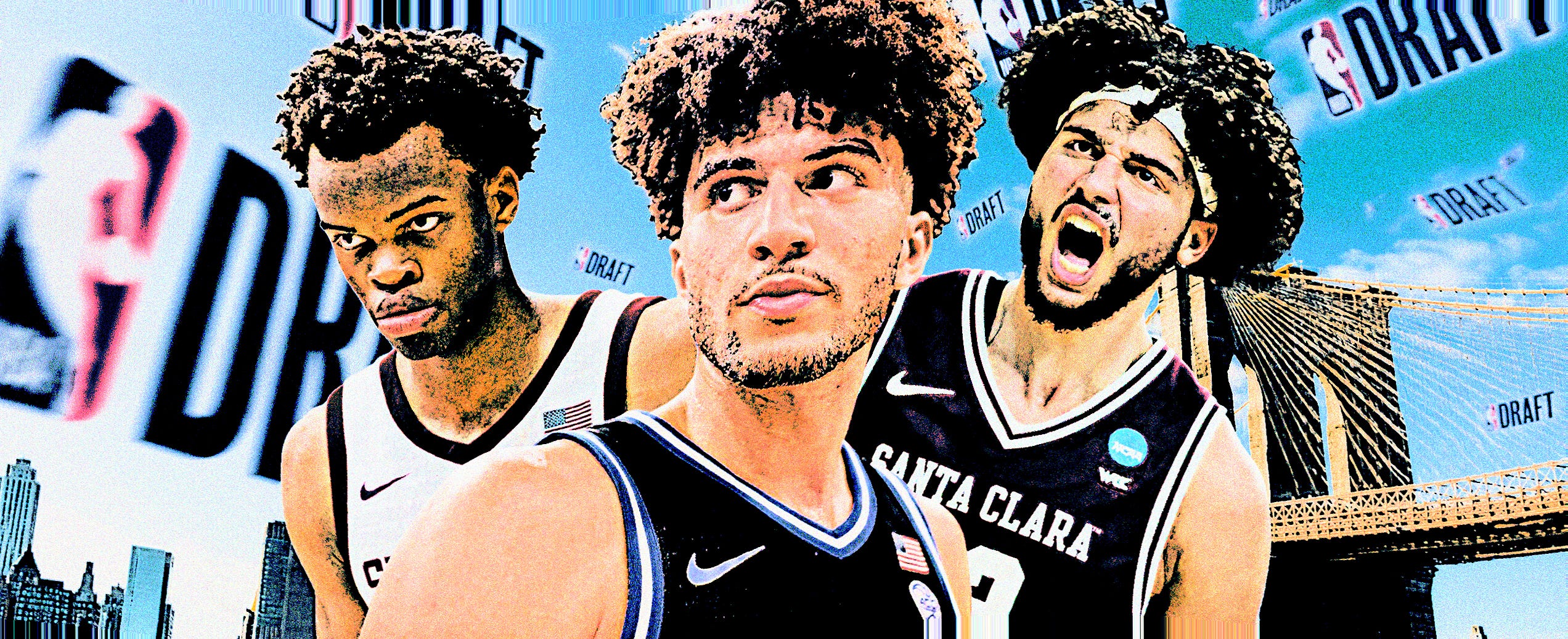
The dust has settled on the 2026 NBA Draft, after a two-day affair that saw plenty of chalk followed by plenty of surprises. From freshman phenoms to super-senior surprises and everything in between, this draft had everything—and given the ever-evolving NCAA landscape, this draft will stand out even more in the context of history with the international influx to college basketball and the early entrant withdrawal rates both at all-time highs.
Still, more than anything else and just like every other draft, it will be the 60 prospects who heard their names called on Tuesday and Wednesday nights who will define the 2026 NBA Draft. Before we wrap up this cycle and move on to Summer League and the 2027 NBA Draft (stay tuned on both fronts), we here at No Ceilings had to carry on tradition and give our Superlatives for the 2026 NBA Draft.
Thanks to all of you, No Ceilings family; this one’s for you!
1. Who was the biggest “riser” of the draft?
Rucker: I’m going to cheat here a little bit. I’m going big picture here. What incredible rises throughout the entire 2026 NBA Draft cycle for Morez Johnson Jr. and Ebuka Okorie. At the beginning of the year, no one expected both Johnson and Okorie to be party crashers in a stacked draft class. Not only did they do that, but Johnson ended up as a Top 10 pick, and Okorie ended up going inside the Top 20. We always stress patience at No Ceilings throughout the entire year, and Johnson and Okorie are a perfect example of why. As the season continued to progress, it became evident that the talent was real; it was awesome to hear their names called relatively early in the first round.
Maxwell: I’m actually going to shout out Dillon Mitchell here. I know that’s odd, as the guy was picked 40th. A few years ago, though, he was my go-to example of a type of player who would be on mock drafts entering college only to fall off them as their career progresses. Mitchell was basically an undersized play-finishing big a few years ago. At St. John’s, he did a stellar job of reinventing himself as a high-flying, wheeling-and-dealing, high-feel gadget player despite barely dishing out assists early in his career. We focus a lot on the people at the top of the draft. But the mental fortitude Dillon Mitchell displayed by being a top recruit, falling entirely off the radar, and then fighting to get back on it…what an incredible story.
Metcalf: It has to be Morez Johnson. I’ve had Johnson as a Top 10 prospect since January, so I love the pick. For most, though, this was the biggest surprise of the lottery. Coming into the year, almost no one else had Johnson as a first rounder, as most viewed him as just a bruising, energy big. Over the last two years, though, Johnson has proven that he’s so much more and is just barely scratching the surface. I adore this pick and think their front line of Lively, Johnson, and Flagg is going to cause other teams a lot of problems.
Stephen: I don’t know if this is going to “count” in the eyes of some, but I am going with Jayden Quaintance. I hear you: “But Stephen, everyone had said all season long that his talent is the equivalent of a Top 10 pick.” My response: “You can’t have it both ways.” Yeah, everyone hedged their bets by complimenting the talent of JQ while simultaneously knocking him to the tail end of their Mock Drafts due to health concerns. What happened as soon as the San Antonio Spurs drafted him, though? “Brilliant move by the Spurs!” Based on where he went–and the praise given to the team that drafted him–I was shocked by both of those things. That was due to the discourse that surrounded him up until the moment he was drafted.
Jacob: I’m going to take a seat on the Morez Johnson Jr. train. Once the Michigan Wolverines hailed to the victors, it became painstakingly obvious that their star-studded frontcourt players cemented themselves as first round picks. However, it wasn’t obvious in what order the trio would be selected. Then the Mavericks hired Dusty May a day before the draft, indicating that a Michigan Wolverine might be heading to Dallas. Johnson has always possessed high upside potential, all while playing with an unmatched toughness and energy. He’s the type of player who gets maximized playing with a talent like Cooper Flagg, which likely explains his drastic ascension.
Rowan: When it comes to the start of the draft process until draft night, for me, it would have to be Allen Graves. Graves had a great redshirt freshman season and was beloved by advanced metrics, but a middling combine and understandable scrutiny over his overall draft profile made his stock one that was harder to pin down. In Toronto, Graves is going to play next to players like Scottie Barnes and Collin Murray-Boyles, who also dominate through their all-around games. It’s a testament to his process and belief that he ended up as one of the biggest risers while landing in such a favorable spot.
Nathan: There are a few answers that stand out to me between Morez Johnson Jr. and Allen Graves being popular picks amongst the team. However, I’ll say a different name: Keaton Wagler. Wagler wasn’t thought of as a prospect at all before this season started. His name gained a small bit of buzz as scouts got into Illinois practice to watch the team, but he himself had zero attention on his radar before the cycle started. Now he ended up as the #5 pick in the 2026 NBA Draft after having led his college program AS A FRESHMAN to a Final Four appearance. No story in the draft this year is better than Wagler’s.
Nick: Allen Graves is the pick here for me. While his first round buzz has been building since the end of the college season, I was still a bit surprised that he ended up being a Top 20 pick in this draft. Still, his advanced stats and ready-made stretch 4 game make a lot of sense for the Toronto Raptors. Graves keeps the recent run of success in the draft for Santa Clara going, and he will be a fascinating addition to Toronto’s frontcourt.
2. Who was the biggest “faller” of the draft?
Rucker: I felt like there was a sneaky chance that Labaron Philon Jr. could be the “short stick” of this point guard class when it came to a player potentially slipping through the cracks. Unfortunately, that suspicion was right. Philon was a player I was especially high on. I came into the year wanting to see some legit growth in numerous areas, and Philon answered them all with serious conviction. When Philon measured in with almost identical numbers weight-wise compared to last year’s combine, I started to feel like we could be going down a one-way road. When you heard some mixed reviews about his predraft process, I started to look for a way to make a U-turn. Philon has serious offensive firepower. He’s sensational with his change of gears and can make defenders look silly with his stop-and-go ability and hesitations. I thought he landed in a great spot with the Sixers, as he can give that young backcourt another weapon in their arsenal.
Maxwell: It’s got to be Henri Veesaar. Obviously, once he got into the second round, there was a steering component involved to get him to a team that had a traditional roster spot available for him. But to me, it shows the danger of players in that 20-40 range sitting out of the combine scrimmages. Dailyn Swain wasn’t even good in the scrimmage he played because he was super sick the week before, but I think it did put him front of mind in some ways. Cam Carr may have fallen even further if he didn’t put on a show in front of everybody. I wonder if Veesaar regrets not trying to ball out in Chicago.
Metcalf: I was shocked that Cameron Carr fell as far as he did. I get that he’s skinny and may be tough to get along with at times, but guys who are that athletic, with that wingspan, and are that lethal of shooters have no business falling into the mid 20s. Carr is going to a tremendous spot where he won’t have to create anything on offense. Yet again, though, there was a common theme with the biggest fallers. The NBA continues to tell us what they value, and it’s not skinny players. Also, Henri Veesaar…yikes.
Stephen: It has to be Henri Veesaar–and I’m saying that as someone who had him in the late 30s on my board. Even for someone who was lower on him, I largely expected Veesaar to be taken in the back end of the first round based on the intel. Once the draft advanced past the 30s, my mind immediately raced into thinking, “oh, this is the agency driving him to UDFA so he can pick his team.” Then, the LA Clippers took him at pick 52 and traded him to ATL. It was just a weird situation that left me with more questions. “Why Atlanta?” “Why pick 52?” “Why didn’t another team just take the talent?”
Just strange.
Jacob: Relative to my board, Labaron Philon was the biggest faller. One of the guards falling in this draft was inevitable. While I was extremely high on Philon over the past two cycles, I can acknowledge the conundrum. Being only 6’2” and 175 pounds, the margin of error is slim. On top of that, to truly be an impactful playoff contributor at this size is a rare accomplishment. Front offices likely questioned if he was talented enough to be a primary ball-handler and scorer, yet Philon has already shown he can play second fiddle as a connective piece in his freshman campaign. While I’m not saying Labaron Philon will be a Tyrese Maxey talent, his slide is certainly reminiscent of Maxey’s.
Rowan: After a dominant defensive season at Arizona State, I was hopeful that Jayden Quaintance could get healthy enough to meet the hype he once had as a prospect. It’s rare to blend his athleticism and defensive instincts in a big man. Sadly, Quaintance couldn’t get back on the floor and may need another procedure to play again, which led to him falling to the Spurs. While it isn’t the fall some projected into the late 20s, it’s still a steep fall for someone who had lottery consideration at the onset of the year.
Nathan: By where I expected these players to be, preseason off my board, I would say both Koa Peat and Jayden Quaintance were huge fallers on draft night. By pure ranking/draft spot, I’d go with Peat here. I had high expectations for a 6’7” power forward who could handle, pass, and provide value in several defensive schemes. At times, even though he made plays and contributed to a winning program at Arizona, he just felt a bit passive. He didn’t score as often as he could have or rebound with the same force I had seen from him at lower levels. Add in the jump shot being where it is, and it all led to his tumble down to #30 in the 2026 NBA Draft. Peat has some work to do in terms of rebuilding his image as an NBA prospect.
Nick: There are a few players who stand out to me in this regard, but I’m still stunned by how far Henri Veesaar fell in the 2026 NBA Draft. I was a bit surprised when he fell out of the first round, and I fully expected him to be one of the first players called when the second night of the draft began. Atlanta was not the landing spot that I expected for Veesaar, but his shooting touch and size should allow him to earn a rotation spot for the Hawks and quickly prove that he should have gone off the board before the 52nd pick.
3. Who projects as the best UDFA target given how the draft fell?
Rucker: I was a bit shocked to see Tennessee State guard Aaron Nkrumah fall completely out of the second round. It’s always a bit tough with the second round because you can see some guys prefer to eventually just navigate their way towards free agency. It will be interesting to see where Nkrumah ends up, but it’s a pretty easy sell: good frame at 6’6” and some tools to develop offensively, but an absolute ball hawk on the defensive side of the ball. He’s sure to be a popular name on the UDFA market.
Maxwell: I think the highest-leverage UDFA is Quadir Copeland. The downside is clear because he’s a guard/wing who is gun-shy from three. That said, he hit a good percentage on them, and he was assertive with his shot during the pre-draft process. IF the shot gets there, he’s off to the races. He excels at collapsing defenses, he’s a great passer, he’s a potent defensive event creator, and he has a rare blend of size and skill. If Copeland hits, he’ll hit big.
Metcalf: Donovan Atwell is a sneaky name to keep an eye on. He was a sniper at Texas Tech this year. With Golden State, he could provide some pretty realistic off-ball shooting depth right away. He’s a reliable spot-up and movement shooter who should fit in with what they do as an organization in terms of play style and responsibilities.
Stephen: I could make a case for two names: Aaron Nkrumah–who I had 34th, and Quadir Copeland–who I had 39th. Nkrumah was more of a “shot-in-the-dark” bet for me, as I bought the defense and athleticism–on top of a developing shot. The Nuggets added him on an E-10 contract. I loved that decision, as Denver drafted Trevon Brazile and Bryce Hopkins in the second round–clearly placing an emphasis on athleticism and versatility on cost-controlled contracts.
For Copeland, who landed with Houston on a two-way contract, he makes a lot of sense as an athletic, versatile, plus-sized ball-handler on the team. With his improved shooting, he can, again, provide great value on a cost-controlled contract.
Jacob: As self-appointed president of the William Kyle III fan club, I feel obliged to go with him. However, I’ll pivot to another former Syracuse Orange in Quadir Copeland. Copeland flashed a ton of dribble/pass/shoot skills throughout his collegiate career, while also possessing real size. Houston honestly may be the ideal landing spot, lacking size at the point guard position. Copeland’s success will come down to how coachable he is at an NBA level.
Rowan: It helps that the Milwaukee Bucks just traded their franchise player, but Rafael Castro chose a shrewd spot to start his NBA career. The Bucks did trade for Kel’el Ware and have Myles Turner still on the roster, but I can’t imagine Turner will be there long with the team’s pivot to tanking. That, plus Bobby Portis’s departure, leaves a hole for a big man who can grab rebounds, finish in traffic, and set good screens—just like Castro can.
Nathan: I became a big fan of Quadir Copeland as the year went on. His season at NC State was pretty awesome as a downhill driver who could really attack defenses, make plays, and he plays with effort and energy on the defensive end. He fits the profile of a wing that can return excellent value off an UDFA deal should his jump shot continue to trend in the right direction. I really thought he’d come off the board as a draft pick, but that’s just the way the second round works sometimes.
Nick: Quadir Copeland was the highest player left on my board from the moment that Henri Veesaar was drafted, so I was really glad to see that he signed a two-way with the Houston Rockets. He will provide great size and point guard skills for a team in need of size in their guard rotation, and Copeland has a good shot at being one of the first two-way contracts to get converted next season.
4. “Folks, we got him!” Which selection screams best “fit” for its team’s fanbase?
Rucker: There are a lot of fun answers here, but I’m going to go a little outside the box. I think Brooklyn Nets fans should be thrilled with landing Mikel Brown Jr. at #6. There were plenty of rumblings that the Nets could go in a number of different directions with that selection leading up to draft day, but Brooklyn did a great job of throwing out smoke and sticking with the choice to go BPA near the top. The Nets took a plethora of guards and playmakers in the 2025 class. However, Nets fans haven’t had a floor general with THIS type of superstar upside in a very long time. Brown has the goods to be an absolute star. There will be some growing pains (as there will be with every young point guard), but once Nets fans see Brown when he’s “on” out there, they are going to understand what the buzz was all about. I think Brown’s basketball IQ and intangibles are going to fit beautifully with that coaching staff. Brown is a type of talent that once things start to come together and the game slows down, we’re all going to be in for a heck of a ride.
Maxwell: I’ve got Yaxel Lendeborg to the Warriors here. He provides much-needed youth (even at his advanced age for a prospect) and versatility to their frontcourt. He was #8 on my personal board, and for a team that’s still trying to compete, I’d probably have him even higher. I love what he brings to the table and how it fits in schematically for Golden State.
Metcalf: This feels like cheating, but it’s Darryn Peterson. Peterson was the best player in the draft in my eyes and is a tremendous fit with the Jazz. Peterson is a classic SG who effortlessly flows between on-ball and off-ball reps, is a lethal shooter, and has a ton of defensive upside. Playing alongside Keyonte George, Peterson should be able to ease his way into the NBA by focusing on his off-ball scoring/shooting while slowly rediscovering the playmaking he showed in high school. The Jazz have one of the most fun rosters in the league next year, and I’m expecting a massive turnaround from them. In terms of need, BPA, and stylistic fit, it’s tough to come up with anything better than Peterson with the Jazz.
Stephen: I’ll be boring and agree with some commentary above me. Darryn Peterson fits the Jazz to a “T”. Even the calm, cool, and collected personality we’ve seen from him in his young playing career fits the vibe of what we have become used to from Utah. Say what you will about the missed time and the cramps, even in a “down season,” we saw Peterson put on a stellar season–particularly as a shooter. If you’re hesitant about Darryn’s playmaking, you can rest easy on the fact that he is one of (if not the) best shooters in this class. His floor-spacing opens up so much space for Keyonte George, Ace Bailey, and every member of the frontcourt. His defense was pretty solid, regardless of his offensive load. This two-way ability makes him a seamless fit for the team, while the rest of his game provides the upside to be the best player of this class.
Jacob: My first instinct is to go with Cam Boozer to Memphis, but I’ll switch gears for the sake of not being repetitive and go with Kingston Flemings to Atlanta. Nickeil Alexander-Walker and Dyson Daniels are awesome combo guards, but neither profiles as a primary ball-handler. Flemings patches up that hole, being one of the best stop-and-go guards in the entire class who can navigate screens. His paint touches are going to open up the entire floor for the Hawks. Flemings also thrives in transition, a major strength of Jalen Johnson—not to mention that Flemings is a true competitor and student of the game. Atlanta may have their point guard of the future.
Rowan: Cameron Boozer is my choice, which may seem odd, but stick with me. Boozer is a humble, quiet star who won’t dominate every headline but will show up and show out every day. The best Memphis teams of recent history have been built upon homegrown stars who had their fair share of detractors. Boozer, at his peak, could be the best player the Grizzlies have ever had, and he’s got the zealous attitude toward improvement to endear himself to a fan base that desperately wants and deserves a superstar to cheer for going forward.
Nathan: To be honest, from a “fit” perspective, I thought NBA teams really knocked it out of the park in terms of drafting talent that met the needs of each franchise while also meshing well with what the teams have prioritized. This was an awesome draft through and through with “fit” successes. My absolute favorite fit, though, for a prospect? How about Yaxel Lendeborg with the Golden State Warriors? As much as I adore the Darryn Peterson and Cameron Boozer fits with their new respective franchises, Lendeborg had to be the pick for Golden State. This team doesn’t have anyone else on the roster, besides Draymond Green, who brings what he does at his size. At 6’9” with a 7’3” wingspan, Lendeborg can actually handle the ball, rebound, make plays on the move, and defend multiple positions while offering some of the best defensive event creation in the draft. He tripled his 3PAr this season at Michigan, and was efficient on his outside shots, albeit a little streaky at times. The Warriors are trying to maximize everything Stephen Curry has left, and there may not be more than four other players in this draft more talented than Lendeborg. He will make an immediate impact in the Bay Area.
Nick: Cam Boozer and Memphis seem like a match made in heaven for both player and team. Boozer has been so dominant for so long that his relentlessness can slip by unnoticed, but the force that he brings when attacking the glass and attacking the basket fits perfectly with the Grit and Grind ethos. The aesthetic elements of his game might not exactly be reminiscent of Tony Allen, but there are parts of both Zach Randolph and Marc Gasol in Boozer’s game. Boozer, new frontcourt mate Karim Lopez, and Zach Edey will leave opposing frontcourts bruised and hurting for years to come.
5. Which team had the best overall haul of the draft?
Rucker: What a sentence to write: It’s the Sacramento Kings for me. I thought Scott Perry and the Kings did a great job last year of getting their guys while also allowing the board to play into their hands. The Kings front office followed that up with a similar recipe: staying patient and allowing Darius Acuff Jr. to fall right into their laps at #7 while also being aggressive enough to get back up into the first round and snag Alex Karaban at#29. Sacramento added one of my favorite second round sleepers in the second round in Emanuel Sharp. This is a class that might not scream “upside” outside of Acuff. However, it’s a class that has the bones to help this organization take another step forward. You look at the type of players that the Kings have added in the last two drafts, and they are starting to build a young team that is full of the right mentality you need. Acuff will be a great young guard to develop and allow to blossom. Karaban is a winning player who knows how to utilize his strengths on the basketball court. Sharp is the type of player who figures out a way to play a very long time at the next level. I thought this was a great haul for Sacramento, and this is how you start building a little momentum with your future.
Maxwell: The Memphis Grizzlies got the top player on my board with the third overall pick, so I have to say them. Boozer brings so much optionality to their team. The screens that guys like him, Beef Stew, and Zach Edey are going to set are going to make them one of the most grating teams to compete against in the entire league. He gives them another high-leverage passer in their frontcourt. He’s the high-upside, straw-that-stirs-the-drink mismatch nightmare this team desperately needed to move up in the crowded Western Conference pecking order.
Metcalf: It’s been a while since I’ve said this, but I think it’s the Bulls. For starters, they had the easiest pick of the night at four, where they just needed to grab whoever was there from the top four names. They didn’t screw that up, which is huge. Then, at #15, they continued to add to their SLAP philosophy (SLAP!) with Dailyn Swain. They are rapidly accruing a lot of wings/forwards of that mold, but it’s a new regime, so no one is guaranteed anything. For this new front office to start off their era with someone as dynamic, charismatic, and exciting as Caleb Wilson, and then have the opportunity to grab one of the most versatile and productive wings in the country this year in the middle of the first round is about as encouraging of a start as you could dream up.
Stephen: The San Antonio Spurs. I already spoke about the fact that they drafted Jayden Quaintance, but they also traded for the rights of Tarris Reed Jr. For me, this was very much a “take your medicine and eat your vegetables” textbook execution of playing the board by the ahead-of-schedule Spurs. They got punched in the mouth by the New York Knicks in the Finals–larelgy due to a lack of physicality and in the front court. JQ offers ridiculous upside for a team that didn’t need him to be a Day One return on investment when he was taken at 20. That concept was only amplified by San Antonio trading to get Tarris Reed well beyond where he was projected to go. Aday Mara and Morez Johnson Jr. were projected as the better big men on most boards, but there is a very strong probability that the Spurs could have the two best centers in the class playing behind Victor Wembanyama.
Jacob: The Chicago Bulls. That felt weird typing out. The picks of Caleb Wilson at four and Dailyn Swain at 15 make perfect sense, as both fit Chicago’s fast-paced, heavy rim-pressure style. Wilson is the most talented player the Bulls have drafted since Derrick Rose, giving them their first legitimate young cornerstone since 2008. Dailyn Swain has one of the highest upsides in the entire class. The wing has a legit handle and is a force to reckon with at getting to the bucket. The swing skill for both Wilson and Swain will be the outside shot. The two do complement each other, and the Bulls building blocks in Matas Buzelis and Josh Giddey naturally. For the first time in a long time, Chicago has a strong foundation of young talent.
Rowan: While other teams grabbed great players too, I think the Atlanta Hawks came away with the best haul. Holding firm and taking Kingston Flemings is an act of patience, as they let the board fall as it may to get them a future starting point guard. Nabbing Zuby Ejiofor to back up Jalen Johnson cements their forward rotation as one of the most versatile young front courts in the NBA. Finally, snapping up Henri Veesar late in the second round gives the Hawks a massive body to put in the middle, which they’ve lacked for the past few seasons. Atlanta stuck to their needs, let the board fall how it may, and took three players who could play meaningful minutes on a playoff team from last year. Hard to argue with that.
Nathan: This has to be the Memphis Grizzlies when factoring in the second round. Richie Saunders is an excellent complement to every other player on this roster and will fit right in as a do-it-all shooter in the backcourt. Karim Lopez may not have the biggest fan in me, but he adds to the massive size and strength of this frontcourt that is now spearheaded by not only Zach Edey, but Cameron Boozer, who was the top-ranked prospect on my personal board. I LOVE what the Atlanta Hawks, San Antonio Spurs, Charlotte Hornets, and Sacramento Kings did, among others. But this Grizzlies team has a very legitimate chance to be much better than people think next season.
Nick: Rucker already mentioned the Kings, so I can put my bias aside and leave them in the honorable mentions category here. I think that the Atlanta Hawks would be at the top of my list here. Kingston Flemings is an exceptional guard prospect on both ends of the floor, and Atlanta was able to just let him fall into their lap at #8. Then, they picked up one of the most versatile big men in the draft, Zuby Ejiofor. However, he wasn’t necessarily the center that it seemed like they really needed. Then, the board fell their way once again, and they were able to pick up Henri Veesaar at #52. In a draft where I thought there were plenty of winners, Atlanta takes the top prize in my book.
Bonus round: Which team is most likely to have their second or third pick end up better than their first pick? For example Draymond and Harrison Barnes were drafted in the same class by GS and we know how that turned out.