


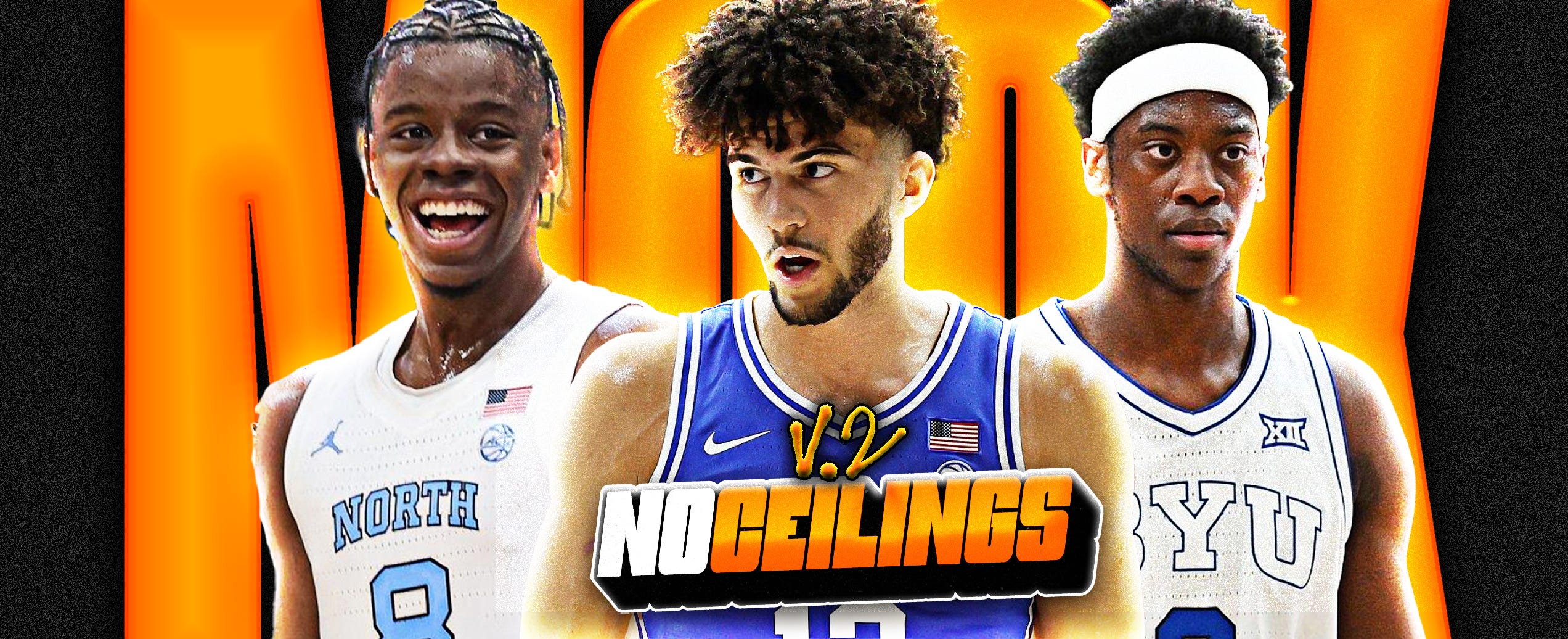
The NBA Draft cycle is starting to heat up, as NBA teams are starting to figure out which teams are likely to end up near the top of a loaded draft. With conference play approaching for NCAA teams, the top prospects for the 2026 NBA Draft are also beginning to separate themselves from the pack. Even though there is still plenty of time for late risers to crash the party, the teams near the bottom of the NBA standings are already starting to get excited about the potential franchise saviors who might be available for their favorite teams when June rolls around. With all of that in mind, the No Ceilings crew convened for another Mock Draft—with a bit more of a sample size of college play available to dive into and plenty of exciting prospects making their draft cases.
For those of you who are new to the No Ceilings Mock Draft experience, the No Ceilings crew gathers behind the scenes to go through all 60 picks. After a Tankathon simulation to determine our order, the team discussed each and every pick, trying to best match player and team. We also provide write-ups for all 30 picks in the first round.
For those of you who are part of the No Ceilings + crew, we will release the video of the Mock Draft later today to get all of the details of our decisions. For now, though, it’s time to kick our draft talk into another gear—the floodgates are fully open.
Enjoy, No Ceilings family!

#1. ATLANTA HAWKS (via NOLA) — Darryn Peterson | G | Kansas
Stephen: Darryn Peterson has long been thought of as the potential #1 pick in the 2026 NBA Draft, but he has recently missed a string of games due to a hamstring injury. He was able to bounce back in a real way against Missouri, where he dropped 17 points in 23 minutes. Even though he is still working his way back, that was the first time Kansas has looked that good in a minute.
Peterson gives the Hawks a player who can play on or off the ball, which gives them some real flexibility in what they want to do with their roster. While he is a capable and talented scorer, he plays defense with intensity and competes on the glass. There is some debate as to whether or not he is a point guard going forward. The good news is that Darryn has built upon his game over the years, and he has answered the call no matter what his teams have asked from him.

#2. WASHINGTON WIZARDS — Cameron Boozer | F | Duke
Jam: There might not be a better fit for the Wizards than Cam Boozer. This is an organization that’s in the process of establishing their foundational pieces and winning culture amidst their rebuild. There isn’t a player in the class more synonymous with winning than Boozer. At 6’9” and 250 pounds, his blend of size, power, skill, and feel is unmatched. There is real perennial All-Star and potential superstar upside in Boozer. A Cam Boozer-Alex Sarr frontcourt should have Wizards fans salivating about their two-way upside and complementary games.

#3. INDIANA PACERS — AJ Dybantsa | F | BYU
Nathan: The Indiana Pacers could go several directions with this pick, but AJ Dybantsa would fit well in an up-tempo offensive structure around Tyrese Haliburton and Pascal Siakam. Dybantsa is a top-tier athletic wing who can handle the ball, generate paint touches, finish at the basket, and dominate in transition. There are some areas to his game defensively that stand for improvement, particularly as a playmaker on that end of the floor, but his overall talent is undeniable. Learning from Coach Rick Carlisle could unlock untapped passing potential within a free-flowing system.

#4. SACRAMENTO KINGS — Caleb Wilson | F | North Carolina
Nick: The Sacramento Kings are not short on needs, and Mikel Brown Jr. was heavily (and fairly) considered here to fill the team’s long-term need at point guard. However, the Kings are also 28th in rebounding (having just crawled out of last place), and 27th in two-point percentage. Furthermore, they were desperately lost defensively until Keegan Murray (the one switchable forward on the roster) returned from his injury. Enter Caleb Wilson, whose brilliance in transition, top-tier athleticism, and frenetic effort on the boards would all be much-appreciated in Sacramento. His lack of self-creation and struggles in the halfcourt are concerns, to be sure–but they’re lesser concerns for a team that already has too many cooks in the kitchen on offense. Wilson and Murray would form a scary forward tandem for years to come, and Wilson would pair very well with either Domantas Sabonis (assuming the team keeps him) or Maxime Raynaud (if Sabonis is dealt away).

#5. BROOKLYN NETS — Mikel Brown Jr | G | Louisville
Corey: I know, I know, I know. Another PG in Brooklyn? Sure. But this isn’t redundancy; it’s philosophy. The Nets continue doubling down on their vision of a multi-creator ecosystem, and Brown represents the highest upside swing on the board to further that identity. At a listed 6’5”, the electric Louisville guard brings a tantalizing blend of outside shot creation, bursty athleticism, and advanced playmaking that fits seamlessly into Brooklyn’s evolving core.
Brown’s season has been a roller coaster statistically, but the underlying indicators paint a far brighter picture than the surface-level shooting splits suggest. Yes, the percentages haven’t been ideal. He’s launching threes at a volcanic rate (14+ 3PA per 100) but converting just around 26% of them. However, the touch indicators remain solid. He’s hitting an impressive 83% from the free throw line while posting a 50+% FTr, showcasing both smooth mechanics and a relentless ability to pressure the rim. The athleticism is already translating too. Brown already has seven dunks on the year (five in the halfcourt), underscoring the pop and explosiveness that separate him from traditional lead-guard molds. Combine that with his creativity off the bounce and willingness to make advanced reads, and it’s easy to see why a team hungry for dynamic guard play would buy in.
For Brooklyn, Brown offers something they haven’t fully unlocked yet: a potential top-tier offensive engine who thrives both on and off the ball. As his percentages normalize, Brown’s scoring punch and multi-level creation give the Nets a true high-upside piece to build around.

#6. OKLAHOMA CITY THUNDER (via LAC) — Koa Peat | F | Arizona
Maxwell: On one hand, the Oklahoma City Thunder are playing with house money. Still, they’re always a calculated, thoughtful front office. A player like Koa Peat could make sense here. The 6’8” bruiser has found a tremendous deal of success everywhere he’s played. He fights his way to his spots before finishing or delivering a slick pass to an open teammate. He can also get physical on the glass and guard multiple positions. His subpar shooting resume leaves a lot to be desired, and his off-ball defense is inconsistent at the moment. However, Peat’s winning track record, stat-sheet stuffing production, physicality, and feel could make him a worthwhile bet for the Thunder at #6.

#7. CHARLOTTE HORNETS — Kingston Flemings | G | Houston
Metcalf: The Charlotte Hornets are still very much in talent acquisition mode, and Kingston Flemings has some of the most upside of any guard in this class. Flemings is playing out of his mind, but he’s also showing that he can pivot into more of a complementary role on nights when his shot isn’t falling. Regardless of what LaMelo Ball’s future with the Hornets looks like, this team is still in need of interior size and additional perimeter on-ball creators. We’ve seen how brutal Charlotte’s offense can look when Ball goes down, so having someone who can play different roles, take over when needed, and run the second unit is incredibly valuable.

#8. DALLAS MAVERICKS — Braylon Mullins | G | UConn
Rucker: At this point, the Dallas Mavericks would probably be dreaming of adding another high upside talent to the mix alongside Cooper Flagg. Although Kingston Flemings (Houston) and Mikel Brown Jr. (Louisville) could be just out of reach, the Mavericks manage to get another fantastic piece here at #8. Insert UConn freshman Braylon Mullins, who would be a sensational addition to the mix. Mullins has finally returned to the court after missing the first six weeks of the season from a preseason ankle injury. He hasn’t skipped a beat, dropping 17 points in a recent impressive road victory over Kansas. A lethal floor spacer with good size, feel, and two-way potential, Mullins would be a sensational asset alongside Flagg for years to come.

#9. OKLAHOMA CITY THUNDER (via UTA) — Jayden Quaintance | C | Kentucky
Maxwell: We haven’t gotten to see Jayden Quaintance yet this season, but we haven’t forgotten about him. For an Oklahoma City team that values passing feel and defensive versatility, Quaintance makes a lot of sense. As a 17-year-old freshman at Arizona State, Quaintance emerged as one of the most active defensive playmakers in the country. He covers ground at warp speed, slides his feet like a much smaller player, and flies off the floor for rejections. Offensively, he can finish above the rim, but it’s his on-ball skill set that always caught my eye. He can wire great passes from the top of the key and while driving downhill. His lack of a jump shot and injury concerns are worth considering. However, Quaintance’s age-relative production and evolving feel make him a great target here.

#10. PORTLAND TRAIL BLAZERS — Nate Ament | F | Tennessee
Jam: Ament’s profile and raw talent should be too much for Portland to pass up. Getting him here at 10 could be one of the better values in the draft. His blend of size, shooting, ball skills, and defensive tools gives him the foundation to become an impactful NBA starter with the upside for more. Portland provides a landing spot for Ament to continue to grow into his game and body without needing to rely on him for heavy on-ball usage.

#11. CHICAGO BULLS — Labaron Philon | G | Alabama
Corey: Labaron Philon doesn’t fit the traditional archetype of the Artūras Karnišovas era, as Chicago has long gravitated toward 6’8” wings with athletic pop and questionable shooting. At this stage of the draft, though, Philon is simply too dynamic, too polished, and too productive to overlook. The 6’4” guard brings a level of shifty, quick-twitch creativity that immediately injects juice into a Bulls offense who craves pace pushers.
Philon has taken a real leap as a scorer this season, showing improved willingness and confidence shooting from the perimeter while still thriving as a paint-touch machine. His ability to consistently collapse defenses unlocks the full context of his playmaking, a testament to how effectively he bends coverages and finds teammates. The fit alongside Josh Giddey isn’t seamless, but Philon has already shown as a freshman that he can function next to high-usage initiators.
In Philon, Chicago lands a dynamic guard who can pressure the rim, generate advantages, make teammates better, and guard at the point of attack.

#12. MILWAUKEE BUCKS — Chris Cenac Jr | C | Houston
Metcalf: The Bucks feel like they’re on the verge of blowing it up; even if they don’t, though, Chris Cenac Jr. feels like the best home run swing they can take. At a minimum, Cenac will immediately infuse size, athleticism, and floor spacing. Cenac is still pretty raw, but it’s clear how badly he wants to be good with his work rate and coachability. At a minimum, Cenac’s combination of size, athleticism, and shooting should be great value at this spot. If he really hits, though, Cenac has the tools to be one of the better players from this draft.

#13. MEMPHIS GRIZZLIES — Bennett Stirtz | G | Iowa
Stephen: Do we think the Memphis Grizzlies could be in the market for a new point guard? Whether you agree with it or not, the culture of this team has been called into question–as well as the future of the star players on the team. One way that we have seen teams overhaul their rosters is by adding players who play with an immense amount of feel and competitiveness. That’s what Bennett Stirtz brings to the table.
Stirtz broke out last season with Drake, but NBA teams wanted to see how he would fare playing in a stronger conference. That led to him following his coach to Iowa, where he has put up some solid numbers to this point. He is still connecting from deep and getting his teammates open. Michigan State gave him a tough contest, but they sold out on Stirtz and dared the rest of the team to beat them. That’s truly a testament to the ability of the guard, who would be able to play off the talent in Memphis, while simultaneously enhancing their strengths with his playmaking.

#14. SAN ANTONIO SPURS (via ATL) — Thomas Haugh | F | Florida
Rucker: We’re starting to enter the territory of whoever Thomas Haugh might get one of the best “steals” in this draft. That comment could carry even more weight if Haugh ends up with a team like the Spurs. Haugh has been sensational this year for the Gators, seeing his game take a massive leap from his sophomore year. He’s got great size at around 6’9” and plays with his hair on fire. As my co-host Tyler Metcalf put it in the preseason, “Haugh does all the things on the court that your superstars DON’T want to do.” The Spurs continue to add a lot of firepower in the garage. Adding a player like Haugh would be one of those players who not only raises the ceiling of the team moving forward but also the floor.

#15. GOLDEN STATE WARRIORS — Yaxel Lendeborg | F | Michigan
Nick: The Warriors are in the midst of an up-and-down, injury-plagued season. As we’ve seen with this iteration of the Warriors in recent years, they aren’t exactly committed to being the best place for developing project players. So…why not bring in one of the most NBA-ready players in the class? Sure, Lendeborg will turn 24 before the start of his first NBA season. For the Warriors, though, that just means that they’ll get the prime years of an exceptional switchable defensive prospect with brilliant passing vision and enough shooting gravity to be a plug-and-play fit in pretty much any system.

#16. MEMPHIS GRIZZLIES (via PHX) — Hannes Steinbach | C | Washington
Nathan: There isn’t anything particularly “flashy” about the game of Hannes Steinbach, but he’s already been massively productive for the Washington Huskies as a 6’11” paint presence. Steinbach is an elite rebounder, an excellent play finisher, and a mountain of a man in the lane to try and score over. Steinbach’s consistency across the board in key areas for a big man should provide the Memphis Grizzlies front office staff with confidence, especially in an era where teams are looking for skilled big men to play together. If Steinbach can unlock some more shooting touch and get opportunities to operate more often in the middle of the floor, his ascent up the 2026 NBA Draft may end up higher than this selection at #16.

#17. ATLANTA HAWKS (via CLE) — Aday Mara | C | Michigan
Corey: With the 17th pick in the 2026 NBA Draft, the Atlanta Hawks select Aday Mara out of Michigan.
After a turbulent two-year stint at UCLA, Aday Mara has finally unlocked his game in Ann Arbor. The towering Spanish big man brings a fascinating blend of size, touch, and feel that makes him one of the more intriguing developmental centers in the class. Offensively, he showcases slick post work and impressive playmaking for his size; defensively, his massive frame and timing translate to intimidating rim protection, highlighted by a career 14% block rate. There are still questions regarding how many minutes he can carry at the NBA pace, but the minutes he does give you tend to be highly productive. For an Atlanta team still searching for a long-term anchor in the middle, Mara offers a high-upside solution as someone who can grow alongside Jalen Johnson and give the Hawks a foundational piece at the true center spot.

#18. OKLAHOMA CITY THUNDER (via PHI) — Cameron Carr | G | Baylor
Stephen: How many times do we need to speak to the embarrassment of riches the Thunder have coming into one of the strongest draft classes in a while? It’s not going to stop now, as OKC adds one of the best tough shot makers in all of college basketball. Carr came to Baylor after having some hype surrounding him in high school, but it never felt like he got a fair shot at actualizing it at Rocky Top. Now, he is one of the more electric players in college.
Carr ranks in the 95th percentile in the number of shots that he takes while guarded. He ranks in the 98th percentile in making those shots. That’s just a fancy way of saying he makes some tough looks. Beyond that, Carr has some bounce, which he uses to throw down monstrous dunks and to reject shots from the weak side. Despite being a little slight of frame, Carr plays tough, and he isn’t deterred from getting to the rim. He can provide floor spacing and defense on a team that values the ability to be multiple different things on the floor.

#19. MIAMI HEAT — Neoklis Avdalas | G/F | Virginia Tech
Nathan: The current Miami Heat front office and coaching staff have gotten creative with their offensive scheme to maximize the dribble, pass, and shoot talent on the roster. Neoklis Avdalas has the skill set to function well with this current Heat team, as a 6’9” playmaking wing who can get his own shot in the mid-range. He’s struggled with consistency from an efficiency standpoint, but has generally played low-mistake basketball while also taking on a lead role with Virginia Tech. Avdalas may not be a primary “engine” for an offense, but he’s the exact type of talent that would thrive in a secondary or tertiary role within a creative system like Miami.

#20. CHARLOTTE HORNETS (via ORL) — Isaiah Evans | G/F | Duke
Jam: With the Hornets continuing their culture shift under second-year President of Basketball Operations Jeff Peterson, Isaiah Evans makes a ton of sense here. Yes, it’s another member of the Brotherhood staying home in North Carolina, but Evans brings an immediate NBA skill in his shooting/shotmaking alongside positional size, infectious energy, and a clear work ethic illustrated by his evolving game. He continues to be active/engaged as a defender, attacking closeouts with aggression, and he is able to make plays for others within the offense. Evans would be seamless off-ball next to Ball, Miller, and Knueppel.

#21. BOSTON CELTICS — Tounde Yessoufou | G | Baylor
Rucker: The Boston Celtics continue to be red hot in the basketball world (I’m not complaining). As our own Nathan Grubel shouted out during the No Ceilings War Room, “Boston’s developmental staff is on fire.” Boston could therefore be in an interesting dilemma this year, especially if they believe they could make some serious noise, and a certain superstar is going to return. For now, though, this pick should be too valuable for a team like the Celtics to pass up. In a potentially deep class, Boston could use finding another piece in the rotation for the Brown-Tatum duo. Despite a rollercoaster of a start to the year, I actually like this type of value and fit for both the team and the player. Baylor freshman Tounde Yessoufou has the tools to be a dynamic weapon on the perimeter, especially when it comes to putting the ball in the basket. There’s been some good flashes on defense as well, when it comes to the on-ball potential and more. While Tounde needs some time to work on his craft, there’s no denying he can put the ball in the basket. With a team like the Celtics, that alone could be enough to be patient with the rest of the craft.

#22. TORONTO RAPTORS — Patrick Ngongba II | C | Duke
Nick: With what he was able to show in limited minutes while playing behind Khaman Maluach last season, it was all but a given that Patrick Ngongba II would be the heir apparent to the long line of Duke centers going in the first round of the NBA Draft. Everything appears to be on track for Ngongba to continue that lineage this season. While his rebounding numbers have been hurt by playing alongside glass cleaner extraordinaire Cam Boozer, Ngongba’s passing flashes from last season have grown into some really nice dimes this year. The Raptors have been one of the most pleasant surprises of this NBA season, even with their recent cold spell, but their center depth behind Jakob Poeltl is disastrously thin. Ngongba would plug that gap right away, with the chance to grow into something more as the Raptors continue to climb.

#23. MINNESOTA TIMBERWOLVES — Darius Acuff Jr | G | Arkansas
Metcalf: The Timberwolves desperately need PG help, and Darius Acuff continues to play excellent basketball. Acuff is one of the better organizers of offense among this freshman guard class, and his floor vision and playmaking versatility are constantly on display. He doesn’t struggle to get paint touches and does a great job of finding the open teammate based on where the defensive rotation came from. Acuff has also shown a ton of growth in being able to play without the ball, something he’d have to do with Minnesota. With his playmaking, ball security, and improving scoring versatility, Acuff could help alleviate some of the shortcomings for the Timberwolves.

#24. CLEVELAND CAVALIERS (via SAS) — Ryan Conwell | G | Louisville
Maxwell: Ryan Conwell has a rare blend of raw power and soft touch. He’s built like a running back, which helps him to plow through smaller players before drawing fouls or finishing inside. Still, he’s an electric, versatile shooter who has long been able to marry volume and production from three-point range. He’s a solid, low-mistake passer, too. Defensively, his strength enables him to cover more positions than his listed height might indicate, and he loves to use his frame to bully opposing guards. The Cavs have found a lot of success with off-ball guards who can really shoot, and that’s what Ryan Conwell is—just inside a much larger frame than you usually find for that archetype.

#25. NEW YORK KNICKS — Henri Veesaar | C | North Carolina
Rucker: The big man class for the 2026 NBA Draft could be a bit of a dealer’s choice. There are a lot of different types of centers that offer their own unique flavor when it comes to what NBA teams will be looking for in the draft. When it comes to the New York Knicks, this team could obviously go in a number of different directions. However, the idea of adding a player like Henri Veesaar just seems way too juicy to pass up. Veesaar would be a great finesse big for the Knicks. He’s a high motor type of big who can shoot it from outside while battling in the paint and has some strong feel as a playmaker. If the Knicks ever wanted to pair Veesaar on the court with a jumbo lineup and have him at the 4, things could get even more chaotic and fun. This seems like a potentially awesome fit for both parties.

#26. LOS ANGELES LAKERS — Amari Allen | F | Alabama
Stephen: One of the more pleasant surprises in the early college basketball season has been Alabama freshman forward Amari Allen. An interesting note about Allen is that he came to the Tide as the third-ranked recruit, behind Davion Hannah and London Jemison. Despite the ranking, Amari has played in every game for the Tide, starting in two of them.
On the season, Allen has posted shooting splits of 48/40/65, scoring in double figures in five straight games. Allen can bring legit size to the Lakers, with a strong level of feel. Allen has a solid handle and a unique, herky-jerky approach to get to where he wants to go. His floor spacing will complement the play of their guards, and he does have some solid defensive instincts. Right now, the only thing LA needs to worry about with Amari Allen is whether or not he’ll be available at the 26th spot come draft night.

#27. DENVER NUGGETS — Christian Anderson | G | Texas Tech
Nathan: The Denver Nuggets could afford some help in the backcourt at point guard, and Christian Anderson has all of the talent to make an impact in the NBA from the jump. Anderson’s passing craft in the pick-and-roll has been on full display this year at Texas Tech, as he’s taken on a lead role as the offense’s primary initiator. His shot-making from the perimeter fits both in an on-ball and an off-ball role, making him a versatile addition to any team’s rotation. Concerns have stemmed from his frequency and efficiency at the rim. However, Anderson has made the most of constant double teams and ball pressure, and he makes the right play far more often than not. Anderson is the exact type of guard who could end up pushing himself much higher in the draft than where he’s currently projected.

#28. OKLAHOMA CITY THUNDER (via HOU) — Paul McNeil Jr | G | NC State
Corey: Oklahoma City adds another asset to its stockpile, selecting Paul McNeil out of NC State with the 28th pick.
At 6’5”, McNeil enters the league as one of the premier shooting specialists in the class. He is a dynamic off-ball threat whose spot-up and movement shooting should scale cleanly into OKC’s system. He can create his own look in a pinch, but his real value lies in the way he relocates and bends defenses without the ball. While his playmaking flashes haven’t translated to a big AST% this season, McNeil’s decision-making stands out in a different way. He rarely turns it over, posting an absurdly low 3% TOV%. Defensively, he’ll need to add strength and be more disruptive to guard NBA wings, but the offensive fit is obvious. With their fourth first round pick of the draft, the Thunder make a smart, cap-friendly bet on elite spacing. If they need someone to slide into the Isaiah Joe blueprint, McNeil looks like a seamless plug-and-play option.

#29. DETROIT PISTONS — Meleek Thomas | G | Arkansas
Metcalf: The Pistons clearly have a type with guys who defend at a very high level with plus athletic tools. Meleek Thomas doesn’t exactly fit that billing, but his offensive upside could provide a fun injection of scoring to this team as a rotation guy. Thomas isn’t a good defender yet, but the work rate and desire to defend are clearly there. In this culture, it wouldn’t be shocking to see his defensive performance improve rapidly. Additionally, one of Thomas’s biggest areas of improvement is his on-ball creation and processing speed, as he can be prone to over-dribbling. That won’t be an issue with the Pistons, as his role as an off-ball scorer (where he’s lethal) would be very clearly defined. Even though Thomas doesn’t exactly fit the type of guy the Pistons have targeted, his personality would be a great fit while also providing a skill set that they don’t already have.

#30. WASHINGTON WIZARDS (via OKC) — Dame Sarr | G | Duke
Jam: Although Sarr hasn’t been a major statistical force so far this season, there have still been glimpses of why he could develop into the best perimeter defender in the class and a projectable 3-and-D fit. Sarr is long and fluid with good defensive instincts and switchability. The shooting has historically been a bit up and down, but he’s displayed touch throughout his career. Sarr’s selection adds to the much-needed collective defensive upside in D.C. (Boozer, Sarr, George, Coulibaly), provides a possible profile/role replacement for Coulibaly, who’s approaching restricted free agency, and could form a dynamic defensive wing duo with Coulibaly as well.
SECOND ROUND

#31. BOSTON CELTICS (via NOLA) —Karim Lopez | F | NZ Breakers

#32. NEW YORK KNICKS (via WAS) — Chase Ross | G | Marquette

#33. MEMPHIS GRIZZLIES (via IND) —Joshua Jefferson | F | Iowa State

#34. BROOKLYN NETS — Matt Able | G | NC State

#35. SACRAMENTO KINGS — Braden Smith | G | Purdue

#36. LOS ANGELES CLIPPERS — Tarris Reed Jr. | C | UConn

#37. SACRAMENTO KINGS (via CHA) — Dash Daniels | G | Melbourne

#38. OKLAHOMA CITY THUNDER (via DAL) — Dailyn Swain | G/F | Texas

#39. SAN ANTONIO SPURS (via UTA) — David Mirkovic | F | Illinois

#40. SAN ANTONIO SPURS (via POR) — London Jemison | F | Alabama

#41. WASHINGTON WIZARDS (via CHI) — Tahaad Pettiford | G | Auburn

#42. BOSTON CELTICS (via MIL) — Juke Harris | G | Wake Forest

#43. PORTLAND TRAIL BLAZERS (via MEM) — Billy Richmond III | G/F | Arkansas

#44. CHARLOTTE HORNETS (via GSW) — Keaton Wagler | G | Illinois

#45. BROOKLYN NETS (via ATL) — Zuby Ejiofor | F | St. John’s

#46. WASHINGTON WIZARDS (via PHX) — Cayden Boozer | G | Duke

#47. CLEVELAND CAVALIERS — Emanuel Sharp | G | Houston

#48. HOUSTON ROCKETS (via PHI) — Morez Johnson Jr. | F/C | Michigan

#49. ATLANTA HAWKS (via BOS) — Mario Saint-Supery | G | Gonzaga

#50. ORLANDO MAGIC — Daniel Jacobsen | C | Purdue

#51. SAN ANTONIO SPURS (via MIA) — Alex Condon | C | Florida

#52. TORONTO RAPTORS — Ebuka Okorie | G | Stanford

#53. WASHINGTON WIZARDS (via MIN)— Karter Knox | F | Arkansas

#54. NEW YORK KNICKS — Bradyen Burries | G | Arizona

#55. MINNESOTA TIMBERWOLVES (via SAS) — Dwayne Aristode | F | Arizona

#56. PHOENIX SUNS (via DEN) — Jeremy Fears | G | Michigan State

#57. TORONTO RAPTORS (via LAL) — JT Toppin | F | Texas Tech

#58. HOUSTON ROCKETS — Tyler Tanner | G | Vanderbilt

#59. NEW YORK KNICKS (via DET) — Zvonimir Ivisic | C | Illinois

Dybantsa is an underrated playmaker. Even on non assists he makes the right read. He can shoot a bad shot at times but all stars do that. So far, his playmaking has been very good. His turnover rate is low and he’s passing with his weak hand at a high rate (14.2%) which ranks top 3 in terms of last years draft. I still have questions about boozers rim protection and self creation fluidity or shake. But when he wasn’t loaded up on he completely ate. Dybantsa is still dominating without even attempting 3s. Advalas is a I like the idea more than what’s going on. He's at his best at the rim, but he struggles to get by in the half court, lacks some explosion, and settles for too many jumpers, inconsistent shooter as well. He’s theoretical, but I think he would be higher if he was parried with a high volume creator. Would be very nice. Can’t lie, I’m loving Cameron Carr. Maybe too much. 😂. Meleek is launching a ton of 3s, and strirtz plays very slow. The whole offense is directed around him and it works, but it’s reasonable to question how that translates since he doesn’t separate extremely well in the half court. A one man offense who can play off the ball is very good though. Amari Allen looks pretty versatile. Peterson is well, Peterson.
I feel like if Cenac is still available for the Bulls at 11, they'd likely take him. They need a center for the future because Vuc is on his way out, and they don't have anyone else at the moment to become the long-term solution. Although I'm not sure where I stand at the moment with Cenac, he does seem like a good option at first glance if the Bulls opt to seek out a rim-running center in the draft.
Having Meleek Thomas at 29 also seems a bit low, even given the valid criticisms regarding his defense. He still generates steals at a good rate and is a pretty solid playmaker, too. He does a good job of limiting turnovers, which I think is a really underrated part of his game at the moment.