


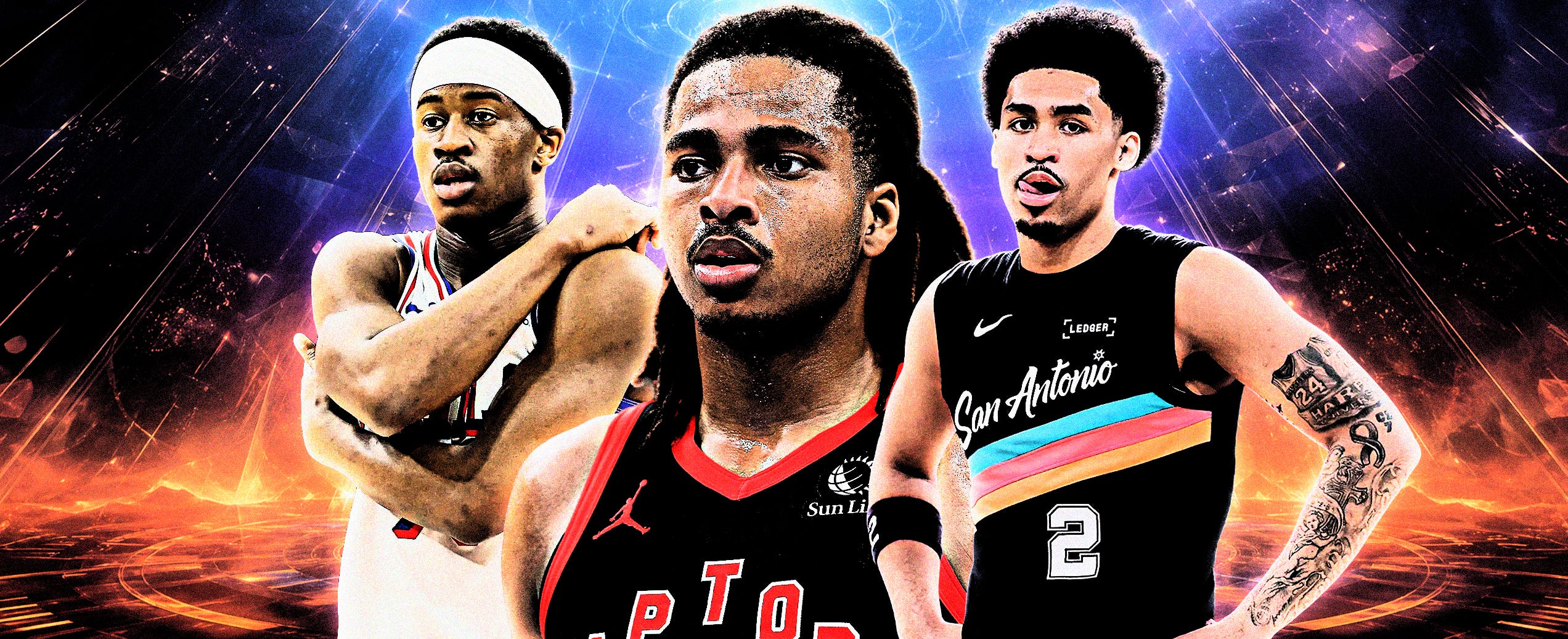
The NBA rookie trio of Dylan Harper, VJ Edgecombe, and Collin Murray-Boyles has gotten off to one heck of a start in the 2026 NBA Playoffs.
In large part, these players are being utilized in similar roles/rotation patterns compared to the regular season and are contributing in a lot of the same ways. However, there have been signs of growth for each player that’s worth calling out during the first round of this postseason.
So this week, I want to take a peek into each player’s game and what is working well during the playoffs, and how they’ve grown either from when they were prospects in the 2025 draft, or even from the first part of their rookie seasons.
Let’s start up in Toronto with Murray-Boyles of the Raptors!
Collin Murray-Boyles, Toronto Raptors
Collin Murray-Boyles has been a physical force for the Toronto Raptors against the Cleveland Cavaliers.
During the regular season, Murray-Boyles was an efficient 6’7” small-ball big who leveraged his touch in the paint, ball-handling capabilities, and impressive footwork to generate face-up offense. A lot of his buckets came in most of the same ways they’re coming in this series, too: offensive rebounds and cuts/dunker spot finishes.
Even if Murray-Boyles isn’t creating a lot of his own offense off the dribble in the playoffs up to this point, he’s been in the right place at the right time consistently. That’s a large part of the appeal of CMB, dating back to his college days at South Carolina. He just understands where he needs to be on the floor at all times, and he is proactive in positioning himself rather than always playing reactionary.
That is a common theme I continue to find amongst the best players in the NBA. How proactive are you in setting yourself up for success vs. relying almost exclusively on physical traits coupled with reactionary tendencies to hopefully get the job done? Those who can read two to three steps ahead and play out of an advantage they’re able to create ahead of time, rather than waiting for that advantage to be created for them, are incredibly valuable within a playoff context.
Now, a lot of the mental processing and awareness I’m talking about isn’t always actionable if the player isn’t built to physically take advantage of those gifts. Murray-Boyles is a 235-pound forward, however, with excellent length, hands, and feet. He can bulldoze his way to the basket and grab offensive rebounds like he’s done this entire series to create second-chance opportunities. Some of the screens Murray-Boyles is able to set are also impactful in creating space for others, and opening up the possibility for secondary actions or give-and-go opportunities, where he’s proven effective as an off-the-ball mover or stationary passer from the top of the floor.
I’ve outlined several ways in which Murray-Boyles has impacted the game on offense, even without shooting the basketball. That’s why his defensive muscle and versatility have been critical for Toronto, as it’s allowed him to stay on the floor more as a big alongside perimeter-based forward options like Scottie Barnes and Sandro Mamukelashvili. He’s able to operate in the dunker spot, in the short roll, or out of the post without compromising the team’s spacing and overall offensive flow.
And on defense, Murray-Boyles offers excellent value as a switchable small-ball five that can box out and hold his own on the glass against opposing centers. With this type of player, it’s important to have 7-foot centers elsewhere on the roster for certain matchups, which Toronto has in Jakob Poeltl. But with Poeltl not nearly as effective as he used to be, coupled with the team’s deep roster of size and length on the wing, Murray-Boyles is a great fit for what this team wants to do defensively. He can show and recover, play straight up against several center matchups, and even blitz in certain ball-screen coverages to overwhelm ball handlers. He’s difficult to move off his spots, which works in his favor since he’s not the tallest guy going after defensive rebounds.
There just aren’t many players like Murray-Boyles in the NBA, and there haven’t been many throughout the game’s history. You can’t put CMB in a box. Again, a lot of his offense has come off dirty work, but I’ve loved watching every second of it. Those extra screens, box outs, and shoves from Murray-Boyles are the physicality that Toronto needs in order to advance in a playoff series without a steady stable of three-point shooters constantly stepping on the floor. His passing helps to create looks for others, and he can dribble his way out of trouble if needed from the wing.
Murray-Boyles is built like a 16-game player, and should be valued as such by the Raptors and fans around the league moving forward.
Dylan Harper, San Antonio Spurs
There weren’t many questions about Dylan Harper’s translation to the NBA outside of his perimeter shooting and what that looked like in particular at Rutgers.
From a distance, Harper wasn’t the most efficient guard both off the dribble and off the catch. Despite concerns about a one-season sample that painted a negative picture of how much he could impact the game early on as a shooter, I felt comfortable with Harper’s overall projection in that area because of his mechanics and confidence. Harper was willing to take tough shots and shoot when the ball swung around to him, regardless of where he was on the floor, and his form and follow-through were consistent at Rutgers. He looked the part of a lefty shooter, even if the makes weren’t always raining in.
Fast forward to this season with the San Antonio Spurs, and in particular this postseason, and it’s been an entirely different story for Harper as a three-point scorer. During the regular season, Harper finished 39.6% off catch-and-shoot triples, with great splits whether he was guarded or unguarded. Off-the-dribble threes were an entirely different story, and still a work in progress for Harper, but all he really needs is a way to punish defenses if they sag off him to protect against his menacing drives to the basket.
Harper is relentless in getting to the rim, be it in the halfcourt or in transition. His explosiveness, strides, and finishing touch are a load to deal with coming from a 6’5” point guard built to operate like a freight train. Defenses are best served by not crowding him so he can’t get a step and attack the paint. In giving him space to take threes off the catch, Harper has made those defenders pay for lacking aggressiveness in closing out. And because he’s become such a threat from deep, it opens the door for him to attack a fly-by closeout with a side-step three OR drive against a displaced defense where he can either draw a foul or pass out to another open shooter, a staple of the offensive system for the Spurs.
In all but one playoff game so far against the Portland Trail Blazers, Harper has been essentially unstoppable from everywhere on the floor. He’s scored from every level and has carried over his hot hand shooting the basketball. Whether it’s been attacking from the second side, operating in pick-and-roll against switches, or in transition, Harper has made his contributions as a scorer in the backcourt as he impressively did off the bench all year long for San Antonio.
And while it’s commonplace to praise an offensive prospect for his scoring contributions, he’s also been excellent on defense pretty much the entire year. Harper’s size has helped him to scale up and down the lineup as needed, even to the point of guarding opposing forwards in a pinch, depending on the switch. Harper has great length, and he knows how to use his strength to his advantage. Harper’s lower body is solid, and he’s strong in his core to withstand contact and hold his position. He’s also much better than given credit for in terms of sliding his feet to contain opposing backcourt matchups.
If Harper becomes a better shooter off the dribble from distance, there’s just no way to guard him straight up at that point. The option left will be to force the ball out of his hands with a double team, and good luck when he has guys like Victor Wembanyama, Stephon Castle, and De’Aaron Fox to skip the ball to.
I’ve appreciated watching Harper’s growth as a two-way player for the Spurs. A player whose identity was known for attacking the rim and finishing in the paint has expanded his game in meaningful ways as a pull-up scorer inside the arc, and a knockdown shooter off the ball from distance. These layers all add meaningful versatility to his game, whether he has the ball in his hands or not—which is essential given the reps he shares in the backcourt with two other dynamic lead handlers in Castle and Fox.
Harper may very well be a key to the Spurs competing for a championship this season; it’s far from ordinary for a rookie to be mentioned in conversations like that.
VJ Edgecombe, Philadelphia 76ers
Before we can get to all of the good that came from VJ Edgecombe’s Game 2 performance against the Boston Celtics, we have to acknowledge where he’s struggled.
Game 4 was the worst Edgecombe has played in a postseason stint up to this point. He couldn’t get anything going offensively and struggled to contain not just Boston’s wing duo of Jaylen Brown and Jayson Tatum, but also the dynamic scoring guard Payton Pritchard. Edgecombe wasn’t able to impact the game doing the little things as he usually does (more on that later), and the team as a whole looked rudderless versus the Celtics.
On top of that single-game stinker, Edgecombe has seemingly regressed from three-point range for the majority of the series, now sitting at 23.1% from deep. His catch-and-shoot stroke has left him, which really made it more difficult on offense in the aforementioned Game 4 because VJ didn’t have nearly as clear a path to the rim as he had in prior games.
All of that out of the way, I do want to highlight that Game 2 masterclass from Edgecombe, as he put together an entire scoring package while maintaining what makes him such a special player for the 76ers.
What Edgecombe may lack in pure bulk and strength, he more than makes up for in speed and elusiveness on both ends of the floor. Edgecombe is a playmaker first and foremost, as he loves to capitalize on the mistakes of his opponents and force turnovers to fuel transition offense. A lot of his best defense comes from deflections, direct steals, or blocks, putting his team in position to score on easy breakaways.
Not only was Edgecombe timely with his defensive tenacity in that second game, but he was great as a rebounder, creating new opportunities for himself and his teammates. Edgecombe’s energy and leaping ability are nearly unmatched, and when his motor is hot, it never stops.
Add all of that together with the type of shot-making one would expect to see from a star, and it was easy to see a bright, bright future for Edgecombe all season long. He’s had outings like Game 2 before, but his first postseason two-way explosion felt different, like he was gaining the confidence to level up, especially as a one-on-one shot maker.
Unfortunately, that excitement was short-lived with Philadelphia’s lack of fight in the City of Brotherly Love. Still, it’s important to highlight where Edgecombe has grown while also acknowledging key areas of improvement for his future.
Edgecombe has improved all season as a pull-up scorer in the midrange and as a passer, particularly on the move. He’s become more comfortable for longer stretches as a pick-and-roll ball handler, and it’s helped his overall development in hunting for his own shot alongside Tyrese Maxey.
We saw all of those glimpses in Game 2 against Boston, along with the other “star in his role” traits he’s possessed every single time I’ve seen him step on the court.
Going into this offseason, Edgecombe’s priority should be to continue getting stronger to further his development as an on-ball defender who can match up with opposing wings and tougher, bulkier backcourt matchups. Offensively, Edgecombe needs to continue tightening his handle so he has an easier time learning how to change gears and get to his spots using more than just pure speed and stop-on-a-dime athleticism.
This 76ers franchise doesn’t have anywhere to go with the roster. This core is what’s locked in for the next three seasons until at least 2028. If that’s the case, the only way for Philly to properly contend in the Eastern Conference is if Edgecombe realizes his two-way potential while playing in between Maxey and Joel Embiid. We saw what that can look like in spurts this season, but what needs to happen now is that Game 2’s Edgecombe is the consistent presence night in and night out for Philadelphia.