


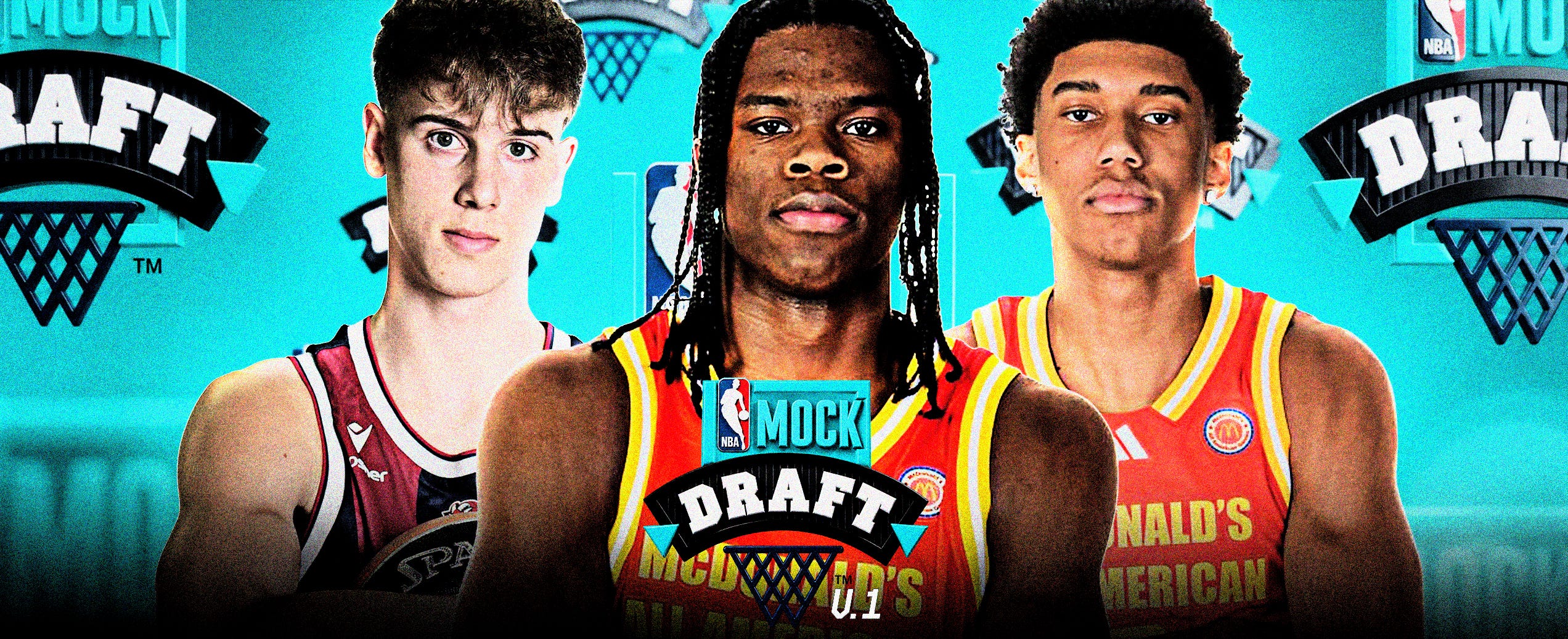

HELLO, Draft Fans!
We officially have less than 20 DAYS until the start of the 2026-27 NCAA season.
International hoops have gotten underway, which means that it’s almost time to be full speed ahead for the 2027 NBA Draft cycle.
It’s shaping up to be one of our biggest and best years yet. As always, we thank all of you for the continued support over the years. We cannot wait to get back rolling for what should be a very interesting cycle.
After an offseason that surprisingly seemed like a big blur, the No Ceilings team came together to jump into the War Room to install their first MOCK DRAFT of the 2027 NBA Draft cycle.
Because the NBA season will be returning next week, we went ahead and ran a Lottery Simulation, using the new odds.
To say it got a little crazy would be putting it lightly.
Buckle Up, Folks. We’re Back.

#1. HOUSTON ROCKETS (via BKN) — Jordan Smith Jr. | G | Arkansas
Finn: The rich are getting richer here as the Houston Rockets, a playoff team, get the opportunity to pick first overall thanks to the Brooklyn Nets—who gave this pick, which originally belonged to the Phoenix Suns, to the Rockets in a 2024 trade. Houston is invested in the core tandem of Amen Thompson and Alperen Sengun (their payroll shows it), so the next logical step is to find a guard to pair with the duo for the long haul. With that in mind, Jordan Smith Jr., the number one player on No Ceiling’s latest big board, would be an awesome addition here. Smith’s elite defense and motor not only give him a high floor as a contributor with any team, but would make him a natural fit within the defensive identity the Rockets have built. He has plenty of upside as an on-ball guard offensively too—certainly more than enough to justify him being the first name off the board here.

#2. NEW ORLEANS PELICANS (via MIL) — Tyran Stokes | F | Kansas
Jam: The Pelicans land arguably the most talented player in the class, Tyran Stokes. Listed at 6’8” and 230 pounds, Stokes is a physical and athletic wing with ball skills who leverages his tremendous tools and a versatile skill set to thrive on both ends of the floor.
There is variety in his offensive arsenal which can complement and eventually anchor an exciting Pelicans core (Zion, Fears, Queen, Murphy, Bey, Jones, Missi). He’s a dynamic self-creator who can finish with power and athleticism at the rim or get to his multiple-level pull-up game while making plays for others off the bounce thanks to intriguing passing feel, both as a manipulator and connector. Stokes can also shine as a play finisher from transition floor runs and timely off-ball cuts to being an exciting roll/pop man out of ball screens and creating second-chance opportunities on the offensive glass. Defensively, he’s a switchable defensive playmaker who is equipped with tools to become a real menace on the ball.
Stokes is the type of two-way wing talent that every team seeks at the top of the draft and could be exactly what the New Orleans franchise needs to ascend into a perennial playoff team and eventual contender.

#3. CHICAGO BULLS — Bruce Branch III | F | BYU
Corey: The Bulls landed their franchise cornerstone in Caleb Wilson in the 2026 NBA Draft, pairing him with Matas Buzelis as the foundation for new executive Bryson Graham. Graham’s SLAP philosophy (size, length, athleticism, physicality) is the clear blueprint for the new-look Bulls.
Bruce Branch III checks a lot of those boxes while bringing star upside at #3. A 6’7” swing wing, Branch is one of the youngest prospects in the class at just 18.6 years old on draft night. He’s a super smooth mover with a creative handle who can get his own shot. He was also highly efficient around the basket last season, finishing 70% at the rim on 120+ attempts at Prolific Prep. When I saw him at the Nike Hoop Summit, his height and wingspan really popped, and he uses that condor length defensively to force tough shots. The questions are his jumper consistency (28.6% from three) and his frame. At 195 pounds, he can get bumped off his spots by stronger defenders on drives, and offensive players can go right through his chest. Still, Chicago can afford to be patient with a wing this skilled, and Branch has the tools to fill out Graham’s vision of skilled, interchangeable guys on the perimeter.

#4. SAN ANTONIO SPURS (via ATL) — Caleb Holt | G | Arizona
Rucker: The San Antonio Spurs are already ahead of schedule when it comes to ascending in the Western Conference. After an appearance in the NBA Finals last year, San Antonio will be looking to continue to develop their young core in order to contend for the foreseeable future. As of now, this class could figure to have plenty of guards near the top of the class. That could present an intriguing dilemma for the Spurs. The team clearly has some depth in the backcourt with Steph Castle, Dylan Harper, and De’Aaron Fox under contract. However, adding a talent like Caleb Holt could be too enticing to pass up. Holt would give the Spurs another dynamic backcourt addition who is more of a combo guard. He’s a lethal on-ball defender with athleticism, toughness, and scoring upside. We’ve seen how important it is to have various options in the backcourt for teams over the recent years, and adding Holt would be another nasty addition for the Spurs moving forward.

#5. OKLAHOMA CITY THUNDER (via LAC) — Stefan Joksimovic | G | Baskonia
Ignacio: Oklahoma City is experiencing the pains of every successful NBA team in the second-apron era: they’re getting expensive quickly. The Thunder traded away three key rotation players this offseason (Lu Dort, Aaron Wiggins, and Isaiah Joe) and could use their treasure trove of first-round picks to replace players on expiring deals with rookie-scale players. Enter Stefan Joksimovic, who, at just 17 years old, has already made his professional debut with both Baskonia and the Slovenian senior national team and is coming off an MVP performance at this summer’s FIBA U18 EuroBasket.
Joksimovic would give the Thunder versatility. He thrives with the ball in his hands as an aggressive slasher who utilizes his 6’7” size, length, and strong frame to finish around the basket. He is also a consistent decision-maker who can run the offense as a secondary initiator, and he can also play off the ball as a timely cutter and dangerous spot-up shooter.
This role malleability, which has allowed him to make an impact with or without the ball, and his experience at the two highest levels of competition outside the NBA (Euroleague, Spanish ACB), should make him a perfect fit for the Thunder as they look to add wing depth while avoiding the hard cap.

#6. WASHINGTON WIZARDS — Luigi Suigo | C | Villanova
Albert: All eyes are on the Washington Wizards this season. Questions are swirling about how the team will merge its young core, headlined by the number one pick in the 2026 NBA Draft, AJ Dybantsa, with the expensive veterans they’ve brought in over the last year. With the Wizards looking like they won’t extend Anthony Davis, your social media feeds will be covered in fake trades for him all season long. Whether the Wizards trade or keep Anthony Davis, the team should be looking to add to its front court for the future. If you’ve lost track during the offseason, Deandre Ayton is on this team, too. Between him and Davis, you’d bet both guys aren’t in the squad’s long-term plans. If they end up drafting this high next June, adding a big who can play with Alex Sarr should be high on their list of priorities. This is where Luigi Suigo slides in, standing at 7’3” and close to 300 pounds. Suigo has real deal size, has shown the ability to space the floor from outside, and can pass the rock. If Suigo can keep the fouls down and continues to develop his frame and cardio, he could be the perfect frontcourt partner next to Sarr.

#7. SACRAMENTO KINGS — Abdou Toure | W | Arkansas
Nick: With the presumed return to health of De’Andre Hunter and the addition of Alex Karaban in the draft, the Sacramento Kings have made some progress in terms of addressing their lack of size in their forward/wing rotation. However, they could certainly use a top-tier athlete who can grow with Darius Acuff Jr., throw down lobs, and cover multiple positions defensively. Enter Abdou Toure, who would instantly answer plenty of those questions. Toure plays bigger than his 6’5” listed height, and his two-way ability would certainly be enticing for the Kings. There would certainly be some spacing issues by adding Toure to one of the worst long-range shooting teams in the league last season, but Toure answers enough other questions for the Kings that he would be worth the swing anyway.

#8. MEMPHIS GRIZZLIES — Quentin Coleman | G | Illinois
Parker: The Memphis Grizzlies are now building around Cam Boozer, Cedric Coward, and Zach Edey. How about fortifying the advantage on the glass with a 2-guard who is among the best rebounders for his position in this freshman class? Coleman’s initial disadvantage with size is nullified with this trio. While his creation equity can improve, he can excel as a movement shooter, a skill that’s intriguing around a player of Boozer’s passing acumen. His shooting mechanics and preparation are absolutely divine. In the process, he can build his creation equity with closeout attacking and next-action pick-and-roll initiation. He’s a smart defender with a good nose for the ball; he’s a factor on the glass and in passing lanes. Coleman can slot into a complementary role in the meantime and gradually round out his creation upside, but his current strengths align so well with the core of this Grizzlies team.

#9. INDIANA PACERS — Arafan Diane | C | Houston
Stephen: The Indiana Pacers are in an interesting place right now–balancing title contention while adding pieces to a fairly established roster. While it’s true that this team already gave up some decent draft capital to acquire Ivica Zubac, he has been injured recently, and it’s okay to add some depth—especially with the upside of Arafan Diane. Diane provides a ton of upside as a passer and shooter, while having been a high-end rebounder in every league he’s played in. There are concerns with his weight and conditioning, but some of those have been quelled by him reportedly losing 20+ pounds in Houston’s intense offseason workouts. The Pacers are sneakily getting older, so adding a big man with upside to play in a deep frontcourt would be a smart play from a smart organization.

#10. HOUSTON ROCKETS (via PHX) — Colben Landrew | F | UConn
Latif: Six years later, the Rockets are still feasting off the return from the blockbuster James Harden trade, and this pick is the final swap from Brooklyn that Houston owns. As a perennial playoff team with established young talent, tradeable contracts, and other premier draft assets, this selection is a luxury, and with it they draft UConn freshman Colben Landrew to bolster their wing room. Landrew will give the Rockets— a team that lacks wings with offensive versatility—a dribble-pass-slash-shoot wing who can also add on the margins with solid positional rebounding and perimeter defense.

#11. ATLANTA HAWKS (via NOLA) — Christian Collins | F | USC
Owen: Although they are by no means title contenders at this point, the Atlanta Hawks have quietly built a well-rounded foundation. Jalen Johnson, Kingston Flemings and Dyson Daniels round out the core pieces, but beyond those three, the Hawks do lack a bit of firepower. How do you fix that? The answer is unclear, but plugging in a 6’9” forward with ball-handling and shot-creation abilities surely won’t hurt. The scare with Collins is, of course, the undisclosed foot injury that he has been dealing with for the past month or so. If he can return to health and patch some of the turnover and shooting woes he’s had in the past, though, then Collins could be the missing piece to an eventual Atlanta title core.

#12. ORLANDO MAGIC — Caleb Gaskins | F | Miami
Owen: The Orlando Magic are currently in one of the most confusing scenarios in the entire NBA. On paper, having two “All-Star”-level talents under the age of 26 in Paolo Banchero and Franz Wagner—not to mention a solid secondary cast featuring Jalen Suggs and Anthony Black, both of whom are also under 26—is a good problem to have. That said, a shaky on-court fit between the core pieces, on top of contract stipulations coming in the near future, allows the Magic to take a swing on the upside of a guy like Caleb Gaskins. The 6’8” forward provides one of the more intriguing skill sets in the entire country, as his combination of power, functional athleticism, and handle makes him one of the more lethal threats in both transition and as a spot-up threat. Gaskins has also shown some flashes of excellence as both a roll man and a ball handler in ball-screen sets, adding to his functionality as a scorer in the halfcourt. Not to mention, Gaskins provides a real threat from the perimeter, ranking in the 87th percentile in catch-and-shoot efficiency in his senior year at Columbus, per Synergy Sports. The real questions lie within his ability to consistently provide impact on the defensive end, an area that has been vastly underwhelming given his physical dominance on the other end, on top of some playmaking limitations holding back his halfcourt impact. Nonetheless, he’s a talented player worth taking a look at in the lottery.

#13. MEMPHIS GRIZZLIES (via UTA) — Brandon McCoy Jr. | G | Michigan
Parker: The Grizzlies have three first-round picks, and while Brandon McCoy is currently out for the season, they can afford a swing on a talent who would be in the mix for the Top 5 if he were healthy. The “combo guard” archetype is among my favorites in the league–players like Alex Caruso, Cason Wallace, Nickeil Alexander-Walker, and Derrick White. McCoy is an absolute menace on the floor. He’s a pick-six machine with his assertiveness to create turnovers and open-floor speed. He’s a great guard rebounder. He’s comfortable guarding positions 1-3. He needs to build out his offense a bit. His playmaking is behind course for his archetype, but that weakness is mitigated with Boozer’s passing. He’s not a formidable shooter right now, but he’s a reliable two-point scorer–59.1 percent on two-pointers in his pre-NCAA competition, per Cerebro Sports. The Grizzlies haven’t been bashful about adding more physical players that project as upside defensive players, and McCoy fits that bill perfectly.

#14. CHARLOTTE HORNETS (via DAL) — Ivan Kharchenkov | F | Arizona
Nick: The Charlotte Hornets wrap up the lottery with one of the biggest sophomore breakout candidates in Ivan Kharchenkov. The exhibition slate for Arizona has made it clear that Kharchenkov will have a much bigger offensive role this season after being a supercharged role player for the Wildcats last season. Kharchenkov’s excellent defense and funky scoring game around the basket were intriguing enough last year, and it will be fascinating to see how he builds on that this coming season. There are also still questions about how much shooting value he will provide, but he is super-efficient inside the arc (58.2% on his two-pointers last season), and he already covers so many gaps as a complementary player; if he can scale up to higher usage well this coming season, he could easily climb much higher in the lottery than #14 by the end of the season.

#15. GOLDEN STATE WARRIORS — Motiejus Krivas | C | Arizona
Finn: The Golden State Warriors have put very little emphasis on the center position in the 2020s. Maybe the James Wiseman disaster turned them off, or maybe they’re stuck in the past where an old Zaza Pachulia could be a passable starter, but they’ve been running with a revolving door of role players at the five for most of the decade so far. Heading into 2026-27, they’re rolling with a mysteriously ill Kristaps Porzingis and an ancient Al Horford. Clearly, the Dubs need a staple at center, and Mo Krivas could be exactly that. Krivas is a massively impactful paint presence with adequate feel, and it’s tough to imagine him not being at least an elite backup at the NBA level.

#16. CHARLOTTE HORNETS — Trey McKenney | G | Michigan
Jam: After selecting Ivan Kharchenkov at #14 to close out the lottery, Charlotte grabs another potential plug-and-play piece who has the skill set to impact winning for a long time. After all, McKenney’s ideal NBA role as an off-ball guard with scoring chops and defensive tools is nearly identical to the one he excelled in last season during Michigan’s national championship campaign. McKenney shot 39.1% from distance while flashing his strength and length as a projectable defender. There is a comfortable 3-and-D floor on top of an NBA frame, but there could be more on-ball upside to believe in that could be explored this season at Michigan and become a significant stock booster.

#17. PORTLAND TRAIL BLAZERS — Baba Oladotun | F | Maryland
Corey: Portland takes a high-upside swing, selecting Baba Oladotun out of Maryland with the 17th pick.
Baba is a reclass from the 2027 class, so he’s one of the youngest prospects in the draft at just 18.5 years old on draft night. Baba missed nearly all of his senior season before returning for the final two games and leading his team to a state title, so we haven’t seen much high-leverage basketball from him in a while. That could be masking where he is as a prospect and makes him a potential steal for the Blazers. Oladotun measured 6’10.5” with a 6’11.5” wingspan at the Nike Hoop Summit. He didn’t make a big impact on the game itself, but he had some really impressive moments in practices and the scrimmage that not many players are capable of doing. He’s a super fluid mover at his height who switches across positions defensively, has slick footwork in the paint, an intriguing handle, and shows flashes of quick connective passing. The questions are gonna be the jumper (34.1% on catch-and-shoot looks and 62.9% at the line in EYBL 17U) and his frame. He’s young enough to buy into physical development, but as it stands at just 202 pounds, he can’t consistently finish through contact against stronger dudes, can get stuck on screens, and guys can play through him on drives. He also needs to be more disruptive defensively, as he can be prone to being too stationary off the ball. Still, Portland can take a bet on the upside of a rare blend of size, length, athleticism, and skill.

#18. LOS ANGELES CLIPPERS (via TOR) — Anthony Thompson | F | Ohio State
Latif: After receiving one of the harshest penalties in NBA history for allegedly circumventing the salary cap, the Clippers will be in no-man’s land for the next half-decade. However, Kawhi Leonard was kind enough to net them two first-round picks from the Raptors as he walked out of the burning building, and in this mock, they use the first to take a swing on versatile forward prospect Anthony Thompson. Thompson can shoot, pass, and defend and shows flashes of being able to put the ball on the floor. However, he needs to get stronger, become more physical, and display a consistent motor. At times, he lacks assertiveness and doesn’t exert his will on games, but if he can turn his tools into consistent production, he won’t be available for the Clippers at this pick.

#19. MEMPHIS GRIZZLIES (via LAL) — Amari Allen | W | Alabama
Parker: The measurements were a letdown with Amari Allen, but he’s still a 6’6” wing that can create off the dribble, make high-level reads while avoiding turnovers, crash the glass, and contribute to a team defense. In Memphis, they like to run these Flow actions that empower their 2s and 3s to run some pick-and-roll. In addition, they like to get out and run. Both of those skills fit with Allen, as a secondary playmaker who crashes the glass at a high level. The shot has to come around this year, and there’s hope since he was a 40% three-point shooter until a catastrophic slump towards the end of the year. Aside from Cedric Coward, they don’t have a lot of creation equity on the wings, so adding a player of Amari Allen’s caliber should keep the offense humming and add more variability to their sets and actions.

#20. CHARLOTTE HORNETS (via MIA) — Stefan Vaaks | W | Illinois
Albert: The Charlotte Hornets had an exciting season last season but underwent a major roster overhaul by trading star guard LaMelo Ball to the Minnesota Timberwolves. This move may not have shocked many, but it will have ramifications for a team that ranked 5th in the league in Offensive Net Rating last season. Without the playmaking and dynamism of LaMelo Ball, the team will lean harder on second-year forward Kon Knueppel, veteran Coby White, and rookie guard Christian Anderson to lead the offense. Kon had an excellent rookie season, and the team should be thrilled with his trajectory. Adding Christian Anderson, with his shooting ability and underrated playmaking, will make them a really interesting watch this upcoming season. That said, adding someone like Stefan Vaaks, who many of us believe could be Illinois’s most important player this season, could be the perfect running mate with Kon and Christian Anderson for the future. Vaaks is a legit jumbo creator, standing 6’7”. He’s also a deadly shooter whose efficiency numbers last season don’t fully reflect how good of a shooter he really is. Vaaks has parking lot range both off the dribble and off the catch. He’s also a savvy and creative playmaker who can competently run your offense.

#21. BROOKLYN NETS (via HOU) — Patrick Ngongba II | C | Duke
Stephen: The Brooklyn Nets are still establishing a pecking order–and even an identity despite the addition of Julius Randle and keeping Michael Porter Jr. Mikel Brown Jr. (who is rumored to miss time) and Egor Demin are the youth pieces that figure to be a huge part of the future for the team, so adding pieces who make sense around them is the smart play. Though he has a recent run of injuries, Patrick Ngonogba II does offer a lot of feel for the big spot, as well as rebounding and help-side protection. There are those who believe that his natural touch around the rim could extend beyond the three-point line–which would be icing on the proverbial cake. He would be an excellent pick-and-roll partner with the initiators of the offense, and would make sense as a short-roll passer for dumpoffs to cutters, or someone who could kick the ball out to the shooters. With Sharpe on the team, there wouldn’t be a huge burden for Ngongba to be an “every-down-back”, so to speak–allowing him to be more of a committee big.

#22. UTAH JAZZ (via CLE) — Billy Richmond III | W | Arkansas
Rucker: After some overhauling and some lottery luck, the Utah Jazz are preparing to be a team that is quickly on the rise ahead of the 2026-27 NBA season. It looks as if the Jazz have the pieces in place to start their ascent in the Western Conference. But Utah will still need to look to find some real pieces in their depth. Arkansas junior Billy Richmond III is highly regarded in NBA circles. Richmond is a chaotic energizer bunny on the basketball court who plays on the defensive side of the ball like a ball-hawking NFL safety. He’s a player who stands out with his intangibles and willingness to do the dirty things on the court. Richmond has taken strides with his outside shot since his freshman year, but it’s never going to be his calling card. He’s got a bright future as a connecting-piece Swiss Army knife type of asset who understands how to thrive in his role.

#23. PHOENIX SUNS (via MIN) — Miles Sadler | G | West Virginia
Corey: Phoenix takes a real swing on talent here, selecting Miles Sadler out of West Virginia with the 23rd pick.
Miles Sadler is going to fall victim to the small guard tax and be a contentious draft prospect for that reason, but he could also end up one of the most productive freshmen in the country for the Mountaineers. Sadler measured 6’0” and 170 pounds with a 6’1” wingspan at the Nike Hoop Summit, but he plays bigger than his size. He’s an absolute gamer and a winner who took home the 2026 Chipotle National Championship. While he will walk amongst a talented crop of small draft prospects, he has an elite trait to fall back on in that he is almost always going to be the fastest (and most competitive) player on the floor. He’s so slithery getting into the paint, where he collapses the defense and sprays passes all over the court. He’s also a confident shooter off the bounce who hit 37.3% from three over his career—though he’s more good than great there and probably needs to get to great given the small guard tax. On defense, he’s a freaking pest who will pick up 94 feet and get into the shirts of opposing ball-handlers using his quick hands to swipe and poke balls away. The concerns are very real, though. He’s super turnover-prone, dribbling himself into traffic and taking chances on jump passes without a plan. Also, did I mention he’s small? With a center rotation of Mark Williams and Khaman Maluach, though, Phoenix can afford to bet on Sadler’s speed, skill, and pedigree.

#24. DETROIT PISTONS — Austin Goosby | G | Texas
Stephen: The identity of the Detroit Pistons is largely attached to defense and, to be brutally honest, attitude. While this makes for some fun in terms of scrums and old-school nostalgia, the long-standing issue on this team has been a lack of help for Cade Cunningham on the offensive end. Drafting with the 24th pick doesn’t typically result in the best second bananas, but Austin Goosby does offer some scoring relief–and he’s available here! Goosby does show some signs of being a professional bucket-getter, with Cerebro crediting him as a career 36.4% shooter across 71 tracked games. He’s also fairly athletic and shows some defensive juice to him–which would fit the identity of Detroit. He isn’t the tallest athlete but, being listed at 6’5”, he should fare well in a backcourt with Cade.

#25. OKLAHOMA CITY THUNDER (via DEN) — Sammy Jackson | G | VCU
Albert: Sammy Jackson might be my favorite player in the country. I didn’t say I thought he was the best player; he’s just my favorite. Jackson is so much fun to watch because he’s the ultimate hooper’s hooper. This dude genuinely enjoys playing team basketball; he loves finding his teammates for open looks. Jackson’s teammates are going to love moving off ball because they’ll know the ball will find them as long as they’re getting open. Jackson is a wildly creative passer who has a wide array of passes in his bag. Jackson loves a hook pass, can manipulate defenses with his eyes, and hit beautiful no-look passes anywhere on the floor. As fun as his creative passing is, I love Jackson’s game so much because he is consistent in the mundane. He throws passes with real accuracy, anticipation, and great timing. Like an elite quarterback, Jackson can make the boring look spectacular and can make the spectacular look boring. All of this is more exciting because he’s a solid 6’7” and comes equipped with a smooth shooting stroke. We know how much the Thunder value guys with feel, and the fact that he can shoot and has good size makes him an easy pick for them at this range in the draft.

#26. PHILADELPHIA 76ers — Na’Jai Hines | C | UConn
Parker: The 76ers have needed a backup center since the beginning of Joel Embiid’s superstar ascension. Centers have come and gone from Philadelphia, but the need persists, especially after Ariel Hukporti tore his Achilles. While a first-round pick won’t solve their problems this season, it’s an opportunity to strike on quality depth for the medium term. Hines checks a lot of boxes as a big man. His rim influence is absurd as he inhales rebounds and swats shots at a high clip. He’s an effective play-finisher as well. These strengths should only be amplified in Dan Hurley’s system, where his rebounding, screening, rim protection, and cutting will be highlighted to a degree. He still has to prove he can handle a starter’s workload–from a collegiate standpoint–while also cutting down on his fouls. However, he has all the makings of a draft riser with his frame and analytical profile. For the Sixers, he can answer their outstanding question for a backup big man who has the upside to be a starting center answer in the long term.

#27. BOSTON CELTICS — Braylon Mullins | G | UConn
Rucker: No team has done as good a job lately in terms of developing talent as the Boston Celtics. In this exercise, Boston sprints to the podium to add another intriguing asset to the roster in UConn sophomore Braylon Mullins. On potential and tools alone, Mullins could be a name that finds himself ending up in the Top 10 for the 2027 NBA Draft class. But there’s going to be plenty of evaluators who want to “see it” after an up-and-down showing throughout his freshman campaign. Much of that was due to Mullins’s delayed debut from a preseason injury. The expectation is that Mullins will have all of the opportunity to showcase his skills during his sophomore campaign. If he can deliver early on, he will become a popular riser. For now, Boston adds another floor-spacing asset with a good feel for the game and intriguing defensive tools.

#28. BROOKLYN NETS (via NYK) — Alijah Arenas | G | USC
Finn: Things are trending upward for the rebuilding Nets, but they’re still missing that blue-chip player to take the reins and lead the team back into firm playoff contention. Mikel Brown Jr. could be that guy, or maybe it could be Alijah Arenas, whose ceiling may be meaningfully higher than that of most prospects available this late in the first round. Arenas had quite the shaky freshman year with USC, and picking him is definitely a gamble. However, it’s a bet Brooklyn can afford to take—especially because if it hits, it will hit big.

#29. OKLAHOMA CITY THUNDER (via SAS) — Hugo Yimga Moukouri | F | Nanterre 92
Owen: There haven’t been many — if any — teams in the history of basketball that have been able to take the kind of coordinated draft swings that the Thunder have. The luxury of having an influx of picks in every draft means that sometimes, you can afford to take a swing on the “boom-or-bust” prospect. Hugo Yimga Moukouri may not fit that traditional bill of a “boom-or-bust” guy, as he already possesses the ability to win by utilizing traits like strength, touch, and footwork. That said, an underdeveloped array of ancillary skills, which includes but is not limited to a history of poor assist numbers and stock rates, suggests Yimga has a bit of work to do before he can contribute positive minutes on an NBA floor. That said, his rapid developmental trajectory, which by all accounts is fueled by his own work ethic, on top of the right situation, could create the perfect storm for us to look back on Yimga Moukouri as the steal of the draft in a handful of years.

#30. TORONTO RAPTORS (via OKC) — Dame Sarr | W | Duke
Nick: The Toronto Raptors close out the first round by picking up Duke super-defender Dame Sarr. The case for Sarr is pretty simple: he was one of the best defenders in college basketball last season, and he shot just under 40% on his corner threes last year. The offense outside of his corner shooting is a work in progress, to be sure, but his remarkable point-of-attack defense at 6’8” would give Darko Rajakovic yet another weapon to improve what was already a Top 5 defense by Defensive Rating last season. If Sarr can show just a touch more offensively this season, his draft stock could soar; even if he doesn’t, though, his defensive acumen is special enough for him to stick around in the NBA for many years to come.
SECOND ROUND

#31. SACRAMENTO KINGS — Tounde Yessoufou | G | St. John’s

#32. WASHINGTON WIZARDS (via BKN) — Thomas Haugh | F | Florida

#33. MILWAUKEE BUCKS — Obinna Ekezie Jr. | C | Louisville

#34. CHARLOTTE HORNETS (via NOLA) — Cameron Williams | F | Duke

#35. OKLAHOMA CITY THUNDER (via CHI) — Tyler Tanner | G | Vanderbilt

#36. CHARLOTTE HORNETS (via MEM) — Cameron Houindo | F | Cedevita Olimpija

#37. UTAH JAZZ (via LAC) — Shelton Henderson | F | Miami

#38. NEW YORK KNICKS (via WAS) — Rueben Chinyelu | C | Florida

#39. MILWAUKEE BUCKS (via DAL) — Tajh Ariza | F | Oregon

#40. INDIANA PACERS (via UTA) — Bryson Howard | G | Duke

#41. PHILADELPHIA 76ERS (via PHX) — Pryce Sandfort | F | Nebraska

#42. SACRAMENTO KINGS (via CHA) — Alex Condon | F/C | Florida

#43. WASHINGTON WIZARDS (via GSW) — Jason Crowe Jr. | G | Missouri

#44. PORTLAND TRAIL BLAZERS — Dylan Mingo | G | Baylor

#45. ATLANTA HAWKS — Davis Fogle | G | Gonzaga

#46. UTAH JAZZ (via ORL) — Deron Rippey Jr. | G | Duke

#47. WASHINGTON WIZARDS (via IND) — Dash Daniels | G |

#48. TORONTO RAPTORS — JJ Andrews | F | Arkansas

#49. BROOKLYN NETS (via LAL) — Juke Harris | G | Tennessee

#50. NEW ORLEANS PELICANS (via MIA) — Miikka Muurinen | F | Arkansas

#51. NEW YORK KNICKS (via HOU) — Isaiah Johnson | G | Texas

#52. CHICAGO BULLS (via CLE) — Juni Mobley Jr. | G | Ohio State

#53. PORTLAND TRAIL BLAZERS (via MIN) — Drew Scharnowski | F/C | Duke

#54. DETROIT PISTONS — Amani Hansberry | F | Virginia Tech

#55. UTAH JAZZ (via DEN) — Malachi Moreno | C | Kentucky

#56. PHILADELPHIA 76ERS — Jeremy Fears Jr. | G | Michigan State

#57. PHOENIX SUNS (via BOS) — Flory Bidunga | F | Louisville

#58. NEW YORK KNICKS — Xavier Edmonds | F | TCU

#59. SAN ANTONIO SPURS — Milan Momcilovic | F | Kentucky
