


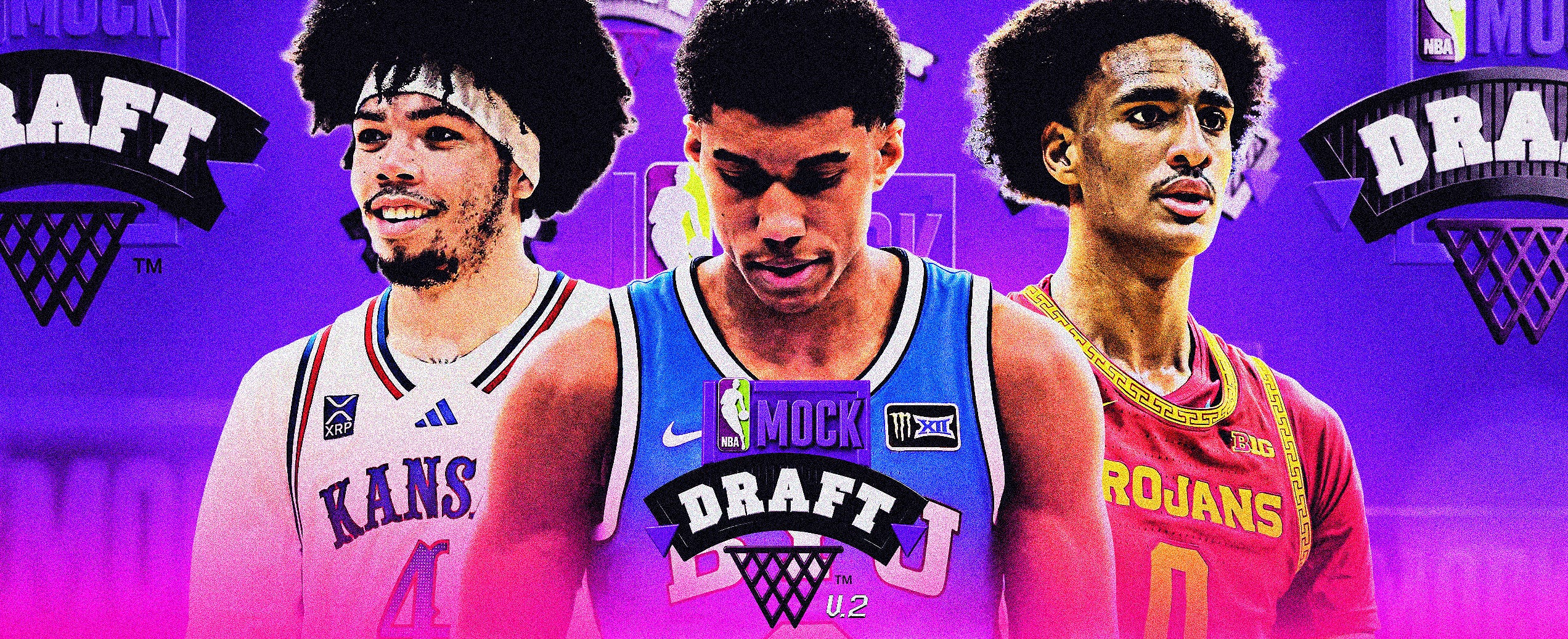
Well, hello there.
Feast week is rapidly approaching, which means it’s time to see which players in college basketball will start to shine as legit early-season names to focus on for this cycle.
We’ve already had plenty of players who have started to pop, so we had to get together for another mock draft installment.
As always, the No Ceilings team comes together for a War Room mock draft. We go around pick by pick and give nominations for each selection. After some lengthy debriefing, we take it to a vote.
These are the results.

#1. NEW ORLEANS PELICANS (via MIL) — Tyran Stokes | F | Kansas
Rucker: When you find yourself picking at the top of the mountain in any draft class, you’re going to swing for the fences. The New Orleans Pelicans have taken some pretty big swings in recent years, adding point guard Jeremiah Fears and big man Derik Queen. If the Pelicans were to land the top spot here, adding another building block on the perimeter could start to get things falling into place. Stokes, one of the most talented prospects in this class, plays the game with an intriguing combination of power and versatility on the offensive side of the ball. The offensive game has continued to take strides, especially when it comes to the creation and floor spacing consistency, but Stokes has plenty of bully-ball moments where he can overpower opponents with his combination of strength and power off the bounce. The most underrated plus skill of Stokes’s game continues to be the playmaking, which gives him intriguing upside as a forward who could become an engine of a weapon on the offensive side of the ball. For the Pelicans, this would be taking another high-upside pick who could pair nicely alongside Fears and Queen for the hopeful future.

#2. OKLAHOMA CITY THUNDER (via LAC) — Bruce Branch III | F | BYU
Owen: Oooooffff course, the Oklahoma City Thunder get yet another chance to bolster the future of what is already one of the more esteemed young cores in the NBA by adding none other than Bruce Branch III. The 6’8” wing-guard hybrid has made his mark on the draft world, with some (me) being so bold as to consider him the best prospect in the class, and for good reason. Rarely can you find a prospect who blends shot-making with high-end passing feel and defensive activity, all wrapped into an 18-year-old who has nothing but brighter days ahead of him. As for his fit in OKC, well, there isn’t a clear way for him to find his way onto the court out of the gate, as a loaded roster with depth all around makes things difficult for even the most highly touted prospect to find his way. That said, injuries, lineup changes, and, most importantly, development happen throughout the course of the season. With Branch providing the long-term outlook that he does, he’s almost a can’t-miss prospect for the Thunder if they were to end up in this spot.

#3. INDIANA PACERS — Jordan Smith Jr. | G | Arkansas
Stephen: The Indiana Pacers are a team who, at their best, play with…pace. Playing suffocating defense, forcing turnovers, and pushing the break feels like it has been an integral part of their historical identity–the cornerstones of their best teams. With Haliburton back, the guard position looks to be buoyed, but the depth behind him isn’t Teflon. Andrew Nembhard is a tough defender and an awesome decision-maker. T.J. McConnell is doing fine, but he has his limitations and is getting older as a smaller guard. Behind him, there are some intriguing marginal darts, but no one they should be afraid of drafting over. Inserting Jordan Smith Jr. seems to be a strong move. Jordan Smith Jr. is an absolute hound on the defensive end. Though he is listed on the shorter side, he is very thin and has tremendous length. Smith has an innate ability to stay in front of his man and force tough shots and turnovers. Offensively, he plays well in a straight line with the ball, and is an instinctive cutter. Playing next to Haliburton, the questions surrounding Smith Jr.‘s handle and shooting ability should be managed as he improves. Having a couple of hounds in Smith and Nembhard to play with (and without) Tyrese Haliburton would provide significant relief to Indiana in the regular season and in the playoffs.

#4. CHICAGO BULLS — Colben Landrew | F | UConn
Latif: Usually, back-to-back Top 4 picks would be a godsend to start a rebuild, but not in Adam Silver’s NBA. The league decided to overcorrect on the tanking “issue,” and now a genuinely bad team would be removed from having a third consecutive Top 5 pick next year in what’s shaping up to be a loaded class.
However, selecting Colben Landrew isn’t anything to doom and gloom about. Landrew fits Bryson Graham’s SLAP philosophy to a T, and he showed it in UConn’s dominant win over the defending champions. The freshman is a bruising yet skilled driver with shot-making chops and the size, length, and willingness to be a solid defender. Landrew would add to a crowded wing group, but the Bulls don’t have the luxury of drafting for fit.

#5. ATLANTA HAWKS (via NOLA) — Alijah Arenas | G | USC
Jam: There might not be a more gifted scorer in the class than the 6’7” Alijah Arenas, who has an innate ability to put the ball in the basket. Arenas mixes a creative handle, an array of counters, multiple-level shotmaking, and limitless confidence to befuddle defenders. The glimpses of reliable playmaking and serviceable defense are budding ancillary skills that could round out both his game and Top 5 case.
Atlanta doesn’t have a player like Arenas on the roster. A pure scorer (though it comes with efficiency questions) with NBA wing positional size and length that can really raise the team’s ceiling while complementing a fascinating young core led by Jalen Johnson, Kingston Flemings, and Nickeil Alexander-Walker. This could be looked at as a bit of a swing for Atlanta, but it’s the type of swing you take in the Top 5; Arenas’s floor could be much higher than what is perceived at the moment.

#6. HOUSTON ROCKETS (via BKN) — Quentin Coleman | G | Illinois
Albert: The Houston Rockets are bona fide title contenders in the West, but they end up with the sixth pick here. Given their current roster construction, adding a dynamic guard who can detonate from outside and comfortably handle the ball should be a top priority if they actually land a pick this high. Enter, Quentin Coleman. Coleman is a true offensive weapon as he can effortlessly play on or off the ball. Coleman is a dead-eye shooter with a silky smooth jumper. He lets it fly off the dribble and off the catch; he’s got great balance shooting off movement, too. One of the most intriguing things about Coleman’s offense is his ability to handle the ball. Coleman has a very low center of gravity and knows how to mess with tempos and hesitations to get defenders going the wrong way. The sneaky truth about Coleman is that he can easily play point guard. Coleman’s on-ball ability and vision as a passer make him a real deal offensive engine. As the season progresses, don’t be alarmed when Coach Underwood gives Coleman the keys to the offense. Coleman will have to continue to add mass to his frame to prevent being overwhelmed on the defensive end of the ball, but he’s scrappy, embraces physicality, and loves attacking the boards.

#7. MEMPHIS GRIZZLIES (via UTA) — Ivan Kharchenkov | F | Arizona
Nathan: The Memphis Grizzlies don’t NEED to find a Jaylen Wells replacement tomorrow, but the position in general could certainly be upgraded in between Cameron Boozer and Cedric Coward. Ivan Kharchenkov is arguably the best wing defender in this upcoming draft class, while also continuing to grow on offense by the game. He’s maintained efficiency from two-point range into this season, is becoming more comfortable as a three-point shooter, and has looked better than advertised in situations where he’s had to make plays off the dribble. There’s a certainty around Ivan today that isn’t quite shared amongst other prospects on the board at this point in the draft, giving all the more reason for Memphis to bring him into a great rebuilding situation.

#8. SACRAMENTO KINGS — Patrick Ngongba II | C | Duke
Nick: The Sacramento Kings certainly have no shortage of problems, so ending up here at #8 due to lottery relegation rules would be brutal. Still, the biggest problem for the team is their defense, especially in terms of rim protection; the Kings are currently dead last in the NBA in blocks. The center rotation with Domantas Sabonis, Maxime Raynaud, and Dylan Cardwell does at least have one solid defender in Cardwell, but adding Patrick Ngongba II would certainly help in terms of protecting the basket. The Duke junior has had an excellent start to his season, and his interior game would mesh well with Raynaud offensively and Cardwell defensively after the almost-inevitable Sabonis trade.

#9. CHARLOTTE HORNETS — Stefan Joksimovic | G | Baskonia
Finn: Last season, Charlotte had one of the most exciting offenses in the league. This year, they’ve had one of the ugliest. Trading LaMelo Ball unsurprisingly messed things up, and now they need more creation. Stefan Joksimovic could step in as their new jumbo creator, injecting some fresh energy into their attack with his shifty handle, flashy shot-making, and ability to pressure the rim. How well he can play off the ball is still up in the air, but he would get a lot of time with the rock on this Hornets squad.

#10. HOUSTON ROCKETS (via PHX) — Amari Allen | G | Alabama
Rucker: The season is young, but Alabama wing Amari Allen has been one of the best returners in college basketball so far. After generating some buzz as a freshman, Allen decided to return to the Crimson Tide for his sophomore year, and he has hit the ground running. A versatile piece on the offensive side of the ball, Allen can shoot the cover off the ball and is a tough rebounder. After showing some flashes last year as a playmaker while playing alongside Labaron Philon, Allen has gotten more runway early on to lean on that skill set, and it’s popped in a big way. For the Rockets, Allen would bring in another offensive weapon who is a bit of a Swiss Army knife and can impact the game in a number of different ways. This would be one of those classic “oh, that’s a nice pick” selections—especially for a team like Houston.

#11. CHARLOTTE HORNETS (via DAL) — Christian Collins | F | USC
Albert: Christian Collins hasn’t set foot on the floor for the Trojans yet this season, but his time is coming. After a foot injury over the summer, Collins is making progress towards a return to the floor, and when he does, he could really wow people with his two-way ability. Collins is a 6’9” five-star recruit who has guard-like skills for a front court player. Collins has a strong handle and shows real bend and flexibility with the ball. He’s a good shot-maker, but is not quite an elite shooting prospect. Collins is wildly enticing not only because he can handle the ball, but because he can make high-level reads all over the floor. Defensively, Collins can really move laterally and bother ball handlers with his length and good hand-eye coordination. He’s also a rock-solid communicator and exhibits a strong motor. To develop on both ends of the floor, he’ll need to keep adding strength, as he is definitely on the skinnier side. For the Hornets, who are looking to establish a new offensive identity in a post-Lamelo world, adding a versatile forward like Collins who can contribute on both ends of the floor makes a ton of sense.

#12. ORLANDO MAGIC — Caleb Holt | G | Arizona
Corey: Orlando adds a physical wing with the 12th pick here, selecting Caleb Holt out of Arizona.
Holt has been a projected Top 5 pick heading into the draft cycle, but he falls a bit here because of the questions with both his perimeter scoring consistency and his ability to consistently leverage his offensive game to make plays for his teammates. The shot itself looks good. He has a strong, balanced base, rises up with big elevation, and gets it off quickly with a hard, high-arcing ball. But he lands a little off platform even on spot-ups, and his shot prep can look rushed and sped up at times. Holt can handle the rock a bit, comfortably stringing together combos, but he lacks elite side-to-side shake, which limits his on-ball creativity. He’s at his best out of DHOs and zooms, where he can shoot, attack, or hit the roller. When he gets downhill, he loves utilizing an exaggerated hop step to avoid defenders. Holt is also a sharp cutter off the ball and a big-time vertical athlete who you can throw the ball up to, and he’s willing to absorb contact at the rim when he gets there. As a playmaker, he puts a lot of zip on his passes and makes quick decisions, but he’s not a true lead creator and sometimes telegraphs his reads. Defensively, he’s the real deal. He’s tough as shit, smothering on-ball creators with quick hands, his physical frame, and elite lateral mobility. The aggressiveness can lead to fouls at times, however. Off the ball, Holt makes great rotations and shows off his excellent motor chasing shooters around screens. If the scoring consistency comes around, Orlando could get a steal at the back end of the lotto.

#13. OKLAHOMA CITY THUNDER (via DEN) — Brandon McCoy Jr. | G | Michigan
Finn: The Thunder can afford to be patient with a mystery man like Brandon McCoy. McCoy’s defense is almost certainly going to be awesome, but his shooting and handling linger as question marks that need answers. Unfortunately, we won’t get to see him play a single game this season, adding to the shroud here. However, OKC wouldn’t need him to contribute from day one, or even in his rookie year, period, which would leave him with all the time in the world to develop in one of the NBA’s best environments. That said, his defense could be enough to get him on the floor early.

#14. MIAMI HEAT — Billy Richmond III | G | Arkansas
Stephen: The beginning of the Giannis era in Miami hasn’t gotten off to the hottest of starts. The shooting isn’t great but, oddly, neither is the defense. It may be a chemistry thing that could be ironed out, but the wing defense looks to be the crux of the defensive issues. Adding Billy Richmond III would help bolster that perimeter defense. With his size, length, and flexibility, Richmond will provide stronger point-of-attack assistance, but he also plays well in help as an additional rim protector. Offensively, Billy won’t provide much help in bolstering the three-point shooting concerns Miami currently has. BUT, he is a very smart passer–even on the move. He also can finish above the rim in transition and in the halfcourt. He cuts and makes quick decisions. Drafting Billy Richmond III to Miami is also a “fit” decision–a “culture” pick, if you will. He plays hard, he’s smart, and he does all of the things coaches love. Coach Eric Spoelstra would surely love utilizing him in similar ways he used Jaime Jaquez Jr., Justice Winslow, and Josh Richardson–among others.

#15. WASHINGTON WIZARDS — Dame Sarr | G | Duke
Jam: If the Wizards decide not to re-sign Bilal Coulibaly, Dame Sarr is the perfect replacement. Sarr is a long, athletic, and rangy defensive ace who brings a ton of defensive versatility and impact defensive playmaking at 6’8. He’s the type of defensive ace who can be a stopper, defend at the point of attack, and be a disruptor all over the floor.
Sarr should easily slide into a 3-and-D role, especially if the shooting continues to come around. He shot 32% from deep last season, but has clean and compact mechanics, and buried 39.5% of his corner threes (86 3PA). The ingredients are there for Sarr to become a key cog on an eventual playoff team without taking away touches from the protostars for the Wizards, Dybantsa and George, nor their veteran All-Stars, A.D. and Trae, if they are ticketed to be in Washington long-term.

#16. GOLDEN STATE WARRIORS — Luigi Suigo | C | Villanova
Nick: There have been some bumps in the road early on for Luigi Suigo, which led to him falling a bit past the consensus range in this Mock Draft, but the Golden State Warriors couldn’t pass up on him here at #16 given their lack of size. The 7’3” Suigo would certainly solve that issue right away, along with providing more shooting touch than most players his size. On top of that, his ability to pass and read the floor would make him a better fit in the Golden State offense than most behemoth centers.

#17. UTAH JAZZ (via CLE) — Motiejus Krivas | C | Arizona
Corey: Mo Krivas goes to the Jazz at pick 17, giving them their next elite defensive center following the Rudy Gobert and Walker Kessler eras.
Krivas does almost all of his damage near the rim. He’s at his best as a play finisher, since he’s struggled with touch issues when creating his own offense on the block in the past. He has shown some shooting flashes at the international level but hasn’t shown the ability to stretch the floor much at Arizona. Still, he’s a career 77% free-throw shooter, so there may be some untapped shooting potential for Utah to unlock. That number matters even more because he’s drawn fouls at an elite rate around the rim, carrying a 65.6 FTr throughout his career. Defense is where Krivas breads his butter. Krivas isn’t just a rim protector with gaudy block numbers–he’s a rim deterrent, using his size and feel to time his contests and sometimes keep scorers from even challenging him. He doesn’t have a sexy modern game and is a known commodity playing out his fourth year in college hoops, which is why he slides a bit here, but Krivas may end up being the most impactful center in the class in the long run.

#18. LOS ANGELES CLIPPERS (via TOR) — Obinna Ekezie Jr. | C | Louisville
Owen: Draft darling meets NBA purgatory as, with the 18th overall pick, we have the Los Angeles Clippers selecting Louisville center Obinna Ekezie Jr. The freshman sensation has already taken the college basketball world by storm, showcasing a stretch-big skill set on offense that is as coveted as ever in the modern NBA, along with real scalability on the defensive side of things that makes his upside all the more intriguing. As for his fit in L.A., well, there really isn’t a way that he couldn’t fit in. The Clippers are currently in one of the worst situations in modern NBA history, as, after a scandal involving former franchise cornerstone Kawhi Leonard, Los Angeles is now left with no first-round picks of its own for the next five years. They do have a potential “dude” in Keaton Wagler to build around, so what better way to bolster their future outlook than to pair a franchise-level guard with a potential franchise-defining big in Ekezie?

#19. BROOKLYN NETS (via NYK) — Na’jai Hines | C | UConn
Latif: The Nets are still paying for their short-lived James Harden experience, so they’ll likely fall to the late first round despite being one of the worst teams in the league, but selecting Najai Hines could be a more than fine consolation prize. Hines is one of the most dominant rim protectors, rebounders, and finishers in the class. If he can become a more disciplined defender, learn to stay out of foul trouble, and show a bit more in the feel/processing departments on offense, he could make a run at being the first center selected in the class.

#20. SAN ANTONIO SPURS (via ATL) — Thomas Haugh | F | Florida
Owen: One could make the argument that there isn’t another franchise in the entire NBA with a better long-term outlook than the San Antonio Spurs, particularly in terms of what they have going on in the frontcourt. See, they have this “guy”—alien, rather, named Victor Wembanyama or something. Apparently, he’s pretty good. Even behind him, though, Tarris Reed and Jayden Quaintance are both wildly intriguing flyers that they took in the most recent draft, both of whom bring a bit more of that enforcer mentality. To that, they can add Thomas Haugh, who can act as a bit of a swing forward, potentially sharing frontcourt minutes with any of the three guys previously mentioned, along with slotting down to the 3 in some bigger units. Questions surrounding Haugh’s ability to scale his game down to the NBA level are warranted, with him lacking a true standout skill at this point in time. But given the ancillary value he provides as a garbage man and potential tertiary shot creator, there is definitely reason for intrigue in adding him to a roster that is ready to compete.

#21. MEMPHIS GRIZZLIES — Trey McKenney | G | Michigan
Finn: Memphis will probably be running a lot of offense through Cameron Boozer and Zach Edey for the foreseeable future, making Trey McKenney a sensible fit in the backcourt for this team as a guy who can play on and off the ball comfortably. McKenney showed during Michigan’s 2026 championship run that he can make a big impact as a complementary piece by hitting catch-and-shoot threes, defending on the perimeter, and making sharp extra passes. He has plenty of on-ball upside too, which he’ll hopefully tap into more and more throughout his sophomore campaign.

#22. PHOENIX SUNS (via MIN) — Deron Rippey Jr. | G | Duke
Jam: Though Devin Booker has been solid adjusting to the role over the past few seasons (ideally should be at his natural 2 spot) and Collin Gillespie has come into his own as well, Phoenix desperately needs additional support at the point guard spot. Deron Rippey would provide an exciting two-way boost to the position and team as a whole. Few, if any, point guards in the class can match Rippey’s blend of speed, explosiveness, vertical pop, playmaking, multiple-level shotmaking, and defensive upside. In the span of a minute, Rippey can posterize a defender, then pressure at the point of attack to force a turnover, then drop a slick dime. As the season goes on and Rippey gets more playing time, he’s bound to prove that he’s a lottery-caliber talent; this would be a steal for the Suns.

#23. PORTLAND TRAIL BLAZERS — Abdou Toure | G | Arkansas
Stephen: Oh, how the turntables…The Portland Trail Blazers were thought to be bottom-dwellers coming into the season. I mean, how could a team find success with multiple, talented ball-handlers? *Coughs* Oklahoma City*Coughs*. Seriously, the guards have been good, and Deni Avdija is still him. Donovan Clingan is growing as a player, and Toumani Camara is the skeleton key who opens up all of this team’s rotational doors. With this being the case, Portland adding more wing depth seems to make too much sense. Arkansas Razorback Abdou Toure seems to fit with the ethos of this roster. He is long for his position. He is an athlete who can run the floor. He rebounds. He defends. Toure is locked into a deep Razorback roster, with the team still looking to figure out the best way to deploy their pieces. In a terrible loss against Virginia, Toure was a lone bright spot, going 4-of-8 from the floor and 1-of-3 from deep. The shooting is going to be a swing skill for Abdou, but he isn’t a prospect who lacks confidence.

#24. DETROIT PISTONS — Braylon Mullins | G | UConn
Owen: Although there is some debate regarding how polished Braylon Mullins is as an all-around talent, given his early returns from his sophomore campaign, it’s fair to bet on him being a first round pick, with Detroit being arguably the perfect landing spot. In the Motor City, Mullins can take a back seat to Cade Cunningham, providing floor spacing and ancillary creation value, along with bringing a bit of nastiness on the perimeter as a defender. Continued growth in other aspects of his game, such as downhill creation and playmaking, will be what makes or breaks Mullins’s NBA tenure, but it definitely isn’t the worst thing the Pistons could have done with this pick.

#25. BROOKLYN NETS (via HOU) — Caleb Gaskins | F | Miami
Latif: There are a number of “if he shoots it” wings and forwards in this class. Few are more tantalizing than Miami freshman Caleb Gaskins. Gaskins has prototypical size and length, which manifests in his ability to attack the rim, rise up over defenders for mid-range shots, guard both forward spots, and rebound the basketball. The next step in his development is outside shooting. He shot 28% from three on low volume in his final EYBL season, and a modest 75% from the charity stripe. Gaskins needs some polish offensively, but the Nets have some time to be patient as he continues to develop both on and off the ball.

#26. BOSTON CELTICS — Austin Goosby | G | Texas
Rucker: Texas freshman Austin Goosby is going to be a fascinating talent to monitor throughout the year. Much like some of the top teams in college basketball, the Longhorns have a roster that is deep with talent. That might mean that he is in for some inconsistent box scores, just with so many mouths to feed on this team. Goosby has some awesome tools in his arsenal. He’s a shifty bucket-getter, but there have been some fantastic early flashes as a playmaker. For a team like the Celtics, this would be another piece that could develop into a real find, especially with a good developmental track record. Goosby has some flashes on the basketball court where you wonder if he will eventually even be anywhere close to this sort of range come draft night. For now, he’s a player with enough upside that a team like the Celtics would jump all over him if he was still on the board.

#27. OKLAHOMA CITY THUNDER (via SAS) — Arafan Diane | C | Houston
Stephen: How many times do we need to say things like “the Thunder can take their time with this player” when discussing the draft? I suppose we’ll need to keep saying it as long as it’s true. Even with the Chet Holmgren injury, OKC just slid the rotation up to allow Aday Mara to play…and look good! It’s been mentioned, but the roster for this team has now become expensive. Isaiah Hartenstein has been fake-traded since last season. Thomas Sorber carries a decent cap hold for being a player who has seldom played. Jaylin Williams has found himself to be a subtly important player for the Thunder, capable of being a big or playing with other bigs on the team. The 2027 offseason could see some reshuffling of the center deck. It’s hard to imagine Holmgren being moved. Mara is becoming a mainstay. J-Will is a cost-effective rotational player. Maybe that means I-Hart and Sorber will be moved?
With Branch III and McCoy filling out other key positions, why shouldn’t OKC go with a high-upside big man? Look, Diane is being slow-rolled in Houston–and that is expected. But, in the glimpses we’ve seen, Diane is making smart plays on defense and attacking the offensive glass. As a younger big man, there is an adjustment period that should be expected. There is an argument that if Arafane is the 27th projected pick, then he’ll just return to college. But his skill set and his size will be heavily desired by NBA teams.

#28. PHILADELPHIA 76ERS — Alex Condon | F/C | Florida
Albert: The Sixers are currently at the top of the Eastern Conference, and they’ve kept questions about how the star power fits at bay as the season starts. With their young superstar, Tyrese Maxey, leading the way, the Sixers look to be having a blast and are winning a ton of games. That said, the roster isn’t perfect, and whatever happens by the end of the season, they will definitely be looking to add depth in their frontcourt. After Ariel Hukporti’s season-ending pre-season injury, their frontcourt options went from thin to very thin in the blink of an eye. Adding a versatile big like Condon makes a ton of sense, especially since he’s older and ready to contribute from Day One. Condon isn’t the most exciting prospect in the class, but his steadiness and ability to do multiple things make him an intriguing option, especially for a veteran-laden squad like the Sixers. Condon will do everything you need from your big: clean the glass, protect the paint, and set good screens. The wrinkle, though, is that he can dribble, pass, and shoot a little bit—which makes him all the more enticing. Condon won’t ever wow you on the court, but he’ll do plenty to carve out a role.

#29. MEMPHIS GRIZZLIES (via LAL) — Davis Fogle | G | Gonzaga
Nick: Davis Fogle has been one of the breakout stars of the opening weeks of college basketball; at this rate, he almost certainly will not be on the board this late in the first round of the 2027 NBA Draft. His stalwart defense, excellent rim-finishing ability, and playmaking chops as a 6’7” guard were points in his favor after his freshman campaign for Gonzaga, and he has ramped all of that up this year while also being much more willing to let it fly from distance. Adding Fogle to the wing duo of Cedric Coward and Jaylen Wells would be right in line with Memphis’s past history, and Fogle would give Cam Boozer yet another threat to kick out to on the wing who can attack a closeout at a high level and make defenses pay for leaving him any space—especially given that Memphis added Ivan Kharchenkov and Trey McKenney earlier in this Mock Draft.

#30. TORONTO RAPTORS (via OKC) — Miles Sadler | G | West Virginia
Corey: Toronto closes out the first round with a bet on heart over height, taking Miles Sadler out of West Virginia.
The Raptors like their small point guards who compete on both sides of the ball, and Sadler fits that mold. Size is the only reason Sadler is still on the board here anyway. Sadler’s already picked up right where he left off in high school, getting into the paint whenever he wants and is already creating for his teammates at the level of the best point guards in college basketball. Sadler is an absolute blur on the floor. Nobody in the country is going to get to a spot faster than he does, and his ability to change speeds keeps defenders off balance and on their toes. Once he’s in the lane, he’s a natural at manipulating defenders with his eyes, opening up passing and scoring opportunities. Sadler is comfortable pulling up off the bounce, using combos and stepbacks to create space, though he’s more shot-maker than shooter. Defensively, he brings real toughness, with active hands and a willingness to get into a shirt and pressure ball-handlers the length of the floor. With CMB, Scottie, and Kawhi’s size on the wings, Toronto can insulate Sadler’s lack of size on defense, which makes him an easy swing at 30 as a guard with this much speed, competitiveness, and feel.
SECOND ROUND

#31. PHILADELPHIA 76ERS (via MIA) — Pryce Sandfort | F | Nebraska

#32. NEW YORK KNICKS (via WAS) — Tounde Yessoufou | G | St. John’s

#33. WASHINGTON WIZARDS (via DAL) — Rueben Chinyelu | C | Florida

#34. UTAH JAZZ (via DEN) — Dylan Mingo | G | Baylor

#35. UTAH JAZZ (via ORL) — Baba Oladotun | F | Maryland

#36. WASHINGTON WIZARDS (via PHX) — Stefan Vaaks | G | Illinois

#37. WASHINGTON WIZARDS (via GSW) — Jeremy Fears Jr. | G | Michigan State

#38. SACRAMENTO KINGS (via CHA) — Juke Harris | G | Tennessee

#39. SACRAMENTO KINGS — Milan Momcilovic | F | Kentucky

#40. INDIANA PACERS (via UTA) — Daniel Jacobsen | C | Purdue

#41. MILWAUKEE BUCKS (via BKN) — Tajh Ariza | F | Oregon

#42. CHARLOTTE HORNETS (via POR) — Klark Riethauser | F | Chalon

#43. OKLAHOMA CITY THUNDER (via CHI) — David Mirkovic | F | Illinois

#44. NEW ORLEANS PELICANS (via IND) — Jason Crowe Jr. | G | Missouri

#45. UTAH JAZZ (via LAC) — JJ Andrews | G | Arkansas

#46. MILWAUKEE BUCKS — Anthony Thompson | F | Ohio State

#47. CHICAGO BULLS (via CLE) — John Mobley Jr. | G | Ohio State

#48. TORONTO RAPTORS — Shelton Henderson | F | Miami

#49. NEW YORK KNICKS — Darius Ratliff | C | USC

#50. ATLANTA HAWKS — Malachi Moreno | C | Kentucky

#51. CHARLOTTE HORNETS (via MEM) — Tyler Tanner | G | Vanderbilt

#52. PORTLAND TRAIL BLAZERS (via NOLA) — Bryson Howard | G | Duke

#53. PORTLAND TRAIL BLAZERS (via MIN) — Nik Khamenia | F | UConn

#54. DETROIT PISTONS — Isaiah Johnson | G | Texas

#55. NEW YORK KNICKS (via HOU) — Miikka Muurinen | F | Arkansas

#56. PHOENIX SUNS (via BOS) — Kayden Mingo | G | Baylor

#57. SAN ANTONIO SPURS — Hugo Yimga Moukouri | F | Nanterre 92

#58. PHILADELPHIA 76ERS — Dash Daniels | G | SE Melbourne

#59. BROOKLYN NETS (via LAL) — Somto Cyril | C | Miami
