


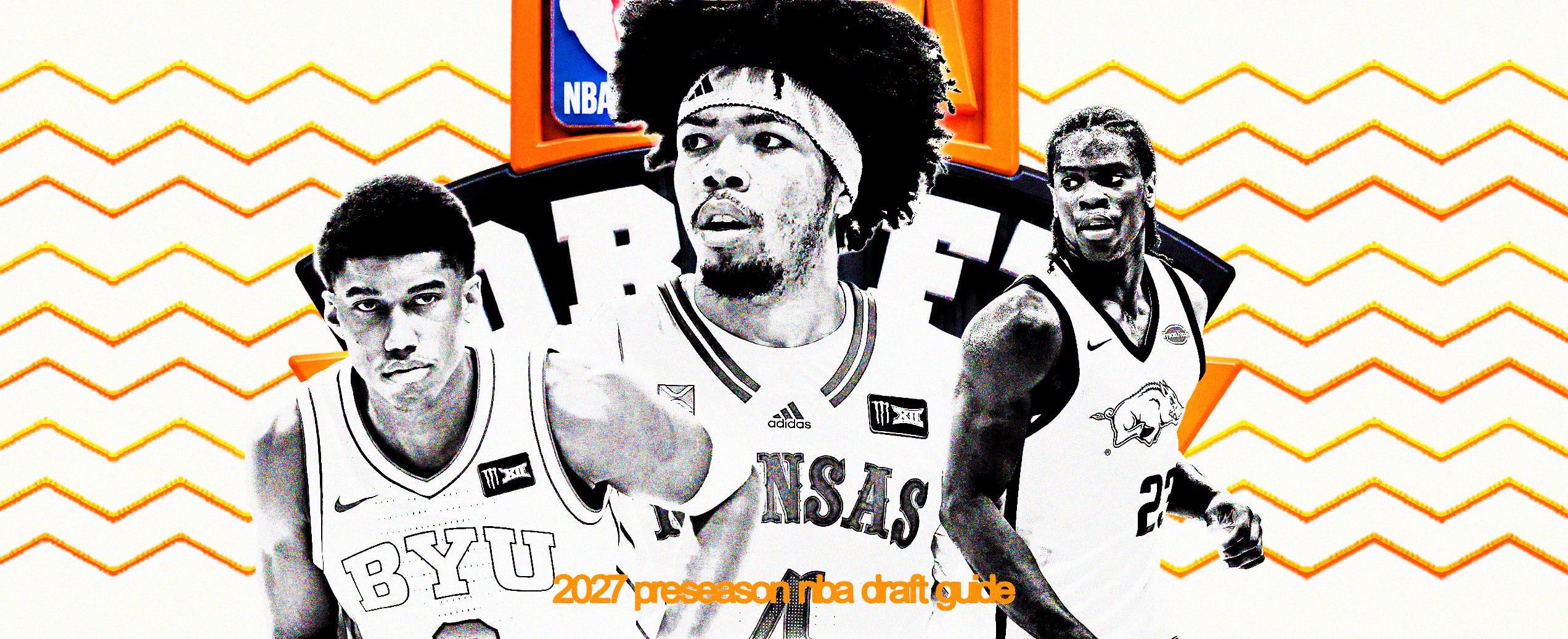
The start of the college basketball season is just around the corner, and some of the international superstar prospects have already gotten their seasons underway. For those of you who are new to No Ceilings: welcome! We’re always happy to have new folks stopping by. For the old heads among you, though, you probably already know what time it is.
DRAFT MANIA IS BACK IN ACTION. IT’S PRESEASON DRAFT GUIDE TIME.
In case this is your first guide, or if you need a refresher:
Prospects are listed in Alphabetical Order by First Name.
Measurements are based on Team Websites.
Background and Analysis of each prospect are provided by our No Ceilings panel of evaluators.
Prospect Chemistry (Our twist on Pro Comparisons).
Pros and Cons (Strengths and Improvement Areas).
As always, we are eternally grateful for all of your support; it means the world to us.
Enough preamble, though.
LET THE GAMES BEGIN.

Name: Abdou Toure
Position: Wing
Date of Birth: August 14th, 2007 (19)
Hometown: New Haven, Connecticut
Measurements: 6’6.5”, 206 pounds (6’9.5” WS via 2026 Nike Hoop Summit)
Class: Freshman
Despite being one of, if not THE most explosive athletes in the 2027 class, Abdou Toure heads to Arkansas with a major question to answer: can a score-first wing impact winning when the shots aren’t falling?
Toure can really light it up when he has it going, and he has it going a lot. He’s at his best attacking downhill, where a quick first step and a creative handle allow him to string together combos to beat his man one-on-one. He likes to drive left and can counter a rotating help defender with a smooth hop step, playing off two feet to stay in control in congested areas. As a finisher, he’s the best vertical wing in the class, blending power and finesse with enough hangtime to finish up-and-unders or rise up and embarrass defenders waiting at the rim. His poster against Inglewood is one of the craziest high school dunks you’ll find.
Toure is a monster in transition, capable of grabbing and going himself or filling the wing to finish lobs. Off the ball, he’s an active cutter who should feast on stampede cuts at the next level.
What makes Toure’s scoring package exciting is that he’s more than just a twitchy athlete. He brings a smooth stroke to Fayetteville, getting a ton of elevation on his jumper from midrange and beyond the arc. His narrow base and JR Smith-esque heat-check tendencies can, however, lead to forced no-no-yes shots; his shot selection will need to become more intentional.
As a passer, Toure is more reactive than manipulative. You won’t find him slinging live-dribble weakside skips off a ball screen, but he flashes some passing feel and carries a career 1.22 AST, per Cerebro’s database. He uses his elevation to open passing windows, but he’ll often force passes into tight windows and can get loose against pressure—areas that need cleaning up.
Defensively, Toure has the tools to make an impact. His timing and extension generate on-ball blocks, and he can disrupt plays away from the ball. His performance against Inglewood, where he finished with six blocks, showcased his defensive ceiling. On the ball, though, he doesn’t consistently pressure handlers or take away space. It’s not necessarily a lack of engagement, but he could stand to be more aggressive defensively.
Toure’s size and athletic profile will intrigue NBA teams, but to create a lottery outcome, he’ll need to prove he can thrive in a lower-usage role than he had in high school while consistently locking in on the little things.
Sell me this pen: Want one of the best athletes on the wing in the 2027 NBA Draft class? Abdou Toure is your guy.
Prospect Chemistry: Jaylen Brown, Shaedon Sharpe, Ben Mathurin
Pros: S-Tier Athleticism, Shooting, Self-Creation
Cons: Shot selection, On-Ball Defensive Aggressiveness

Name: Alex Condon
Position: C/F
Date of Birth: July 25th, 2004 (22)
Hometown: Perth, Australia
Measurements: 6’11”, 236 pounds
Class: Senior
Alex Condon has been a consistent connector for an excellent Florida team, and he offers a glimpse of his potential NBA role.
Condon functions as a handoff big man. He looks to find the most advantageous two-man game with his guards—whether it’s flowing through handoff actions on the perimeter or slinging dimes to cutters. He also knows when to reset an action and pull the ball back to the perimeter for a two-man game, often when posting up. The only downside is that he can become too reliant on the pass and lose sight of the basket. He can also put the ball on the deck when he pops or slips the screen. The league has shifted towards sets involving the big man on the perimeter: Miami, Zoom, or Split actions. Condon fits that bill.
He’s a great play-finisher who can capitalize on cuts, but he can struggle physically against similar or bigger players. He’s a decent shooter, but far from a big man who requires much shooting attention when on the perimeter, where Condon resides within his actions.
Defensively, Condon has the tools to be a great rim protector. He contests shots with intentional verticality, staying tall when defending the rim. He’s a bit awkward as a mover, but he can handle coming up near the level of ball screens and hold his own on islands. His rebounding is solid and probably has another gear, as his individual rebounding can be suppressed by sharing the floor with a combination of Rueben Chinyelu, Thomas Haugh, and Micah Handlogten. His translation concerns come with his strength. He can get bullied by stronger opponents, especially when defending in the interior. His struggles against more physical teams lead to some concerns about how he can anchor an NBA defense.
Condon profiles as a reliable big man who can string actions together and make quick decisions. His ceiling could top out as a good bench center, given his strength and frame may be highlighted against starting bigs. Nonetheless, Condon’s skillset adds real value to NBA offenses.
Sell me this pen: Condon is one of the best passing big men in the country, and he already has a high-level understanding of how to run and when to execute NBA actions.
Prospect Chemistry: Mason Plumlee, Mo Wagner, Zach Collins
Pros: Passing, Screening, Defensive Mobility
Cons: Interior Strength, Touch, Rim Protection

Name: Alijah Arenas
Position: Guard
Date of Birth: March 16th, 2007 (19)
Hometown: Los Angeles, California
Measurements: 6’7”, 199 pounds
Class: Sophomore
There is a quote from the legendary NBA Hall of Famer and 11-time NBA champion Bill Russell that always comes to mind when watching Alijah Arenas operate: “What these youngbloods have to understand is that this game has always been and will always be about buckets.”
Arenas is such a talented and innately gifted bucket-getter. As the son of Gilbert Arenas, a three-time NBA All-Star with a career 20.7 PPG mark across 11 seasons, bucket-getting is quite literally in Alijah’s blood. It doesn’t stop with Gilbert either. Alijah’s mom, Laura, played college basketball at New Mexico State.
At 6’7”, Alijah combines NBA positional size and length (with a reported 7-foot wingspan) with an immense amount of off-the-dribble creativity, shotmaking confidence, and smooth footwork to score on all three levels. He has the ball on a string and is equipped with counters on top of counters, allowing him to get to his scoring spots and quickly react to the defense. Arenas is incredibly comfortable getting to his middy pull-up and creating separation with that slick handle and footwork.
Arenas will need to answer concerns around his scoring efficiency (34% FG), shooting consistency (21% 3P on 4.4 3PA), and ancillary skills. We know he can create for himself at any moment, but he must find efficiency through better shot selection while building off his glimpses of passing feel and defensive playmaking. After he was limited to just 14 games last season, a fully healthy Arenas could shake up the top of the draft and has the upside to cement himself as a no-doubt lottery pick.
Sell Me This Pen: Arguably the most naturally gifted shot creator and three-level scorer in the class, Arenas is a versatile offensive threat with intriguing ancillary skill flashes that could provide excellent scoring bench punch or develop into a dynamic lead handler in the right situation.
Prospect Chemistry: Less athletic Nick Young, Taller Jordan Poole, Taller Gilbert Arenas
Pros: Shot-creation, Multiple-Level Scoring, Positional Size
Cons: Strength, Shot Selection, Lack of Consistent Ancillary Skills

Name: Amari Allen
Position: Wing
Date of Birth: January 26th, 2006 (20)
Hometown: Green Bay, Wisconsin
Measurements: 6’6”, 215 pounds
Class: Sophomore
Amari Allen is a 6’6” forward with good passing instincts and rebounding ability, giving Alabama the flexibility to use him in different lineups. As a freshman, he primarily played a supporting role alongside Labaron Philon and Aden Holloway. Even so, Allen averaged 3.1 assists and 6.9 rebounds on an 18.7% usage rate. His 17.9% assist rate and 19.6% defensive rebounding rate reflect a player who can impact possessions without being a primary scorer.
Allen is comfortable initiating offense, reading the middle of the floor, and making the next decision once a defense has rotated. His feel could become even more useful in handoff actions or as a screener who can catch and make the next pass. He moves the ball quickly without overdribbling, and his rebounding allows him to push the break without waiting for an outlet pass, giving Alabama more opportunities for early offense.
His scoring is less developed. Allen doesn’t consistently beat defenders in front of him, and his handle can get loose in tight spaces. He tested as an excellent vertical athlete at the combine, but that explosiveness hasn’t translated to reliable separation or finishing through traffic. He also shot 34.1% from three on 4.3 attempts per game, with a late-season slump reminding us that his jumper remains inconsistent.
On defense, his help-side awareness and willingness to rebound are positives, though he can lose track of his assignment away from the ball. Allen also averaged 4.2 fouls per 40 minutes, highlighting the need for better discipline. He has the tools to guard multiple positions, but he’ll need to improve his consistency to earn that responsibility.
With Philon gone, Allen should have more chances to create offense. The increased responsibility will help determine whether he can develop beyond a secondary playmaker into someone capable of creating advantages himself.
Sell Me This Pen: The more scoring talent you have, the more valuable Allen becomes: a big wing who sees the openings others miss.
Prospect Chemistry: Josh Hart, Kyle Anderson, Royce O’Neale
Pros: Passing Vision, Positional Rebounding, Offensive Versatility
Cons: On-ball Separation, Shooting Consistency, Defensive Discipline

Name: Andrej Stojakovic
Position: Wing
Date of Birth: August 17th, 2004 (22)
Hometown: Carmichael, California
Measurements: 6’7”, 205 pounds
Class: Senior
Andrej Stojakovic has had a bit of a roundabout journey to this point, but he will be playing his senior season for the same team as last year after playing on four teams in four years (Jesuit High School, Stanford, Cal, and Illinois) before withdrawing from the 2026 NBA Draft to return to the Illini.
Let’s start with the elephant in the room: Stojakovic does not play like his father Peja. If anything, the two of them have almost diametrically opposed games. Andrej is a downhill force who plays solid defense on the wing, but Andrej shot just 24.4% from deep last season on the lowest volume of his college career. His mid-range game and his 80.5% mark at the free-throw line last season both indicate more touch than his three-point numbers would suggest, but pigeon-holing Andrej into playing the same way as his father was exactly what went wrong with his freshman season at Stanford.
Instead, let’s focus on Andrej’s strengths. He shot 61.9% at the rim last season, per Synergy, on good volume while also hitting 58.3% of his shots inside the arc overall. He’s a solid defender, particularly in help situations; while he’s not a defensive playmaker, he knows how to make opposing scorers uncomfortable.
It will be interesting to see what role Stojakovic plays for Illinois this season with Quentin Coleman replacing Keaton Wagler as the presumed freshman superstar (not that anyone assumed that about Wagler BEFORE last season). Stojakovic played off the bench at times last season despite being the second-leading scorer; he may do so again for a team with National Championship aspirations. If he can show more as a playmaker and knock down a few more shots, he could sneak into the first round of the 2027 NBA Draft.
Sell me this pen: Need a two-way wing who can attack the basket on one end and play solid defense on the other? Stojakovic is your guy.
Prospect Chemistry: Jaime Jaquez Jr., Ayo Dosunmu, Josh Hart
Pros: Downhill scoring, defense, mid-range scoring
Cons: Three-point shooting, passing

Name: Anthony Thompson
Position: Forward
Date of Birth: August 9th, 2008 (18)
Hometown: Lebanon, Ohio
Measurements: 6’9”, 215 pounds
Class: Freshman
Despite profiling as a Top 5 talent on paper, Anthony Thompson will need to show Ohio State that his physicality and motor can catch up to his skill set.
Thompson is at his best as a floor-spacing forward, and he does real damage from deep. The lefty forward has projectable form with a high, smooth over-the-head release and good follow-through. Thompson is comfortable getting the shots up at volume too, launching over seven threes a game on near 38% at Western Reserve during his senior campaign. Thompson can shoot off some basic movement actions like pin downs and flares and is comfortable leveraging hard close-outs into 1-2 dribble pull-ups. His base is a bit wide, and the release can look catapulty on tighter contests, but the volume and touch are real.
Thompson’s on-ball game has clear limits, though. He has a competent handle for a wiry four, but tight hips keep him from creating consistent space, and he gets sloppy stringing together combos against hard pressure from defenders. He flashes some cool moments where he’ll hit a quick snatch-back to get his jumper off. However, he settles for off-balance midrange pull-ups when he gets shut down on drives, and he struggles to finish and play through contact. At the next level, he’ll be more of a play finisher than a creator, as he is more of a ball mover than a playmaker. However, he does show ambidexterity and is comfortable passing out of a live dribble.
Defensively, Thompson’s lack of force becomes a real problem. He plays prevent defense on the perimeter instead of getting into his opponents; he struggles to push guys off their spot in the post, and can look lost guarding as a big in ball screens. Off the ball, he turns his back to the action too often, bites on pump fakes, and watches guys go up at the rim without contesting. His 2.6 stocks per game during his senior year was way too low for the competition level he played for someone with a rumored 7’4.25” wingspan.
Thompson’s size and shooting profile are enough to get you excited about the long-term upside, but there is a world where he ends up as the Nate Ament of this class. The skills are there, but the motor doesn’t always run hot. Thompson will need to play with more force to live up to his draft range.
Sell me this pen: If you’re looking for a player with a sky-high ceiling, size, and shooting touch, Anthony Thompson is one of the best bets you could make.
Prospect Chemistry: Jabari Smith Jr., Thad Young, Tyler Smith
Pros: Shooting, Connective Passing, Physical Tools
Cons: Motor, Self-creation, Defensive Event Creation

Name: Arafan Diane
Position: Center
Date of Birth: November 19th, 2007 (18)
Hometown: Conakry, Guinea
Measurements: 7’0”, 280 pounds
Class: Freshman
Part of what makes this class so interesting is how different some prospects are from their positional peers. The 2027 NBA Draft class will feature plenty of big men who can shoot, defend, pass, or rebound, but few with the potential to do all of it—and fewer still at legit NBA size. Enter: Arafan Diane.
Diane enters as Houston’s prized high school get. A Guinea native, he grew up playing soccer and reportedly didn’t take to basketball until around age 12. He moved to Canada at 14, but visa issues limited his playing time before he finished at Iowa United. A McDonald’s All-American, Diane drew blue-blood interest from Kentucky and Kansas, but, out of respect for Kelvin Sampson, he chose Houston.
Raw as he is, Diane’s natural gifts have accelerated his development. He’ll draw the typical big-man tropes: too slow, can’t do anything in space, etc. Yes, his high school film shows a 7-footer north of 300 pounds. AND YET, his footwork is clean—thanks, in part, to soccer. He can pump fake, take a few dribbles, and throw it down with emphasis. That pump fake gets respected because the touch is real: he finishes through contact with soft hands and has flashed enthralling floor-spacing potential. He sets any screen a coach could want—highway, Gortat, down—and does nifty things out of them off the catch. He passes out of the post, rejects handoffs, and makes the second read. He’s been a leading rebounder in every league he’s played in.
Where things get murky is defense. It’s not effort, and he isn’t “bad,” but this is where foot-speed concerns carry weight. Once he’s beaten off the bounce, his recovery is capped. Still, Diane has reportedly dropped around 20 pounds in Houston’s legendary culture of toughness and conditioning. That could be the catalyst for Diane to become not only the best big man in the class, but one of its best players, period.
Sell Me This Pen: Diane has all the makings of a potential all-time sleeper of a big man: soft hands, smooth footwork, keen vision, unearthed potential, and legit size.
Prospect Chemistry: Joel Embiid, Day’ron Sharpe, Aday Mara
Pros: Rebounding Dominance, Interior Scoring, Size
Cons: Potential Conditioning, Foot Speed, Lack of Polish

Name: Austin Goosby
Position: Wing
Date of Birth: November 17th, 2007 (18)
Hometown: Melissa, Texas
Measurements: 6’5”, 205 pounds
Class: Freshman
Austin Goosby has the tools to be a big part of Texas’s season as a top SEC team, and he could solidify himself as a sneaky one-and-done freshman.
Goosby’s defense really pops out as a help defender. His instincts rock as an off-ball defender. He’s a great rim protector for his position and size, particularly shown by helping near the rim when chasing down fastbreak opportunities and rotating with verticality when the defense is tilted. He covers a lot of ground when flying out to close out on shooters. He has quick hands that are leveraged with his on-ball pressure and his activity in the passing lanes. He could use a bit more muscle to be more of a stopper, as well as an adjustment with his technique, as he can defend with high hips, limiting his change of direction. However, Goosby has the tools to be an absolutely wicked defender.
Offensively, Goosby profiles more as a reliable secondary playmaker that can function on and off the ball. As a primary, he might be more limited without consistent burst or handle for advantage creation, or the shot creation to punish defenses. He has real passing versatility where he can create looks, make the right reads, and find his teammates in early offense opportunities–all without turning the ball over much (1.91 assist-to-turnover ratio, per Cerebro Sports). He’s a smart off-ball player who’s explosive at the rim. The real swing skill for Goosby offensively is tied to the jump shot, where he hasn’t demonstrated consistent results. However, he did shoot 42.1 percent from three in 20 Overtime Elite games this past season on 3.3 attempts per game. If a shooting leap is there, it’ll do wonders for his game, NBA prospects, and Texas’s stature in the SEC.
Goosby profiles as a combo guard that adds value through his playmaking with turnover aversion, defensive versatility, and athleticism near the rim. He has a good skeleton for a playoff rotation 2-guard, and his ceiling as a potential starter could become actualized with a consistent jumper.
Sell me this pen: Goosby is a high-feel combo guard who has the potential to be a monster defender; he could reach another gear with a modest jumper.
Prospect Chemistry: Jalen Suggs, Lonzo Ball, Josh Green
Pros: On-ball defense, Playmaking, Off-Ball Defense
Cons: Shooting, Positional Size, Playmaking

Name: Babatunde Oladotun
Position: Forward
Date of Birth: December 15th, 2007 (18)
Hometown: Silver Spring, Maryland
Measurements: 6’10”, 205 pounds
Class: Freshman
Baba Oladotun enters his freshman campaign at his dream school with an outstanding pedigree, a ton of talent, and high expectations. The DMV native and former #1 overall high school prospect in the 2027 class, reclassified to the 2026 class where he became the 10th overall prospect before committing to the home state Maryland Terrapins. Oladotun’s commitment makes him the second highest ranked Maryland recruit since Diamond Stone (#8, 2015).
Listed at 6’10” with a reported 7’1” wingspan, Oladotun is a legit big wing with ball skills that’s equipped with a foundational dribble-pass-shoot toolkit. He isn’t someone who will overwhelm with quick-twitch athleticism or explosion to create advantages; however, he has a growing understanding of how to utilize his mix of size, fluidity, footwork, and evolving handle to get to his spots on the floor for scoring and playmaking opportunities. When at the rim, his creativity flashes with euros, spins, decels, extension, and above-the-rim finishes that are enticing and get you dreaming about his upside.
We see Oladotun hit shots across multiple levels alongside some shotmaking versatility from pull-up jumpers to movement and catch-and-shoot threes. Although he’s more of a shotmaker than shooter (32.2% three-point mark on 195 3PA through 64 events tracked via Cerebro Sports), there is natural touch and shotmaking confidence to believe in long-term. As a playmaker, Oladotun is a connective one who will make the extra pass, find cutters in the halfcourt, and make quality decisions in transition.
Defensively, there are tools to work with in his length and fluidity as he corrects the fundamentals, like getting into a sound stance instead of being so upright. He’ll need to show that he can at least be a defensive playmaker.
Oladotun is a lottery-level talent who might be more tools than skill at this stage, but big wings with his toolkit are the archetypes worth swinging for in the draft.
Sell Me This Pen: Oladotun is a young, big wing with a dribble-pass-shoot foundation, defensive tools, and pedigree that’s always worth swinging on. He’ll need some development time, but it could be well worth the wait.
Prospect Chemistry: Nate Ament, Kyle Kuzma, KZ Okpala
Pros: Shotmaking Upside, Plus Positional Size, Defensive Tools
Cons: Strength, Explosiveness, Lack of an Elite NBA Skill

Name: Billy Richmond III
Position: Wing
Date of Birth: April 11th, 2006 (20)
Hometown: Memphis, Tennessee
Measurements: 6’10”, 205 pounds
Class: Junior
Arkansas has used Billy Richmond III everywhere from point guard to power forward, and that versatility goes beyond his athleticism. Richmond has the speed to defend smaller guards, fights through screens, and recognizes when to leave his assignment to provide help at the rim. He earned SEC All-Defensive honors as a sophomore, ranking second in the conference in steal percentage (2.2%) and fifth in block percentage (3.0%). His aggressiveness can occasionally pull him out of position, while his lack of elite positional strength may limit how often he can defend bigger NBA forwards. Still, his quickness and energy should make him useful in plenty of perimeter matchups. He also turns defensive stops into scoring chances by beating opponents down the floor in transition.
Richmond is most effective offensively without the ball. He’s an energetic cutter, runs the floor well, and attacks the offensive glass. He finished 38 dunks last season while shooting 63.5% inside the arc. His finishing ability was already established, but his decision-making took a step forward in his second year at Arkansas. Richmond became more comfortable moving the ball when help defenders arrived, and his turnover rate dropped from 19.9% as a freshman to 11.8% as a sophomore. Five consecutive 20-point performances in February also showed he could handle greater scoring responsibility without an advanced isolation game.
The outside shot remains Richmond’s biggest concern. He made just 15 of 58 three-point attempts, which accounted for less than 20% of his total shots. Richmond also remains more comfortable driving in straight lines than creating separation. NBA defenses will help off him, crowding the paint and shrinking the cutting and driving opportunities that make him effective. With Arkansas bringing in so many new players, Richmond has a chance to prove how much more offense he can create when his responsibilities grow.
Sell Me This Pen: He'll take the toughest perimeter assignment, then sprint the floor for points nobody drew up. Richmond makes his minutes matter.
Prospect Chemistry: Bruce Brown, Gary Payton II, Josh Okogie
Pros: Defensive Versatility, Explosive Athleticism, Off-Ball Play Finishing
Cons: Perimeter Shooting, Halfcourt Shot Creation, Positional Strength

Name: Brandon McCoy Jr.
Position: Guard
Date of Birth: November 13th, 2007 (18)
Hometown: Los Angeles, California
Measurements: 6’5”, 200 pounds
Class: Freshman
Unfortunately, we won’t get to see Brandon McCoy play at all this year due to a knee injury suffered in Michigan’s overseas preseason trip. Injuries are always awful, but even more so when they happen to guys who have a legitimate shot to be one of the best players in the class. The way that McCoy affects the game on the defensive end is special. He’s physical, has great technique, very good athletic tools, and can effortlessly pick opponents up full court without sacrificing his fundamentals. In those preseason games, we immediately saw how impactful his defense was. He is prone to getting a little overzealous jumping passing lanes, but it’s always better to have to tone a player down than have to rev them up.
The biggest questions with McCoy came with his offense. Most of his production comes from his athleticism. He’s very good at attacking the rim and is an adept cutter. He also has shown a ton of growth as a connective passer and as a secondary creator. His handle can get loose, and his ball security needs work, so he may not be able to fully transition to being a full-time point guard. What needs the most work, though, is his jumper. He is inconsistent, and defenders are happy to let him launch.
McCoy missing this whole season is a bummer, but it doesn’t rule him out for the 2027 NBA Draft given when he had the injury. McCoy’s medicals will be a huge story come draft time, and as long as he gets a green light, I wouldn’t be surprised if he stays in this draft given how wide open it is.
Sell me this pen: Given his injury situation, there might not be a single better buy-low candidate in the 2027 NBA Draft class than Brandon McCoy.
Prospect Chemistry: Kris Dunn, Jalen Suggs, Jrue Holiday
Pros: Defense, slashing, off-ball scoring
Cons: Shooting, injury, tendency to gamble

Name: Braylon Mullins
Position: Guard
Date of Birth: April 18th, 2006 (20)
Hometown: Greenfield, Indiana
Measurements: 6’6”, 198 pounds
Class: Sophomore
There’s a ton to like about Braylon Mullins and his game, which doesn’t negate the fact that he had a tumultuous freshman season. On paper, he’s everything you want in a shooting guard: a springy 6’6” frame, a lightning-quick release, and the confidence to fire from anywhere with a hand in his face. He took 215 threes as a freshman and made 72 of them, the second-most by a freshman in UConn history, and he buried the game-winner against Duke with less than a second left to send the Huskies to the Final Four. That’s the player that I’m looking for in Year Two in Storrs.
The reality is, he had a bumpy first season. An ankle injury cost him the first six games; nagging injuries and a concussion followed, and he never found a real rhythm early. He finished at 34% from three on 6.5 attempts a game, which is solid but not the elite efficiency you’d hope for from a player whose entire profile is built on shooting. He did shoot 89% from the line, which speaks to his elite touch. Then came the national championship game, where he went 3-for-10 from deep and 4-for-17 overall. What you’re hoping for in year two is more consistency that hopefully comes with a clean bill of health.
Beyond the jumper, Mullins adds value by cutting, running the floor, and attacking long closeouts with floaters and runners. The questions around his physique and strength are hard to ignore. He took only about one free throw a game, so he isn’t pressuring the rim, and his slender frame needs real strength to finish through contact and hold up defensively. He’s been a good defender, but the jury is still out on how he’ll hold up against NBA size. Health and a stronger base are the two swing factors for me heading into year two, and if both break his way, the shooting numbers should follow. As inconsistent as his first year was, you have to hold out hope that the player we were all excited about heading into his freshman season is still in there.
Sell me this pen: Braylon Mullins is a quick-release shooter with a flair for the biggest moments. A healthy sophomore season could prove he’s much more than a freshman who got hot in March.
Prospect Chemistry: Allan Houston, Luke Kennard, Joe Harris
Pros: Outside Shooting, Positional Size, Defensive Effort
Cons: Frame, Lack of Rim Pressure, Consistency

Name: Bruce Branch III
Position: Forward
Date of Birth: October 24th, 2008 (17)
Hometown: Gilbert, Arizona
Measurements: 6’8”, 190 pounds
Class: Freshman
The phrase “boom or bust” is thrown around a lot in NBA draft discourse, and it’s a title that incoming BYU freshman Bruce Branch III has found himself attached to. At face value, it makes sense: a long, rangy forward with an unpolished handle and a smooth jumper that lacks consistency. He checks all the boxes, right?
Well, no, as a lot more lies within Branch’s game than the average player with that billing. But let’s not beat around the bush: The kid is raw. Despite having a fluid and projectable shot form, Branch has yet to back it up with numbers, cashing in under 30% of his 3-pointers last season and—even more concerning—under 70% of his free throws.
That said, he still eclipsed a respectable 56.2% True Shooting mark, mostly fueled by him shooting 70.2% at the rim. There, Branch flashes the touch that you would hope can scale back to jumpers, all of which could really tie together if he can continue to take strides forward with his handle.
Branch has also flashed some ridiculously high feel for live-dribble passing. He’s displayed the ability to whip passes overhand to the weak-side corner, throw lobs to cutting big men, along with making the simple reads look simple.
On the defensive side of things, he’s arguably even more intriguing, displaying the ability to balance being a true wing stopper while also playing his part in generating stocks. As he fills out his frame, the ceiling for who he could be on this end of the floor only grows.
Now, at BYU, the hope is that Branch can turn these flashes into general production. If he can do so, there is a real world where he hears his name called #1 overall come draft day.
Sell me this pen: Bruce Branch is an 18-year-old wing with plus length, elite scoring instincts, passing feel, and two-way versatility.
Prospect Chemistry: Mikal Bridges, Young Paul George, Rip Hamilton
Pros: Natural Scoring Feel, Intriguing Live Dribble Passing, Defensive Activity
Cons: Handle, Shot-making Consistency, Handling Physicality

Name: Bryson Howard
Position: G/F
Date of Birth: August 12th, 2008 (18)
Hometown: Dallas, Texas
Measurements: 6’4”, 190
Class: Freshman
If Bryson Howard can find ample playing time in Duke’s rotation, he could be the biggest riser in the glass. However, the path to consistent minutes is incredibly crowded at Duke.
Howard’s offense is built on his outside shooting; he’s a knockdown shooter with fluid, repeatable mechanics. Per Cerebro Sports, he shot 43.9 percent from three on 5.7 attempts per game. It’s a floor skill for his impact but far from the only way he can contribute offensively. He’s a reliable finisher, shining more in the open floor. When touching two feet into the paint, he has smooth gathers to get to his spots and can absorb contact. From there, he needs to build out his creation a little bit. He’s shakier as a pull-up shooter, which could hurt his utility when he has to create separation from rotations or closeouts. Within that, his wiggle is a bit limited, which could hurt him when he needs to create advantages on straight-line drives. In addition, he’s more of a connective passer than a playmaker–which isn’t detrimental but could limit his upside.
Howard is an impeccable shooter and a steady finisher, but developing counters will take his offensive game to another level.
Defensively, Howard has plenty of tools to stack to round out his skill set. He boasts good size on the wing for his position, as he has a perfect solid frame to pair with a reported 6’11” wingspan. His main question defensively with his size is his height, since he’s a 6’4” wing that may be at his best defending up than down positions. He’s a solid low-man defender due to his awareness and length. He’s a reliable rebounder and can also drum up turnovers, 2.0 steals per game, per Cerebro Sports. While identifying his best defensive position will be something a team has to work with, Howard brings too many physical tools and specific strengths that bode well for his projection as an NBA defender.
Howard has a crowded backcourt and wing room to break through at Duke, which may hurt his draft prospects. However, if he finds a consistent role, he won’t look back, as his skills amplify a core. A steady role should let Howard contribute to a contending Duke team while making his case as a one-and-done prospect.
Sell me this pen: Howard is a lights-out shooter who can defend bigger than his size and be a powerful transition attacker.
Prospect Chemistry: Desmond Bane, Jaylon Tyson, Ja’Kobe Walter
Pros: Shooting, Finishing, Off-ball defense
Cons: Creation, Positional Size, Playmaking

Name: Caleb Gaskins
Position: Forward
Date of Birth: August 13th, 2008 (17)
Hometown: West Palm Beach, Florida
Measurements: 6’8”, 221 pounds
Class: Freshman
Caleb Gaskins arrives at Miami after winning Florida’s Gatorade Player of the Year. Through 32 games as a senior at Columbus, he averaged 22.6 points, 9.5 rebounds, and 3.1 assists. Now the question is how his physicality and developing perimeter game translate against ACC competition.
At 6’8”, Gaskins has an intriguing combination of strength, mobility, and scoring touch. He runs the floor well and can finish above the rim, but his offensive appeal extends beyond his athleticism. In the half-court, he finds pockets of space off the ball and gets into his mid-range jumper, where his high release allows him to shoot over any defender.
Shooting remains the biggest swing skill for his long-term projection. Gaskins has shown touch on pull-ups and from the mid-post, but extending that effectiveness beyond the arc remains a work in progress. Becoming a reliable perimeter shooter would make his off-ball scoring more valuable and force defenders to respect him further from the basket.
Defensively, Gaskins’s frame allows him to battle larger players, while his mobility gives him the potential to guard multiple positions in space. Gaskins projects most naturally as a complementary forward. For his NBA outlook, the key will be showing that his defense and rebounding translate while his shooting develops enough to make him a dependable offensive fit alongside primary creators.
Sell Me This Pen: Gaskins brings NBA size, physicality, defensive versatility, and scoring touch, with a developing jumper that could unlock his offensive ceiling.
Prospect Chemistry: Rui Hachimura, Derrick Jones, Taylor Hendricks
Pros: Physicality, Versatility, Rebounding
Cons: Perimeter Shooting, Self-Creation, Ball-Handling

Name: Caleb Holt
Position: Wing
Date of Birth: August 13th, 2008 (17)
Hometown: Huntsville, Alabama
Measurements: 6’5”, 200 pounds
Class: Freshman
Caleb Holt was born to compete. When you watch him play the game of basketball, you can feel his competitive spirit emanating from him. Holt’s superpower will always be his hunger and desire to win. If you sat down and watched one of his games with no idea who he was or what he was ranked, you’d think he was literally playing with his life on the line. Holt doesn’t hold back; he doesn’t care who he’s playing; he gives max effort as long as he’s still breathing.
Standing at 6’5” and 215 pounds, Holt has all the physical tools you’re looking for from a shooting guard prospect. He’s got great flexibility, is extremely quick laterally, and can soar through the air.
As an elite athlete, Holt can be a dynamic driver and attack the rim with real ferocity. He’s really worked on his game, and he continues to show real growth with his outside shooting. At this stage in his development, he’s still an erratic shooter, but to his credit, he shoots with real confidence and range. The concern with Holt may be that he shoots with too much arc, and he shoots a bit of a hard ball, so misses can really clang off the rim or backboard. Holt will have to keep working on his shooting touch to become an elite shooter. The positive about his shot is that he gets a ton of elevation and is very difficult to block. With more reps, he has a good-to-above-average shooter in there; it’ll just be up to him to unlock it.
Holt really shows his ferocity on the defensive end of the ball and on the boards. Holt is a relentless rebounder for a guard who likes to use his motor and athletic ability to mix it up with the trees and fight for rebounds. On defense, Holt can slide with pretty much anybody, gets ridiculously low in his stance, and can flip his hips like an All-Pro NFL corner. It is not hyperbolic to say that Holt is likely the best perimeter defender in his class, probably even the best overall defender.
Sell me this pen: Caleb Holt is a premier defensive wing prospect who can absolutely shut down his opponent. He’s a blossoming offensive player with real flashes of scoring upside.
Prospect Chemistry: The Beast (X-Men), Latrell Sprewell, Victor Oladipo
Pros: Motor, Athleticism, Defensive Influence
Cons: Shooting Touch, Limited Playmaking

● Name: Cameron Williams
● Position: Big
● Date of Birth: October 25th, 2007 (18)
● Hometown: Phoenix, Arizona
● Measurements: 7’0”, 215
● Class: Freshman
Cameron Williams ascended the high school ranks at a pace few prospects have ever matched, ending his senior year as the fourth-ranked prospect in the country. Now he faces the uphill battle of establishing himself as a part of perhaps the most talented frontcourt in the country.
Listed at 7’0”, Williams has a special combination of size, fluidity, and shooting touch that makes him a special prospect. He has a beautiful shooting stroke and gets his shot off extremely quickly, not just for a big but for any position. His confidence (and eagerness) to attempt threes is particularly exciting for his long-term development, and he has very projectable ability to stretch the floor at the next level.
Defensively, Williams has the requisite tools to be an elite defender. The lateral mobility, timing, verticality, and size are all there, and he has proven he can be truly disruptive. Maintaining a consistent motor will be a deciding factor in Williams’s ability to earn minutes this season.
Williams is too contact-averse at this point and needs to embrace physicality, something that will likely improve as he continues to fill out his frame. Until then, he could struggle to maintain impressive rebounding numbers and finish around the rim on non-dunk attempts.
Still, Williams has a budding face-up game with real flashes of skill as a ball handler and the coordination to take defenders off the dribble. He is nearly unstoppable around the rim in transition and should at the very least be a strong lob threat in Duke’s halfcourt offense.
Sell Me This Pen: Cameron Williams’s rare combination of size, shooting, and defensive versatility clearly gives him one of the highest ceilings in the class.
Prospect Chemistry: Evan Mobeley, Myles Turner, Bol Bol
Pros: Shooting, Defense, Mobility
Cons: Physicality, Passing, Playing Time

● Name: Cayden Boozer
● Position: Guard
● Date of Birth: July 18th, 2007 (19)
● Hometown: Westchester, Florida
● Measurements: 6’4”, 194
● Class: Sophomore
Cayden Boozer showed a solid understanding of running an offense in his first year at Duke. His offensive role was limited for much of the season, but Caleb Foster’s injury gave him a larger opportunity. Boozer started seven postseason games, averaging 13.0 points and 3.6 assists during Duke’s ACC and NCAA Tournament runs. He had more freedom to control the pace and look for his own offense.
Boozer doesn’t have great quickness off the dribble, relying instead on pace, angles, and strength to operate in ball screens. He knows how to keep a defender behind him while finding a rolling big man or open shooter when the help defense shifts, staying patient until the passing lane opens. His 22.1% assist rate reflects that ability, although his 17.2% turnover rate shows that pressure from more physical, experienced defenders can still give him trouble. Boozer also has excellent touch around the basket, shooting 59% on two-point attempts last season. He uses his body and footwork rather than trying to finish over bigger defenders.
There is still a legitimate concern about how much separation Boozer can create for himself. He shot 30.3% from three on fewer than two attempts per game, giving opponents a reason to go under screens and stay closer to his teammates. His 81.3% free-throw shooting is encouraging, but improving his confidence and consistency as a pull-up shooter has to be a priority.
Defensively, Boozer has trouble staying in front of quicker guards at the point of attack. His strength helps him compete, but he’ll need to improve his footwork and discipline to handle faster opponents. With Cameron Boozer gone and more competition in Duke’s backcourt, Cayden has an opportunity to show how much offense he can generate without relying on the familiar scoring options he’s played alongside for years.
Sell Me This Pen: Cayden Boozer makes plays that matter in winning situations, both as a floor general and timely shot maker.
Prospect Chemistry: Tyus Jones, Andrew Nembhard, Jordan McLaughlin
Pros: Pick-and-Roll Playmaking, Court Vision, Crafty Scoring
Cons: Pull-up Shooting, One-on-One Separation, Defensive Footwork

Name: Christian Collins
Position: Forward
Date of Birth: September 11th, 2007 (19)
Hometown: Inglewood, California
Measurements: 6’9”, 200
Class: Freshman
Christian Collins is a 6’9” swing forward who moves like a guard, and that combination of size, length, and skill makes him one of the most intriguing prospects in the 2027 class.
Collins is at his best when he’s creating out of ball screens, where his smooth, fluid handle lets him string together advanced combos. He likes to play out of hang-hesitations, changes speeds well, and shows real patience when defenders play at the level. His set-ups approaching the screen are advanced for his age, and he loves getting to a Dwyane Wade/Donovan Mitchell style high pickup in traffic. As a finisher off the bounce, he tries to finesse his way through traffic and uses his length on extension finishes to create closer looks at the rim, but Collins is also comfortable playing off the ball, finding slivers in the defense and generating easy looks at the rim off cuts. And he has real bounce and really plays above the rim with some ferocious finishes when he has a runway.
While he may not operate in a primary on-ball creation role for USC, Collins flashed real feel as a playmaker in high school. Collins uses his height to see over the top and hit the roll man. He makes cross-court reads out of ball screens or when he plays out of the mid-post; he also throws a soft lob off dribble penetration, and is comfortable making live-dribble reads with his strong hand.
Collins’s perimeter shooting is the swing skill. He is way more of a shot maker than a shooter right now. He shoots a palmy ball with an over-the-head release that comes out a little flat and catapulty, often resulting in short misses. His base is also really squared to the hoop, and angling off a touch could clean up some of the funkiness to his shot. He does get good elevation to shoot over defenders and is confident pulling up from distance, so there is a foundation to build on.
Defensively, Collins is a smooth lateral mover who flips his hips swiftly and uses his length to generate strong contests. He can get skinny over screens and communicates well. Collins also hammers the boards, finding a body and actively going after the ball to end the possession. He could certainly stand to be more aggressive contesting shots near the rim, but the tools are all there for him to be an impactful defender at the next level.
If the jumper rounds into form, Collins has the profile of a high-level two-way forward, and he could work his way into more Top 10 conversations.
Sell me this pen: Most players of Christian Collins’s size don’t move anywhere near as well as he does—and they also don’t playmake like he does, either
Prospect Chemistry: Pascal Siakam, Matas Buzelis, Jerami Grant
Pros: Handle, Motor, Athleticism
Cons: Shooting, Mid-range Diet

Name: Colben Landrew
Position: Wing
Date of Birth: February 27th, 2008 (18)
Hometown: McComb, Mississippi
Measurements: 6’6”, 236
Class: Freshman
A well-accomplished high school athlete, Colben Landrew enters the season playing for the deep and talented UConn Huskies. Colben dominated the high school ranks in Georgia, earning Mr. Georgia Basketball, MaxPreps Georgia High School Player of the Year, and Georgia Gatorade Player of the Year honors. His play secured him a spot on the 2026 Team USA squad at the FIBA U18 AmeriCup, where he earned a silver medal.
Colben Landrew is a powerfully built and skilled perimeter-based player. Landrew was an absolute unit in his high school days, but he balanced that with such fluidity and lean when operating with the ball. He has solid command of the ball, starting and stopping well and using his handle to get to his spots. He is well-versed in bumping his man off of his spot—creating separation for him to finish with craft. When securing a defensive rebound, Landrew likes to push the break, getting easy shots for himself or others. He does a great job of using his scoring gravity to create opportunities for his teammates in the halfcourt as well.
He is much more of a shot-maker than a true shooter. His base can be a little misaligned at times, and the mechanics look to need a little smoothing. But none of that is anything that can’t be corrected. Defensively, Landrew has more work to do. He is susceptible to ball-watching, and his footwork isn’t always great. There is also the question of how scalable he can be with his foot speed.
Still, the commitment to UConn should help Colben improve in those areas. There are just some questions as to how big his role will be—how much he can show—considering the quality of teammates around him. So long as he is potent in those moments, Landrew has a chance to work his way to the top of draft boards under Dan Hurley.
Sell Me This Pen: Blessed with power and skill, Colben Landrew has the dribble-pass-shoot potential that all NBA teams covet.
Prospect Chemistry: Tobias Harris, Marvin Williams, Rui Hachimura
Pros: Interior Finishing, Connectivity, Tough Shot-Making
Cons: Defensive Consistency, Shooting Consistency, Athleticism

Name: Dame Sarr
Position: Wing
Date of Birth: June 4th, 2006 (20)
Hometown: Oderzo, Italy
Measurements: 6’8”, 200
Class: Sophomore
Dame Sarr is an effective perimeter defender at 6’8”, with more to his game than simply using his length to bother shooters. He can stay in front of smaller ball handlers, fight through screens, and recover quickly when caught on the wrong side of an action. His off-ball awareness also made him one of Duke’s most dependable defenders as a freshman, particularly when rotating to help around the basket. Sarr earned ACC All-Defensive honors and ranked in the 92nd percentile defensively according to Synergy. His experience playing professionally with Barcelona shows in his comfort taking difficult defensive assignments, although he’ll need to get stronger against bigger wings.
His offensive game remains less established. Nearly 64% of his field goal attempts came from beyond the arc last season, where he shot 32.3%, while making only 53.2% of his free throws. He shot over 40% from both corners, but those smaller samples don’t erase the concerns about his overall consistency. Sarr understands where to position himself to space the floor and generally takes catch-and-shoot opportunities within Duke’s offense. The challenge comes when defenders run him off the line. His handle is limited, and despite his athleticism, he struggled to score efficiently on cuts and in transition. His cutting graded in the 37th percentile according to Synergy, although that was based on only 16 tracked possessions.
Sarr was more productive cutting and finishing in transition during his time at Barcelona, which gives some reason to believe those parts of his game can improve. While Duke can afford to be patient with his offensive development, NBA teams will need him to make open shots, finish cuts, and move the ball quickly enough to keep opponents from ignoring him. His defensive ability already gives him a chance to make an impact at the next level.
Sell Me This Pen: Wing defenders at 6’8” shouldn't be able to chase point guards through screens. Sarr does, and that can change your entire defense.
Prospect Chemistry: Herb Jones, Matisse Thybulle, Andre Roberson
Pros: Point-of-Attack Defense, Screen Navigation, Off-Ball Play Finishing
Cons: Perimeter Shooting, Self-Creation, Positional Physicality

Name: Daniel Jacobsen
Position: Center
Date of Birth: April 25th, 2006 (20)
Hometown: Chicago, IL
Measurements: 7’4”, 250
Class: Junior
Matt Painter has built a reputation for producing some of the best jumbo big-man prospects in recent years at Purdue, but so far, Daniel Jacobsen has flown under the radar. A freshman-year injury slowed Jacobsen’s sophomore season, but with a year of college basketball under his belt, he’s primed to emerge in the Big Ten.
You can’t teach the size that Jacobsen brings to the table, as he has a hulking 7’4” frame and a lengthy wingspan. Jacobsen challenges any shot in his vicinity with ease, using verticality principles alongside his natural reach to protect the rim. He also moves solidly for a player his size, since he isn’t a lanky center like some modern NBA bigs.
Jacobsen’s offense is more limited than his defense, but it’s still potent. He is a reliable finisher at the rim, whether bulldozing his way through players or finishing over them. He doesn’t create much with the ball in his hands, but his screens and rolls help keep the offense running for the Boilermakers.
That lack of versatility could hamstring Jacobsen’s long-term potential in the NBA. He isn’t a prolific passer and doesn’t move the ball much on broken plays, and he hasn’t shown enough touch as a shooter from the free-throw line or beyond the arc.
If Jacobsen can show the same flashes he had as a two-way big, it won’t matter that his game is more focused than other big men. That’s a big if, but a big like Jacobsen can achieve it with his talents in Purdue’s system.
Sell Me This Pen: You can’t teach size, but not having to teach a big man to set good screens, finish at a high level, and guard the rim doesn’t hurt either.
Prospect Chemistry: Dereck Lively, Daniel Gafford, Steven Adams
Pros: Size, Rebounding, Shot Blocking
Cons: Playmaking, Shooting

Name: David Mirkovic
Position: Forward
Date of Birth: January 6th, 2006 (20)
Hometown: Nikšić, Montenegro
Measurements: 6’9”, 250
Class: Sophomore
Mirkovic made a seamless transition to the college game, averaging 13.3 points per game in his first season with the Illini while shooting 48.4% from the field and 37.5% from three-point range. He also led the team with 8 rebounds per game. However, his freshman-year success came as no surprise to those who had followed his career overseas: he had consistently stood out in youth invitational tournaments for both his club and national teams across Europe and had two full seasons of Adriatic League experience under his belt.
The 20-year-old has the combination of size, fluidity, and touch around the basket that allows him to make an impact in the paint. Standing 6’9” and weighing 250 pounds, his size allows him to crash the offensive glass, finish around the basket, and consistently attack mismatches in the post. In one-on-one situations, he can score over opponents thanks to his touch on floaters, hook shots, and difficult layups. However, his most impressive moments come when he attracts multiple defenders, as he’s able to make advanced reads and deliver passes out of the post, consistently finding open shooters on the perimeter.
The Montenegrin forward can also make an impact outside the paint with his three-point shooting. He converted 37.5% of his attempts from beyond the arc, including a solid share of dribble jumpers, which he converted at an impressive 42.1% clip.
Mirkovic’s limitations mostly stem from his athletic profile. He lacks the elite length and vertical explosiveness to protect the rim as either a primary or secondary rim protector, and he can also struggle defensively on the perimeter, particularly when trying to stay in front of quicker wings and more athletic forwards.
While finding an optimal defensive role will certainly be a challenge at the NBA level, Mirkovic’s combination of size, multi-level scoring ability, and feel for the game is unique and could prove to be extremely valuable for a team looking for a player with playmaking hub upside.
Sell me this pen: Few players of David Mirkovic’s size read the game or shoot as well as he does.
Prospect Chemistry: Boris Diaw, Jared Dudley, Alperen Sengun
Pros: Three-Point Shooting, Below-the-Rim Finishing, Passing out of the Post
Cons: Athletic Limitations, Perimeter Defense

Name: Davis Fogle
Position: Forward
Date of Birth: June 6th, 2006 (20)
Hometown: Anacortes, Washington
Measurements: 6’7”, 205
Class: Sophomore
Davis Fogle could be one of the biggest breakout prospects among all returning players for the 2027 NBA Draft. Fogle was a slow burn at Gonzaga last year as he didn’t get many minutes early but steadily improved throughout the year. By the end of the season, it was clear that Fogle was one of their most impactful wings, as he was building on the exact skills we saw him display in high school. Fogle has legitimate wing size and athleticism, and he knows how to use that combination. His most consistent production came on defense. He’s extremely versatile and disruptive on the perimeter. His footwork and work rate give him a ton of versatility defending on the ball and allow him to regularly generate blocks and steals. Fogle’s defensive playmaking isn’t solely limited to his on-ball defense, as he’s also an adept off-ball defender. He’s attentive with rotations, jumps passing lanes, and even sprinkles in some weak-side rim protection. The bigger intrigue, though, is his offense. Fogle is great in transition, moves really well without the ball, and is a good slasher. He’s also a fantastic connective passer who regularly finds teammates in transition and out of his drives. The two big areas he has to improve on are his on-ball creation and shooting. Fogle’s handle needs refinement, and he has to improve his shooting consistency. If those happen, he’s going to be a massive contributor for Gonzaga while his draft stock skyrockets. Fogle isn’t being overly hyped by most outlets because there are important areas of improvement he needs to prove. However, don’t be surprised if Fogle starts popping up in first round mock drafts sooner rather than later.
Sell me this pen: If you want a ready-made connective player on both ends of the floor, Davis Fogle has the goods.
Prospect Chemistry: Pat Connaughton, Andrew Wiggins, Trey Murphy III
Pros: Cutting, Defense, Passing, Off-Ball Scoring
Cons: Shooting Consistency, Defensive Discipline, Space Creation

● Name: Deron Rippey, Jr.
● Position: Guard
● Date of Birth: August 1st, 2007 (19)
● Hometown: Brooklyn, New York
● Measurements: 6’3”, 185 pounds
● Class: Freshman
While Deron Rippey Jr. joins a heralded line of five star Duke point guards, you’d have to go all the way back to Tyus Jones or Kyrie Irving to find the last time Durham had a point guard as dynamic as Rippey.
Rippey is a twitchy athlete with an elite handle that allows him to get downhill and collapse defenses. He dominates in transition as both a playmaker and scorer, single-handedly changing the tempo of his team’s offense, something that will be interesting to monitor for a Duke program that typically plays at a slower pace.
In the halfcourt, Rippey’s pacing really pops, particularly in pick-and-roll opportunities. He has a great cadence as a ball-handler and keeps his defender off-balance, while also having the speed to burst through defensive gaps. Rippey does not shy away from physicality and is comfortable lowering his shoulder into defenders to create separation around the rim.
Rippey is a creative passer who is always looking to make the right play. He can read multiple lines of defenders and fit passes into tight windows. His ability to collapse defenses and kick to opposite corners will be sought after by any NBA team.
Defensively, Rippey plays with a solid motor and has clearly added size to his frame over the last couple of months. However, with a self-reported 6’3” wingspan in 2023, he has plenty to prove defensively, especially given that he will not carry enormous offensive usage. The main concern is that Duke will look to senior John Blackwell and sophomore Cayden Boozer as their primary ball-handlers, limiting Rippey’s opportunities to prove himself this season.
Sell Me This Pen: Rippey’s natural self-creation, paired with his playmaking in the halfcourt and transition, makes him a clear first round talent.
Prospect Chemistry: Rob Dillingham, De’Aaron Fox, Ja Morant
Pros: Ball-handling, Playmaking, Pick-and-Roll Navigation
Cons: Undersized, Playing Time, Defense

Name: Dylan Mingo
Position: Guard
Date of Birth: October 6th, 2008 (18)
Hometown: Farmingdale, New York
Measurements: 6’5”, 185 pounds
Class: Freshman
With players like Jordan Smith Jr. and Caleb Holt drawing attention at the top of the 2027 NBA Draft class, the door is wide open for Dylan Mingo to punch his way up. A five-star recruit, Mingo attended the 2024 Men’s U17 and 2025 Men’s Junior National Team training camps. In 2025, he was named Nike EYBL 17U Defensive MVP and NBPA Top 100 Camp MVP. With the PSA Cardinals, he averaged 19.3 PPG, 7.8 RPG, 2.6 APG, and 2.3 SPG in 12 injury-shortened games. North Carolina, Penn State, and Washington recruited him heavily, but he opted for Baylor to play with his brother, Kayden.
Mingo is a guard with good size who has such command over the ball. Out of the pick-and-roll, he plays with good pace and cadence, using his tools to push his way to the paint. He leans on hesitations, Euro-steps, rip-overs, and stop/start. Mingo slings crisp, on-target passes. He’s the sort of playmaker teammates must keep their hands up for at all times, as he can make passing angles materialize seemingly out of nowhere.
On the other side of the floor, Mingo uses his natural gifts to be an impactful defender. He has quick hands and plays with awesome anticipation. His length and footwork allow him to cut off driving lanes and pressure the ball. His size and instincts make it easy to see him as at least a two-position defender.
The areas of improvement come with the shooting. The form is a bit regimented and feels like it progresses in segments, which makes the shot off the bounce and off movement hard to see translating in the short term. One will have to wrestle with how good the handling and defense must be to tolerate the shooting while it develops. That will carry a lot of weight in his draft stock and his viability as a true one-and-done prospect in the 2027 NBA Draft.
Sell me this pen: Dylan Mingo is a true table-setting guard who makes advanced reads while pressuring the basket—and a two-way prospect with strong positional size.
Prospect Chemistry: Andrew Nembhard, Anthony Black, Kris Dunn
Pros: Organization, Playmaking, Defensive Impact
Cons: Shooting, Scoring Versatility, Creation for Others

Name: Flory Bidunga
Position: Big
Date of Birth: May 20th, 2005 (21)
Hometown: Kinshasa, Democratic Republic of the Congo
Measurements: 6’9”, 235 pounds
Class: Junior
Flory Bidunga entered his freshman year at Kansas as one of the most highly-touted big man prospects in the country, finishing 18th in the RSCI rankings for his class. He showed flashes of that talent during his freshman year, blocking an astounding 5.6 shots per 100 possessions and shooting just under 70% from the floor in 16.3 minutes per game. Still, there were signs that he had even more to unlock, especially offensively. Those flashes came to fruition in his sophomore year, where Bidunga was named Big 12 Defensive Player of the Year and made the All-Big 12 First Team. He was particularly impressive in his moments as a secondary offensive hub while Darryn Peterson was out with injury; while Bidunga’s offensive numbers faded as the season went along (in no small part due to Peterson playing more minutes), he still led the Big 12 with 2.6 blocks per game and showed that he was more than just a defensive menace. After transferring to Louisville, Bidunga will be looking to prove that his offensive successes last season were more than just a flash in the pan.
The ultimate NBA sell for Bidunga is pretty simple: he’s not just a pogo stick; he’s a smart interior defender who cut down on his foul rate pretty significantly last season as well. He’s also a nifty interior passer in addition to being an emphatic finisher around the basket and a solid rebounder on both ends of the court. If you’re looking for a stretch big man, you should look elsewhere, but it is encouraging that Bidunga improved his free-throw percentage last season (albeit only to 65.4% from the charity stripe). Still, the defensive impact and strong finishing around the basket should be more than enough for the right NBA team.
Sell me this pen: Flory Bidunga is one of the best shot-blockers in college basketball, and he also showcased an expanded offensive skill set when Darryn Peterson missed time last year.
Prospect Chemistry: Moussa Diabate, John Collins, Day’Ron Sharpe
Pros: Shot-blocking, at-rim finishing, interior passing
Cons: Shooting touch, undersized frame

Name: Hugo Yimga-Moukouri
Position: Forward
Date of Birth: July 3rd, 2008 (18)
Hometown: Colombes, France
Measurements: 6’9”, 225 pounds
In a class that projects to have more international depth and impact, Hugo Yimga-Moukouri has the potential to be the best of them all. Hugo has done well on the international scene for a while, medaling with France at the FIBA European Championships in 2023, 2025, and 2026—even earning All-Tournament Team honors in 2026. Despite the increase in international prospects defecting to college, Yimga-Moukouri has returned to Nanterre 92 in the LNB Élite.
What makes Yimga-Moukouri a fun projection is the intersection of size and skill for his age. Hugo will still be 18 on draft night, so there is a theoretical developmental curve that NBA teams value. At about 6’8”, he offers the desirable size that unlocks the positional scalability they want, too. But those are just traits. Hugo is a confident scorer who is willing to space the floor, with the craft to finish around the rim—and the tough shot-making to be lethal in the mid-post. He likes to drive and apply pressure. Defensively, he isn’t the quintessential “stopper,” but he is fundamentally sound, winning with footwork and an understanding of rotations.
Of course, he has his areas of improvement. His listed weight varies by source, but regardless, he is on the slimmer side. To his credit, he doesn’t play like a contact-averse prospect, but the way he can be moved out of position will likely hamper him early. While he isn’t shy about attacking the rim, his handle can be a bit loose. He’s a capable shooter from deep, but the form is pretty skinny—both at the base and up top—and takes a little time to get off. Still, he shows confidence from deep and some encouraging indicators.
Teams will have to reckon with threading the needle of letting him adjust to the American game while getting stronger. Still, the outline of a high-end NBA starter is a reasonable expectation in the right ecosystem.
Sell Me This Pen: A true 3-and-D prospect, Hugo Yimga-Moukouri offers immense versatility and is the sort of Swiss Army knife NBA teams covet.
Prospect Chemistry: Khris Middleton, Cameron Johnson, Zaccharie Risacher
Pros: Scoring Versatility, Length, Defensive Fundamentals
Cons: Potential Strength, Handle Polish, Shot Consistency

Name: Isaiah Johnson
Position: G
Date of Birth: May 25th, 2007 (19)
Hometown: Los Angeles, California
Measurements: 6’2”, 182 pounds
Class: Sophomore
Most college basketball fans are well aware of just how talented the 2025 recruiting class was. From the star-studded Big Four that took over the draft world to a flurry of under-the-radar talents and highly touted recruits alike making a name for themselves, the class will go down as one of the better in modern history. One of the names who seemingly was lost in the bunch, however, was former Colorado guard and now Texas transfer Isaiah Johnson.
Although undersized, listed at a generous 6’2”, Johnson was quietly one of the more productive freshmen in all of college basketball this past season. He racked up nearly 17 points per game on 63.4% true shooting, showcasing a very well-rounded scoring arsenal.
Around the rim in particular is where Johnson separates himself from the average score-first small guard, as he was able to finish 66.2% of his looks there, while also posting a very respectable free-throw rate of 58.6%. Stretching beyond that, Johnson was great from beyond the arc as well, making 37.8% of his looks on 8.6 attempts per 100 possessions.
Where the issues lie with him, however, are the ancillary aspects of his game. Nobody is doubting that Johnson can put the ball in the basket effectively, but they do question his ability to facilitate for others and guard his yard.
Johnson did a good job of limiting turnovers last season, hanging at an 11.3% turnover rate, but an 18.6% assist rate paired with some fairly rudimentary passing feel suggests he has some room to improve.
Defensively, it is par for the course for a small guard, as even though he is a willing competitor, Johnson’s lack of size and elite instincts hinder any impact he can make.
That said, Texas head coach Sean Miller has proven capable of maximizing the talent he has, meaning Johnson could be next in line for a breakout season.
Sell me this pen: Isaiah Johnson is an incredibly effective and efficient scorer, capable of getting to whatever spot he pleases without giving the other team the basketball.
Prospect Chemistry: Nick Van Exel, Immanuel Quickley, Devonte’ Graham
Pros: Scoring efficiency, Pick-and-roll Creation, At-rim scoring prowess
Cons: Size, Defensive Activity, Playmaking Nuance

Name: Ivan Kharchenkov
Position: Wing
Date of Birth: September 20th, 2006 (20)
Hometown: Munich, Germany
Measurements: 6’7”, 230 pounds
Class: Sophomore
Ivan Kharchenkov has an opportunity to become the first non-freshman off the board in this draft due to his seamless complementary skill set while possessing a gear of creation upside.
Kharchenkov’s floor skill is his defense. He’s a solid perimeter defender who can impact the game in multiple ways. He’s active in passing lanes to generate turnovers–boasting a 2.7 steal percentage. He’s also aggressive with his denial defense to top-lock his assignment and prevent opponents from getting into actions. He can defend multiple positions and archetypes due to his size and physicality. His lateral quickness adds to his positional versatility–shining in the NCAA tournament with an assignment on 6’0” Braden Smith–while coupling with his physicality to shut down drives. These traits stacked together make him a formidable defensive stopper that can slow down the opposing team’s best perimeter.
When finding an area of improvement defensively, he has to crash the glass more–although rebound suppression is real when sharing the floor with players like Tobe Awaka, Koa Peat, and Motiejus Krivas. Secondly, he has to stay skinnier on screens and navigate them better if he’s going to be tasked with guarding high-usage players.
Offensively, he fit incredibly well within Arizona’s system. He moves well without the ball. He’s a quick decision-maker to either drive, shoot, or pass. His driving is intriguing for his size, as he can snake his way downhill and beat his opponents with a good first step. He’s a solid passer that can keep the ball moving without turning it over much. The next step for him is to improve his shooting and his ability to scale his game upwards. He has to level up to becoming an average shooter, at least, to elevate and unlock high-end outcomes. In addition, he has to level up his creativity. He should be maintaining driving efficiency against tougher matchups, executing more difficult leads, and creating his own shot to a degree.
Kharchenkov has a sound game that checks a lot of boxes for what NBA teams look for in an NBA wing, but his ability to shoulder more responsibility–effectively–could increase his draft stock to a significant degree.
Sell me this pen: Kharchenkov is a big connective wing who can defend at a high level, attack the glass, and maybe unlock a sneaky gear of upside.
Prospect Chemistry: Deni Avdija, Gerald Wallace, Jae Crowder
Pros: Perimeter Defense, Rebounding, Driving
Cons: Shooting, Offensive Creativity, Rebounding

Name: Jason Crowe Jr.
Position: Guard
Date of Birth: July 18th, 2008 (18)
Hometown: Inglewood, California
Measurements: 6’4”, 190 pounds
With 4,718 career points and 43.6 points per game as a senior, you would be hard-pressed to find a more decorated high school scorer than Jason Crowe Jr. The incoming University of Missouri freshman is by far the record-holder for the California career scoring record and is one of the most intriguing incoming freshmen in all of college basketball.
Crowe is as elite of a tough-shot maker as you’ll ever see for someone his age, hitting shots off of virtually any platform. Pull-ups in the midrange, step-back 3s, one-legged floaters, deep heaves: name a shot, he’s likely taken it and made it.
Crowe isn’t just a scorer either, as he has shown really interesting passing feel, particularly in the open court, along with showing a solid understanding of how to operate in the pick-and-roll. That said, Crowe has struggled quite a bit with keeping the ball in the hands of his team, logging just a hair under four turnovers per game this past season.
Alongside his ball-security issues, Crowe has also been somewhat shaky on the defensive side of things. Although the 3.6 steals and 0.8 blocks per game he logged suggest he makes a real two-way impact, a deeper dive will reveal a lot of senseless gambling and a lackadaisical nature that will need to get cleaned up. A 1.5 assist-to-turnover ratio just won't cut it for someone who has the ball in their hands as much as he does.
That said, if Crowe can limit the turnovers, show off more consistency as a passer and defender, along with being at least half of the scorer that he was in high school, then it will be a shock if he DOESN’T hear his name called in the lottery come draft night.
Sell me this pen: Jason Crowe Jr. is one of the most decorated scorers in the history of high school basketball who has shown flashes of playmaking and defensive upside.
Prospect Chemistry: Brandon Jennings, CJ McCollum, Jordan Poole
Pros: Three-level scoring feel, Shooting Touch, Open-floor Playmaking
Cons: Off-ball Activity, Defensive Effort, Court Vision

Name: Jeremy Fears Jr.
Position: G
Date of Birth: April 19th, 2005 (21)
Hometown: Chicago, Illinois
Measurements: 6’1”, 196
Class: Senior
Jeremy Fears Jr. is unquestionably one of the best players in college basketball heading into the 2026-27 season. The incoming senior was named Big Ten Preseason Player of the Year, made the Preseason All-Big Ten Team unanimously, and will likely get recognition on preseason Naismith watchlists as well. Fears’s NCAA stardom is irrefutable, but he proved last season he has real NBA potential too.
Fears is a genius floor general who plays out of the pick-and-roll at an elite level and makes everyone around him better. He’s an unbelievable court mapper who always knows where his teammates are and when to feed them the rock. He can make every type of pass in the book and is virtually unfazed by blitzes and traps. The Chicago native powered Michigan State’s entire offense last season, running 519 pick-and-rolls in 35 games, according to Synergy. He also led the whole nation in assists per game with 9.4.
While he definitely prefers to drop dimes, Fears can score, too, specifically inside the arc. He’s a nifty driver with a knack for drawing fouls, and he loves to hunt a trusty pull-up mid-range shot when he’s coming off screens. His three-ball is a little shaky, though, which will hinder him in the pros. He shot 32.1% from deep on 3.1 attempts per game in 2025-26, which isn’t bad, but his slow release will make it hard to get pull-ups off cleanly against NBA defenders.
Fears was one of the biggest standouts at the 2026 NBA Draft Combine. His leadership was loud and impactful. His energy was tangible and infectious. He brought order to inherently disorganized scrimmages. He built real momentum as an NBA prospect that week, and if he keeps it going in 2026-27, he could absolutely hear his name called on draft night next year.
Sell me this pen: Fears is a basketball supercomputer who has solved the NCAA and is ready to crack the NBA code next.
Prospect Chemistry: TJ McConnell, Braden Smith, Tre Jones
Pros: Playmaking, Pick-and-Roll Offense, Feel for the Game
Cons: Size, Three-Point Shooting, Screen Navigation

● Name: JJ Andrews
● Position: Wing
● Date of Birth: March 7th, 2008 (18)
● Hometown: Little Rock, Arkansas
● Measurements: 6’6”, 235 pounds
● Class: Freshman
JJ Andrews stayed home, committing to Arkansas after finishing high school as the state’s top-ranked player and cementing himself as a key piece in the nation’s best recruiting class.
Andrews is at his best attacking downhill and around the rim, where his combination of size, strength, and speed makes him difficult to contain. He is comfortable barreling into the chests of defenders with an “I’ll figure it out once I get there” mentality. He can be erratic, but his ability to collapse defenses in isolation and against closeouts is exciting. Polishing his pacing and downhill handle will be key to unlocking his offensive ceiling, but the physical tools to attack NBA defenders are already there.
Andrews shoots with confidence and a quick release, but his mechanics need smoothing out, and his high school shooting volume was limited. Shooting remains his biggest swing skill; even average perimeter shooting would further unlock his downhill game. I’m dubious he’ll have opportunities to develop his jumper in this Arkansas role, but his confidence and release speed leave me relatively optimistic long term.
Defense will undoubtedly be Andrews’s calling card. At 6’6” and 235 pounds with a 7-foot wingspan, few freshmen offer comparable defensive versatility. He can guard 1–4 and averaged 2.3 steals and 1.1 blocks as a senior.
Playing time and role are the biggest concerns. There is considerable overlap in the size, skill sets, and weaknesses of Billy Richmond, Abdou Toure, Jordan Smith Jr., and Andrews. Still, a wing with his tools and motor, should have the chance to show enough flashes that NBA teams will be impressed, especially if he can get hot from beyond the arc.
Sell Me This Pen: His true defensive versatility with his combination of physical tools, rebounding, and passing is undoubtedly worth a first round pick.
Prospect Chemistry: Gary Payton II, Christian Braun, Josh Hart
Pros: Positional Size, Rebounding, Downhill Threat
Cons: Perimeter Shooting, Ball Handling, Playing Time

Name: Jordan Smith Jr.
Position: Guard
Date of Birth: September 11th, 2007 (19)
Hometown: Washington, D.C.
Measurements: 6’2”, 205 pounds
Class: Freshman
Jordan Smith Jr. is one of the most highly-touted prospects in the class and is rightfully projected to be in serious contention for the first overall pick in the 2027 NBA draft. To some, he is the best player in the class because of his collection of physical tools, defensive prowess, evolving offensive game, elite competitiveness, and the propensity to drive winning.
Regardless of position, it’s tough to argue that there is a better or more NBA-ready defender than Smith Jr. At 6’2” and 205 pounds alongside roughly a 6’9” wingspan, a chiseled mature frame, and explosive athleticism, he consistently leverages his physical tools and motor to be a physical and versatile defender that disrupts offenses and gets stops whether he’s guarding up or down. Smith Jr. brings the coveted ability to be both an on-ball menace, especially at the point of attack, and a dynamic defensive playmaker. He’s physical with quick hands on the ball and features passing lane instincts, capable weak-side shot-blocking, and effective screen navigation away from the ball.
Smith Jr.’s offensive game continues to grow and will ultimately determine his ceiling. The two-way guard is a physical and aggressive downhill slasher with progressing creativity off the dribble who finishes at the rim with power and craft. There is some off-the-dribble playmaking upside, but he’s at his best as a reactive and connective passer.
The shooting developments appear to be very real. He’s more of a multiple-level shotmaker than shooter and is particularly confident getting to what’s becoming a signature middy pull-up game. Already an exciting playfinisher in transition and in the halfcourt, his shooting progression is a major addition to his scoring versatility.
Smith Jr.’s high floor as a relentless two-way guard with upside whose fingerprints are all over winning is a tremendous bet at the top of the draft.
Sell Me This Pen: Jordan Smith Jr. is a tenacious and highly competitive two-way guard with an evolving offensive game who can impact winning across multiple facets while being an All-NBA caliber defender.
Prospect Chemistry: Cason Wallace, Marcus Smart, Jrue Holiday
Pros: Defensive Prowess, Growing Shot-Creation, Competitiveness
Cons: Shooting Consistency, Lack of Ideal Positional Size

Name: Jayden “Juke” Harris
Position: Wing
Date of Birth: July 22nd, 2005 (21)
Hometown: Salisbury, North Carolina
Measurements: 6’7”, 205 pounds
Class: Junior
During the college basketball offseason, there was a period of time when all the buzz centered on where Juke Harris would play next season. Every day brought a new rumor, from the NBA to Michigan to Louisville. Harris eventually committed to play for Rick Barnes and the Tennessee Volunteers, where he is slated to take the torch as Tennessee’s major wing creator.
Part of Harris’s intrigue is how he creates his shots. He doesn’t need the ball in his hands to be effective; at Wake Forest, he thrived off-ball, on handoffs and pin-downs. In fact, he was one of the best DHO players in the country, ranking in the 83rd percentile in efficiency and the 93rd percentile in frequency. Harris uses his sleek frame to slither around defenders, keep his shoulders square, and position himself to either rise up or attack the rim. Harris constantly relocates, making his fit as a connective piece in NBA offenses clear.
Harris has never shied away from shooting the rock either. He’s got a smooth dribble jumper, and he knocked it down at 44.4% this past season, mostly from the midrange. The shot faltered off the catch. Hitting open shots was never an issue. Yet, off heavy closeouts, Harris’s form breaks down, only shooting 28.7% on contested CnS attempts. Right now, that’s the concern for NBA translation, as contests will be faster and longer.
Part of Harris’s intrigue comes from his positional size at 6’7”. This size makes him a proficient rebounder, averaging 6.5 rebounds per game. It also gives him a solid defensive foundation as a switchable wing, though his lack of strength can lead to him getting pushed around by stronger players, as was evident against power conference opponents.
Where Harris needs to take a jump is his creation. Currently, he isn’t a threatening on-ball creator and struggles in PNR and isolation situations. His slim build limits his ability to create space through strength and limits the separation he can create when attacking the rim. His passing is still developing, as he hasn’t truly demonstrated it despite a massive workload.
Sell me this Pen: Juke Harris is a talented movement scorer with size, length, and feel who impacts the game without needing the ball in his hands.
Prospect Chemistry: Jaylin Nowell, Jeremby Lamb, Alec Burks
Pros: Movement Shooting, Positional Size, Off-Ball Movement
Cons: Strength, Rim Finishing, Live Dribble Creation

Name: Luigi Suigo
Position: Center
Date of Birth: January 29th, 2007 (19)
Hometown: Tradate, Italy
Measurements: 7’4”, 290 pounds, 7’5” WS via NBA Draft Combine
Class: Freshman
Few players in the 2027 class can match Luigi Suigo’s blend of size and skill, and his ability to pass, score on the block, and stretch the floor gives him one of the highest offensive ceilings among bigs in the class.
Suigo is at his best as an offensive hub, which is how he’ll be featured at Villanova. He has nice footwork on the block and leverages double teams to make plays for others. His passing is the real separator for a player this size, as he hits high-low looks, entry passes, weakside skips out of the post, and makes quick .5 connective passes. Suigo has even flashed the ability to grab a rebound and lead the break, and he consistently attacks hard close-outs in the half-court. As a finisher, Suigo is a legit lob threat in the P&R, and a freight train when he gets momentum running toward the basket. He has a large catch radius and good hands, often catching passes thrown to spots other bigs might struggle to catch. Suigo’s shooting looks promising. He has good shot prep to step into his jumper, a balanced base, and a smooth, high release with smooth follow-through. He lacks some touch from 15 feet when he pops out of the short roll, but at 7’4” in shoes with a high release, defenders will struggle to get a strong contest on his jumpers when he lets it fly.
Defensively, Suigo uses his size and length to change and intimidate shots near the rim, and he has even got to show some nice moments switching onto the perimeter to guard ex-NBA players during his time with Mega. The concern is his feet. He moves well on his first effort but gets stuck in the mud on quick rotations, doesn’t explode up from a standstill, and can be baited to leave his feet when rotating over, which leads to drop-offs. He also gets caught guarding screens with his hand down too often.
Offensive versatility at his size is unteachable. If he can survive on the perimeter defensively, he’s a lottery-caliber piece.
Sell me this pen: Saying you can’t teach size is one thing; when you add in Suigo’s offensive arsenal, few human beings on the planet can match his potential impact.
Prospect Chemistry: Aday Mara, Brook Lopez, Nikola Vucevic
Pros: Size, Scoring Versatility, Passing
Cons: Perimeter Defense, Ball Fake Discipline, Speed

Name: Malachi Moreno
Position: Center
Date of Birth: October 24th, 2006 (19)
Hometown: Georgetown, Kentucky
Measurements: 7’0”, 250 pounds
Class: Sophomore
Kentucky’s blueblood status is unquestioned, but the luster of the Wildcats has certainly faded in recent years. Part of that is on Mark Pope and the team’s underachievement, but the lack of clear NBA draft prospects has affected the team as well.
Malachi Moreno has the best chance of any big on this year’s roster, and he also had a good shot at being drafted last year. Moreno brings natural size and talent to the table, with good mobility and height for the position. Few seven-footers are as lithe and fluid as Moreno, which makes him an easy fit in the modern NBA.
Moreno isn’t just a tall athlete, though, as he has a few other wrinkles in his game. Moreno showed a solid repertoire as a passer last season, with a positive assist-to-turnover ratio and multiple nifty finds to cutting or waiting teammates. That should raise his ceiling at the NBA level, too, as he sets solid screens and can operate out of the short roll.
If Moreno has any weaknesses, it’s likely his touch close or far from the basket. He misses some touch shots near the basket and hasn’t shown much, if any, range to become a stretch big man.
That isn’t a death knell to his draft stock, but it does put him in a thinner band of potential NBA outcomes. A strong season as an offensive engine would start to turn the narrative around for him, but even if he doesn’t grow his offensive versatility, Moreno should still be a strong contender to hear his name called on draft night.
Sell Me this Pen: Bigs who can move like Moreno are few and far between. When combined with his offensive and defensive upsides, the sky is the limit for his ceiling.
Prospect Chemistry: Nick Richards, Cody Zeller, Mason Plumlee
Pros: Size, Passing, Athleticism
Cons: Shooting, Touch

Name: Matas Vokietaitis
Position: Center
Date of Birth: November 5, 2004 (age 21)
Hometown: Marijampolė, Lithuania
Measurements: 7’0”, 255 pounds
Class: Junior
Hopes for Texas basketball are high this year, with a Top 5 transfer class and highly touted high school recruits Marcus Spears Jr. and Austin Goosby ready to make an impact. But it isn’t all fresh faces in Austin, though, as the Longhorns retained one of the country's more talented big men, Matas Vokietaitis, who’s slated to start for a second straight season.
Matas does his damage in the post, where he gets more than 40% of his offense. He works before the catch, willing to make contact early, using his 255-pound frame and tree-trunk lower body to seal his defender and drive them deep into the paint. Once he gets the ball, he’s patient, blending balance and footwork to get to his spot and finish through contact.
He’s also an effective roller in the pick-and-roll, setting wide, hard screens that free his guards and let him roll into the lane with ease. He scored 1.26 PPP as a roller, catching on the move and using his physicality to free up space and score before defenders can recover. Compared to other bigs, he’s a sleeker mover. Those same physical traits shine on the glass, where he boxes out and positions himself for easy putbacks.
While Matas relies on paint touches, he isn’t really an above-the-rim threat. He lacks explosive vertical lift, so he’s more inclined to be patient and find the right angle to attack. Does that work in college? Absolutely. However, against athletic, longer bigs and forwards, his finishes will get disrupted. He also isn't the type of lob target who can bail a guard out on a loose pass with an extreme catch radius.
His lack of vertical pop also presents itself on the defensive end. Rather than contest at the rim, he holds his position and pushes players out of the paint. He uses his body well to wall off drivers, but his inclination to push out of the paint leads to fouls, as he averaged 3.4 a game.
Sell me this Pen: Vokietaitis is a proficient post scorer with real instincts on the inside; he bullies people in the post, finishes on the roll, and puts the opposing frontcourt in foul trouble.
Prospect Chemistry: Jock Landale, Drew Timme, Kosta Koufos
Pros: Post Scoring, Roll-man Duties, Size, Coordination
Cons: Shooting Range, Touch, Above-the-rim impact, Fouls

Name: Matt Able
Position: Wing
Date of Birth: July 12th, 2007 (19)
Hometown: Parrish, Florida
Measurements: 6’5”, 200 pounds
Class: Sophomore
Matt Able is the kind of guard we want to see get a real runway, because the shooting upside is the part of his game that can carry him the furthest. He’s a 6’5”, 200-pound guard with a 6’8” wingspan, a good release, and the ability to shoot off movement. He hit 35.5% from three as a freshman at NC State and 79.6% from the line, and the best snapshot of what he can be came on February 17, when he went for 19 points with five threes against the very program he’s now committed to play for in Chapel Hill.
The reality is that his freshman year was more modest than that night suggests. He spent the season coming off the bench, averaged 8.8 points, and shot 41.6% overall. He used his size and shake to get downhill, but the finishes didn’t always follow, and he converted only 53% of his rim attempts. Playmaking is the other piece to monitor closely. In high school, he
showed real passing feel and creativity, but at NC State he averaged less than an assist a game, partly because his role asked him to spot up more than create.
The bigger question is opportunity. North Carolina’s guard room is crowded, and the biggest obstacle is Neo Avdalas, a 6’9” Virginia Tech transfer who looks to be the primary initiator. That hurts Able in particular because the passing feel and creativity I like most about his upside are exactly what Avdalas was brought in to do. It would also help if Able can continue to grow as a defender. With a slender frame, he needs to keep adding mass and embrace physicality on that end of the floor. To his credit, he had a 3.3% steal percentage and just under a 2% block percentage, but he’ll need to become more solid on this end.
He may end up a spot-up shooter first, but the creativity is in there somewhere, and what the hope for Year Two is enough minutes and freedom to let it come out, since that combination is what would turn a promising freshman year into the breakout many think he could put together this season
Sell me this pen: Matt Able is a dynamic shooter who can do more than he’s been given the chance to show. Becoming more consistent and physically stronger will be his top priorities this season.
Prospect Chemistry: Josh Richardson, Jordan Poole, Kevin Huerter
Pros: Dynamic Shooting, Passing Flashes, Defensive Playmaking
Cons: Frame, Consistency

Name: Miikka Muurinen
Position: Center
Date of Birth: March 4th, 2007 (19)
Hometown: Järvenpää, Finland
Measurements: 7’0”, 220 pounds
Class: Freshman
Muurinen has been one of the most exciting players to emerge in European basketball over the past two years. The Finnish forward had a tremendous performance at the 2023 FIBA U16 EuroBasket, where he showed a unique combination of size, rim protection, and perimeter potential. Muurinen then moved to the US, where he broke out on the EYBL circuit during the summer of 2024, quickly earning a five-star rating from recruiting services.
After transferring from Sunrise Christian to AZ Compass Prep for the 2024-25 season, Muurinen returned to Europe for another breakthrough performance, this time with the Finnish national team at FIBA EuroBasket 2025. He was named the competition’s Rising Star and played important minutes for Finland in their run to the Semi-Finals.
What stood out during Muurinen’s EuroBasket run was his tremendous athleticism. Listed at 7’0”, the 19-year-old moves with a rare level of speed and explosiveness for his size, allowing him to elevate for blocks, dunks and transition finishes. Muurinen knows how to use his combination of size, length, and mobility defensively by contesting shots as an on-ball defender and occasionally blocking shots around the basket as a help defender.
He also showed impressive flashes of on-ball creation, with a more fluid handle than you would expect for his size, and with the ability to hit the occasional jumper.
Since his EuroBasket appearance, however, Muurinen has logged just over 100 minutes of official playing time. After moving to Serbian giants Partizan, he struggled to find consistent minutes and was publicly criticized by his coach before leaving the team midway through the season.
Currently projected as a second round pick, Muurinen will undoubtedly enter first round conversations if his elite size and open-court athleticism translate into actual production at Arkansas, as they did during his time with Finland. If his flashes of ball-handling and shooting develop into consistent offensive weapons, his ceiling will be even higher.
Sell me this pen: Few players in this draft class have shown more potential upside than Muurinen; if he puts it all together, he could be one of the steals of the draft.
Prospect Chemistry: Christian Wood, Nic Claxton, JaJuan Johnson
Pros: Physical Tools, Elite Athleticism, Defensive Productivity, Shooting/Ball-Handling Flashes
Cons: Playmaking for Others, Shooting Consistency

Name: Milan Momcilovic
Position: Wing
Date of Birth: September 22nd, 2004 (22)
Hometown: Pewaukee, Wisconsin
Measurements: 6’9”, 220 pounds
Class: Senior
It genuinely might be impossible to overstate how ridiculous a season Milan Momcilovic put together on the offensive end last season. After shooting 39.6% from three on good volume in his sophomore season, Momcilovic somehow turned it up to 11 in a junior year for the ages. The 51/49/88 shooting splits are absurd enough on their own, but they somehow don’t tell the full picture. For starters, that 49% mark came on 7.5 three-point attempts per game, and those were no easy shots. He ranked in the 99th percentile offensively and the 100th percentile in the halfcourt (no, that is not a typo), per Synergy. He ranked in the 99th percentile as the roll man in the pick-and-roll, the 98th percentile on spot-ups, and the 97th percentile as a pick-and-roll ball-handler. He ranked in the 99th percentile on all jump shots, and the 98th percentile on catch-and-shoots. Oh, and he also ranked in the 98th percentile in at-rim efficiency, finishing 78.4% of his shots around the basket.
The last number is a bit of a mirage, given the tiny sample size of 37 at-rim attempts, but the shooting gravity is preposterous nonetheless. Still, the small sample size at the rim makes it easy to transition into the drawbacks. Despite his 6’8” frame, Momcilovic has exactly one dunk for his three-year college career so far. His lack of bounce and slow lateral movement make him an easy target defensively.
Nevertheless, the shooting results are hard to argue with. It will be nearly impossible for Momcilovic to repeat that performance at Kentucky this year, but improvements as a playmaker and a step up defensively could solidify his draft stock. Then again, he’s already proven himself as one of the best shooters in the world; anything else would just be the cherry on top.
Sell me this pen: Milan Momcilovic is 6’8” and proved himself as one of the best shooters on the planet last season.
Prospect Chemistry: Steve Novak, Cam Johnson, Duncan Robinson
Pros: Movement shooting, off-the-dribble shooting, deep range
Cons: Athleticism, defense

Name: Miles Sadler
Position: G
Date of Birth: July 4th, 2007 (19)
Hometown: Ontario, Canada
Measurements: 6’0”, 170 pounds
Class: Freshman
Tyler Tanner, step aside, for there is a new small guard for draft fans to divide themselves on entering the college scene. This year, West Virginia guard Miles Sadler has his chance to assert himself as the small-guard draft darling, and deservedly so.
Unlike Tanner, whose thin frame and lack of off-the-dribble shooting limit him from being in a lot of high-end discussions, Sadler thrives as a self-creator, and his thick frame allows him to impose his will in the paint. On top of that, Sadler is one of the more prolific off-the-dribble shooters in the entire 2026 recruiting class, even extending his range well beyond the high school line on occasion.
Sadler, too, has the ability to playmake when moving downhill and out of ball screens. He does struggle to play with pace at times, as he is often moving at 100% or at a slow pace, but that constant aggression forces defenses to direct their attention to him, opening up easy passing windows.
Expanding his passing ability beyond those first-level reads, along with cutting back on the turnovers, is one of the next steps in his development. But for now, he projects as one of the more prolific offensive players in the country, despite his size.
On the defensive side of things, Sadler is an absolute hound. The same kind of lateral quickness, aggression, and sturdiness that makes him so effective on offense translates to defense as well, making him a pest at the point of attack. He consistently picked up full court, turning ball handlers at will, all while keeping active hands, ready to poke away at wild dribbles.
All in all, you can’t ask for much more out of a small guard. The only question is whether he can scale his role to better fit the constructs of the NBA game.
Sell me this pen: Few guards can offer the same level of off-the-dribble shooting and defensive intensity that Miles Sadler provides.
Prospect Chemistry: Ty Lawson, Davion Mitchell, Michael Adams
Pros: Off-the-dribble shooting, Live dribble creation, Point-of-attack defense
Cons: Height, Proactive playmaking, Mid-range/floaters

● Name: Motiejus Krivas
● Position: Center
● Date of Birth: December 1st, 2004 (21)
● Hometown: Šiauliai, Lithuania
● Measurements: 7’2”, 260 pounds
● Class: Senior
Motiejus Krivas enters his senior season at Arizona as one of the more intriguing big-man prospects in the 2027 NBA Draft, offering an imposing interior presence with legitimate rim-protection upside.
Krivas’s greatest strength is his defensive impact. Standing at 7’2” with a strong 260-pound frame, he combines excellent size with improving timing and instincts to deter shots around the basket. He averaged 1.9 blocks per game last season, earning All-Big 12 Defensive Team honors. Krivas does a good job contesting vertically and using his length to alter shots without necessarily needing to leave his feet early. However, his ability to defend in space remains a question, particularly against quicker guards in pick-and-roll situations.
On the glass, Krivas uses his size and positioning to establish rebounding advantages on both ends. His 8.2 rebounds per game demonstrate his ability to consistently contribute without needing offensive touches. Offensively, he is most effective operating around the rim, finishing through contact, converting dump-offs and capitalizing on second-chance opportunities. He also possesses promising touch and passing flashes for his size.
Despite these strengths, Krivas’s offensive ceiling remains uncertain. His perimeter shooting is still developing, having converted just 30.8% of his career three-point attempts at Arizona. Without a reliable jumper or advanced face-up game, his offensive contributions may remain largely limited to the paint. Additionally, his foot speed and lateral mobility could restrict his defensive versatility at the next level.
Ultimately, Krivas projects as a potential starting-caliber NBA center whose draft stock will depend on his continued defensive development, offensive consistency, and ability to handle perimeter actions. A productive senior season could solidify his standing as one of the premier bigs in the 2027 class.
Sell me this pen: Big men who play with Krivas’s fire on both ends of the floor are rare—especially in an already-strong and NBA-ready 7’2” frame.
Prospect Chemistry: Walker Kessler, Jakob Poeltl, Ivica Zubac
Pros: Rim Protection, Rebounding, Interior Finishing
Cons: Perimeter Shooting, Lateral Mobility, Offensive Versatility

● Name: Na’jai Hines
● Position: Center
● Date of Birth: March 27th, 2007 (19)
● Hometown: Plainfield, New Jersey
● Measurements: 6’11”, 265 pounds
● Class: Sophomore
Na’jai Hines is an exciting kind of big man prospect because it’s rare to find
someone with his size and defensive instincts who can move as he does. He plays like a true interior anchor, the type of physical presence that makes a team think twice about attacking the rim. At close to 300 pounds, his lateral ability and how quickly he gets off the ground are not normal. He led the Big East in blocks at 2.2 a game as a freshman at Seton Hall while playing just 18 minutes a night, and the tape shows a big who understands verticality, absorbs contact, and doesn’t leave his feet unnecessarily. He had an absurd 16.3% block percentage last season, and a 1.3% steal percentage as well.
Beyond the rim protection, he’s an awesome play finisher who was very productive around the rim. He also stuffed the stat sheet even in limited minutes. He shot 60.2% from the field, averaged 5.5 rebounds in just 18 minutes, and put up four double-doubles in a bench role, mostly by finishing around the basket and relentlessly cleaning the glass. Something to monitor
with him this season: he was pretty foul-prone in his limited minutes. Hines can get a little handsy and, when guarding post-ups, can get too aggressive, smashing his forearm into guys.
The fit at UConn might be the most exciting part of this season for Hines. The Huskies had no centers on the roster before he committed, with Tarris Reed Jr. gone to the Spurs, so Hines is expected to step into the starting role with Nik Khamenia alongside him in the frontcourt. Putting a rim protector like that behind guards like Silas Demary Jr. and Braylon Mullins gives UConn a defensive vacuum to clean up.
The hope in Year Two is that the foul numbers come down as his minutes go up, that he continues to finish everything around the rim, and that the block numbers hold up against a bigger workload, since that combination would make him one of the most impactful defensive centers in the country.
Sell me this pen: Na’jai Hines is a terrifying defensive anchor with elite physical tools for a man his size. His offensive game will be limited, but you’re getting a nimble big man who has a ton of room to grow.
Prospect Chemistry: Robert Williams III, Andre Drummond, Neemias Queta
Pros: Shot-blocking, Size, Rebounding
Cons: Fouling, Shooting

● Name: Nikolas Khamenia
● Position: Wing
● Date of Birth: December 27th, 2006 (19)
● Hometown: North Hollywood, California
● Measurements: 6’8”, 220 pounds
● Class: Sophomore
Nik Khamenia entered last year’s draft cycle with significant hype, but he did not live up to those expectations. After a season playing a role at Duke, Khamenia entered the transfer portal and committed to the UConn Huskies. While he will have no shortage of teammates who command their share of respect and command of the ball, Dan Hurley’s system could give him more opportunities to make plays with the ball.
In high school, Khamenia attacked with the ball to a considerable degree, made sharp passes, and was an effective scorer. At 6’8” and 215 pounds, he has good size to play both forward positions. The keys will be his consistency from deep and his decision-making. While 34% from deep is nothing to shout from the mountaintops, if that’s what a “down year” looks like on 8.2 attempts per 100 possessions, the positive swing could look mighty impressive.
Rightfully so, Duke’s offense ran through Cameron Boozer operating out of the mid and low post. UConn will feature a swinging ball and quick decisions from multiple areas of the floor. This schematic change could do wonders for a player like Khamenia, who works well in a dribble-pass-shoot philosophy. And, like at Duke, he will have others who can help keep defenses honest.
Defensively, he has more work to do. There is potential for him to be featured in the Alex Karaban role with the Huskies. While Karaban wasn’t an elite stopper, he showed good help instincts and was an underrated shot blocker. If Khamenia can carve out a niche as a help defender, that would be a nice improvement for him.
Sell Me This Pen: In a league that values size with dribble-pass-shoot dimensions, Nik Khamenia offers intriguing tools and a pedigree that suggests a bounce-back season.
Prospect Chemistry: Jaylon Tyson, Kyle Anderson, Sam Merrill
Pros: Scoring Versatility, Rebounding, Positional Size
Cons: Shooting Consistency, Defensive Playmaking, Creation for Others

● Name: Obinna Ekezie Jr.
● Position: Center
● Date of Birth: May 8th, 2008 (18)
● Hometown: Lagos, Nigeria
● Measurements: 7’2”, 240 pounds
● Class: Freshman
Ekezie doesn’t have as flashy of a game as some of the other centers this year, but he could still be one of the most impactful. Ekezie is a more traditional big man who generates his value through defense, rebounding, and finishing plays. He may not be the uber-versatile unicorn that we come to expect from elite bigs, but few centers in this year’s class do the big man stuff as well as he does.
Where I get the most excited with Ekezie is on defense. He’s projected to be a legitimate defensive anchor, and it wouldn’t be shocking if he ends up taking a lot of the center minutes in the rotation. Ekezie does a great job in drop coverage, moves relatively well in space, and is a very reliable rim protector. He uses his size, length, and timing really well to deter or flat-out turn away shots at the rim. It also helps that he gobbles up any rebound in his vicinity.
Offensively, Ekezie is equal parts fascinating and frustrating. When he’s around the rim as a rebounder, cutter, and rim runner, he looks fantastic. While he didn’t shoot it much in high school, his form looks encouraging. The annoyances arise when he floats on the perimeter too much instead of getting his hands dirty in the paint. Ekezie doesn’t have a good handle and is a limited passer, so we’re unlikely to get much creation out of him at any level of the floor. However, if he can really lean into being a great screener and low-maintenance play finisher, he should have a major impact.
Sell me this pen: Every team needs big men who defend, clean the glass, and finish around the basket at a high level; Obinna Ekezie checks all of those boxes.
Prospect Chemistry: Neemias Queta, Goga Bitadze, Tiago Splitter
Pros: Defense, Rebounding, Play-finishing Versatility
Cons: Shot creation, Shooting, Ball Skills

● Name: Patrick Ngongba II
● Position: Center
● Date of Birth: February 13th, 2006 (20)
● Hometown: Manassas, Virginia
● Measurements: 6’11”, 250 pounds
● Class: Junior
Patrick Ngongba brings a formidable blend of physical tools, skill, and feel that impacts both ends of the floor. When he’s healthy and at his best, Ngongba is one of the best bigs in college basketball and has a strong case to be amongst the top tier of bigs in the draft class. Although he might be a tad shorter than his 6’11” listing, he still possesses adequate positional size and does an excellent job of leveraging his strength and plus length (with a reported 7’4” wingspan) to help compensate. Ngongba thrives as a playfinisher (71% at the rim) and vertical spacer while being a capable post scorer with touch, footwork, and strength in the post when called upon. Additionally, there are glimpses of perimeter touch and repeatable mechanics that could develop into reliable open three-point shooting in the future.
Ngonba’s playmaking ability is his most translatable modern big skill. He’s a playmaking weapon that coaches can deploy all over the floor whether stationary or on the move. The versatile big can read the defense and deliver the appropriate pass to cutters out of the post, run dribble handoffs, and find teammates on short rolls via drop-offs, lobs, and kick-outs.
Defensively, Ngonba isn’t an anchor or dominant shot-blocker, which limits his ceiling. However, he still provides value as a serviceable weak-side shot-blocker and effective drop coverage defender thanks to his length, timing, and feel.
If Ngongba can produce a fully healthy season and be more impactful on the glass, there is no reason why he can’t be a Top 20 player in the class and a long-term NBA player.
Sell Me This Pen: Not many other bigs bring the winning mix of size, feel, playmaking, touch, and defensive tools to the floor that Ngongba provides. If healthy, Ngongba is the type of big that fits every NBA team and is needed on a championship roster.
Prospect Chemistry: Shorter Jakob Poeltl, Less athletic Thomas Sorber, Thomas Bryant
Pros: Playmaking, Play-finishing, Feel
Cons: Injury History, Explosiveness, Defensive Versatility

Name: Pryce Sandfort
Position: Wing
Date of Birth: June 23rd, 2004 (22)
Hometown: Waukee, Iowa
Measurements: 6’7”, 218 pounds
Class: Senior
Although many may not realize it, Nebraska senior Pryce Sandfort has quite the pedigree within the sport of basketball. From his brother, Payton Sandfort, who has earned himself a cup of coffee in the league, to even his high school days played alongside former five-star recruit and McDonald’s All-American Omaha Biliew, his history in the sport runs thick already. Not to even mention the massive role Sandfort played in leading Nebraska to its first-ever NCAA Tournament win.
Despite all of that, when most people think of him, they place him strictly into the box of “shooter.” Which he absolutely is, don’t get me wrong. Guys who shoot 41.6% from 3 on almost 16 attempts per 100 possessions don’t just grow on trees. But part of what makes Sandfort the player he is lies within the other aspects of his game.
His scoring arsenal is a bit one-dimensional, but Sandfort has shown a solid feel in other areas. He shot 73.1% at the rim last season, which is obviously a great mark. It just looks less impressive when you factor in the fact he was only attempting 2.7 rim-shot attempts per game.
Beyond that, the midrange volume is very underwhelming, and an 18.3% free-throw rate definitely leaves something to be desired. However, it’s hard to say he needs to change much considering he just averaged 18.1 points per game on 64.4% true shooting, all while posting a sub-5% turnover rate.
The defensive side of things is where the real improvement will have to come. Sandfort proving that he is more than just a one-trick pony and he is, in fact, capable of being a true 3-and-D standout is likely the final stepping stone in cementing himself into an NBA roster.
Sell me this pen: Sandfort is an elite shooter who draws constant gravity on the perimeter and is an intelligent decision-maker with the ball in his hands.
Prospect Chemistry: Taller Isaiah Joe, Mike Miller, Sam Hauser
Pros: Shooting, Split-second decision-making, Team defense
Cons: On-ball defense, Downhill creation, Lack of burst

Name: Quentin Coleman
Position: Guard
Date of Birth: July 28th, 2008 (18)
Hometown: O’Fallon, Illinois
Measurements: 6’4”, 180 pounds
Class: Freshman
Quentin Coleman was one of the biggest risers in the 2026 class. Now he has the chance to step into one of the top teams in the country and become the next Illini one-and-done prospect.
Coleman can operate as either a primary or a secondary handler. He moves smoothly as a driver, and his polish and footwork are sound for his age. He demonstrates great cadence while playing off two feet. His crafty driving when weaving inside the arc is advanced for his age, and strength will only amplify it, which is currently hindering his rim pressure as a below-the-rim finisher.
Coleman’s outside shooting will be an early floor skill. He’s a knockdown shooter (38.5% on 3.4 attempts per game in EYBL) with beautiful mechanics and consistent shot prep. He should generate and convert tons of open looks in Illinois’s system alongside Stefan Vaaks and David Mirkovic.
Coleman’s creation equity is arguably his biggest question right now. He has to be more consistent as a live-dribble scorer, and although it may not be his calling card early with Illinois or in the league, it’s definitely a ceiling-raiser. He also doesn’t have the advanced handle or the primary playmaking chops to be a lead guard right now. He operates best within the flow of the offense, attacking closeouts, making skip passes out of traps, or finding teammates in the second or third action. It’s not something that gets him off the floor, but it could determine his ceiling and possible role outcomes.
Defensively, Coleman has such a tremendous nose for the ball, which will be a margin enhancer as he gets stronger. He’s usually at the right place at the right time. He crashes the glass on both sides of the ball. As a help defender, he’s smart with his rotation and looks for opportunities to get up on jumpers or knockaways in the gaps, all while not breaking the shell of the defense.
Coleman has the tools to be one of the country’s most productive freshmen on a national championship contender. To build a one-and-done case, he needs to keep flashing his complementary game as a shooter, defender, and rebounder. If he couples it with improved creation, he could crash into the lottery.
Sell me this pen: Coleman is a strong secondary guard who can shoot the leather off the ball, crash the glass, and defend within the team’s shell.
Prospect Chemistry: Tyler Herro, Coby White, Max Christie
Pros: Shooting, Rebounding, Off-ball defense
Cons: Strength, Athleticism, Facilitation

Name: Rueben Chinyelu
Position: Center
Date of Birth: September 30th, 2003 (23)
Hometown: Lagos, Nigeria
Measurements: 6’10”, 265 pounds
Class: Senior
One of several standout upperclassman prospects on Florida’s roster, Chinyelu is a paint beast for the Gators on both ends. He’s a traditional big with NBA-translatable skills that could make him a solid backup option for any team.
Chinyelu’s imposing size and relentless motor make him a force to be reckoned with on the glass and around the rim. He was one of the most formidable rebounders in college hoops last year, leading the entire NCAA in TRB% at 24.2% and finishing third and fifth on the DREB% and OREB% leaderboards, respectively. The possession battle is a major focus in today’s NBA, and Chinyelu helps teams win it.
The big fella is a pretty effective finisher who loves to get his own basket on quick-hit post-ups. He establishes position inside aggressively and makes decisive moves when he’s backing his man down. He only logged 23 roll-man possessions last season according to Synergy, but it’s easy to picture him smoothly scaling up that volume at the next level.
On the defensive end, Chinyelu overwhelms opponents with his size, reach, and mobility. He’s an impressive standstill rim protector and a stout one-on-one post defender, and he’s also comfortable hedging, blitzing, and switching on the perimeter against pick-and-rolls.
Chinyelu’s red flags are his underdeveloped ball skills and shaky touch. He doesn’t do a good job of taking care of the rock, and he doesn’t make even the simplest passing reads with consistency. He posted an abysmal 0.42 AST/TO ratio in 2025-26. That could be a serious hold-up for some NBA teams, especially as more and more bigs are asked to be sound 0.5 decision-makers and short-roll passers. However, Chinyelu’s borderline dominance on the interior should be more than enough to keep himself on draft boards.
Sell me this pen: Chinyelu, with his impressive physical tools and unyielding motor, should have little trouble translating to an NBA backup role.
Prospect Chemistry: Charles Bassey, Adem Bona, Moussa Diabate
Pros: Rebounding, Motor, Defensive Versatility
Cons: Passing, Decision-Making, Touch

Name: Shelton Henderson
Position: Forward
Date of Birth: November 17th, 2006 (19)
Hometown: Houston, Texas
Measurements: 6’6”, 239 pounds
Class: Sophomore
While the narrative around Miami basketball will likely focus on Head Coach Jai Lucas’s aggressive transfer-portal campaign, his retention of former heralded high school recruit Shelton Henderson shouldn’t go unnoticed. After pledging his loyalty to Lucas last year and following him from Duke to Miami, Henderson’s freshman season laid a strong foundation for what he can be, averaging 13.8 points on 56.7% shooting. Lucas clearly trusted Henderson, starting him in all 35 games last season. With a full year of collegiate ball under his belt, Henderson is a strong candidate for a sophomore surge.
On offense, everything begins and ends with finishing at the rim. Nearly two-thirds of his shots came at the rim, where he shot an impressive 66.2%. Henderson’s improvisational downhill attacks are mostly comprised of quick one or two dribbles, where he’ll impose his 6’6”, 240-pound frame to knock defenders off their line and create space. Henderson also has his fair share of counters for help defenders, including a soft runner that shows his finishing goes beyond physicality. He did a ton of damage in transition as an off-ball piece, running with a head full of steam and converting clean, easy looks.
Henderson parlayed his strength and frame into his pick-and-roll scoring duties, where he’s become much more proficient than in high school. He ranked in the 94th percentile as a pick-and-roll scorer, where he’d willingly hunt mismatches, especially against smaller guards. Henderson wasn’t just creating for himself in the pick-and-roll; nearly half of his pick-and-roll drives ended with him kicking out to shooters, with the occasional tight-pocket pass to the roller. The next step in his development as a passer is reading committed help faster, as his handle loosens under pressure. However, unlocking another dimension as a passer can only come from a shooting jump.
Simply put, Henderson’s jumper is a major work in progress. He shot just 25.5% from three, barely 30% on open spot-ups, and was sub-60% from the line. Until that changes, Henderson’s NBA ceiling is capped.
On defense, he uses his length and motor to switch across multiple positions. Like most young players, Henderson often gambles and loses his position. However, he can rebound at will and disrupt passing lanes.
Sell me this pen: Henderson is a physically imposing connective wing who has flashed pick-and-roll chops; he finishes at the rim at will, and can be a switchable defensive piece.
Prospect Chemistry: Josh Okogie, Isaac Okoro
Pros: Finishing, Point-of-Attack Defense, Physicality
Cons: Shooting, Live Dribble Creation, Decision-Making when Sped Up

Name: Stefan Joksimovic
Position: Guard
Date of Birth: November 16th, 2008 (17)
Hometown: Belgrade, Serbia
Measurements: 6’7”, 205 pounds
Stefan Joksimovic entered the summer as the clear-cut top player in the 2008 international generation. During the 2025-26 season, after two years of standout performances at the junior levels, he developed into a key rotation player for both Baskonia and the Slovenian senior national team, a rare feat for a 17-year-old.
The Slovenian wing continued his ascent at this summer’s FIBA U18 EuroBasket, where he took home the MVP award after leading Slovenia to the title and showcased tremendous offensive versatility.
Jokismovic proved to be tremendously difficult to stop for opposing wing defenders in his age group, putting constant pressure on the rim with his combination of 6’7” size, polished footwork, acceleration, and physicality. His slashing, combined with his ability to finish tough looks around the basket, allows him to draw multiple defenders, opening up passing lanes that he exploits time and time again with advanced reads and deliveries. Joksimovic also converted 35.6% of his three-point attempts, converting jumpers off-the-catch and, despite not having the most versatile off-the-dribble bag, hitting multiple step-back threes.
The trade-off to his versatility is that Joksimovic is yet to master any one skill. He’s not an explosive or shifty ball-handler who can consistently get by opponents with his first step or change directions in traffic. He’s not really a primary initiator either, operating more as a passer on the move, and his three-point shooting has yet to translate to the senior level, where he has made only 26.1% of his attempts from beyond the arc.
One of the youngest players in the draft, Joksimovic is projected to be a Top 5 pick thanks to his offensive versatility and experience at the two highest levels of competition outside the NBA. The key to cementing that status will be showing that he can translate the on-ball creation and off-ball efficiency he displayed at the U18s to the senior level of competition.
Sell me this pen: Players who are Joksimovic’s age and can read the floor as he does are special; he has a chance to be the best player in this draft class.
Prospect Chemistry: Evan Fournier, Gordon Hayward, Jeff Green
Pros: Offensive Versatility, Secondary Initiation/Feel for the Game, Age
Cons: Shooting Consistency, Lack of an Elite Skill

Name: Stefan Vaaks
Position: Guard
Date of Birth: May 8th, 2005 (21)
Hometown: Tabasalu, Estonia
Measurements: 6’7”, 215 pounds
Class: Sophomore
Stefan Vaaks spent two seasons playing pro in the Latvia-Estonia basketball league, and it really showed during his freshman year at Providence. As a freshman, he averaged 15.8 points and 3.2 assists a game, earning Big East All-Freshman honors. He capped his season off with a real exclamation point, averaging over 25 points in the Big East tournament, paving the way for him to transfer to Illinois.
Vaaks’s overall understanding of how to attack angles stands out. He was the primary pick-and-roll ball-handler for the Friars, ranking in the 89th percentile frequency-wise. He’s a patient ball-handler who times his handle off picks well, creates space, and gets to the necessary spots to create. What makes him such a threat in these pick-and-roll situations is his ability to rise up off one to two dribbles into a smooth jumper that help defenders can’t reach in time. His shooting was even better in spot-up scenarios at 1.17 PPP, via Synergy. He did a job off the ball, relocating into open windows when defenses loaded up on the ball.
Vaaks’s shooting really opens up his entire game. Despite a heavy diet of contested looks, he knocked down 35% of 260 attempts. Defenders close out on him hard, allowing him to use various counters to get past defenders and get both feet in the paint. I’m more generous on him as a passer than the numbers suggest, as he’s flashed the ability to make passes in tight windows or skip passes to weak-side corners. He’ll also have the added benefit of playing next to some real stretch forwards in David Mirkovic and the Ivisic Twins.
The biggest drawback for Vaaks as a prospect is his sense of physicality. He doesn’t manufacture the separation you’d want from a guard, nor does he have the burst to bail him out, effectively making him a bit of a tweener. This also presents itself on the defensive end, where players would willingly attack him. Off the ball, shooters do a great job getting separation on him, causing him to overclose, opening up driving lanes. Adding muscle will be the swing factor in Vaaks’s NBA draft projection.
Sell Me This Pen: Vaaks is a confident ball-handler with real size, shooting, and feel who is a few pounds away from truly unlocking his game.
Prospect Chemistry: Vit Krejci, Svi Mykhailiuk
Pros: Shooting, Pick-and-Roll Creation, Size
Cons: Physicality, Screen Navigation, Isolation

Name: Tajh Ariza
Position: Wing
Date of Birth: March 21st, 2008 (18)
Hometown: Playa Del Rey, California
Measurements: 6’9”, 200 pounds
Class: Freshman
Trevor Ariza built a fruitful 18-year career in the NBA by playing gritty defense, knocking down spot-up threes, and, overall, being a helpful role player on contending teams. His son, Tajh, could be a supercharged version of his pops.
As a five-star prospect out of Link Academy ranked 36th in his class by ESPN, Ariza has hype behind his name, and rightfully so. He already has the foundation of an awesome 3-and-D guy in place. The 3-and-D designation gets misused way too often, but it’s genuinely applicable here.
The California native has a smooth jumper with a nice high release point. He can be lethal off the catch, and his pull-up game is clean too, which he can tap into further to raise his ceiling. As for the defense, it’s quite intriguing. Ariza is lengthy, fluid, and flexible, and while his athletic tools fuel much of his defensive impact, his motor and IQ are there too. He’s switchable and disruptive on the ball, and he knows where to be off the ball for help.
The areas for improvement for Ariza lie outside of the 3-and-D realm. He has a solid functional handle, but he can’t do much with it beyond getting to his spots for pull-up mid-range jumpers. He’s generally not an aggressive or threatening driver or slasher in the halfcourt, mostly because he doesn’t have the strength or power to finish through contact consistently at the rim. On top of that, his passing vision and accuracy need polish.
The better Ariza gets at attacking the basket against closeouts, the better he can become. The defense, especially as he continues to add muscle, and the three-point shot give him a decently high floor. But to heighten his ceiling and become a guy who makes a difference in meaningful games at the next level, he’ll have to get tougher and deepen his bag of counters.
Sell me this pen: At 18 years old, Ariza is already a polished jumbo 3-and-D forward with room for much more development.
Prospect Chemistry: Mikal Bridges, Jaden McDaniels, Trey Murphy III
Pros: Shooting, Defensive Versatility, Defensive Playmaking
Cons: Passing, Finishing Through Contact, Strength

Name: Thomas Haugh
Position: Forward
Date of Birth: July 7th, 2003 (23)
Hometown: New Oxford, Pennsylvania
Measurements: 6’9”, 215 pounds
Class: Senior
After years on NBA Draft radars, Thomas Haugh enters his final season of college basketball with the Florida Gators. With a championship and All-American status to his name, Haugh comes off a season averaging 17.1 PPG, 6.1 RPG, 2.1 APG, 1.1 SPG, and 1.0 BPG on 46/33/77 splits in 33.3 MPG. He did this while playing a good chunk of his minutes at small forward for the first time.
Part of the appeal—and part of his criticism—may have to do with the position he played last season versus the one he would most likely play in the NBA. At 6’9”, 210 pounds, Haugh profiles more as a power forward. With that in mind, his decision-making and growth as an outside shooter become more appealing. Thomas shot nearly the same percentage from deep as the year before, but on almost three more three-point attempts per 100 possessions. He’s coming off consecutive seasons averaging at least 2.1 APG. While sharing a frontcourt with Alex Condon and Rueben Chinyelu, Haugh posted a 7.0 offensive rebounding percentage and a 12.3 defensive rebounding percentage. Oh, and he shot 77.4% from the line on 49.8 free-throw attempts. Add a 2.9 block percentage while playing the 3, a 1.8 steal percentage—and so on. Simply put: Haugh has a hand in literally everything.
The negatives come when trying to classify an “elite skill.” For hoopers, hustle and give-a-crap go a long way—especially when they lead to tangible production and more wins. For those who are more analytically driven (save, maybe, some on/off arguments), the lack of elite shooting and advanced creation could be a major deterrent for a prospect who has received buzz as high as a potential Top 10 talent.
Sell Me This Pen: Josh Hart, Draymond Green, Alex Caruso, and many others proved that effort is a skill. Winning is a skill. Thomas Haugh brings those areas of the game in spades.
Prospect Chemistry: Josh Hart, Dean Wade, Rasheer Fleming
Pros: Hustle, Rebounding, Versatility
Cons: Shooting, Dribble-Drive Game, Creation for Others

Name: Tounde Yessoufou
Position: Wing
Date of Birth: May 15th, 2006 (20)
Hometown: Cotonou, Benin
Measurements: 6’5”, 220 pounds
Class: Sophomore
Tounde Yessoufou moved from Benin to Southern California to play high school basketball, and it paid off: he finished his high school career as the all-time leading scorer in state history, breaking a 21-year-old record. He went to Baylor to begin his college basketball career and promptly broke the Baylor freshman scoring record while taking huge strides on defense. Still, some were disappointed by his long-range shooting struggles and limited playmaking with the Bears, and he steadily slipped down draft boards as the season went on. Yessoufou transferred to St. John’s for his sophomore season, where he will lead Rick Pitino’s offense after Zuby Ejiofor, Bryce Hopkins, and Dillon Mitchell made the NBA.
The place to start with Yessoufou is his ability to attack the basket. Yessoufou is 6’5” and 215 pounds of relentless force charging at the rim; he made 63.8% of his looks at the basket, per Synergy. He’s also a master of the mid-range game, despite what his detractors might say about his three-point percentage; Yessoufou hit 48.8% of his off-the-dribble twos last season and 56.7% of his overall attempts inside the arc. He also averaged 2.0 steals per game last year and improved significantly in his defensive decision-making; he was a bit of a gambler on that end in high school, but took a huge step forward in defensive discipline at Baylor.
The drawbacks are almost as easy to see as the positives; Yessoufou took a healthy 5.3 three-point attempts per game but hit just 29.3% of them. He also had more turnovers than assists and sailed some passes one would expect him to make. Still, his special scoring ability should not be overlooked. With improvements from distance and as a playmaker this season at St. John’s, Yessoufou could easily land in the lottery for the 2027 NBA Draft.
Sell me this pen: Yessoufou broke the Baylor freshman scoring record last year in a “down” year and took huge strides defensively–buy in while you still can.
Prospect Chemistry: DeMar DeRozan, Bruce Brown, Hamidou Diallo
Pros: At-rim scoring, athleticism, mid-range game
Cons: Passing, long-range shooting

Name: John “Trey” McKenney III
Position: Guard
Date of Birth: September 6th, 2006 (20)
Hometown: Flint, Michigan
Measurements: 6’4”, 220 pounds
Class: Sophomore
Trey McKenney was a crucial piece in Michigan’s dominant title run. He didn’t put up outlandish numbers, but he steadily improved month after month. The main selling point with McKenney is his off-ball shooting. He has a fluid release and can be absolutely deadly off the catch. As last season progressed, though, we saw him steadily break out of that mold and show more offensive versatility.
It’s crucial to properly classify McKenney’s offensive capabilities, though. McKenney’s handle isn’t overly dynamic, he isn’t elite at pressuring the rim, and he doesn’t have the most advanced playmaking package. If your hope is that he’ll grow into a sneaky valuable primary creator, you’ll likely be disappointed. However, as a secondary creator, McKenney has immense value. His comfort level running the pick-and-roll is already substantially higher than this time last year. He does a great job of using his frame and strength to put defenders in jail, get to his spots, and methodically pick apart the defense.
That level of physicality also pops on defense as McKenney is proving to be an encouraging and versatile on-ball defender. He has the strength to defend up in size and the footwork and instincts to shut down guards. While McKenney is typically referred to as a bucket-getter, he has so much more to his game.
Sell me this pen: Trey McKenney has the chance to be the biggest sophomore breakout candidate in this draft class; his shooting touch might be the main sell, but he has a lot more than that in his arsenal–especially defensively.
Prospect Chemistry: Eric Gordon, Norman Powell, Miles McBride
Pros: Shooting, Off-ball Scoring, On-ball Defense
Cons: Playmaking, Rim Pressure, Defensive Playmaking

Name: Tyler Tanner
Position: Guard
Date of Birth: February 1st, 2006 (20)
Hometown: Brentwood, Tennessee
Measurements: 6’0”, 180 pounds
Class: Junior
No longer overlooked, Tyler Tanner exploded as a sophomore and led Vanderbilt to their most feel-good season in recent memory. There was a ton of pre-draft buzz about the Commodore extraordinaire declaring for the draft, but he ultimately chose not to after the combine and workout process.
Tanner’s case as a draft prospect rests on the same foundation that put him on radars last season. He’s a disciplined point guard who can run an offense with comfort and ease. Tanner knows when to attack with his own drives and pull-ups, while getting his teammates shots from the perimeter and at the rim in a pro-style offense.
Tanner’s defense is also a major calling card, as he doesn’t let his size limit his positioning and turnover generation. Few players get to the floor faster than Tanner, who sells out for plays without leaving his defense out to dry with his passing-lane attacks.
It’s hard to talk about Tanner without mentioning his size, as one could argue it’s the only reason he’s still playing at the college level. At barely 6’0” with a slimmer frame, Tanner has had struggles against larger guards, which will only be exacerbated at the next level.
Smaller guards still exist in the NBA, but their numbers have dwindled in recent years. Tanner could be the next successful shorter guard, but he needs to address his physicality concerns and prove he can sustain the success he had on a winning team last season before he makes it to the NBA.
Sell Me This Pen: Positional size has nothing on defensive playmaking, offensive creation, and the exemplary statistical case for a point guard.
Prospect Chemistry: TJ McConnell, Darren Collison, Fred VanVleet
Pros: Playmaking, Perimeter Defense, Shooting
Cons: Size, Frame

Name: Tyran Stokes
Position: Wing
Date of Birth: October 12th, 2007 (18)
Hometown: Louisville, Kentucky
Measurements: 6’8”, 230 pounds
Class: Freshman
Entering the season as a consensus top prospect in many places naturally leads to one’s game being taken apart. For Tyran Stokes, that title has been his for much of the pre-draft process leading up to his eligible season. Whether fair or not, a ton of focus has been put on Stokes’s game, positive or negative.
The positives are easy to witness when Stokes has a head of steam. He’s a bulldozer in open court, thanks to his chiseled frame for a player his age. Stokes has the body control to adjust mid-sprint, can fly for dunks above outstretched arms, and has real wing size to play up on the perimeter as a ballhandler at the college level and beyond.
For a player his age and size, Stokes shows hints of who he could be. He can run some offense on his own and shows a willingness to take his own shots while still spreading the ball to his teammates. Although his jumper is still a work in progress, Stokes has a high-enough release point to keep teams from exploiting it.
When he’s locked in, Stokes’s defense can disrupt opponents. That first part is the most important part, however, as Stokes’s motor has been one of the biggest knocks in his high school career. He takes a few too many plays off on either end for a player who should be commanding his class because of his natural talent.
Therein lies the essential question for Tyran Stokes: with as much talent and potential as he has, will he be able to reach his ceiling as a prospect? If so, he’s an understandable contender for the top pick in the 2027 draft. If not, another, more motivated player could leapfrog him in the standings.
Sell Me This Pen: An athletic, do-it-all wing who can create for himself and others? Which team couldn’t build around that archetype?
Prospect Chemistry: Jonathan Kuminga, Aaron Gordon, Jaylen Brown
Pros: Athleticism, Frame, Playmaking
Cons: Motor, Shot Selection

Name: Zvonimir Ivisic
Position: Center
Date of Birth: August 9th, 2003 (23)
Hometown: Vodice, Croatia
Measurements: 7’2”, 250 pounds
Class: Senior
The term “unicorn” is often used in basketball to describe seven-footers with perimeter skills and/or unusual mobility. A one-word description for Zvonimir Ivisic that’s better than that probably doesn’t exist. Ivisic, one half of Illinois’s twin duo in the frontcourt, is more of a hypothetical commodity than you’d want an incoming senior to be, but the vision with him is fascinating.
In 2025-26, Ivisic attempted 100 total threes and 71 total twos in 37 games. That’s an atypical shot diet for a 7’2” guy, but it reflects his comfort as a floor spacer. Many giants in hoops have clunky jumper mechanics, but not Ivisic. His form is clean, and he’ll let it fly confidently when spotting up or popping after screening. Now, the issue is that he only shot 28.0% from deep last season, and he’s at 33.6% for his college career overall. He launched 9.7 triples per 100 possessions, which is encouraging volume from a shot legitimacy perspective, but that only matters so much if the ball isn’t going in enough.
Ivisic will have to refine his shot to make it a weapon at the NBA level, but in the meantime, he can still make an impact by owning the paint. He’s a dynamic finisher who runs the floor hard, screens and rolls with intention, and catches any lob thrown his way. He’s virtually automatic in the paint. The 23-year-old is also a towering rim protector who swats away any layup put up in his direction with authority and ease. He lacks perimeter discipline, but he can absolutely hold it down in the restricted area.
Ivisic hasn’t averaged over 20 minutes per game in any of his three collegiate campaigns, nor has he been a full-time starter. How much he can scale up is up in the air, but his ability to contribute on both ends in a relatively small role is valuable. He’s an intriguing, low-maintenance backup center option for any team trying to keep up with the NBA’s trend toward bigger centers.
Sell me this pen: Guys like Zvonimir Ivisic don’t grow on trees, and his unique value proposition could be enough to get him drafted.
Prospect Chemistry: Karlo Matkovic, Aday Mara, Luke Kornet
Pros: Size, Rim Protection, Interior Finishing
Cons: Shooting Consistency, Closeout Defense, Passing