


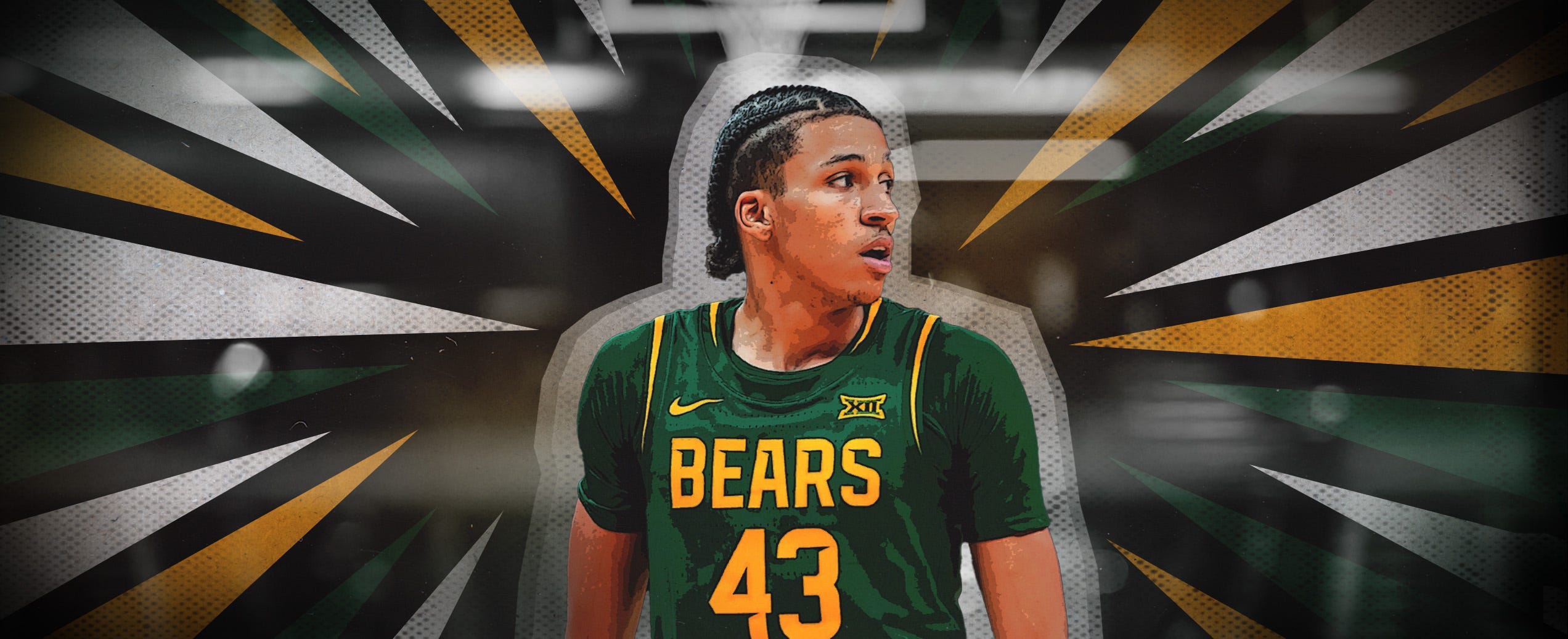
Deciphering who and what is real is a vital skill in life and player evaluation. In the case of breakout prospect seasons, it’s easy to get fooled by production that won’t translate to the NBA. In the case of Baylor’s Cameron Carr, there is nothing artificial about his breakout and NBA translation.
Listed at 6’5” and 190 pounds, Carr is a former four-star prospect out of Minnesota with an NBA bloodline. His father, Chris, played collegiate basketball at Southern Illinois, where he was the 1994-1995 Missouri Valley Conference (MVC) Player of the Year and MVC Tournament MVP. He would spend six seasons in the NBA, and for those crazed Kobe Bryant fanatics like myself, you might recognize Chris Carr as the runner-up to Kobe in the 1997 NBA Slam Dunk Contest. As discussed later, it’s safe to say that Chris’s athleticism translated to Cameron.
Cameron won on the grassroots level at both the famed MoKan Elite and Link Academy programs (Missouri). He took home the 2022 Nike EYBL Peach Jam championship with MoKan and the 2023 GEICO Nationals with Link after bouncing back from a knee injury that kept him out of his junior season.
After spending roughly one and a half seasons at Tennessee in a tenure marred by inconsistent playing time and injury (left thumb), Carr found his footing in Waco, Texas, as a member of the Baylor Golden Bears. His breakout started to percolate this past summer, when Baylor represented Team USA in the Rhine-Ruhr FISU World University Games. Carr helped lead Baylor to a silver medal finish with 18.2 PPG, including 26 points in the gold medal game.
Carr’s ascension is now in full effect with averages of 19.6 PPG, 5.4 RPG, 2.6 APG, and 2.3 stocks on 52/40/77 shooting splits this season. What was once a theory is now a reality, with the question now being what’s fueling Carr’s breakout, NBA translation, and ascending draft stock?
Off-ball Prowess
Driven by his three-point marksmanship (40% on 5.2 3PA), Cameron Carr’s ability to operate off the ball offers real scheme versatility to play alongside any player. He’s equipped with silky smooth mechanics, extended range, consistent lift on his jumper, and what feels like unlimited confidence. Carr is the versatile shooting threat that opposing teams must defend, as both a standstill and movement shooter. Digging deeper into his numbers via Synergy, this season he’s shooting:
43.9% on spot-up threes (41 3PA)
43.3% on catch-and-shoot threes (67 3PA)
44.7% on guarded catch-and-shoot threes (47 3PA)
40.0% on unguarded catch-and-shoot threes (20 3PA)
He still needs to prove himself as a high-end three-point shooter. This is Carr’s only collegiate season with a significant sample, but I’m trusting the numbers, shooting priors, mechanics, touch, and confidence.
Carr’s lethal shooting creates opportunities to attack closeouts and cuts to the rim, where his dazzling blend of explosiveness, vertical pop, wiry strength, and fearlessness shines. We’re talking about a prospect with NBA dunk contest athleticism. He literally has it in his blood. In the halfcourt, he’s converting 69.4% of his rim attempts, including 24 dunks.
His off-ball movement as a shooter naturally transitions into his cutting. Carr has a feel for timely cuts and an understanding of how to set up and use off-ball screens to create at-the-rim opportunities. His athleticism and fearlessness with a head of steam in space make him a real playmaking weapon for NBA teams.
On-ball Upside
Carr’s on-ball upside is tied to his ball-handling development and pull-up shooting. His handle is a bit loose at times, which prevents him from getting to his spots on the floor effectively, especially at the rim and in his pull-up game.
If the handle doesn’t take a step forward in becoming both more secure and dynamic to create space/separation, the pull-up becomes even more vital. In very small sample sizes, Carr is knocking down 50% of his pick-and-roll threes as the ball-handler on 16 attempts and 35.3% of his off-the-dribble jumper twos in the halfcourt (17 FGA). When Carr shows those captivating moments of self-creation, it’s easy to imagine the possibilities. These flashes are reflected in his NBA-level physical tools, tricky handle, burst, and multi-level shotmaking.
Although Carr doesn’t project to be a primary handler and playmaker, there are real passing flashes that should have evaluators intrigued in a secondary creator role. The clip below of Carr against TCU is one of the key reads and deliveries that convinced me there is more to mind as a passer/playmaker. Carr rejects the screen and attacks the baseline to draw multiple defenders (at one point, has the eyes and attention of every TCU player on the floor), then whips a one-handed skip pass for an Isaiah Williams IV three.
At the very least, Carr projects to be a valuable connective passer. He understands skip, swing, and hit-ahead passes, which help keep the offense flowing.
Defensive Value
Carr is excellent at leveraging his phenomenal physical tools and activity to excel as a disruptor and defensive playmaker, evidenced by the previously mentioned 2.3 stocks a match. It’s an incredible defensive toolkit featuring explosive athleticism, anticipation, good timing, and recoverability. The cherry on top is the reported 7’1” wingspan via Tennessee’s roster page during his sophomore season.
The rangy wing is active in passing lanes for steals and deflections, along with being a shot-blocking threat on the weakside, closeouts, and on-ball. There is some upside as a point-of-attack defender, and I’m hoping it's explored a bit more at the NBA level.
Watching him effortlessly glide around the court to quickly cover ground and make plays on multiple defensive levels can be a real treat. The possession below against Houston encapsulates much of Carr’s defensive appeal and tools. He fights through the Zoom action (popular NBA action) screen set by Cenac Jr. to get back into the play, then aids the helper (Nnaji) for a perfectly timed block on Tugler at the rim.
Right now, strength is a legitimate concern on the NBA level for the 190-pound Carr. There will be some challenges holding his line as opposing players will target his chest. However, I still ultimately believe that his frame is projectable (broad shoulders, long arms, and already some mature muscle in the upper body) and will eventually add adequate strength to it. Additionally, I trust Carr’s defensive playmaking and activity to compensate for whatever he might ideally lack as an on-ball defender.
Rebounding has been a pleasantly surprising and valuable ancillary skill for him. Nearly all his rebounds end possessions, with 4.7 of his 5.4 rebounds per game coming on the defensive end. He’s able to point balls with his signature vertical pop and length while also chasing them down in and out of his area.
Carr’s rebounding allows him to initiate grab-and-go opportunities where he thrives in the open floor both as a scorer and playmaker. His rebounding on nights when the jumper isn’t falling is worth monitoring because not only does it help him add additional value, but it can also be an activation link to the rest of his game.
NBA/Prospect Comp Blend
Think a blend of Terrence Ross and a more athletic Jordan Hawkins. Both Ross and Hawkins were versatile shooting wings/guards and dangerous off-ball threats, with concerns about their strength. Ross probably had more on-ball scoring juice than Carr does. Ross spent 11 years in the NBA after being drafted by the Toronto Raptors with the eighth overall pick in the 2012 draft. Hawkins is in his third year in the NBA after being selected by the New Orleans Pelicans with the fourteenth pick in the 2023 draft.
Closing Thoughts
Cam Carr is an electric shooter and playfinisher with NBA bloodlines whose potent NBA positional tools and defensive playmaking will allow him to impact games in a 3-and-D role while the rest of his intriguing game develops. He’s no doubt a first-round prospect and a top 20 lock for me that I could easily have in the lottery by the end of the draft cycle. I’m expecting Carr to be a show stealer in the pre-draft process and prove that his collegiate breakout and NBA translation are real and they’re spectacular.
Love the analysis, Jamaill! Just stumbled upon you about an hour ago and am impressed with your scouting (and writing!) skills. I'm currently writing my next blog article about the 2026 draft (scouting my preferred prospects) and would like to ask you if I'm able to reference some of your stats/numbers in my work? .. I'd tag you in the post, and if it means anything I average 1.8 views per article lol so don't worry about me swooping your fan base away😂 .. Either way I wish you continued success in your journey!
As a long time Raptors fan I am not excited about Carr if he is “like” Terrence Ross and Jordan Hawkins.
Ross was a permanent disappointment to the Raptors, who never seemed to understand where to be on the court coupled with shooting that needed so much support to have an open shot that he took away from the rest of the team.
Jordan Hawkins can’t seem to surpass Gradey Dick, taken by the Raptors two spots ahead of Hawkins. Only now, after 3 years, does Gradey have the muscle to play in the No Boys Allowed league (and you’ve highlighted Carr’s slight frame).
Now if you had suggested that Carr is a longer, more athletic, better shooting version of JaKobe Walter, I’d be interested. But you didn’t, even though JaKobe came from Carr’s team, Baylor.
To be fair, I am not an expert and I have not watched Carr assiduosly, so maybe you can just disregard these comments.