


A lot of different roles are valued in the NBA. The 3-and-D archetype is arguably the most plug-and-play, as they can defend up and down the lineup due to their size and length while spacing the floor for pick-and-roll or isolation offense. Efficient big man play may be the most in vogue it has been since the early aughts—with NBA teams opting to go for the double big lineup (shoutout Houston, Cleveland, etc.). Guards who handle pressure and defend full court give teams schematic wrinkles. We saw the Oklahoma City Thunder build an NBA Championship team utilizing this type of guard against the Indiana Pacers—a team that also had guards who fit this archetype.
Players like these will almost always be in high demand; most of the scouting community understands this. Where we can sometimes fall short of our understanding is remembering why these player types are valuable. They provide floor spacing. They provide lob threats. They take on the toughest assignments. They rebound. They screen. They introduce variables into screen coverage and decisions for defensive rotations. They make life easier.
But, for whom?
The Star Player—the hardest archetype to find.
Star players are the sun and the moon for their team. They are the players that defenses have to scheme around—resulting in defenses cheating up, allowing cutters and lob threats to have a credible runway. Their pressure forces rotations and help—providing passing lanes for open kickouts. The push-pull these players apply to defenses is rare, which is why teams are willing to “swing” on players who fit this mold as opposed to taking more “safe” bets within a draft class.
This is why AJ Dybantsa has been seriously considered as the #1 player within the 2026 NBA Draft Class, despite having some areas of concern.
It’s hard to find a player of AJ’s dimensions (listed at 6’9” on BYU’s school site, and 210 pounds on Sports Reference) who can handle the ball, get to his spots, and hit difficult shots on volume. Adding real facilitation on volume—as well as some flashes of defensive brilliance—it becomes even more difficult to rule him out as a credible option in being the top pick.
The Crunch
We may spend a little bit of time in this section for AJ. There is some interesting polarization for Dybantsa when it comes to his analytical profile. In terms of being an outlier, AJ is special in a real way. He is the only freshman in the BartTorvik database (dates back to 2008) who has ever done the following:

Usage: At least 30
Assist Percentage: At least 20
Free Throw Rate: At least 50
Two Point Percentage: At least 50
Three-Point Percentage: At least 35
That’s not a very extensive list of filters for Dybantsa. This query shows his efficiency on high usage, his on-ball gravity and rim pressure, and his playmaking volume.
High usage without efficiency is common. Efficiency without usage is common. Both together—especially at this scale—is rare.
The next thing I want to do is to compare some of the top players within the NBA who compare physically and stylistically in some ways to AJ Dybantsa. It should go without saying—but it’ll be said anyway—these players are not one-for-one comparisons. They are players with whom AJ has some similarities. Additionally, these names were selected based on The Ringer’s NBA Top 100.
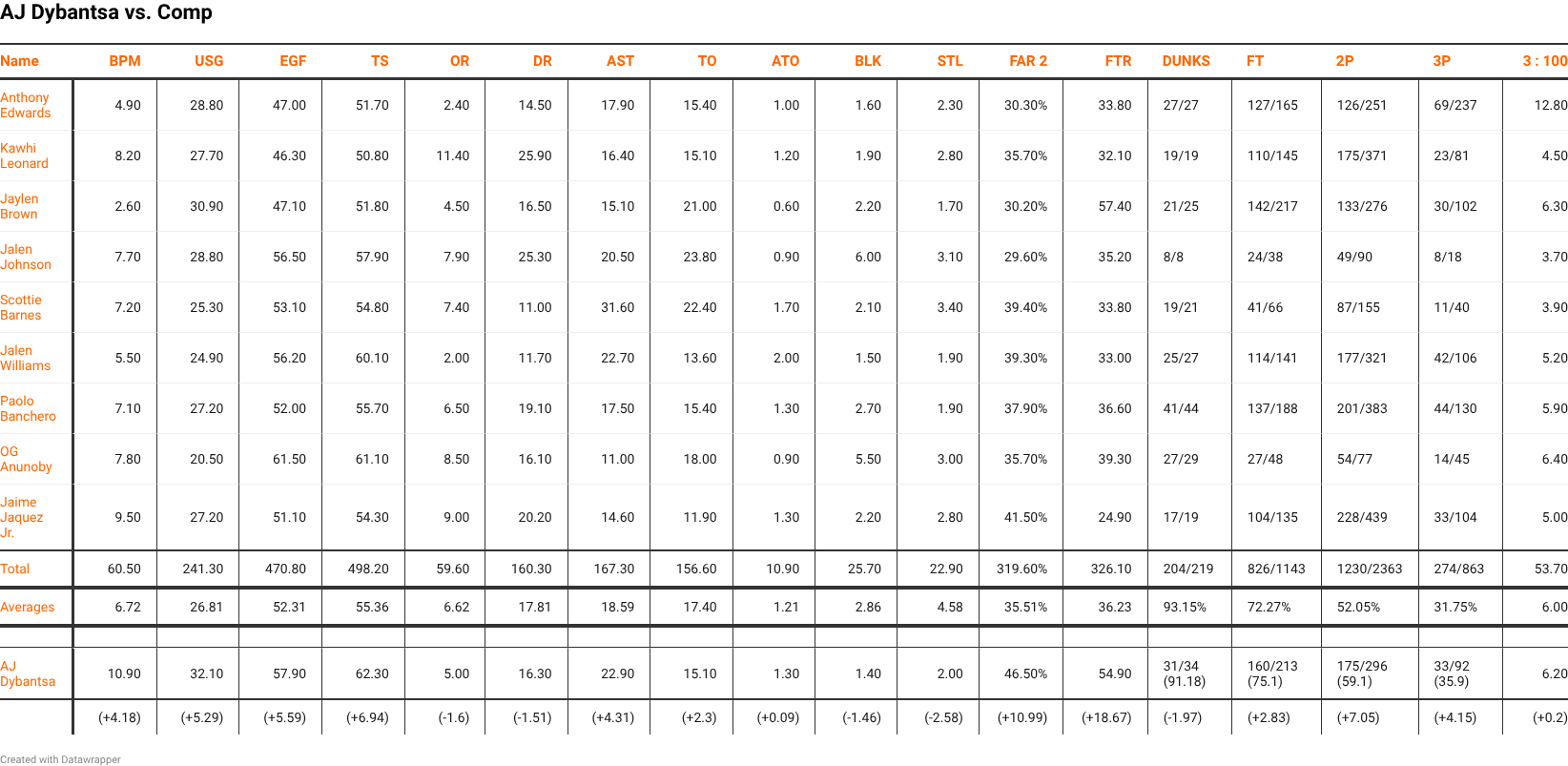
The differentials listed below represent AJ’s draft-season metrics relative to the average draft-season production of this comparison group:
BPM (+4.18)
Usage: (+5.29)
Effective Field Goal Percentage: (+5.59)
True Shooting Percentage: (+6.94)
Assist Percentage: (+4.31)
Turnover Percentage: (+2.3)
Assist-to-Turnover Ratio: (+0.09)
Far Two-Pointer Percentage: (+10.99)
Free Throw Rate: (+18.67)
Free Throw Percentage: (+2.83)
Two Point Percentage: (+7.05)
Three Point Percentage: (+4.15)
3s per 100 possessions: (+0.2)
Based on how AJ compares to like players, it would be safe to say that Dybantsa is very advanced offensively. However, he does draw a lot of concerns defensively. In fact, the numbers do show that Dybantsa is below average when assessing both Steal and Block Percentages. But, how far behind is he?
He is in last place in terms of Block Percentage, so out of the numbers and names listed above, teams likely won’t be drafting AJ for his weakside rim protection or chasedown blocks. Something worth noting regarding AJ’s steal percentage is that he has produced at a higher level than some prominent NBA defenders. In fact, his current metrics rank higher than:
Jaylen Brown
Jalen Williams
Paolo Banchero
It’s also worth noting that Jalen Williams—who was about 21 years old when he was drafted—is only slightly higher in Block Percentage. Perhaps it’s not crazy to project AJ on par with J-Dub’s developmental curve or those of other players, due to the fact that Dybantsa is a true freshman? It’s certainly something to consider.
Other things that are some fun takeaways from the table:
AJ’s BPM is far and away the highest among the listed players
AJ also has the highest usage
AJ has the highest Far Two-Pointer Percentage
AJ’s Assist Percentage trails only Scottie Barnes
AJ already has the second-most dunks on the list
AJ is tied for 3rd in ATO
AJ’s 3s per 100 Possessions only trail Anthony Edwards, OG Anunoby, and Jaylen Brown
The Dive
What makes a star player a “Star Player” is their effectiveness when operating with the ball in their hands. As we know, this is mostly exemplified by that player’s ability to operate the pick-and-roll. This just so happens to be Dybantsa’s most used play type—with about 24% of his total possessions coming from those sets.
Pick-and-Roll Scoring
Pick-and-Roll Screen Usage
AJ has done a remarkable job of getting to the basket with consistency. He has been able to get to the rim to the tune of being ranked in the 52nd percentile in frequency. When running pick-and-roll sets, he has converted over 56% of his two-pointers. This clip does a great job of showing why.
AJ (#3 in blue) is going to start this clip by bringing the ball across halfcourt, and setting up toward the top of the key. He is going to be defended by Tounde Yessoufou (#24 in yellow)—one of the top freshmen within the 2026 NBA Draft Class. AJ is going to wait for his teammate, Abdulla Ahmed (#34 in blue), to come and set a screen to his left. At the last moment, Ahmed ends up setting a screen off to AJ’s right. AJ is able to explode off the bounce, sending Tounde directly into the screen. Dybantsa is able to shoot the gap between additional help defenders and put up a high layup off the glass and into the cup.
Pick-and-Roll Screen Usage + Contact
Sticking to this Baylor matchup, we have another chance to see how Dybantsa is able to attack the defense out of a PnR set. This time, we see things get a little more interesting for him.
Here, we see AJ come off the left wing and get a pass from Khadim Mboup (#7 in blue). Mboup gets the ball to Dybantsa and sets a little ghost screen. AJ is able to see a very slight gap within the defense, and he attacks. The stride and flexibility are on full display on this possession, as he is able to collect the ball and swing the ball through the crease in the defense. Dybantsa is able to extend and glide past the defense, but he gets a little bit of a hack on his shooting arm. The strength of AJ is able to allow him to finish through the contact for an And-One opportunity.
These are star plays. The handle, acceleration, flexibility, athleticism, and strength all coalesce into a three-point opportunity.
In-Between Game
Something else star players have to have is some sort of in-between game. Defenses simply must pay if they are giving these players any sort of daylight. We will take a look at how Arizona is picking their battles in terms of the sort of shot they’re willing to give Dybantsa.
We’ll see AJ start this clip on the left side of the floor, with a screen being set toward his right. AJ is going to be defended by Koa Peat (#10 in blue)—yet another highly touted Freshman in the 2026 NBA Draft Class. Dybantsa runs Peat into a screen set by Keba Keita (#13 in white). Arizona opts to defend this screen with Montiejus Krivas (#13 in blue) slinking back into drop coverage. With the amount of space created by both the screen and coverage, Dybantsa is able to confidently step into a pull-up middy, which he cashes in.
You can see in moments like this exactly why AJ has the sort of two-point percentage he has—particularly on the pullup, where he has converted on almost 46% of his dribble jumper two-pointers.
Off-the-Bounce Threes
One of the more dissected aspects of AJ’s game is his shooting. This becomes difficult to support if you look at his numbers next to the draft-season numbers for NBA players that were posted earlier. AJ is advanced in terms of both volume and efficiency on his three-ball compared to Kawhi, J-Dub, Jalen Johnson, Jaylen Brown, Paolo, Scottie Barnes, etc.
In this play against UConn, we’ll see how Dybantsa is capable of weaponizing his pull-up jumper—even from deep. AJ is going to quickly get a handoff from Rob Wright III on the left wing to start this clip. He is going to take his man—Silas Demary (#2 in white)—into a screen set by Mboup. AJ can see that Silas is coming back to contest a potential shot while Tarris Reed Jr. (#5 in white) is in drop.
Demary hustles to get back into the play, but AJ goes into a pull-up three after crossing to his left. AJ is able to get his feet underneath him and rise up with a hand in his face and drain the three-pointer. Something to note about AJ shooting out of pick-and-roll looks is that he is hitting nearly 36% of his threes as the pick-and-roll ball-handler.
Playmaking
Pressure + Strength
It’s interesting that—for some of the conversations that surround AJ—a healthy sliver of that discourse pie is regarding his playmaking. We touched on the metrics earlier, but when it comes to his passing metrics compared to like players, Dybantsa is pretty advanced. We’ll look at some examples here.
Per Synergy, AJ drives on 24.0% of his total possessions. Comparing this to other top players within the 2026 NBA Draft Class, he ranks second—only behind Kingston Flemings:
Kingston Flemings- 29.4%
Darius Acuff Jr.- 20.2%
Keaton Wagler- 17.9%
Caleb Wilson- 16.1%
Mikel Brown Jr.- 15.1%
Cam Boozer- 14.8%
Darryn Peterson- 9.3%
We can see in the clip above how AJ can leverage his driving ability and success around the basket to create passing lanes for his teammates. This clip begins with AJ bringing the ball up in a semi-transition situation. As he crosses halfcourt, AJ drives from the right side of the court and continues left.
A few things really stand out once Dybantsa opts to commit to driving. AJ is defended by Bangot Dak (#8 in black) on this drive. It’s subtle if you’re not looking for it, but AJ is able to create a good amount of separation by use of his right shoulder. This is a must for players who are going to run the lion’s share of an offense: creating separation. Once Dybantsa picks up his dribble and pivots, notice how the entire Buffalo defense is surrounding AJ and Keita. There are three credible passing outlets for Dybantsa here. AJ kicks the ball out to Rob Wright at the top of the key for three easy points.
This entire play is contingent upon AJ’s handle, strength, and vision.
Drive and Kick
We’ll take another look at the driving and kicking from AJ again here, but this time we’ll see how he does without any sort of transition advantage.
Dybantsa starts this play off with the ball just left of the top of the key, defended by Tounde. AJ calls out for Keita to set a screen for him, which he patiently waits for. Dybantsa attacks the defense wide and to the right—going right at Caden Powell (#44 in yellow).
AJ is very sudden whenever he chooses to accelerate to the basket, and we see that once he identifies the “mismatch” (I say mismatch because Powell is listed as taller than AJ at a similarly listed weight). Something that stands out with this drive by AJ is that he goes into a shooting motion that closely mimics a shot he would actually take. He goes into a scoring motion which forces Powell into a contest, but it also pulls in Isaac Williams (#10 in yellow)—who makes an attempted dig on the ball. All of this clears out a clear passing lane for Rob Wright, who is open in the same-side corner. AJ is able to see his open teammate for an open three.
Dybantsa likely intended to score on this possession, but his downhill pressure creates the runway to make impressive plays like this.
Patience + Strength
In this Houston game, we can see how AJ can make different reads out of his drives.
He is picked up by Isaiah Harwell (#1 in black). Harwell is listed at 6’6” and 220 pounds—a little shorter, but comparable in terms of strength and mass. Dybantsa drives to his right and draws the attention of JoJo Tugler (#11 in black) and Milos Uzan (#7 in black). AJ does an incredible job here of handling three players attempting to wall him off around the right block. Instead of picking up his dribble immediately, AJ is able to take an additional dribble into the defense.
This additional dribble forces all three defenders to truly commit to him, as they are all aware of his scoring prowess. It’s one thing to attract all of this attention, but what does a player do next in this situation? The baseline pass is in a blockade. There is no same-side corner kickout. This has all of the makings of a turnover.
Dybantsa does something that very few players on Earth can even dream of doing. AJ throws up a pump fake, which causes Uzan—the defender furthest baseline to bite. This slight opening creates a tight window for AJ to throw a wrap pass to Ahmed in the paint for a can’t-miss dunk.
This sort of play isn’t a “gimmie”, nor is it something that anyone else at the top of this class can do.
Live Dribble Facilitation
There is a contingent of people who will point out that Dybantsa makes reads a beat late, or it takes him a while to see the open man. Those plays do exist within his film, but AJ is very capable of making heads-up, live-dribble plays. We’ll take a look at one here against a good Miami team.
This clip starts off with AJ getting the ball on the left wing. He waits for Keita to set a screen to his right, and then goes into another drive. Again, we can see how defenses are forced to defend Dybantsa: three defenders meet him at the right elbow, and the baseline help is acting as a Free Safety. By keeping his head up on this drive, Dybantsa is able to see how the defense collapses because of him, and he kicks the ball out to Rob Wright in the same-side corner.
Ancillary Offense
Transition Threes
One of the biggest narratives out there regarding AJ Dybantsa is that his offense can only slow down the natural flow of the game. There may be some metrics or lineup data that would, perhaps, give footing to this notion, but the tape does offer some evidence that Dybantsa will be better playing off of others than consensus has led us to believe.
In this clip against Houston, we’ll get the chance to see how AJ can get into his shot quickly. Wright III gets the rebound to start this clip and zips the pass cross-court to Dybantsa on the right wing. AJ’s shot prep allows him to confidently step into a three-point shot while being left open. AJ rises up and knocks the three down.
At this point of the season, Dybantsa is shooting over 36% on his transition threes.
Kickout Catch-and-Shoots
This clip shows how AJ is going to be able to play off of big men who can create mismatches around the rim, or those who are able to create second-chance looks.
We’ll start this off with Keba Keita getting an offensive rebound on the right block. AJ is on the left block—the same side as Keita. The strength advantage Keba has on this play is apparent, and it puts AJ’s defender, Jake Wahlin (#10 in orange), in a precarious spot. Does he help on the block, or does he position himself to guard AJ?
Keita does an awesome job of pivoting toward the basket, which forces Wahlin to provide additional support from his deny stance. AJ sees this and works his way to the deep corner. Keita continues to rotate to face out to the perimeter. By this point, Dybantsa has presented himself as an open kickout outlet for his teammate—who is getting pressured in the post.
A bounce pass is dimed out to AJ, who steps into the corner and quickly launches a three-pointer. No stop-and-survey here. No record scratching—just a clean catch-and-shoot look that finds the bottom of the bucket.
Off-Ball Action Three
AJ actually grades out well as a catch-and-shoot option away from the ball. In fact, he shoots 35.6% from deep on such looks—grading out in the 64th percentile. We’ve seen some simple kickout and transition threes, but can Dybantsa actually be used in motion?
We haven’t seen much of this, to be honest, but it’s more comforting to know that AJ can just waltz into looks like these and do well. Rob Wright is going to start with the ball at the top of the key. To his right, you can see that BYU is looking to work some sort of screen action. AJ is going to be on the right side of a down screen set for him, which he uses. AJ curls off the down screen, goes into a ghost screen, then flares out to the left wing.
Wright is able to hit AJ in motion. While gathering the ball, Dybantsa’s shot prep kicks in. Notice how organized his feet are while bringing in the ball with his right hand. AJ is able to gather, turn while squaring up, and go right into his jump shot.
AJ is shooting almost 37% on his catch-and-shoot three-pointers.
Defense
This is probably the area in which AJ gets picked apart the most—mainly due to a lack of Stock (Steals + Blocks) generation. In comparison to the eight prospects within the 2026 NBA Draft class, AJ is fourth in Stocks (41). He trails:
Caleb Wilson (67)
Cam Boozer (59)
Kingston Flemings (53)
He has a substantial hold on the fourth-place position, as the next-closest player is Keaton Wagler with 28 Stocks.
Playing Passing Lanes
Tools matter when projecting players into the NBA. Listed at 6’9”, Dybantsa appears to have a quality wingspan for his frame as well. In plays like this one against Baylor, we can see how these tools can be effective in a team-defensive construct.
Isaac Williams is going to begin with the ball and bring out Mboup after a quick screen action. Williams looks to the post for the size mismatch in the paint, but opts to try to take Mboup off the bounce. After a couple of counter dribbles and drives by Isaac, Rob Wright abandons the post defense to pressure the ball.
Once Williams dribbles back toward the corner, Wright rotates back to his man, but AJ’s man lurks closer to the basket. Williams picks up his dribble, which prompts Mboup to use his length to remove space between himself and the ball. Williams tries to pass the ball to Powell along the baseline, but Dybantsa picks off the pass.
The length and recognition from AJ are on point on this possession, as he is sort of roaming back and forth between a couple of Bears. His timing on jumping the pass is perfect, resulting in a steal.
Guarding Guards
Forgive me for not quantifying this anecdote, but, in watching AJ’s defensive tape, it appears that AJ is more comfortable defending down the lineup. Now, that may come across as a negative to some fans and evaluators, but there is a ton of value in a 6’9” ball handler who can defend some of the smaller, quicker players on the opposing team.
We’ll see about as good of an example of someone doing just that as there is on this clip. Houston’s Kingston Flemings (#4 in black) is widely regarded by many as the best Point Guard prospect within the 2026 NBA Draft Class. Dybantsa is going to pick up Kingston on the right wing. AJ’s length is very apparent going against his man, as he is able to slide with Flemings while also making a play at the ball.
While AJ wasn’t able to make a play on the ball, he maintained his position. Kingston feels as if he has the space he needs to get the shot off—now that AJ is trying to swipe the ball from him. Kingston rises into that all-too-comfortable midrange shot and tries to go over the top of AJ. AJ is able to still rise and contest against Flemings on the shot, and he is able to get a piece of the ball.
For AJ, he isn’t putting up a strong defensive profile on paper. What is working for him are his tools, the overall awareness of where actions are leading, and the fact that he is able to defend down the lineup. At his size, being able to handle shiftier guards like Flemings can allow his team to play larger, more smothering lineups.
Curtains
In a class such as this one, there are a lot of players who can serve as legitimate distractions. With names like Kingston Flemings, Keaton Wagler, Mikel Brown Jr., and Darius Acuff Jr. all producing at credible levels, a sort of mirage can take place and make tier breaks a bit more ambiguous. If Caleb Wilson has played well enough to work his way into the top tier of this class, who is to say that either of those aforementioned four players cannot do the same?
These are questions that should be asked. For the teams that are picking within the Top 4 of the 2026 NBA Draft, though, the questions that they should be focusing on are:
Do we need a star player?
If so, how many of these players truly offer up that level of upside?
There are several ways to attack those questions. For my money, there are really only two players that offer a clear path to be a #1 option. One is Darryn Peterson, who has faced injury and camp questions lately, on top of role and shot balance concerns.
The other is AJ. He has been remarkably efficient from all four levels of the court, as well as being one of the better passing prospects—especially at his size. The areas of his game—defense, rebounding, and ancillary scoring—that many have dissected all have low-hanging fruit for him to be able to improve.
AJ’s production at this level and at his size makes him a unique prospect within the 2026 NBA Draft Class—solidifying his projection as a #1 option in the NBA.
Follow me on Twitter: StephenGHoops
Catch me on BlueSky: StephenGHoops
Catch the Draft Sickos show LIVE on the No Ceilings NBA channel:
He loves the fakes, pivots, and the gather over in the mid post to the middle. He does that thing a lot where he takes a dribble and covers extra ground for a mid range by walking in sync with his dribble
It's an interesting situation where we have a guy with as much hype as AJ does yet he isn't the runaway top guy (vice versa for DP). I think the narrative would be a lot different if there was only 1 of these guys (Boozer included too). We're going a lot of comparing and who's better than solely focusing on one guy.