


The 2026 NBA Draft class has been full of surprises. The depth of the guards in this class has been discussed a ton up to this point. The quality and production of the Freshmen within this class has been impressive—even outside of the “this year guy” category. Some things have been surprising in a completely opposite direction. For example, the crop of big men hasn’t been what we’ve been used to seeing over the past few classes. And, where are the international breakouts?
There are, of course, individual prospects who have taken this cycle by storm. Last week, I wrote about Keaton Wagler and how he has gone from an unknown to an undeniable prospect. Tyler Tanner has created quite a stir within the scouting community with the crazy production he has put up at his size. Morez Johnson Jr. has been generating some buzz as a potential first round talent—proving to be immensely valuable to a team that could win a National Championship. Even Cameron Carr has shown why he was a highly ranked prospect prior to playing for Tennessee, now that he has found a new home in Baylor.
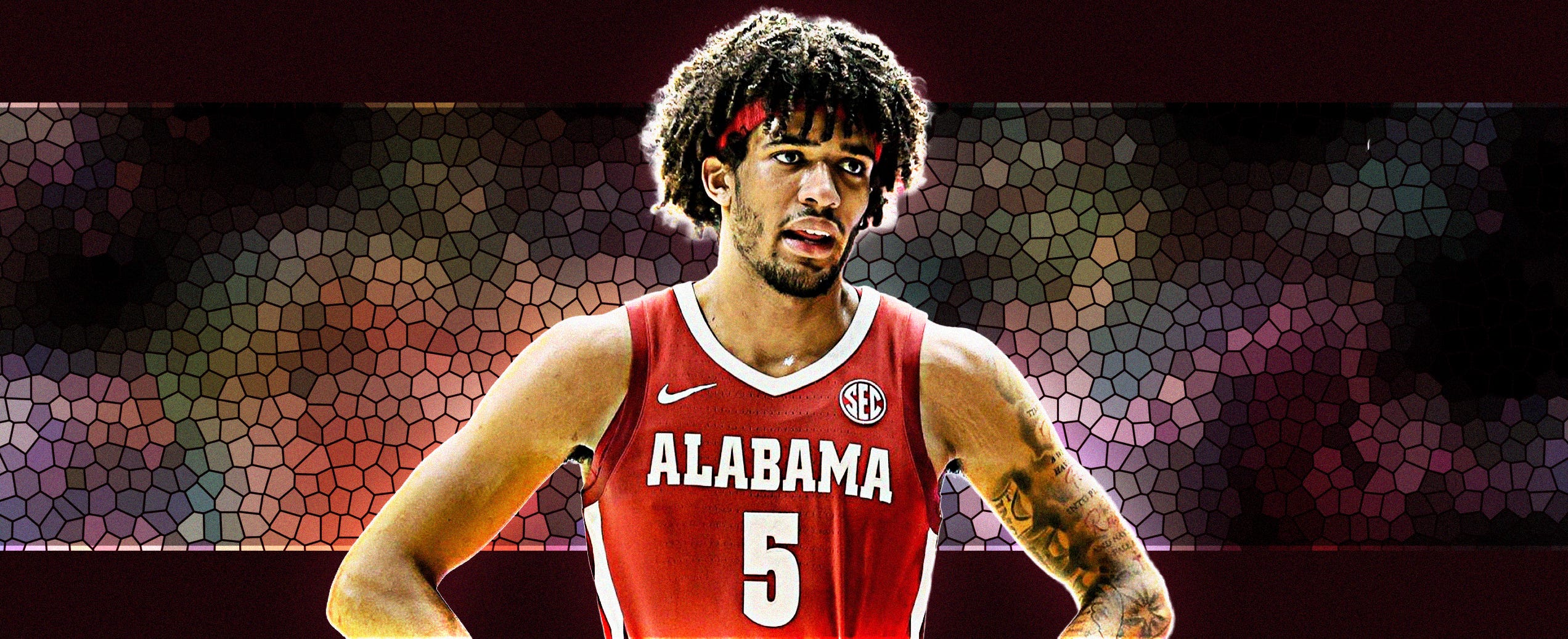
Today, we’re going to take a dedicated look at a freshman who offers a ton of versatility, feel, strength, and length while being listed at 6’8”: Amari Allen.
The Background
Amari Allen is the most recent in an illustrious line of Gatorade Players of the Year for the state of Wisconsin. In his senior year playing for Ashwaubenon, Allen averaged 34.1 PPG, 11.5 RPG, and 8.5 APG. Despite the recent lineage turning out three NBA players, and two notable college prospects (Milan Momcilovic and Seth Trimble, Amari was ranked as the 69th prospect in his class, per the RSCI rankings. He was still able to attract the attention of some prominent schools, such as his home state school of Wisconsin, Ohio State, Missouri, and Cincinnati.
Amari chose to play for Alabama “because of the strong basketball culture and the opportunity to grow under Coach [Nate] Oats”. Alabama does run an NBA-friendly system that has led to players getting significant looks from NBA teams.
The Crunch
Allen has some very fun and good film on the season, and we’ll get to that in just a second, but his statistical profile has been fun to monitor.
Amari Allen is one of only 55 players in the BartTorvik database who have recorded the following metrics:
Query One
Defensive Rebounding Percentage- At least 17
Assist Percentage- At least 17
Free Throw Rate- At least 45
Three Point Percentage- At least 37
The list of players within the “BT” database consists of a variety of players, such as George Hill, Kyle Anderson, DaRon Holmes II, Evan Turner, and Royce O’Neale—among others.
In running another query, Allen is one of only 41 players who have done the following at a maximum height of 81 inches:
Query Two
Offensive Rebounding Percentage- At least 7
Defensive Rebounding Percentage- At least 17
Block Percentage- At least 2.7
Steal Percentage- At least 1.7
Three Point Percentage- At least 35
Three Pointers Attempted Per 100 Possessions- At least 6
The players that show up in this query include Draymond Green, Keegan Murray, Robert Covington, Jae Crowder, Rasheer Fleming, Chuma Okeke, and Chris Singleton.
These reflect the sort of versatility that Amari offers a team. The one area worth noting is that Allen ranks in the bottom four in the first query, and in the bottom 11 in the second query.
Amari’s usage is at 18.9. Here’s something to consider regarding the draft’s history in terms of usage percentage:
There are 770 players who have been drafted in the first round in BT’s database
Allen’s 18.9 USG% would put him above only 113 prospects who have been taken in the first round
This would put Amari approximately in the 15th percentile among all first round draft picks in NBA history, should he declare and stay in the 2026 NBA Draft
There is good news in terms of being a player who would fall this low in Usage Percentage. Anthony Davis, Devin Vassell, Walker Kessler, and Reed Sheppard are among those who were drafted who had the same Usage Percentage or lower when they came to the NBA. So, it wouldn’t be impossible for Amari to come out and be a successful player.
The Dive
To this point of the season, Amari grades out in the 68th percentile on all scoring possessions—averaging 1.005 PPP (Points Per Possession). What’s interesting about his offensive splits is that he is more comfortable scoring in the halfcourt (79th percentile scoring in the halfcourt), as opposed to transition (22nd percentile). At Allen’s size, he is able to provide a lot of versatility within the flow of the offense, as he offers the makings of a true dribble-pass-shoot player at the next level.
Offense
Running Sets
Amari Allen has done a very good job of being able to initiate offense for Alabama throughout the season. This clip shows Amari (#5 in red) getting the ball on the right side of the court, and looking to run the two-man game with Aiden Sherrell (#22 in red). This play stands out because Allen is showing the ability to pursue the pick-and-roll even if his first drive attempt isn’t there.
Amari looks to drive left, but that angle is shut on him. Instead of moving off the play, he backs out and looks to attack left. He is able to drive to his left, but is met by the big man. Allen is able to attract the two defenders and place a pretty bounce pass to a rolling Sherrell. Amari’s Assist Percentage of 18.2 isn’t setting the world on fire, but he does have a strong Assist-to-Turnover ratio of 2.4.
Second Side Attacking
Allen has shown a solid foundation as a playmaker of sorts to this point, but some may be dubious of his projection to be a primary playmaker. After all, he isn’t even the primary guy on his own team. Even if there is reason to think he couldn’t be the lead facilitator, Amari is capable of attacking defenses that are out of position on the second side.
This clip is going to start with Allen getting a handoff from Sherrell on the right wing. Amari squares up and attacks to his left, drawing in more defenders. As Amari is driving left, Aden Holloway slides down the left wing to the corner. Allen does a great job of keeping his head up and his dribble alive to find Holloway open for a three.
Spatial Awareness
Amari’s plus feel allows him to be a passing threat from seemingly anywhere on the floor. Synergy grades him out in the 99th percentile in all isolation plays, including passes. In fact, he ranks in the 91st percentile in all offensive possessions that include assists. On plays like the one posted above, you can envision how well Amari could project as a passer in short roll scenarios.
This clip starts with Holloway kicking the ball to Noah Williamson (#15 in red) on the right wing. Allen is at the top of the key, but then he flashes down along the right elbow and on his way to the basket. Williamson dishes out a well-timed bounce pass that finds our guy in stride. Amari is able to collect his gather and get into a scoring motion, which forces the low man to slide over and contest.
It’s plays like this where Amari Allen enthusiasts will fall out of their chairs about his upside. And rightfully so.
Allen knows exactly where his teammate is on this play—and this is something that we routinely see with him: He knows where his guys are almost always. London Jemison (#6 in red on the opposite wing) is parked in the weakside corner as Amari drives to the rim. There is no reason why he would move based on what Allen is doing—and Allen knows this.
Allen’s propensity to keep his head up is such a subtle (but important) aspect of his game. This—along with his ability to constantly know where his guys are—allows him to throw this baseline whip pass to Jemison, who is able to drive and score on a layup.
Pass Placement
There are plenty of plays like the one above where Amari Allen passes to where is teammate is going to be, as opposed to where they are.
This play is quick, but looks like these are spammed by ‘Bama regularly. Houston Mallette (#95 in white) runs and goes into a ghost screen/shallow cut, to which Allen attacks to his right. To Allen’s weak side, Sherrell is setting a screen on Mallette’s man. Allen then crosses to his left and sees the separation that the Sherrell screen has created for Mallette.
Amari doesn’t pass to Mallette—who is open—but he passes to the opposite wing, where Mallette is going to be. Mallette runs underneath the pass, gathers into his shot, and hits the three that Allen was able to set up with awesome pass placement.
Shooting
There are many reasons why many are high on Amari Allen’s pro projection, but the shooting has to be one of the “tent pole” reasons for that. At face value, there is reason to be confident in the shooting translation for Allen. He is shooting nearly 37% from deep on his threes. That is coming on moderate volume, with 7.0 three-pointers attempted per 100 possessions.
This clip isn’t an elaborate breakdown, but it does showcase the confidence in his shot, as well as his smooth shooting motion. We see our guy spotting up on the left wing. Once the ball finds his hands, Allen steps into his shot and lets it rip without hesitation. Oddly enough, Allen’s shooting percentage off the catch isn’t a very high percentage. He is, however, pretty efficient off the catch…
Pull-up Jumper
…albeit, on about a third of the volume. You can see here that Amari is able to bring the ball up the length of the court, pass it off to his teammate, get the ball back, and get the ball off quickly. Amari is hitting over 55% of his three pointers off of the dribble, which has helped boost his percentage higher.
Defense
Amari gets a ton of love for what he has done on the offensive end, but there are some fun defensive skills that he has shown off.
Instincts
This clip shows how instinctive Allen can be on the defensive end of the floor. Oklahoma’s Mohamed Wague (#5 in white) gets the ball at the top of the key from his teammate, Nijel Pack (#9). After Wague has the ball, he looks to put the floor to allow the possession to unfold. Amari is a big guy—something that allows him to be projectable as a prospect.
Wague appears to be comfortable putting Amari on his shoulder and dribbling the ball. His hubris ultimately leads to a turnover. Our guy reaches…around Mohmed and pokes the ball out from behind him. This poke-out leads to Amari capturing the rock.
A Helping Hand
In this clip against Texas, the star player for the Longhorns, Dailyn Swain (#3 in orange), gets the ball on the right wing. Now, Amari Allen isn’t the primary defender against Swain; he is on the opposite block. London Jemison is the on-ball defender against Dailyn, but he is screened off of him. Dailyn looks to take advantage of this separation and drive to the paint for a layup.
Little does Swain know that our guy is waiting for him as the low man. As Swain attacks, we see Amari setting up to contest his shot. Swain goes up—thinking he has a clean look at the rim—but our guy sends his shot away.
Recovery
One aspect of Allen’s game that can be called into question is his athleticism. He doesn’t have the jaw-dropping dunk numbers that many associate with being a top-shelf athlete, only having one dunk in the halfcourt, per Synergy. While Amari doesn’t show a ton of run-jump flashes, he isn’t bereft of athleticism.
This clip isn’t anything that requires an in-depth breakdown. Texas’s Tramon Mark (#12 in orange) has the ball and is pushing the break in transition. Mark is a bit of a shifter guard and should be able to finish this play with no problem at all. What happens instead is Amari chasing down Mark and swatting his shot off the backboard.
In terms of defensive metrics, Allen has a Block Percentage of 3.0 and a Steal Percentage of 2.1. Of all players in college basketball who have a Minutes Percentage of at least 65, Amari is one of only 50 players who have a Block Percentage of 3.0 and a Steal Percentage of 2.0. In terms of Freshmen with those same metrics, Allen is one of just five.
Room for Improvement
Despite posting some impressive numbers at his age and size, Amari has some room for improvement (of course, right?). We saw how Allen is able to provide some solid help as a low man. That isn’t to suggest that there is some “Small Ball Five” outcome for Allen—as I think that role in the NBA isn’t as prevalent as some think that it is. While that clip of Allen blocking Dailyn Swain shows such solid help, we do see our guy playing well off of his assignment (sometimes that is required).
This clip shows some of the downsides of Amari helping a little too much. Chendall Weaver (#2 in orange) gets the ball on the left wing. Amari Allen’s assignment, Camden Heide (#5), flashes up to the opposite wing. Weaver drives into the paint, which causes our guy to rotate down toward the block. “Rotate” is being used loosely here.
In all honesty, Allen just sort of turns to look at Weaver in the paint, which puts his back to Heide. Amari is in a bit of a “no man’s land”, defending neither Weaver nor Heide. As Weaver pivots away from the help, he sees that Heide is in position for a kickout, and he isn’t being properly defended.
As Weaver kicks the ball out to Heide, Allen goes for the lazier play. He leaps in the air, hoping to come up with the ball, instead of recovering out to Heide. Heide—a career 43% shooter from deep—gets an open look and cashes in three points. Plays like this aren’t all that uncommon for Amari, which is why some remain a little bit more skeptical of his translation to higher levels of competition.
Curtains
Amari Allen is the most interesting prospect within the 2026 NBA Draft Class, and there are several things at play to make this the case. We took a major look at Allen’s film, which shows several aspects that NBA teams value—dribbling, passing, and shooting. At his size and position, there would be a desire for him to project as a formidable defender. The metrics suggest that this would be the case, while the film can sometimes show Amari not demonstrating proper defensive technique and playing out of position. This “give and take” within his game gives Amari some “blurriness” to an otherwise clean projection.
There is also the conversation of positional scarcity. While the top of this draft features a big forward with versatility and craft in Cameron Boozer, and a toolsy athletic forward in Caleb Wilson, you have to look significantly further down most Big Boards to find another player of Amari’s size and skill. Sure, Yaxel Lendeborg and Thomas Haugh may offer some of those same traits, but Amari is a freshman—which will likely factor into NBA decision-making come draft night.
There is also the wondering as to how high a team should draft a player who is often the third-most (sometimes higher) important player to his own team. Labaron Philon has long been considered as the “best” or “highest ranked” player for Alabama. Aden Holloway offers a lot of utility as a scoring punch for the Tide. Now, Amari is the best rebounder on this team—a skill that is typically a strong translation to future success. He’s also second on his team in total assists and steals. His role and usage could simply be due to the way Alabama typically hands off roles as players age up into the system, but it may be hard for some to look past the fact that he is the team’s third scoring option.
As the season marches on, it would be wise to monitor the trend of Allen’s production. Since the beginning of conference play, he has done the following:
14.4 PPG (+2.7 more than his season average)
42.1 3P% on 3.8 attempts per game
9.2 RPG
2.2 Stocks (Steals+Blocks) Per Game
3.4 APG : 1.6 TOPG
Not a bad start to conference play for someone who has been one of the biggest risers of the early portion of the 2026 NBA Draft cycle.
Follow me on Twitter: StephenGHoops
Catch me on BlueSky: StephenGHoops
Catch the Draft Sickos show LIVE on the No Ceilings NBA channel:
Very interesting player — love the breakdown! Wanting to see more of how his game progresses in SEC play, but I’m close to having him as Wing2 in this class