


Emphasis
The Principles of Design. The “fundamental rules” of how we should arrange what we can visually see. Are there five, seven, or twelve, as most answers online would say? Is putting rules, supposedly fundamental or not, even what we should do, upon visual design? Somewhere hidden beneath all these questions, another question arises:
What does this even have to do with basketball and draft scouting?
Basketball is a visual game. The way players move on the court and how they approach the sport are what keep fans glued to the game. It’s not remiss to call basketball an art form, given the countless hours players spend crafting their game in secret before debuting it in front of others.
Like any form of art, basketball is influenced by aesthetics, the study and judgment of art. Just because there are a hundred ways to score a basket doesn’t mean that there aren’t some that look cooler than others. As a draft pundit, I do my best to keep aesthetic opinions in check; as a fan, I sure as heck have a ton of players I love to watch just because of how they look when they play!
The principles of design, then, can be applied to basketball in a way that is less about judging a player’s aesthetic appeal and more about how they arrange their game. Draft scouting based on aesthetics is a foolhardy pursuit, as it ultimately doesn’t matter how good a hoop looks when it’s made as long as it’s made. Instead, my scouting of a player, based on the principles of design, focuses more on the composition of their game and how they put it all together.
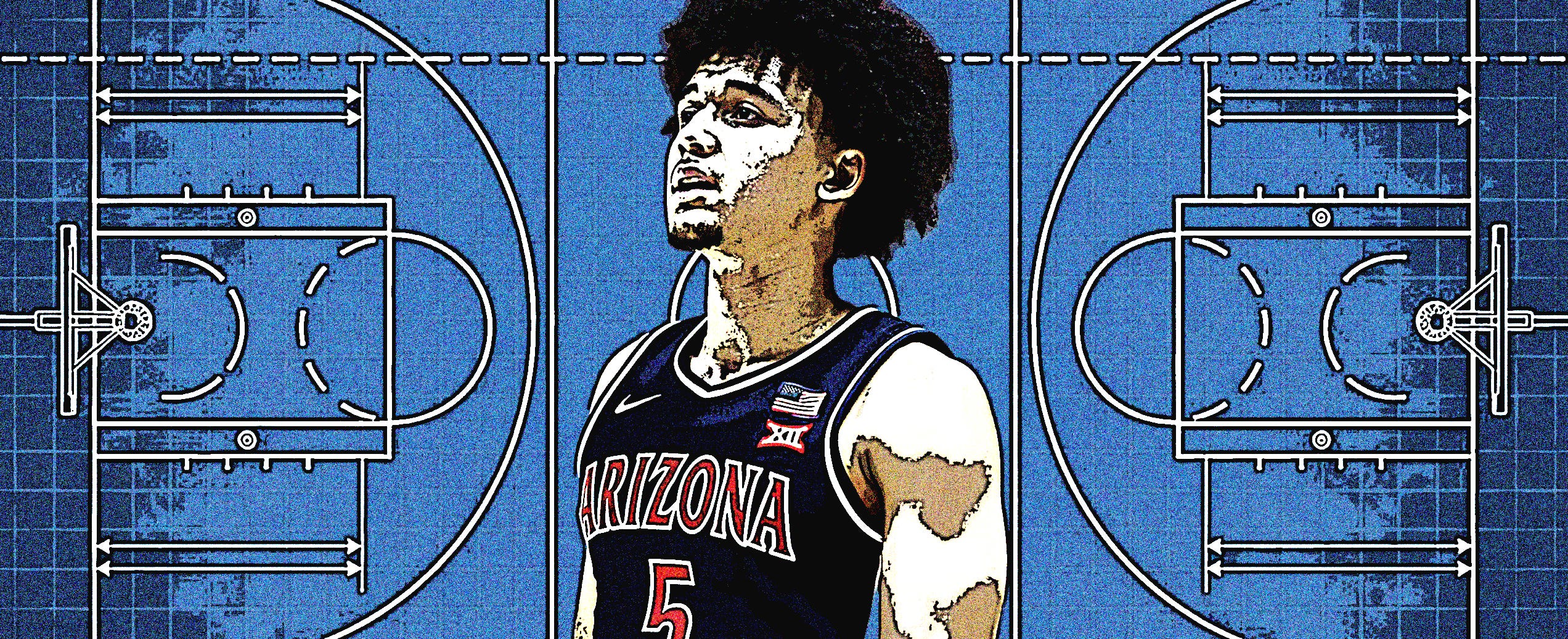
Enter Brayden Burries. One of Arizona’s star freshmen this year, who led the team in scoring, has both substance and aesthetics on his side. Burries has bullied his way into draft lottery conversations, but how has he done it? My long look at Burries’s game, studying how he designs his game and all its fascinating facets, revealed why he’s worth his late-blooming lottery hype.
Movement
“…such that they move the viewer’s eye.”
Brayden Burries athleticism exists somewhere between fiercely functional and upstanding. At 6’3.75” and 215 pounds with a 6’6” wingspan1, Burries has a good frame for a combo guard. Without good athleticism, however, those physical measurements would be for naught. Athleticism from a guard is rooted in leaping, hopping, and jumping, but sprinting, side-shuffling, hip-swiveling, and short-stopping, to name a few, are all paramount to a positive long-term prognosis.
The clearest use of athleticism for a guard prospect on offense is getting to the rim. That’s something Burries can do in multiple ways, given the nuances of his movement skills. When Burries moves, he almost glides on his way to the rim. That’s an overused term, but there isn’t a violent lift-off when Burries jumps; instead, he has a buoyant rise that ends with him puncturing the rim with his mostly-transition slams.
It’s not just above-the-rim where Burries succeeds when going full speed. It’d be difficult, to put it simply, to shoot 67.4%2 in transition while only having a dunk package. Instead, Burries has a bag of tricks that help him finish at a high level, even at full speed. He squeezes his shots through tight windows, loops his arms to wild angles on reverses, and scoops his way to scores, pairing his moving finishes with his high-speed transition motor.
I’d even argue that Burries’s drives in the half-court are built off his speed without him starting from a standstill. He was effective as a spot-up driver, hitting 51.4% of his twos from spot-up situations3. His spot-ups and handoffs blended together in the motion-heavy perimeter of Arizona’s offense, but Burries had his clearest success as a driver when he was already on the move toward the rim.
When you watch him play, Brayden Burries moves your eyes with the way that he drives. He isn’t fast enough to be a bewildering blur, but instead bursts toward the basket while still visible in real time. Being so effective at scoring the most effective shots in basketball is an important part of the design behind Burries’s game and one that NBA evaluators will point to when building a base for his case as a draft prospect.
Balance
“…the visual weight of elements.”
Balance for a shooter is almost counterintuitive. You must remain fluid and static at the same time as a shooter, but the best shooters in the world find their own balance. It’s necessary as a shooter to hit shots from a standstill; it’s a differentiator to still maintain your balance while flying around the court. Luckily, Brayden Burries builds his own balance out of the thin air that he creates with his off-ball movement and on-ball juice.
Starting at spot-ups is the easiest place for a shooter, and it’s where we’ll start with Burries, too. He took 100 catch-and-shoot bombs this season and hit 39 of them, which speaks to his baseline as a shooter. Burries is calm in the face of tumult in front of him, has a snappy wrist on his shot, and gets his looks up quickly. All of these ingredients bake together to form a tasty spot-up shooting package and one that Burries can rely on if his off-balance arsenal ever goes through a cold snap.
As an evaluator, I’m most taken with how balanced Brayden Burries is when he’s in motion as a shooter. I’m not talking about his darting around screens, although that is something he can do well, too. I’m talking about his self-creation, where he uses his crafty handle to create space to fire. Burries had an “Excellent” rating as a dribble jumper shooter,4 and it’s crystal clear to see what makes him a balanced shooter off-the-bounce when you turn on the tape.
Having a well-balanced diet as a scorer is the most reliable pathway to stardom for an NBA player. It’s helpful that Brayden Burries can drive the basketball and stay poised on his finishes, but it’s more impressive that he can keep his composure while firing shots on the move. The midrange may have seen its utility diminish in the present day, but it’s a widely used tool for stars who are savvy enough to know when to deploy it and good enough to justify its use when the going gets tougher.
I’m not projecting Burries to be an outright star because of other imbalances in his game, but it does help his margins that he can create shots for himself with such consistency. It’s a key part of his design DNA as a prospect that he’s such a strong shot creator, and it is probably the most important skill that will keep him on the floor early in his NBA career. If he can remain a truly dangerous shooter, Burries’s balance may be what tips the scales toward a higher developmental trajectory than even someone like myself could project.
Contrast
“…the difference between elements.”
Covering Brayden Burries as a scorer was always supposed to be a treat. Watching what he did as a passer and a creator for others was supposed to be a mixed bag. The problem with that principle, then, is that supposition is a limited window into a future we think we’ll see. What happens on the court is never set in stone, which makes Burries’s positive decision-making and burgeoning ceiling as an ancillary passer that much more of an interesting contrast to what he was “supposed” to be according to some circles.
It’s hard to oversell Burries’s 1.65 assist-to-turnover ratio alongside his 9.7% turnover percentage5. Those numbers, especially for a freshman guard who wasn’t given a ton of leeway to make mistakes, are highly impressive. While it is a one-season sample size that equates to half an NBA season in raw game totals, I was moved by the contrasting types of passes Brayden Burries was hitting while operating Arizona’s offense. Simply put, there was a clear difference between the passing elements that he put on tape every night.
It’s a smorgasbord of fun finds for Burries, as he served as a great contrast to floor general Jaden Bradley in the Wildcats backcourt. Burries’s movement and balanced synced up to help him hit kick-out passes to waiting shooters, while he always kept his head up on the break to hit ahead to one of his talented teammates. He even showed a growing depth of play in the pick-and-roll, which could suggest a higher ceiling as an offensive player if given the time.
Alongside the passes themselves, I was moved by Burries’s poise on limiting his turnovers. His drives had purpose, rarely veering into traffic without a clear plan. He didn’t try to stretch himself to hit a tiny window, only making assured assists instead. While that may be seen as a bit of a low-ceiling approach for a creator, I’d laud him for knowing his role and staying engaged in running a clean offense while under a heavier load of creation.
It’ll be incumbent upon Burries to start attempting the tougher reads and skips for his long-term growth, but I’m more bullish on him there than I was heading into Arizona. It’s a fun contrast to see the small, meaningful jumps he made as a passer in Arizona’s system. It isn’t the main draw for him as a player or even as an offensive player, but it’s a necessary addition to the scoring package that helps Burries remain a top-tier prospect in a 2026 draft class that is full of those types of players.
Pattern
“…uniform repetition of the elements.”
I break no ground by announcing that defense is the less glamorous end of the game. Sure, a block or a steal may make a highlight reel,
but few outside of
the fanatics grab a bowl of ice cream, tuck themselves in, and fire up a montage of well-executed closeouts.
That stems from the difference with defense:

instead of an ever-changing offensive kaleidoscope, defense in basketball is
often
more
about
repetition.
Walk with me on the page, if you will.
While an offensive player’s job is to unlock a defense and use their creativity,
a good defensive player sticks to their principles.
There is always a task,
a direction to force,
a look to funnel a player toward, that defines
the patterns of defense.
A good defender, then, can
force offensive entropy into defensive order
with their fundamentals and ability to shut down glitches to a defensive system.
Brayden Burries is more of an offensively-skewed player, but
that doesn’t mean he’s a slouch on defense.
It’s hard to be a key cog on the second-ranked defense in adjusted defensive efficiency, per BartTorvik, and not have some chops on that end.
Burries wasn’t the leading perimeter stopper for the Wildcats,
nor was he the rim anchor for the team,
but he showed a pattern of solid defense for his size
that should help NBA teams feel more confident in him not giving up too much on one end that he can’t fill back in on the other.
When guarding the ball, Brayden Burries is sticky.
He’s up in the jersey of his opponents,
                                      doesn’t foul too often,
                                                   and keeps his hands where the defender can see them. It was a curious surprise to see a pattern I didn’t expect to emerge quickly on film:
I think that Brayden Burries may be quicker on defense than on offense.
There’s a certain lethality that Burries has when
he smells blood on the defensive end, as he’s quick to
                                                                                    cut off a driving lane or nab a steal
                                                                                      that looked to be out of reach for
the average defender.It’s a good thing that Burries is proficient as a steal artist, with his 2.8% steal percentage, as his off-ball work needs some work. He does his best to stay attached to screens and cuts, but often finds himself having to lunge or reach to contest shots on the outside. It isn’t the most foreign place for a freshman to struggle, but it is a place that he’ll need to clean up if he wants to reach his ceiling as a complete player.
The pattern that emerges when watching Burries play defense is one of growth.
He has the bulky frame to bully players on the ball,
and he uses it to
strong effect.
It’s not easy to put potential into practice as early as he has, but that is both
a credit to his work and a caveat given his older age as a freshman.
Either way, Burries is a well-principled defender with some areas for improvement,
but
he has designed his defense to complement his offensive approach.
Rhythm
“…movement implied through the repetition.”
I have saved one of the favorite sections for last, as it’s hard to quantify touch in a basketball player. To really get a good idea of a player’s touch, you have to watch everything:

                  the air under their shots,

                                               the way that they loft passes to their teammates,

                 and even the ability to adjust their angles while midway through an attempt.

It’s foolish to ever really say how good a player’s touch is compared to another’s, as you’d have to perfectly watch everything every player does, but you can find enough on film to support a conclusion and track how a player gets in their rhythm with their touch on the court.
I watched the majority of Burries’s free throws, pull-ups, and rim attempts, and feel strongly enough to proclaim that Brayden Burries has good touch as a player. His movement and balance definitely play into his skills here, but he also has the right type of timing and force put into his finishes from the dreaded no-man’s-land middle to be an effective floater fan. He shot 45.0% on his floaters6, while also showing some nifty touch on his finishes over players while running his pick-and-rolls for Arizona.
The touch on Burries’s shooting is also important to consider, as he’s the type of shooter that creates his own rhythm and doesn’t get sped up by anyone else. He can accelerate his own clock on offense by getting to his spots early and ignoring defenses that try to harry his attempts, which makes him a valuable scorer. It helps, too, that Burries is a 80.5% free-throw shooter, as getting to the line is only part of the battle if one can’t cash in there, too.
I have a lot of respect for Burries’s rhythm on offense, especially when it comes to touch, as it’s often one of the harder skills to track. In contrast to having to hunt for shots that prove his talent there, Burries’s game is designed to highlight his great touch. He gets to his spots, owns them even if someone else is infringing on his space, and uses the right oomph on his passes and shots to increase his efficiency, all while making it a joy to watch.
Unity / Variety
When parsing Brayden Burries’s principles of design for his game, it’s hard to narrow down how to encapsulate it. Like most players, Burries’s bag contains multitudes, especially on the offensive end. It’s not just a pretty game he brings, although it’s certainly a dream to watch, as he backs up his aesthetically pleasing offense with the numbers and impact to boot.
Should I opine on Unity and how Brayden Burries has aligned his game to be a high-level prospect? He isn’t a polarized player who can only play on one end, but he has a clear identity that makes him a threat to score over and stop his opponents. The way Burries moves to attack the rim, get to his spots, and dart into passing lanes is unified by his style and success.
What about Variety instead? It’s hard to find a Burries finish, jumper, or floater that looks like any other. He has the creativity needed to solve his offensive problems, while also steeling himself to defend against a variety of coverages and player archetypes on the perimeter. It’s not lazy nor uninstructive to say that Burries’s game contains multitudes, as he brings a ton to the table on both ends.
Since I can’t decide, I’ll just stick to my principles and laud Burries for having such a well-designed game on both ends. It let him flourish as a freshman on a team that reached the Final Four, propelled him from the bench to a starting role at the start of the season, and ultimately landed him in his current lofty lottery status. It may be more of a preferential choice once teams like Brooklyn, Sacramento, and Dallas, to name a few potential options, are selecting their next lead guard, but Brayden Burries has shown enough of his game to emphasize his worthy place at the top of the 2026 NBA draft board.
Per the NBA Draft Combine’s official measurements
Per Synergy
Per Synergy
Per Synergy
Per Basketball Reference
Per Synergy
Great article, loved the use of all of the videos, and the whole concept was very well done.
Love the design of your article, emphasizing the words you are writing. There’s some Haiku, some Western poetry rhythms - right on. Thank you for the care you take on the design.
Otherwise, Burries is awesome, he looks like Devin Booker and will be as impactful. Sadly I cannot see any way the Raptors can finagle a trade to get him. Oh well, maybe we’ll snatch his running mate and see what we can do.
Finally, may I recommend A Pattern Language by Christopher Alexander and others? First published in the late 1960s, it is currently out of print. It is a book on architecture with 3-4 page vignettes on everything from city design, park placemenet, neighbourhood design, outside the house looks and inside the house design. It is a bible among the architectural community (I’m not part of that) and is delightful read on how everything is design. Look for the 3 page chapter on the “Zen View”, or “windows in corners”. If you like the way Burries plays basketball, you’ll like this book.