


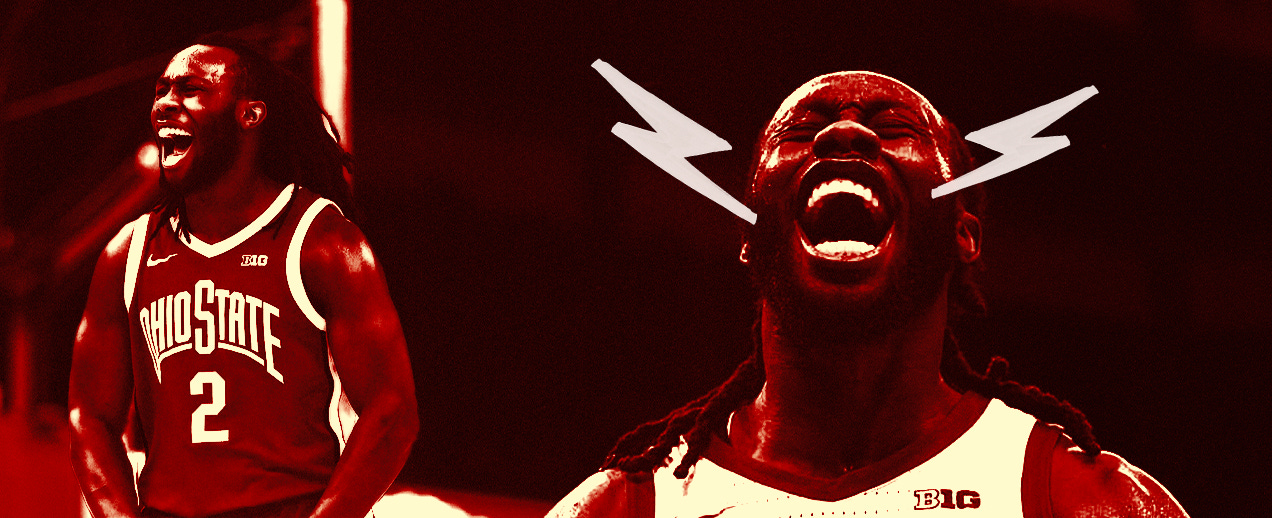
In today’s collegiate game, a player like Bruce Thornton is rare to come by—and no, this oddity has nothing to do with the fact that Thornton has played for the same Ohio State program under two different head coaches for all four years. I applaud the loyalty; however, what makes Thornton stand out to me is that, even with the drastic uptick in usage and responsibility, he’s consistently improved without sacrificing his style of play.
Before setting foot in Columbus, Thornton was already a reputable player. The guard established himself as the state of Georgia’s number one overall prospect, earning Mr. Georgia and Gatorade State Player of the Year honors in 2022, all whilst leading Milton High School to a state title. Thornton’s transition to the collegiate game was seamless, immediately starting and contributing in winning ways.
As Thornton’s reps increased, instead of reinventing his game, he leaned fully into his strength of thriving under discipline. In this larger role, Thornton has let the game come naturally to him. His movements and decisions, which started heavily calculated, have become second nature. While many players hang their hat on a specific skill or trait, Thornton embraces a balanced approach rooted in restraint. His mastery of control projects him to be a prospect that can seemingly fit within any NBA team’s context, making him one of the safer swings in this year’s draft.
Physical Profile
In the words of a family friend who’s an Ohio State fan, “Bruce Thornton is built like a running back.” Upon first glance, what immediately pops about Thornton’s stature is his stocky build. At just 6’2”, Thornton weighs in at 215 pounds with bulging shoulders and a thick lower body. His dense build allows him to comfortably absorb contact on either end. Thornton’s speed only comes within short bursts, and is only weaponized in necessary situations. He also lacks the ideal size and length for a modern NBA guard. Despite these shortcomings, Thornton has managed to leverage his build and athletic profile to his advantage.
Every move Thornton makes appears to be calculated. He doesn’t waste any motion. Thornton relies on his coordination, instincts, and balance to navigate the court. Rather than bulldozing opponents, Thornton uses his strength situationally, whether that’s absorbing contact or standing his ground. He prefers to play at his own speed, only upping the tempo when an advantage presents itself. Thornton doesn’t move just for the sake of moving; he takes steps only when they serve a purpose. This conservative use of athleticism yields extremely efficient basketball, with Thornton maintaining body control most of the time.
Offensive Profile
The offensive end has been Bruce Thornton’s calling card his entire collegiate career, progressing from a connective piece to a primary offensive engine for the Buckeyes. Delving into the metrics, his offensive numbers are bonkers. In his freshman campaign, Thornton contributed 0.08 OWS/40 (cbbanalytics.com), placing him in the 83rd percentile that season. The following season, that number rocketed to 0.13, putting him in the 99th percentile, where he’s remained his entire tenure. On top of that, this season Thornton has an RAPM of 5.7 (98th percentile) and an ORAPM of 4.1 (99th percentile). When Bruce takes the court, the offense operates at a higher rate, resulting in complete possessions. This is further proved through Ohio State’s drastic difference in offensive net rating when Thornton is on the court versus off. In lineups without Thornton, the rating drops from 126.4 to 103.1, a 23.2-point differential that places him within the 99th percentile. The root of all these impressive numbers is Thornton’s ability to generate a diverse profile of plays that not only allow him to thrive but also open up opportunities for his teammates.
Thornton is a midrange maestro. This season, he’s scored 1.11 points per possession (hoop-explorer.com) on midrange attempts (99th percentile). Thornton tends to utilize his low center of gravity and sturdy strength to take one to two dribbles, break through the arc, create separation, and rise for a soft middie. His favorite area to attack lies on the foul line extended, where he shoots 67% from that range. They say the midrange is a lost art in the NBA. However, it remains an integral part of playoff game plans, especially with teams laser-focused on limiting three-point attempts and closing driving lanes, creating a path for Thornton to be a potential playoff contributor.
Similar to his midrange, Thornton’s rim outputs yield elite results. While only 43.1% of his points are off rim attacks, Thornton scores 9.9 points in the paint per 40. As previously mentioned, Thornton doesn’t possess lightning straight-line speed, captivating length, or immense verticality. His rim finishes stem from calculated movements that leverage his strength and coordination. The guard likes to accelerate once he’s in the paint, which catches defenders off guard, allowing for easy buckets. His first step isn’t the most twitchy, but it’s fast enough to get the edge on a consistent basis. He possesses an arsenal of ball fakes, combined with jabs and step-throughs, that create adequate space for finishes. Even if Thornton struggles to create separation with his defender, he’ll often resort to using his raw strength to stay upright, maintain balance, and convert. Thornton shields the ball particularly well, likely due to his imposing shoulders, which allow him to retain control through contact. Many of Thornton’s rim attempts aren’t forced, scoring 1.24 points per possession on rim attacks. Thornton’s soft touch in the midrange translates to a sufficient floater game. The next step in Thornton’s finishing development is to generate more fouls. His 5.2 personal fouls drawn per 40 are a tad misleading, as you’d like his 37% free throw rate to be a bit higher. His limited wingspan also raises the question of whether his rim-finishing efficiency will translate against longer defenders.
Bruce Thornton’s three-point shooting has been highly reliable the past four years, shooting 38.2% from long range. Yet his three-point attempt rate throughout college is just 38.1%. While the attempt rate doesn’t meet the usual NBA threshold, the efficiency truly makes up for it. Many of his three conversions come off catch-and-shoot scenarios, often from a driving teammate who kicks it out to him. He’s grown more comfortable creating off the bounce, nailing a few tough threes with defenders in his face. He’s not at the level where he’s knocking down step-backs and fadeaways routinely, but as a projected second-round pick, Thornton will not be shooting five threes a game. He won’t ever be asked to be a primary floor spacer, but choosing the right shots and knocking them down is more critical to function at an NBA level.
Thornton’s playmaking is more than reliable, and of course, it’s extremely efficient. He takes proper care of the ball, with an assist-to-turnover ratio of 2.00. By protecting the ball well, Thornton maintains his handle and remains calm under defensive pressure. This allows him to penetrate the paint and find open players on the wing at an efficient rate of 1.16 points per possession, placing him in the 95th percentile. Thornton does a proficient job reading help defenders, allowing for some timely passes to open teammates, punishing defenders for overhedges and doubles. While Thornton doesn’t go through many reps operating the pick-and-roll, it’s still done in an efficient manner, at 1.10 points per possession. Passes to the screener won’t be forced, and Thornton will only commit to it if he has an open window. Making passes in tight gaps isn’t his forte. However, he’ll utilize ball fakes to expand these windows, finding guys for easy looks. The major red flag in Thornton’s playmaking profile that alarmed me was his assist rate, which dips as his usage increases. However, with Thornton’s selective and efficient passes, he’ll likely thrive within the flow of the offense as a connective playmaker.
My biggest concern with Thornton’s offensive game is how he handles the NBA’s faster pace. Thornton plays his best basketball within a controlled structure, where he can be more patient and wait for opportunities to arise, mainly in half-court settings. The fastbreak has been an issue for Thornton his entire career, as he struggles to generate both points and assists in the open court, reflected in both the tape and metrics. This is likely due to Thornton’s lack of burst and overreliance on composure. At high tempos, advantages have to be made and recognized on the whim, which makes Thornton lose some of his edge.
Defensive Profile
Bruce Thornton’s defensive game is a trickier evaluation than his offense. Most of this derives from his physical profile, which limits his switchability. Sure, he’ll have the muscle to maintain his ground against guards and some wings, utilizing it to absorb contact. However, his length and lack of verticality make him an easy target to hunt. He doesn’t generate plays off defense, with a lowly stock percentage of 2.2%. Additionally, he doesn’t make many winning plays on that end of the floor, averaging only 0.04 defensive win shares per 40. Given these limitations, one may believe Thornton is a traffic cone. But he’s a much stronger defender than he’s given credit for, especially when watching the film.
Thornton’s defensive positioning has been more than reliable throughout his four years. He stays glued to his man on actions, combining his strength and timely footwork. The low stock numbers are likely due to his selective aggression. You won’t find Thornton gambling on plays by jumping the gap prematurely or pulling the chair. He prioritizes being at the right place at the right time, limiting defensive breakdowns. This also means Thornton doesn’t foul often, averaging about 1.5 a game. His ability to closeout has significantly improved, hustling hard to put a hand in a shooter’s face.
I’m also more optimistic about Thornton being a plus point-of-attack defender. Thornton stays low, uses his sharp footwork and strength to get around screens, and stays connected to his man. He has a pretty good understanding of angles, allowing him to anticipate actions early and properly hedge and recover efficiently. His light-footed nature allows him to ice screens effectively, cutting off plays from ensuing.
It’ll take a lot for Thornton to be a productive defender at the NBA level, especially given his physical shortcomings, but the awareness and discipline are there for him not be played off the floor.
Closing Remarks
Bruce Thornton’s maturity and commitment to play controlled in an efficient manner could make him one of the safest swings in the second-round. Being undersized for the modern NBA and already 22 years old limits his ceiling; however, he’s established a concrete floor as a connective guard who can play within his role and stabilize lineups. Thornton can function efficiently at both high and low usage, making him a perfect depth addition at the end of the draft.
Strengths:
Offensive Efficiency
Inside-the-Arc Scoring
Ball Security
Off-Ball Movement
Weaknesses:
Frame
Transition
Defensive Playmaking
Limited On-Ball Ceiling
Bruce Thornton has a 3.0 assist to turnover ratio, not 2.0 as noted in this assessment. At times in his career he was at a 4 to 1 ratio. He also played most of his college career without a 7'0" or taller starting center. That role was filled by players 6'8" or less with 6'6" players providing the bulk of power forward rebounds.
No other guard in the Big 10 had less than 50 turnovers a season. It's difficult to understand why some writers are projecting he is a late 1st round pick. His college turnovers per game are less than Chris Paul, Allen Iverson, Damian Lilliard, Gary Payton, Donovan Mitchell, Chris Mullen and all other college greats I have researched. None of these players dropped to 2nd round NBA picks.
At point guard he was second on his team in rebounds this year and his .550 field goal shooting accuracy is very near the top for point guards this year.
To be fair to Bruce Thornton the writers should notice that his 3 to 1 assist to turnovers ratio is one of the very besy in history. Hurley actually had 5 turnovers a game in his career, Magic had 4 and Isiah Thomas had 3 on an undefeated team.
Thornton's .550 field goal accuracy this year and .484 career accuracy is high level.
On the 2000 points, 500 rebounds and 500 assist list of 41 players, Bruce Thornton is 4th for shooting accuracy.