


In the last draft cycle, the guards were by far the strongest position group in the class. This season I reckon it’ll be the wings.
This year’s cohort features a few intriguing freshmen who lack the upside to be primary creators, but have additive skill sets that could make them productive role players and lockdown defenders who need to improve their shooting to round out their profile, and a mix of returners who look to step into new roles and increase their draft stock.
The latter is where I’ll continue my “Buying the Dip” series, a collection of pieces evaluating what returning NBA draft prospects must do to strengthen their chances to hear their name called next June.
Amari Allen
Amari Allen went under the radar heading into his freshman season at Alabama and made a run at being a one-and-done before ultimately returning to Tuscaloosa after uninspiring combine measurements.
On the floor, scouts were intrigued by his well-roundedness and outlook as a swift, army-knife wing who could handle, pass (2.2 AST.TO), shoot (50 3PAR), defend multiple positions, and rebound (12.3 TRB%).
For Allen to increase his stock from a projected second-round pick to a comfortable first-rounder, he needs to show he can handle a heavier burden of on-ball reps while maintaining his ancillary production, show an ability to score efficiently in the paint (50.8% at the rim and 47.1% from two in the half court), and establish a true standout skill.
All of Allen’s numbers (outside of the rebounding, which is quite good) meet the threshold you’d want from a wing, but none were elite. He’s a quality ball mover, off-ball defender, spot-up shooter, and closeout attacker. Still, he has to show he can handle a heavier offensive load, knock down threes at a higher clip, and defend better at the point of attack, particularly when navigating screens.
Over two games, albeit vs. poor competition, Allen has increased his usage by four percent, increased his pick-and-roll volume by 24%, maintained a 2% steal and block percentage, continued to rebound at a high level, and turned the ball over less than last season.
His playmaking volume should come back down to earth, especially with Aden Holloway returning soon. Still, if he’s anywhere close to the numbers he’s produced so far while seeing a positive regression in efficiency, then he profiles as a secondary ball-handler who can toggle on and off the ball, defend on the wing, and be a conduit for lineups. He’ll likely be competing for a lottery pick come June.
Ivan Kharchenkov
Last season, Ivan Kharchenkov was an impactful role player for a national title contender and heads into this year as a near-consensus top-ten pick. His proponents believe that with increased usage, he can be more of a creator for himself and others and transcend the connective role he played last season.
For me, it’s still a wait-and-see.
I am a fan of Kharchenkov’s size and strength, his ability to defend multiple positions, and his efficiency as an off-ball scorer. Still, I’d like to see significant offensive growth and for him to showcase a standout skill to warrant that high a selection.
My reservations start with his shooting and how it could limit him as a scorer. During his final season with Bayern Munich, he shot 23.9% from three and 48% from the charity stripe on low volume. In his freshman season, that drastically improved to 31.7% and 72.3%, respectively.
Further shooting growth is paramount, and he also needs to show improvements as an on-ball scorer. Kharchenkov scored particularly well in the pick-and-roll and showcased an astute understanding of pace as he knifed to the rim, but he struggled on overall drives, shooting 45.8% from the field, turning the ball over on 15.3% of his scoring possessions and generating just 0.894 points per play.
Kharchenkov was a great Swiss Army knife offensively who showed some flashes of creation juice in PNR reps, but over 55% of makes were assisted last season, including 42.9% at the rim.
The sophomore shot 62.9% at the rim overall, but that fell to 57.3% in the half court, where he made just 56.8% of his layups. A fair amount of his rim struggles can be attributed to the abhorrent spacing the Wildcats played last season, but Kharchenkov also tended to pick up his dribble too early, take wide angles to the rim, and struggle to generate lift in traffic.
Furthermore, I’m looking for Kharchenkov to establish a standout trait with his increased usage that will keep him on the floor. In both his international and freshman samples, he posted solid rebounding relative to his position, is a good but not great defender, and has shown more as a connective passer than a true initiator.
For what it’s worth, Kharchenkov has been excellent at the start of his sophomore campaign. He has averaged 27 points, 10 rebounds, and four assists; improved his efficiency from every spot on the floor; drawn more fouls; and rebounded at a high level. The wing was also dominant in the Wildcat exhibition games. If he can handle higher usage while staying efficient, limiting turnovers, and being a quality defender, I’ll be much more bullish on him as a lottery pick.
Davis Fogle
As a freshman, Davis Fogle didn’t start getting minutes until January, but when he did, he thrived. After January 15th, he posted the 11th-highest Box Plus-Minus in the nation among freshmen and averaged 10.6 points, 4.5 rebounds and 1.5 stocks per game in 23 minutes a night.
When he got on the floor, Fogle was able to show his proficiency as a slasher ( 1.083 points per drive, 70.2% at the rim in the half court, and 53.6% from two), versatility as a defender (2.0 steal + 3.4 block percentage), and connective passing ability ( 15.4 AST% + 2.4 AST/TO ratio).
He and first-round pick Allen Graves were the only two freshmen to meet the benchmarks below.

To my surprise, Fogle is heading into his sophomore season routinely mocked as a mid-to-late second-round pick.
That’s far too low for a player who can credibly slash, pass, rebound, and defend multiple positions. I can understand needing a stronger sample size — he only played 500 minutes last season — and needing to see growth as a shooter (35% on low volume), but this feels like a breakout candidate hiding in plain sight.
Similar to Kharchenkov, he needs to show he can handle more usage, remain productive in a higher role, improve as a shooter, and create for himself at a higher rate — 43.4% of his makes were assisted — but for a player with a similar skill set, but better rate stats, I’m somewhat baffled by the gap between the two players in national media outlets.
Tounde Yessoufou
Yessoufou has gone from Anthony Edwards comparisons and preseason lottery projections to being under-discussed and overlooked in just a year.
While I never thought those comparisons had any merit past aesthetics, and I don’t think he profiles as a creator at all, I think he can play his way back into first-round consideration with a few tweaks to his game.
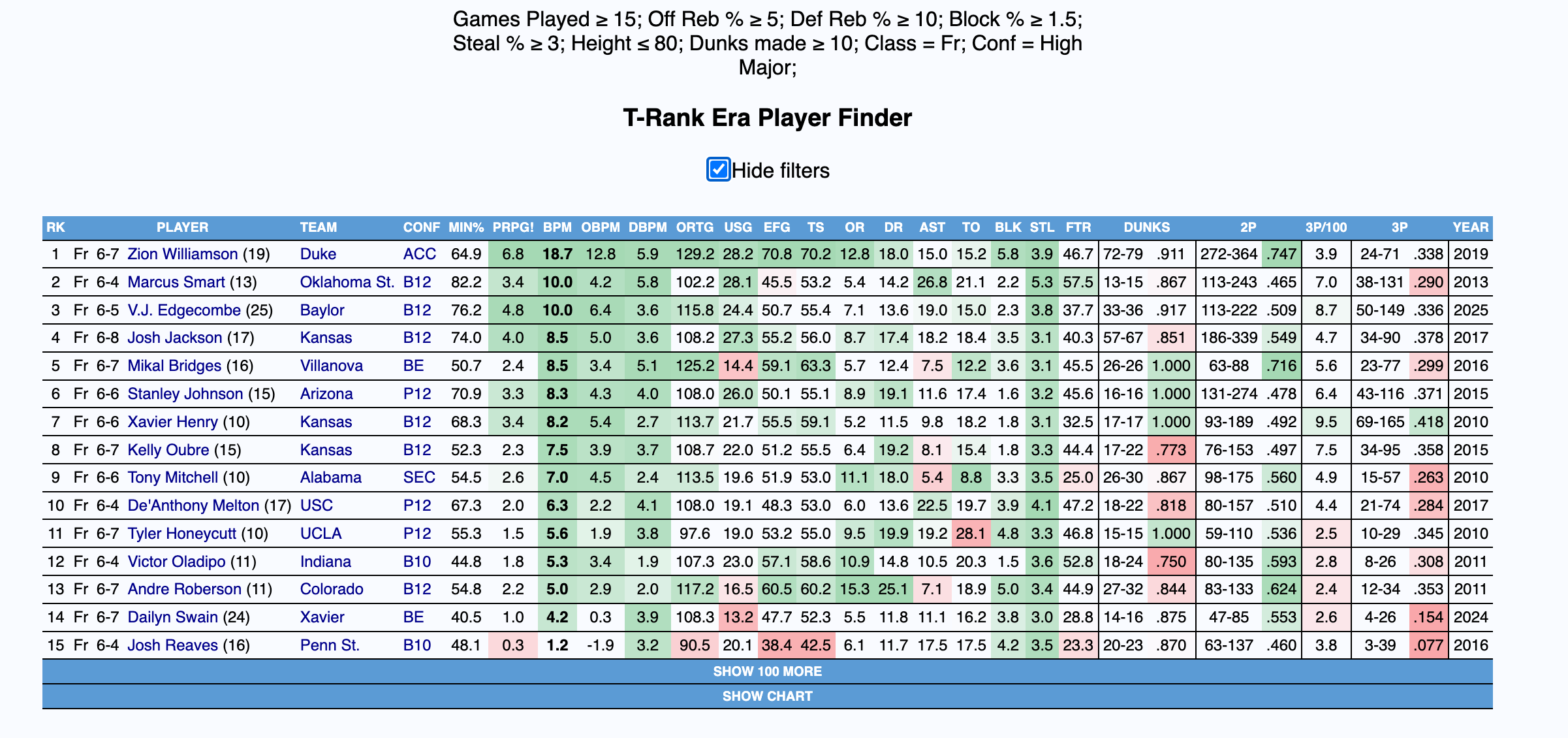
In an overall disappointing year, Yessoufou still showcased the athleticism and ancillary production that made him an intriguing prospect before his freshman season. He impacted the game on the glass, forced turnovers, and was great in transition. Even as an older freshman, I think finding yourself in the query below is commendable and even signals a pathway to NBA success.
What stopped him from starting his journey a season earlier was an extremely rough half-court scoring process, an inability to create for himself or others efficiently, and inconsistent defensive impact relative to his defensive playmaking production. At Baylor, Yessoufou posted a 0.74 rim-to-non-rim ratio, a sub-40 three-point rate and free-throw rate, and a 0.8 AST/TO ratio.
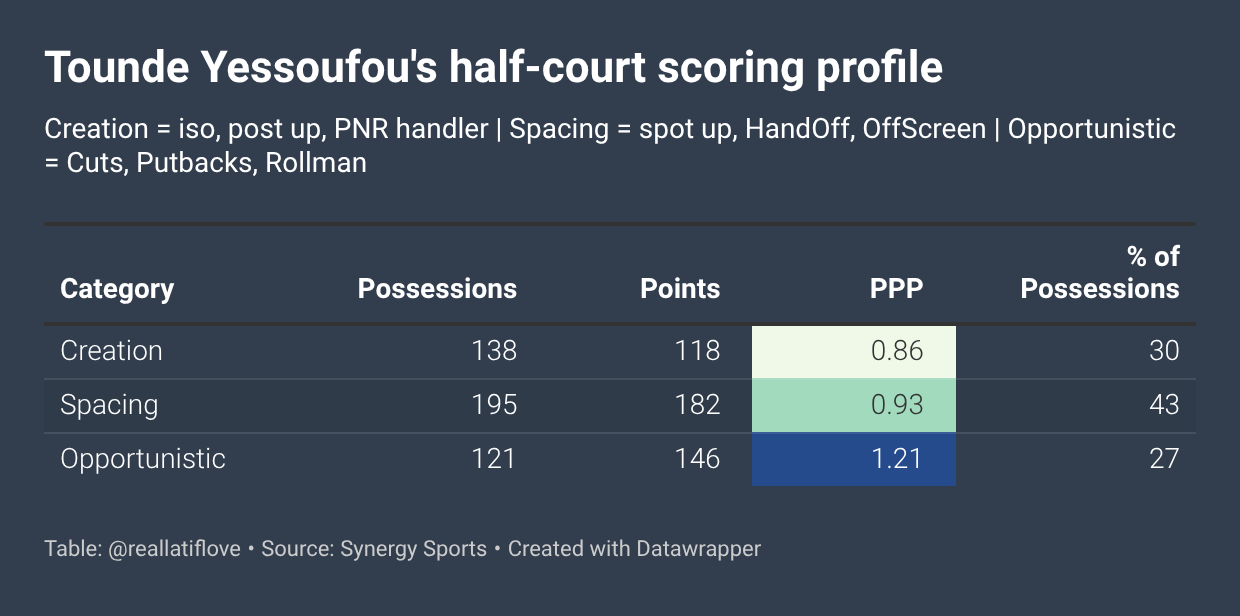
Last year, I believe he was overtasked and thrown into a primary ball-handler role where he masqueraded as a focal point of the offense. In spacing, off-ball, and opportunistic play types (spot-up, cuts, putbacks), he thrived and was much more efficient and effective than when he was tasked with creating reps.
When Yessoufou makes the transition to the NBA, I believe he has the tools to scale down into a smaller role and use his 6’5, 220lb frame and his 6’10 wingspan to buy into being a defensive ace who also can attack closeouts, cut to the rim, keep possessions alive on the offensive glass, and run in transition.
This season I’d like to see him increase his three-point volume (37.2 3PAR) and efficiency (29.3%), make quicker decisions when an advantage is present, and shore up his defensive technique and awareness on and off the ball.
Some pre-draft analysts compared Yessoufou to Anthony Edwards, and maybe he even bought into those comparisons himself. Still, if he buys into a role that makes him more impactful, his outcome could look closer and even better than a wing now playing in Atlanta.


Shelton Henderson
Henderson is one of the most physically imposing wings in college basketball, standing 6’6, 240 pounds, with a 6’10 wingspan and the athleticism to overwhelm defenders at the rim.
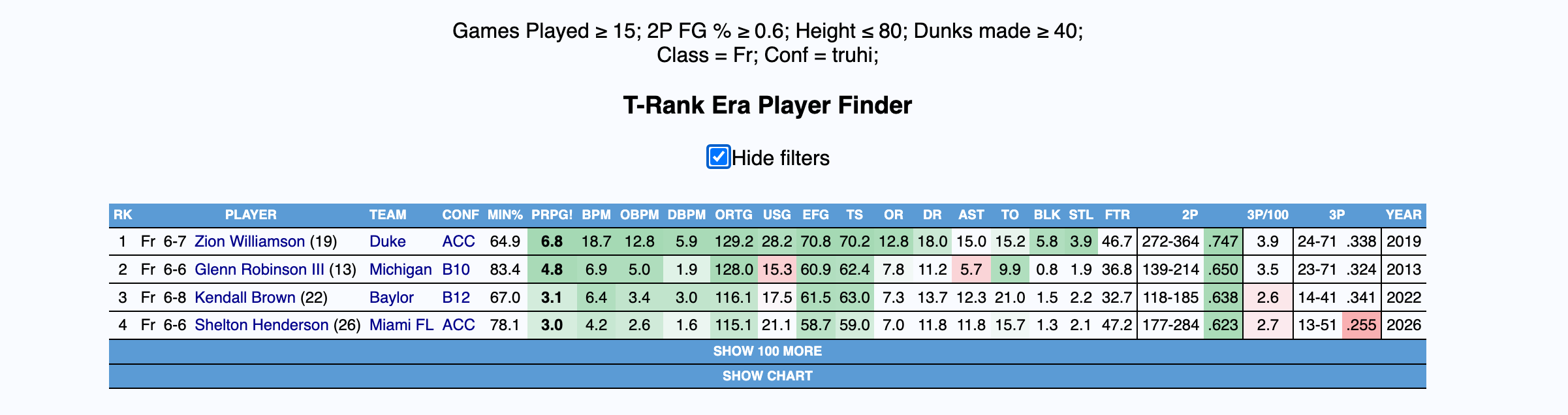
As a freshman, Henderson was a force around the basket, converting 64% of his rim attempts and 58.8% of his overall two-point attempts in the half-court. He was particularly effective in transition, where he could use his combination of size, strength, and explosiveness to get downhill and finish through contact. His 47 dunks, including 21 in the half-court, further show how effective he can be when he can leverage his physical advantages.
He’s one of four wing-sized high-major freshmen to dunk the ball 40 times and finish at least 60% of his two-point shots.
Defensively, Henderson has the tools to be a versatile on-ball defender who can guard up and down the lineup. His strength lets him absorb contact against bigger wings and forwards, while his lateral quickness and length let him stay in front of smaller players.
However, like Yessoufou, Henderson has significant development ahead of him as an offensive player, particularly as a decision-maker and shooter.
Despite being an effective interior scorer, Henderson struggled mightily as a processor when tasked with creating for himself and others. He turned the ball over on a staggering 21% of his drives and posted just over a 1:1 assist-to-turnover ratio. For a player likely to attack closeouts, make quick decisions, and play within the flow of an offense at the next level, those numbers are concerning.
Furthermore, Henderson’s lack of perimeter shooting could severely limit his offensive utility in the NBA. He shot just 25% from three on a 15.2 three-point attempt rate, offering little evidence that defenses will have to respect him away from the basket. Without significant improvement as a shooter, it's hard to envision how he’ll consistently leverage his physical advantages against NBA defenders who can sag off him and take away driving lanes.
I also think Henderson has room to grow defensively despite possessing the physical tools to be an impactful defender. While he can be effective at the point of attack, he doesn’t consistently maximize his athleticism and length as a defensive playmaker, as evidenced by his underwhelming steal and block production. He also tends to fall behind plays, lose track of his assignments, and fall asleep off the ball.
For Henderson to improve his draft stock, I’d like to see him become a more reliable decision-maker, show tangible growth as a perimeter shooter, and become a more consistent defender away from the ball.
Henderson has a clear path to carve out a role as a physical, defensive-minded wing who can finish plays around the basket, attack closeouts, and wreak havoc in transition.