


The guards in the 2026 NBA Draft were the class's crown jewels.
Darryn Peterson, Keaton Wagler, Darius Acuff, Mikel Brown, Kingston Flemings, and Brayden Burries headlined what could be the strongest cohort of ball-handlers since 2020.
This one’ll be different—at the very least.
A year after offensive sensations like Bennett Stirtz, Ebuka Okorie, and Labaron Philon Jr. fell out of the lottery, the next class would likely see each as a lottery pick.
However, the 2027 class wields some intriguing guard bets. Several guard-sized players with wing skill sets, a few who straddle the six-foot line and put heart over height, and a mix of returners primed to increase their draft stock.
The latter is where I’ll start the “Buying the Dip” series, a collection of pieces evaluating what returning NBA draft prospects must do to strengthen their chances to hear their name called next June.
Three-Headed Monster
Tyler Tanner - Vanderbilt
Before returning to Nashville, Tyler Tanner was one of the most polarizing prospects in the 2026 NBA Draft. Several amateur scouts lauded the guard as a top-10 pick, enamored by his pristine feel for the game and outlier athleticism for a player his size.

Others were more skeptical that a sub-six-foot guard without elite shooting would translate to the NBA.
In the end, consensus won, and Tanner returned to school after weighing in at 167 pounds during the combine. Gaining significant weight should be at the forefront of his efforts to earn a first-round selection. The list of sub-170-pound players who found success in the NBA is short. Vanderbilt lists the junior at 181 pounds, which, if true, would be a notable increase from his combine listing four months ago and would help him become a stouter on-ball defender and, in turn, make teams more comfortable using a premium pick on him.
But even if the Commodores Athletics website is accurate, Tanner still has significant areas to improve on the court.
Tanner is the type of guard who constantly creates advantages by attacking the rim to create for himself and others, but his half-court counters to that playstyle are still underdeveloped. At the next level, getting to and finishing in the paint will be harder, so increasing his three-point attempt rate (34.7), pull-up three-point efficiency (29.0%), and floater efficiency (26.3%) will be paramount to his scoring and overall offensive translation.
Chance Mallory - Virginia
Tanner, Chance Mallory, and Nigel James Jr. (see blurb below) are triplets: small guards with high-level cognition who add value on the margins in ways few others their size can. The trio rebounds well, protects possessions, and creates more opportunities for their team by forcing turnovers.
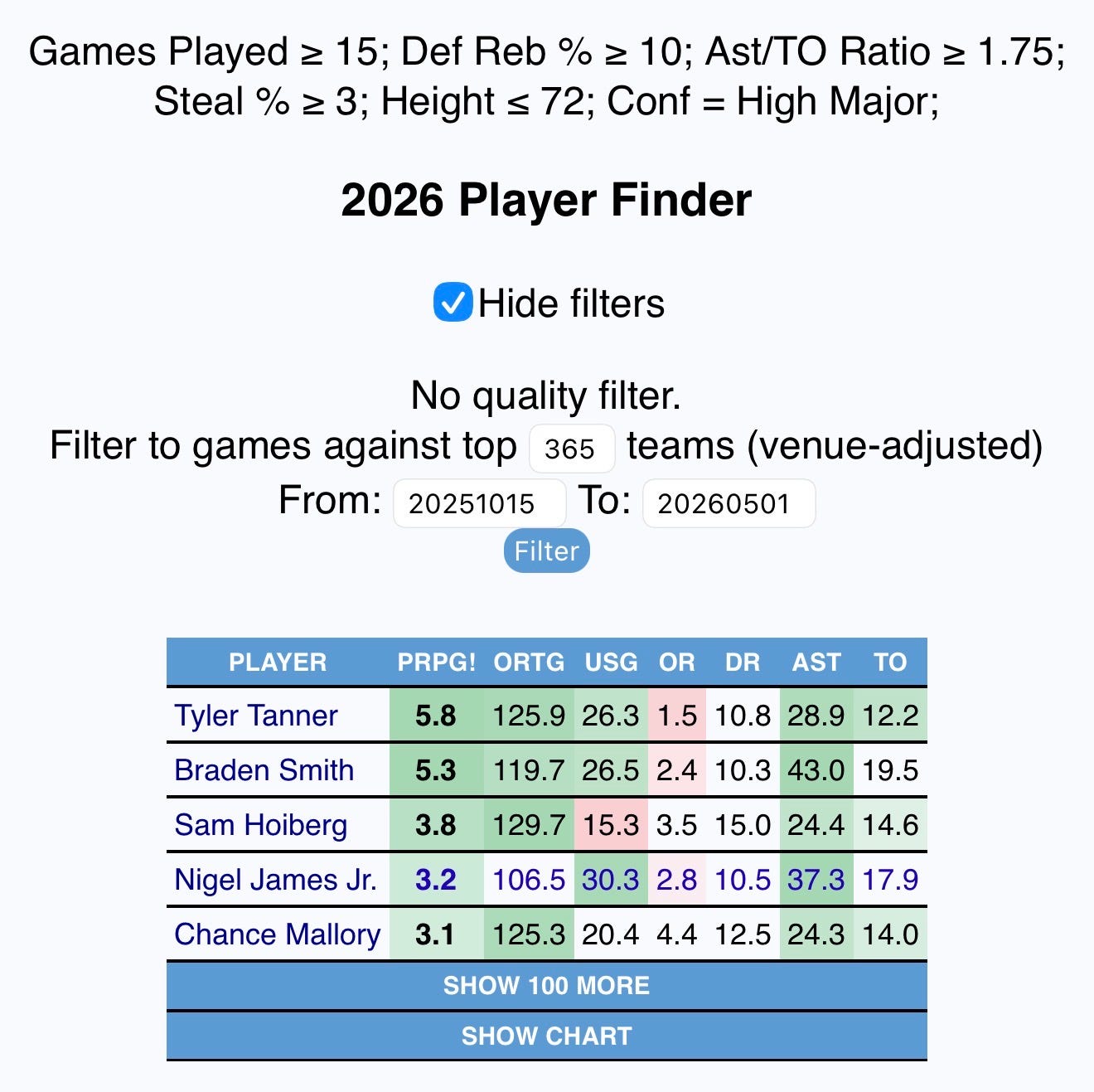
Tanner is the class’s premier returning small guard prospect, but Mallory is a close second. As much as I find the two similar in how they combine guard skills with traits found in players who are usually bigger than they are (or playing bigger than their size), I’d almost combine their profiles to create the perfect outlier small guard prospect.
I’d give Tanner Mallory’s mass and stockiness and give Mallory Tanner’s athleticism and rim-finishing ability.
Said rim-finishing ability, along with overall two-point scoring (49.6%), is the biggest area for improvement in Mallory’s sophomore season.
Though Mallory’s 55.6 free-throw rate helps his interior scoring struggles, he shot just 56.0% at the rim and 33.3% on non-rim two-pointers, and both figures fell within the half-court (53.2% and 32.0%, respectively). Mallory’s not a player who’s going to jump out of the gym, so he needs to show an ability to generate and make floater attempts if he wants to have success at the next level.
He also needs to generate more three-point attempts off the bounce (0.7 pull-up 3PA per game) and improve on his 34.5% from behind the arc.
Most importantly, he needs to prove he can stay additive as a rebounder, maximize possessions, and create turnovers with the increased opportunity he’s bound to see this season.
Nigel James Jr. - Marquette University
Nigel James Jr. is the final of the three head dogs, and he shares the same ancillary strengths as Mallory and Tanner, but he is arguably the most physical and athletic of the trio. James Jr. is a nightmare to stay in front of, can get to the lane at will, and create for others as he gets downhill.
However, despite averaging more raw points and assists than Mallory and carrying a heavier offensive load than Tanner, his offensive projection feels murkier.
He got to the paint at will but shot only 54.6% at the rim and had a free-throw rate of 31.0, which isn't bad on its own, but he pairs those finishing struggles with low three-point volume (28.9 3PR) for a pretty rough scoring profile.
With a scoring profile that doesn’t lean towards elite three-point shooting or foul drawing, James Jr. would have to be an elite shotmaker to maintain his efficiency.
And he’s not one.
He shot 38.8% on non-rim 2s, 34.7% from three, and his other touch indicators are bleak (69.2% FT)
To build a stronger scoring projection, James Jr. must finish better at the rim, develop his non-rim counters, and improve as a shooter, because margins are razor-thin for small guards.
Shooters with Shots to Show More
Braylon Mullins - UConn
Braylon Mullins was a projected lottery pick heading into the 2025-2026 season, but an ankle injury and a slow start saw much of the draft buzz he’d accumulated dissipate by the year’s end. Instead of signing as a late-first-round pick, Mullins returned to Storrs for an NIL bag that likely exceeds what he’d make in the NBA and a chance to show scouts he’s more than a shooter.
Or maybe that he’s an elite shooter at all?
After shooting 44.3% from behind the arc on over 500 attempts, Mullins' percentage fell to 33.5% as a freshman.
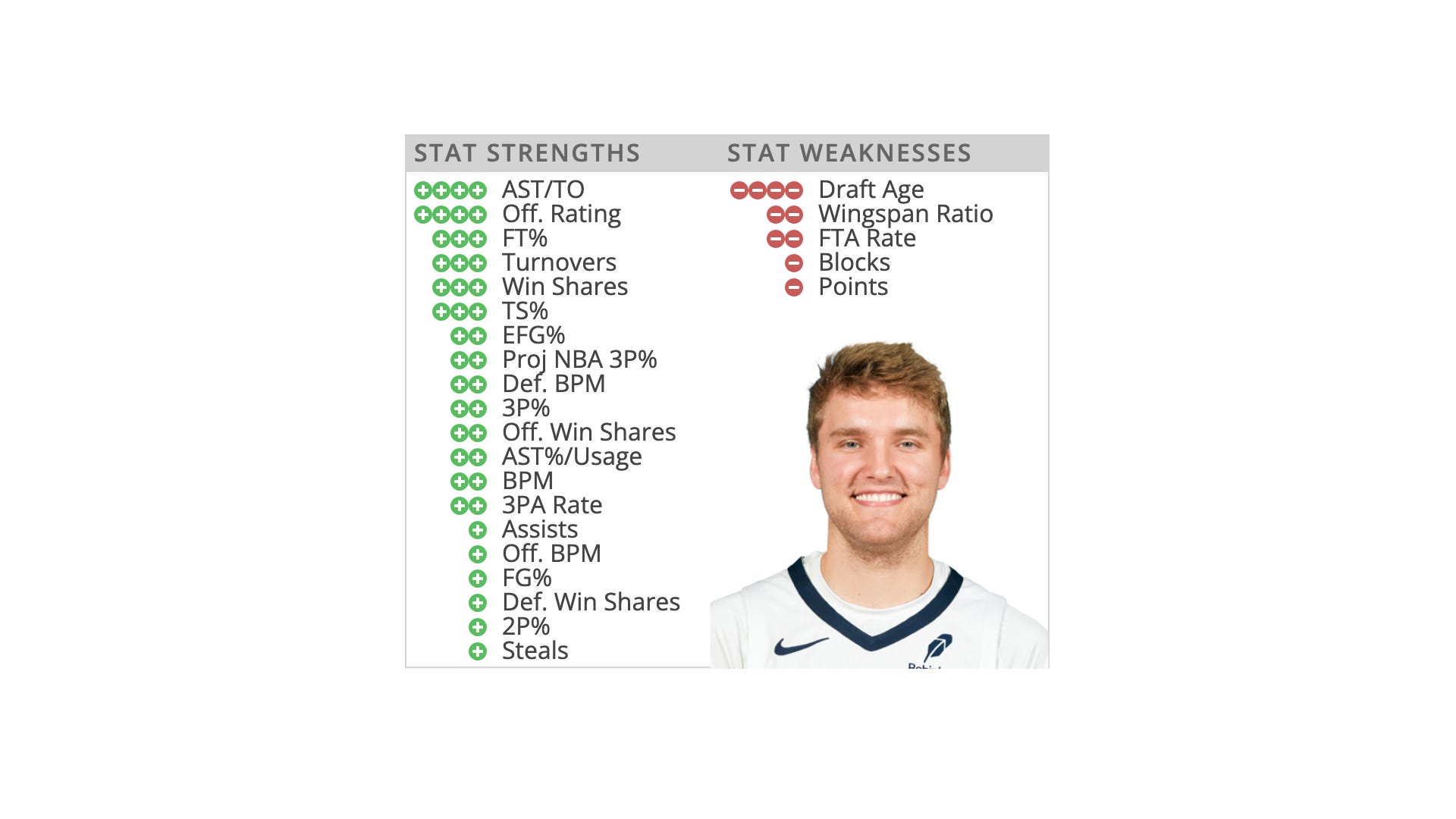
But that was clearly due to the ankle injury or variance; he’s an elite shooter. Players who post the figures listed in the query below don’t typically fail as shooters.
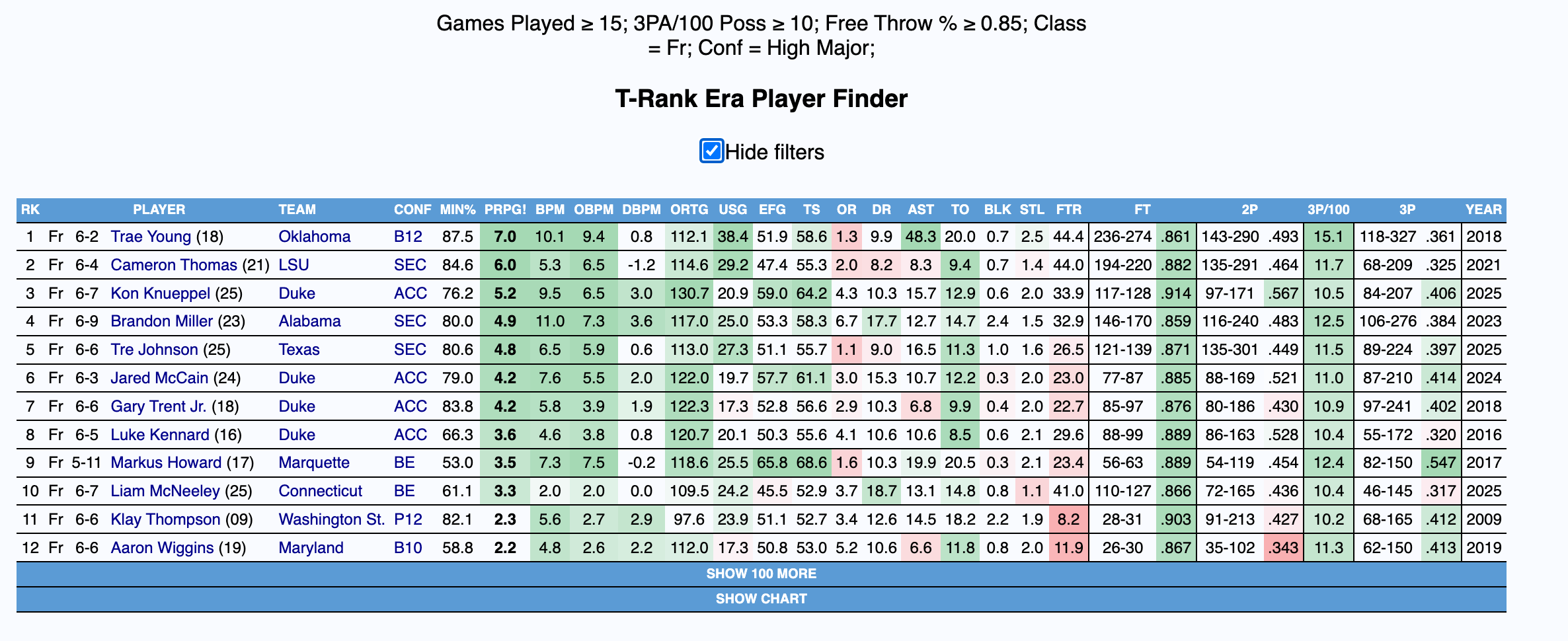
However, I am concerned about what value he adds on the floor outside of his shooting. Specialists are going out of style. Especially in playoff settings. Or if they’re not shooting lights out. Just ask his fellow Huskie and former lottery pick Jordan Hawkins, who Mullins has some striking similarities to.
Functionally, both are guard-sized wings who scored on a highly assisted shot diet and don’t create for others.
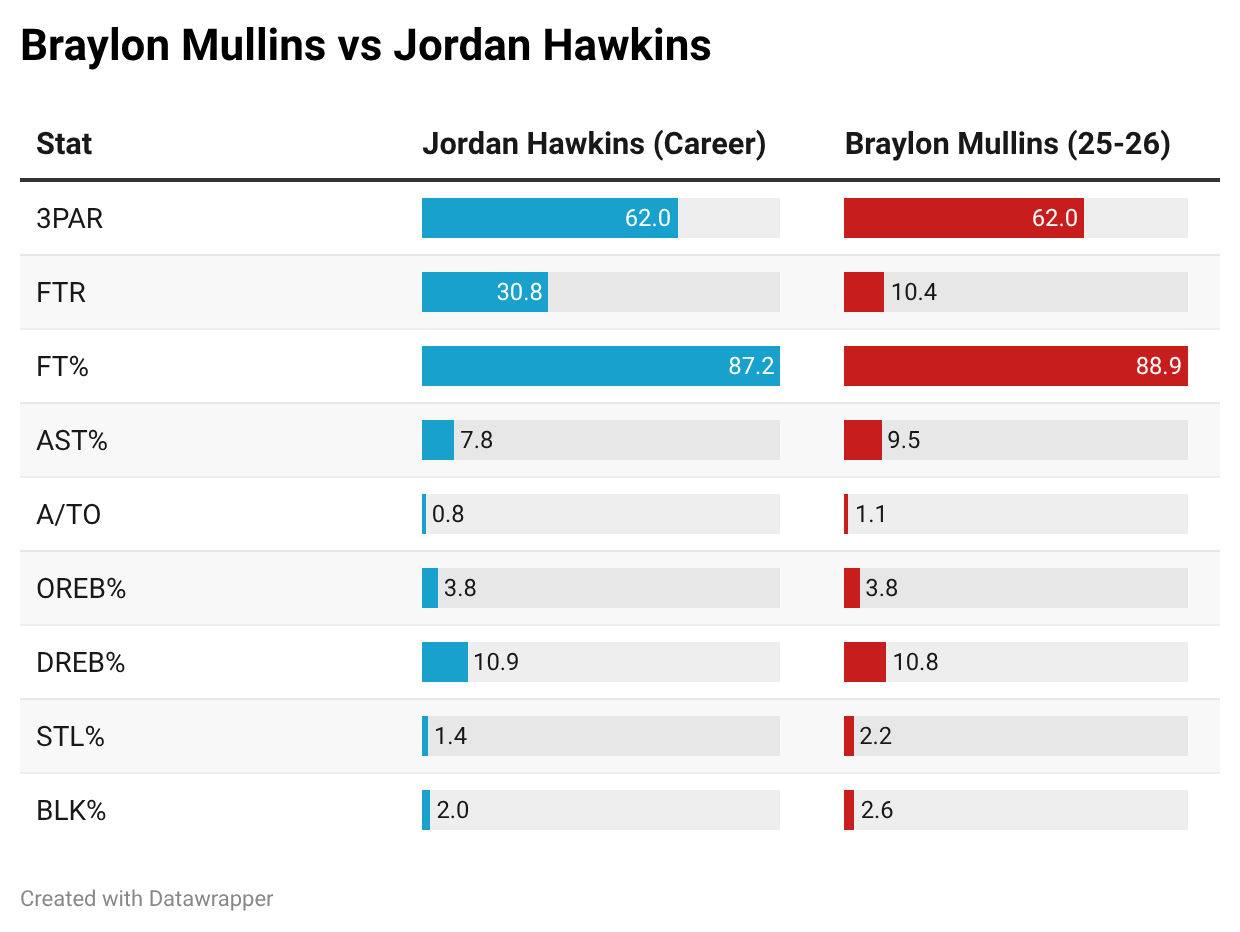
It’s worth mentioning that Mullins is a better two-point scorer and defender than his predecessor. Still, he hasn’t done enough to separate himself from the typical movement-shooter archetype.
To re-establish himself as a lottery-level prospect, he needs a season like a Huskie who’s had more success than Hawkins despite being drafted 39 picks later.
Trey Mckenney - Michigan
In year one, Trey Mckenney was a valuable bench piece for the Wolverines en route to a championship. His shooting provided much-needed spacing for a frontcourt that wasn’t exactly made up of knockdown shooters, and he paired it with being one of the team's strongest perimeter defenders.
Mckenney shot a blistering 39.1% from three on 11 three-point attempts per 100 possessions and, for good measure, made 89.5% of his free-throw attempts, building an elite spot-up shooting profile.
He also fits the above query, which signals future NBA shooting success.
But like Mullins, Mckenney needs to prove he can handle a bigger role and show he’s more than the sum of his archetype. That’ll start with taking on more on-ball responsibility and showing he can create for himself and others. Of Mckenney’s makes, 61.9% were assisted, and he had just a 6.4 assist rate.
Furthermore, the shooting guard needs to show he can add more value on the margins. His 2.3 offensive rebounding percentage, 10.5 defensive rebounding percentage, and 0.2 block percentage are at best lukewarm for his size (6’4, 220 pounds, with a rumored 6’9” wingspan) and position. Those figures—as does the film—paint him as a below-average athlete, so he’ll need to supplement his ancillary production in other ways.
Mckenney’s draft stock sits between the late first round and the lottery if he needs to significantly improve his creation and provide value outside of scoring and defense.
But there are tons of reasons for optimism, and indicators of potential self-creation efficacy. On low volume, he showed a pretty advanced mid-range toolkit. As a freshman, Mckenney knocked down 58.3% of his mid-range jumpers and shot 53.5% on all non-rim twos. He also generated 1.065 points per possession (PPP) on drives, per Synergy Sports.
Following in Their Families' Footsteps
Jeremy Fears Jr. - Michigan State
As a redshirt sophomore, Jeremy Fears Jr. had a historic facilitating season last year as the Spartans' lone ball-handler. Fears posted an enigmatic 53.0 assist percentage, which is the highest in Barttorvik’s database.
But he’s the only high-major player since 2008 to suppress turnovers in the way that he did.

Fears’s season should have generated more draft buzz: an extremely tough, physical point guard who can create for others, run your offense, and limit mistakes, but I understand why teams paused.
Though Fears has a plus 4-inch wingspan and a BMI of 26.6, he measured 6’0” without shoes at the combine. The junior also has a sub-optimal shot diet-especially for a player of his size—with a 29.9 three-point attempt rate and a 0.6 rim-to-non-rim ratio. Fears also shot under 60.0% at the rim, below 50.0% on twos, and just 32.0% from three.
He scored with respectable efficiency thanks to a monstrous (57.1) free-throw rate, which has been consistent throughout his career. Still, his rim-to-non-rim ratio and poor athletic indicators (5 career dunks, 1.6 ORB%, 8.1 DRB%, 0.6 BLK% in 83 career games) don’t paint the picture of a guard who will inevitably touch the paint.
If Fears wants to improve his draft stock and follow in his younger brother's footsteps, he must dramatically increase his three-point volume off the dribble, improve as a two-point scorer, and show he is more of a playmaker than a facilitator.
Cayden Boozer - Duke
Cayden Boozer came in last season in his brother's shadow and stayed there as his twin had an all-time great freshman year. He wrestled for playing time with Caleb Foster, but shined down the stretch when Foster went down with injury and closed the season on a promising note.

Over the season, Boozer was what he’s always been: a table-setting, low-mistake point guard who scores efficiently inside the arc and competes on defense.
The key to changing his trajectory from a four-year college guard who became a legend at Duke to a viable NBA guard option is twofold. Boozer must increase his three-point volume (31.4 3PR) and efficiency (30.3%) and show he can create more for himself. Of his makes, 40.0% were assisted, including 95.0% of three-point makes.
The sophomore could also strengthen his case by adding more on the margins. His 5.7% total rebounding rate and 0.4% block rate were poor, especially for a guard his size.
The Transfer Trio
Isaiah Johnson - Texas
As a freshman, Isaiah Johnson was one of the few bright spots on a mediocre Colorado team. He’s the son of longtime NBA skills trainer Chris Johnson, who’s worked with LeBron James, Dwayne Wade, Chris Paul, and Tyrese Maxey.
And it’s clear Johnson grew up in an environment with some of the world’s most skilled players.
He walked into Boulder and instantly became one of the best scorers in the Big 12, and arguably the nation.
On the surface, Johnson averaged 16.9 points on 63.4% true shooting, but the underlying numbers make that even more impressive for a player his age. His three-point and free-throw rates were above 40.0%; he shot a ridiculous 57.3% from two and posted a 2.7 rim-to-non-rim ratio. Johnson excelled as a pick-and-roll ball-handler, in isolation, spotting up, and coming off of screens.
Most importantly, he handled semi-high usage without turning the ball over and limited team turnovers. He had a rare blend of usage and some passing volume, while maintaining elite efficiency.
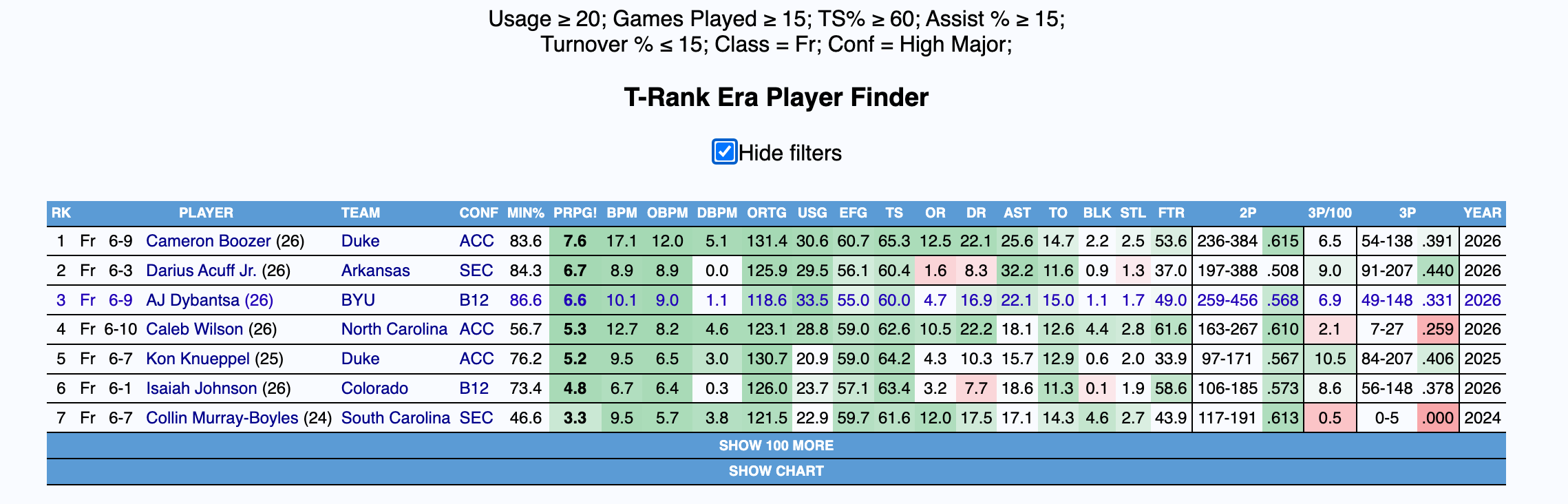
Given Johnson’s season, you could argue he deserved more draft buzz, but I overlooked him last season because he profiled more as a shooting guard; though, at 6’1, 170lbs, he’s built more like a point guard. This phenomenon is called the 1.5 guard.
Johnson’s assist volume (18.6 AST%) and AST/USG (0.78) suit two guards, and his reads are simple drive-and-kicks, pocket passes, and dump-offs. He’s also more of a reactive than proactive playmaker.
At Texas, he needs to not only add weight (reportedly put on 15lbs of muscle this offseason) but also show he can be a viable point guard. The Longhorns should be an incredibly deep, talented team with multiple playmakers for Johnson to distribute the ball to.
Beyond adding weight, he could bolster his profile by rounding out his in-between game (15% on runners, but 47% on dribble twos??) and adding more ancillary production. Last season, he crashed the offensive glass well, but his 7.7% defensive rebounding, 1.9% steals, and 0.1% blocks are lukewarm to poor.
Acaden Lewis - Miami
Acaden Lewis was one of the country's best facilitators last season, especially for his age. He’s excellent at probing in the pick-and-roll, finding his bigs with pocket passes as they dive to the rim, or quickly identifying perimeter advantages and finding shooters. His 1.42 AST/USG% is pristine, and his ability to keep turnovers relatively low 2.4 AST/TO) puts him in elite company.
The deciding factor between Lewis being a four-year guard and a real NBA prospect is his scoring process and efficiency. Lewis is a quality finisher (61.2% at the rim and 60% in the half court), but he shoots 31.2% outside the paint, including just 27% from three.
The guard doesn’t mask his poor shot-making with effective foul-drawing, and his FT% (58.3%) doesn’t inspire much optimism for future shooting growth.
As a guard who’s not an elite athlete, improving as a shooter and a shotmaker outside is paramount.
Kayden Mingo - Baylor
Kayden Mingo’s outlook is somewhat similar to Lewis’s. He’s a quality passer, slasher, and decision-maker who protects possessions, defends, and creates more opportunities for his team (both had a 3.8 STL%).
Mingo’s swing skill is also his scoring and shooting touch. He shot 24.% from three on 5.7 attempts per 100 possessions and just 70.5% from the stripe. However, there is some cause for optimism: He shot 45.3% on 64 non-rim two-point attempts, mostly floaters.
At Baylor, I’d like to see Mingo increase his three-point volume while maintaining the decision-making that makes him intriguing. He doesn’t need to become an elite pull-up shooter overnight, but showing he can punish defenders for going under screens would make his slashing and passing more threatening, especially for a player who's not a great athlete.
The other challenge is sustaining his defensive impact and ancillary production (2.1 OREB% + 12.1 DREB%) while taking on more offensive responsibility alongside his brother.