



Before Brad Underwood stepped on campus in 2017, it’d been five years since the Fighting Illini boasted a first-round pick in the NBA Draft.
Under his reign, the streak ballooned to 12 before Terrence Shannon Jr. opened the floodgates in 2024.
Since then, Illinois has been a hotbed for finding and developing NBA talent. Will Riley, Kasparas Jakucionis, and—perhaps Underwood’s most audacious find yet—Keaton Wagler headline Champaign’s deepest talent pool since the days of Deron Williams.
The Illini have a chance to keep the streak going in the 2027 NBA Draft. Coincidentally (or maybe not), their prospect with the highest chance of continuing the trend is, like Wagler, a skinny combo guard from Missouri who flew up recruiting rankings toward the end of his grassroots career.
And, like Wagler, Quentin Coleman has the talent to become a lottery pick amid the Fighting Illini’s National Championship quest.
Here’s why.
Quentin’s NBA Qualities
At the forefront of any sell for Coleman as an NBA player is his shooting ability. Over a 34-game sample gathered by Cerebro Sports, the guard posted a 37.3 three-point attempt rate and knocked threes down at a 39% clip. In his final EYBL season, he shot 39%, with 40% of his shots coming from behind the arc.
Coleman has a smooth, one-motion release with a quick trigger. He’s comfortable taking shots well beyond the collegiate line and is efficient on both catch-and-shoots and pull-ups.
Additionally, Coleman is a sharp off-ball mover with excellent spatial awareness, which allows him to relocate within the flow of any offense.
The threat of a bomb from Coleman opens up his game as a driver. As defenders converge and run him off the line, he is adept at quickly attacking a defender’s top foot as he slashes to the rim. Coleman is better at attacking closeouts or scoring off of dribble handoffs—essentially extending and finishing advantages—than he is at creating a paint touch from a standstill, but he still extracts a ton of value out of said play types.
The guard fancies a left-to-right cross, has great footwork, plays well off of two feet, and has displayed adequate touch around the rim. Most importantly, he initiates contact.
On his way to a Peach Jam Championship with Bradley Beal Elite (BBE), he shot 60% at the rim and generated 0.9771 points per possession on drives (22 percent frequency).
In AAU and during high school seasons with the Principia Panthers in Saint Louis, Coleman displayed the ability to play on and off the ball. With BBE, he played primarily off the ball, but back home he scaled up, and his passing ability flashed much more. On tape, Coleman didn’t make many advanced reads, but he’s an exceptionally quick decision-maker, never over-dribbles, and takes what the defense gives him every time.
As a result of a lower-risk passing diet, Coleman limits turnovers (1.8 AST:TO in his final EYBL session) and maximizes his team’s possessions. He takes advantage of some of the low-hanging fruit, such as hit-ahead in transitions, finding cutters on the move, and hitting shooters one pass away.
When tasked with more on-ball usage, he showed the propensity to find rollers, make interior passes as he drove to the rim, and even the occasional skip pass.
The idea of possession maximization, which Coleman exhibits through multiple facets of his game, presents the most interesting pillar of his evaluation: rebounding.
Champaign’s newest star possesses a motor that’s somewhat atypical of a five-star guard prospect. Despite his 180-pound frame, he plays with physicality. He crashes the glass with vigor, has an innate feel for where to be, and constantly creates extra opportunities. Coleman posted a 12.4 defensive rebounding percentage and an astounding 10.5 offensive rebounding percentage with BBE.
Coleman’s full offensive skill set, built on shooting, quick decision-making, ball-moving, turnover aversion, and offensive rebounding, builds a portfolio of traits that has led to positive impact for several NBA players. Players who shoot a ton of threes, crash the glass, and limit turnovers have pathways to three-factor (offensive true shooting, offensive turnover, and offensive rebounding) impact. They can help offenses function more efficiently.

If Coleman can show the same scalability across contexts as he did in high school, while maintaining his ancillary value, I’m bullish on his chances of being a lottery pick next June.
But first, I’d like a few questions answered.
Coleman’s NBA Concerns
Coleman has said the Illini coaching staff compared him to other players they’ve had in the past during their pitches to bring him to the University after he decommitted from Wake Forest.
I’d imagine Wagler was the main comparison, and it goes beyond the aesthetic reasons mentioned earlier.
Both are physical, high-feel guards who are great shooters; they can play on and off the ball, and also crash the glass.
And, unironically, I have a few of the same concerns for Coleman that I did for Wagler.
For starters, he’s really light, and his lack of strength hinders him on both ends.
Defensively, he can struggle at the point of attack when guarding stronger players who can move him back and score through and over the top of him.
Coleman frequently conceded drives to quicker/shiftier guards and stronger, more powerful wings. At his size, he’ll also likely be incapable of switching onto bigger players and holding his own.
He’d sometimes struggle to slide his feet and cut guards off, and his hips were too high on occasion.
However, Coleman doesn’t take many plays off; his motor and feel are apparent on both sides of the ball, even when he gets overwhelmed physically.
Though he may struggle as an on-ball defender until he puts on more muscle, I was routinely impressed by his off-ball defense and ability to generate turnovers. He posted a 2.7 STL% at EYBL and averaged 2.5 steals per 40 minutes in Cerebro’s 34-game sample.
Coleman has some fantastic digs at the nail, closed out well on shooters, and possesses great hand-eye coordination that helps him get deflections and steals in passing lanes.
The guard’s event creation and team defense could help quell some concerns about his individual defense, but my questions about his lack of strength are exacerbated on offense because he lacks top-end foot speed, burst, and vertical athleticism.
Coleman is a crafty player who plays with pace and can finish with both hands, but I am skeptical of his upside as a creator because of the aforementioned concerns. He can struggle at times to create clean separation against longer and more athletic defenders. He also has room to improve when finishing through contact.
Despite Coleman finishing 60% at the rim overall, he shot just 50% at the rim in the halfcourt in his final AAU season, and he’ll face much more potent rim protection in the Big Ten this season. Without a go-to non-rim counter (or a monstrous free-throw rate), he could struggle from two, similar to his predecessor.
It’s paramount for Coleman to keep fine-tuning his deceleration as the competition rises and he grows into his body.
The latter part can be more complicated, but fortunately for Coleman, Illinois has one of the best strength-and-conditioning programs in the country.
In fact, his decision to choose the Illini as the environment to help him blossom into a pro makes me more bullish on what his performance could look like this season.
Far from a Verdict
Illinois has an ecosystem tailored to maximize Coleman’s strengths. Perhaps that’s why the Illini recruited him so hard.
Last season, Illinois ranked in the 96th percentile in three-point attempt rate and the 99th percentile in both offensive rebounding percentage and turnover percentage. In other words, the Illini already emphasize what makes Coleman such an intriguing prospect.
They generated the nation’s second-highest adjusted offensive rating despite being almost allergic to fast-break points. Illinois averaged just 5.6 fast-break points per game, ranking in the third percentile nationally. The team also plays a conservative defense that disincentivizes gambling for steals and is meant to keep the team out of the rotation. As a byproduct, the Illini have been outside of the Top 100 in forced turnover rate in seven of Underwood’s nine seasons.
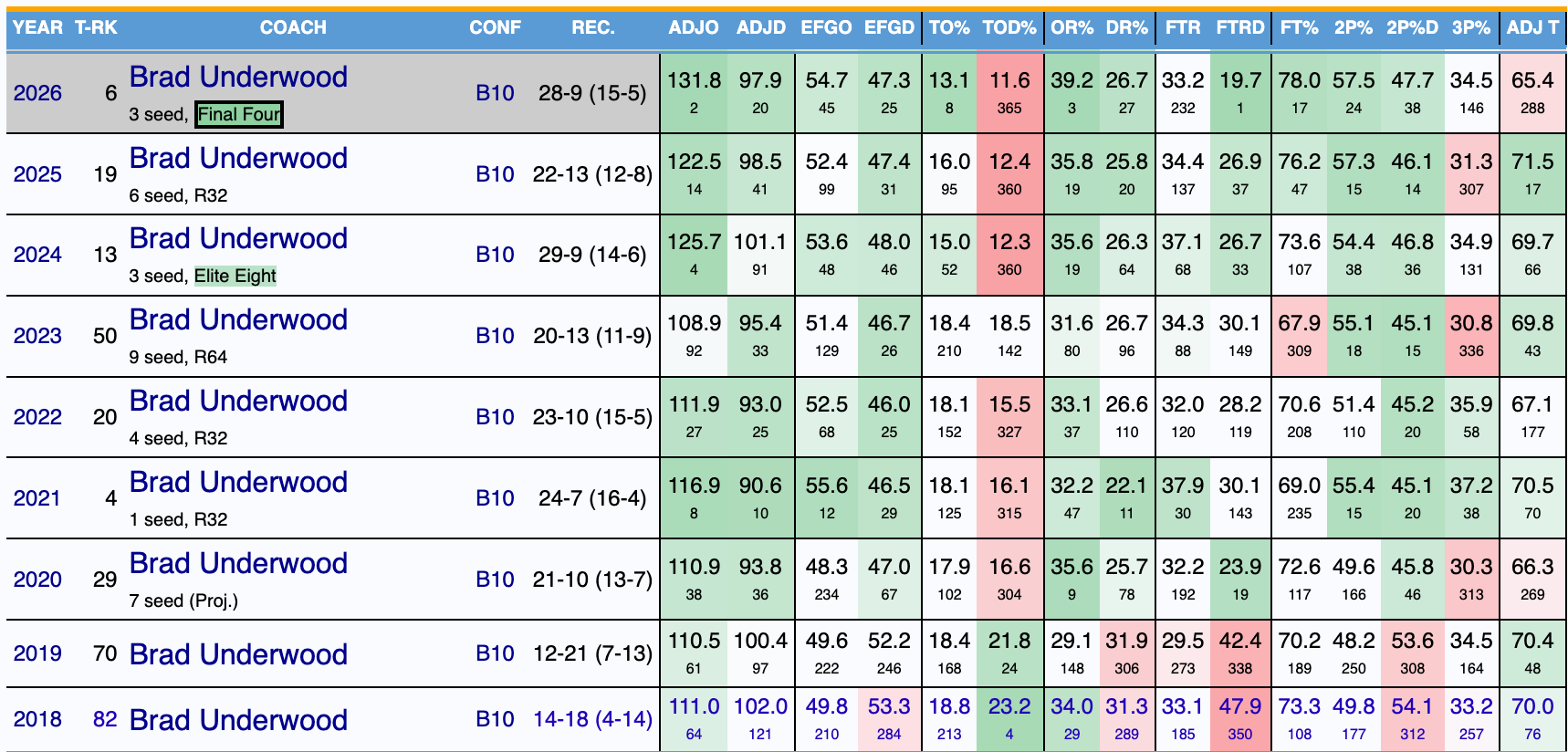
Instead, Underwood’s offense thrived through deliberate halfcourt execution, spacing, crashing the glass (a Top 20 in OREB% in four of eight years), and heavy doses of pick-and-roll offense.
The Illini have run a five-out system with bigs who can roll or pop, giving their ball-handlers an overwhelming spacing advantage. In back-to-back seasons, those offenses have been captained by high-volume pick-and-roll creators in Jakucionis and Wagler.
That responsibility will likely fall primarily to transfer guard Stefan Vaaks, who ranked in the 89th percentile in pick-and-roll ball-handler volume last season.
Early on, I’d expect Coleman to operate as Illinois’s secondary ball-handler and a movement shooter, attacking tilted defenses rather than being solely responsible for breaking them down himself.
That should play directly into his strengths as a scorer and passer.
Coleman can relocate around Vaaks-led actions, punish defenders for helping off him, attack closeouts, and keep possessions moving without requiring a high volume of touches.
His offensive rebounding should also translate particularly well in a five-out system, where his instincts and motor can punish defenses stretched away from the basket.
The more interesting question is how much Illinois eventually asks him to scale up.
With Vaaks’s addition and Andrej Stojakovic returning for another season, Coleman’s usage isn’t clear-cut. He could slide into a role closer to the one he occupied with BBE, functioning mostly as an off-ball scorer, or he could absorb more creation responsibility in David Mirkovic’s temporary absence.
Either outcome should tell us something valuable about his NBA projection.
In the former, Coleman gets an opportunity to prove his ancillary skills translate immediately. Can he remain an efficient shooter, crash the glass at an elite rate, buck the trend of the Illini’s anemic defensive playmaking, and consistently make the right decision without dominating the ball?
But the latter scenario is where Coleman could establish his ceiling.
If Illinois entrusts him with more pick-and-roll reps and he proves capable of consistently creating advantages against Big Ten defenders—rather than merely extending ones created for him—his pathway to the lottery and the Illini’s pathway to four first-round picks in a row become crystal clear.
level up
Awesome debut, Latif!