


The coming 2026-2027 season has drawn some skepticism from both draft fans and analysts alike. You’ll hear things along the lines of “I mean, sure, there will be NBA players come out of this class, but it’s not very good.”
When I hear sentiments such as that, it makes me feel some sort of amalgam of frustrated and sad, but—mostly—motivated. Comments like that gas me up to find players who can shine and thrive. Not to say that I’m right and everyone else is wrong, but it’s worth remembering that thousands of basketball players are about to play a full season of basketball.
I get what people mean when they call a class “weak” or “not very good.” They mean there’s no Cooper Flagg or Victor Wembanyama standing at the top of it, already announcing himself as a generational talent.
Fair enough.
But in 2024, I—along with the rest of you—was told that class wasn’t any good either. And I’m pretty sure I just watched Stephon Castle play a significant role on a team that went to the NBA Finals. Which isn’t to say there weren’t good players in that class all along; it was just that they hadn’t been found yet.
So, what’s my point here?
What we’re going to do here and in the following piece is highlight 15 players I’m leaning on to help shape the depth and quality of the 2027 NBA Draft. What I’m not going to do is pick at the top of the board. Top freshmen prospects will be covered elsewhere within No Ceilings, whether that’s here on the website or across our podcasts. Even the top returning prospects in this class won’t be covered here. To show there are plenty of prospects worth getting excited about, I want to focus on players who are primed to make “The Leap” into the consciousness of the greater basketball community (maybe not for all of you Sickos out there).
Five prospects will be evaluated here, five will be covered in the second part, and five in the finale.
Let’s dive in!
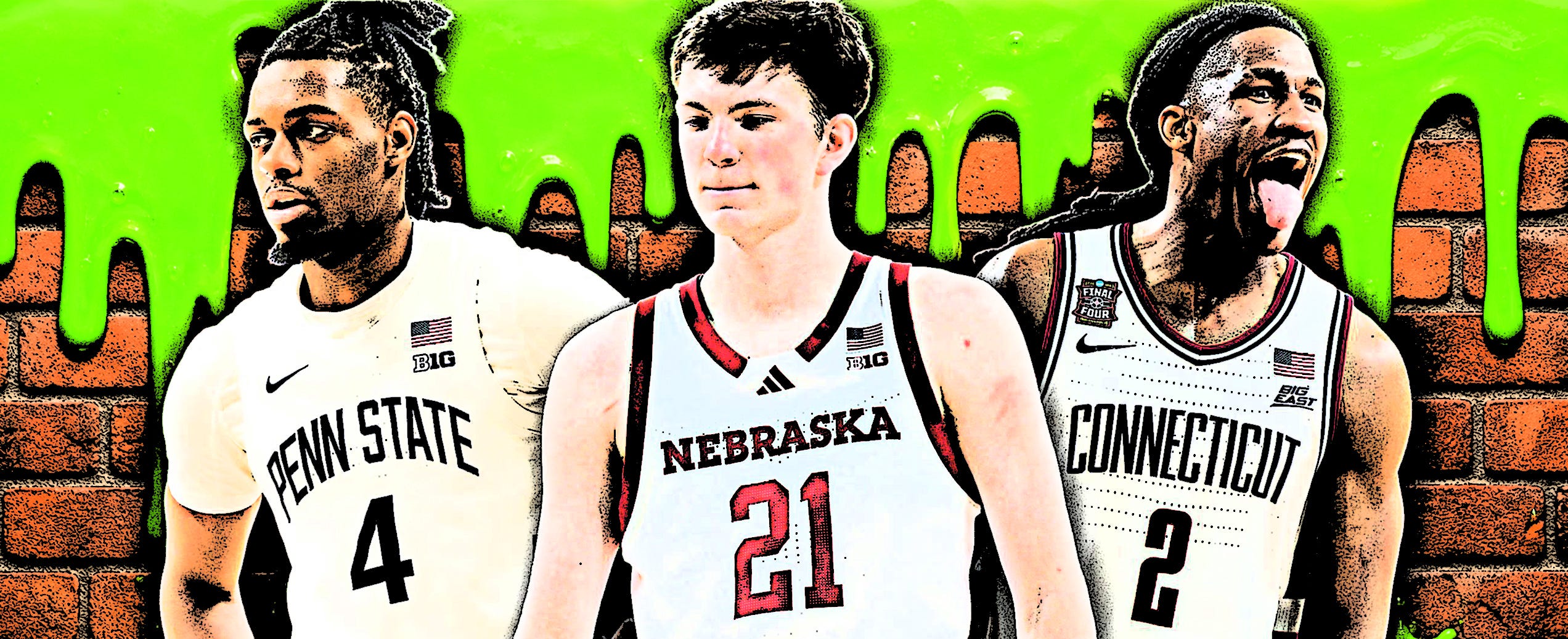
Pryce Sandfort | Wing/Forward | Senior | Nebraska
Many know Pryce Sandfort as the younger brother of now-NBA player Payton Sandfort, but Pryce has been one of the most productive, ascending talents in the college basketball landscape. Coming out of high school, Sandfort was a fringe-Top 100 recruit and committed to play for the Iowa Hawkeyes—the same school as his brother. He spent two years with Iowa, playing a modest role before transferring to the Nebraska Cornhuskers. Last year, Pryce experienced a significant leap in his own right—going from 8.8 PPG on 49/40/64 shooting splits as a sophomore, to 18.1 PPG on 48/42/86. With his role and usage the highest they’ve ever been, Sandfort led Nebraska to a 28-7 record—a seven-game improvement for the team.
What’s Working
Floor Spacing
Much like his older brother, Pryce Sandfort has carved out a true niche as a floor-spacer. Sandfort has been a 40%-or-better shooter from distance in each of the past two years, and his 15.9 attempts per 100 possessions helped him get recognized as a premier marksman. In terms of shooting gravity, Pryce is elite. He shot almost 42% from deep on high volume, shot nearly 86% from the free-throw line, and shot 40% on his far two-pointers. The shooting motion figures to translate well. Sandfort mobilizes it well—gathering the ball on handoffs and screen actions, and shooting off platform. The release is quick and high, and he can make it rain whether he is guarded tightly or not. That floor spacing will be his primary skill to get him real looks in the NBA, but that isn’t all he brings to the table.
Decision-Making
Being a laser from deep is a fine skill to hang one’s hat on, but if that’s all you can do, you’re going to be relegated to a significantly smaller role. This is especially true if a player cannot be trusted to make decisions with the ball in their hands. Pryce has proven to be a solid ball-mover in his own right. What’s interesting is that he isn’t an offensive hub—or someone who is going to generate for the entire team—but he does make passes while attacking the basket more than one might assume based on his shooting ability. Sandfort keeps his head up and looks for opportunities to find his guys on the move. His assist-to-turnover ratio of 2.1 was quite good relative to the other players in the 2026 NBA Draft cycle (ranked 57th among players with a Minutes Percentage of at least 40). This bodes well for Sandfort when he does make the jump to the NBA, as he will have to make those quick decisions upon the catch.
At-Rim Finishing
Look, to acknowledge this right off the rip, Sandfort doesn’t get the lion’s share of his shot attempts at the rim. In fact, per Synergy, 15% of his shots are at the rim. BUT! Pryce has converted 70.3% of his 101 attempts from there. When you have this sort of variance in terms of efficiency, like always, you have to take it to the film. Sandfort plays aggressively once he looks to attack inside the three-point line. What helps him is that Pryce doesn’t look to do a whole lot of “east-to-west” movement; he is much more interested in making decisive lines to the rim. He’s not averse to contact, either, as Sandfort recorded 10 And-Ones last year—six of which came on drives to the basket. With Pryce returning, this is one aspect of his game that I will be keeping tabs on, as it could unlock the rest of his offensive repertoire.
What Needs Work
Defensive Playmaking
Pryce Sandfort isn’t going to be confused for a disruptor on the defensive end. And, ultimately, that’s probably going to be just fine in the long run for his role. Still, any sort of step forward in this area would make him that much more desirable. When factoring his size and functional position, Sandfort’s 1.1 Block Percentage and 1.8 Steal Percentage are slightly below average, historically speaking. He doesn’t have the sort of twitch or pop to recover if he loses his line or positioning on defense, so Pryce has to win on defense by doing his work early—toggling between man-ball-rim and being fundamentally sound. Based on his film and his metrics last year, Sandfort actually projects as a neutral-level defender. With low defensive playmaking numbers, this projection is largely based on his impact on the overall team defense with Nebraska. Any meaningful strides in the playmaking department only increase his value on that end of the floor.
Rebounding
With the increase in playing time, it was good to see Sandfort average two more rebounds per game in his first season as a full-time starter. To be fair, Sandfort isn’t necessarily a “bad” or “poor” rebounder in totality, but he isn’t “plus” or “above average” in that regard, either. In terms of offensive rebounding, he doesn’t grade favorably—but much of that has to do with his role on the offensive end. When dissecting his finishing preference, most of his shots come from the perimeter (he actually grades out in the 100th Percentile in perimeter finishing). This would explain why his numbers would be a little lower on the offensive glass. On the defensive end, he does leave a little to be desired. His 14.2 Defensive Rebounding Percentage sits at about average. This takes me to a similar thought process for his rebounding as I had for Sandfort’s defensive playmaking: any meaningful improvements only make him that much more desirable.
What to Expect
With another offseason to work on his body and game, there are plenty of ways this season could go for Pryce Sandfort. The obvious expectation is for him to continue to be one of the best shooting prospects in the class. Even in the lower outcomes for Pryce, his combination of high volume and accuracy is going to get him his fair share of looks in the NBA. What makes him more than just another shooter is his feel for the game; it places him into another level of prospect. Think of it like this: this past draft—featuring a loaded class—Richie Saunders, Isaiah Evans, and Meleek Thomas were priority second round picks. In fact, they were selected 32nd, 33rd, and 34th overall, respectively.
Speaking to the “working on his body” piece, this could be major for the rebounding—and even Pryce’s increase in at-rim frequency. It remains to be seen whether 1) Sandfort has, in fact, made these improvements, and 2) whether those improvements would help him improve his defensive playmaking. It’s an easy assumption that improved strength and, perhaps, strides in foot-speed, agility, and quickness would allow him to be a quality team defender. To that, I would expect Sandfort to at least hover around that neutral-level defensive projection.
All of this leads me to have Pryce as a pretty safe first round player. I’m not going to pretend to understand the rules around someone being able to return to college basketball, but it would appear that Sandfort would have the ability to play another year of college basketball if he wanted to. Sandfort’s junior season had parallels to how Corey Kispert and Reggie Bullock performed in college—heck, his offensive efficiency even got close to Suns-era Mikal Bridges and Kon Knueppel. When considering that, there is a level of safety in Pryce being a successful NBA player—which should place him around the Top 20 at a minimum.
Silas Demary Jr. | Guard | Senior | UConn
A common thread you readers will probably catch on to here is that the players featured in this series were quite productive, but that production went under the radar relative to those who were often featured in mock drafts and big boards. Silas Demary Jr. at UConn was one such player. In his first season with the Huskies, Silas actually saw the number of his shot attempts and minutes go down under Coach Hurley. This was likely an expectation coming from a school that hasn’t really gotten the most out of their talent—and Demary had talent. He was a consensus Top 75 prospect in his class coming out of North Carolina. Despite the slight drop in shot attempts and minutes, Silas averaged 10.1 PPG, 5.9 APG, and 4.5 RPG—on splits of 45/39/80. His production played a significant role in UConn reaching the National Championship game.
What’s Working
Advantage Creation
One of the best aspects of Silas’s game is how consistent he has been in terms of generating offense for his team. His Assist Percentage of 35.8 ranked 24th among all 2026 season prospects and holds up well against all played seasons since 2008. Demary spent 60.9% of his offensive possessions (including turnovers and assists) operating out of the pick-and-roll. That ranked in the 95th percentile in terms of time spent in that play type—and he ranked in the 67th percentile in points-per-possession there, too. Demary is incredibly comfortable advancing the ball deeper into the heart of the defense. He keeps his head up and his handle alive—with an understanding of where his escape routes are. While he hasn’t been the most efficient at the basket (more on that in a bit), Silas did put up more than 40% of his shots in the heart of the paint. His ability to be a pressure point for the offense is a desirable trait to have at his position—especially when considering what else he can do on the offensive end.
Floor-Spacing
If there is a thing I can be an absolute sucker for, it’s continuous improvement in a prospect. Over the past three seasons, Silas Demary Jr. has improved his three-point percentage from 30.3%, to 37.4%, to 38.5% last season in Storrs. For someone in his position, Silas did a solid job of connecting on his off-the-dribble threes last year. He gets into his shot quickly and does a good job of organizing his feet. While the shot has a tendency to be a bit of a line drive, it falls softly and has fallen at an above-average efficiency. Though the volume isn’t that of someone like the aforementioned Pryce Sandfort, he has been an 80% shooter from the free-throw line over the past two seasons. He also shot just under 40% on his long two-pointers last season. These touch indicators—on top of his year-over-year increased efficiency—should provide some confidence in Demary being a reliable floor spacer on top of his creation.
Defensive Prowess
Guards in the NBA have taken on a unique role and responsibility if they aren’t the source of offensive generation. If their offensive burden isn’t a primary option, NBA guards have a few paths to be helpful—but the most meaningful is being able to space the floor and make good decisions on offense. On the other end of the floor, they have to be capable of applying intense pressure to force turnovers. Silas Demary Jr. has the tools to thrive in that role. His impact on the defensive end is exemplified by his 4.8 DPPM ranking—which grades out high historically. Demary has the strength and quickness to fight through screens and stay in the play. That strength also allows him to maintain his line defensively. His athleticism affords him the ability to force events on defense—whether that’s getting off the floor to challenge shots or swiping and intercepting the ball to create easy looks for his team (his Steal Rate of 3.4 grades out above average compared to BartTorvik’s database).
What Needs Work
Decision-Making
It may seem strange to compliment Silas on his ability to pressure the defense and create opportunities, but then call his decision-making into question. As great as the Assist Percentage was for Demary, though, the Turnover Percentage was quite high. Now, sure, there is a “cost of doing business” when a playmaker has the ball in their hands at a high rate. The thing with Silas was that he wasn’t a player with an incredibly high usage last season—his Usage Percentage came in at 22.5. That’s compared to a Turnover Percentage of 21.3. Silas isn’t much of an “east-west” creator, as he favors straight-line drives to advance the ball. So, when he does attempt to improvise a bit, this is where he is more prone to make mistakes. Making improvements in this area will give NBA teams more confidence in Silas running different lineups.
Rebounding
Quite the nit to pick with a guard, isn’t it? Seriously, there aren’t many considerably weak areas to Silas’s game, but improved rebounding is something I want to see. There isn’t the typical “small guard” excuse that exists with Demary as there is with other positional peers. Even if he isn’t truly 6’4”, Silas is strong and athletic. Some of the reasoning for his numbers could be architectural: something that’s dictated by Coach Hurley. The big men and frontcourt players typically come down with the lion’s share of the rebounding, which makes sense. Therefore, this could be something he leans on more in the NBA, as he isn’t particularly a poor rebounder. Silas is just capable of doing more in that regard.
What to Expect
Again, I’m not going to pretend like I fully understand what is and isn’t happening with college eligibility at this point. But should Silas Demary Jr. opt to be more traditional in his path to the NBA, there is a strong probability that he could be drafted this season. His numbers last year did compare favorably to some former NBA players—as well as some prominent collegiate standouts. While Brad Wanamaker isn’t the NBA player kids grow up wanting to be, he did make a path to the league—and Silas has some defensive similarities to him. What helps Demary is that he was clearly a better offensive option than Wanamaker while maintaining similar defensive impact. To speak to his feel, Demary was in similar creation territory to Bennett Stirtz in the 2025 NBA Draft cycle. He even paralleled Mason Falslev out of Utah State—a draft community sweetheart—this year on defense and in shooting efficiency. If he can show more reliable decision-making while pressuring the defense, NBA teams should be more inclined to take him in a similar spot to where Bruce Thornton was taken in the 2026 NBA Draft.
Kayden Mingo | Guard | Sophomore | Baylor
Speaking of the 2026 NBA Draft, that class was clearly recognized for the quality of the prospects at the top. To me, though, the identity of the class came from the depth of guards—particularly the freshmen guards. While at Penn State, Kayden Mingo had a productive season in his own right, but it wasn’t quite at the level of his peers. Kayden started all 28 games he played for the Nittany Lions—averaging 13.7 PPG, 4.3 APG, 3.5 RPG, and 2.1 SPG. This came on 48/24/71 shooting splits. After his freshman season, Mingo took to the transfer portal to play with his brother, Dylan Mingo, at Baylor for his sophomore campaign.
What’s Working
Advantage Creation
Kayden Mingo plays with a ton of poise while handling the rock. There is a certain “aura” (as the kids say) he has while bringing the ball up the floor and assessing where his line of approach is going to be. His pacing allows him to essentially set up the defense where he wants them to be, and then explode past them. It’s kind of like a running back setting up their blocks. Kayden is able to pressure the basket, which gives him the option to finish at the rim (more on that in a second), or allows him to find an open teammate. His Turnover Percentage of 15.3 is pretty good compared to his 26.4 Usage Percentage. His processing is quick and is perfectly encapsulated by his 2.1 assist-to-turnover ratio. Mingo is able to find his teammates on the move, and can make seemingly every pass a guard needs to make. There is more that goes into advantage creation than simply the passing component—which we will get into next.
Interior Finishing
What makes Kayden such a dynamic player is that he can get to the cup, and he can finish once he gets there. As a player listed at 6’3” and 195 pounds, Mingo ranked in the 62nd percentile in terms of at-rim attempts. When he got to the rim, he finished at just under 63%—which ranked in the 71st percentile in at-rim finishing. While he could stand to get a little tougher, Mingo has a bevy of moves he can go to in the paint. He has good length and pacing to be able to gather the ball on those Donovan Mitchell-esque, high rip-overs. His Euro is fluid and comes naturally, allowing him to shield the ball away from the defense. He also has those random moments of suddenness that allow him to pirouette and contort around would-be rim protectors. And—again—even though he isn’t super thick, Kayden is more than capable of absorbing a bump when attacking the rim.
Defensive Playmaking
One of the tricky things when it comes to evaluating guards is figuring out how much they can contribute to teams. Oftentimes, it comes from just having a ton of usage on offense. For Kayden, being an impactful defender is another path to success. Mingo has solid length for his reported 6’3” size. He also has a reported 6’6” wingspan. His quickness on offense also shows up on the defensive end; he paces himself well, waiting for the right moment to make a play on the ball. Even when looking at how he handles being attacked by drives, Mingo has shown consistent moments of fundamentally sound footwork and vertical play. There is a sound blend of knowing where to be on defense and how to get there—as well as someone who can force transition opportunities. This is exemplified by his 63 stocks (steals + blocks) generated, compared to his 53 fouls committed. His Steal Percentage of 3.8 placed him 53rd among all college players with a Minutes Percentage of at least 40. This two-way ability should come in handy while some of his areas of improvement round into shape.
What Needs Work
Shooting
There is no dancing around it: Kayden Mingo’s jumper is the biggest area of his game he has to figure out. That’s not me taking an easy way out—or picking low-hanging fruit—but it’s the most glaring weak area. Looking at the numbers, Kayden shot under 25% from three, which grades out slightly below average. Even his volume of 5.7 attempts per 100 possessions is in that same bucket of slightly below average. For those who value free throw percentage, he barely cleared 70%—which also falls in the slightly below average range. When guarded, he only shot 15% from deep. When he shot off the bounce, he barely cleared 26% beyond the arc. One of the biggest things that stands out with Mingo’s shot is that the base can be pretty inconsistent. Starting with the foot placement, he has a tendency for one of his feet to be significantly further ahead than the other. This affects his balance, which leads to the trajectory of the shot going off. Beyond the placement, he also flares his feet outward—away from each other, even. If this had a chance of drawing a shooting foul, I wouldn’t like it, but I would understand it. However, he does this even when there is no defender closing out on him. This untamed footwork also impacts the mobility of the shot. If there is some glimmer of hope for the jumper to take a step in the right direction, it’s that he shot over 45% on his far twos—which is quite high.
Frame and Strength
Look, I know I’ve made the case that being a little slight hasn’t gotten the better of Kayden where it matters. Just to speak to how good he is at essentially everything else, though: if he can improve in this area, Mingo can be a real problem. I mean that in a very good way. With as much time as he spends in the teeth of the defense, he could stand to have some added strength to attract and finish through contact. To put this idea into context, Mingo ranks in the 81st percentile in how I track interior scoring profiles. This is juxtaposed against him ranking 1,067th in Free Throw Rate. His lack of strength also shows up in the rebounding numbers. Even though he is a 1 positionally, most of his shots came near the basket. Keeping that in mind, his offensive rebounding numbers were lackluster. Even among players his height or smaller, Mingo ranked 332nd. On the defensive glass, he only ranked 118th. Should he improve in terms of strength, Kayden could really shore up his ability to be a three-level scorer from the inside—as well as in his rebounding.
What to Expect
Of course, there are several outcomes that exist with Kayden Mingo and his translation to the NBA. Not only do we have the areas of improvement he must, well, improve upon to weigh, but now we have an entire new school, scheme, and cast of teammates that make things a little tricky to factor into his projection. That being said, Baylor landing Kayden—who was a Top 40 RSCI recruit last season—should imply that Coach Scott Drew will lay a hefty amount of responsibility on Kayden Mingo’s shoulders. When comparing Kayden to past NBA players, there aren’t a ton of tight matches at the top. BUT, there is one name that rises to the top that is intriguing: De’Aaron Fox. Both have similar frames, similar burst, and a tendency to apply rim pressure. In Fox’s lone season with Kentucky, he showed a stronger Free Throw Rate and defensive playmaking than Mingo, but Mingo was a better finisher inside the three-point line. Their rebounding and three-point shooting parallel each other. Fox serves as an example of how Kayden could thrive in the NBA at, perhaps, his highest ceiling. Fox grew to be a career 33% three-point shooter in the league—and a multi-time All-Star and All-NBA player. When looking beyond the obvious names within this coming draft class, a player like Kayden Mingo should be in consideration for being a Top 20 player based on what we have seen, and could see moving forward.
Adlan Elamin | Forward | Sophomore | Cincinnati
If there is such a thing as an unheralded, under-the-radar prospect, Adlan Elamin is that idea personified. Coming out of high school, Elamin was a three-star (or four-star, depending on the outlet) prospect out of Virginia. He won a state championship and led his team to multiple high-winning seasons. With his success, he was recruited by Iowa, Penn State, and VCU. His commitment to Utah State resulted in him starting in 28 of the 35 games he played for the Aggies. Utah State went 29-7 with Adlan averaging 6.7 PPG, 3.1 RPG, 0.9 APG, 0.7 SPG, and 0.5 BPG. After a Round of 32 loss in March Madness, Elamin hit the transfer portal—ultimately committing to play for the Cincinnati Bearcats.
What’s Working
Finishing
To start, Elamin isn’t a perfect finisher, but he was still highly efficient around the basket in spite of that imperfection. His reported 6’9” frame comes in handy when he is operating around the cup. He can finish above the rim—regardless of whether he’s in transition or in the halfcourt. Adlan showed some ability to work his way into the paint off the bounce, finishing in crafty ways. There were multiple occasions in which he used his body to shield off defenders and used his reach to protect the ball while converting his shot. Elamin has awesome instincts for when to attack the rim, and which angle to attack it from. This is what allows Adlan to be an above-the-rim finisher on lobs in the halfcourt.
Defensive Playmaking
The length and athleticism of Adlan Elamin have their place on offense, but his natural tools and abilities flashed more on the defensive end of the floor. Last season, he was one of only 29 freshmen who recorded a Steal Percentage and a Block Percentage of at least 2.0 with a Minutes Percentage of at least 40. Adlan is a major disruptor. His length and stride allow him to be a force on the weak side as a rim protector. He’s proven able to defend up against some players who some would assume would give him problems physically. There is an elastic quality to how Elamin defends that keeps him in plays—that allows him to recover at a high level to send shots in reverse. He has active hands and sound timing for poke-outs and digs as ball handlers look to attack him. It also helps that Elamin has a reported 7’ wingspan.
What Needs Work
Connectivity
For the things that Adlan Elamin is good at, there are some significant areas of his game he needs to clean up. Perhaps one of the easier areas he could make strides in is his connectivity. Elamin’s Assist Percentage of just 8.0 isn’t great, but some of that could just be due to him being designated as a play finisher. When putting on the film, there are moments when Adlan surprises as a ball-mover. He is better as a stationary passer, but he’s proven capable of taking a few dribbles and dishing the ball to a teammate in scoring position. Where he struggles is when he’s trying to create out in the open floor. The handle has gotten away from him a few times. Other times, Elamin turns the ball over due to traveling. If he can make more controlled and structured reads, Adlan can be more consistent than a player who just shows flashes of playmaking.
Shooting
Elamin is another player who can stand to improve as a shooter. He shot just over 30% from deep—which was below average. He did this on 7.7 attempts per 100 possessions, which is pretty modest volume. When you look at his long two-point percentage, he only shot 35.3%—also below average. Adlan’s shooting motion isn’t terrible, but there are parts of his mechanics that need cleaning up. The shot is kind of “flicky” and out in front of his space. It’s good to see that his jumper doesn’t take a lot of time to get off, but that rigidity could be the aspect of his shot that’s impacting his efficiency. He’s also really only a threat off the catch, as that’s where he’s most comfortable letting it fly. Adlan missed all nine of his off-the-dribble shots last season, per Synergy.
What to Expect
I’ll start by saying that I am aware I only included two categories under the “What’s Working” part of Adlan Elamin’s writeup. That’s because there’s a huge “boom/bust” dynamic that exists with him—almost a fork in the road. Elamin had a very low usage (just over 16) with Utah State, and plenty of areas to improve. The good news is that there was just enough to believe in. We touched on the flashes of passing skill, but he also shot 42.4% on his open three-pointers. He also shot 83% on his free throws. Mix in that his threes per 100 were decently encouraging, and there could be a shooter in waiting with Adlan. There is also some historical context that gives hope for Elamin. His freshman season has some similarities to that of Franz Wagner. Franz had more of a scoring punch and was a better rebounder, but Adlan was more efficient and showed a higher assist-to-turnover ratio. The good news is that Elamin has a ton of tools and showed versatility on both ends. He has to go out there and realize his potential. Even some of the “lesser” comps for Elamin are talented collegiate prospects who could still have a path to playing NBA basketball. This will likely result in me having Elamin as a second round player—with the understanding that this range would more than likely result in him returning.
Julius Halaifonua | Big | Junior | Oklahoma State
Rounding out this group of prospects is now-Oklahoma State Cowboy big man Julius Halaifonua. One of my favorite recent trends in roster-building has been the resurgence of value in drafting bigs. It turns out that screening, rebounding, and anchoring a defense are all still important to the game of basketball. Who knew? It’s because of this that I find Halaifonua so interesting. Halaifonua, a New Zealand native, conquered basketball in New Zealand and Australia before making the leap to the U.S. He was recognized as one of the best big men in the 2025 class prior to reclassifying to the 2024 class. He spent his freshman season with the Georgetown Hoyas, where he appeared in just six games. Halaifonua returned to the team for his sophomore season and played a significantly larger role. Julius averaged 9.5 PPG, 4.4 RPG, 1.3 APG, and 0.7 BPG while playing nearly 20 minutes per contest. He went from not starting a single game to starting in 28 of the 32 games he played with the Hoyas. After his season was over, Julius entered the transfer portal and committed to play for Oklahoma State and a revamped roster.
What’s Working
Play Finishing
Halaifonua is a player who can make the most of a shot opportunity around the basket. There is an ease to his movement and surprising quickness in his footwork that allows him to pile on points in a hurry. He has counters on the block—up-and-unders, jump hooks, step-throughs—you name it. His touch in the midst of the trees is one of the primary reasons why he led Georgetown in points-per-possession. Listed at 7’ and 260 pounds, Julius is light on his feet but also strong. He’s adept at carving out space in the paint and can maintain his man on his hip—allowing him to establish position and stack up points. To put numbers to the words, last season Halaifonua ranked in the 65th percentile as the roll man on pick-and-roll plays, the 90th percentile on cuts, and the 78th percentile on post-ups. His reliability as a play finisher gives Julius an immediate role on the offensive end.
Passing
I touched on some of the things big men have to do in order to succeed within today’s game: finish, rebound, and protect the rim. However, big men must also be able to process and make good decisions as passers—at least, if they want to see significant playing time. This is an area where Halaifonua thrives. His work in DHO sets is encouraging. Of course, he can hand the ball off and use his size to pave driving lanes for other ball-handlers, but he can also reject the handoff and find cutters with a slick bounce pass. When he’s backing his man down, Julius does an awesome job of keeping his head up and finding shooters to kick the ball out to. He can also get into his post moves, maneuver toward the rim, and find others cutting to the basket. His decision-making profile shows a player who posted a 1.7 assist-to-turnover ratio. On a modest 20.6 Usage Percentage, he only had an 11.0 Turnover Percentage. This sort of baseline at a school that isn’t in the limelight allowed Halaifonua’s game to go a little under-the-radar.
What Needs Work
Defensive Consistency
Back to the things big men have to do at the next level (finish, rebound, and protect the basket): Julius needs to become more consistent in this area of his game. To put it bluntly, he fouls a lot. There are parts of his defensive profile to be excited about, but he has to be able to stay on the floor for any of it to truly matter. He’s strong, and he knows it—he has the enforcer mindset, similar to that of Matas Vokietaitis. He’ll put his chest into someone, and he’ll look to “steer” his man into disadvantageous positions, but he’ll bite on pump fakes. He’ll hook and hold down would-be rebounders. He’ll reach, swing, and hip-check drivers if he’s out of position. Now, there’s a school of thought that says: “don’t allow easy baskets.” BUT, if Julius wants to be a “three-down back” as a big man, he has to work on his positioning and hone in on those cheap fouls that limit him and his team.
What to Expect
Like Adlan Elamin, I really only have two areas under the “What’s Working” section of Halaifonua’s writeup—but I also have just one area under the “What Needs Work” portion. That’s because, for his position and playstyle, things are a little more straightforward. Reports online suggest that Julius doesn’t have a substantial plus-wingspan, which is a little disheartening at face value. That shows up in some of the rebounding and shot-blocking numbers.
What is encouraging is that Halaifonua still has sound metrics (albeit not earth-shattering) despite not having those breathtaking tools. There are some touch indicators with Julius that suggest he could space the floor. Sure, he only connected on just over 27% of his threes on low volume, but he’s also a decent free-throw shooter—and he connected on 44.4% of his long twos, which is a very respectable hit rate. Taking all of his game into consideration, Halaifonua should be in my second round range in this class at a minimum. He draws interesting parallels to other high-level collegiate prospects in terms of his output, but he also paralleled what Evan Mobley did in his lone season at USC. I know Julius is not Evan Mobley; I get that. BUT, Julius did show a higher assist-to-turnover ratio and drew similar assist output, offensive rebounding, and reliability as a two-point scorer.
Follow me on Twitter: StephenGHoops
Catch me on BlueSky: StephenGHoops
Catch the Draft Sickos show LIVE on the No Ceilings NBA channel: