


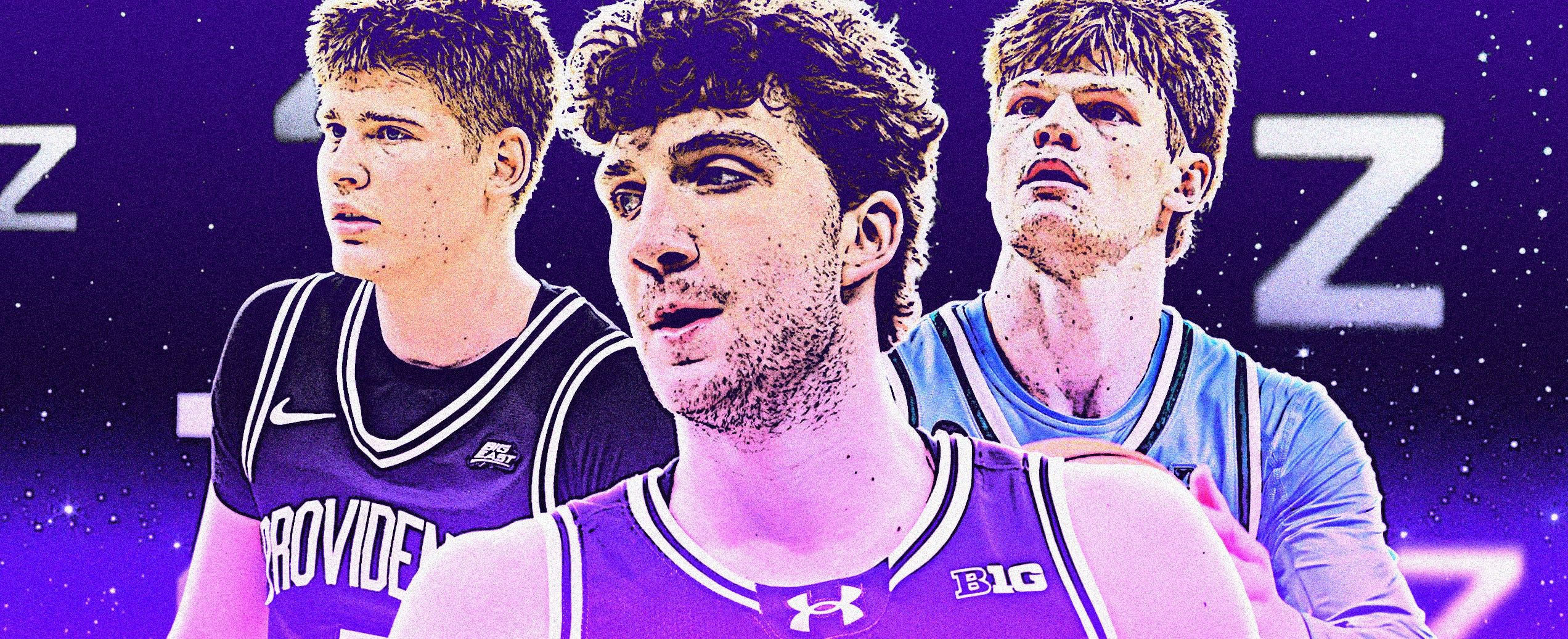
While we have been/are in the midst of watching Conference Tournaments in college basketball, it’s easy to gravitate to the stars—but we don’t just focus on those players; we give shine to the sleepers!
Rowan Brumbaugh | Tulane | Guard | Junior (R.S.) | 6’4” | 185
Rowan Brumbaugh has been mentioned in this series, but he has caught fire during the American Conference Tournament. In the two games (at the time of this writing) we’ve seen from Rowan, he has put up 35 points against Memphis in Round One, as well as 25 points in the loss against Charlotte. In these two games, Brumbaugh has averaged 30.0 PPG, 5.0 RPG, 2.0 APG, 0.5 SPG—with splits of 62/62/84.
With the college season nearing its end, it’s worth highlighting Brumbaugh’s strong year. He has averaged 19.2 PPG, 4.9 RPG, 3.5 APG, and 1.6 SPG. Those have come on splits of 45/36/80. The majority of these numbers are better than what we saw from Brumbaugh last season with Tulane—particularly in terms of efficiency.
Rowan’s confidence has been evident throughout this season. His ability to get to the paint has been one of the brighter aspects of his game. He ranks in the 49th percentile in terms of at-rim scoring frequency—and in the 61st percentile in at-rim efficiency. This led to him recording 17 and-ones on the season—tying a team-high—and recording a Free Throw Rate of 57.8. Rowan has also done a very solid job of balancing this rim pressure with his passing. There have been some fun moments of looking his teammates open, or even Nash-dribbling around to find the open man with wrap and whip passes. Defensively, Brumbaugh uses his length to challenge and contest shots, as well as making the ball handler make erratic decisions. He has even been able to tip passes and make timely interceptions. He is also a very active communicator on that side of the floor.
His limitations come from a slight frame for a player of his size and length. He isn’t overtly athletic either, and some may cite the lack of dunks on the year as an indicator of that. I wouldn’t go so far as to say he is a bad or poor athlete, but he isn’t overtly plus. Rowan has to win with positioning and communication—which he is fairly decent at doing. The dip in assists and Assist Percentage while improving in other areas is a bit concerning, but it may be due to the construction of the team. The biggest worry for Brumbaugh’s position is the three-point shooting efficiency. This is the second consecutive season where Rowan has shot around 36% from deep. This is fine, but NBA guards that have the same strengths as Rowan need to be automatic from downtown. Specifically, Brumbaugh’s 27% three-point shooting off the bounce is a bit troublesome. Rowan will likely return to college next season, which makes his decision as to where he plays critical. If the pull-up shooting improves, Brumbaugh could potentially carve out a role as a secondary ball-handler with some defensive utility at the next level.
Money Williams | Montana | Guard | Junior | 6’4” | 211
Money Williams is making his debut here in this series, despite garnering some acclaim from other publications. Money is in his third season with the Montana Grizzlies, after playing his high school ball at Oakland High School. Playing for the same high school that Damian Lillard attended, Williams led his team to its first-ever state championship. After averaging over 17 PPG during his senior season, Money opted to commit to Montana. After a couple of seasons playing as a key role player, Williams has stepped up to be the guy for the Grizzlies. This season, Money has averaged 20.6 PPG, 4.7 APG, 4.3 RPG, and 0.9 SPG. His season splits have been 49/34/86. In the Big Sky, he averaged 20.6 PPG, 4.4 APG, 4.1 RPG, and 1.3 SPG—splits of 49/33/89. Even in the non-con part of his schedule, Money dropped 19 points on Stanford, 30 points on UNLV, and 22 points on Texas A&M.
Just when it seemed like the production had reached a predictable level of output, Money ramped things up during the Big Sky Tournament. In the three games he’s played against Northern Colorado, Portland State, and Idaho, Williams has averaged 30.3 PPG, 6.0 RPG, 1.7 APG, 0.7 BPG, and 0.3 SPG—on splits of 51/35/85.
The sell with Money is that he is a professional scorer. He has capable size from the point guard position, and a handle that allows him to get to various spots on the floor. He is a good pick-and-roll (PnR) ball-handler, and ranks in the 77th percentile scoring out of PnR sets. Something that separates Williams from other college guards is that he can score well without screens, too. When it comes to scoring out of isolation, Money ranks in the 89th percentile. He has a deceptive first step, which allows him to blow by defenders. Once he gains an advantage, Money does well to maintain it—utilizing hesitation and hostage dribbles to keep his body between his defender and the ball. He ranks in the 98th percentile in floater efficiency and in the 61st percentile in frequency on those shots. Money’s ability to hit middies and floaters—while also being able to finish at the rim and draw fouls—gives him a desirable offensive skill set.
While he has apparent strengths, the concerns with Williams can be equally apparent. The physical shape of Money isn’t the epitome of NBA athleticism and is something teams will likely question. The shot-making with Money is fine, but the three-ball isn’t all that efficient. The mechanics are fine, with a high-arching, high release that looks smooth. He is best shooting the ball off of the bounce, as he is hitting under 35% on such attempts—which isn’t a mark a scoring guard should be at. He is shooting a nearly-identical percentage when open on catch-and-shoot (CaS) looks. That lack of ancillary scoring essentially typecasts Money as an on-ball guard. Williams will have to either show undeniable on-ball prowess—to include off-the-dribble shot making—or better shooting off of the catch to have NBA teams ready to add him. This will likely lead to Williams returning to school—potentially transferring up. If that proves to be true, Money will have a slew of schools lobbying for his services while he works on the necessary improvements to his game.

Stefan Vaaks | Providence | Wing | Freshman | 6’7” | 212
From one debut to another, Stefan Vaaks will also grace the series this week. Stefan is a “freshman” who came to Providence from Estonia—where he played some professional ball before trying his hand in the collegiate ranks. Vaaks played for Estonia in the 2025 European Championship, and he played for BC Kalev/Carmo in the 2024-2025 FIBA Europe Cup. In his first college basketball season, Vaaks has averaged 15.8 PPG, 3.2 APG, 2.5 RPG, and 0.8 SPG. That has come on splits of 40/35/84. Stefan averaged 16.2 PPG, 3.1 APG, 2.6 RPG, and 0.7 SPG in conference play—on splits of 38/31/88. Those numbers haven’t been great in terms of a holistic analysis, but there were eight games where he dropped 20+ points.
Still, Vaaks did show moments where he wasn’t fully acclimated to the American style of play. That is, until he hit the Big East Tournament. In the two games he played in the tournament against Butler and St. John’s, Stefan averaged 25.5 PPG, 3.0 RPG, and 2.0 APG—with splits of 57/59/75.
Where Vaaks captivated the imagination of evaluators has been as a floor spacer. Against Butler, he hit eight threes. He followed that up by hitting five against St. John’s. On the season, Stefan shot about 35% on his threes—which isn’t the sexiest number. However, he did attempt almost 15 three-pointers per 100 possessions. That sort of volume gives confidence that Vaaks can be a knock-down shooter. At his size, NBA teams will be interested in potentially using him as a floor spacer. Stefan has a little bit of a handle—which comes in handy when he is chased off of the line. While he isn’t a lead initiator, Vaaks has connectivity as a passer and has an Assist-to-Turnover (ATO) ratio of 1.7. He hasn’t shown it a ton, but Vaaks has some grit and nastiness to his game. At his length, Stefan can finish near the rim and is capable of scoring off cuts and dives.
Vaaks has to show that more often—the nastiness and grittiness. He isn’t a super-strong rebounder, which is almost unacceptable in the NBA at his size. There is a little bit of inconsistent effort on the defensive end. That can be frustrating because Stefan has the tools and know-how to be better. While it is frustrating, we can take encouragement in understanding that it’s there and can be brought out. With him surely returning to college next season, I would also like to see some more at-rim finishing in terms of both volume and efficiency.
Nick Martinelli | Northwestern | Forward | Senior | 6’7” | 225
Nick Martinelli has received some draft love this season, but only in the sense of a mid-to-late second rounder for the 2026 NBA Draft. Martinelli scored over 1,300 points for Glenbrook South High School, where he averaged almost 23 PPG and 7 RPG in his last season of high school. By the time his days at Glenbrook were over, Nick ranked seventh in the state of Illinois and was a three-star prospect. Nick opted to stay in-state and committed to play for Northwestern. Nick played an incredibly modest role for the Wildcats his first two seasons with the program, but he scored over 20 PPG last year—playing alongside Brooks Barnhizer (at least, as much as he could given Brooks’ injury).
Martinelli was actually my favorite to be the best scorer in all of college hoops, and he has at least been in the conversation—if not the guy. This season, Martinelli has averaged 23.0 PPG, 6.2 RPG, 2.0 APG, 0.8 SPG, and 0.4 BPG. This has come on splits of 51/42/81. Since the beginning of conference play, Nick averaged 23.4 PPG, 6.1 RPG, 2.0 APG, 0.7 SPG, and 0.4 BPG—with splits of 49/36/82. Over the course of that stretch, Nick scored 25+ points on ten occasions. This led nicely into a strong three-game stretch within the Big 10 Tournament. Northwestern faced off against Penn State, Indiana, and Purdue in those games, where Nick averaged 25.7 PPG, 5.7 RPG, 3.0 APG, and 2.0 SPG—on splits of 59/50/81.
With Nick being a senior, he will be en route to the NBA at some level after this season. What helps the projection for Martinelli is that he has improved as a three-point shooter. With his size and strength, Nick growing into a nearly-42% shooter from deep has made the evaluation much cleaner. He is shooting almost 45% from deep on CaS looks, and is shooting almost 53% on his open three-point jumpers. That floor spacing has opened up the court and has offered a complementary element to his bruising style of play. He has the size and strength to be a good rebounder in the NBA as a try-hard combo-forward, too. On defense, Nick has the strength to hold up against bigger matchups.
A lot of the ancillary aspects of his game are a bit questionable. With him being such a focal point for Northwestern, it will be a bit of a guess as to how scalable he can be. There is a bit of a cautionary tale in betting on players who have a track record of being sub-par shooters in college, who see their three-point percentage balloon in their final season. Nick’s 5.7 three-point attempts per 100 possessions are fine, but they don’t instill an unassailable degree of confidence in his shot translating. With less usage, can he become an on-ball dog on defense? Can the moments of connectivity become more consistent? Can those moments be in the vein of “0.5” basketball? Those are the questions evaluators will have. Even still, there will likely be a large number of underclassmen returning to college, which leaves the door open for Martinelli to capitalize on whatever opportunity is afforded to him.
Ugonna Onyenso | Virginia | Big | Senior | 7’ | 245
Ugonna Onyenso closes out this edition of the series. Some may remember Ugonna from his promising high school days or from committing to Kentucky for his freshman season. Coming out of school, the Nigerian-born Onyenso was considered a four-star recruit and was a consensus Top 50 prospect. He played his high school ball in Connecticut, where he was ranked the #1 prospect in the state. After winning a national championship, Ugonna committed to Kentucky and played there for two seasons. After not living up to some lofty expectations, he transferred to Kansas State, but played less than 12 minutes per game—averaging 2.8 PPG, 2.4 RPG, and 0.9 BPG. After yet another down season with a separate Wildcat program, Ugonna transferred to Virginia for his final season of college basketball.
His role with the Cavaliers hasn’t been that of a “star player”, but Onyenso has showcased a number of translatable skills this season. On the year, Ugonna has averaged 6.4 PPG, 4.9 RPG, and 2.8 BPG (all career-bests)—with shooting splits of 55/27/71. During conference competition, his numbers held steady at 6.2 PPG, 5.2 RPG, and 2.6 BPG. That has come on shooting splits of 56/31/75. In an ACC Tournament game against NC State, Onyenso scored eight points, grabbed six boards, and swatted eight shots—exemplifying the sort of concentrated productivity that he has shown all season. He followed that up with 17 points, five rebounds, four blocks, one assist, and one steal in a Semifinal win over Miami. The last game for Ugonna in the ACC Tournament came in a loss against Duke. He recorded six points, eight rebounds, and 9 blocks. His shot-blocking set an ACC Tournament record previously held by Tim Duncan.
Despite being a player with lower traditional statistics, there is a huge sales pitch with Ugonna: he does the “Big Man things” well. Onyenso ranks in the 84th percentile in at-rim finishing and in the 76th percentile in at-rim frequency. To top it off, Onyenso is scoring on 67% efficiency around the basket. His length and activity has resulted in him being a threat in PnRs as the roller—where he ranks in the 72nd percentile. He also ranks in the 79th percentile on putbacks—boasting an Offensive Rebounding Percentage of 10.4. He’s also crashing the defensive glass, too, with a Defensive Rebounding Percentage of 19.5. On defense, Ugonna has some “special” to his game. He is immensely coordinated and gives multiple efforts. He is able to time and high-point the ball when patrolling the paint, which is made evident by his 16.8 Block Percentage. He’s also active in tipping and ripping the ball away in terms of steals—resulting in a Steal Percentage of 2.2. One way you can quantify impact on defense while demonstrating fundamentals is to look at a player’s Stocks (Steals + Blocks) compared to the number of fouls they commit. For Ugonna, he has 109 Stocks to just 42 fouls committed. If you prorate his fouls to a per-40 basis, Onyenso only commits 2.9 fouls per 40 minutes.
The statistical profile for Onyenso almost makes him a can’t-miss prospect. Ugonna’s rim protection alone could make him an intriguing developmental center for NBA teams. But one can begin to be concerned when considering the fact that he is only playing 18.2 MPG. Ugonna hasn’t exhibited much feel as a decision-maker. Yes, his ATO is 1.2, but we don’t have anything definitive to suggest he could be used in DHO sets, or extend a play if the initial read breaks down. Beyond that, there is a strong “low-risk-high-reward” case with Ugonna in a Dylan Cardwell sort of way. A team could essentially air-drop him into the exact same role that he has shown at Virginia.
Honorable Mentions
Kanon Catching | Georgia
Alton Hamilton IV | Eastern Washington
Jason Rivera-Torres | Monmouth
CJ Shaw | UC Santa Barbara
Follow me on Twitter: StephenGHoops
Catch me on BlueSky: StephenGHoops
Catch the Draft Sickos show LIVE on the No Ceilings NBA channel: