



Coming into this season, Bennett Stirtz was one of the most fascinating returners in college basketball. After an electrifying junior season at Drake, Stirtz easily could’ve entered the 2025 NBA Draft and likely been a first-round pick. Instead, Stirtz opted to follow his coach to Iowa, level up in competition, and prove that he wasn’t just feasting on lesser competition but could sustain his production in one of the toughest conferences in the country. Despite a worrisome start to the season against top competition, it didn’t take long for Stirtz to adjust, a paragon of consistency, and reemerge as one of the best point guards in the 2026 NBA Draft.
We see players struggle all the time when they have to scale up in competition, especially when doing it for an entire season. Through mid-December, it was looking like Stirtz could unfortunately be the next prominent victim of this. His overall numbers were fine through this stretch, but six of those ten games were against lesser competition. In the four games against Top 100 teams, Stirtz struggled… a lot.

Coming into the year, we knew he was a good passer and shooter. Both of those aspects of his game translated and maintained immediately. Not surprising. The more important questions, though, came with his athleticism and ability to collapse a defense. Early on, against top competition, he simply couldn’t do it. He struggled to turn the corner, looked hesitant and unconfident in traffic, and didn’t have the physicality to get to his spots. Teams were playing incredibly aggressive gap coverage against him and daring anyone else on Iowa to punish them. They couldn’t, and Stirtz’s scoring efficiency and creation floundered because of it.
In those clips, Stirtz was facing some fantastic on-ball defenders, but those are the types of defenders he’ll see on every possession in the NBA. It was a start to the year that exacerbated every concern and left the optimistic view to conjecture. The hope that Stirtz could fit in as a starting point guard who could really manipulate the game was rapidly fading as we were forced to lean on platitudes like “it’ll look better in an NBA context” and “he has no help out there.” Thankfully, there was a lot of basketball left to be played, and it didn’t take long for Stirtz to figure it out. Since mid-December, Stirtz has been outstanding against Top 100 competition.

Not only did his numbers bounce back in a crucial way, but they recovered to mirror what he accomplished at Drake. Players constantly have adjustment periods and down stretches. They’re inevitable and unavoidable. The key, though, is this: how does the player respond to those periods, and how quickly do they break out of their slumps? It didn’t take long for Stirtz to do exactly that and essentially reproduce his dominant production in a high major conference.

Stirtz is now on one of the more impressive two-year stretches of offensive production in college basketball in a while. The lingering question, though, is how it translates to the NBA. At first glance, his scoring repertoire may seem like it could be a bumpy translation. Stirtz isn’t one of these guards like Darius Acuff, Kingston Flemings, or Mikel Brown who can get to the rim whenever they want. Stirtz is a good slasher (we’ll get into that more in a second), but his scoring is largely predicated on his perimeter jumper. This season, Stirtz ranks in the 91st percentile in all jumpers, the 96th percentile shooting off the catch, and the 91st percentile shooting off the bounce, per Synergy. Stirtz has an effortless shooting release that he gets off quickly and doesn’t require a ton of space to do so. He isn’t superb at creating acres of space, but he uses hang dribbles effectively, has a crisp stepback move, and doesn’t shy away from punishing defenders when they go under screens.
Stirtz will still likely have some athletic struggles, at least early, in the NBA—similarly to what we saw at the start of this season. That adjustment period is there for all players, but the fact that we’ve seen Stirtz climb that hill once already while having a lethal jumper as a legitimate weapon should help quell most concerns. Additionally, it’s not like we haven’t seen this type of profile have success before.
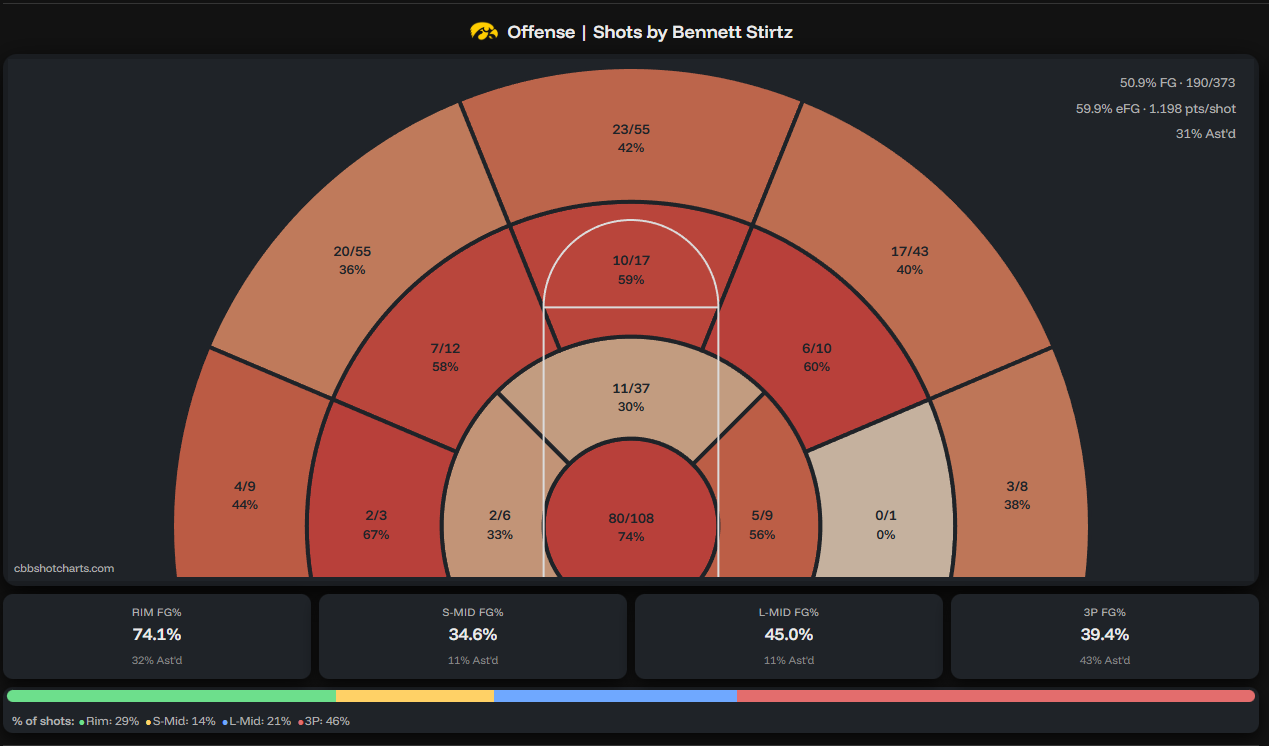
Of Stirtz’s field goals, 59.6% of them are jumpers, and 28.1% come at the rim. It’d be great if his at-rim frequency was a little higher, but his proven jumper negates any gripes I may have with it. It makes me feel even better when we look at the profiles of three guys Stirtz reminds me a lot of in Tyrese Haliburton (61.7% and 23.8%), Payton Pritchard (61.8% and 31.4%), and Malcolm Brogdon (59.1% and 30.6%). None of these guys were elite athletes; all faced myriad critiques about how their games wouldn’t translate, and those questions have been similarly echoed with Stirtz. As we can see, though, all of these guys had similar shot distributions, statistical profiles, and solid NBA careers. Getting to the rim at will and having a sky-high free-throw rate is tremendous, but it isn’t mandatory if the shot and processing capabilities are NBA-ready. That seems to be the case with Stirtz.

I don’t want it to come across as though Stirtz is some horrid athlete, though. While he may not be the most explosive and needs to get stronger, he still has a very good first step and is effective around the rim. From a scoring standpoint, there isn’t much that Stirtz can’t do on the ball. This year, he ranks in the 95th percentile in pick-and-roll frequency and the 94th percentile in pick-and-roll scoring. He also ranks in the 98th percentile in isolation frequency and the 88th percentile in isolation scoring. After those early-season struggles, Stirtz quickly figured out his driving angles, held his line better, and continued to finish at the rim with ease, shooting 72.2% overall and 71.8% in the halfcourt. Those are ridiculous figures for a largely below-the-rim scorer. As we can see, though, Stirtz is terrific at exploding out of his first step; he has really soft touch at the rim, and finishes through contact out of the pick-and-roll, isolation, or movement. Those same hand dribble moves and short area burst that we saw with his pull-up jumpers are also consistently implemented in his downhill attack.
What makes those play type figures even more impressive, though, is that most of Stirtz’s buckets are unassisted. He’s capable of getting his own shot from anywhere on the floor despite not being a dynamic space creator. Instead of overdribbling or hunting his shots, Stirtz opts for efficient and decisive moves to create space on the perimeter or to generate driving lanes to get downhill. There really isn’t a bad shot for Stirtz to be taking this year, and most of them are self-created. Having the efficiency, versatility, and volume that Stirtz has, combined with the volume of self-created looks, is incredibly encouraging for how his scoring arsenal can translate and morph at the next level. For comparison, Darius Acuff is at 40% assisted overall and 26% assisted at the rim, Kingston Flemings is at 27% and 24%, and Mikel Brown Jr. is at 37% and 26%, per CBB Shot Charts.
Stirtz’s isolation numbers rock and give us a fun illustration of what type of offensive engine he is in college, but it’s unlikely that he’s going to have that type of isolation volume in the NBA. Thankfully, Stirtz has proven that he’s just as effective without the ball as well. Stritz ranks in the 74th percentile in spot-up scoring, the 72nd percentile in handoff scoring, and the 100th percentile in scoring on cuts. The threshold for being a primary creator in the NBA is astronomically high. Maybe Stirtz can break through and hit that threshold, but even if he’s more of a complementary playmaker/initiator, he has all the tools to still make a massive offensive impact. We love to fixate on a player’s ability to initiate everything, but their malleability and versatility are often the abilities that get them on the floor early in their career, barring the very top picks. The fact that Stirtz has the tools to run the offense or play alongside an established creator, though, makes him a rather seamless fit in any offensive system.
The cherry on top for Stirtz’s offensive game is that he’s also one of the best passers in the country over the last two seasons. He’s just one of 34 players this year and one of 23 from last season to have a usage of at least 25, an assist rate of at least 25, and an assist-to-turnover ratio of at least 2.0. Of those groups, he’s just one of nine who also have a turnover rate less than 13 this season and one of ten with a turnover rate less than 14 last season. Stirtz has some of the fastest processing in the country. Even though he almost always has the ball, it almost never sticks with him. He is constantly making the extra pass, attacking off the catch, or taking what the defense gives him. He’s surgical and methodical with how he moves the ball. There aren’t many players in recent years who dominate the ball, take care of it, and create for their teammates like Stirtz does.
You may have picked up on it, but there wasn’t a whole lot of overly dynamic playmaking in those clips. It was a lot of pocket passes, running a deadly two-man game, and finding guys one pass away. These aren’t always the “sexiest” assists, but they are absolutely crucial to running a well-oiled offense. It isn’t difficult to imagine the pick-and-roll success that Stirtz could have in the NBA with a legitimate rim-running or floor-spacing center. Even if he goes into a team with an established creator, Stirtz’s ability to quickly process and counter defensive rotations should allow him to carve up opponents as a second-side creator.
Stirtz has been a tremendous passer this season, but he’s left me wanting more as a playmaker. The way I differentiate those phrases is: great passers take care of the ball, find the open guy, are accurate, and make great decisions. Think Tyus Jones. Great playmakers, though, have a bit more creativity, manipulate help defenders, have a higher risk tolerance, and pass teammates open. Think LaMelo Ball. Stirtz has firmly fallen into the first bucket this year for me. It isn’t a bad thing, but I would like to see a bit less risk aversion from him. Thankfully, we did get more of that last season at Drake, but it would’ve been nice to see more of him manipulating help defenders against this year’s tougher competition.
The key with all of that, though, is the offensive scheme that Stirtz is playing in. The way that Stirtz operates with the ball and makes quick decisions, you’d think that Iowa would be running a pretty high-paced, read-and-react type of offense. It’s actually the exact opposite, as they’re one of the slowest teams in the country. Per Evan Miya, Iowa ranks 356th in tempo. Last season, Drake ranked 364th. It’s shocking to have a player like Stirtz and bottle him up like that. Sometimes you need to let the Ferrari out of the garage. While I’ve overcome pretty much every major offensive concern with Stirtz, it is still fair to wonder how, or if, he’ll adjust to the speed of the NBA. My instinct is to just chalk it up to the stringent demands of Ben McCollum. Stirtz processes the game so quickly in the halfcourt that it’d shock me if he can’t adjust.
The other area that will likely be the biggest pain point in his NBA translation is his defense. Stirtz isn’t bad, but I wouldn’t classify him as a good defender either. There are stretches where he’s attentive off the ball and slides his feet well in isolation. However, he pretty consistently struggles with screen navigation, can get happy feet, and lacks the strength to be a major deterrent. On the plus side, he is 6’4” and has recorded steal rates of 2.4 and 3.3, respectively, the last two seasons. Even though he won’t be a defensive stopper, there are at least some signs that point to him being able to survive out there. When we look at players like Reed Sheppard, Mike Conley, and those I mentioned earlier who all faced similar concerns, we inevitably see their IQ and offensive skillset take over enough to cover a lot of the warts.
The 2026 NBA Draft is absolutely loaded at the guard position. In most years, Bennett Stirtz could easily be considered a lottery lock. However, with the depth of the position, his lack of raw athleticism, and his age (22 on draft night), Stirtz is a prime candidate to fall to the latter half of the first round. The NBA constantly tells us what they value in the draft, and it’s rarely players of Stritz’s build. However, we also constantly see the types of players who thrive in the NBA. Players who process the game, shoot, and pass like Stirtz does rarely flat-out fail.