


The early entrant deadline can serve as a powerful tool for prospects looking to work their way into the NBA. The decision to “test the waters” (declaring for the draft while maintaining college eligibility) often comes down to visibility as much as evaluation. Some players are unsure of their range. Others are looking to get their name in front of teams, using the process as a way to generate feedback and build familiarity.
We’ve seen players take different approaches to that process. Some make their intentions public early, shaping how they’re discussed throughout the season. Others keep their options open: balancing the draft, the transfer portal, and the evolving financial landscape of college basketball.
But not every prospect needs that kind of runway.
Some players don’t need to build their case through exposure; they’ve already been operating in roles that demand it.
Stanford freshman Ebuka Okorie falls into that category.
The Background
Ebuka Okorie’s freshman breakout might not have been anticipated, but it didn’t come out of nowhere.
Before arriving at Stanford, Okorie played for Brewster Academy, where he averaged 14.0 PPG, 4.0 RPG, 3.0 APG, and 2.0 SPG while shooting just under 55% from the field and nearly 39% from three. He led Brewster to a deep run in the Chipotle National Basketball Tournament and earned New Hampshire’s 2024–2025 Gatorade Player of the Year.
Despite that production, Okorie was viewed as more of a fringe high-major recruit, typically landing in the three-to four-star range depending on the outlet.
He initially committed to Harvard before ultimately choosing Stanford, with the Cardinal securing him over programs such as George Washington, Northeastern, Bryant, Rice, Brown, and Samford.
The résumé was there. The role—and the stage—were not.
The Crunch
Ebuka Okorie didn’t just produce this season. He produced while carrying his team in one of the least efficient offensive environments among high-major teams.
Stanford finished 65th in adjusted offensive efficiency, but the underlying indicators tell a different story. The Cardinals ranked 173rd in effective field goal percentage, 164th in free throw rate, 100th in three-point percentage, and 321st in assist rate. This was not an offense built on structure or shared creation; it was built on necessity, with Okorie at the center of it.
When you isolate his individual production, the profile reflects that level of responsibility.
BPM: 9.6
Usage Percentage: 30.1
Effective Field Goal Percentage: 52.8
True Shooting Percentage: 58.9
Offensive Rebound Percentage: 2.4
Defensive Rebound Percentage: 10.3
Assist Percentage: 23.9
Turnover Percentage: 10.4
Assist-to-Turnover Percentage: 1.9
Block Percentage: 1.0
Steal Percentage: 2.7
Free Throw Rate: 44.9
Dunks: 8 (3 in the Half Court)
Free Throw: 188/226 (83.2%)
Far Two Percentage: 36/85 (42.4%)
Three-Point Percentage: 63/178 (35.4%)
Three-Point Rate: 9.7 3PA/100
This is the profile of a player operating with both volume and efficiency—two things that rarely coexist for freshman guards in this kind of role.
Compared to his peers (freshmen guards), Ebuka ranks second in Bart Torvik’s proprietary “PRPG!” ranking (behind Darius Acuff Jr.), and fourth in BPM (behind Darryn Peterson, Kingston Flemings, and Brayden Burries). These metrics don’t just reward production; they reflect impact within context, and the context here is important.
Okorie averaged 23.2 points per game on 47/35/83 splits, while the second-leading scorer on Stanford, Benny Gealer, averaged just 10.9 PPG. That gap illustrates how much of the offensive burden fell on Okorie. The same shows up in Win Shares, where he accounted for 5.7 compared to 3.7 from the next-closest teammate.
The clearest indicator of his role, though, comes from how those points were created.
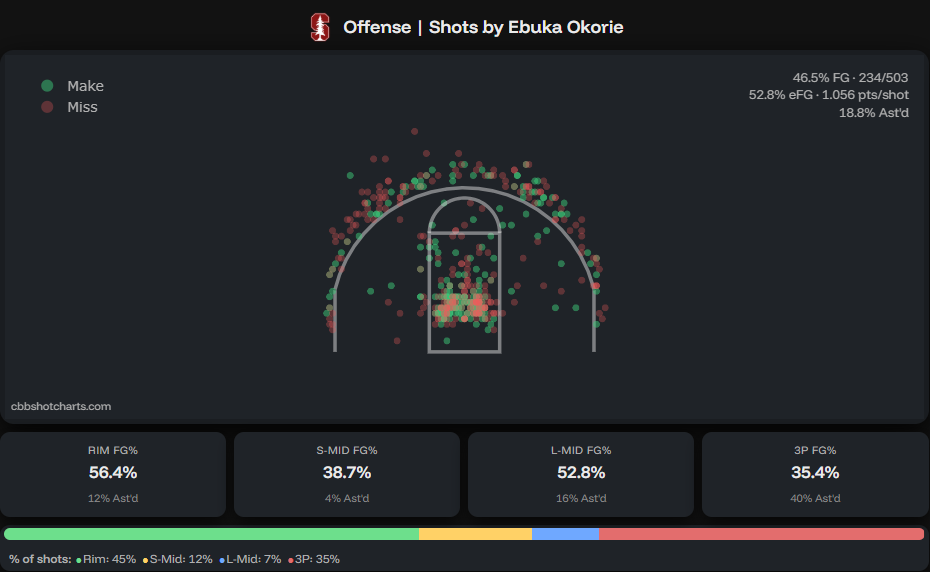
Of Okorie’s 503 total field goal attempts, under 19% were assisted. For comparison, that’s significantly lower than peers like Darius Acuff Jr. (36.8% shots assisted), Mikel Brown Jr. (36.6%), Keaton Wagler (26.2%), Kingston Flemings (24.8%), Labaron Philon (25.9%), and Bennett Stirtz (31.1%). This wasn’t just high usage within a system; it was self-generated offense at scale.
His shot distribution reinforces that—45% of his attempts came at the rim, while 35% came from beyond the arc. That’s an NBA-aligned profile built almost entirely on his own creation.
This is what running the show actually looks like.
The Film
Postseason play has reinforced something that’s been clear all year: guards have to be able to handle pressure—and they have to make plays in the face of it. That responsibility shows up across pick-and-roll, isolation, and even spot-up situations.
Pick-and-Roll Processing
Shooting off the dribble is a critical swing skill for NBA guards, and one that directly impacts projectability. When a guard can generate pull-up threes, it forces defenses into tougher decisions in ball screen coverage and limits how aggressively they can contain the ball.
On a Stanford team that offered limited spacing and support, Ebuka Okorie still proved capable in this area. He shot over 34% on 108 off-the-dribble three-point attempts, with those looks accounting for 60% of his total threes on the season.
That level of volume is significant. Among the top lead guards in the class, only Bennett Stirtz generated a higher percentage of his threes off the dribble (74.8%).
This is about creation beyond just shot-making. Okorie’s handle, ability to navigate screens, balance, and release allow him to generate clean looks in pick-and-roll situations—even when defenses are keyed in on him.
Those same traits show up when Okorie turns the corner and gets downhill.
He ranked in the 61st percentile in at-rim frequency—a solid number on its own, but more meaningful within the context of his role. At 6’2” and 185 pounds, Okorie isn’t overwhelming physically, yet he consistently creates separation out of ball screens and maintains his line to the rim.
Even when defenders stay attached, his balance and core strength allow him to absorb contact and finish through it. He doesn’t get knocked off his path easily, which shows up in both his touch and his ability to convert difficult attempts in traffic.
That physical control translated to production. Okorie recorded 33 and-one finishes on the season, leading Stanford by 23.
In order to keep defenses honest, lead guards can’t just call their own number; they have to create for others out of the pick-and-roll. The analytics show some room for growth here, as Okorie ranks in the 68th percentile in points per possession when including passes, which is a solid mark but not at the same level as his scoring efficiency. The film, however, provides important context.
Okorie consistently shows a strong feel for when to apply pressure and when to move the ball. His processing (where to drive, the pace in getting there, and when to deliver kickouts against a collapsing defense) stands out, and he’s not forcing reads as much as reacting to what the defense gives him. That shows up in the variety of passes he’s able to make on the move (whips, wraps, bounce passes, and dump-offs) while getting downhill. For a sub-6’4” guard, his length and extension help him access passing angles that aren’t always available at his size, which adds another layer to his playmaking profile.
This isn’t a finished product as a playmaker, but the indicators are there—especially within the context of the role he was asked to carry.
Isolation Decision-Making
Jeff Teague, former NBA player and host of the Club 520 show, recently shared his philosophy on why mid-major prospects often translate well to the NBA in a conversation with CJ McCollum:
“I think that guys who go to smaller schools, they become better players because they got to do more…so like [CJ McCollum], Steph, Dame—y’all could make the toughest shots because y’all saw two defenders all the time. And, now when y’all get to the NBA, it’s one-on-one…
Obviously they put in a lot of work, and they had to do that for their team to be successful. I always commend people who went to smaller schools, because you put in more work.”
While Stanford isn’t a mid-major, the underlying principle applies. Okorie operated in an environment where defensive attention was tilted toward him, often requiring him to create against loaded help. That showed up clearly in isolation.
With nearly 80% of his shot profile coming from threes and attempts at the rim, Okorie consistently leveraged defensive reactions to generate his own looks. When defenses collapsed, he didn’t force the issue. Instead, he’d reset, create separation, and attack the moment the coverage relaxed. That push-pull dynamic allowed him to create clean pull-up threes, often catching defenders in recovery rather than in position.
This is what manipulating the defense with your shot creation looks like.
Even when confronted by length, Ebuka Okorie is able to use his dribble cadence and timing to attack the paint with suddenness. What might appear to be a reliance on physical tools—length, speed, balance—is grounded in a clear understanding of footwork and positioning.
Operating in space with a low, tight handle, Okorie is able to read his defender’s base and strike when it’s compromised. He consistently takes advantage of “wrong-footed” defenders, attacking when the inside foot is planted and creating a direct path to the lane.
From there, the control stands out. Okorie maintains his balance through contact and finishes with his inside hand, allowing him to shield the ball and convert difficult attempts at the rim. That same control also creates opportunities at the free-throw line, creating additional scoring chances.
His ability to attack out of isolation only amplifies his playmaking. The same traits (timing, balance, and inherent feel) show up when Okorie gets downhill, allowing him to process the floor while under pressure.
What may sound simple is anything but: he is a “heads up” playmaker. In other words, Okorie is able to attack while surveying his teammates—a skill that not all guards have. He doesn’t put his head down and predetermine decisions; instead, he reads the second line of defense as it rotates and adjusts accordingly.
The production reflects that. Okorie ranks in the 88th percentile as a scorer out of isolation, and even when factoring in passing possessions, he still ranks in the 83rd percentile. That level of efficiency holds steady when he’s asked to create for others. He is also comfortable attacking in either direction, not favoring drives to the right or left. That comfort level, coupled with his heads-up attacking ability, allows him to generate advantages for both himself and his teammates.
Off-Ball Prowess
Despite not being the most efficient shooter from deep this season, the degree of difficulty on Ebuka Okorie’s attempts helps explain why he “only” shot around 35% from three. Just 33% of his jump shots came off the catch, highlighting how infrequently he was able to operate in lower-difficulty situations.
That context becomes even clearer when looking at shot quality. Just over 14% of Okorie’s three-point attempts were classified as unguarded, according to Synergy Sports—one of the lowest markers among high-usage guards. Those are typically the most efficient looks a player can generate, and often reflect both team structure and surrounding talent. When those opportunities did come, Okorie capitalized. He shot nearly 39% on unguarded catch-and-shoot threes, showing that his underlying shooting ability is stronger than his overall percentage might suggest.
Beyond the numbers, the film supports that notion as well. Okorie has a strong feel for spacing and positioning, consistently placing himself in passing windows and maintaining proper floor balance. When the ball finds him, he gets into his shot quickly and cleanly, with soft touch and a repeatable release. When he’s not asked to create everything for himself, he’s fully capable of taking advantage of the opportunities created by others.
The threat of Okorie as a shooter creates opportunities for him to attack off the catch. When defenses close out aggressively or hesitate between helping and staying home, he takes advantage with timely cuts and quick dives to the basket.
That same spatial awareness he shows as a spot-up shooter carries over here. Okorie understands where to position himself and when to move, allowing him to create separation without needing the ball in his hands.
The production reflects that. Okorie converted on over 57% of his two-point attempts in spot-up situations, consistently finishing plays off give-and-go actions and quick interior catches. When the defense reacts to his shooting, he’s able to counter by turning those moments into efficient scoring opportunities at the rim.
Defensive Ability
NBA teams aren’t going to be drafting Ebuka Okorie for his defense, but there are subtle indicators that suggest he can contribute on that end. The young guard plays with an edge, consistently applying pressure and looking to disrupt opposing ball handlers.
His shiftiness and sudden burst allow him to generate deflections, particularly at the point of attack. Okorie is active with his hands and willing to take chances, using his quickness to jar the ball loose and create transition opportunities.
That same hand activity shows up not only at the point of attack, but in Okorie’s rotations as well. He reads where the offense is trying to go with the ball and reacts quickly, which is especially valuable when teams look to exploit size in the paint. His speed allows him to cover ground and dig down at the right moments, turning those reads into real disruption. When Okorie commits, he’s timing it to create turnovers instead of just swiping.
The production supports it. Okorie posted a 2.7% steal rate, placing him ahead of guards like Darius Acuff Jr., Keaton Wagler, Mikel Brown Jr., Labaron Philon, and Bennett Stirtz.
One of the more encouraging aspects of Okorie’s defense is his ability to stay in front of opposing guards. He’s disciplined with his footwork, plays with physicality without fouling, and consistently makes timely plays on the ball. He works to flip his hips, stay attached, and recover on drives, showing a level of care and effort that translates.
Even when he’s late to the initial action, his length and reaction time allow him to contest—and occasionally block—shots in ways that aren’t typical for a guard his size.
The production reflects that. Okorie posted a 1.0% block rate, trailing only Keaton Wagler and Kingston Flemings (1.3%) among comparable guards. He also recorded 58 stocks (steals + blocks), second-most on the team, while committing just 43 fouls—the second-fewest among Stanford players with over 100 defensive possessions.
Curtains
Ebuka Okorie’s case becomes clearer the more that you factor in his surrounding context. He spent his freshman season operating as a primary creator in an environment that asked him to do a little bit of everything: handle pressure, generate offense, and create for others without the benefit of consistent spacing or an optimal scheme.
The numbers support the workload, and the film fills in the details. Okorie shows the ability to control pace, manipulate defenders, and make decisions on the move, all while maintaining efficiency in a role that typically comes with tradeoffs. Whether it’s out of pick-and-roll, in isolation, or working off the ball, he consistently finds ways to create advantages and convert them into efficient outcomes.
In a class that features a number of talented guards, the conversation naturally shifts toward who can translate into a role at the next level. Okorie’s value lies in the fact that he has already been operating in one. As the environment changes—with more space and more help around him—the reads become cleaner, but the foundation of his game remains the same.
There’s still room for growth, particularly as a playmaker, with continued physical development and consistency on the defensive end, but the core traits are in place. Okorie has shown that he can both run an offense and function off the ball.
That’s not something every guard in this class can say.
Follow me on Twitter: StephenGHoops
Catch me on BlueSky: StephenGHoops
Catch the Draft Sickos show LIVE on the No Ceilings NBA channel:
I am so enamored with this guy. He is captivating to watch. I am very curious about his real draft range and where he ultimately ends up.