


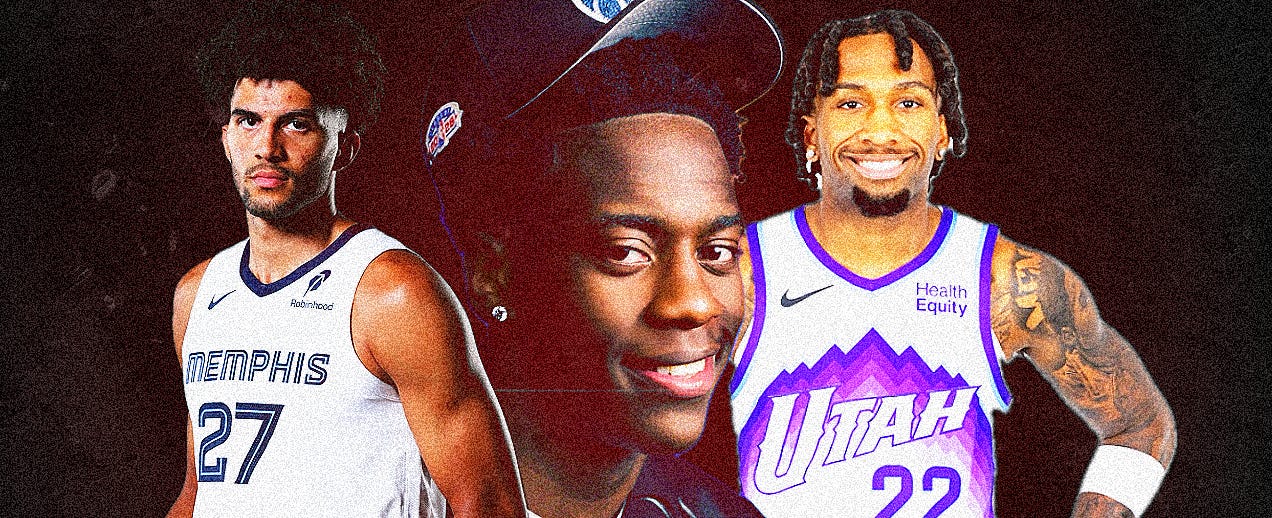
***NOTE: trades are likely to have happened in the editorial process, the day of this post, or even while you’re reading this. Please exercise patience if some of the write-ups are no longer up to date.***
I know everyone is going to read this piece and react with complete reason and restraint, right?
Seriously, though, the 2026 NBA Draft class was one of my favorite groups to evaluate. Months of film, analytics, historical context, conversations, and countless revisions eventually became my final big board.
And then the actual draft happened.
Trades take place leading up to, during, and immediately following the draft. Situations and environments change. The unknown suddenly becomes the known.
And if our information changes...
Shouldn’t our rankings?
This isn’t a traditional re-draft. No one has played an NBA game yet, so pretending we suddenly know who the best players are would be a fool’s errand. Instead, this is an Environment-Adjusted Big Board—a look at how each prospect’s landing spot changes my outlook on their NBA future.
Some players landed in organizations that accentuate their strengths. Others may have a steeper path to minutes, a less-than-ideal developmental timeline, or a roster that muddies their projection. None of that changes who they are as prospects; it just gives us another data point. And…
It’s okay…
It’s okay to think about how this new information and allow it to change how we feel about the future of this class. Like everything leading up to this moment in time, this is a data point—something to consider. It’s an exercise. It’s an untangling of thoughts.
It’s fun.
So…let’s go ahead and have some fun!
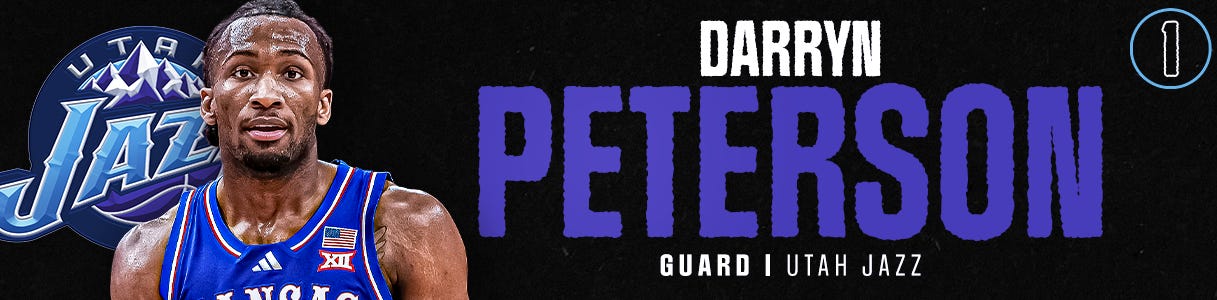
#1. Darryn Peterson | Utah Jazz
Darryn Peterson was my #1 prospect coming into the 2026 season, and I truly feel like he is set up for the greatest degree of success. Most of the major players on the team are still intact; the only significant change has been Walker Kessler getting shipped off to play with Luka Doncic and Austin Reaves in LA. Be that as it may, Utah selecting Peterson felt like the most hand-in-glove fit among the top players in this year’s draft. His floor spacing will allow Keyonte George to work pick-and-roll/pop actions with Lauri Markkanen, Jaren Jackson Jr., and Ace Bailey. Speaking of Ace, I truly love the idea of him and Darryn working together to get open shots from deep. While he isn’t likely going to be the “lead guard” on volume with the Jazz, Darryn will certainly have moments where he can flex that muscle the same way he did in high school. Peterson’s floor and ceiling outlooks both look encouraging, and he is now primed to prove he is the best player among his peers.
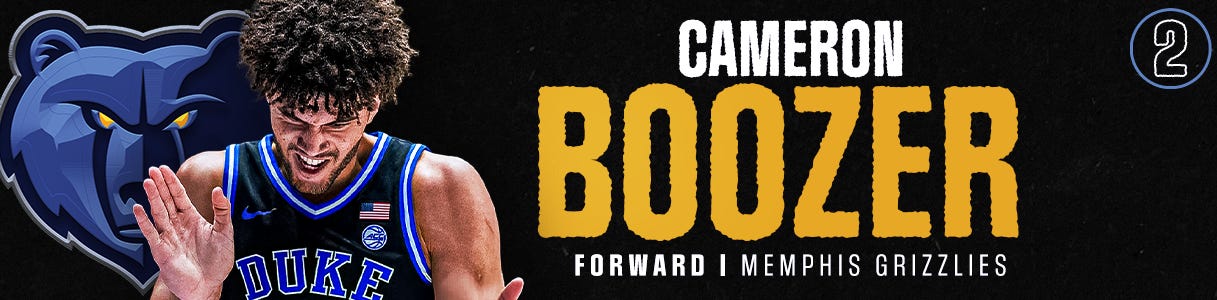
#2. Cameron Boozer | Memphis Grizzlies
To let you in behind the curtain, there was another write-up here for Cam prior to the Ja Morant trade (and this has happened with other prospects, too). Even with Ja now off the team, I still feel good about having Boozer here as the second-ranked player in my post-draft re-board. Memphis has shown to have a reliable cast of guards who can still help take pressure off of Cam in a way he hasn’t known. The wing players are still going to be able to space the floor for him, and allow Boozer to finish with craft and touch. He’ll also make plays from a number of areas on the floor. The defense with Boozer—and Memphis at large—is the biggest concern for me when it comes to Cam. Bringing in Isaiah Stewart helps to insulate Cam, but he will need to show some more nimble footwork, as the best players of the NBA will look to take Boozer out on an island on the perimeter. I’m not the most confident in his ability to keep up in that regard. Still, it feels apparent that his impact to this team on the court and within its culture is much needed, and he should make Day One impacts in both aspects.
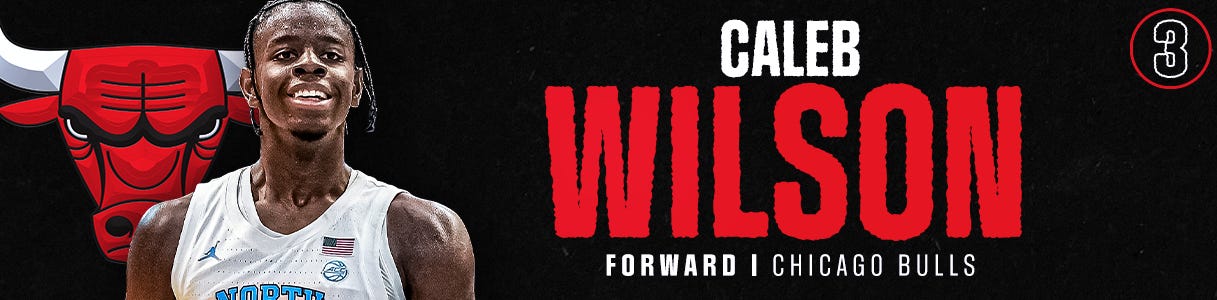
#3. Caleb Wilson | Chicago Bulls
I went back and forth on which prospect to pick here, but I went with the team that seems to make more financial sense. There is a ton of space with Chicago for them to add or move players, which gives Caleb Wilson a bit higher of a chance to have a better roster. The Bulls could a couple of floor-spacing big men who could open the floor for him, while having one of the best table-setters in Josh Giddey. Matas Buzelis and Leonard Miller have great positional size to offer up while playing alongside Caleb—not to mention another ball-handling forward that we will get to in a bit. This opens the court up for Wilson to be a rim-pressuring monster with tremendous upside. His passing feel went underrated during the cycle, and should play into some interesting pick-and-roll looks with a number of other players on the team. He’ll need to actualize his tools to get the most out of himself here, but there is a good chance for him to do those things with the talent surrounding him.
#4. AJ Dybantsa | Washington Wizards
I hope people read this part after seeing the name and number associated with this write-up.
The talent of AJ Dybantsa is immense—as well as his upside—and I truly think he has the skill to vastly exceed this slot. But, in the days before and after he was drafted, the Wizards have behaved in a confusing way. Anthony Davis has been speculated to be traded for weeks, but he remains with the team. He could quickly be moved, but I do worry about what this could lead to in terms of construct and chemistry. AD aside, the recent contract extension of Trae Young wasn’t well-received by the majority of fans and analysts. Sure, Trae could help make AJ’s life easier—and he might. However, the appeal of Dybantsa is from him having the ball, and we haven’t seen Trae be willing to play off others on volume. His prior team, Atlanta, was not only willing to move off of him, but to do it without getting any pick in return—and moving him within the division! The lack of floor spacing also makes AJ’s life more difficult. Luckily, Sarr is a willing shooter from deep—and Davis has been too—but neither are remarkably efficient. Again, I am rooting for AJ, but I question how the current roster meshes.
#5. Kingston Flemings | Atlanta Hawks
I was lower on Flemings coming into the draft, but I genuinely love the fit with him on the Atlanta Hawks. The questions I’ve had with Flemings haven’t been because of his defense or his passing, but mostly because of the load he would have to take on as a two-way player. If Kingston were taken to be a primary option to a random team, I would have worried about how that would impact the defensive side of the ball—which is really what separated him from the other guards in the class. Between Jalen Johnson, Dyson Daniels, CJ McCollum, and Nickeil Alexander-Walker—those four averaged over 21 APG. Flemings becomes additive within this Hawks system, and gives them yet another perimeter defender and transition threat. With CJ returning, there is no immediate need for Kingston to step in and be the Point Guard, which gives him the ability to give that consistent effort on the defensive end. The concerns about the way his jumper looks have been well documented all season, but the good news is that Atlanta already had (and has added) shooting from multiple players on the team.
#6. Jayden Quaintance | San Antonio Spurs
The player no one knew where to mock fell to the team no one knew how to mock. One of the glaring weaknesses for the Spurs that showed up all playoffs long was how they would bleed points once Wemby came off the floor. The minutes watch for Victor likely won’t go anywhere, and neither will the Luke Kornet on/off numbers. After getting punched in the mouth, adding the player who has the highest upside relative to where draft outlets were projecting him was a smart play (especially considering their subsequent move). JQ’s skill has long been discussed, as many analysts hedged their ranking of him by complimenting the young big’s talent. His intersection of twitch and power is genuinely terrifying and allows him to make breathtaking defensive plays and be a monster on the boards. His offense will be limited to arm’s reach as a scorer, but Quaintance also showed off some moments of brilliance as a playmaker. The Spurs can allow his strength and conditioning to build up following his injury. Sprinkling JQ in rotations with Dylan Harper, Stephon Castle, Carter Bryant, and Victor Wembanyama could be the ultimate “shut off their water” lineup.
#7. Morez Johnson Jr. | Dallas Mavericks
Morez Johnson going to Dallas is the pick that really introduced a wrinkle in the draft. With Dusty May making the jump to the NBA, it appears that he may have advocated for and influenced which Michigan man the Mavs would draft—despite how “in the dark” he may have been. This team already features Cooper Flagg and Kyrie Irving—with players like Dereck Lively II, Klay Thompson, and Naji Marshall rounding out the top of the rotation. This allows Morez to do the things that he is good at—defend, rebound, make sharp moves to the rim—while also providing him the leeway to develop next to players with sound basketball IQ. The biggest thing I could see helping his perception with the masses is the development of his deep ball. Should he start in a lineup that features Flagg and Lively, the spacing could get a little murky if he isn’t a player who could open things up on his own. The addition of Santi Aldama be have chipped away at some of Johnson’s projected minutes, but this gives him another frontcourt mate to help out and be helped out by. This placement of him is slightly a bet on him being a solid contributor on an ascending team, but Morez does have just as much of a shot to develop as any other young players within this class.
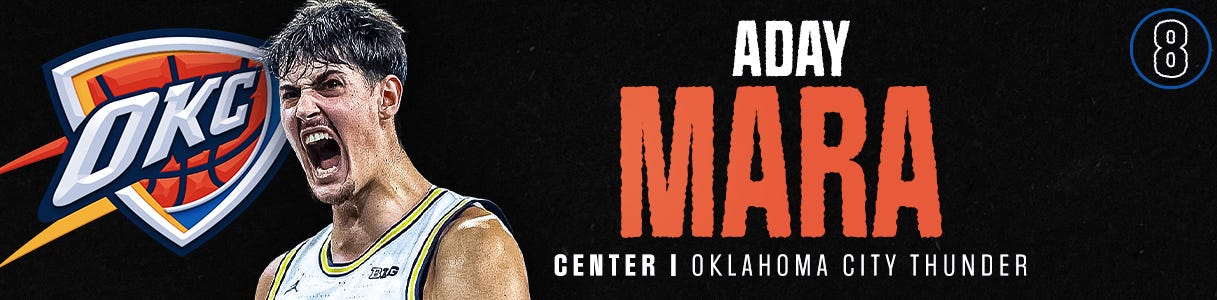
#8. Aday Mara | Oklahoma City Thunder
Look, I have been one of the people who have mentioned the words “Aday Mara” and “Wemby-Stopper” within a few sentences of each other during the draft cycle. Many members of the basketball community have hand-waved and gnashed their teeth as soon as this notion began to circulate within mainstream draft coverage. I understand that Aday Mara isn’t going to defend Wemby one-on-one. I get it. I do. Really. However, OKC does need to focus on this Spurs team. Most of the answers were probably on the injury report for the Thunder—but, you can’t tell me adding a 7’3” big man with a near-10 foot standing reach, who can pass, rebound, and protect the rim isn’t going to be helpful. Him running DHOs with SGA and Ajay would be a ton of fun—as well as him running high/low actions with Chet, I-Hart, and J-Will. Again, I am not suggesting that Mara is going to single-handedly wall off Wembanyama, but I’m of the firm belief that in order to stop an oddity, you need oddities of your own. Aday Mara is such an oddity.
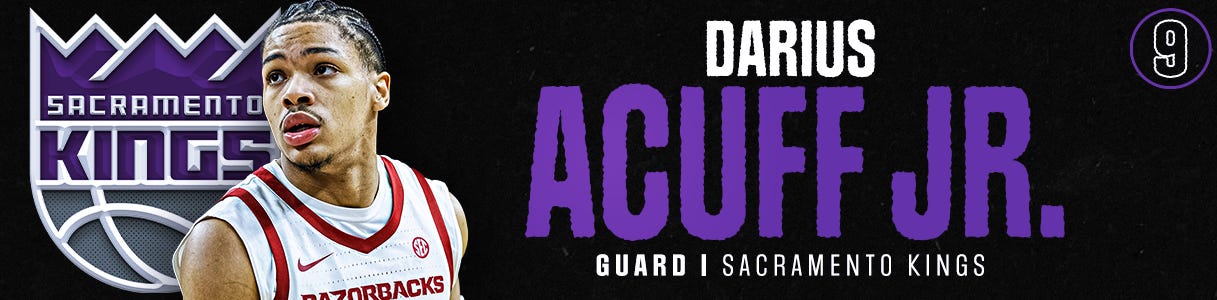
#9. Darius Acuff Jr. | Sacramento Kings
Part of this exercise is separating how I feel about players in a vacuum from how I feel about their likelihood to become the best version of themself based on where they landed. I had Darius Acuff Jr. as the fifth-best player on my board going into the draft. But Sacramento is a tough spot (not impossible) to project Darius becoming the player I think he can be. There is a weird hodgepodge of up-and-coming players, as well as vets. Acuff and Sabonis as a two-man game can be very fun—allowing for some interesting DHO sets. Pick-and-pops with Acuff and Maxime Raynaud could be a ton of fun. So could lob passes from Darius to Dylan Cardwell. But with the Kings having Zach LaVine and DeMar DeRozan on the team, I wonder how the pecking order plays out. I’m largely high on the outcome being positive, but I’m not sure on the larger contracts on the team. Add to the mix of confusion that Jalen Duren is reportedly meeting with the Kings to potentially find a new home. Without knowing who will be a part of that potential deal, there is even more ambiguity on how this team will look. This feels like a good threading of the needle of talent and team projection for me.
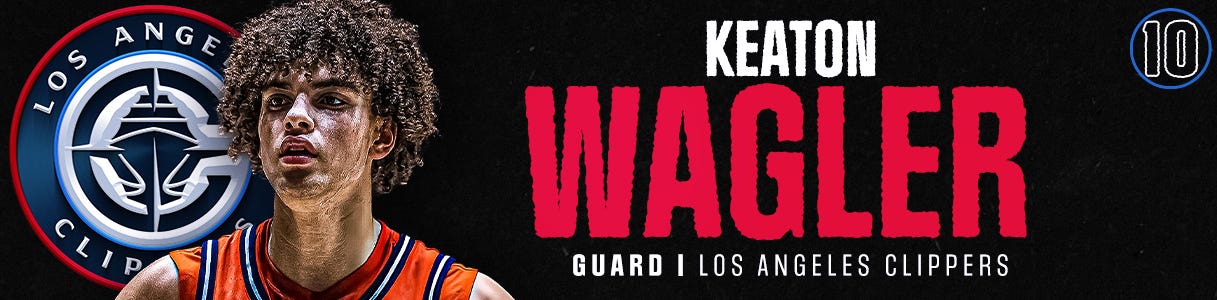
#10. Keaton Wagler | Los Angeles Clippers
Oh yeah, Wagler’s write-up is another update following a trade. In my opinion, the Clippers were fleeced again in a Kawhi Leonard trade—shipping out the All-NBA player for Brandon Ingram, Gradey Dick, and some picks without getting Collin Murray-Boyles in return. As it stands, Keaton’s best teammates appear to be Darius Garland Jr., Brandon Ingram, and (hopefully?) Bennedict Mathurin. Garland is a very capable offensive teammate, but is a smaller backcourt player—placing more defensive responsibilities on the wing players. Brandon Ingram is another professional bucket, and he is coming off his second All-Star season. BI’s scoring prowess should help alleviate some pressure from Keaton when he is on the floor, but he is far from being a primary defender himself. Bennedict Mathurin’s Restricted Free Agency will be a looming decision for the team, too, and will figure into the team’s pecking order and rotational decisions for the coaching staff. This situation just leaves me slightly concerned for Wagler now, as I’m not sure what his role will be on a team that is good enough to have a couple of All-Star-level offensive talents, but not quite good enough to project to be a real threat in the Western Conference. Is he a starter for a middling team? A sixth man? Do we trust the Clippers to nail their draft picks and properly manage their younger players? I still buy the talent of the player—his environment just became a little more concerning.
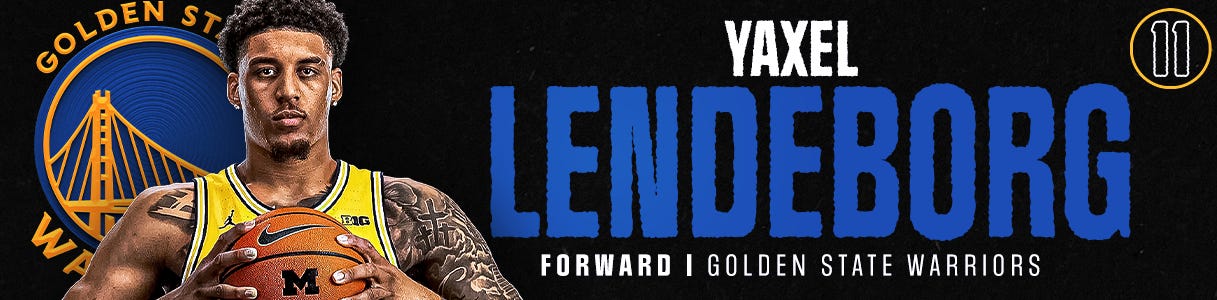
#11. Yaxel Lendeborg | Golden State Warriors
While the interviews of Yaxel Lendeborg post-draft may raise some concerns about Yax, the basketball fit makes a lot of sense. The upward developmental trajectory with Lendeborg has led to him being a reliable floor-spacer, relentless rebounder, and solid defender. And—even though he is going to be one of the oldest rookies drafted in the lottery—he is still going to provide young legs for one of the slowest teams in the NBA. The chemistry between Yax and Draymond Green will be fun to monitor and will be of particular interest to big NBA media—given the chronicled interactions between Green and other, younger teammates. Stephen Curry is going to do what he does best, and he can fit next to any assimilation of talent, but Lendeborg’s ability to open up the court should make Curry’s life at least a tiny bit easier—and vice versa. The Warriors haven’t been particularly potent as of late, and there could be reason enough to be skeptical of Steve Kerr’s inclusion of inexperienced talent. Given the lack of options for the team and the vast skill set of Lendeborg, though, Yax could be the rookie who actually plays a sizable role for Golden State—even if a super team forms!
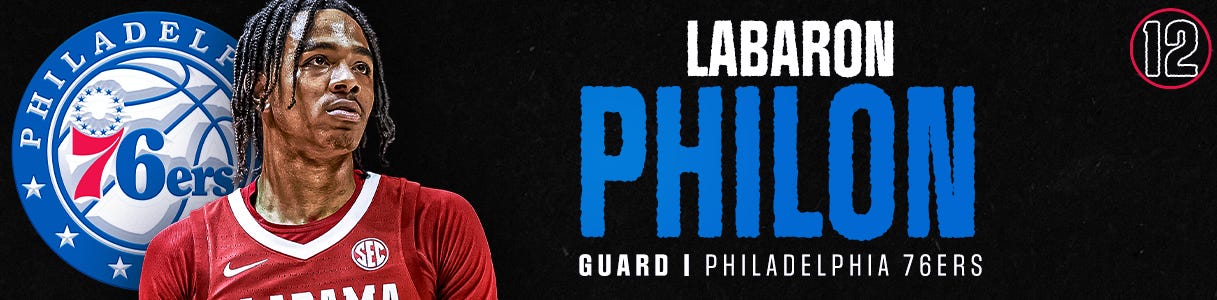
#12. Labaron Philon | Philadelphia 76ers
I was high on this matchup of team and talent even before the Jaylen Brown deal! Much has been made (even by me) of the weight concerns that accompany Labaron Philon. After weighing in under 180 pounds in consecutive NBA Draft Combines, there is a major uphill climb for Philon to be a successful NBA player. Being drafted to a team that has developed young guards is a good first step. Say what you will about Philly trading away Jared McCain and Isaiah Joe, the Sizers have brought along Tyrese Maxey and VJ Edgecombe nicely—and this should give confidence to Labaron. Not to mention that now they have moved off of the oft-injured Paul George for Jaylen Brown—a player who carried the Boston Celtics to the NBA Playoffs by the scruff of their necks. Even with a rollercoaster-type player in Joel Embiid, Philly has real talent who can be accentuated by a motivated JB. Coming off the bench, Philon can play next to either of the starting guards, as he shot the ball incredibly well for a year-and-a-half while at Alabama. Labaron’s at-rim finishing has been among the best of all the guards in the 2026 NBA Draft Class, and he has shown the ability to defend at a high level. His size will allow him to only be so impactful defensively, but Labaron is smart and can at least be an irritant on that end. Philly played above expectations last season, and there is a good chance that Philon can help them continue to be in the mix in the Eastern Conference—even in a bench role.
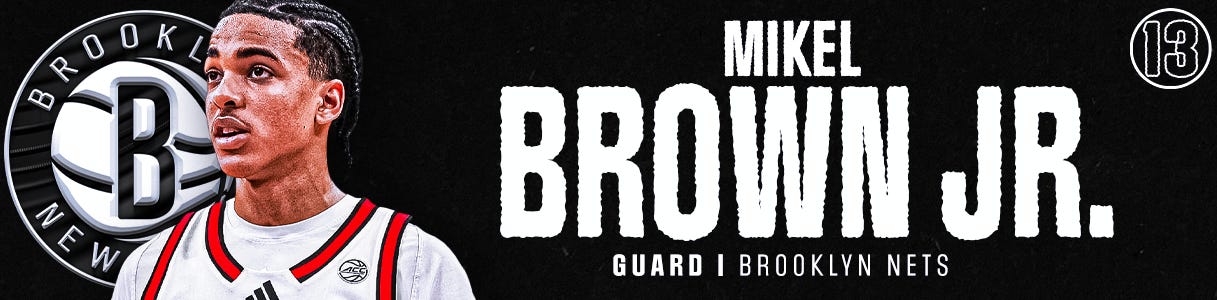
#13. Mikel Brown Jr. | Brooklyn Nets
Mikel Brown Jr. is another player who I had ranked significantly higher than where I have him here. To be blunt, there is a severe lack of trust that I have in the way the Nets have gone lately. I understand they “got another first rounder” for taking on Julius Randle’s contract, but Minnesota moved back five spots to get maybe the best shooting prospect in the class. They moved off Nic Claxton too, for almost nothing. There isn’t a ton of defense on the team, and the shooting is in the “if you squint, you can see it” territory at best. This isn’t great context for Mikel as a talent—regardless of his awesome shooting and creative playmaking. He also has the pressure of being the second guard taken in a class where he could easily be outdone by those behind him. Again, I loved the talent, but a single player can only do so much to change the perception and production of a poor team. Honestly, there is a case that he could go lower on this ranking, but I will still hold to some of the upside that had me rank him as the second-best guard in the class.
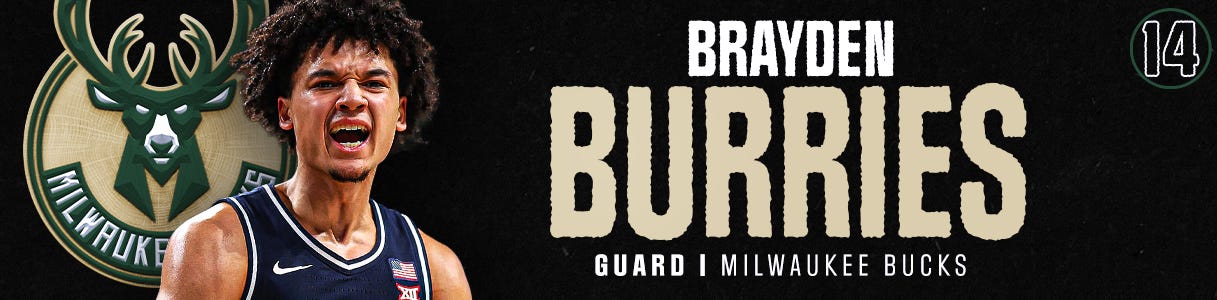
#14. Brayden Burries | Milwaukee Bucks
Burries is yet another player who I had ranked higher before the draft than where he falls in this exercise. Honestly, he fell to the one team that could have had me cool on his environment—and a lot of that comes down to the fear of the unknown. Part of the trade package from Miami to get Giannis Antetokounmpo from the Bucks was Tyler Herro. In theory, Herro could be moved relatively soon. In the meantime, He projects to play over Burries—and, he kind of should. Herro is one of the more underrated scorers in the NBA, so there is a clearer path for the Bucks to center the team around him. This also helps bolster any potential trade packages in the future. Ryan Rollins also figures to get a lot of run, as he has been a proven commodity for this team. Burries could be an Alex Caruso-type of guard off the bench. He can pressure the rim, he has shown the ability to space the floor, and he has looked like a stellar defender. There is less pressure here for Brayden, but he will have to punch his way up on a “scrappy-at-best” Bucks team in the East.
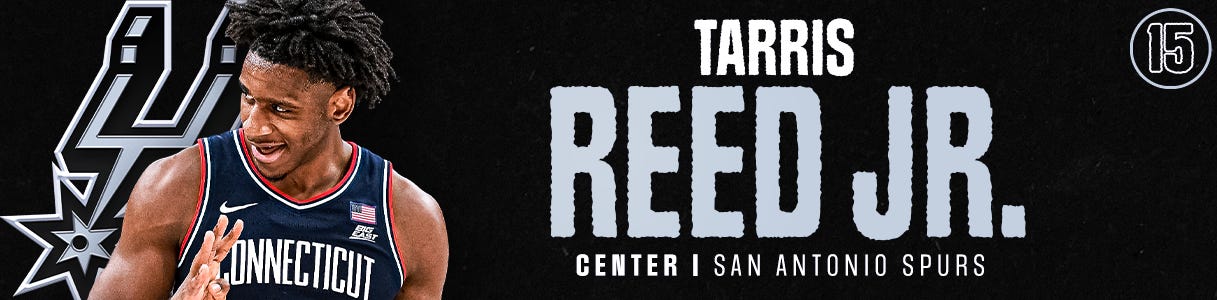
#15. Tarris Reed Jr. | San Antonio Spurs
As if the Spurs needed a potential “monster-in-waiting” with Jayden Quaintance, they doubled down by getting Tarris Reed Jr. further back in the draft than many were led to believe. While JQ can continue to recover and learn the nuances of being an NBA player, Tarris can provide some immediacy to San Antonio. Like Quaintance, Reed is a proficient passer out of the pivot spot and can be trusted to find the players who like to make cuts on this team. He is a monstrous rebounder and moves better than you would first expect. With the center rotation coming into question in the latter stages of the NBA Playoffs, the Spurs made the ultimate “take your medicine” move by trading up to draft Tarris Reed Jr. a few spots after Quaintance. By adding Tarris and JQ in the draft, and signing Tobias Harris out of Free Agency, the reigning Western Conference Champions appear to be even more dangerous.
#16. Bennett Stirtz | Oklahoma City Thunder
The Thunder could have almost taken anyone, but the fact that they added another perimeter player made sense. Adding on that they took one of the best guards in the class, things are going the right way in OKC. With Aaron Wiggins and Isaiah Joe now gone—and with there being a strong probability that either Lu Dort or Cason Wallace will be out somewhere down the line—the Thunder likely needed another perimeter-oriented player to bet on. Stirtz has shown the ability to take on so much that scaling down for him feels like it will be pretty easy. He possesses the whole dribble-pass-shoot thing that the Thunder have shown to value, and he thinks the game to a very high degree. With his size and length, Bennett has been a capable defender, and the Thunder typically get the best out of their players on that end too. OKC doesn’t have to hand the keys over to Stirtz anytime soon, which does alleviate otherwise added pressure. However, one can’t help but think that Bennett will thrive in any opportunity that this team gives him.
#17. Cameron Carr | Los Angeles Lakers
With LeBron out the door, the Lakers have looked to add to a Luka-led roster. With Austin Reaves in tow as secondary creator and scorer to Doncic, the winning formula for a team like this is adding a rim-running lob threat, and 3-and-D players. Carr fits the mold of a 3-and-D player, as he has a strong case to be the best shooting prospect in this class. He’s also a world-class athlete—capable of finishing above the rim on cutting actions away from the ball. Defensively, he covers a ton of ground and even shows some rim protection prowess. He is a bit slight of frame, but as he gets stronger, he can help space the floor for Doncic and Reaves to run actions with whichever big man is out there. He’ll likely be asked to take on some of the more difficult assignments, which would worry me in the immediate. But the addition of Quentin Grimes gives Cam a little bit of time to grow accustomed to the NBA. As he gets stronger, he should be able to work his way into a larger role, taking on difficult perimeter assignments.
#18. Ebuka Okorie | Detroit Pistons
One of the things that the NBA Playoffs told us was that Cade Cunningham needs some sort of help on offense. The notion that the 2026 NBA Draft class was so deep at the lead guard position that one would have to fall came to fruition, and that allowed the Pistons to get Okorie. There is a strong case to be made that Okorie has the highest upside of the guards outside of the Wagler-Mikel-Acuff-Kingston quadrilateral. His speed, handle, and ability to get to his spots offer some instant offense to a team that needs it. The questions about his shot and passing feel are finally going to be answered, but I’m optimistic that he is going to show why I ranked him 11th on my board. If there are concerns about his defense, this is the team that could insulate him. But his awesome wingspan should help him adjust to the league despite being a sub-6’4” guard. But there is still an overall lack of spacing that does muck things up a bit—especially with Tobias Harris off of the team.
#19. Christian Anderson | Charlotte Hornets
I feel like I am on a bit of an island following the results of the LaMelo Ball trade. I’ve heard all of the “sell high” conversations that everyone is saying, but who is the rim-pressure guy?! Kon? He hasn’t been one. Miller? He hasn’t been one. Newly-drafted Christian Anderson? He hasn’t been one either. This is a lot of pressure to place on the team collectively. With Ball now gone, Coby White is likely the starting guard, with Anderson now being put in a position to take on more of an immediate role. I’m not worried about the shooting translating. I’m not worried about the connective passing translating. But, is there now going to be some expectation for Christian to be the new point guard of the future? If so, I don’t know how fair or reasonable that is. There is just a lot of uncertainty with a player I was, admittedly, a little lower on.
#20. Nate Ament | Milwaukee Bucks
The Bucks are actually shaping up to be pretty interesting to monitor. Honestly, they may be atop the League Pass rankings for me. The Bucks added Tyler Herro, Kel’el Ware, Jamie Jaquez Jr., and Kasparas Jakucionis for Giannis Antetokounmpo and Bobby Portis. After adding the aforementioned Brayden Burries, they were able to add Ament. Now, I am slightly worried that, after facing poor Kevin Durant comparisons, that the 6’10”, tall, skinny, high-upside prospect is now going to be looked at as the “Giannis Replacement” for the Bucks. I just think that will be a natural and almost subconscious connection to make. I do like that Ament won’t have to be the “savior” for the team, as Herro is a professional bucket. Ryan Rollins is a bucket. Ware has high upside as a backup—or even replacement—for Myles Turner. Jaquez is a smart, connective player. Burries and Jakucionis have the potential to be scary as greyhounds to unleash off the bench. Ament has the runway to work on the jumper and to become a stronger and more capable defender. I was actually lower on Nate compared to this re-rank of him, because I did not see star upside—even Jaden McDaniels-level upside. But this is actually an interesting place for him to land and become a best-outcome version of himself with little to no pressure.
#21. Allen Graves | Toronto Raptors
The Raptors made a move that required me to provide a bit of a revision here, but most of how I felt about Graves still translates over with Kawhi Leonard now on the team. Graves comes into the NBA with a relatively safe floor. At his size, the way he shoots the ball, rebounds it, and the level of feel he possesses…it just feels like he will bring some sort of value offensively. His athletic concerns are valid, but he gets an opportunity to play next to Scottie Barnes, Collin Murray-Boyles, and Jakob Poeltl. Because he can do the things that he can, Graves fits next to each of those guys relatively cleanly. His floor spacing opens up driving lanes, as well as some of the guards and wings to run pick-and-roll looks. The question with Graves on this team is: How much playing time should we expect with a team that is looking to contend atop the Eastern Conference? How much of his game should we expect Toronto to explore with real…aspirations? If the athleticism concerns prove real, I’m not sure how much of a runway Graves will have with the Raptors.
#22. Hannes Steinbach | Charlotte Hornets
There was a significant amount of buzz regarding Steinbach’s standing among NBA teams coming into draft night. He was rumored to go even higher than the 14th pick that was used to get him—though I was slightly lower, having him at 19. It’s crazy how much the LaMelo trade shifted my view of Charlotte’s draft, because, initially, I loved Steinbach for this team. I felt he would start, be a screener and handoff guy for Ball, and get second-chance buckets. Now, not only is Ball gone—leaving a vacuum at the paint-pressure role on the team—but now Naz Reid is probably starting over him. This isn’t to say that Hannes can’t be a contributor off the bench for Charlotte, but the general thought is that the team is now “strategically” expecting to take a step back. So, is Hannes a hustle bench player of a lower-rung Eastern Conference team? And are we just expecting that some shadowy silhouette of a future player to be the answer for the team? Some may hope so, but I’m a bit skeptical.
#23. Dailyn Swain | Chicago Bulls
I’m in a weird spot where I kind of like what the Bulls have done in the draft, but I also want to acknowledge the amount of push-ups that still need to be done. Chicago did the right thing by taking Caleb Wilson—regardless of the outcome. But, considering the number of players who were still available at pick 15, taking Swain is a bit of a head-scratcher for me—and I liked Swain; I had him 17th on my board. This does feel like a bet on the frame and what he showed off this season at Texas. Floor spacing isn’t something this team has an abundance of, and the only comfort Dailyn showed as a shooter was off the catch when wide open. Wilson feels like a lock to start next to Buzelis. The newly acquired Nic Claxton figures to play some sort of role for the team. Josh Giddey is going to man the helm on this team. The hope is that Giddey has his third season in a row where he shot 36+% from deep and could go for a fourth, while Matas rises above the 34.9% that he posted. With Swain, if he could play the two-guard spot for Chicago, he would bring another ball-handler who shot 40% from deep…albeit on very low volume. This would likely be needed in the long term, though, as Chicago signed Norman Powell in free agency. There also has to be some hope that the defensive tape while Dailyn was at Xavier is still within the player. Swain does fit the S.L.A.P model, but if he can’t shoot, he feels relegated to playing alongside Leonard Miller off the bench.
#24. Zuby Ejiofor | Atlanta Hawks
The Atlanta Hawks have been one of the busiest teams in the Eastern Conference—bringing back CJ McCollum, working the draft the way they did, bringing in Aaron Wiggins for a couple of second round picks, and taking on Devin Carter’s contract while getting another pick for their troubles. The addition of Kingston Flemings made so much sense and, to a very respectable degree, so did the selection of Zuby Ejiofor with the 23rd pick in the draft. The biggest question I have is: Where does his playing time come from? Jalen Johnson is the star of this team moving forward. The Hawks seem keen on Onyeka Okongwu, as they should. There is no shortage of wings and guards who allow this team to play Five-Out. Zuby will likely come off the bench and be able to provide some high-intensity, high-effort plays—in the mold of an Isaiah Stewart type of player. However, he is smaller, and he doesn’t shoot—so Atlanta will have to be creative with the lineups they look to use him in. Luckily for him, there are several players who can open up the floor for him. While I liked Zuby a great deal (I had him 21st on my board), I’m not sure how much playing time he will realistically get on the team.
#25. Henri Veesaar | Atlanta Hawks
I’m not sure how you could say the 2026 NBA Draft was “chalk” while Henri Veesaar fell into the 50s. Even for me—who had Veesaar ranked 37th—the fall for Henri was unexpected, though I understand how he may have been “steered” to the Hawks. While I was lower on him in a vacuum, the fit with Atlanta makes so much sense. He is someone I can envision playing next to Okongwu, as both players have some floor spacing to them. His passing fits their “our team is the point guard” philosophy. He is a good rebounder and has good touch around the rim. Atlanta was very smart to go after another frontcourt player who allows them to roll out a different look the way Veesaar does. There is a real shot that he could end up yielding a higher return than Ejiofor for the Hawks, too.
#26. Karim Lopez | Memphis Grizzlies
I really liked Lopez coming into the draft—and that’s relative to other prospects and where many had him ranked within the consensus. Lopez going to the Grizzlies made some sense with how they appeared to value size and strength, but he’s already going to be relegated to a bench role. Karim figures to play the 4, which puts him behind his classmate, Boozer. With the Ja trade bringing in Jerami Grant, there is yet another level of uncertainty as to how much time Lopez will get. Sure, he’s young, and he still has time to develop. But, as we like to say, the best way to get better at basketball is by playing basketball. This is where I have concerns with Lopez. So much of the developmental time is guaranteed to go to Boozer. There are still younger players on the team also seeking to improve. Being a young, depth player behind other younger teammates rarely ever works out for the young depth pieces. But it’s not impossible.
#27. Richie Saunders | Memphis Grizzlies
I know that Saunders fits into a similar situation as Lopez, but his archetype is a cleaner introduction to a team. Floor spacing is something you really cannot have too much of, and Richie looks to provide that at a minimum. He has good size, he plays hard, and can open things up for Boozer, Edey, Coward, and company. His injury is slightly concerning, but we know he will play basketball again at some point in his life. In all seriousness, when he comes back, there is a world where his steady hand could serve Memphis well in a pinch-starting spot—even if it’s for a shorter minutes total. He is a scrappy defender, but he doesn’t figure to improve the team’s defense. That’s one area I’m curious to monitor with the Grizzlies, but I’m not going to knock Saunders for that. I’m also curious to see if Memphis does some sort of BBQ Tater Tots dish to honor the spud heritage of the Saunders family.
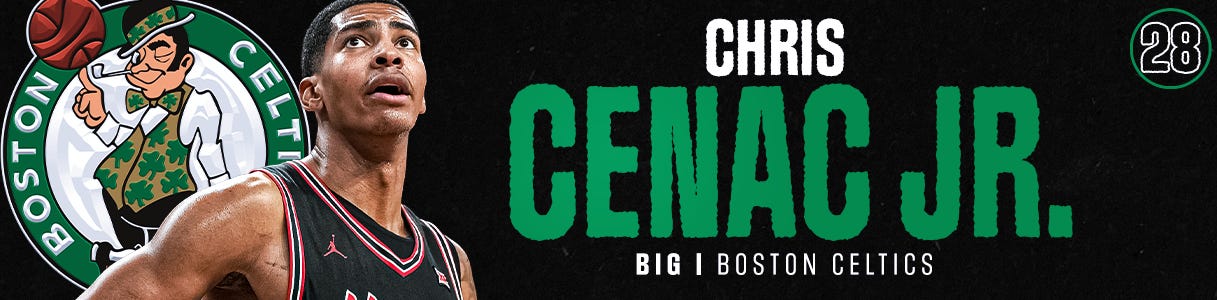
#28. Chris Cenac Jr. | Boston Celtics
With Jaylen Brown being traded to the inter-divisional 76ers, it remains unsure as to how competitive Boston will look to be next season. Sure, Paul George is a good talent when healthy—but how healthy can we expect him to be? Not to mention that Jayson Tatum is coming into his first full season post-injury. Neemias Queta took on the starting role for Boston last year, and we knew that there would likely be a yearning for the team to improve at that position. That thought process was solidified by the Mitchell Robinson signing. Chris Cenac Jr. could be Boston’s answer in the long term, but he has a long road ahead of him. He isn’t a strong rim protector—which is something that we know is vitally important to how Boston has historically looked to defend. He does rebound well, and he can really move—I think about how well he moved defending AJ Dybantsa when he faced BYU far more than I should. But he needs to become better at keeping the ball out of the basket as the backline guy. To add to the positives, he does fit the Celtics’ offensive philosophy for the most part, as Cenac looks to space the floor to some degree. I would like to see him improve more as a decision-maker—and he certainly can as he continues to develop. My biggest question is Boston’s patience and willingness to allow Cenac developmental minutes during the season. And that is hard to project given their recent roster decisions.
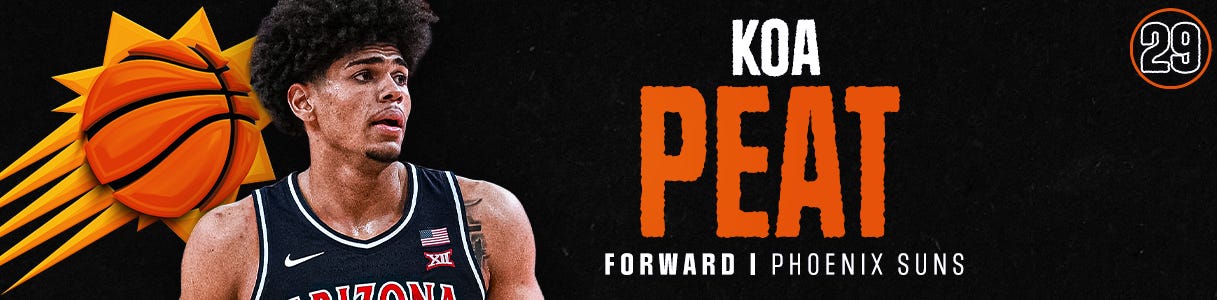
#29. Koa Peat | Phoenix Suns
I spoke about this with Charlotte a couple of times within this piece—that the moves after the draft left me more sour on their draft decisions. The same thing applies here with Phoenix trading into the First Round to take the in-state prospect, Koa Peat. Peat’s season at Arizona resulted in wins, but his standing within the class fell as the cycle progressed. His shot has been picked apart enough, so I’ll move on from there. Koa’s consistency was also called into question. Even still, he was the one prospect who came remotely close to Cameron Boozer’s accolades and accomplishments. I still think he could be the Peyton Watson of this class—being a far better pro than what we saw of him in college. Then the Suns did the most Suns thing ever, and traded for a Michigan State alum in Miles Bridges. Considering the things that come along with Bridges, trading for him is going to come with inherent criticism on its own. Moving off of two floor spacers, some pick gymnastics, and getting someone who plays the same position as the guy you just moved capital to acquire…like I said, it was the most Suns thing ever. Even without getting Bridges, you have a lot of developmental time to invest in Khaman Maluach for a (hopeful) Sophomore breakout. Also, Rasheer Fleming plays the same position. Peat has the talent to overcome these concerns. I’m more so worried about the environment that he is going to have to punch his way through.
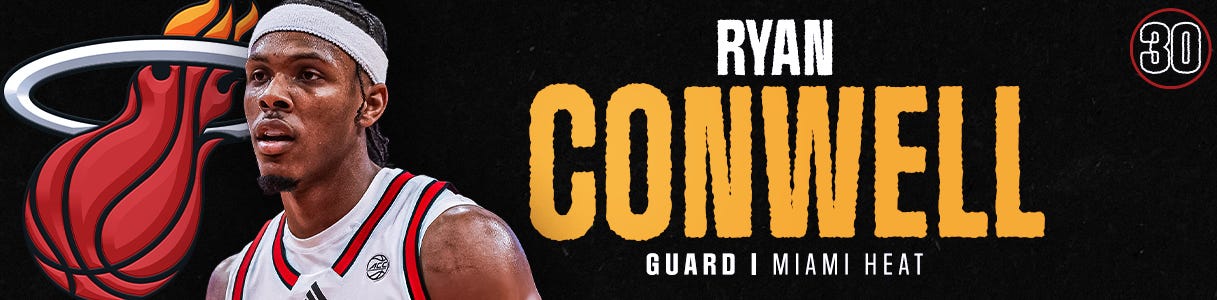
#30. Ryan Conwell | Miami Heat
It’s such a Miami Heat thing to do: get a dog of a player on the margins who fits what their star player needs. After moving off so many young players to acquire Giannis Antetokounmpo and Bobby Portis, landing Conwell is an A+ selection. Ryan shot 35% on 17.4 attempts per 100 possessions. On open threes, he shot about 39%—which is the sort of shot he should expect playing next to an MVP-caliber player in Giannis. He’s also a very strong and capable defender, with his lowest Steal Percentage in college being at 1.8 in his Sophomore season. If he is in a position where he can sell out as a defender—like in Miami—he can be a frightening, two-way guard. Miami thrives in getting players like Ryan Conwell, so it wouldn’t be a surprise to me at all if he plays a vital role for Miami and ends up being far more productive than his 37th overall selection would suggest.
Follow me on Twitter: StephenGHoops
Catch me on BlueSky: StephenGHoops
Catch the Draft Sickos show LIVE on the No Ceilings NBA channel:
I'm super curious about Wagler's environment as well. Who the heck is going to play defense?!
Carr can play 12-18 mpg immediately in my opinion. Defense, make open shots, cut hard at the slot...almost too easy for him!
Enjoyed the breakdown!
The clock has struck July and the NBA’s great bazaar of human potential bursts wide open. We are stepping directly into the fantastical pages of Gabriel García Márquez’s One Hundred Years of Solitude, where the surreal becomes ordinary, and the marvelous town of Macondo is reborn in the neon glow of free agency negotiation rooms. Just as Melquíades brought wondrous, reality-bending inventions to a remote village, general managers are now wielding trade assets like ancient alchemy, trying to transmute draft capital into golden championship banners.
Who will find their own beautiful, isolated paradise? And who is destined for a century of basketball solitude? The anticipation for the magic realism of the NBA open market is absolutely exhilarating.