


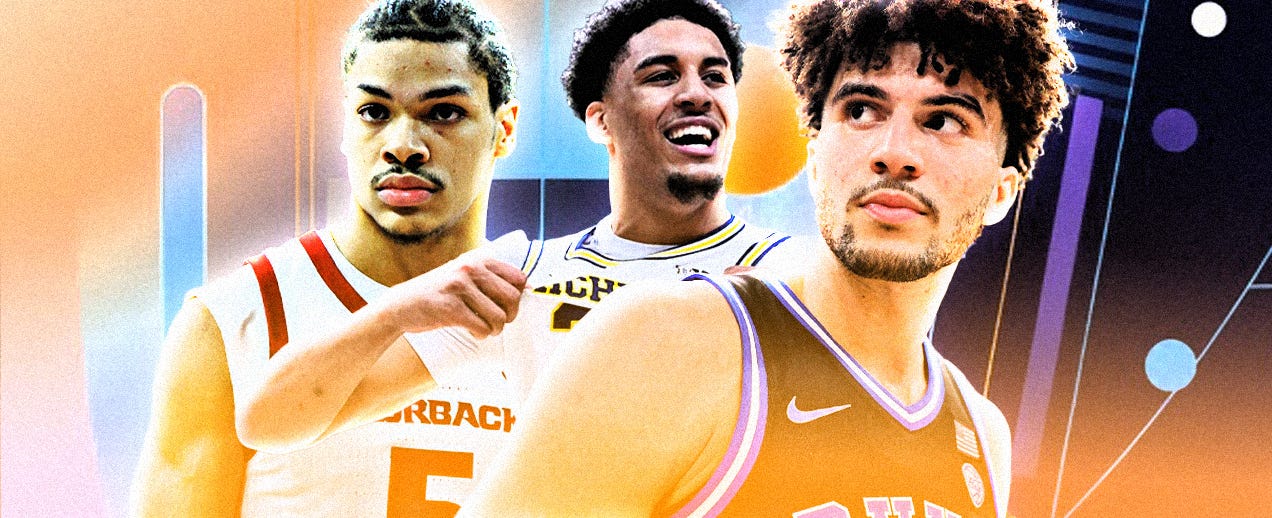
Feast Week is in the books! Today, we take a break from the traditional Prospect Overview format to cover the events of this past week best.
The Yax Man Cometh
It’s hard to think of a bigger Feast Week Winner than Yaxel Lendeborg. Just a few weeks back, things weren’t looking so hot for Michigan’s 6’9” Swiss Army Knife. He had a rough game in his first big test against Wake Forest. Some panicked. After all, the big knock on Lendeborg was that he struggled to score efficiently against high-level opposition at UAB. If a 23-year-old is having that issue, how can we confidently project him to the NBA? Lendeborg had a solid-but-unremarkable follow-up game against TCU. But at the Player’s Era Festival, Lendeborg responded emphatically to his doubters.
Michigan wiped the floor with San Diego State, Auburn, and Gonzaga. Across those three games, Lendeborg averaged 17.3 PPG on 63.0/43.8/7.33 splits, 7.3 RPG, 3.7 APG to 1.3 TOV, 2.0 SPG, and 1.3 BPG. The week was a masterclass in modern basketball. Lendeborg has the “energy guy” traits that could scale down into a reduced role effectively. He runs hard in transition on both sides of the floor, whether it’s to get a run-out jam on offense or to reject a layup on defense. Offensively, he can make quick decisions and crash the glass. Still, there’s more to him. He can put the ball on the floor and make impressive passes on the move. Defensively, he’s able to bother opponents up and down the positional spectrum. Off-ball, he can time his digs well from the perimeter or rotate hard to the rim to swat an opponent’s shot.
My favorite evolution in Lendeborg’s game this year, though, has been his willingness to let it fly. Lendeborg was always something of a theoretical shooter. He’d hit 34.9% of his threes on low volume at UAB while shooting 77.8% from the free-throw line, a great mark for a player his size. Still, it was frustrating to watch him at times. He’d get open looks from deep and pass them up despite shooting good percentages and having a smooth, consistent stroke. That’s no longer the case. Lendeborg is letting it fly. He’s taking 4.7 threes per game, up big from his 1.9 attempts per game last season. While his 39.4% mark from deep might not sustain itself, if Lendeborg shoots around 36% on that volume, that’s stellar for a player his size, and really transforms his case as a draft prospect.
For Lendeborg, the question was largely, “how is this guy going to score on an NBA court?” The fact that we saw him score with ease across three marquee matchups is highly encouraging. But the fact that Lendeborg is letting the three-ball rip is of monumental importance. How many 6’9” guys are legitimate threats to dribble, pass, and shoot? And how many of them are also great rebounders who can legitimately guard a wide variety of opponents? It’s a short list, and Lendeborg is tracking to be on it.
Of course, there’s a discussion to be had about his age. Lendeborg is a month older than Josh Giddey. Still, I think Lendeborg’s unique background has me far more optimistic about him than most other older prospects. As I noted back when I covered him for No Stone Unturned, Lendeborg only played 11 games of high school varsity basketball. In an era where it feels like NBA players are constantly dealing with injuries, the fact that Lendeborg doesn’t have the “year-round since middle school” wear-and-tear on his body may be significant. Additionally, with most late bloomers, the issue that plagues them is that they are too far behind the “feel” curve and can’t catch up. With Lendeborg, that paradigm is flipped. He’s relatively inexperienced in terms of high-level play, but he’s an advanced processor for his size on both ends of the floor. If any older prospect deserves the benefit of the doubt, it’s Yaxel Lendeborg.
Throughout the course of a draft cycle, it’s important not to get too high or too low on a prospect. There’s still a lot of ball left to play. We’ve already seen the ebb and flow of things within Lendeborg’s short season—a valley against Wake Forest, and a potential peak in Vegas this past week. But even if Lendeborg is somewhere between those two points, I want in, and I want in earlier in the draft than many might expect. Players with his size and skill set don’t grow on trees.
A Windy City Classic
Duke freshman Cameron Boozer had a bit of a funky start to the season. Against lesser competition, the 6’9” powerhouse looked every bit as dominant as he did in high school. He bossed around smaller players, fought to his spots, and cleaned up on the interior. Defensively, his blend of feel and physicality allowed him to shut down opponents. However, when matched up against big dogs like Texas and Kansas, he looked much more mortal. He struggled inside, trying to spam pump fakes in order to get clean looks inside against players who could match his strength and athleticism. He needed a great game against a great team, and he had one on Thanksgiving night.
Boozer posted 35 points, nine rebounds, three assists, and two steals against Arkansas. Most importantly, he scored efficiently. Boozer went 13-for-18 from the field. He scored from ball screens, spot-ups, and isolation possessions, fighting his way to spots before converting with touch finishes. Boozer also slammed home a few jams. While Trevon Brazile and Malique Ewin might not be the most polished or powerful rim protectors, they’re nothing to scoff at, either. The fact that Boozer was able to get to his spots, generate clean looks in the paint, and get the ball to fall through the net against a high-quality opponent should ease some of the concern about him as a super high-end prospect. Everything else is there. Boozer is an unbelievable passer, a smart, versatile defender, an elite rebounder, and a good shooter for his age and size. If he can continue to A) get to his spots effectively and B) get buckets on the interior, there won’t be much to quibble with.
On the other side of the floor, Arkansas’ Darius Acuff Jr. put on a show. I’ll be honest—I was highly skeptical of Acuff coming into the year. The 6’3” freshman is a bit ground-bound as a finisher, his shooting priors were iffy, and his defensive effort often left something to be desired. The version we’ve seen of Acuff in college is a much better, more complete player.
For starters, his competitive spirit is awesome. I know mileage may vary with that type of take, and as a self-professed Calculator Boy, I get it. But there is a real mental and emotional element to basketball, especially in the modern climate. The pressure to make it in the NBA, the influx of NIL money, social media, and the dramatic rise of sports betting have made college basketball a pressure cooker of the highest order. There’s the stress of the performance on gameday, anxiety over what the future might hold, the off-color remarks from fans online, and dudes in the stands yelling at you over their parlay. That’s a lot, and it can take a toll. If it is taking a toll on Darius Acuff Jr., you wouldn’t know it. He took complete command of the game for the Razorbacks. He hit big shots and got in opponents’ faces on defense. You’ll never have to ask if the moment is going to be too big for him. Acuff is always going to carry himself like he’s the best player on the floor.
From a skill perspective, he’s been good, too. His jumper looks great off the catch, and he’ll pull up from deep when given space. As always, he’s been a consistent, reliable table setter. Defensively, he can struggle off-ball at times, but he’s been productive and rock-solid at the point of attack. The swing skill to watch will be his finishing. Through seven games, Acuff has only taken seven half-court rim attempts, and he’s only made two of them. He’s more reliant on floaters, which can tend to be a high-variance shot. In a loaded guard class, even the top prospects will have little margin for error. But Acuff’s tenacity, shooting, and passing have him ahead of schedule.
Joshua Jefferson is Stuffing the Stat Sheet
The Iowa State Cyclones went 3-0 during the Players Era festival, and much of the credit for that should go to Joshua Jefferson. The 6’8”, 240-pound forward has the physical dimensions of a big NBA forward. He produces like one in many respects, too. But it’s Jefferson’s uncanny floor vision and passing ability that make him particularly intriguing. During his three games in Vegas against St. John’s, Creighton, and Syracuse, Jefferson averaged 16.0 PPG, 8.0 RPG, 6.0 APG, 1.3 SPG, and 1.0 BPG.
Jefferson is a strong, bruising player. He does most of his scoring on the interior. He has a smooth handle and powerful backdown game, and he’ll use either of those weapons to get to his spots inside. If off-ball defenders try to get too cute with their help positioning, though, Jefferson will punish them. He’s able to execute high-level passes both from a standstill and while driving. In particular, he loves to palm the ball like a water polo player before whipping it across the court. Even when his passes don’t directly lead to an assist, the advanced, unexpected passes he makes often throw defenses off guard and get them scrambling. In my notes, I jotted down that he’s “a habitual domino tipper.” He’s always doing something that flusters opponents and leads to positive, high-value looks for his team.
On defense, Jefferson is like a bizarro version of himself on offense, using all of his traits and tools to prevent dominoes from getting tipped. At the point of attack, his long arms and strong chest make him an impenetrable force. Off-ball, his balance, timing, and understanding of what the opposing offense is looking to accomplish allow him to always be in the right spots. There will be so many times throughout the course of a game where it feels like a team is about to get their offense flowing, but something Jefferson does will bring everything to a halt.
The same scoring question I brought up with Lendeborg applies to Jefferson, but more firmly. He’s a lower-volume scorer, historically. Last year, Jefferson struggled both beyond the arc (31% from three on low volume) and at the rim (55.8% on halfcourt shots at the basket, per Synergy). While Jefferson hasn’t gotten his jumper to fall yet this year (28.6% from three on two attempts per game), he’s done better on the interior, converting 66.7% of his halfcourt rim attempts. He’s shown more patience and poise before going up with the ball. His use of pump fakes and the angles he’s generated both show an increased attention to detail. We’ll have to see how that holds up throughout conference play.
I’m generally terrified of guys with scoring questions. That said, it’s hard not to be even more intrigued with Joshua Jefferson coming out of Feast Week. He’s got size, strength, savvy, and skill on both sides of the ball. Historically, the guys who thrived in an “overtasked” college role are the guys who tend to make it work in a reduced role at the NBA level. Right now, we’re witnessing Joshua Jefferson be a key part of Iowa State’s defense while also spearheading their offense. I understand not wanting to bet on a sub-par shooter without over-the-top run-jump athleticism, but Jefferson’s combination of productivity, feel, and creativity makes me too afraid to not bet on him. It just feels like he always has an answer for whatever is in front of him, and it wouldn’t surprise me in the least if he has more answers at the NBA level.
Maui Gets The Chad Baker-Mazara Experience
There are certain times when I’ll watch a prospect, and a sequence will unfold on the floor, and I’ll think to myself, “that’s (insert player here) in a nutshell.”
Chad Baker-Mazara had one of those moments in The Maui Invitational final against Arizona State. The 6’7”, 25-year-old hit a pull-up three, and then immediately got a technical for taunting. He’s no stranger to extracurriculars and has dealt with high-profile ejections in high-stakes games before. It can be frustrating to watch, especially given his age and experience. He can feel a little bit erratic and hard to trust. For NBA teams hunting prospects on the margins, that’s a complicated thing to weigh out. It’s an issue you’ll hear varying levels of concern about depending on who you talk to. Some care a lot, others don’t sweat it all.
But the reason Chad Baker-Mazara, who turns 26 in January, is still talked about as an NBA prospect despite his occasional shenanigans is because he’s really, really good at basketball. He’s an awesome shooter who’s gone a hair under 40% on high volume over the last three seasons. He has a quick first step and the bounce to finish above the rim. He has excellent timing as a passer and can freeze defenses with his sharp, on-the-go deliveries. Defensively, his length, quickness, and lift make him a threat both on and off the ball.
Chad Baker-Mazara is an archaic prospect, and some of his antics may be off-putting to certain evaluators. But at the end of the day, the job of an NBA front office is to put people on a basketball court who can help you win a basketball game. A 6’7” sniper with ball skills who can make things happen on defense is tough to overlook, regardless of how you slice it. Life would be easier for NBA teams if CBM had flamed out USC, and they didn’t have to think about such a complex evaluation. But Chad Baker-Mazara was always going to be too talented to make that happen. He’ll be one of the most fascinating prospects to monitor in both the short and long term, as the value of his college production at his age is something NBA teams haven’t had to view through a draft-specific lens in a long time, if ever.
The Power of the Punch
Can we talk about TCU knocking off Florida and Wisconsin in back-to-back games?! If that wasn’t supposed to happen, no one informed the Horned Frogs. The TCU prospect who caught my eye most is David Punch. The 6’7” sophomore has been doing it all for the Horned Frogs. He’s got a funky game, but it’s tough to argue with his production. He scores most of his points in transition. In the half-court, he likes to use his power to back down smaller players before finishing inside. He’s also a hard-nosed rebounder and an exquisite passer who can fit the ball through tight windows. Defensively, he’s all over the place. His rim rotations are on point. He has an excellent nose for the ball in passing lanes with the speed to pick off the rock. His quick hands enable him to poke into handles with pinpoint precision.
Punch isn’t a complete prospect at this stage. He’s a wing-sized player who scores more like an energy power forward from two decades ago. He’s a career 28.9% three-point shooter on one attempt per game, and he’s only hit 56.7% of his college free throws. Still, his volume and efficiency have climbed from both long range and the free-throw line this season. While his jumper is slow loading and he really takes his time to aim it, the actual motion is smooth. David Punch is probably going to need some time to round out his offensive skill set so that it can provide value at the NBA level. But right now, he’s good enough to win games against great college teams, and his production makes him worth monitoring in the long run. Punch’s length, athleticism, and feel have me excited.
The Lightning Round, Positivity Edition
6’10” Seton Hall big man Najai Hines has incredible instincts on both sides of the floor. NC State’s Matt Able has been up-and-down, but his defensive want-to against Boise State really caught my eye. He might not be one-and-done, but his shooting track record and defensive disruption are tantalizing. I’ve always been a Keyshawn Hall skeptic, but his productivity, physicality, and reduced turnovers this year have me changing my tune to a degree. Northern Iowa’s Leon Bond III has become one of my favorite mid-major prospects. He’s a dribble-pass-shoot wing with an unrelenting defensive motor. I’m intrigued to see where his shot settles in come conference play. Felix Okpara, I see you taking and making the occasional three-pointer!
The Lightning Round, Disappointed Edition
I still love Michigan’s Aday Mara, and he’s still placed quite high on my board, but I am a hair disappointed that his game has been a bit quieter since his dominant performance against Wake Forest. To be clear, he’s still been good, and I’m still a firm believer, but I’m still wanting a bit more. Baylor’s Tounde Yessoufou’s motor and physicality are awesome, but they may not be enough for a sure-thing, one-and-done campaign. His instincts on drives and in heavy traffic leave a lot to be desired, and his jumper hasn’t turned the corner yet. Creighton guard Josh Dix had some buzz coming into the year, but he’s come out a bit flat. While he’ll probably start hitting his shots, the fact that his value tapers so dramatically when they don’t fall is reason for concern. It’s been tough for up-transfer guard Xaivian Lee and Donovan Dent. Lee finally had a good game against Providence, but his first several games in a Florida Gators uniform were rough. During his time at Princeton, Lee had a tendency to make the game harder for himself than he needed to as a shotmaker. Those traits have been an issue at Florida, where he’s forced a lot of tough looks with tough results. Donovan Dent’s lack of size has stuck out like a sore thumb on a high-major court, and he’s struggled mightily as a scorer. For most of these players (the exception being Mara), a shaky start has done some pretty serious harm to their placements on my board. The good news for all of them is that there’s still plenty of basketball left to play. And the best news of all is for Aday Mara, who’s still been awesome, I’m just being greedy.
Hey, this column isn’t over! No Ceilings+ subscribers get an additional bonus section every week! This week, I wrote about Caleb Wilson’s ridiculous start! I believe our track record of consistent, thoughtful work over the past three years speaks for itself. There is no better way to support the work that we do at No Ceilings than by subscribing to NC+. It’s only $8/month or $80/year, so please consider supporting the work that we do. You’ll get our pre-season draft guide, access to our Discord, this extra section of my column each week, bonus columns from our entire team, live scouting reports, and MUCH MORE!
