


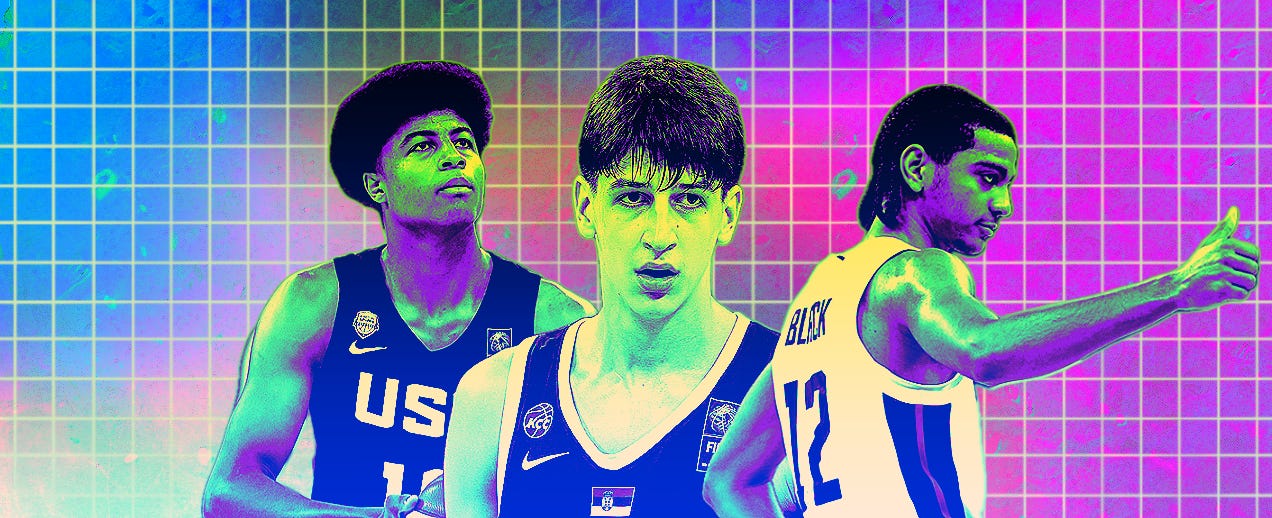
The 2026 FIBA U17 World Cup went about how it almost always does. Team USA cruised to a gold medal behind a 7-0 record and massive point differential to extend the program’s all-time record to 58-0 and its eighth straight gold medal. Joaquim Boumtje Boumtje walked away with MVP honors as he was shockingly dominant across the board and broke the tournament’s rebounding record. Boumtje Boumtje wasn’t the only standout, though, as Beckham Black, CJ Rosser, NaVorro Bowman Jr, and others had tremendous tournaments for Team USA along with plenty of other meaningful showings from guys like Nikola Kusturica, Luke Paul, Omer Kutluay, and more.
Joaquim Boumtje Boumtje – USA – F/C – Duke Commit (2026)
Given the numbers that he put up, it’s no surprise that Boumtje Boumtje earned the tournament MVP. For pretty much every minute that he was on the floor, he was too big, strong, and powerful for anyone to deal with. At first, it looked like Boumtje Boumtje’s success was solely derived from his power. It felt like, “oh great, another brutish big from Team USA.” That skepticism didn’t last long at all, though, as Boumtje Boumtje quickly showed his agility, shooting, defensive versatility, and passing. Don’t get me wrong, a ton of Boumtje Boumtje’s production comes from the insane level of physicality he plays with, but he isn’t reliant on it. The fact that he’s going to be a two-year college player, starting this coming season for Duke, makes his developmental curve fascinating. The biggest area that Boumtje Boumtje left me wanting more was with his shot creation. He had plenty of powerful drives, but everything was in a straight line with minimal bend or change of pace. It’s a nitpick because he may never really be asked to play that way, but if people are going to start throwing around Cam Boozer comps, then I’m going to need to see his on-ball creation take a leap. Aside from that nitpick, Boumtje Boumtje was a dominant and versatile play finisher, an explosive at-rim finisher, and showed a ton of positional skill. Defensively, he protected the rim, moved pretty well in space, jumped passing lanes, and singlehandedly controlled the boards. The main area for improvement for me is his defensive consistency in space. He would go through spurts of playing way too upright with slow feet. It wasn’t a glaring issue, just something that’d continue to take his game to a ridiculous level.
Beckham Black – USA – G – Uncommitted (2027)
I promise it’s not hyperbole when I say that Beckham Black looked like a superstar in the making in this tournament. He looked like the exact type of point guard that’ll eventually go top five in his draft. The way that he controlled the offense and effortlessly created whatever he wanted was shockingly polished. He did a great job of having the ball on a string, changing pace, and playing off of both feet. He finished with finesse, power, and through contact while also having games where he was scorching hot from outside. When you combine his scoring versatility with his defensive playmaking and playmaking creativity, it’s easy to understand why he’s the top-ranked recruit in his class. The biggest thing for Black to work on going forward is his consistency. It’s tough to put too much weight on this as most of the games were blowouts, so some lax decision-making and execution at times is understandable. If Black’s defense, ball security, and shooting were consistent every game, though, he could’ve easily walked away with the MVP instead of Boumtje Boumtje.
NaVorro Bowman Jr. – USA – G – Uncommitted (2027)
NaVorro Bowman wasn’t the most dominant player in this tournament, but he was one of my favorites. While some aspects of his game were pretty inconsistent, his defense was elite throughout. He was an absolute menace defending on the ball, showcasing quick feet, quick hands, and good physicality. Away from the ball, Bowman was attentive on rotations, versatile with switches, and more than eager to jump passing lanes to turn defense into offense. Offensively, Bowman is currently at his best in the open court where he can maximize his quickness and aggressiveness. In the halfcourt, though, is where we saw more of his inconsistencies arise. He was at his best when he was acting as an off-ball guard who played simple and made quick decisions. There were plenty of flashes of scoring versatility and intelligent passing reads. When he tried to take on more of a creator role, though, his ball security and on-ball shooting struggles were amplified. Bowman’s foundation of an incredibly high-motor guard with elite defense and promising off-ball creation is enticing enough. As his ball security and on-ball creation improve, though, his overall stock and impact are going to skyrocket.
CJ Rosser – USA – F – Uncommitted (2027)
CJ Rosser’s steady growth throughout this tournament was so much fun to watch. Every game he seemed to get a little more comfortable and add a little more to his game. Currently, Rosser looks at his best as a 3-and-D wing, but that is underselling how high his upside is. Rosser regularly showed off a reliable spot-up jumper but continued to implement more movement shooting, off-ball scoring versatility, and off-ball creation as each game passed. By the finals, Rosser was easily one of the most impactful and versatile players on the court. His handle needs to continue to get tighter, but it’s fine in the open court and as an off-ball creator. I also loved some of the connective passing reads that he consistently executed that proved that he’s much more than just a scorer. Where Rosser’s confidence really popped, though, was on defense. He has good fundamentals and instincts that pair tremendously with his size and length. Rosser shut down drives, switched consistently, was active off the ball, and proved to be a reliable weak side rim protector. He profiles like the exact type of wing that we consistently see go in the top 10 in every draft.
Cayden Daughtry – USA – G – Uncommitted (2027)
Cayden Daughtry has been on a tear recently, and this tournament isn’t an exception. What stood out the most with Daughtry’s game was his defense, transition offense, and playmaking. In pretty much every game, Daughtry was super disruptive on defense coming off the bench. He got into ball handlers, showed off his quickness, and capitalized on lazy ball security. Daughtry also was solid on the boards, which gave him another avenue to thrive in the open court. Team USA typically dominates these tournaments because of their athleticism and ability to ramp up the pace and pressure. Daughtry was a big catalyst for this all tournament as his transition offense was fantastic. He made some high-level playmaking reads, proved he could make the simple pass, and got plenty of buckets for himself. I wish we would’ve gotten a little more from Daughtry in terms of running the halfcourt offense, but given his role coming off the bench against second units, he did a tremendous job of buying into his role and capitalizing on their glaring advantage with depth.
Jordan Page – USA – G – Uncommitted (2027)
Jordan Page didn’t put up crazy numbers, but I adore how he approaches the game. Page almost never forced the issue or focused on filling up his own numbers. Instead, he constantly did the little things, filled in where needed, and played winning basketball. It was the exact type of impact and mentality that coaches and fans will fall in love with. He played fantastic all-around defense, proved to be an intelligent and versatile passer, and showed off some fun scoring versatility. He wasn’t one of the flashier performers, but he played some of the most consistent winning basketball.
Nikola Kusturica – Serbia – F – UCLA Commit (2026)
Nikola Kusturica was one of the biggest storylines from this tournament as he led the scoring charge for Serbia throughout. Kusturica showed tremendous versatility from start to finish, averaging 24.6 points, 6.9 rebounds, 2.7 assists, 2.3 steals, and 1.7 blocks while shooting 60.8% from two and 26% from three (on 7.1 attempts). The biggest standout in Kusturica’s game was his offensive aggressiveness. He was fantastic getting to the rim. He was active without the ball, physical on drives, and didn’t struggle to finish with power or finesse. While his handle wasn’t overly dynamic, he did showcase some functional wiggle, burst, and physicality on his drive. Once he tightens up his handle just a little bit, he’s going to be a nasty slasher. Kusturica also showed some intriguing passing upside, but his consistency and accuracy left a lot to be desired. There’s certainly a lot to be unlocked there, but I wouldn’t necessarily classify it as a strength right now. The biggest question about Kusturica’s offense is his jumper. He started the tournament off with a few scorching hot games, but his efficiency plummeted as the games continued. I love the variety and volume of his attempts, but there are some very real mechanical issues. Kusturica has a nasty hitch at the top of his shot, he brings the ball across his face from left to right, and he has some aggressive knee collapse on his load up. Defensively, Kusturica’s fundamentals need some fine-tuning, but he is super competitive, active, disruptive, and covers a ton of ground. Heading to UCLA next year, Kusturica should hopefully be able to make a positive impact pretty quickly with his slashing, off-ball movement, transition offense, defense, and rebounding. His shot needs work, and hopefully he doesn’t fall into the same pitfalls we’ve seen from numerous international prospects who’ve gone to UCLA in recent years.
Matija Lukic – Serbia – F
Matija Lukic was one of the more intriguing and effective off-ball wings in the entire tournament as he averaged 16.1 points, 4.4 rebounds, 2.4 assists, 1.4 steals, and 1.0 blocks while shooting 60% from two and 41.9% from three on 6.1 attempts. Lukic was at his best as a spot-up shooter with a smooth, consistent release. What made him stand out, though, was his off-ball activity and ability to attack closeouts. Lukic moved well without the ball and regularly got paint touches on drives where he’d finish it off himself or make a nice pass to a teammate. Lukic struggled when he tried to create on the ball as his handle, burst, and wiggle were underwhelming. As a secondary creator, though, Lukic was significantly more effective and comfortable. Whether it was through his off-ball creation, shooting, or team defense, Lukic consistently stood out in every game by making winning plays.
Luke Paul – Australia – G
Paul came into this tournament as Australia’s headline name — the youngest player ever to sign an NBL Next Stars contract — and the tape showed exactly why, alongside exactly what still needs to sharpen up. Paul was incredibly fun for the vast majority of the tournament. His shot, from both on-ball and off-ball situations, looked really pretty. My only complaint about it was how low his volume was. He needs to let that thing fly way more frequently, but he also needs to speed up his release to do so. The highlight of Paul’s game, though, is his passing. He has tremendous vision and is very accurate as a passer. Despite not being an overwhelming athlete, Paul regularly got paint touches that he used to create for others. He was a true three-level playmaker. Unfortunately, Paul had two of his worst games against the two best teams he faced in USA and Serbia. Against lesser competition, Paul’s athleticism wasn’t an issue as his change of pace/direction, craft, and IQ were enough. Against USA and Serbia, though, his inability to create space and easy looks on the ball was exacerbated, as were his defensive limitations. Paul had a tremendous tournament and thinks the game at a very high level. He still has a steep mountain to climb, though, especially if he continues to be a low-volume shooter.
Omer Kutluay – Turkey – G
Omer Kutluay was one of the most fun offensive engines in this entire tournament. He wasn’t immune to some overdribbling and questionable decision-making, but I chalk most of that up to the insane offensive load he had to carry. Kutluay was one of the most creative and shiftiest on-ball creators in the tournament. His handle, creativity, and change of pace/direction allowed him to get wherever he wanted whenever he wanted. This led to dynamic scoring outbursts and stellar playmaking reads. It’d be fascinating to see what he looks like in a context that doesn’t demand that he creates everything, but I am a little skeptical about what his game looks like when the responsibilities are scaled down. The plus side, though, is that he proved he can handle that level of creation demand. Kutluay also showed some promise as a defender. He wasn’t very physical and struggled navigating screens, but he had good instincts and was disruptive in passing lanes.
Nathan Soliman – France – F
Nathan Soliman, along with the rest of this French team, was unfortunately one of the biggest disappointments of this tournament. Coming into it, I was very excited to see Soliman’s two-way impact and athleticism. Unfortunately, we didn’t get much of it at all. Soliman had two monster games against Canada and Italy, two solid ones against USA and China, and was largely invisible against Japan, Turkey, and Lithuania. Offensively, Soliman was at his best attacking the rim. He was a physical driver with some encouraging pop on his first step and above-the-rim finishing. He was also very good on the boards for most of the tournament while also incorporating some impressive defensive flashes. My biggest issue, though, was Soliman’s consistency as he frequently disappeared from games. He didn’t show much on-ball creation or playmaking. His defense was super inconsistent too as he too frequently floated, lost track of his man, and just went through the motions. There’s clearly a very solid two-way wing lurking there, but he has a lot of work to do to unlock his full potential.
Messi Yangala – France – F
The player I came away the most impressed with on France’s team was Messi Yangala. He was very solid cutting, finishing around the rim, and rebounding. I also loved his defensive versatility. He has very intriguing athletic tools and doesn’t struggle to move in space. Unfortunately, he doesn’t shoot, and his ball skills need substantial work. For most bigs, that’s not uncommon or that big of an issue. The problem, though, is that Yangala is listed at 6’7”. That’s tough. Hopefully he has an incoming growth spurt or massive developmental leap, but I was intrigued with his foundation.
Quick Hits
· Asa Montgomery – F – USA Uncommitted (2027): Montgomery was an interesting two-way role player. He played strong defense, was physically imposing, and proved to be a mismatch nightmare. There wasn’t much on-ball creation, but his off-ball impact was impressive.
· Erick Dampier Jr. – C – USA Uncommitted (2028): Dampier being one of the youngest players in the tournament is pretty exciting. He clearly has a high feel for the game, which is evident in the advanced passing reads he consistently made. Other than his passing, the rest of his game was pretty inconsistent with scoring, defense, and athletic limitations. He’s a very fun name to keep an eye on long term, especially if he can improve his foot speed and scoring consistency.
· Nathan Djako- G – Cote d’Ivoire: Djako was pretty fun defensively. His offense left a lot to be desired, but his 3.7 steals per game with 4.9 rebounds was a fun combination.
· Antonio Browne – G – Australia: Browne was super fun. He’s shifty and funky and constantly pops on the film. Unfortunately, that’s for both good and bad reasons. For every flashy drive, three-point make, or creative assist, he followed it up with an avoidable turnover, questionable shot, and chaotic energy. Brown is fun, but he has to tone down the chaos in his game.
· John Aryang – F – Australia: Aryang is super raw, but he has some intriguing tools. He was at his best attacking the rim in transition or off the ball. He had some good defensive moments too. His handle, passing reads, and shooting mechanics (push release way out in front of his face) need a good amount of work, though.
· Darius Karutasu – F – Turkey: Karutasu was a crucial off-ball scorer and rebounder for Turkey. He had some massive scoring outbursts with his play finishing versatility. Unfortunately, it looks like there may be some athleticism limitations, but he was a very fun stretch four.
· Lun Jarc – F – Slovenia: Jarc ended up with some really impressive averages (18, 6.8, and 3.5), but they didn’t seem to reflect his actual impact. Jarc struggled to create much of anything on the ball, was inconsistent with his shot, and struggled with fouls at times. Despite all of this, there were a lot of really encouraging signs of him growing into a stretch four with quality connective and complementary skills on both ends of the floor.
· Jakob Siftar – G – Slovenia: Siftar was by far at his best in an off-ball role. He struggled with scoring consistency and on-ball creation. However, his cutting, his ability to attack close outs, and his secondary creation were a bright spot in his game.
· Jayden Cecil – G – New Zealand: Cecil was one of the most electric scorers in the entire tournament, averaging 29.9 points while shooting 48.1% from two and 38.3% from three. Cecil struggled with ball security, defensive consistency, and finishing through contact, but he had a massive scoring load and showed off some insane scoring versatility and volume all tournament.
· Gabrielius Buivydas – G – Lithuania: Buivydas was inconsistent, especially with his shot and ball security, but he had some incredibly fun games. He was good getting to the rim, grabbing rebounds, and showed some really creative playmaking. He struggled with physicality and ball security, but I’m excited to see how his game grows.