


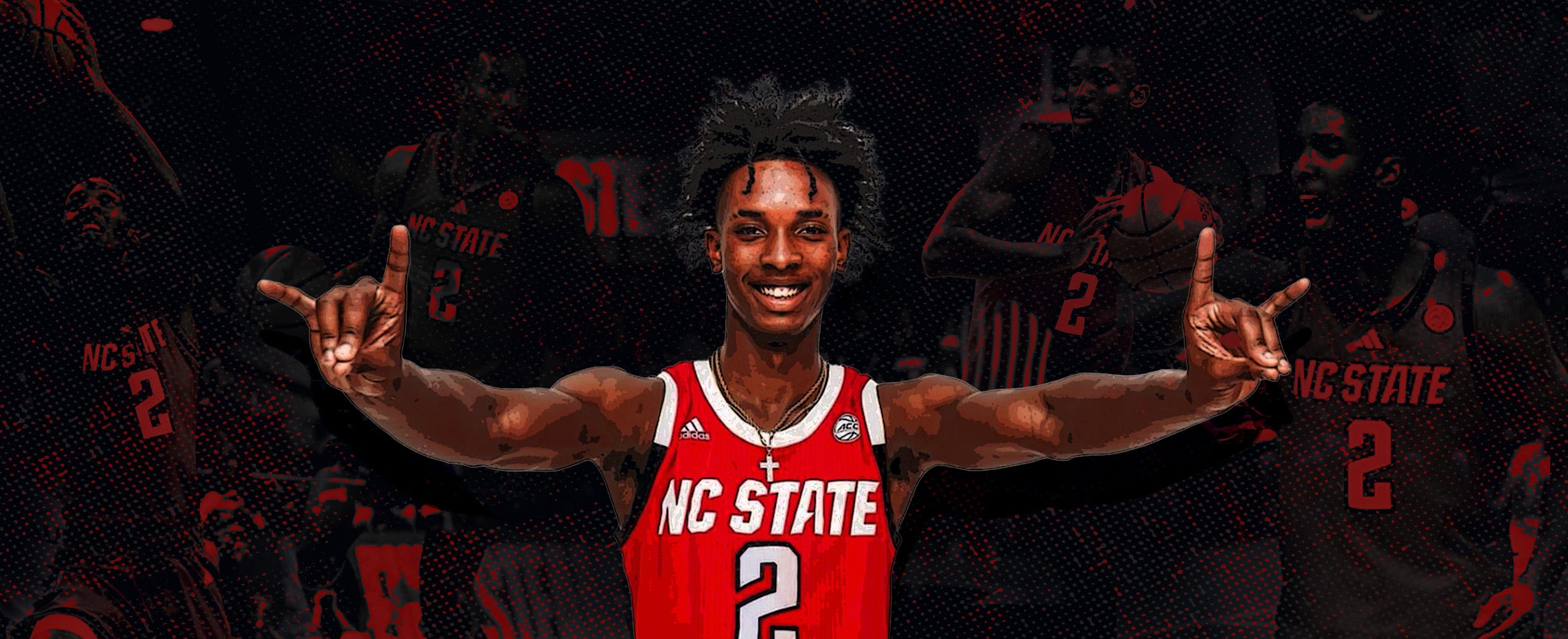
When I first watched Paul McNeil Jr. at the college level, I was a little bit confused. The NC State guard, who was a freshman at the time but is now a sophomore, has a wiry build at 6’5” and 190 pounds. He looked on the skinny side, but he did a lot of the good stuff you’d expect from a guy with that physical profile. He exploded onto radars late in his inaugural campaign with the Wolfpack thanks to his microwave scoring ability, namely, a 24-point outing against Wake Forest. He could generate separation and convert on the classic “pro shot-maker” types of attempts. But what really threw me was some of his tendencies. While his frame did lead to some issues on defense, and he was far more perimeter-oriented on offense, he had a level of competitiveness that resonated with me. It showed up on the glass, where in a small role, he managed to register a 9.2 ORB% that flew in the face of what you’d expect for someone his size and archetype. Because he played limited minutes, he was a good bet to return to school, so I thought to myself, “Figuring this out will be a next year problem.”
For me, a lot of scouting is about pattern recognition. One-to-one player comparisons can be problematic. On one hand, they can set too lofty expectations for a prospect. Too many forwards who struggled with their jumpers but played good defense and could pass/dribble a little bit have been compared to Draymond Green. But if a player is only 50-to-75 percent as good as Green in a number of critical areas, that’s not Draymond Green. In fact, in many cases, these guys ended up barely scratching replacement level, because Green wasn’t just competent in those areas, he was excellent. Conversely, they can also undershoot what a player is capable of becoming. I had Jalen Williams higher than most, but still undersold what he would turn into, because I viewed him as, “what if Ayo Dosunmu was really big?” Both were big for the role they played on their college team, played good defense, got to the rim a lot, and made their catch-and-shoot threes. I sort of pigeonholed Williams into being a good bench player, largely because he was a mid-major upperclassman. I didn’t compensate enough for how potent an athlete he was and how meaningful that size difference was going to be on both sides of the ball.
But when I really struggle is with the guys who feel different. I’ve long had a harder time assessing players who don’t fit as neatly into boxes. I’ve zigged and zagged on this over the years. With players like Leonard Miller, I shot too high on how quickly his motor and rebounding would lead to production. With a Reed Sheppard, I felt like I shot just right, betting that ultimately his shooting, feel, and defensive playmaking would allow him to become a super valuable contributor. With Brandin Podziemski, I went too low, over-indexing on what I believed would be physical shortcomings.
This brings me back to Paul McNeil Jr. Today, we’re going to talk about his game, but I’m also going to try to figure out what he approximates and how I should be valuing what he brings to the table. Let’s dig into his game, and then we’ll contextualize the data.
Scoring
Paul McNeil’s greatest offensive strength is his three-point scoring. So far this season, he’s drained 41.7% of his threes on a gaudy 15.6 attempts per 100 possessions. He’s dynamite both pulling and off the catch. Plus, he has a deep range on his shot, so he’s not a guy who will have to go through a serious readjustment process with regard to the NBA line. What I love most about his shot, and you can see in the video above, is McNeil’s ability to quickly get his balance under him. Whether he’s quickly pulling up because a defender made the mistake of going under a ball screen against him or he’s flying into his shot off movement, McNeil does a stellar job with his gather footwork to ensure he has a steady base under him while not compensating with regard to his pop time. He manages to remain in complete control of his body even when operating at warp speed. This ability to get into his shot both quickly and cleanly should bode well for when he has to deal with the best athletes in the sport trying to contest his jumpers.
Inside the arc, things are a bit of a mixed bag. McNeil doesn’t get to the rim very often, which isn’t abnormal for someone who shoots as many threes as he does. It can be frustrating at times, as he’ll take difficult, off-balance pull-ups that rim out. Still, he’s also displayed impressive displays of shot-making at times. He’s three-for-six at the rim in the halfcourt this year, per Synergy. At times, his size betrays him, as he isn’t someone who can drive rim protectors backwards to finish through contact. Still, he’s far from averse to physicality (.399 FTr), and at times, he’s able to string together dribble combinations that make defenders miss on his way to the cup. For me, McNeil’s interior scoring game is one of the trickier parts of his game to pin down and project, simply because we haven’t seen a lot of it. If he can continue to fill out his frame and actualize his mid-range game a bit more, he could be cooking with gas. However, if he’s someone who struggles at the rim and can’t find consistent results, he could run into trouble, as we’ve seen with someone like Bub Carrington during his cold stretches with the Wizards. I’ll be monitoring this area of his game closely throughout conference play.
Playmaking
Paul McNeil Jr.’s playmaking isn’t the easiest thing to assess, either. I’m going to throw some numbers at you, and I’m going to ask that you remain calm as you read them. McNeil is averaging under one assist per game, and he has a 6.3 AST%. He’s primarily utilized as an off-ball weapon, which, from a basketball standpoint, makes a ton of sense within NC State’s context. For starters, we already know that McNeil is a deadly off-ball shooter. But when you factor in the sheer number of steady, reliable table setters that the Wolfpack have on their roster, it makes even more sense. Guys like Darrion Williams, Quadir Copeland, and Tre Holloman are all most comfortable playing with the ball in their hands, reading the floor, and finding the open man. In a lot of settings, I’d be concerned about someone who’s built more like a combo guard playing off the ball so often, but within NC State’s context, I don’t believe it’s a fair criticism to make of McNeil. It’s not so much that McNeil isn’t capable of displacing other options; it’s more so that the way he’s used best maximizes the roster’s chances to win basketball games. If it makes you feel any better, he had a 20.1 AST% last season when he was on the ball more often.
There are some positives and negatives on the tape. At his best, McNeil is able to leverage his scoring gravity to get inside, play off of two feet, and find openings on the move. He’s also a reliable “next one” skip passer who doesn’t halt the flow of the offense. Other times, I have some doubts about his handle, as he can let his dribble get away from him or have issues staying under control in tight spaces. His pick-and-roll playmaking can be inconsistent. He has a bad habit of picking up his dribble pretty quickly against pressure, which can put him in some tough spots, but he ultimately does a great job of avoiding turnovers. He also has a good knack for making simple decisions quickly when he draws two on the ball. McNeil is probably more reliable than his pure assist numbers and rates indicate. He takes really good care of the ball, boasting a microscopic 3.0 TOV% this year after limiting himself to a 7.5 TOV% last year. Still, he’s not the most advanced playmaker. We haven’t seen a ton of dynamism in his handle or advanced reads at this point, but again, that could be a symptom of his role rather than an indictment of his game.
Defense
On defense, Paul McNeil Jr. runs into the issues one would expect given his frame. Because he’s thin through his lower half, he can be driven backwards fairly easily. Additionally, he has some technical woes guarding the ball. For starters, he tends to cede more ground than he should, allowing opponents to get inside without much resistance. He also doesn’t do the best job of staying square, instead opening up his hips to allow for easy driving lanes to the basket. His 1.7 STL% and 1.5 BLK% are far from anything to write home about.
Still, I wouldn’t be so quick to throw him under the bus as a negative defender. He has great speed through his feet. I also really appreciate the level of “want to” that McNeil competes with. He’s clearly attentive, doing a good job of managing man and ball for the most part, even if he has the occasional lapse on a rotation. He seems to understand basic help principles, like when to be at the nail. The steals he collects come in combination from his engagement, length, and athleticism. Plus, he’s a super competitive rebounder, posting a 15.1 DRB% that you don’t come by often for a player in his mold. The tools, attentiveness, and motor are there, even if refinement is needed in some areas.
Figuring Out Paul McNeil Jr.
Let’s get the negative stuff out of the way first, and then we’ll get into the optimism. I fear overvaluing Paul McNeil Jr. for the following:
He does very little inside the arc.
He hasn’t shown that he can be a playmaker on respectable volume for a good team.
His stock rates leave a lot to be desired.
Let’s dive into players who had similar issues. To be more specific, productive players who dealt with similar issues. While McNeil may struggle in these respects, it’s important to make sure we’re looking at him within the context of other players who were in the vicinity of an NBA opportunity. McNeil had a 7.4 BPM in a limited role last year and a 9.8 BPM this year. There are always outliers (Ajay Mitchell had a BPM of 5.0 in his final college season, for instance), but usually, you want to see at least a BPM of around 6.0 for serious prospects, so that’s where I’m setting the cutoff today. I’ll also be limiting the query to players from within the last ten years, so that we’re dealing with a more up-to-date playstyle, generally speaking.
6’6”-and-Under Players Who Did Little Inside the Arc
What I have here is a list of productive college players from the last ten years who shot under 90 twos while operating as high-volume three-point scorers. I chose 90 two-point attempts because that’s on pace to be a bit over where McNeil will finish the year if his shot diet remains the same.
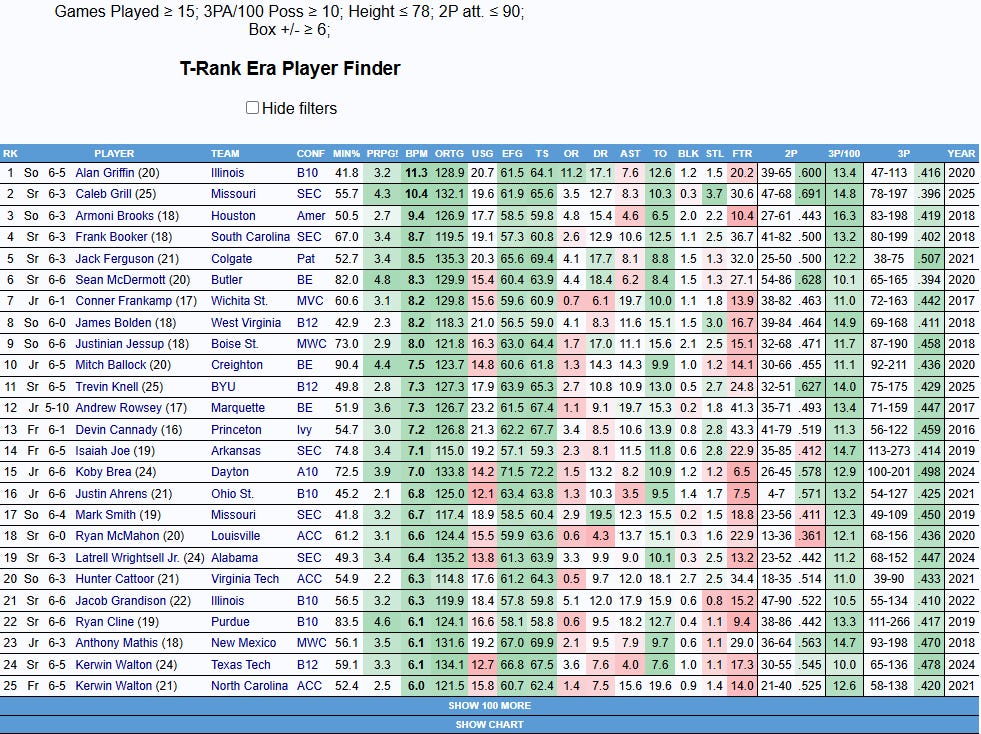
That’s…not awesome. The big success story there is Isaiah Joe, who has gone on to be an important role player for the Oklahoma City Thunder. Armoni Brooks is a guy who got a cup of coffee in the league. The jury remains out on recent draft pick Koby Brea, though he’s had a rocky start in the G League this year. But by and large, this type of shot diet we’re seeing from Paul McNeil isn’t a common one among long-term NBA players. The good news, though, is that he’d be second on that list in three-point volume and second in usage, so there’s an argument to be made that the prolific nature of his shooting could provide greater value than those who didn’t manage to catch on. He also has two dunks on the year already, which fifteen players on that list didn’t manage to do in their similar seasons.
Sub-6’6” Players with Low Playmaking Volume
Here, I looked at players 6’5” and under who carried a usage rate below 22 and an assist rate under 10. Again, it is worth mentioning that McNeil had a 23.7 USG% and a 20.1 AST% last season, though he played limited minutes for a subpar team.
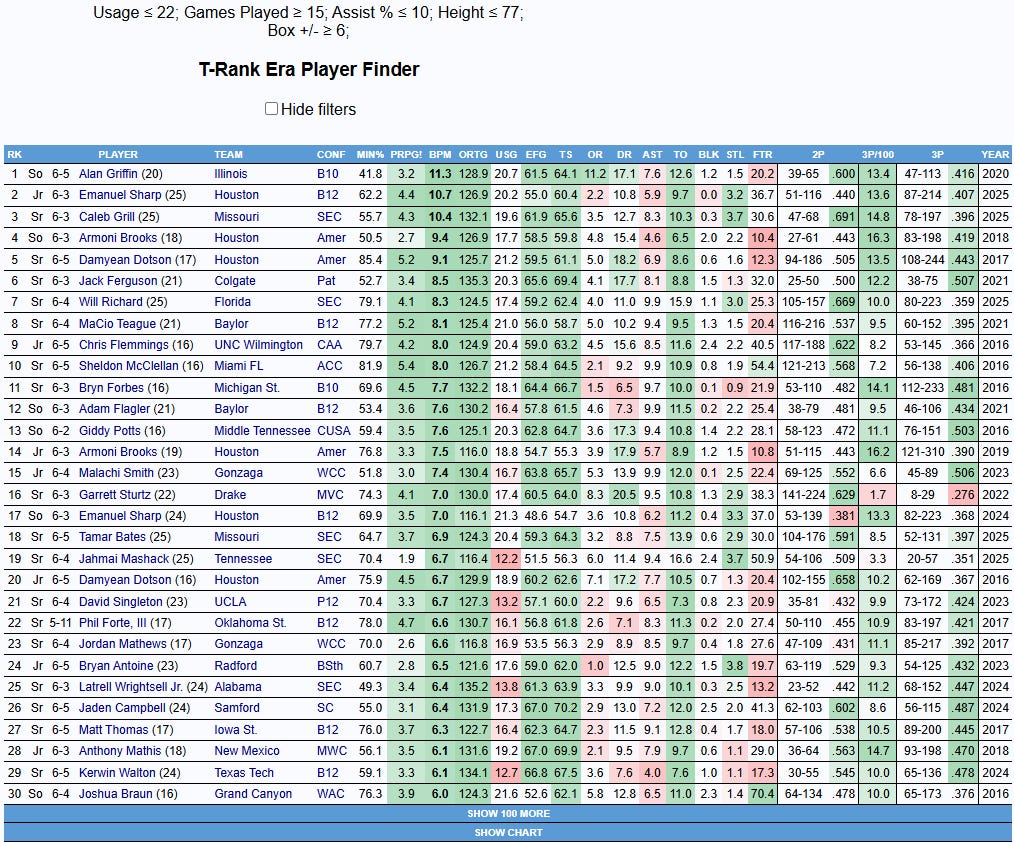
Again, we don’t have the best list in the world at our disposal. There are some “cup of coffee” guys like Armoni Brooks, Adam Flagler, and even a long-term role player in Bryn Forbes. There’s also Will Richard during his pre-draft season. If there’s a reason for optimism here, it’s Will Richard. I think his case is particularly insightful here, as it’s probably the most similar to McNeil’s. In the transfer portal era, guys like Richard and McNeil are often pushed into smaller roles on great teams, whereas in the past, they would’ve likely ended up being THE DUDE somewhere. Can you imagine what Will Richard would’ve done as a senior at Belmont if he’d stayed there all four years? I doubt his usage load would’ve been so small. But in the transfer portal era, sometimes really good players will end up…playing with a lot of other really good players, some of whom are more comfortable operating with the ball in their hands. As a result, good coaches will find ways to maximize their rosters, and it may result in players doing less than they’re capable of at times. Now, to be fair, Richard had a much sturdier frame, he was a much better interior scorer, and he produced more on defense. I’m not saying they’re the same player, but I’m saying there’s a case to be made that their circumstances led to similarly stifled playmaking production.
Sub-6’6” Players with Lackluster Stock Rates
For this query, I looked at productive young college players who were on the smaller side that offered little in the way of defensive production.
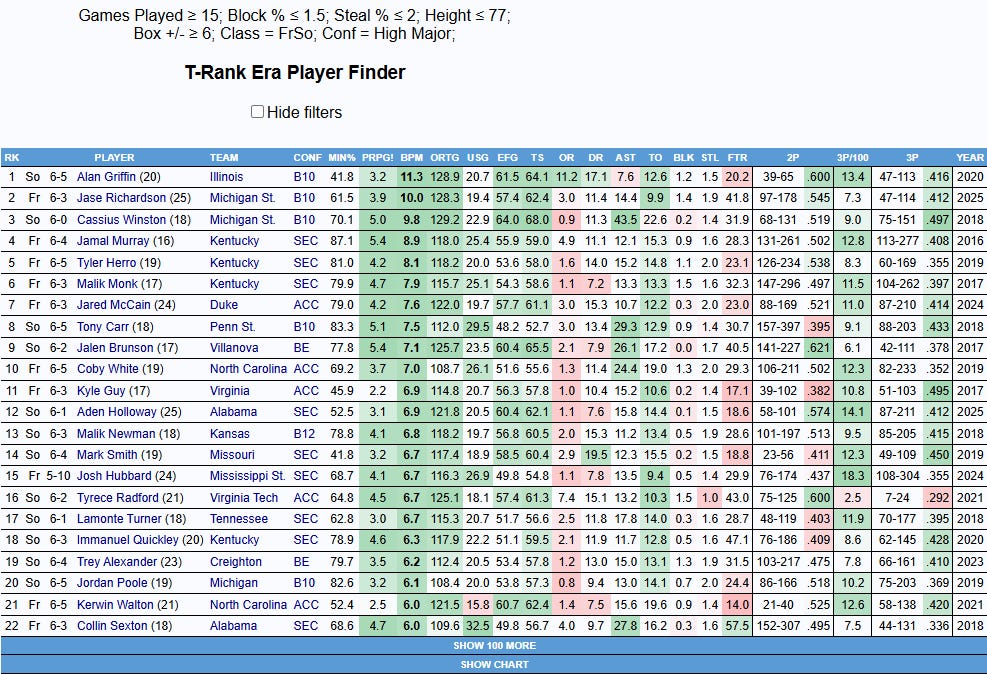
This is actually a great list for Paul McNeil’s case. Sure, some of these guys didn’t do much at the next level. But prolific perimeter shot-makers like Jamal Murray, Tyler Herro, Malik Monk, Jared McCain, Coby White, and Immanuel Quickly all turning up here gives plenty of room for encouragement. I’ll still give the caveat that many of them carried a larger usage burden and did more inside the arc than McNeil is likely to this season, but it’s still encouraging to see that players within a similar mold have managed to provide value at the NBA level in spite of their shortcomings as defensive disruptors.
Now, let’s turn the tables a little bit. Instead of focusing on where McNeil has struggled, let’s take a look at where he’s thriving.
Threes and Free Throws
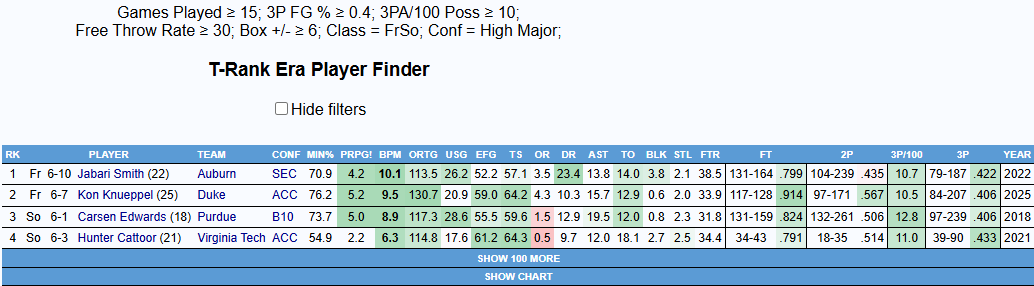
Here, I looked for efficient three-point bombers who managed to get to the line and play productive basketball as high-major underclassmen, just like McNeil. Simply put, it doesn’t happen very often. McNeil’s length differentiates him from Edwards and Cattoor, too. Threes and free throws are two of the best shots in basketball. Guys who can get them and hit them at volume come at a premium, and that’s what McNeil is bringing to the table.
Threes and Turnover Aversion
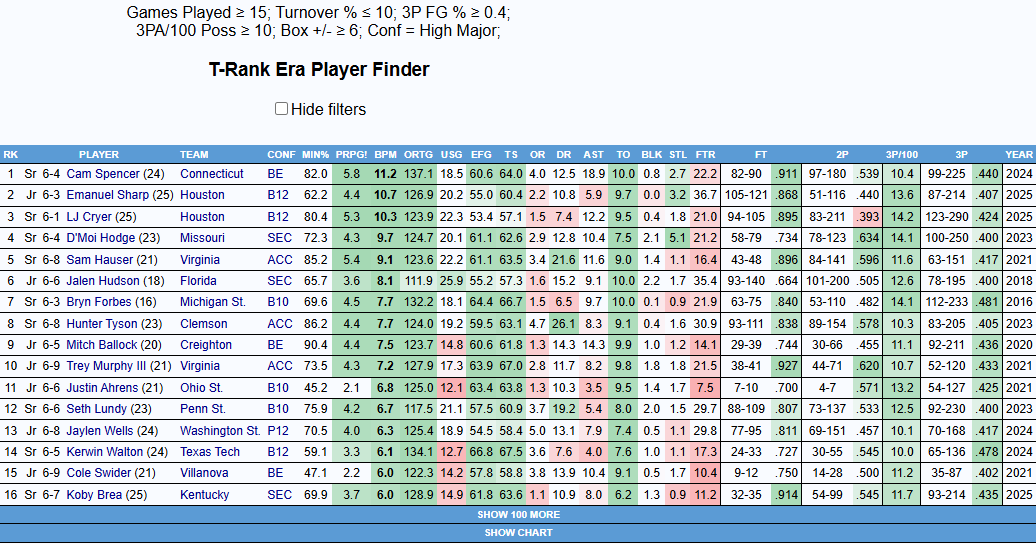
Look, not everyone on this list has panned out. But one of the biggest trends I’ve noticed among players who initially cut their teeth as off-ball connectors and shooters is that they do a great job of avoiding turnovers. Players like Cam Spencer, Sam Hauser, Bryn Forbes, Trey Murphy, and Jaylen Wells didn’t enter the NBA with the deepest creation bags in the world. That said, they were really good at not screwing up. While there are differences between McNeil and those listed, it’s also worth noting that McNeil is on pace to be the only freshman since 2016 to shoot so many threes so efficiently while keeping a turnover rate below ten. The microscopic nature of his 3.0 TOV% cannot be overstated, especially when you consider that even when he was on the ball more last year, his turnover rate was still super low at 7.5%.
Threes and Rebounding
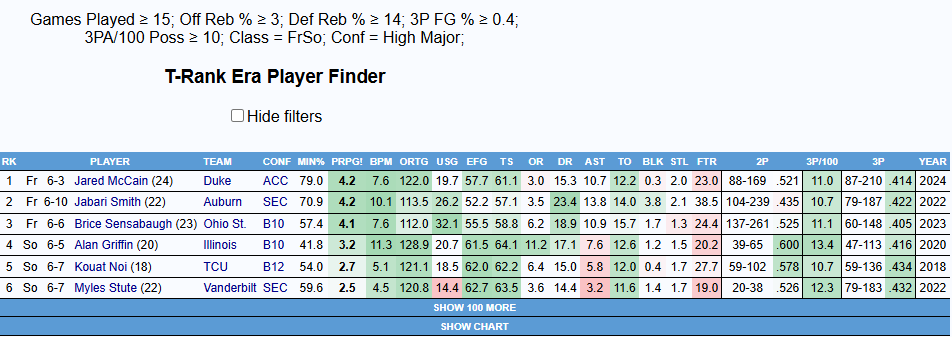
Another thing that I like about McNeil is how he contributes to the possession battle through his rebounding. A lot of shooting specialists, well, just shoot. While McNeil hasn’t been as much of a menace on the offensive glass this year as he was last year, he’s still an above-average offensive rebounder for his position this season (2.6 ORB%). Additionally, he’s gained ground on the defensive end with his 15.1 DRB%. We haven’t seen a lot of high-major underclassmen who can both shoot threes and contribute on the glass like this in the past decade.
Conclusion
I still don’t feel like I have Paul McNeil Jr. totally figured out, and I can live with that. It’s highly unlikely that anyone will ever be able to map professional outcomes onto prospects without any error. What I ultimately wanted to figure out here, though, was if his unorthodox production was more likely indicate that he’s on the right or wrong side of the NBA cliff.
There is some worrying stuff. His lack of an interior scoring threat, subpar stock rates, and mundane playmaking portfolio certainly leave something to be desired. Still, there are players cut from similar cloth both stylistically and situationally who’ve managed to get over these same hurdles in the past. Additionally, I’ve gained a new appreciation for the rarity of his overall production, shooting profile, foul drawing, rebounding, and turnover aversion as a young player in a great conference.
In the NIL era, I generally view most prospects as more likely to return to school than not. Still, I think it’s important to ask myself where I would rank a prospect if they were to stay in the draft, because you never know. When it comes to McNeil, I can’t quite bring myself to be as excited about some of his most ardent supporters. But at this stage, I think a late-first, early-second type of swing on McNeil is more than justifiable. For one, he has an NBA-level trait with his shooting. I love the numbers, and I love the film. He takes a ton of difficult threes, he makes a great percentage of them, and his mechanics have me encouraged that it will work at the next level. From there, McNeil’s ability to take care of the ball, draw fouls, compete on the boards, and work on defense helps me to see where he can create value at the next level. I was skeptical about Paul McNeil going into this exercise, but now, I’m more optimistic that he may indeed be the real deal.
Quick Hits
Since we just submitted our internal big board rankings, I wanted to spend this week’s Quick Hits section covering some of my favorite “undervalued” prospects.
Excuse me, but shouldn’t we be talking more about Joshua Jefferson? Iowa State’s 6’8” senior was already interesting entering the season thanks to his high level of feel, ridiculous passing bag, and defensive versatility. But he’s really figured out how to score it this season. Jefferson has been tasked with creating a ton of offense for the Cyclones this season, as evidenced by his 26.7 USG%. In spite of that, he’s posting a career high 63.5 TS%! Look, I get it if you don’t think he’s going to sustain his 42.4% mark from three, I don’t think he will either. But Jefferson is scoring more effectively inside the arc, too, going a career-high 59% on twos. He’s also long been a good foul drawer and free-throw shooter. I think he’s the total package and a top twenty guy.
It feels like Richie Saunders should have more buzz. The 6’5” senior from BYU is archaic by prospect standards, as he’ll turn 25 prior to the start of his rookie year. Still, I see the vision enough to consider him worthy of a guaranteed contract. He’s long, strong, and moves well. He’s also in his second straight season of shooting over 40% from three. Run him off the line, and he can make basic reads, finish at the rim (63.8% on twos) or draw a foul (.405 FTr). Defensively, his length and activity (4.2 STL%) make him a chore to deal with. He’s just a well-rounded dude with a pro body who is good at basketball.
I’ve seen excitement around a lot of guards this year, but not enough of it for Jaden Bradley. I get it, he’s an older prospect who doesn’t shoot a lot of threes. But Arizona’s 6’3” lead guard gets everywhere he wants on the floor. He lives at the rim, he gets to the line frequently (.690 FTr), and is a consistent pull-up shooter in the mid-range. He’s also one of the primary engines for one of college basketball’s best teams, and he’s a dogged defender (3.8 STL%). I understand having shooting concerns about a likely secondary NBA option who isn’t tall and has averaged 1.2 three-point attempts per game throughout their college career, but at a certain point, the physicality, feel, and winning are too much for me to overlook.
Purdue’s Daniel Jacobsen is 7’4”, he has a 70.5 TS%, and he has a 16.1 BLK%. He’s also 73% from the line and gone 2-for-6 from three this year. I haven’t seen a ton of immediate NBA buzz for the sophomore, but I think there should be.
Louisville’s Adrian Wooley started slow, and his first three games weren’t anything to write home about. But in games 4-13, he’s averaged 10.7 PPG on 50.7/41.5/85.7 splits while averaging 1.8 APG to 0.7 TOV. I cautioned selling stock in him when I wrote about him prior to the season, so I hope you all kept diamond hands. His timing and cadence on drives feel so much more under control now than they did in his early-season outings.
This column still isn’t over! No Ceilings+ subscribers get an additional bonus section every week! This week, I wrote about Keaton Wagler! There is no better way to support the work that we do at No Ceilings than by subscribing to NC+. I believe our track record of consistent, thoughtful work over the past four years speaks for itself. It’s only $8/month or $80/year, so please consider supporting the work that we do. You’ll get our pre-season draft guide, access to our Discord, this extra section of my column each week, bonus columns from our entire team, live scouting reports, and MUCH MORE!
