


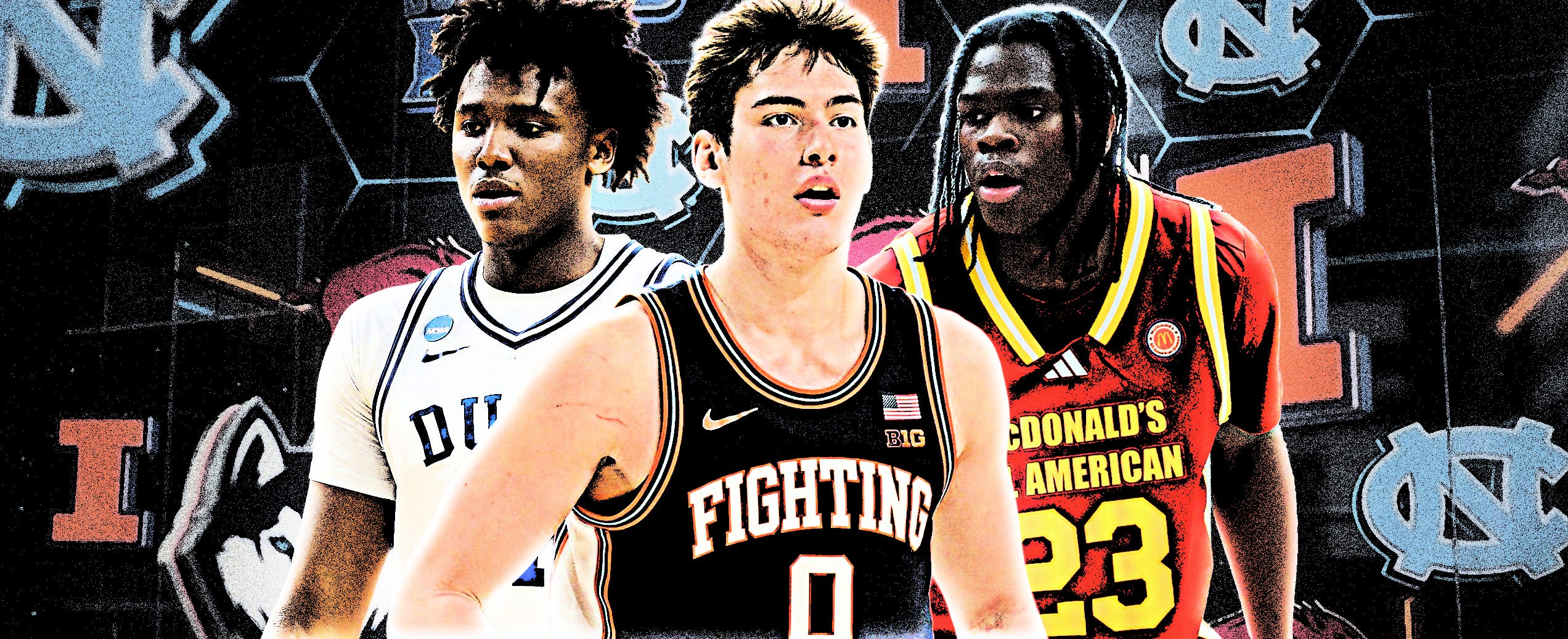
Although I do wish I had a crystal ball, I’m not here to tell you which team is going to win the National Championship. I’m not trying to predict the Final Four in September. Give me about two months, and then we can get to my predictions about all of that.
I’m more interested in something much more important: Which college teams are going to be appointment viewing for NBA Draft sickos?
Which campuses have multiple legitimate prospects? Which rosters could produce three, four, maybe even five draft picks? And, most importantly, which players are going to force us to completely rethink the 2027 class by March?
There are plenty of teams with intriguing NBA talent. But five immediately stand out. One of them might be in a tier of its own.
Let’s get into it.
Arkansas: The NBA Draft Superteam
Let’s start with the obvious one. Arkansas is absolutely ridiculous.
The Razorbacks currently have five players in Bleacher Report’s Top 100, including two players inside the Top 5. That’s Jordan Smith Jr. at #2, JJ Andrews at #5, Miikka Muurinen at #22, Abdou Toure at #25, and Billy Richmond III at #54.
Five. From one college roster.
At this point, I don’t even think the question is whether Arkansas has NBA talent. The more interesting part is figuring out how many of these guys are going to make us move them up.
Smith Jr. is obviously the headliner. At #2, the expectations are already enormous. Being highly ranked before the season is one thing, but already looking like one of the best players in the country is another. As a senior at Paul VI, Smith averaged 25.1 points, 6.0 rebounds, 5.3 assists, and 3.0 steals per game while leading his team to both the WCAC and VISAA Division I championships. Now comes the translation phase. Smith has already shown he can score at a ridiculous level. The next step is consistently creating advantages against college athletes. The ability to bend a defense, get two defenders leaning, and make the right read when the obvious scoring opportunity isn’t there will determine how much of an offensive engine he can become. That’s the difference between simply putting up numbers and actually dictating possessions.
And then there’s Andrews; he’s #5 in the B/R rankings, so again, not exactly a sleeper. But I think that’s part of what makes Arkansas so interesting. Andrews put together a ridiculous senior season, averaging 30.7 points, 16.9 rebounds, 3.1 assists, 2.3 steals, and 1.1 blocks while shooting 60.9% from the field. He also finished his prep career with 2,865 points, fifth-most in Arkansas high school history, and earned 2026 McDonald’s All-American honors.
You could make a legitimate case that Smith Jr. isn’t even the biggest riser on this roster by the end of the season.
Andrews has the production and physical profile to make that argument very real.
Muurinen is a completely different kind of bet. He’s 6’10” and already has legitimate high-level international experience, including a run with Finland at EuroBasket 2025 where he averaged 6.6 points and 1.9 rebounds in eight games. He also spent part of last season with Partizan, appearing in both the ABA League and EuroLeague. His numbers there weren’t overwhelming: 4.1 points and 2.9 rebounds in 12.0 minutes per game in the ABA, but that’s part of what makes his #22 ranking so fascinating. The production hasn’t caught up to the projection yet. The tools and flashes are what evaluators are betting on with Muurinen.
Toure gives the Razorbacks another high-upside bet, and that’s where this roster starts getting silly. He’s another freshman entering a situation where he doesn’t have to carry the offense immediately, which could allow his strengths to show without forcing him into a role he’s not ready for. That’s exactly the type of prospect who could make a big jump once college basketball starts giving us actual data points. And if Toure forces his way into the lottery conversation, suddenly Arkansas has potentially four players fighting for serious draft position.
Then there’s Richmond, sitting at #54 as the guy who could potentially make the biggest leap in the group. Unlike the other four, we’ve already seen him produce against high-level college competition. Richmond averaged 11.2 points, 4.3 rebounds, and 2.0 assists last season while shooting 56.3% from the field, and he earned a spot on the 2026 SEC All-Defensive Team. He also played every game and saw his role grow from 17.5 minutes per game as a freshman to 27.6 minutes as a sophomore. That’s the part I’m watching. If the offensive game continues to develop while that defensive versatility remains, #54 could look pretty low by March.
That’s what makes Arkansas so deep.
You have Smith Jr. already sitting at #2, Andrews coming off a monster prep season, Muurinen bringing international experience and enormous upside, Toure as another high-upside freshman, and Richmond as the one guy in the group who has already shown he can contribute at the college level.
That’s absurd depth.
It also creates several fascinating storylines for the season. Smith Jr. enters as the established headliner. Andrews has the production to challenge him. Muurinen brings perhaps the biggest international upside swing. Toure has a path toward the lottery conversation. Richmond has the opportunity to make the largest leap from his current ranking.
That’s why Arkansas gets the top spot. This isn’t just a team with NBA prospects; this may be an entire NBA Draft ecosystem.
Duke: Four Problems for NBA Scouts
If Arkansas is the draft superteam, Duke isn’t exactly struggling.
The Blue Devils have four players in Bleacher Report’s Top 100, and all four are currently inside the Top 40: Bryson Howard (#10), Patrick Ngongba II (#13), Cameron Williams (#23), and Dame Sarr (#40).
I’m particularly interested in Howard, because I think we’re getting to the point where the conversation around him needs to move beyond the obvious stuff. Yes, he’s big. Yes, he can shoot. But the next layer of his evaluation is self-creation. As a high school senior, Howard averaged 22.8 points, 8.5 rebounds, 3.3 assists, 3.2 steals, and 1.3 blocks per game. He was also an absolute flamethrower from deep on the EYBL circuit, averaging 19.7 points per game while shooting 46.2% from three. That’s the foundation. Now the focus shifts to what happens when the athletes get better. Howard’s ability to get downhill against a set defense, create separation, and make plays when the offense breaks down will be critical. If he adds legitimate self-creation on top of the shooting and size, the ceiling gets really interesting. Suddenly we’re not just talking about a big wing who fits into an NBA offense. We’re talking about someone who might actually drive the offense.
Ngongba II is another player I’m really curious about because his evaluation is so different. At #13, the talent is clearly there, but his next step is about expanding his impact beyond traditional big-man production. As a freshman at Duke, Ngongba averaged 10.1 points, 5.8 rebounds and 2.0 assists in 21.9 minutes per game while shooting 60.6% from the field. He also shot 66.4% from the free-throw line, which is an interesting number for a young big. The production wasn’t overwhelming, but the efficiency gives him a strong foundation. Ngongba’s physicality, decision-making, and ability to provide value without needing the offense to run through him will be important developmental areas. If those pieces expand alongside the existing interior efficiency, there’s a very real chance he spends the season reminding people why he was ranked this highly in the first place.
Williams is another name who could make this roster even more dangerous. He’s already sitting at #23, but this is exactly the kind of situation where a player can benefit from being surrounded by other high-level talent. Williams averaged 24.6 points, 12.0 rebounds, 2.9 assists, 2.8 blocks, and 1.7 steals per game as a senior. Duke may have another young player on their hands who could be pushing his way toward the top of the board.
Then there’s Sarr, sitting at #40 and potentially representing the biggest wild card of the group. He’s the guy whose ranking could change dramatically with the right season. Sarr averaged 6.4 points, 3.8 rebounds, and 1.1 assists per game for the Blue Devils during the 2025–2026 season. He made a significant defensive impact, earning a spot on the ACC All-Defensive Team. He’s already played professional basketball abroad, which gives him a completely different developmental background from the other players on this roster. At #40, you’re already talking about a legitimate prospect. But a season where the production begins matching the talent could put him into a completely different tier.
That’s what I love about this roster.
There isn’t one way to win the draft evaluation game here.
You can watch Duke and come away obsessed with the scoring. Or the shooting. Or the size. Or the versatility. Or the upside.
There are just too many places to look.
That’s why Duke might have one of the deepest collections of high-end NBA talent in the country.
UConn: Three Top-25 Guys, Three Very Different Questions
UConn is where this gets really interesting.
The Huskies don’t have five players on the board. They don’t even have four. They have three. But all three are currently inside the Top 25: Braylon Mullins (#7), Colben Landrew (#11), and Najai Hines (#24).
Mullins is the obvious name.
We already know about the shooting. We already know about the off-ball value. The next step is expanding his creation.
Last season, Mullins averaged 12.0 points per game as a freshman while shooting 33.5% from three and 88.9% from the free-throw line. That free-throw percentage is particularly encouraging as a shooting development data point. The shooting gets him on the floor. Developing consistent advantage creation off the bounce is what could move him into the upper tier of the draft.
Landrew is where things get even more intriguing. He’s already #11, so we’re not discussing an under-the-radar player who needs to introduce himself to the draft world. At 6’6” with a 6’10” wingspan, he’s already got the physical profile, and the flashes of offensive versatility are there. He shot just under 34% from three in 3SSB play, but knocked down 46% of his open catch-and-shoot threes, which gives him legitimate floor-spacing gravity. The swing skill is creating that gravity himself. He went just 1-for-15 on dribble jumpers in 3SSB play, making that an obvious developmental area to monitor. If that part of his game develops, the rest of his toolkit becomes much more dangerous. He’s already a terrific offensive rebounder at 2.4 per game, finishes 65% of his attempts at the rim, and averaged 1.3 steals. Also, his strength allows him to defend multiple positions. When you’re ranked #11 before the season, you’re not simply trying to prove that you belong. You’re trying to prove that you belong even higher. For Landrew, that could come down to whether the shooting and secondary creation eventually become something more than flashes.
Then there’s Hines at #24. This is the guy who could really shake up the UConn hierarchy. His freshman season at Seton Hall was more about flashes than overwhelming production: 6.5 points and 5.5 rebounds in just 18.0 minutes per game, but he shot 60.2% from the field and averaged 2.2 blocks. He didn’t start a game, either. That makes his next step particularly interesting. An expanded role will provide a much better indication of how well his efficiency and defensive impact scale with increased usage. If Hines can turn those flashes of interior production into a larger offensive role without sacrificing what already makes him effective, #24 could end up looking pretty low.
That’s what I like most about this group. These aren’t three copies of the same prospect. They’re three different bets, with three different developmental paths. Right now, the rankings tell us Mullins is the guy. But by March, because we all know how things can get crazy during that electric month, that hierarchy could look very different.
Illinois: Seven Prospects, Tons of Possibilities
No, I didn’t just put the Illini here because they are my team. It does, however, definitely help that they have a pretty stacked roster.
Out of all the ranked teams I have here, Illinois takes the cake with SEVEN players in B/R’s top 100. Illinois has Quentin Coleman at #19, David Mirkovic at #42, Stefan Vaaks at #43, Lucas Morillo at #61, Andrej Stojakovic at #75, Zvonimir Ivisic at #89, and, last but not least, Tomislav Ivisic at No. 92.
Phew. My fingers started cramping a little bit there. But we progress.
That’s a large volume of players receiving high praise before this season has even started, and three of them have yet to step on the Illinois hardwood and play a game with the team. That’s what makes this roster so interesting to me. It feels like one of those teams where the whole could become much more interesting than the individual pieces.
Coleman is the obvious starting point. He’s already sitting at #19, so there isn’t much mystery around his draft status, but this season will determine whether he can turn that ranking into a statement season. Many have viewed Coleman as the replacement for Keaton Wagler, so seeing if he can emulate some of Wagler’s craft and fill the hole he left when he moved on to the NBA will be crucial. Coleman certainly has the production to make you believe in that possibility. He averaged 23.1 points, 6.1 rebounds, 3.9 assists, and 2.7 steals as a senior at Principia while shooting 64% from the field and 50% from three, leading his team to a 29-2 record and another state championship. He even dropped 50 points in the state title game. Obviously, none of that guarantees those numbers will translate to the Big Ten, but that’s exactly what I’m watching for with him. His three-level scoring and playmaking now have to translate against college athletes.
Mirkovic is a completely different evaluation. There isn’t much he lacks in terms of skill and physicality. He’s got size, shooting, passing, and versatility. Also, we already have a pretty good statistical baseline for what that looks like at the college level. As a freshman, Mirkovic averaged 13.3 points, 8.0 rebounds, and 2.6 assists while shooting 48.4% from the field and 37.5% from three. He also started 36 of Illinois’s 37 games and posted a 56.2% Effective Field Goal Percentage. That’s a really fun combination in the modern NBA, and one that is becoming more prevalent as the years progress and draft classes evolve. The next layer of his evaluation is expanding that skill set. More creation, more ability to punish switches, and more consistent defensive pressure would turn an already versatile offensive profile into something much more difficult to scheme against.
Then there’s Vaaks, who transferred to Illinois this season from Providence. He is absolutely my Illinois wild card, and I know that may be a bold statement. He’s the type of player who could make this entire roster look different by March. Vaaks arrived at Illinois after a monster freshman season at Providence, where he averaged 15.8 points, 2.5 rebounds, and 3.2 assists while shooting 35.0% from three and 83.9% from the free-throw line. He also made 91 threes in 31 games, earned Big East All-Freshman honors, and averaged 31.5 minutes per game. He wasn’t just an intriguing transfer addition; he was one of the most productive young offensive players available in the portal. Now he’s walking into a Final Four program with a chance to become one of its most important players, and that in and of itself boosts the amount of eyes on him. If he can be the player Brad Underwood envisions, I have no doubt Vaaks will be one of the most talked-about prospects in the entire country.
Then you get to the other pieces that make this roster so ridiculous. Stojakovic is sitting at #75, and he’s another player I’m watching closely because he doesn’t necessarily need to become the team’s primary option to see his stock rise. He averaged 13.5 points, 4.5 rebounds, and 1.0 assists per game for Illinois last season while shooting 50% from the field and 80.5% from the free-throw line. The interesting part is that his three-point shooting fell all the way to 24.4%, after he shot 31.8% at Cal the year before. That’s a huge swing, and it’s one of the things I’m watching most closely. If the shot comes back while the efficiency and scoring remain intact, I could see his draft conversation getting much louder.
Morillo, meanwhile, is #61 and feels like another player with plenty of room to climb. He hasn’t played a college game yet, but there’s plenty of production to point to with him. He averaged 20 points, nine rebounds, and 4.3 assists for the Dominican Republic at the 2025 FIBA U19 World Cup, while also averaging 1.9 steals. He also put up 15.1 points, 8.8 rebounds, and 5.1 assists as a junior at The Newman School. With this much talent around him, he won’t have to carry Illinois every night, which could actually work in his favor. The main focus will be seeing how much of that all-around production translates when the athleticism and physicality jump up another level.
Then, because apparently Illinois wasn’t done collecting interesting prospects, we have the Ivisic twins. Zvonimir is #89, and Tomislav is #92, and both bring another layer of size and skill to an already loaded roster. Zvonimir averaged 6.5 points and 4.5 rebounds last season while blocking 72 shots, giving Illinois a legitimate rim-protection presence. Tomislav, meanwhile, averaged 10.4 points, 5.6 rebounds, and 1.6 assists while shooting 31.3% from three. At 7’1”, that shooting and passing combination is what makes Tomislav especially interesting to me, even if the three-point percentage leaves plenty of room for improvement. With both brothers, the next step is translating those physical tools into bigger, more consistent roles. If either one proves capable of performing on both ends of the floor at a consistently high level, those rankings could start looking pretty conservative.
We’re looking at seven players who all have legitimate draft conversations happening around them, and they’re all very different players. That’s what makes Illinois so fascinating. You can look at Coleman and see a potential Big Ten creator. You can look at Mirkovic and see a versatile offensive piece with room to expand. You can look at Vaaks and see a potential offensive engine. You can look at Morillo, Stojakovic, or either Ivisic and see completely different paths to a draft-stock jump. Illinois doesn’t need all seven of these guys to hit; they might just need a few of them to hit at the same time.
If that happens, this could be one of those squads that other teams will find absolutely miserable to prepare for in March.
North Carolina: The Wild Card
Finally, we have North Carolina.
The Tar Heels have Maximo Adams at #30, Sayon Keita at #46, and Neoklis Avdalas at #53.
But if you’re asking me which player I want to put under the microscope? That would be Sayon Keita. He is the kind of prospect that makes draft nerds like myself, and probably you reading this, stay up too late. Keita is coming over from Barcelona. He’s huge. He’s long. He’s physically intriguing. And we don’t really know exactly what happens when all of that gets dropped into high-level college basketball.
That’s because the statistical track record isn’t exactly going to tell us what Keita is going to become. He appeared in just nine Liga ACB games last season, averaging 0.9 points, 1.3 rebounds, and 0.4 blocks in 5.4 minutes per game. He also saw a slightly larger role in six EuroLeague appearances, averaging 2.5 points and 1.5 rebounds in 8.7 minutes while shooting 58.3% from the field. Those numbers aren’t impressive on their own. They’re also not really supposed to be. The sample is tiny. The minutes are tiny.
That’s exactly why I’m so interested. The evaluation here is almost entirely about translation. Keita’s length, physical tools, and defensive potential have to become functional basketball. His ability to consistently create defensive events, rebound, finish through contact, and stay involved offensively will determine how quickly the game slows down for him. If Keita figures things out quickly, we’re going to have a very different conversation about him.
But Keita isn’t the only reason I’m interested in UNC. Adams is already sitting at #30, which means the expectations are much higher for him. Also, unlike Keita, we already have a pretty good idea of what Adams can do as a scorer and rebounder. During his run with Vegas Elite on the Nike EYBL circuit, Adams averaged 20.5 points and 11.4 rebounds per game while shooting 42% from three. He was one of the best rebounders on the entire circuit, and that production is a big part of what helped push him into the upper tier of the 2026 class. He was even more productive at Peach Jam, averaging 18.8 points, 10.2 rebounds, and 2.6 assists while shooting 51.4% from the field, 40% from three, and 85.7% from the free-throw line. That’s a pretty interesting foundation. At #30 on a 2027 board, though, the expectations are much higher than simply putting up good numbers against high school competition. His scoring versatility and rebounding now have to translate to college basketball. A strong season could turn him from a guy sitting comfortably inside the top 30 into someone pushing toward the very top of the class.
Then there’s Avdalas at #53. This is where things get really intriguing because, unlike both Adams and Keita, Avdalas has already played a full season of high-level college basketball. As a freshman at Virginia Tech, Avdalas averaged 12.1 points, 3.1 rebounds, and 4.6 assists in 31.7 minutes per game while starting all 31 games. He shot 38.6% from the field and 31.4% from three, but the playmaking really stands out. A 6’9” guard averaging 4.6 assists per game is a pretty unusual statistical profile. The passing is already there. The size is already there. The next step is improving the efficiency. If Avdalas can turn that 31.4% three-point shooting into something more respectable while maintaining the playmaking and adding a little more scoring efficiency, #53 could look pretty silly by the end of the season. He already showed he can handle a major college role. Now a change of scenery and another year of development give him an opportunity to turn that production into something more efficient and more dangerous. He doesn’t need to become the star of this team. He just needs to show enough flashes of creation, shooting, and overall offensive impact to make evaluators wonder whether #53 is simply where he starts.
That’s what makes UNC the wild card for me.
Adams is the established high-upside freshman. Avdalas is the proven college producer with an intriguing physical profile. Keita is the complete mystery box, and maybe that’s the most fun combination of all.
Keita is the “what if?” player, and those are usually my favorite ones. He’s not necessarily the prospect who has everything figured out, but the prospect where you watch five minutes and think: “Wait... what happens if this all comes together?” That’s Keita.
So... Who Is the Biggest Draft Factory?
That’s the most intriguing part.
Because I don’t think there’s one obvious answer.
Arkansas has the ridiculous depth. Duke has four high-end prospects stacked together. UConn has three players inside the Top 25. Illinois might have the most interesting mix of established talent and breakout potential. North Carolina has multiple prospects who could completely change their draft conversations with the right season.
But here’s where I’m going to plant my flag: if I had to pick the team I think could have the biggest impact on the 2027 NBA Draft, I’m taking Arkansas. If I had to pick the team I’m most curious to watch, it’s Illinois.
And those are two very different things.
Arkansas has the names right now. That’s the easy part. The fascinating part is figuring out whether all of those names actually live up to the rankings—or whether someone sitting outside the top tier forces their way into the conversation.
Illinois is different.
Illinois feels like the team where the rankings might tell us the least about where these players are going to finish.
Seven players in the Top 100 is ridiculous, but I don’t care nearly as much about the number seven as I do about which seven.
If Coleman takes another step, Mirkovic proves he can consistently leverage all of his skill, Vaaks becomes the offensive engine I think he can be, and one or two of the other guys make a legitimate jump, we’re going to look at this roster very differently by March.
That’s really the entire point of doing this in September.
We’re not trying to pretend we know exactly what the 2027 NBA Draft is going to look like. We don’t.
We’re trying to figure out where the next major risers are hiding.
The player who turns a jumper into a weapon. The guard who suddenly becomes a legitimate creator. The big who discovers he can punish switches. The transfer who walks into a new situation and completely changes his trajectory. The guy sitting at #40 who finishes the season at #12.
That’s what I’m watching for this season.
So, yes, these are my five college basketball draft factories entering the 2026-27 season.
But if you make me pick one team to bet on before the season starts?
Arkansas has the most talent.
If you make me pick one team that could completely change the way we talk about its players by March?
I’m taking Illinois.
And if you make me pick the player I’m most interested in watching blow up his current ranking?
Well...
That’s why we’re here.
The season hasn’t even started yet.