


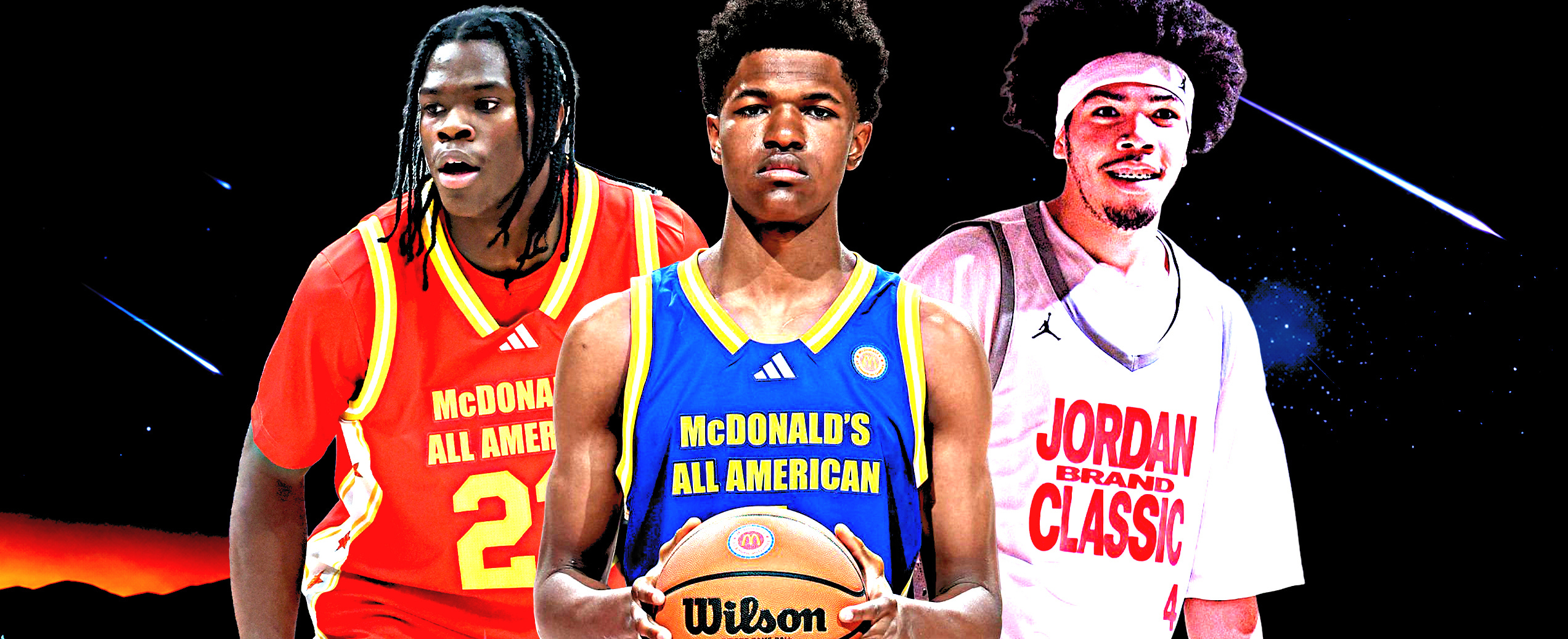
Every draft class has a handful of guys who walk into situations where they have massive shoes to fill. That’s the name of the game, though, when you go to big programs with NBA aspirations. The unfortunate part for this year’s freshmen, though, is that they’re replacing what could be a legendary freshman class from the 2026 NBA Draft. Kansas lost Darryn Peterson, BYU lost AJ Dybantsa, Duke lost Cameron Boozer, and Arkansas lost Darius Acuff Jr. It isn’t fair, but the freshmen who are filling those shoes are inevitably, even if it’s subconsciously, going to be compared to them. While this class is wide open, Tyran Stokes, Jordan Smith Jr., Bruce Branch III, and Cameron Williams are filling big shoes and are consistently talked about towards the top of the 2027 NBA Draft. Here’s how I currently view their games, how I think they’ll impact their teams, and where I’m willing to put them today.
Tyran Stokes – Kansas
It had been a long time since Kansas landed top recruits, and now they’ve done it in back-to-back years with Darryn Peterson (#2) and Tyran Stokes (#1). Peterson and Stokes are vastly different players, so the one-for-one replacement isn’t applicable, but their role as the focal point of the team is. What they also share, though, is that they are arguably the most talented players in their class. On paper, Stokes should be the no-brainer top overall prospect for the 2027 NBA Draft. Listed at 6’8” and 230 pounds, Stokes has the combination of power, size, and skill that nearly every NBA front office looks for in their wings and forwards. Stokes can be disruptive on defense, a bull around the rim, a dynamic shooter, and a versatile playmaker. It’s a blend of capabilities that few players his age possess.
Unfortunately, Stokes is very hot and cold, both on and off the court. His off-the-court issues have been well documented, but even on the court his game has a lot of Dr. Jekyll and Mr. Hyde to it. While Stokes has almost always put up superb numbers, his execution, work rate, and fundamentals haven’t always been there. I think Stokes has by far been at his best in Team USA settings. Even when he isn’t putting up gaudy numbers, he’s executing his role, doing the little things, clapping up teammates, and staying consistently engaged. In high school and AAU settings, though, Stokes tended to put up better numbers but had some of the most frustrating film you’ll find from someone with his talent. It was way too common for Stokes to have games where he was totally disengaged on defense, never boxed out on rebounds, had some of the worst body language you’ll see, and had an incredibly questionable shot selection.
The question with Stokes coming into this year has nothing to do with his talent, but more so which version are we going to get. Sometimes, all it takes is a new setting and a new voice to unlock the best in a player. Hopefully, Bill Self and the Kansas staff will be able to do that with Stokes this year. If they can, then Kansas is going to have one of the most dynamic wings in the country who is a versatile three-level scorer, brilliant passer, and disruptive defender. If we get the Team USA version of Tyran Stokes, he’s likely going to be a Top 3, if not first overall, pick.
On the Record: Stokes should go first overall, but I worry there’s just as good of odds that he doesn’t go Top 3.
Jordan Smith Jr. – Arkansas
Any guard that is going to a John Calipari-coached team is going to face steep expectations, and Jordan Smith Jr. is no exception. What Darius Acuff Jr. did for Arkansas last season was insane. While Smith could impact winning at a similar level, it’s crucial to understand that he’ll do it in a vastly different style. Smith isn’t the shifty, dynamic scoring/playmaking point guard that most of Calipari’s guards tend to be. Instead, Smith finds his success through his athleticism/physicality, defense, malleability, and steadily growing offensive game. Think more Cason Wallace and less Darius Acuff.
As a senior at Paul IV, Smith won basically everything there was to win, from Gatorade National Player of the Year to Naismith Player of the Year to USA Today Player of the Year along with myriad other accolades. Whenever Smith is on the court, you feel his impact. That includes last summer when he was playing with AJ Dybantsa, Mikel Brown, and Cameron Boozer on Team USA, where Smith had numerous stretches where he looked like the best player on the court. In that setting, Smith did a brilliant job of scaling down his game and impacting winning through his defense and secondary creation. At Paul IV, Smith was the driving engine of the offense, where he was the primary scorer, playmaker, and creator. That versatility in terms of impacting winning is why Smith could be the first guard off the board in the 2027 NBA Draft.
The biggest leap that Smith made in his senior year was as a shooter. He still has a lot of work to do, and it’ll likely be his swing skill this year, but there were very encouraging signs from his volume and shot versatility. Smith tends to shoot a line drive ball, though, which does bring his touch into question, especially with his mediocre free throw percentage. Where Smith was at his best, though, was attacking the rim. He does a great job playing off of two feet, finishing through contact, knocking down tough midrange jumpers when his drives get cut off, and using his scoring gravity to find open teammates. Highlighting the shot as the improvement area is always the easiest, but there are other areas I’d love to see Smith take a big leap in this year. The first is with his at-rim finishing. He’s good around the rim, but the vast majority of his finishes are power-based, and he plays off two feet a lot. Neither of these are bad things, but I’d love to see some more versatility with finesse finishes, finishing craft, and playing off one foot with deceleration, Eurosteps, etc. incorporated into his game. Also, his playmaking needs to take a substantial leap. He’s a very good passer and does a great job keeping his dribble alive through contact. However, a lot of his playmaking stems from him countering rotations and using his scoring gravity. This is fine for a two-guard or combo guard, but at his size, Smith will likely need to ultimately lean into more of the point guard role. If he can speed up his processing and manipulate defenders in situations other than out of his drives, it’ll make his translation significantly more exciting.
Smith likely won’t be the type of point guard that Acuff was, where you throw him the ball and ask him to go create magic. Instead, Smith is the type of player who can fit effortlessly in any setting he’s thrown into, do whatever’s asked of him, and make life easier for those around him. If Smith was a few inches taller, he’d likely be most people’s top prospect entering the year.
On the Record: Smith is my top prospect, and if he was a few inches taller, I think he’d be almost unanimous right now.
Bruce Branch III – BYU
When it comes to filling the shoes of a predecessor, no one may be in a more unfair position than Bruce Branch III. Branch is a very intriguing wing, but he is a vastly different player than AJ Dybantsa. If BYU fans are hoping that Branch will be able to step in and take on a similar role that Dybantsa had, they’re going to be disappointed. That’s not meant as a denigration of Branch; it just isn’t who he is as a player.
Where Branch struggled the most last season was with his on-ball creation. His handle is just alright, and his athleticism/explosiveness leaves a lot to be desired in terms of on-ball creation. He doesn’t have much wiggle and struggles to get to the rim or create space. Far too many of his drives result in midrange turnarounds. If he’s doing that against high school defenders, he’s undoubtedly going to struggle against college ones. This is where proper expectations and scouting a player for who they are rather than who you want them to be come into play, though, because I really like a lot of Branch’s game.
As a 3-and-D wing, Branch has a ton of upside. He has a promising shooting stroke, especially when his shoulders are squared up. He also moves well without the ball, is very effective on the boards, and is a highly intelligent passer. He’s the type of player that can be put in motion and given the leeway to make myriad decisions. Where I get really excited about his game, though, is on defense. He needs to get a little stronger, but his awareness, fundamentals, and physicality are fantastic. He does such a good job of sitting down in his stance, sliding his feet, defending with his chest, and staying disciplined on shot fakes. Branch is not the heir apparent to the Dybantsa role. However, with his high feel, off-ball scoring, connective passing, and defense, Branch offers a lot in the Moses Moody/Devin Vassell vein.
On the Record: Branch has Top 10 upside, but if his handle and shooting consistency don’t take a leap, he may be closer to the 20s.
Cameron Williams – Duke
Duke’s run on bringing in talented forwards continues with Cameron Williams. Unfortunately for Williams, he’s following two of the most dominant freshmen seasons we’ve ever seen from Cooper Flagg and Cameron Boozer in back-to-back seasons. I don’t think that we’re in store for a threepeat. While Flagg and Boozer were incredibly polished for their age, Williams is much more of an upside bet.
Listed at 7’0” and 215 pounds, Williams has a skill set that is easy to get excited about. He’s a legitimate spot-up shooter who can provide unique floor spacing. He’s also shown some fun flashes of an above-the-rim finisher out of rolls and in transition. On top of that, there are a few more levels that can be unlocked with Williams’s passing. He’s someone who can be a zone buster from the middle of the floor with his shooting and passing. With a bit of experience and coaching, he could provide a massive impact out of the short roll as well. Williams really struggles to create anything for himself as his handle needs a ton of work, but if he can sharpen his passing consistency, it’d unlock some crucial aspects of his game.
Where I get the most excited for Williams, though, is on defense. He has a lot of work to do still. I’m not trying to paint a fraudulent picture because his lower body strength, box outs, and rebounding need meaningful work. However, I’m optimistic about his foundation as a defender, especially off the ball. Williams does a good job of patrolling the baseline and protecting the rim in help situations. He keeps his head on a swivel, is active on rotations, and does a good job swatting shots. There are plenty of examples of him sitting down in a stance and sliding his feet in space as well. As he gets stronger and the game slows down for him, Williams could see a massive leap in his defensive impact.
There’s a very real world where Williams has a tremendous season that makes him a Top 10 pick, but it also wouldn’t shock me if we see him back in Durham for his sophomore season. Flagg and Boozer have set expectations high at that position, but that’s not the type of player Williams is (you may want to look at Joaquim Boumtje-Boumtje if you’re eager to throw out Boozer comps). Williams has a ton of upside, but the question is how quickly it will be unlocked. There’s nothing wrong with it taking an extra year, and two years of Williams and Boumtje-Boumtje should get Blue Devil fans excited.
On the Record: There’s a lot (you could even say all) of basketball left to be played, but I’m not sold on the notion that Williams is a one-and-done.
go mode
I am so excited for Tyran Stokes. I haven’t been this excited about an incoming college prospect since Bol Bol. Hopefully Stokes works out MUCH better.