


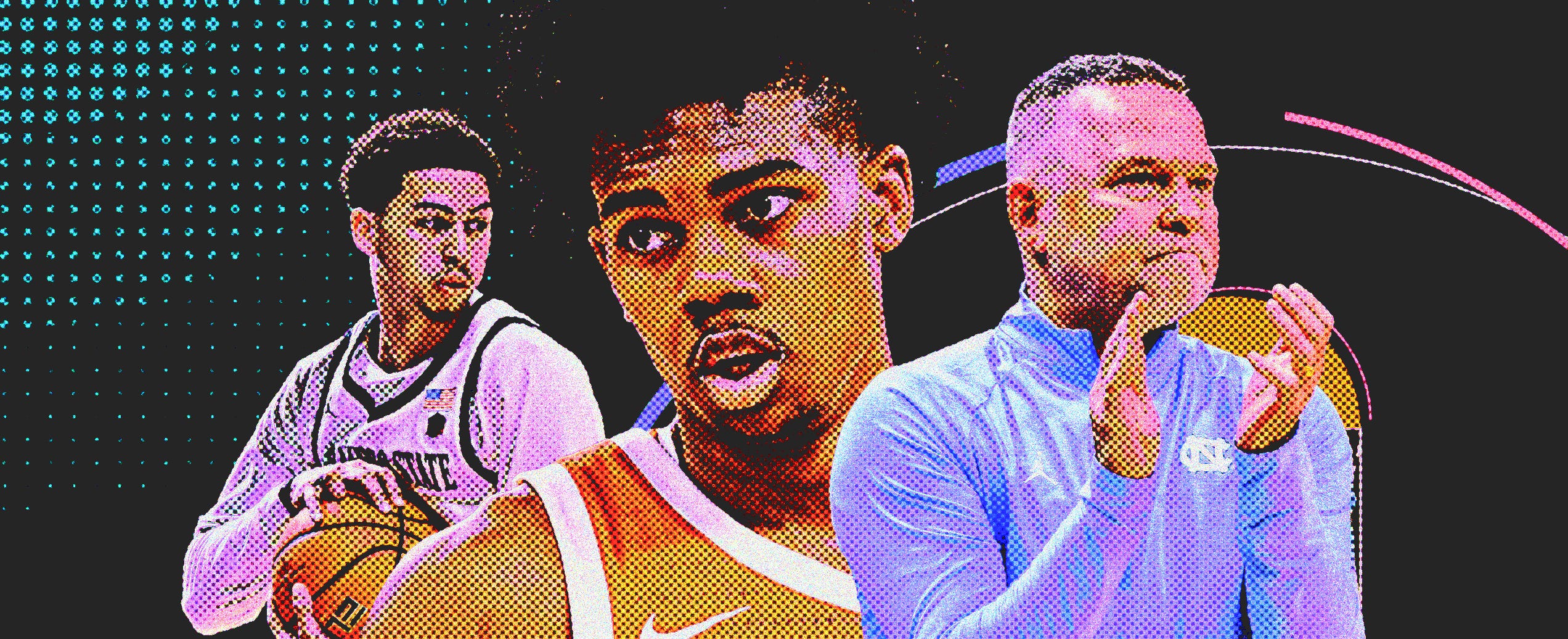
The college basketball season is finally here. Over here at No Ceilings, it feels like Christmas. Throughout the season, truths will begin to be unwrapped.
High-profile recruits will rise to the challenge of adjusting to college basketball, and others will fade. Returning prospects will take massive leaps while some may have their development stagnated or stalled. Whether it’s a freshman, mid-major player, or any other returner, someone will break out onto NBA radars. Teams with big offseason acquisitions will either back up their case as a top team in the country or fall well short of expectations.
Those are the guarantees of college basketball.
Ahead of the college basketball season, I want to lay out some predictions in a format I’ve done on my personal Substack and in my draft guides. It’s a 4-quadrant approach—Quad 1 (critical into positive), Quad 2 (positive-centric), Quad 3 (critical-centric), and Quad 4 (positive into critical).
Examples from past preseasons and a draft guide:
Preseason 2025: Quad 1 (UConn will not 3-peat, but Dan Hurley will develop another lottery prospect), Quad 2 (Kevin Young will start a pro pipeline at BYU and keep Mark Pope’s momentum up as a top-25 team), Quad 3 (A Calipari guard will not be in this year’s lottery), Quad 4(Duke’s depth will help and hurt the stock of different prospects.)
Draft Preview 2025: Quad 1 (The limitations are real, but Asa Newell and Liam McNeeley are better than context suggests), Quad 2 (Collin Murray-Boyles is the most like Draymond Green of anyone who’s received the comparison), Quad 3 (Outside of Harper, the guard class is incredibly shaky), Quad 4 (Sion James, Nique Clifford, and Micah Peavy can be effective defensive stoppers immediately, but the shooting may determine the upside.)
Obviously, I don’t bat 1.000 here. However, it’s an exercise I like to do ahead of the season or the draft, because it challenges me to think about what might go well or not.
So, here are four predictions I have for the college basketball season and its effects on the 2027 NBA Draft.
Quad 1 Take: Michael Malone’s first season at UNC has hiccups due to primary playmaking, but one of their bigs or forwards emerge as a top-20 pick
Michael Malone made the shocking move to join North Carolina as its head coach, as the school now has two former professional championship head coaches tasked with elevating its two biggest programs.
It could be shaky out of the gate for Malone in his first season. It really starts with their lead guards. Neoklis Avdalas will be the team’s primary playmaker. Last year, he was the big international prospect to make the jump to the NCAA. He struggled to maintain early-season momentum. His lack of physicality was highlighted on both ends of the court. His shooting woes hinder his ability to push defenses off the dribble and to shift off the ball. While his playmaking can be mesmerizing for his size, he has to punish defenses with his scoring equity in order to successfully drive an offense for a program looking to be contenders.
Matt Able falls in this category as well. I’ve liked Able due to his ambidexterity as a passer and finisher, and how he stirs activity defensively with his wingspan. He had a great NBA Draft Combine and could leverage the experience with a heightened role to take a leap. However, I feel more of an on-ball role may expose his weaknesses as a primary facilitator and diminish his stock. He also needs to add some more mass to his frame. He’s more at his best as a secondary playmaker who creates for himself and others when the defense is tilted or when he’s in transition. Improving upon his three-point percentage would open up the floor to improve upon these things as well.
With that said, North Carolina’s system will highlight their talent in the frontcourt—at least from an NBA standpoint, as there are a lot of unproven commodities to solidify themselves as NCAA contenders. Two names I’m tracking: Maximo Adams and Sayon Keita. Adams took a monster leap in EYBL, averaging 19.3 points and 10.5 rebounds per game across 20 games—per Cerebro Sports. He boasts solid positional size and length from the 4 spot. He has the mobility to defend out in space and the frame to absorb contact, but he’s likely going to stick to bigger 3s and 4s. He shot 39.2% from three as well, so he can stretch the floor a bit. He honestly reminds me a bit of PJ Washington as a combo forward that can shoot, finish, defend, and rebound. Coming over from the FC Barcelona club, Keita is more of a raw project with an abundance of tools to work with. He’s a fluid athlete who leverages the two traits to defend in space, alter shots at the basket, and finish plays. He still needs to iron out his feel, primarily starting with just the nuances of the pick-and-roll; he’s more than capable in this role but has to be consistently forceful with his screen contact. In addition, he needs to add muscle. Nonetheless, he’s a scheme-versatile big man that can run the floor and stir activity around the rim.
If either gets out to a strong start, they will garner draft consideration.
Even if Michael Malone’s team struggles to make noise in the NCAA championship race, he’ll see one of his players have his name called in the top-20 of next year’s NBA Draft.
Quad 2 Take: Texas becomes the best team in the SEC and has a top-20 pick
When surveying my notes of teams with potential guys, no program stood out more than the University of Texas. They had an unbelievable recruitment cycle, as Sean Miller enters his second season in Austin. They have the depth all across the board to be the best team in the SEC—even among the likes of Florida, Alabama, or Arkansas.
Spearheading the attack, Isaiah Johnson and Mikey Lewis form a solid guard duo. Johnson is the main breakout prospect to watch. Despite being undersized, he remained one of the most productive freshmen last year. He’s a great, balanced driver that can shift gears, slam the brakes, and maintain advantages with hostage dribbles. In addition, he’s a tough shot-maker. The concern with him revolves around his size and how he can increase his margin for error as a small guard. He should look to do so by improving upon his defense and play-making—mainly by leveraging his driving craft to open up looks for his teammates.
It’s mostly a concern for his NBA viability, as his production thus far has been undeniable.
So yeah, it’s Isaiah Johnson with a bunch of top-20 picks—all but one going in the lottery. Yes, Johnson has to show he can scale up his role, as his assist rate is rather low for a lead guard. Nonetheless, he has a steady foundation and a strong supporting cast to round out his game as a lead guard.
They have a ton of depth from the 3-4. They acquired David Punch, Elyjah Freeman, and Amari Evans in the transfer portal. All of these players have the requisite size at their positions to make an impact. Punch, in particular, is a high-feel power forward who can crash the glass, connect the dots as a passer, and wreak havoc defensively. Freeman is a slashing forward who can soar above the rim for cuts, drives, rebounds, and blocks. Despite limited playing time, Evans showed upside with his defensive tenacity and hustle. All three of these players share two common traits: they’re disruptive defensively but face shooting woes. Their ability to have their defensive prowess outweigh their perimeter struggles could determine their ceiling.
Marcus Spears Jr. reclassified up to join as a 17-year-old freshman. Anything you get with him is gravy due to his age and the competition in the SEC. However, he’s a bit rangy forward who strings actions together offensively, while possessing a good nose for the ball defensively. He’s a projected lottery pick in the 2028 NBA Draft.
I’m not the highest on Matas Vokietaitis due to his interior strength and minimal scheme versatility. However, he’s massive and leverages his size to inhale rebounds, finish plays, and protect the rim. At the very least, he equates to the size seen on a nightly basis in the SEC.
Finally, their prized freshman recruit is Austin Goosby, who could become a first-round pick. He fits an archetype I’ve grown to favor when building a contender in today’s NBA. He’s a 2-guard that can slot as a combo due to his playmaking equity, while also applying pressure defensively with his hands, activity in passing lanes, and physicality at the point-of-attack. He’s a wicked rim protector for a guard, averaging 0.8 blocks per game across 71 pre-NCAA games—per Cerebro Sports. Two flaws stand out in his projection. While his defense is intriguing, he’s prone to giving up drives, as his hips are a bit too high in his stance—which becomes shaky when defending against a change in direction. Secondly, I’m not sure where his shooting falls. He shot 42.1% from 3 with Overtime Elite but made just 23.2% of his threes in the previous EYBL circuit.
If the defense impact maintains, and the shooting trends closer to his Overtime Elite numbers, he can be an impact player that rises up draft boards and becomes a one-and-done prospect that flirts with the lottery conversations. I liken him to Nickeil Alexander-Walker if he grew up playing football because of his on-ball capabilities as a scorer and playmaker as a secondary facilitator and his defensive upside.
Regardless, this Texas team is deep and will bring it defensively. They have the pieces to win the SEC championship and to make a run in the NCAA tournament .
Quad 3 Take: 5-for-5 will evaporate the second round
Honestly, it’s a challenge to keep up with this eligibility landscape. Lawsuits have made it more confusing. Here’s to hoping 5-for-5 clears everything up once it fully kicks in next year, when this current class of non-redshirt seniors gets one more season for 2027-28. Can everything relax after that? Hopefully.
I don’t think it’s as terrible as I made it sound, by the way. As we get more data on these older rookies who exhausted all of their eligibility through NIL, I hope it shows that it helps their development and readiness when stepping into the league. Trevon Brazile, Zach Edey, Sion James, Moussa Cisse, and Baylor Scheierman stand out as recent examples to varying degrees.
This year, however, 5-for-5 will obliterate the second round of the 2027 NBA Draft. It leaves current seniors, who would’ve been automatically eligible in the previous landscape, with one extra year. Let’s rattle off some names here: Alex Condon, Pryce Sandfort, JT Toppin, JoJo Tugler, Andrej Stojakovic, Rueben Chinyelu, Jeremy Fears. Heck, Thomas Haugh can forego another first-round opportunity to cash in on NIL for one more year. Maybe some underclassmen recognize this and look to declare for an opportunity to hear their names called on draft night, with the understanding that a deeper 2028 draft may not offer the same chance.
It’ll really come down to grad players, and the only player that stands out in this regard is Miles Byrd. Maybe some other names emerge as impactful auto-eligible prospects—Braden Huff, LeJuan Watts, and PJ Haggerty come to mind.
The shaky depth at the top is already over-discussed, but it’s still full of players that can be starters or playoff-rotation guys—even while the star upside is either flawed or minimal. The depth will be felt most towards the end of the draft. Teams will still find a diamond in the rough—whether it’s an auto-eligible player, international stash, or someone who’s just ready to live out their NBA dream.
Regardless, expect a conversation around the 2027 NBA Draft of who’s even in the pool of players to target in the second round.
Quad 4 Take: The freshman combo guards could surge and the freshman wing/forward room has some variance
The top of the draft has a lot of variance that can lead to players surging or falling down the boards.
Two position groups stand out: the combo guards and big forwards.
On the other hand, this group of freshman combo guards could go a long way in defining this class. Jordan Smith may not be the quintessential number one pick, but he’s straight from the school of winners like Marcus Smart, Alex Caruso, Cason Wallace, and Derrick White. Especially with the chaos ensuing in the new 3-2-1 lottery format, a team can strike gold with him in their playoff rotation within his rookie contract.
Holt is a versatile defender who can hound opposing ball-handlers and crash the glass, but he’s a shaky shooter at this stage of his development. Coleman may not have the creative chops of Keaton Wagler, but he can follow in his footsteps as a one-and-done prospect. He’s a smooth outside shooter who can put the ball on the deck, crash the glass, and be additive within the shell of a team’s defense.
Even though he’s missing the season with a torn ACL, Brandon McCoy could stay in the mix because of his rebounding, defense, and secondary playmaking. Dylan Mingo is a consistent paint touch who can create advantages and get his teammates involved, but he’s a non-shooter. I’m intrigued by how he complements his brother Kayden Mingo at Baylor, as he also boasts defensive chops at the point of attack because of his positional size and length. This group’s defining trait is versatility, but respective playmaking and shooting leaps could elevate their ceilings.
The “big forward” room has equal levels of intrigue and variance. These forwards are all 6’9” or taller and possess wing skills to a varying degree. While achieving on the tantalizing upside can have them crash into the top-5 of this draft, they draw legitimate concerns that could lead to them not entering the draft altogether.
Anthony Thompson has struggled in exhibition games, leading to concerns about his ability to scale up. Christian Collins has been out of exhibition action and already has a crowded path to a large amount of minutes with Jacob Cofie, Eric Reibe, and the Ratliff brothers. Baba Oladotun has tantalizing wing skills, but as a reclassifying freshman, he has a long way to go physically for college ball and quick NBA viability. Miikka Muurinen has the awesome highlights but hasn’t shown much substance yet.
I’m not ruling out a season that raises their stocks in a real degree, but there’s a lot of variance across the board here where either band of outcomes won’t shock me.
College basketball is here. I’m incredibly fascinated to see how this cycle shakes out over the course of the season. I know there’s a sentiment around the depth of this class. For starters, we’ve been spoiled with generational talent the last several years at the top of the class. Even though this class doesn’t have that, it still projects to have players that can contribute at a high level and perhaps unlock a star ceiling. There’s intrigue.
When it comes to process, the lack of generational talent at the top will lead to having an open mind across the board—even at 1. It’s going to be fun to monitor developments over the course of the season.
Curious to see how Duke juggles talent