


I’m not here to waste words or waste your time. This won’t be a hard idea to grasp. I believe Keaton Wagler could be a future MVP candidate. I think he’s going to make multiple All-Star teams and All-NBA teams if all breaks right.
I know a lot of you reading this are thinking the same thing: this fool is just spewing hot takes to garner attention and stir conversation. Honestly, I wish I were that basic. If I were, maybe I’d be super rich by now, with three million TikTok followers. As hot-takey as my statement might have been, I’m going to spend a trillion words on this piece to sell my case to you. I firmly believe Keaton Wagler is a future star, and his journey from an unheralded recruit to leading a high-powered Illinois team as a freshman is only the beginning of his incredible story.
If you follow the NBA draft or college basketball at all, I’m sure you’ve heard the story about Keaton Wagler by now. The quick synopsis is that he went to public school in Kansas, played AAU for a non-shoe-sponsored program, and wasn’t even a Top 100-ranked prospect coming out of high school. Kansas and Kansas State didn’t even recruit him, even though he played in-state. He committed to Illinois, had a ridiculous freshman season that led the Fighting Illini to the Final Four, and was named a consensus All-American and won the Jerry West Award, just to name a few of his accolades.
The question everyone gets asked about why he was overlooked heading into college had to do with his frame and his lack of athletic ability. As someone who has stood next to Keaton Wagler multiple times and has seen him play in person, I can confirm that he is skinny and not an Amen Thompson-type athlete. Those two things are absolute facts and cannot be avoided. The point I want to make is this: just 12 months ago, we saw the whole country, outside of Illinois, miss out on Keaton Wagler because he was skinny and wasn’t a traditional run-and-jump super-athlete. He then went on to have a ridiculous season and put on tape tons of reasons as to why those limitations would not stop him from finding success as he went up a level. He’s about to go up another level to the NBA, and all the same questions persist with him. So my question to all of us is, as we sit here in 2026, are we all about to make the same mistake again?
I’m not an idiot; the jump from high school to college is a very different jump from college to the NBA. I totally understand that the NBA has the absolute best basketball players on the planet, and the jump to that level is nothing to sneeze at. With that being said, I want to be clear that when it comes to some of the question marks surrounding Wagler, not only did he just show the world with his freshman season that he could overcome them, but we have other players who are currently dominating the league, who had similar question marks around them as they entered the league.
The more I watch Keaton Wagler, the more I see hints of Shai Gilgeous-Alexander, Jalen Brunson, Austin Reaves, and even Tyrese Haliburton. We at No Ceilings like to do prospect chemistry, comparing guys to a handful of different players rather than looking for one-for-one comps. When I look at Wagler, and then at the monsters I listed as comps, I think the throughline is that they all entered the league with question marks around their strength, size, or athletic ability. They all had question marks about how their games could translate to the next level, and yet look at the insane production and success those guys have tasted in the league so far. SGA is the reigning MVP and NBA Champion. Jalen Brunson has become one of the best scorers in the entire league and has brought the Knicks back from the doldrums of the NBA. Austin Reaves went from being undrafted to averaging over 23 points per game and just co-led the Lakers to a very successful season. Tyrese Haliburton just led the Indiana Pacers to a Game Seven in the NBA Finals last season before blowing out his Achilles tendon.
I want to be clear about my intentions with this piece. I’m not here to tell you that Wagler is going to be the next SGA or Tyrese Haliburton. My intention is to show you why I think Wagler is awesome and why there’s reason to believe he has a strong path to becoming a future NBA star, whatever that ends up looking like. Instead of navigating this the traditional way by hitting his offense and defense, we’re gonna walk through his perceived weaknesses and how he’s gonna be able to combat them and work on them as a pro.
Slender frame/strength
The first thing you’ll notice when you stand next to Keaton Wagler is that the guy is actually huge. I’m 6’3” in shoes, and when I stood next to him, I was amazed by how tall he actually was. I imagine without shoes, he’ll probably come in at around 6’5”, maybe a little more than that; with shoes on, he looked a legit 6’6” to maybe even a 6’7”. Of course, my perception of things could be wrong, but just standing next to him, he felt extremely tall, and his arms looked long to me. It would be hilarious if he actually measured in at 6’4” with a negative wingspan at the combine, but we shall see.
When you see a guy of his build, it’s easy to assume that they probably prefer to be out in the perimeter, they probably don’t play through contact well, and probably don’t take a ton of free throws because they’re mostly just out around the three-point line. If you never watched Wagler play and just looked at his build, you’d think that’s exactly how he played. The reality of his game is that it couldn’t be farther from that. Wagler is an excellent driver of the ball who generated a ton of touches in the paint all season long. Even with his slender build, he does not shy away from contact, and he pretty much lived at the charity stripe this season.
Wagler is such an intriguing driver of the ball because he uses his toolbox to get there. Where Wagler lacks in conventional athleticism, he makes up for it with his ability to decelerate at a high level, along with his IQ and savvy. I’ve seen people online criticize Wagler for being a ball-screen merchant and for being a guy who pretty much can’t create anything for himself without a screen. I have a two-fold answer to that critique:
NBA teams run a ton of ball screens.
Wagler has shown the ability to attack ball screens with real aggression and craft to create opportunities for himself and others.
As much as people want to use his ball-screen usage against him. The reigning MVP, Shai Gilgeous-Alexander, was a ball-screen merchant himself in his one year for Kentucky. As incredible an isolation scorer as SGA is now, he was a guy who relied heavily on ball screens to get to his spots in Kentucky. In his lone season for Kentucky, SGA was the pick-and-roll ball handler for 39.2% of his team’s possessions; in comparison, only 9.1% of his team’s possessions were SGA iso’s, according to Synergy Sports. SGA, like Wagler, has never been an explosive athlete and has had to rely on craft and non-traditional athletic skills to get to his spots. SGA came into the league with similar questions around his game as Wagler, and interestingly enough, their statistical profile and advanced stats were not too different either when you compare them. Just for fun, let’s look at a comparison between the two:
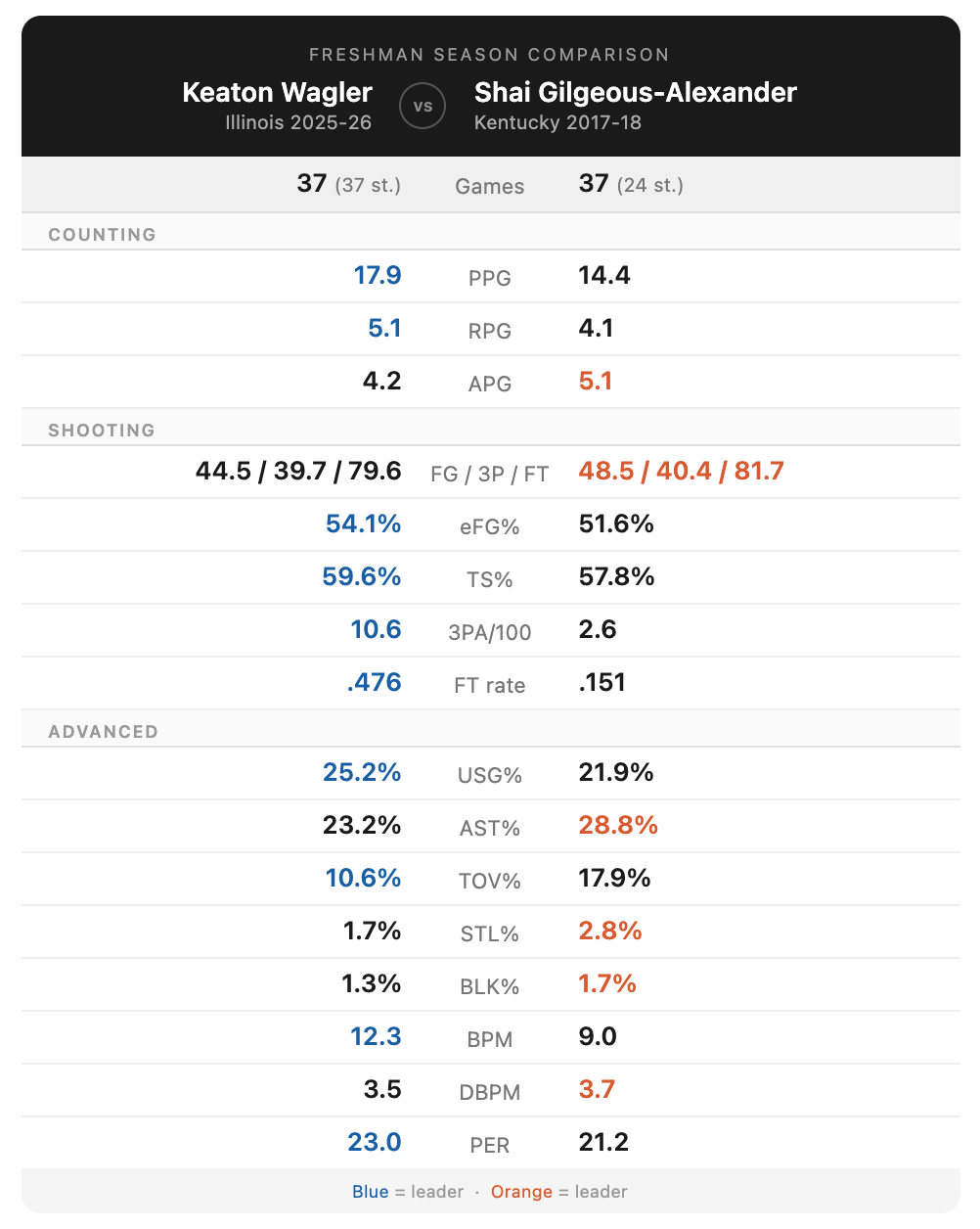
If you look closely at the stats, they’re eerily similar, but as similar as they may seem, it’s important to note that SGA played with guys like Kevin Knox, PJ Washington, and Hamidou Diallo, who took the ball out of his hands at times. Their minutes per game were also very similar, with Wagler at 33.9 and SGA at 33.7. Beyond the numbers, when you turn on the tape, you’ll see some real similarities between the two. As fluid and coordinated as SGA is as a mover, no one was mistaking him for Derrick Rose or Russel Westbrook when he was attacking the rim. If you watch the video compilation I put together of both guys, you can see the incredible craft, the driving angles, the hesitations, and the deceleration they were both using to get to the rim.
When you watch Wagler, you can see how slithery he is and how he uses his long strides and deceleration to slow things down and create separation for himself. It’s also so trippy to see how good he is with his spin move and how he gets so aggressive with it to really bump guys and get them going the wrong way. Something I’d like to see Wagler do more of is attack the in-between game more. He showed beautiful flashes with his pull-up jumper and touch shots in the lane, but I think incorporating more of that will create more opportunities and, more importantly, easier opportunities around the basket. Although Wagler is slender, he is not contact-averse.
When I went to see Wagler play in back-to-back games here in LA, I sat next to someone who worked in the scouting department for an NBA team. Throughout the game, I picked his brain about different players and, more importantly, how he viewed the game. While we watched Wagler walk to the rim time after time, I asked him about strength and how he values strength when evaluating a prospect. I specifically asked him about Wagler and the discourse around him being too weak or too skinny. He assured me that they heavily consider a prospect’s strength and their ability to adapt to the strength of NBA pros, but when talking about Wagler, he said,
“He may not look strong, but look at how he plays through contact; he’s not running from it.”
It is true that Wagler has to add mass and get stronger; there are plenty of drives in his film that show him struggling against bigger, stronger defenders. From day one in the league, he probably will struggle with defenders like Cason Wallace, OG Anunoby, Jrue Holiday, and other powerful defenders like that. I could totally see him playing against the Thunder and just getting walled up by Wallace, JDub, and Lu Dort.
Wagler shot only 54.8% at the rim, according to Synergy Sports. Ideally, you’d want that percentage to be above 60%, but I think he’s going to get there. Wagler does a good job of mixing up his finishes, using his length to protect against bigs, and can throw in same-foot, same-hand finishes to mess with guys, too. He’s exhibited some really nice touch on push shots and floaters, too, great weapons to use against shot-blockers. But what gives me hope about his ability to eventually figure out defenders like that is his mentality. The most important thing is that Wagler wants to get to the rim, pick up fouls, and create advantages for himself and his teammates. The one stat that really sold me on his ability to play through contact and his fearlessness as an attacker was the fact that he took over 5.8 free throws per game and over 10.5 attempts per 100 possessions. His free-throw rate was 47.6%, an elite mark. For context, SGA had a free-throw rate of 46.0%, and Luka Doncic was at 44.3% this past season. Wagler is a player with a strong understanding of the importance of paint touches and, despite his slim build, is constantly looking for ways to get there.
Athleticism
Wagler attempted one dunk all season long, and he missed his one attempt. As terrifying as that stat sounds in a vacuum, Wagler displayed a different type of athleticism all season long. I already talked about his ability to decelerate, as well as his coordination and spatial awareness in navigating tight spaces. Along with all that, Wagler is a gifted lateral mover who can change directions on a dime and send defenders the wrong way.
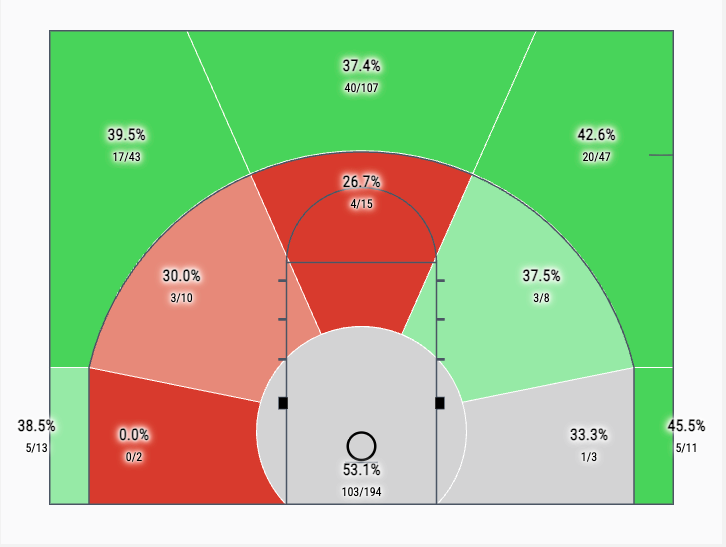
When you watch Wagler create with the ball in his hands on the perimeter, you see how he uses his lateral and stop-and-start ability to create separation. I think one of the main reasons Wagler ascended to this point is his ability to hit really tough shots from deep three-point range, and much of that stems from his ability to create looks for himself off the dribble. If you take a look at his shot chart from this season, you’ll see that Wagler was in the green in every zone beyond the three-point line, but the area that stood out the most to me was his efficiency from the top of the key and the wings.
Wagler’s ability to beat his defenders with step-backs, sidesteps, and off of high screens to get off clean looks from outside was a truly potent part of his offensive arsenal. As soon as Wagler was a couple of steps inside the halfcourt line, he was pretty much in range to let one go. That type of outside threat made it very difficult to guard him in ball-screen action and opened up lanes for him to get downhill and attack the rim. Go ahead and feast your eyes on the compilation I attached below of how potent a shooter Wagler truly was from outside, and his ability to shake defenders to get off clean looks was an incredibly reliable weapon in his toolbox.
According to Synergy, Wagler was in the 89th percentile as an off-the-dribble shooter, and shot 37.7% on them overall, which Synergy classifies as Excellent. The versatility piece of all of this is his ability to shoot off the catch as well, where he was in the 87th percentile overall as a catch-and-shoot jump shooter and, more specifically, in the 91st percentile on guarded catch-and-shoot jumpers. He shot 41.9% on guarded catch-and-shoot jumpers on 43 attempts, which is pretty good stuff. Beyond the shooting, Wagler is also a smart cutter off-ball who knows how to move to create easy opportunities for himself and his teammates. He’s not sitting in the corner waiting for the ball to recycle back to him all the time. He’s willing to find open spots on the floor and keep things flowing for the offense.
The other element to his offensive game that has to be highlighted here is his feel and willingness as a passer. Wagler’s passing film won’t wow you with no-look dimes and elite high-level reads as you’d see with Luka Doncic or Nikola Jokic, but he’s good enough as a passer to manipulate the low man with the threat of his vision and anticipation. He can find rollers and poppers out of ball screens with real competency, and when he’s driving downhill, he does a great job of finding bigs roaming the dunker’s spot and can throw up some tasty alley-oops to reward his hard rolling bigs. Wagler’s ability to whip live-dribble hook passes all over the floor as he’s coming off of screens is a lot of fun to watch. In the compilation I made below, you’ll see him connect on a ton of those passes to his popping screeners for wide-open looks from three.
As slippery as he is in navigating tight spaces, the threat of his passing ability and feel for his teammates just adds another wrinkle that the defense has to worry about when he has the ball in his hands. Wagler had a 25.2% usage this season and an assist percentage of 23.2%; that’s not elite by any means, but it’s also nothing to sneeze at. As an offensive engine who has the ability to play on and off the ball, that type of passing ability to go with everything he can do as a scorer is a serious strength of his.
Why is any of this relevant to his athleticism, you ask? The simple answer is that Wagler may never have the conventional speed and leaping ability that people look for in a prospect, but he has other types of athleticism that help him create advantages for himself, and more importantly, his versatility to mix things up gives defenses so much to think about that it compensates for his lack of burst or explosion. Wagler was a pick-and-roll ball handler for 42.5% of his team’s possessions this season and ranked in the 93rd percentile, averaging 1.080 points per possession, which Synergy categorizes as Excellent. He was also a spot-up shooter on 19.2% of their possessions and ranked in the 86th percentile, averaging 1.151 points per possession, which is also considered excellent. Wagler’s ability to be an offensive engine while also playing off another creator makes him a great fit on almost any team.
For example, people may worry about his ability to turn the corner on defenders, but that becomes less of a threat when he can use ball screens masterfully. As he’s coming downhill, he’s a threat to pull up, read and react off of the low man and the corners, and can also look to go straight to the bucket himself to finish with a crafty layup. The dynamism and complexity of what he offers as a complete offensive package will always outweigh his lack of elite athleticism.
Now, at this point in the piece, some of you guys are probably wondering if we’re ever going to get to his defense. I won’t even beat around the bush with this one: Wagler probably won’t ever make a first-team All-Defense team any time soon, that’s for sure. Between his slender frame and heavy workload on offense this season, it’s fair to say that Wagler’s defensive tape was uneven at times.
When I saw him play against USC, there were some rough possessions where he got demolished by screens and didn’t show much effort to fight through them and get back to his man. It’s also important to note that Illinois was winning by a ton for most of the game, but it’s still not what you want. He wasn’t taking good angles on screens, not showing a ton of fight, and just felt like he was resigned to getting blown up on screens. To his credit, in the following game at UCLA that weekend, he looked like a different player defensively. It definitely felt like the coaching staff pointed out some things to him, instructed him to get skinny around screens, and you could feel a different level of intensity in that game.
The key to Wagler’s success as a defender will be developing his frame. The biggest difference you’ll see between freshman year SGA and Wagler at the same point is in their builds. Even as a freshman, SGA had strong shoulders and sleeper upper body strength. The strength SGA has been a big part of his ability to hold his own on the defensive end of the floor, in addition to his size and length. In his lone season for Kentucky, SGA had a 2.8% steal percentage and 1.7% block percentage. While he wasn’t the craziest defensive playmaker, he did average over 2 stocks per game. Wagler was at a 1.7% steal percentage and a 1.3% block percentage, averaging 1.3 stocks per game. I truly believe that, with the length and IQ he possesses and added strength, he could firmly get to over 2 stocks per game one day.
I don’t know what Wagler’s wingspan will measure out as being at the Combine; on tape, it looks plenty long. Wagler shows good instincts in the passing lanes and has some sneaky-good hands that he uses to poke balls away from ball handlers. Wagler is not an elite lateral mover on this end of the floor and can be pretty upright at times, especially when he’s tired. What we’re hoping for is growth in his frame and the addition of his grown-man strength. Keaton doesn’t look to have narrow shoulders; they just look underdeveloped so far. With more time and NBA facilities and trainers working on him, you could definitely see him beefing up 10-15 pounds in the next couple of years.
If Wagler can just be decent on this end of the floor, his offense and plus positional size become that much more valuable. Never in a written piece have I said that I believe a player has the potential to be an MVP-type prospect one day. I’ve always shied away from it because of fear. Fear of being roasted for a bad take, fear of facing the truth that I was wrong. After doing the deep dive of Keaton Wagler and seeing him several times in person this season, I’m convinced that if everything lines up, he could be an MVP winner one day or at least in the conversation.
Beyond the awards and accolades, I think any team drafting Wagler is adding a player who contributes to winning and has a winning mentality. As an unheralded freshman, Wagler forced his way into the starting lineup from the first game of the season. When Kylan Boswell went down, and Illinois needed someone to run their offense, Coach Underwood and their staff had no problem handing him the keys. Wagler took the keys and never gave them back, and it led to a trip all the way to the Final Four.
My purpose in writing this piece wasn’t to convince you into believing that Keaton Wagler is the next SGA, Jalen Brunson, or Austin Reaves. My intention was to remind you that those guys came into the league with some similar question marks and were passed over by multiple teams. My plea to the world is this: don’t let this happen again. As great as Keaton Wagler’s single season at Illinois was, I want to be clear that this was no flash in the pan like Linsanity. This is just the beginning of an incredible NBA career, and if it were up to me, I’d have no problem spending a Top 5 pick on Keaton Wagler.
Good read. You bring up some great points with the SGA developmental arc. Him being a P&R guy in college. But like Wagler, the iso creation flashes are there. And as you said, SGA had a high floor to at least be a winning contributor. That was the source of my reason for ranking him one spot ahead of Trae Young in 2018. And it’s why I’ll rank Wagler ahead of some other guards in this class too. Let’s hope he becomes what we imagine, but at the least he’s going to be a good player.