


Keyonte George’s ascension into star-level offensive production for the Utah Jazz is well timed given the current landscape of the 2026 NBA Draft class. Why, you ask? Well, because the current first round projections are LOADED with talented guards who all have special qualities that make them stand out amongst peers at other positions.
So there’s no better time to evaluate George’s play this season, look into how he’s developed over the course of his time in the NBA since his pre-college days, and ponder the “franchise guard conundrum” that the Jazz from office has to answer in the coming months, with several other teams not terribly far behind in terms of making draft-day decisions and what will come a few years after those selections.
What constitutes a “franchise guard” on offense? How do we weigh potential defensive drawbacks? Do teams contending for an NBA championship need quality point guard depth?
Now is as good a time as ever to try and sift through some of those questions, but not before actually breaking down where George stands now as a borderline All-Star candidate in the Western Conference for the Jazz.
All stats used are as of 1/11/2026 and are courtesy of Synergy Sports, Basketball-Reference, and Cleaning The Glass
Keyonte George: Franchise Guard Evolution
It’s one thing to take a “leap” on a season-to-season basis and steadily grow as a player in several facets of the game. But to show fairly significant improvement in nearly every area of the game in the span of a few seasons?
Now THAT is what I call a leap!
That’s what’s happened with Keyonte George this season. He’s producing at the highest level of his basketball career up to this point, certainly offensively. His defense is a bit of a mixed bag, but we’ll cross that bridge later.
Let’s stay focused on who George has been as an offensive guard, and how he’s progressed rather rapidly in a few key areas in terms of what can separate good guards from great ones.
Looking at George’s numbers available via Synergy Sports and Basketball-Reference over the course of his pre-draft career at IMG Academy (senior season), his freshman year at Baylor, and his first three seasons in the NBA, it’s clear he’s really taken full shape as a lead guard.

Two things that immediately stand out to me, apart from the jump in points and steady increases in shot attempts overall, are the assists per game and free throw attempts.
George is seeing the floor better than he ever has this season for the Utah Jazz. One could argue that the Jazz thrusting him into a true point guard role right out of the gate, force-feeding him pick-and-roll volume so early in his career, helped to acclimate him and prepare him for what was to come.
Diving into his pick-and-roll numbers a bit further, it gets even more interesting as the total volume of pick-and-rolls, including passes run, has continued to trend down compared to where he was in his rookie season.

George is on pace to finish with fewer pick-and-roll possessions run, while operating at his most effective rate within them. Overall, the Jazz have done a better job of mixing up George’s possessions involved in, giving him more opportunities to work off the ball, play second-side, and step into shots rather than running everything from the top of the floor.
But that’s not to take away from what George has done IN those possessions. George’s cadence as a ball-handler has really taken steps forward. He’s not as “nervous” or “happy-footed” operating in ball screens. He’s showing patience, taking more time to evaluate the floor, and better determine which angles need to be taken and HOW he needs to approach taking that next shot or making that next pass. That’s also evident in his turnover rate within pick-and-rolls being at a career-low mark, even going back to his time in high school.
George taking care of the ball, being more proactive in making reads and acting with decisiveness rather than angst, and choosing his spots better as a pull-up shooter, particularly inside the arc, have all played a factor in him reaching new heights as an on-ball player.

The other major factor into his development has been as a downhill driver in terms of getting all the way to the basket and either finishing or drawing contact. His split in field goal attempts overall, in terms of taking his highest percentage of shots at the basket since high school, on top of drawing free throws at an excellent rate amongst NBA guards, has turned more of his inefficient jumpers into high-percentage scoring offense.
That comes with being more decisive and determined to hunt for the best possible shot on the floor. George is clearly in excellent shape, arguably the best shape he’s been in since high school, as he’s played with awesome burst off that initial step. Being able to use more of that stop-start cadence in ball screen actions has led to catching defenders off guard and finding driving angles at a higher rate. George also being more decisive off the catch, or working a two-man game, has led to similar drives as he’s been much quicker in determining what has to be done as far as driving, shooting, or passing before the ball even touches his hands.

Across the board, George is being asked to do more with or without the ball in his hands on offense, and is excelling at doing so while seeing his best marks rebounding and making plays defensively off the ball. He’s not known for those things, nor is he an above-average guard on that end of the floor, but I’ve personally been encouraged by an increased effort by George to do more of “the little things” that drive winning.
So the question at hand: is Keyonte George playing at a level comparable to the best of his peers at the point guard position?
Comparing Keyonte George To Other “Star” NBA Guards
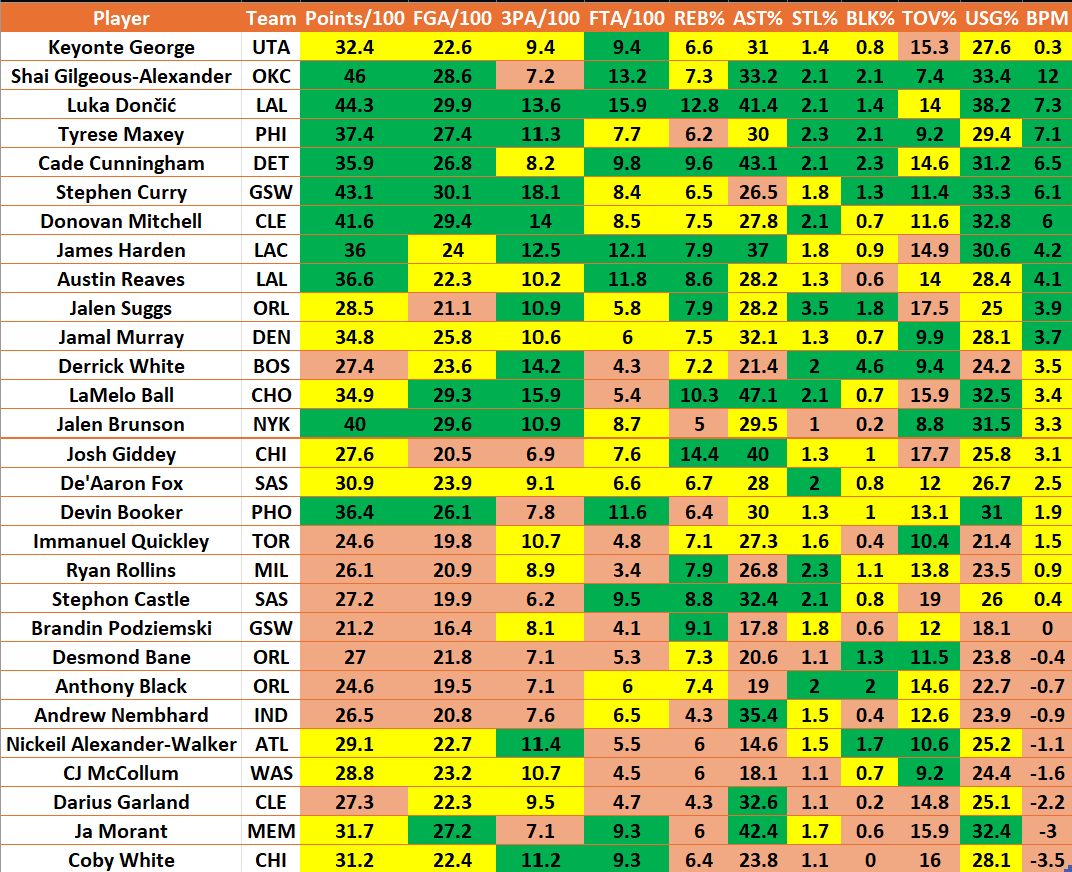
Looking at George’s production across the board in relation to other top guard options across the NBA, he’s pretty much on par with those who are producing at similar levels or above him. He isn’t commanding absurd volume like a Luka Doncic or a Shai Gilgeous-Alexander, but he’s trending in the right direction in almost every statistical area apart from his turnover rate, which is still comparably high overall.
George doesn’t have the size of his “jumbo” counterparts at the position, and he is a defensive liability to a degree that some of those players aren’t because of his size. When George is on the floor for the Utah Jazz, per Cleaning The Glass, the team is 8.6 points per 100 possessions worse. Now, without the help of the team’s best defensive player in Walker Kessler (who is out for the rest of the season), this team doesn’t have any other high-level defensive talent. There are options with size, such as Jusuf Nurkic and Lauri Markkanen, who can offer backline support in different ways, but neither is covering up for the other positions on the floor that are currently being played by younger, more inexperienced wings and forwards.
Needless to say, the Jazz isn’t set up to defend at a high level as a unit without Kessler’s services. Utah is in the lottery race for a reason, and that’s generally tied to teams that fare in the bottom tenth of the league in defensive efficiency (yes, the Jazz sit dead last in the NBA in defensive rating as it stands today).
George isn’t on the floor to impact the game defensively. He’s there to provide the type of offensive firepower needed to be the straw that stirs the drink while hopefully not cratering the defense into oblivion. As of the time of writing this piece, George is succeeding at that,t given his overall offensive output while still having a positive net rating per 100 possessions while he’s on the floor.
To add some context, in 276 possessions that George got to share this season with Kessler, the Jazz stood at +11.5 points per 100 and a defensive rating of 113.8, which would rate in the Top 10 of the league. Small sample size theater absolutely, especially given that the tandem produced a negative net rating just a season ago, but something to consider given George’s sizeable leap offensively over just one year.
Given George’s comparable production to other top-tier guards in the NBA, it’s safe to say that his upward trajectory is worth seeing play out past this season. Utah may have found its star guard of the future, as few players in the league can blend Keyonte’s combination of dribble, pass, and shoot quite like he can. George was overlooked by many (hand raised) in the 2023 NBA Draft because of an inefficient year at Baylor, as far as shot diet and percentages were concerned.
Going back to re-watch his tape at IMG, a lot of what George is doing for Utah this season was shown in extended flashes back at that level. Even though the growth curve wasn’t quite linear from high school through to this point in his career, sometimes that’s just the nature of the beast with basketball prospects. Not everyone’s path is the same, and George clearly had to crawl before he could walk and now run.
All of this being said, there's still one elephant in the room: given the potential amount of money that the Jazz organization needs to extend George at on a “Fun Max” contract, is he the type of archetype of player that this franchise can build with/around in order to one day contend for a championship? Do NBA teams NEED this type of guard to win a title, given the fact that he is a huntable target on the defensive end?
Do NBA Champions NEED A Brilliant Offensive Point Guard To Win It All?
This is a GREAT question to try and drill down on, and truth be told, there’s no one “right” answer to it either.
NBA teams have the flexibility and freedom to build a title contender any which way they choose. There’s more than one way to win a basketball game, largely in part to the types of personnel and the style of play that best suits that collective.
There’s no “magic manual” lying around that says everyone on the court has to be a positive defensive player standing at 6’6” or above, or else the odds of winning a championship are impossible.
BUT… let’s be honest. Teams that ultimately win championships, apart from having (usually) one of the five best players in the world, generally do NOT have links so weak that the entire defensive effort craters into oblivion.
This line of thinking came up recently with the trading of Trae Young to the Washington Wizards. We don’t need to revisit the defensive metrics of the Hawks this season when Young is on the floor, but yes, the numbers are historically bad. Even with Young’s incredible offensive output in terms of overall points produced on a season-to-season basis, can you win a championship with him at the head of the snake, so to speak?
It’s a debate that can lead to several different answers, but before we just slam the door shut one way or the other, it’s great to sometimes look at teams in recent history that have won the title and look at the “point guards” that have led those units to victory in the month of June.
NBA Champions Last 10 Years (Point Guard and DBPM)
2024-25: Oklahoma City Thunder (Shai Gilgeous-Alexander, 2.6)
2023-24: Boston Celtics (Jrue Holiday, 1.1)
2022-23: Denver Nuggets (Jamal Murray, -1.3)
2021-22: Golden State Warriors (Stephen Curry, 0.4)
2020-21: Milwaukee Bucks (Jrue Holiday, 0.6)
2019-20: Los Angeles Lakers (Rajon Rondo/Alex Caruso, -.01 and 2.4)
2018-19: Toronto Raptors (Kyle Lowry, 0.6)
2017-18: Golden State Warriors (Stephen Curry, 0.0)
2016-17: Golden State Warriors (Stephen Curry, 0.3)
2015-16: Cleveland Cavaliers (Kyrie Irving, -0.8)
It’s a very interesting mix of lead guards when looking back over this range of champions. Obviously, some are very well known within the lore of the NBA as offensive shot-makers extraordinare like Stephen Curry, Kyrie Irving, and Shai Gilgeous-Alexander. A few of them are actually known for their defensive versatility and point-of-attack defense across the perimeter in Jrue Holiday and Alex Caruso. But the thing that all of them actually have in common is the fact that they did not crater their team’s defensive efforts. When it mattered most, all stepped up to guard their position, fight over screens, and body up players bigger than them when targeted.
George’s career -2.6 DBPM rating would rank considerably lower than anyone on this list, but we do have to take into account that there is no “perfect” defensive metric that exists. Be it team-driven metrics or individual ratings, all generally rely on the counterparts alongside said players given the importance of rotations, communication, switching, and help. Defense is incredibly difficult to quantify on an individual basis apart from playmaking metrics (which still aren’t the absolute greatest in their own right), and you can easily point to veteran defensive enforcers on those championship teams that carried the weight of those lineups.
Up to this point, George’s closest thing to an anchor he’s played alongside of is Kessler, who is actually one of the best shot-blocking centers in the league who also rebounds incredibly well for his position. He’s an ideal partner for a backcourt player who struggles to contain pressure and is susceptible to hunts and blow-bys.
But for George to succeed at the highest level, it will be up to him to continue to make improvements on that end of the floor and always FIGHT with aggression defensively in order to avoid being the weakest link that causes the chain to break, not just bend.
If George can at least be that on defense, bend not break, he has the offensive skill set that matches some of the best at that position who have hoisted championship trophies. George can operate on the ball, or off of it. He can come off screens, shoot, serve as a decoy, operate in the pick-and-roll, work a two-man game, find teammates in the halfcourt or on the break. Keyonte’s ball handling, wiggle, burst, and pull-up shot making separate him from some other guards in the NBA looking to make similar moves in the direction of stardom.
And this brings us to the “today” of it all. Who are the prospects in the 2026 NBA Draft that share similar characteristics to George, and can return potential star offensive value at the guard position in the league?
Top 2026 NBA Draft Guards That Fit The Mold
Kingston Flemings, Houston
Christian Anderson, Texas Tech
Mikel Brown Jr., Louisville
Labaron Philon, Alabama
Darius Acuff, Arkansas
This is as special of a group of guards that I’ve evaluated in ANY draft class over the last 15 years. There may be one or two point guards who “pop” during a pre-draft process, but never this many that I’ve been willing to rank so high at this point in the process. And I’m not even including every guard who is worthy of first-round consideration here (Bennett Stirtz, Tyler Tanner), along with some combos who have gotten hot over the last month. The backcourt firepower in this class runs DEEP.
I’ve selected these five in particular, however, because they all have lottery grades on my personal board. I would be comfortable selecting any of these five this high in the draft so long as the team I was commandeering had a great developmental plan for them as future stars, because THAT is the upside each and every one of these players has for different reasons.
This piece has largely been designed about Keyonte George’s current play, where he stands in the league, and how he’s a franchise-level guard to build with moving forward. Therefore, it’s as appropriate to compare his numbers to this particular crop of guards in their potential pre-draft collegiate campaigns:


Seeing all of their stats broken out across the same categories I evaluated George in earlier, this class is something to be reckoned with at the point guard position. Back in 2023, I ranked George at the spot he was drafted in, meaning just outside the lottery. All five of these guards are halfway through campaigns that lap George nearly across the board when factoring in volume and efficiency as scorers, shooters, and playmakers.
And what’s fascinating is that each of them brings unique blends of skills to the table. Kingston Flemings has rapidly shot up boards due to his clutch scoring as a pull-up jump shooter in the midrange. But Flemings has also taken care of the ball, pulled all of the playmaking levers for his team, and is scoring at scorching rates at the basket as a finisher off self-created attempts. Flemings has some killer burst as a lead guard, who can seemingly get to any shot he wants. That is a highly valuable skill to have in the league, one that George has shown much more often for the Utah Jaz,z and it’s paid off.
Christian Anderson is a shooter’s shooter in every sense. He has ridiculous shot-making ability from deep with parking lot range the second he steps foot in the building. Almost all of his scoring volume is coming off jumpers, and he’s doing so both inside and outside the arc. The way he goes about creating his patented turnaround jumper in the paint is smooth, and it’s an effective shot that defenders don’t always expect. More than that, Anderson has been highly efficient at creating shots for others out of the pick-and-roll. Whether he’s operating in ball-screen offense as a scorer or distributor, Anderson has played an obscene amount of minutes for Texas Tech and has orchestrated the offense to near perfection. He’s proven at various points in his career that he can affect the game with or without the ball in his hands, and has star upside similar to all of these guards because he can put the ball in the basket from anywhere.
Mikel Brown Jr. isn’t having the best shooting season of his young career up to this point, but he’s also played the fewest minutes in this group due to some injury issues he’s been battling through. Regardless, he’s found ways to put the Louisville Cardinals on his back when he has been on the floor through his electric rim pressure and aggression attacking the basket. He’s hammered home some impressive self-created dunks in the halfcourt, and boasts the highest free-throw rate in this group with great positional size at almost 6’5” tall. We’ve seen Brown knock down jumpers from the logo in other levels of competition, so I’m not concerned about some of the percentages we’re seeing on his jump shots. Brown can explode to the rim, change gears, and hit tough shots with the best guards in this class.
Labaron Philon was a favorite guard of mine last cycle before he chose to return to Alabama for a sophomore season. In essentially every way, Philon has improved his offensive game across the board with increased role and responsibility without Mark Sears alongside him in the backcourt. He shares the floor quite often with another great option in Aden Holloway, but the Crimson Tide runs everything through Philon in the halfcourt and in transition. He’s one of a handful of players who are sporting a high true shooting percentage on a usage rate over 30, and are matching or exceeding their counterparts in other key categories like pick-and-roll efficiency, turnover rate, and catch-and-shoot ability from three-point range. The pull-up jumper remains a weakness for Philon, especially outside the arc, but he’s taken several major leaps this year to where I wouldn’t rule much out in terms of development in short order.
Darius Acuff is last but certainly not least on this list (again, still a lottery prospect on my board) as perhaps the guard who has surprised me the most with his growth and ascension throughout the first half of his season at Arkansas. There was a misconception before the cycle started that Acuff was determined to put the ball in the basket at all costs, and that while he could, his passing would be the thing that would require the most time to further develop. And honestly, that couldn’t be more wrong. Acuff has actually been an exceptional passer on the move, and has played an unselfish brand of basketball up until his team needs him to take over, which has been quite often. At times, I’ve watched the Razorbacks fold except for Acuff. He gives it his all for the entire length of the game, and does everything within his power to keep his team in games and take leads. He can make shots from all over the floor, has the frame that’s perfect to hold his own against both backcourt positions defensively if needed, and just has that “it” factor that’s required of clutch guards in the NBA. Acuff may very well be the most talented guard of this group, and he might cement that answer with his play over the rest of this season.
All five of these guards will get critiqued and picked apart (quite frankly, they already have) regarding whether they’re at a level to serve as key cogs on championship-level teams. In a league that’s pressing, doubling, and shutting off driving/passing lanes more than ever with length and athleticism, you need guards who take care of the ball, can navigate through tight windows, hit contested shots, and make the right reads to get everyone else involved. I’m a firm believer that all five of these guards exhibit the necessary dribble, pass, and shoot skill sets while having the tools, instincts, and/or awareness to make plays defensively or, at a bare minimum, be in the right spots, challenging opposing players at the right times.
Let George be a lesson to not judge a book by its cover based largely around efficiency and shot diet. Players can change who they are as they grow and mature within their careers. George’s overall offensive approach has certainly matured this season for Utah, along with his effort and willingness to do whatever it takes to compete at a high level.
And the fact that I’m already seeing those same traits and understandings from such a talented group of youngsters in college means that the point guard position is in great hands for years to come, rife with star power and swagger.