



Production is one of the strongest signals of NBA translation. Sorting BartTorvik’s database by BPM yields somewhat predictable results: college players who produce at an elite level tend to do the same in the NBA.
If you sort by “BPM” in the database, you’ll quickly see that the players that top this list are all NBA players who have found moderate success, at least. The list is filled with names like Zion Williamson, Anthony Davis, Stephen Curry, Kevin Love—you get the point; good players produce at their level of competition.
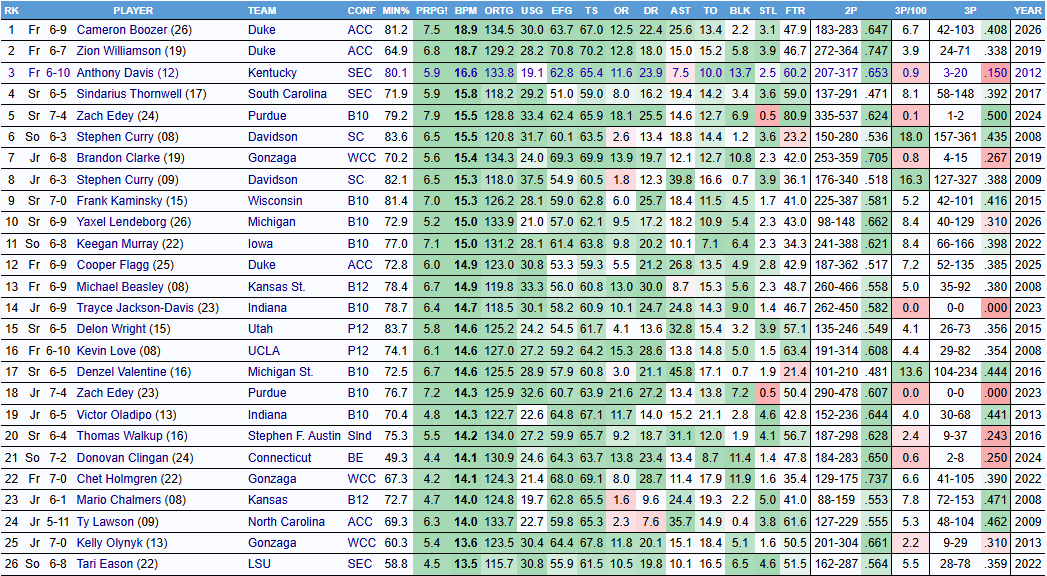
Of course, there is more that goes into scouting than just sorting through BPMs. Sindarius Thornwell posted the fourth-highest BPM in the database since 2008. He is not the fourth-best NBA player from that era.
No metric is foolproof. BPM isn’t the newest metric out there, but it has been shown to be about as reliable as anything out there—especially for college players. Still, some players will slip through the cracks of any measurement, metric, lineup trend, or query if you live and die (so to speak) by a one-size-fits-all threshold. There is a human element to the projection.
For Koa Peat, many will wrestle with the metrics translating into an NBA archetype. Why is that the case?
Setting Expectations
By this point in the season, most people know who Cameron Boozer is. The freshman Duke forward was widely regarded as a Top 3 player within this class. One of the things we hear now about what separates Boozer from his peers is that he just keeps winning; Cam has won at every level. What some people may not know (if you’re just now getting into the 2026 NBA Draft Class, welcome!) is that Koa Peat also came into this season with considerable accolades.
Peat entered college as one of the most decorated prospects in the class: four state titles, multiple USA Basketball gold medals, McDonald’s All-American honors, and an Arizona Gatorade Player of the Year nod. His pedigree and accolades suggested early impact with Arizona.
As the season started, Koa Peat looked as if he was going to have a monstrous season. His first game of the season was against the defending college champions, the Florida Gators. In that game, Peat dropped 30 points on 11-of-18 shooting from the floor. He also chipped in seven rebounds, five assists, three steals, and one block. As the season progressed, he scored 20-plus just three more times—two times against Arizona State, and once against TCU. He’s also failed to score in double figures in five games. This sort of inconsistency over the course of the season has seen his star dim a little bit.
In his first game back following the leg injury he sustained, Koa popped off against Kansas in the first half—going for ten points, four assists, and three rebounds. He went 3-of-4 from the floor and 4-of-4 from the free-throw line. He showed some amazing passing feel, finding Motiejus Krivas cutting to the basket. He also used his natural gifts to pressure the defense, snatch boards, and showcase some touch. He finished the game with 12 points, seven boards, five assists, and a steal—still contributing, just not at the level one would hope for from him.
Koa’s next game resulted in what may have been his best defensive performance of the season. While being the primary defender on Joshua Jefferson, Peat held him to 2-of-17 from the floor—including 0-of-5 from deep. Peat had three blocks against Jefferson, too. Koa grabbed four boards, dished out three assists, and grabbed a steal. However, Peat was just 2-of-6 from the floor himself and missed both of his free throws. This sort of up-and-down nature to his games only makes the scout on him that much more complicated.
How Bad is it, Doc?
Even though Peat hasn’t had the eighth-best season—even among freshmen—there is still a strong possibility that Koa Peat will have success in the NBA despite not performing up to the standard his accolades and strong opening game would otherwise indicate. To put his situation into context, Peat is on a loaded team.
Arizona has four other players on their team with a Usage Rate of 19.8 or better. The distribution of role and reliance is very egalitarian, as the Wildcats have seven players who average nine or more points per game. It’s been discussed with a team like Michigan how rebounding numbers can be hard to come by on a consistent basis with Morez Johnson Jr., Yaxel Lendeborg, and Aday Mara sharing a frontcourt. UConn is a system where it’s understood that some of their best players may not light up a box score routinely, but on any given night, a player like Braylon Mullins or Stephon Castle could go off. The same could be said for Koa Peat on this team.
Brayden Burries is another freshman on this team who may be a lottery pick in the 2026 NBA Draft. Jaden Bradley and Motiejus Krivas have played well enough that they could be drafted in the second round this summer—if not higher. Ivan Kharchenkov has stepped into the starting lineup while Koa Peat has missed time due to an injury (a lower leg strain in mid-February), and has gone from a “maybe he’ll be a breakout prospect next season” player to an “are we sure he’s not a ‘this year’ guy” one. Arizona also has Tobe Awaka and Anthony Dell’Orso, who can come off the bench and provide a significant punch—oftentimes altering the outcome of a game. That’s a lot of mouths to feed. Situations like this can pigeonhole players into roles, which can impact chemistry, confidence, and opportunity.
Luckily for Koa, he isn’t “unique” in the sense that his path to being a successful NBA player isn’t impossible. In recent draft classes, we’ve seen players come into a season with high expectations and commit to a situation that wasn’t conducive to their ideal ecosystem and level of production. We’ll spend a little time in this piece comparing Koa to some players often viewed as “exceptions” to scouting rules or philosophies:
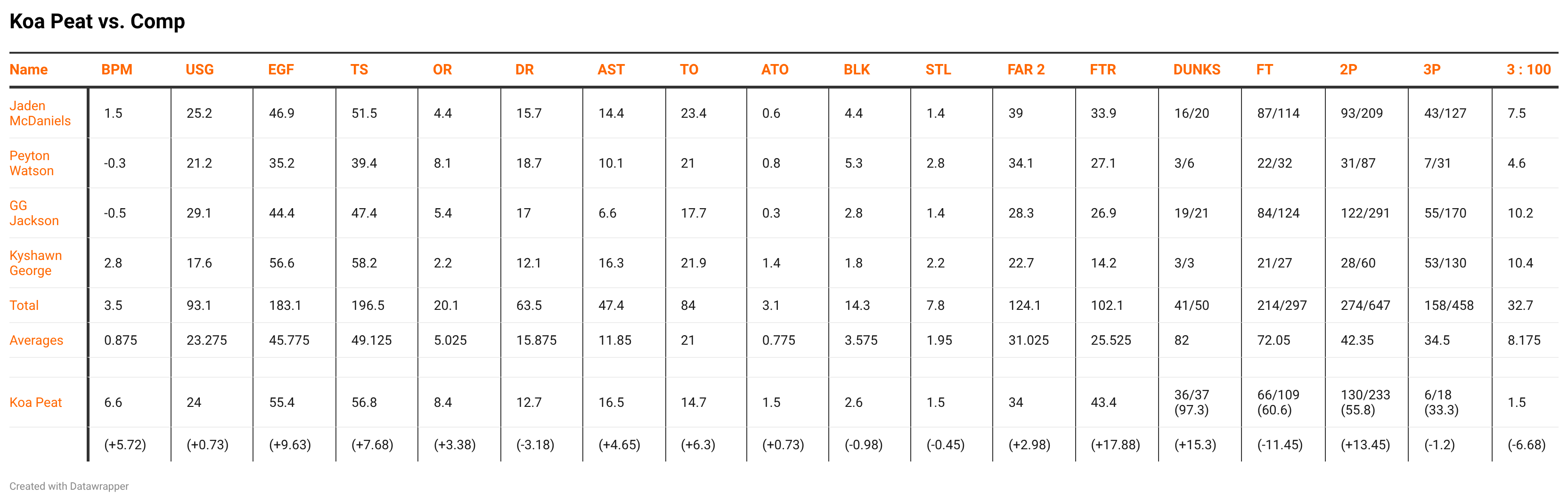
This group is interesting because, of course, there were some expectations set as to how good they would be. Peyton Watson was ranked 18th on version one of the 2022 Big Board for No Ceilings. GG Jackson Jr. was ranked 13th on the first version of the 2023 Big Board for No Ceilings. By the fourth version of the 2024 Big Board for No Ceilings, Kyshawn George was viewed as a first round talent. Jaden McDaniels was a part of the 2020 NBA Draft Class—which predates No Ceilings, but Sam Vecenie of The Athletic mocked him 11th back in November of 2019. Needless to say, each of these prospects carried some sort of “special” that gave them promise early on in their respective draft cycles.
Jaden McDaniels was drafted 28th in his class. Peyton Watson was taken 30th in his draft. GG Jackson fell to the second round at 45th overall. Kyshawn George was drafted 24th. Clearly, they would be taken much higher if teams had a mulligan, but there were real reasons why they were all taken outside of the Top 20 within their drafts.
The table above shows the respective BartTorvik metrics of those four players during their draft years in college. Many of those players were below average in key metrics—which would be heavily criticized in a draft class such as the current one.
And that’s kind of the point. What can we take away from these players, and how can we apply those lessons learned from them?

Data Call
Let’s start with how Koa compares to those players. He is above average compared to those four players in the following categories:
BPM
Usage
Effective Field Goal Percentage & True Shooting Percentage
Offensive Rebound Percentage
Assist & Turnover Percentage
Assist-to-Turnover Ratio
Far Two-Point Percentage
Free Throw Rate
Dunk Percentage & Two-Point Percentage
Look at the areas where Peat is below average within this group:
Defensive Rebound Percentage
Block & Steal Percentage
Free Throw Percentage
Three-Point Percentage
Threes per 100 Possessions
Just from looking at Koa—and considering the program he plays for—one would assume that he is a more impactful defender than what the metrics indicate. The film suggests positional strength and physical engagement, but the lack of defensive playmaking metrics suggests a more limited upside.
Beyond that, everything else sort of checks out with the film. The shooting touch from deep and the free-throw line has been inconsistent. When specifically considering the three-point shooting, it has been all but absent.
For the position that he plays, the Block Percentage (2.6) looks to be the primary area of concern. Compared to McDaniels, Watson, and Jackson—all true bigger and/or powerful forwards—Peat trails all of them in that area. According to Cleaning the Glass, GG Jackson has a Block Percentage of 1.7%—ranking in the 92nd percentile of all players at his position (forward, per the site). Peyton Watson has a Block Percentage of 1.9%, which ranks in the 99th Percentile of his position (wing, per the site). Jaden McDaniels has a Block Percentage of 1.6%. That ranks in the 94th percentile at his position (wing, per the site). Those percentages have translated to the NBA fairly well.
All four players shot at volume in college—averaging over eight threes per 100 possessions. That volume signaled confidence. Conversely, Peat’s volume has signaled reluctance.
What is the Path to Success?
The projection with Peat is steep. The BartTorvik query below shows a list of players who meet the following criteria:
Height: No more than 80”
3PA per 100: No more than 1.5
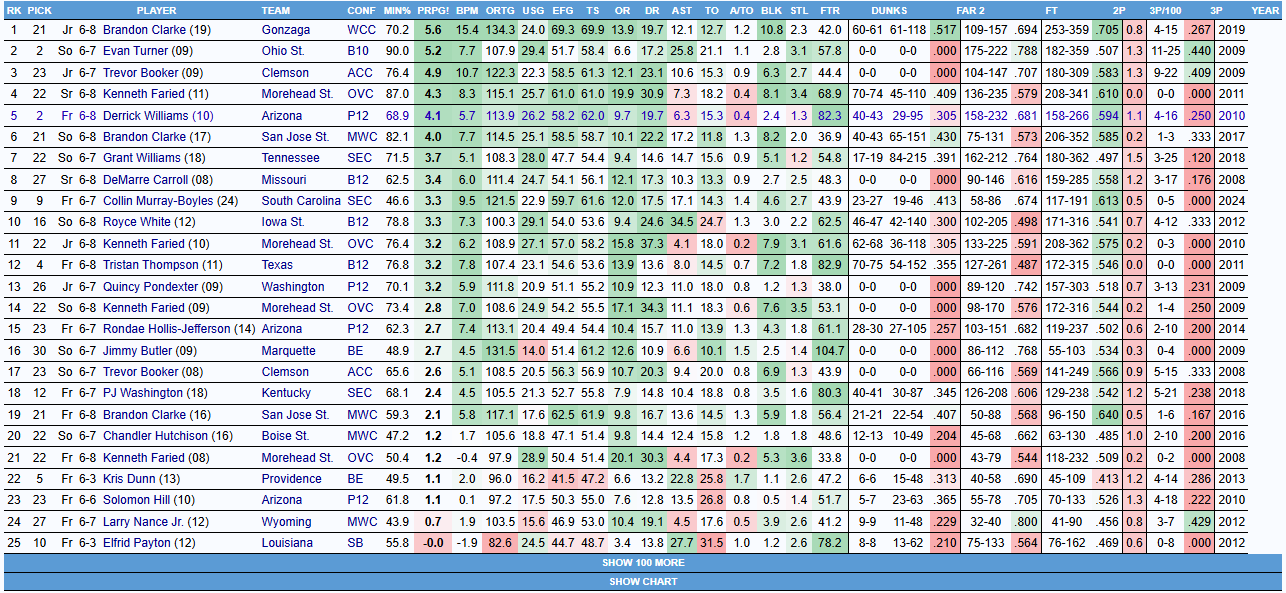
The results were pretty surprising. Under those filters, there have only been 25 seasons by players taken in the first round of the NBA Draft in the history of the Bart Torvik database (dates back to 2008). If you consider the Block and Steal Percentages in conjunction with these results, Koa’s Block Percentage would be better than seven of these season, and his Steal Percentage would only be better than five.
These results give Peat a tight needle to thread for his positional archetype.
With all of that in mind, how could Koa prove to be a better player in the pros than in college based on the things he does well?
Power Playmaker
Peat’s defining trait is his strength. The lineage of professional athletes in his family really shows up in his physical presence. The power of Peat will be a huge component to his game—and that can be quite helpful for seeing the floor early. Peat ranks in the 86th Percentile in terms of at-rim efficiency while also ranking in the 70th percentile in at-rim frequency. Converting nearly 69% at the rim provides immense value as an interior finisher. This can be helpful for what I believe could be the best path for him to be an instant NBA contributor.
Roll Man Prowess
It’s easy to envision Koa operating in DHO sets and in the short roll when you look at clips like this one against Cincinnati. The Bearcats aren’t the best team, but they have one of the largest and most defensively impactful frontcourts in college. This clip begins with the ball being moved from the right side of the floor to Koa Peat at the top of the key (#10 in white).
Peat feeds the ball to Brayden Burries (#5 in white) on the left wing for a quick screen. The low man in this action stays in drop, with Brayden’s man chasing to recover around the screen. Brayden’s wide angle of attack maintains the attention of both defenders guarding the action, which allows Koa to make a 45 cut to the rim. Burries finds Peat diving to the basket and feeds him. Koa gathers the ball in stride and is able throw it down.
Envisioning DHO Looks
He can also be used in similar way as the previous clip while having a different sort of impact on those plays.
This clip begins with Peat getting the ball at the top of the key, prodding at his defender. Koa picks up his dribble and kicks the ball out to Jaden Bradley (#0 in white) on the left wing. Bradley runs his man right into a screen set by Peat. The combination of Peat setting the screen and rolling to the basket frees up Bradley to hit the pull-up middy. The alignment in this play can directly translate to DHO actions at the next level. It’s also easy to incorporate aspects of the previous play. Peat could hand the ball off and cut to the basket. He could keep the ball instead of handing it off and attack the paint. Peat just offers a solid amount of versatility in pick-and-roll looks and in DHOs.
Motion-Offense Decision-Making
Some NBA offenses thrive by getting the ball to a member of the frontcourt and having other plays fly around them. This works exceptionally well when the team has a player within the frontcourt who can make accurate passes to their cutting teammates.
This clip against Florida shows how Peat can be used in such offenses. Peat gets the ball at the top of the key to begin this clip. Koa does a good job of looking to Motiejus Krivas in the paint, which causes his man to lock in on contesting the overhead pass. After deciding to deny the high pass, there is a great moment where Anthony Dell’Orso (#3 in blue) sees his man looking at Peat. Seeing this, Dell’Orso darts to the rim. Koa gives a well-placed ball in front of his teammate, who gets to the paint and cashes in the floater.
Threading the Needle
Here is another instance of Koa using some very good vision to take advantage of what the defense can give him.
Jaden Bradley has the ball on the right wing and then swings the ball to Koa at the top of the key. Koa’s eyes attract the attention of the left side of the court. He responds by driving towards Brayden Burries’ defender. Burries hits the jets and makes a baseline cut to the rim. Peat finds Brayden with a bounce pass that slips between two Auburn defenders. Burries gathers the pass and throws down an awesome dunk.
This sort of frontcourt playmaking does give an offense a fun wrinkle in the type of system they can deploy.
Curtains
There’s a lot that goes into the Koa Peat scout. The pedigree, power, and feel give him a real translation pathway. But what does the version of Peat being successful look like in the NBA?
We’ve identified that Peat’s best look in the NBA, based on what we’ve seen, is as a “power playmaker”, but who is an example of such a player in the league? The cleanest archetypal comparison is Jaime Jaquez Jr. They are both huge (Peat listed at 6’8”, Jaime at 6’6 “, but both are 225-plus pounds), and they both have feel.
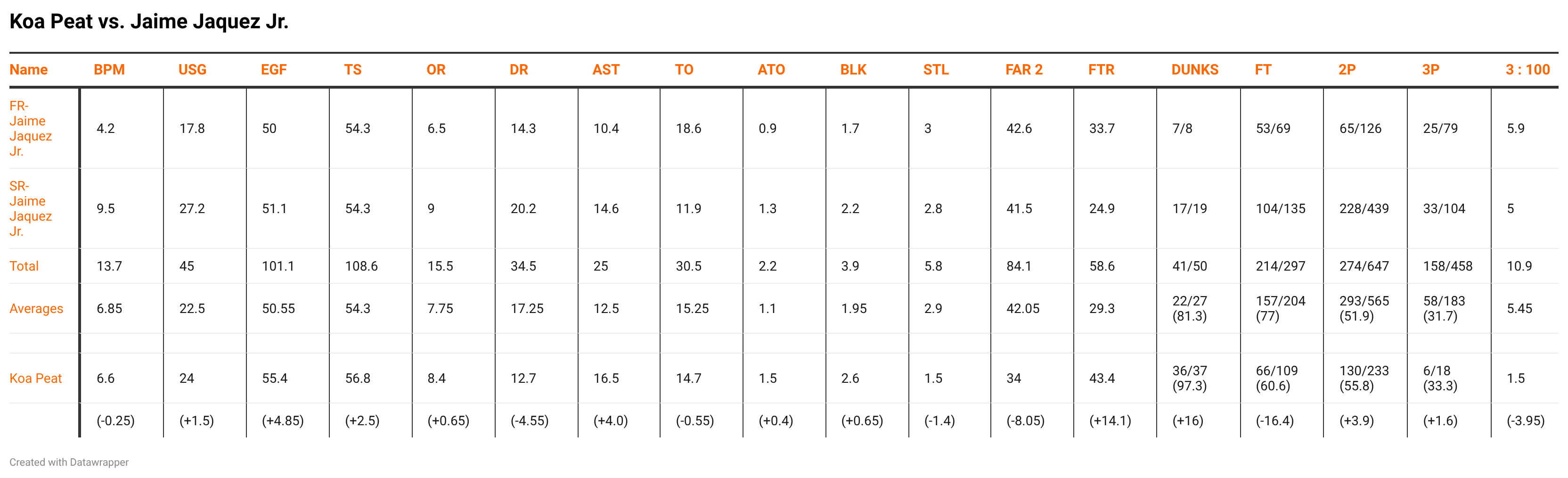
Compared to freshman year Jaquez, Peat is ahead offensively at the same stage. The only areas that freshman season Jaquez was better than Koa at is: Defensive Rebound Percentage, Steal Percentage, Long Two-Point Percentage, Free Throw Percentage and Threes per 100 Possessions. Even with the advantage that Jaime has had over Peat in touch indicators, Jaquez was a 32.2% shooter from deep as a rookie—and he has declined in percentage each season. The shooting projection for Koa appears bleak. However, the sample is small enough that becoming a 30-32% shooter from deep in the NBA is not out of the question.
Why the comp works for Peat is how much Miami has relied upon Jaime’s passing ability. Per Cleaning the Glass, Jaquez ranks sixth among Forwards in Assist Percentage. This is a specific case, but this is the best one possible for Koa—barring him becoming one of the biggest outliers in draft history. That takes us to his draft range.
Where would you draft a Jaime Jaquez Jr. variant in this year’s draft? It’s hard to say, considering how the 2026 NBA Draft Class is shaping up. Jaquez was drafted 18th in the 2023 NBA Draft, and an argument could be made that he was drafted too low. It’s taken a unique situation to mitigate the lack of a shot while maximizing the passing. Jaime’s defense has been something that has also given him the latitude to be a subpar shooter from deep. Peat’s indicators wouldn’t suggest a consistent lockdown defender. But defensive projection often hinges on tools and a player’s level of commitment. Perhaps the right system could bring out a solid defender.
Peat’s draft range is more volatile than many anticipated coming into the season. Based on what we’ve seen, an appropriate range for Peat is most likely somewhere in the 16-25 range. The lottery case would require multiple developmental leaps as a shooter and as a more consistent defender.
Follow me on Twitter: StephenGHoops
Catch me on BlueSky: StephenGHoops
Catch the Draft Sickos show LIVE on the No Ceilings NBA channel: