


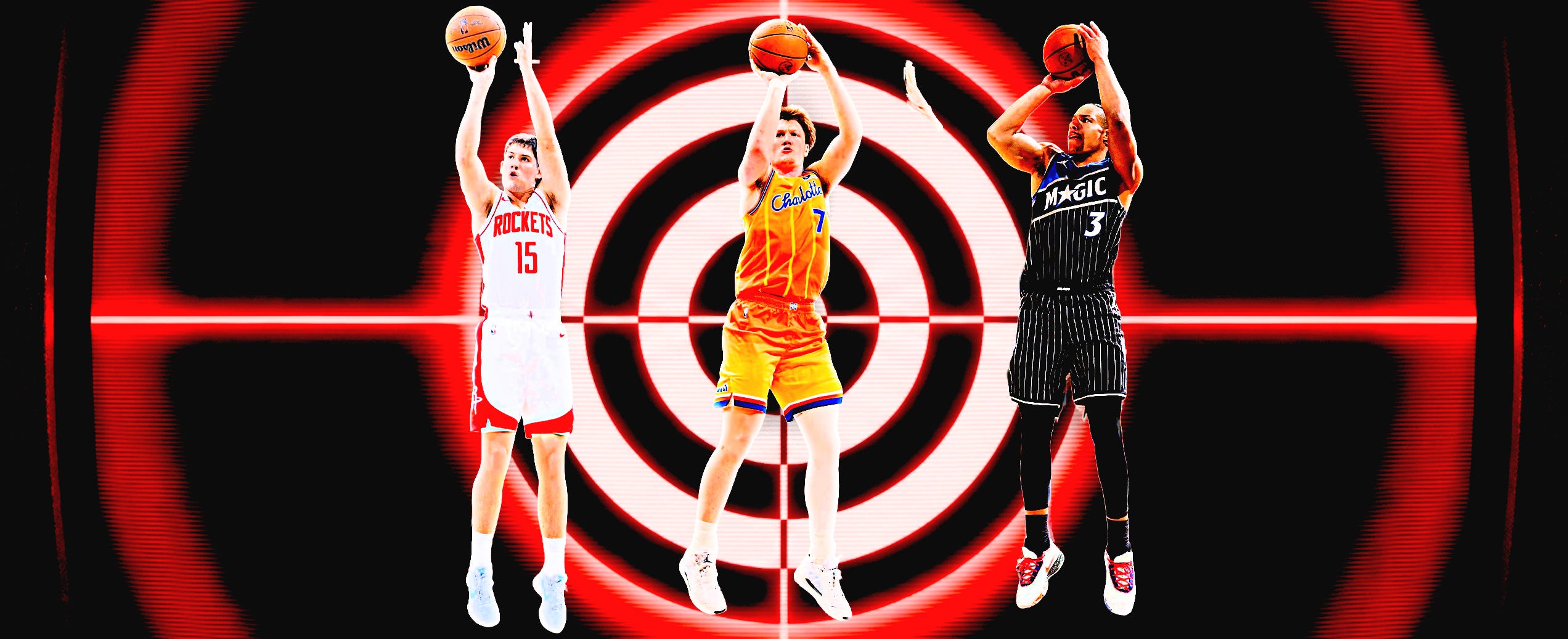
Kon Knueppel and Reed Sheppard are two shining examples in today’s NBA of an archetype that’s technically been around a long time in the league, but hasn’t trended in the way that it is now, thanks to these two players.
The “Skilled Shooter” is quickly becoming something that I’m looking for among role player prospects who fall more into this “false ceiling” category of potential.
Let me explain and unpack this.
For as long as the three-point line has existed in basketball, teams have coveted guys who can stretch defenses and offer a “release valve” for the players who demand the highest usage that can dribble, penetrate, and collapse the defense into the paint. By drawing the attention of multiple defenders, these “stars” can leverage that to their advantage and kick the ball out to an open shooter who can either step into that look, drive at a defender who is closing out too hard, or quickly move off the ball on a swing pass.
These are the plays that keep defenses honest and keep the ball moving to where it can find a GREAT shot, not just a good one. For a long time, many thought that these “shooters” on the perimeter were on the floor to do just that: shoot the basketball.
But defenders have gotten quicker, longer, and can eat up space and close out faster than ever before—even against the best opposing players who can bend the defense at will. That means those who are spotting up have to be able to put the ball on the floor, make QUICK and SOUND decisions, and show as much ability to pass off a live dribble as they can from a stationary spot.
On top of that, if the key offensive hub is swarmed and doubled by defensive pressure, it’s a massive benefit to have guys who can not only shoot but also run the offense in a pinch off a secondary action, dribble handoff, or pick-and-roll.
That’s where skilled shooters come in, most notably the two I mentioned above in Knueppel and Sheppard.
Both of these players have been massive offensive benefits to the Charlotte Hornets and Houston Rockets, respectively. When they’re on the floor, they aren’t the primary attention of the defense. Both teams have players who are either perceived as the primary engines (LaMelo Ball and, to an extent, Brandon Miller) OR legitimate hubs and shot-makers who rightfully deserve all of the defense’s focus (Alperen Sengun and Kevin Durant).
When these teams see defenses key in on these main guys, those players need release valves to kick the ball out to, or ideally, guys who are moving and cutting into space for great looks or next-read opportunities.
Knueppel and Sheppard are excellent at moving without the ball, reading how the defense is playing everyone else on the floor, and setting themselves up for great looks. Coaches don’t have to run plays for Knueppel and Sheppard to get shots or make plays in the same way they do movement shooters like Duncan Robinson, for example.
Knueppel and Sheppard don’t need three different screening actions designed to get them an exact shot at an exact spot. They can improvise because they have the ball handling and passing chops as well as the vision and mental ability to “map” the court in order to make the most out of said touches, be it a shot or a pass.
The value in having guys like Kon and Reed, who can improvise and operate one or two steps ahead of the defense, is such a massive benefit to the offensive game plans for their teams. When everything goes to hell, those two can make something out of nothing because they’re shooting threats the second they step on the floor, and know how to play different driving angles and change speeds to get to where they need to in order to put defenses in an even tougher position.
I’ve been continuing to value ball-handling and footwork as key separators when evaluating prospects for the NBA Draft because they’re the two things that can create advantages even more than if someone is JUST a shooter without those other elements. Guys who can get their shots off quick movement are inherently valuable, don’t get me wrong. However, the players who can put the ball on the floor, limit mistakes, and hit those cross-court skips or swings off a live dribble open up far more opportunities for a team’s offensive rhythm than if they were just looking to immediately catch and shoot.
Most importantly, if injuries occur or certain lineups need a boost in playmaking efficiency, guys like Knueppel and Sheppard can actually run pick-and-roll actions or get creative as slip screeners/short roll operators to take pressure off others who may not be as equipped to step into higher usage roles.
Both Kon and Reed are three-level scorers, albeit just not in the most traditional “aesthetic” sense. They don’t have the deepest bags as dribblers, and they aren’t the fleetest of foot in terms of having that explosive first step and top-end speed to constantly beat every defender in front of them. But when operating off screens, or catching and driving, both players know how to keep players on their hips, snake ball screens, and hit shots with any space given to them. When they do get to the rim, they can finish OR bring the ball back out if a look isn’t there.
These guys know what the RIGHT decision is every time they touch the ball. That mental awareness, combined with their lethal shooting touch and ball control, makes them some of the most valuable role players in the NBA even if they aren’t traditional “star bets” (although both Kon and Reed are shattering their perceived ceilings in real time).
As I mentioned, this isn’t a new archetype of player even within the last 5-10 years. Desmond Bane is a great example of a player who is able to dribble, pass, and shoot while sharing another characteristic with Knueppel and Sheppard, albeit to a greater degree. These “Skilled Shooters” are able to withstand and hold their own defensively so that their teams can win their minutes or net out as neutral on that end of the floor. What that means is they aren’t entirely weak links and targets on that end of the floor.
Kneuppel and Bane possess outlier strength for guards. They also play with sound fundamentals using their feet and chest to play defense, not getting too handsy and playing into foul trouble. Sheppard is on the smaller side, meaning defenses will try and at times succeed at targeting him. However, Sheppard will make up for it other times by playing sound team defense, timing his rotations well, and creating deflections in passing lanes or by digging down on drivers using his excellent and lightning-quick hands and instincts to create turnovers.
Donte DiVincenzo and Quentin Grimes are two more established examples of this “Skilled Shooter” archetype, just not to the degree that Knueppel, Sheppard, and Bane are either breaking into or have emerged through. DiVincenzo and Grimes offer plenty of shooting, while also being able to work in secondary actions and play some out of pick-and-roll. And neither player is a net negative defensively, even having some utility to guard up a position if needed.
Two other young players I project to fold into this “Skilled Shooter” archetype are Bub Carrington and Walter Clayton Jr. Both players have defensive upside that they showed in college, be it related to their physical tools or awareness/savvy, while also serving offensively as excellent shooters off a variety of actions with real passing chops to make those next reads that can keep an offense moving.
I’ve been pretty hard on Carrington of late because this Washington Wizards team needs a true point guard that can organize and get the rest of the team quality shots. However, that doesn’t mean Bub isn’t an NBA player, nor that he can’t add real value when he’s on the court—so long as the rim finishing and two-point scoring eventually right out to league-average levels. The same goes for Clayton Jr., who didn’t get off to the cleanest start this year for the Utah Jazz as a rookie, but has really found his footing playing in some two-guard lineups alongside Keyonte George, where he doesn’t have to pull all of the levers at the same time.
The name of the game of basketball is to dribble, pass, shoot, and defend as well as possible. The more of those things you can do, the better equipped you are to not only play in the NBA but also succeed there. Having the physical and mental skill that ties those elements together, be it passing vision, ball control, and strength, really enhances and pushes players past the traditional “shooter” label into the “Skilled Shooter” archetype.
So, who are some 2026 NBA Draft prospects I could envision following in the footsteps of those mentioned here as examples, and others who have followed similar paths in the league?
Some of my favorite bets fall in the “point guard” category, but offer the same shooting utility and overall skill package discussed here. Texas Tech’s Christian Anderson is one of my favorite prospects in this draft class because he doesn’t take much of anything off the table for Texas Tech offensively. He’s a lethal outside shooter that can create his own shot off the bounce, on the move, or off the catch. Run Anderson off his spot, and he can hit a runner or pull up in the paint. Anderson hasn’t had the ideal spacing to create more driving lanes downhill and get shots at the rim at a higher frequency, but he converts when he gets to the basket. Anderson’s passing has been some of, if not the best, in the country this year, and he really competes defensively, rarely finding himself out of position and not in a spot to contest a shot or make a play on the ball.
Anderson’s 27-point performance for Texas Tech in a massive upset over Duke at Madison Square Garden this past Saturday night was the perfect example of a player shattering pre-conceived notions about a player’s tangible upside and why I value him so highly in this upcoming draft. Few guards, if any, could’ve led the Red Raiders to a victory given the lack of depth in the frontcourt after JT Toppin and LeJuan Watts got in foul trouble. Anderson showed heart, hustle, and poise when his team needed it the most, and it was one of the most impressive performances I’ve ever seen from a draft prospect in 15 years of scouting. Anderson’s dribble, pass, and shoot skill set makes for a worthy star bet in the 2026 NBA Draft, as there is no lineup construction or rotation that he can’t add value to at the next level.
Ryan Conwell is another one of these “Skilled Shooters” that should have much more attention in this upcoming draft class. He fits the bill of size that’s expected out of NBA backcourt threats, has the strength to finish through contact and body up on defense, and has all of the shooting elements a team is looking for. Conwell can hit as many perimeter shots as any other shooter in the country, and do it in a variety of ways. Conwell has embodied the dribble, pass, and shoot role for Louisville this season and has had some real gems to continue pushing him further up draft boards.
In terms of guys who aren’t viewed really as “point guards” and more as combos or wings, Braylon Mullins and Keaton Wagler have my attention. Wagler has had more opportunities this season for Illinois to showcase the underrated passing vision and playmaking on the move, while hitting a variety of perimeter shots at an efficient clip. Wagler stands at 6’6” and has good length to compete and contest shots defensively; he has the potential to further develop with more experience into an average to above-average defensive player.
Mullins has the pre-college pedigree of a lights-out shooting prospect, while also having the type of underrated verticality and burst that allows him to challenge guys at the rim and dunk over them as much as through them. Mullins really gets after it defensively as well; on all of the tape I watched pre-college, I saw him as a prospect who has a chance to continue making a name for himself as a player who can navigate through screens, stay attached to ball-handlers, and fly around the floor as a real pest on that end. I’m continuing to monitor his overall role within the offense, as he started the year on the injury report and hasn’t been incorporated as much yet outside of just making shots. But Mullins has the driving ability and confidence to create those passing windows on the move that can open things up for his teammates as he gets more touches downhill.
Now look, Knueppel and Sheppard are on their way to becoming far more than just “role players” quickly; in the case of Kon, he’s already generating some All-Star buzz in his rookie season based on what he’s accomplished in such a short amount of time in Charlotte. The whole point of this “Skilled Shooter” archetype, though, is to find value in those who don’t meet all of the “aesthetic” criteria that scouts and evaluators look for in players taken in or around the lottery.
We’re at a point in basketball where processing speed, awareness, and instincts aren’t viewed as luxuries anymore, even by the general public. Those who have worked in basketball for years would tell you that the mental side of the game is as important, if not more so, than the physical attributes to a certain extent. Yes, there are bars to clear physically as a professional athlete, but having someone with the right blend of mental processing and on-court skill can often lead to smashing through “false ceilings” even without the top-end speed, verticality, or size and length.
Knueppel and Sheppard are best-case scenarios of this “Skilled Shooter” archetype, but there are more prospects coming that will embody these characteristics and traits. Basketball is a copycat sport, meaning that as the style of play in the NBA continues to shift towards ball and player movement rather than solely focusing on individual shot making ability (outside of the very top 1% of stars), more guys will gravitate towards developing their minds to match a skill profile that adds true value in the NBA for years to come.