


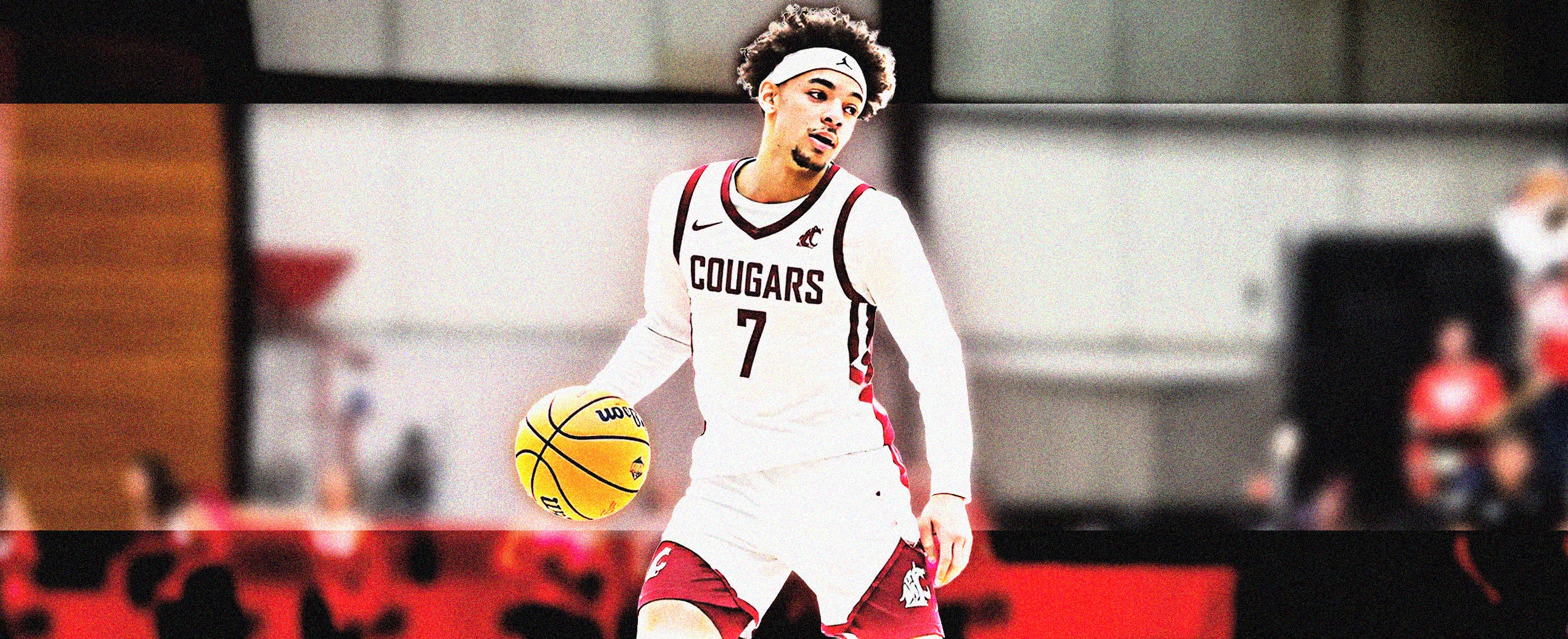
As a journalism student at the University of Missouri-Columbia, I have been gifted the opportunity to learn from some of the best minds and writers in the world. From the different techniques I have been taught to the strategies I can use to keep readers engaged, I am so thankful for all the knowledge I have gained since being here. One thing, however, that remains persistent through any class that I have been in is the value of a strong lede. So, what better way to kick off a film breakdown on a potential sleeper prospect in the 2027 NBA Draft than a mixtape of his dunks? Hope you enjoy.
Pretty crazy, isn’t it? How ’bout I make it a bit crazier by informing you – that is, if you didn’t already know who it was – that the man in the mixtape was Lazerek Houston, who is listed at a generous 6-foot-flat and weighs just 155 pounds. Yes, that same man that you just saw put countless forwards and bigs alike into the rim weighs less than Yuki Kawamura, who at 5’7”, 159 pounds, is easily the smallest player in the NBA today. Now, I understand that those physical limitations could and likely will cause issues for him down the line. But I’ll tell you where they didn’t cause him any issues: Central Missouri. Albeit Division II, but any way you cut it, the production Houston put up this past season was unnatural for any player – no matter the level. The then-freshman logged 20.8 points per game to go along with 4.1 rebounds, 5.1 assists, 1.5 steals, and 0.5 blocks per game. Even better, he did so on shooting splits of 46.2% from the field, 36.8% from three and 75.2% from the free-throw line. Pretty elite if you ask me. Naturally, this production didn’t go without recognition, but bear with me here: Houston picked up quite the trophy case. He was named to the NABC Division II All-Central Region First Team, was named the D2CCA All-Central Region Player of the Year, picked up MIAA Player and Freshman of the Year, and, of course, with receiving those two awards, he was also granted All-MIAA First Team honors. Pretty ridiculous for just one year of play. With all of this in mind, many are likely thinking two things: one being how someone his size was able to produce at that level, and the more important question is whether it is feasible to think he can scale it up to the Division I and potentially even NBA level. That, my friend, is what I’m here for.
Self-Created Rim Attempts
Since I already gave y’all a taste of the rim finishing with the dunk mixtape, I thought it only made sense to stick around the basket and work our way out. A common theme that I will be bringing up throughout this piece is highlighting just how narrow the needle is for small guards to thread if they wish to be successful, at least at the college level. Things only amplify as we level up.
One of the more integral parts of that process is the ability to self-create, winning in isolated matchups and executing on the advantages you create. For small guards in particular, doing such while being proficient around the rim is a great baseline to build off of when trying to weed through the influx of talents. In Houston’s case, self-facilitating efficient looks for himself at the rim and converting on said looks is arguably his strongest trait. Again, I want to reiterate that we are cooking with fire here. Houston does a great job at understanding the matchup in front of him, knowing how the approach he takes will affect the rest of the court around him. The know-how he has in these given scenarios allows him to be one of the best second-effort drivers I have ever had the pleasure of evaluating. Not hyperbole either, but I’ll prove that later. He does a remarkable job at changing his direction in an instant, often using his first effort on drives to set up what follows. Once around his man, he is as creative as can be around the basket, evident by him ranking in the 71st percentile in points per possession on rim attempts, converting 61.7% of his looks there.
With that said, the purpose of this piece was to show, not tell. So let’s break down exactly what allows him to do what he does around the rim:
Before I break down the clip above, I do want to say that I am well aware that this isn’t the cleanest example of a self-created rim attempt. That said, after gassing up Houston’s multi-effort driving ability, it only felt right to get things started with an impeccable example of such.
Houston’s involvement in this action kicks off with a ball reset, likely fueled by communication that he had a mismatch. As soon as Houston gets the ball, it becomes evident that the man in front of him does not feel comfortable in this matchup, something that was recognized by Houston’s teammates, clearing him the necessary space to make some magic happen. However, instead of just letting him dance on an island, Trinell Parker (32) chooses to draw his matchup into the action, setting a ghost screen of sorts which forces another big to switch onto Houston. Except this time, the big dragged in was operating at a disadvantage. As if he already wasn’t squaring off against number 7 in white. Houston instantly recognizes this, giving his new matchup a hard half spin to both give himself space to set up an attack and his big time to clear out. Once those things take place, Houston snatches a quick left-to-right crossover, opening the hips of the man in front of him and giving him a step to the basket. That said, he wasn’t done there, understanding that if he were to just hammer a one-direction drive against a set defense whilst matched up with someone bigger than him, he would likely see some issues. So, he pulls a cross back, opening up his defender’s hips once again, pumps one hard dribble to sell the drive, before spinning back to the very space he created on his first attempt, using his explosiveness to propel himself right through the traffic for an easy two.
In the second clip here, we have a much less complicated string of events take place. Central Missouri is pushing ahead in a semi-transition scenario — led, of course, by Houston. As he pushes the ball ahead to the right wing, the defense in front of him seems to be a bit at a loss, scrambling matchups around and trying to set their defense. Because of this, the weak side of the action at hand is disengaged with the ball, meaning that if Houston and the rest of the Mules offense can operate quickly, they could happen into an easy two points. Of course, Houston realizes this right away, so when his trailing big finds his way to him and his defender chooses to overplay the screen, meeting it far before Houston can even think about using it, he doesn’t hesitate. Houston sells the use of the screen with a simple misdirection cross, before attacking straight at the top hip of the big soft-hedging, resulting in him opening himself to the baseline, allowing Houston to cross back over and now attack the open space created by the screen being disengaged. He has no problems splitting the not-so-tied-up space, finding an easy path to the basket and calmly laying it in.
In the third clip here, I think that we get a good idea of the kind of improviser that Houston is. There are a lot of solid collegiate guards who can operate within structure, but those who rise to the top are able to act on the fly and make something out of nothing. Here we see Houston receive the ball out of a simple misdirection stagger, leading into a pin down out of a sideline out of bounds. Once he gets the ball, it seems as if Central Missouri is trying to get into some sort of isolated side action initiated out of the high post, evident by both players on the right wing exchanging and one seemingly trying to narrow cut to the opposite side of the floor. However, as this action is taking place, Houston’s defender is taking a very aggressive approach, meeting him near the half-court line despite operating at a disadvantage. On top of that, once the defender meets Houston, his hips are open to the weak side of the floor, giving Houston plenty of room to take advantage of, which he does.
On the initial effort, his defender does a nice job at recovering and getting back in front of him, forcing Houston to take a momentary reset. Once reset, he notices that his defender is still drifting back on his heels, so Houston gives him a sharp left-to-right crossover and creates himself a lane. The only issue — he almost runs into his own guy attempting to clear out. Because of this, Houston has to start his low gather from just a hair inside the three-point line, and because he is the athlete that he is, Houston is able to squeeze in between the gap and make his way right to the basket for an easy layup.
In this clip, we get our first look at Houston’s ability to manipulate the defense in transition, and a great one at that. The possession starts fairly simply, as he rebounds a miss and instantly initiates action going the other way. However, like most guards who are dynamic with the ball in their hands, Houston was met at half court and already had layers of defense setting up in front of him. An easy solution in this spot would be to slow things down and try to get a look in the half court, but for Houston, he saw an opportunity and took it.
Due to the defender at half court being entirely stationary by the time he crossed paths with Houston, it only took a simple move to get around him and find some space. In this scenario, Houston chose a simple wrap-around-the-back dribble, which was enough to put the defender on the back of his hip. Once there, the defense in front of him had already begun to set up, meaning that if Houston wanted to find a look, he would have to slow things down for a moment and let the play around him develop. The only issue in doing so is that he has to keep himself in an advantageous spot, as letting up would allow the defender he just made an effort to get around to work his way back in front, killing the action at hand. Luckily, Houston knew what he was doing, keeping that defender on the back of his hip before stepping in front and cutting him off. Whilst that was happening, everyone else on Central Missouri had made their way down the floor, forcing the rest of the defense to let up on the “wall” they made and find a man. This resulted in Houston having a clear driving lane, which he took advantage of, attacking straight at the big positioned in the middle of the paint, spinning around him and keeping the ball low so as to not get it poked by the aforementioned trailing defender. Once that was done, all that was left was for Houston to use his vertical pop and extend for an easy right-hand finish.
In our fifth and final clip for this portion of the film dive, I leave you with one of the simpler yet most important plays to break down. Houston is once again leading a semi-transition look for the Mules, finding his way to the right wing. With him being one of the last guys up the floor on this possession, Houston is operating against a fairly set defense, with the only real rotation coming from an off-ball cutter who ended up dragging his man into the very lane Houston was trying to exploit. But as I mentioned, this was a fairly simple look, as once getting to the right wing, he only waited a beat before thrashing an in-and-out dribble and attacking a single gap. Because Houston was able to get his defender on his heels and open up his hips as much as he did, it ended up being a relatively straight path to the basket, only hindered by the player defending the cutter.No problem for Houston, though, as with him being the kind of athlete he is, he was able to take off from a somewhat abstract launch point, jumping in the direction of the opposite corner of the backboard. Once in the air, Houston did a nice job at selling the straight, over-the-top finish to draw the defender’s hands vertical, before contorting to bring the ball away, swinging it back at the last second to find the finishing angle.
I hope I was able to drive home the point that Houston is a truly special rim finisher for his size. The dunks sell themselves, hence why I led with that portion, but over the last five clips I showed, I tried to show the versatility in which he can attack in isolated looks. Later on, I will walk you through some of his looks out of manufactured advantages, but for now, let’s stick with the scoring creativity.
Off the Dribble Shooting
Arguably the biggest factor in the lifespan of small guards in the NBA is their ability to punish defenses with off-the-dribble shooting. What separates players like Tyler Tanner, who are seemingly flawless in so many ways, from that of Darius Garland is the ability to take what the defense gives them and find shots in open space. It’s hard enough for small guards to not be bracketed to spaces by opposing defenses, given that size is king on the basketball court. So, finding pockets in the midrange and from beyond the arc forces defenses to play them more liberally, which in turn creates other opportunities.
In Houston’s case, sadly, things are still a bit of a work in progress. I’m not saying that he is far gone as an off-the-dribble shooter, as at the worst, he has proven that his scoring touch can translate to other facets. However, any way you cut it, shooting 33.5% on off-the-dribble shots with 44% true shooting being the grand total simply isn’t good. A large part of the raw percentages being as meh as they are lies within the difficulty of shots he was taking, which I will admit likely won’t be as arduous at the next level. With that said, Houston did show a knack for finding his balance in moments where he previously looked a bit askew, which in turn does create some clear space for him. He uses a variety of gathers as well, which is quintessential for finding space in those areas, using step backs, side steps, and spins alike to make the space he needs to get his shot off.
So let’s look at some examples:
Our first clip for this portion has a bit of an abstract start, with the possession starting after a baseline out of bounds following a made basket. The ball was inbounded a bit loosely to our main man, resulting in the man defending him taking a bit of a risk, attacking the ball in hopes of causing some chaos. Luckily, Houston caught on before things went haywire, controlling the ball just enough to regain possession following the successful deflection.
Now, with Central Missouri operating with a four-on-five semi-transition advantage, Houston pushes ahead in hopes of finding a quick look. With the Mules trailing by a hefty amount at this point in the game, a quick three was likely necessary if they wanted any chance of wiggling back into a competitive sphere, something Houston clearly picked up on. As he pushed ahead, the switching defender helping up wasn’t aggressive, taking a more conservative approach and allowing Houston to advance ahead at full speed. He picked up on that quickly, selling the drive to the basket before stopping on a dime just beyond the three-point line, rising up and cashing it in.
Our second clip directs us into more of a structured set. Houston’s involvement in the set starts with a shallow cut, crossing through the paint before filling back out to the top of the key to draw his defender away from the ball handler. Luckily for Houston, his defender got a bit fancy, attacking at the drive taking place right behind him. The result was the defender on the weak-side corner having to help up on Houston, who had made his way to the top of the key, something that was picked up on by the ball handler, who rifled a pass to the far-side corner. Once receiving the ball in the corner, Jevon Hill (15) wasted no time, swinging the ball back to Houston as the defender who tagged him was recovering back to the ball. Because of that quick ball rotation, the only man who could feasibly recover to Houston was his original defender, who was able to close out in time to deter the shot.
However, with him being the craftsman that he is, Houston waited until the closing defender settled in before attacking, allowing him to go against a stagnant player without momentum. Because of this, he was able to attack straight through his chest before pounding, pulling back, and knocking down the open shot conceived through the space he created.
This clip at face value is relatively rudimentary, as all it really entails is a simple isolation rep. But given the setup and the situation, I find this to be one of Houston’s more impressive off-the-dribble shot attempts this year.
His involvement in the action starts fairly simple, working to get the ball near the half-court line and dribbling to his left for what seemed to be a strong ball screen set. However, once beginning his approach, Houston decided he liked the matchup he had, waving for his big to fill the far-side lane extended, clearing room for an isolation rep. Houston gives his man a long skip followed by a hard pound dribble, in which he notices his defender’s drive-oriented reaction too. Even on his reset, Houston’s defender didn’t close the space with much intent, keeping both hands down and not acting with urgency. This moment is where I believe Houston realized he had an easy look. All he did next was a simple pound tween, behind the back — likely used to both nullify his defender, along with setting his feet and getting the gather of his shot in his left hand. To no surprise, the defender remained content with the space given, cueing Houston to rise up and cash in the clutch three.
Clip four here is what I like to think of as the perfect example of live-action problem solving. Everything about the initial action taking place seemed rushed; the spacing was less than ideal, but even despite all that, Houston was still able to find some space and get to a shot.
The action at hand starts with a run-of-the-mill zoom action, with Houston coming off of a pin down as his big was working his way over for a dribble handoff. However, the initial rep was lazy from Houston, as he didn’t do much of any work to properly set up the pin down, and once it was set, he came off so wide that his defender was able to beat him to the handoff despite being the one who was just screened. Because of that, he was able to blow up the first attempt, forcing Houston to wrap back around and receive a flip pass and a rub screen just to get the ball. The big man did a nice job hedging the rub hard, giving his guy a chance to get back into the play, and the weakside did a nice job tagging the short roller to deter the pass. However, through all of this, Houston was able to keep his live dribble, leaving us with a pretty congested wing isolation rep, given the only lane feasible to attack was a single gap. Houston, however, did a nice job changing pace suddenly, using a twitch cross to create an advantage. However, with the defender being placed directly into his driving lane, Houston was forced to use his off hand and shoulder to drive into his defender, whilst simultaneously keeping the ball out of harm’s way of the gap defender. Once around that line of attack, Houston leveraged the bump he just made by exploding into a step back, rising up high for an easy baseline jump shot.
For the final clip of this portion, I bring you yet another example of just how well Houston can leverage the threat of his drive to open up shooting opportunities for himself. What makes this one a bit more special is the fact that it was the opening play of the game, and a bit of an unorthodox gather.
The clip begins with Houston’s backcourt mate Kyran Tilley (4) attacking a mismatch, using a strong left-to-right cross to work his way into the paint. However, once there, he is met with a couple of layers of help, forcing him to pivot and begin a search for a way out. On this search, he eventually finds the trusty hands of Houston, who catches well beyond the three-point line. As soon as he catches, he takes a quick peek at the clock, realizes it’s winding down, and immediately starts his approach to the basket. Houston gives a big hesitation dribble with his left hand — something he does often, as it gives him multiple options to work with depending on the defender’s reaction. On this particular possession, his defender is positioned in a way to try and funnel Houston to the side of the court he is on. That said, his off-center stance, paired with the space he is giving and the double gap to his left, allows Houston to attack his top foot and pursue a drive to the left. His defender does a nice job reacting, keeping a strong base and catching him with his chest just a couple of steps later.
However, with the defender being the one initiating the contact with his chest, Houston is able to use that momentum against him, sliding his right foot outside of his defender’s before snatching a behind-the-back dribble, squaring himself to the basket and clearing enough space for a clean shot, which he makes.
Attacking off the Catch
When a lot of people think about small guards in the NBA — particularly on offense — they typically think about their on-ball value, and rightfully so. Hell, I just spent 3,000 words describing how the very small guard being discussed in this piece is who he is because of what he does with the ball in his hands. That said, being able to impact half-court offense without the ball is important too, and often overlooked in these kinds of discussions.
Think about all the sub-6’1” guards in the NBA today who are playing impactful roles. Now keep that train of thought and think about how many are impactful despite not being primary, secondary, or even tertiary options on their team. Guys like Jose Alvarado, Fred VanVleet, T.J. McConnell, Collin Gillespie, etc., all of whom have made vast impacts in the NBA in roles that don’t involve them as primary initiators. Of course, you can make the argument that each of them — besides maybe Alvarado — has and is capable of taking the reins as the go-to guy in certain situations, but nonetheless, their impact is being maximized elsewhere.
So let’s drag Houston back into this, as the way I see it, this is one of his better traits. It is worth noting that a large portion of his off-ball activity was derived from sets or schemes designed for the ball to find its way to him, but I still think he flashed some great things. He understood how to run off-ball screens, knows when to attack versus reset, and even adds a bit of cadence to his work when playing off the catch, allowing him to create better advantages for himself. All of this compiled led to him ranking in the 85th percentile in spot-up possessions, notching an impressive 57.5% true shooting in given scenarios. But as I mentioned earlier, this isn’t just rudimentary catch-and-shoot threes when left alone, allowing him to be as efficient as he is. Houston has some really fun reps that are worth breaking down.
Enter Owen:
For the first clip in this portion, I tried to keep things as simple as possible. For a lot of the piece prior, I have shown a lot of out-of-structure, highlight-esque plays, so I wanted to hammer home the point that Houston, too, can make the simple reads. In this one, it was as simple as attacking a closeout and making a play at the rim.
The clip starts with Parker (32) being caught in a bad spot. He was doubled in the block extended and didn’t have an easy out. Houston picked up on this, along with noticing the trend of the rotating defense, filling an open space and making himself available for a pass. Due to two guys occupying the ball prior to the pass, once the ball was in the air, a bit of a defensive scramble unfolded, resulting in Houston having a slow-footed big man close out on him. On top of that, the closeout was pretty awful, as his hips were squared almost flat to the baseline, and by the time he had set his feet after the closeout, Houston was already multiple feet outside of him.
Because of that, as soon as Houston caught the ball, he zero-stepped and went. On his path to the basket, however, the original defender of the post-up, along with a strong-side corner tag, forced him to reroute if he wanted to reach the basket. That said, Houston also had to worry about the trailing big man, who had beaten him on his initial drive, but had time to recover due to the circumstances. Houston didn’t panic, however, taking one hard pound dribble to give the illusion that he was resetting his drive and allowing the big man to try and jump in front. Once he did, Houston spun around the big fella, creating enough space to scoop a layup in for an easy two.
This rep in particular is one that I was drawn to, as it’s a good encapsulation of what Houston can be when he’s not the primary initiator. Of course, he will always be a guy who has some gravity due to his prowess once the ball does reach his hands, but being able to create in quick spurts like this is what will separate him from the average small guard prospect.
The clip starts in a bit of unfamiliar territory for Houston, as he’s positioned in the strong-side corner, eyeing down a high ball-screen action taking place. As the screen is set, the defense does a great job reacting to it, with the big flashing a hedge before recovering back to the roller, whilst the point-of-attack defender was working his way back into the play. Weak-side corner did a nice job at tagging the roll as well, deterring any thought of a quick dump and dunk. Because of this, the ball handler (Tilley) was forced to pick up his dribble, which, right as he did so, cued Houston to work his way into the action.
The moment the ball is picked up, he sprints from the strong-side corner, creating a feasible passing angle for his teammate. On the flight of the ball, the defender guarding Houston played a bit ambitiously, trying to stick a hand in the passing lane before recovering to a proper guarding position. That gamble was picked up on right away by Houston, who leveraged the fact that his defender had to slide toward the baseline in order to get back in position. Houston gave him a hard jab right on the catch, which completely turned his defender’s hips, who was likely expecting he’d have to cut off a baseline drive. Houston then attacked hard to his left, eating up the space he created with the jab step to avoid the gap defender. Once to the paint, he directed his attention directly at the big on the weak side, forcing him to stay stationary, which created the room for Houston to pro hop laterally to the basket and finish through contact.
In this clip, we get to see a bit more of the value that proper off-ball movement can provide in regards to setting one up for future scoring opportunities. Anyone who has played basketball at any sort of competitive level has likely heard their coach say “pass and move/cut/clear/you get the gist.” However, sometimes as a basketball collective, we can overlook these simple nuances, and I think this clip shines a nice light on it.
The possession starts with Houston pushing the ball and receiving a bit of a rub screen. However, with this being a semi-transition look, the floor wasn’t set when he received the screen, as both his right and left gap defenders were occupying space. So, Houston did the natural thing and swung the ball before ghosting a screen and filling through to the corner. All of that may have seemed subtle, but Central Missouri caught a bit of luck, as when Hill (15) threw up a shot fake, he got a bit of a bite. That bite was only further amplified when the rub screen came around, as it forced the defender to hesitate for a moment instead of making an instant effort to recover. Because of that, Houston’s defender was dragged into the action, having to stunt at the ball in order to take away the clear driving lane to the basket. Whilst all that was happening, Houston quietly continued his way toward the corner, and after Hill saw his defender stunt at the drive, he swung the ball back to Houston, who was able to catch it with a bit of momentum. Once he caught it, he attacked hard, playing through his recovering defender’s chest before pulling back and rising up for a baseline jumper.
This clip is another example where I want to shed light on Houston executing a simple play properly. I promise, the flashy stuff will return, but for now, it’s nice to keep it simple and prove that he can color within the lines.
The possession starts with Tilley (4) bringing the ball up the court with a bit of pace, likely trying to make do with the four-on-five advantage they had. However, with him not exactly being a lights-out shooter, the defense played him a bit soft, giving up the three-point line in favor of taking away the drive. Tilley doesn’t end up making do with what he had, attacking the paint before quickly rounding his drive and rerouting to Jake Fritz (5), who was flying out of the corner in search of a handoff. Whilst all this is taking place, Houston remains patient on the backside, filling in the space Tilley left behind following his drive, but not enforcing himself on the action. Once Fritz gets the handoff, he immediately fires a one-more pass to Houston, which came a lot quicker than what the gambling gap defender was expecting. The result was an easy decision for Houston, who ripped and went and began his pursuit to the basket. Once in the paint, both the strong-side corner defender and the weak-side rim protector pinched in, trying to keep Houston away from the basket. However, with both men leaving their responsibility to try and make a play on the ball, neither fully committed to cutting off the drive, leaving enough space for Houston to squeeze through with a high gather, showing off the balance as he absorbed contact from both sides and finished at the rim.
For the fifth clip here, we change up the defensive coverage a bit — which is always fun. Despite D2 not exactly providing the best athletes in the world, most teams don’t turn to zone much, rather playing a more ambitious gap coverage in man-to-man. Which does make sense considering the shooting gap is a big part of what separates D1 from D2 talent, but we have spun off topic here. Back to Houston.
In this clip, Colorado Mines (one helluva school name) is running about as basic a 2-3 zone as you can get. The defenders are clearly more focused on occupying space than they are tagging opposing offensive players, meaning that with some crafty movement and a good play design, the Mules should find themselves with an easy basket. That they did. All that Central Missouri did was run a basic zone beater. The timing of Fritz (5) replacing Hill (15) in the middle of the zone was a bit off, as in an ideal world, you can get those two replaced near or at the time Tilley (4) received the reversal. But nonetheless, the replacing action was enough to draw out the tagging low man in the zone, creating the easy passing window to the middle. Once Fritz gets the ball, right away he turns to Houston’s side of the floor, understanding that depending on how that low and high man in the zone chose to tag him will determine his next move. Lucky Fritz, both guys chose to take a crack at the ball, resulting in Houston finding quite a bit of open space when relocating to the wing. Fritz made the right decision, swinging the quick kickout to Houston, who instantly recognized the wild closeout coming his way and chose to attack in search of some points. However, with this being a zone, guys are set in stone, guarding their yard, meaning there is little manipulation Houston can do to create a bucket. So, instead of trying to find an angle at the rim that both beats the quickly recovering defender who tagged the middle and is proficient enough to not be affected by the rim protector standing in the middle of the lane, Houston chooses to stop and float a shot high off the glass that banks in for two.
Catch-and-Shoot
Now that I have showcased what Houston’s off-the-catch downhill attack game looks like, I thought it’d be a good time to show the very skill that allows him to create those kinds of looks. As I’m sure you noticed throughout the previous segment, a lot of the advantages he was able to create stemmed from the fact that opposing defenders had to stay tight to him on the perimeter, creating more leeway for Houston to exploit. This is another simple yet necessary skill for guards to have, especially those who want to work on and off the ball at the power four or NBA level. In Houston’s case, he is more than proficient, notching a 59% true shooting on catch-and-shoot shots, placing him firmly in the 80th percentile of players. His shot off the catch is just as fast as it is off the bounce, and he is just as comfortable shooting off nearly any platform. Houston does a great job at finding his footing quickly as well, allowing him to set his base in an instant, giving him the luxury of expanding his range well beyond the three-point line.
You see what I’m getting at here — this part isn’t incredibly complicated, but it’s still something worth breaking down. So let’s do it.
In clip one, we get a good mix of all the kinds of things you want to see out of a truly great shooter. The possession starts with our now good friend Fritz (5) swinging the ball over to Houston, who is being given his typical treatment from beyond the arc. His defender quickly eats up the space given, closing out with two high hands to deter any thought of a shot. Once he makes the connection, his defender is immediately making hand-to-hip contact, trying to keep Houston from doing anything with his dribble.
However, this seemed to play right into Central Missouri’s design, as when Parker (32) pops, he is quickly swung the ball. On the swing, Houston was able to leverage that aggressive perimeter defense, giving a subtle feint and a cut before running over the top of Parker and receiving a handoff. Once he gets the ball, Parker seems as if he is setting himself up for a re-screen, squaring himself back to Houston’s defender, but none of that was needed. Due to the feint Houston threw out, his defender was forced to take a really awkward angle to cut him off, going under the screen and leaving plenty of room for Houston to rise, fire, and cash — despite being well beyond the arc.
In clip two here, we get a bit more fun, as Central Missouri flashes a little creativity to free up Houston. I mentioned earlier that a lot of his positive off-ball movement either came when he was attempting to bail out a teammate or when he was actively involved in an action, and this clip is an example of the latter half.
His movement is cued when Hill (15) swings the ball back to Tilley (4), alerting Houston to cut directly under the basket. Once there, a rub screen takes place on the opposite side of the floor, which was a bit unsuccessful, as the defense was able to sniff it out and force Tilley to make a second effort in order to create himself a bit of an advantage. Once he does, the second-side action kicks off with a pair of pins being set for Houston to work off of. The read for him was fairly simple from there. All Houston had to do was notice if his defender went under or over the first screen, as depending on which direction he went would give Houston the read as to if he should drift toward the wing or deeper in the corner. His defender ended up going under both, and the second that Houston saw it, he sprinted to the wing for an easy catch-and-shoot three.
I’ll make this our third and final clip for this segment, as after all, I don’t want to lose anyone’s interest by overanalyzing catch-and-shoot clips. However, this is a good clip to end on, as the action Central Missouri ran was one that my very high school team ran as well. Not like I’m gonna take credit for it or anything, as after all, it’s a simple action, but effective nonetheless.
The clip starts with Houston inbounding the ball in a low flat set. On his catch, both players on the block flare up, with the far-side man — Tilley (4) — cheating a bit to get a running start at the stagger screen he was about to work off. The stagger didn’t connect fully, but with the opposing team not switching and his defender having to take a longer path to the ball, the pass was completed, cueing the primary action. That primary action was Houston walking his man to the middle in order to set a path for him to come off of a staggered pin down. Again, the opposing team’s refusal to switch or even jam Houston as he ran off the stagger came back to bite them, as Houston set it up properly and freed himself up for a wide-open three.
Isolated Playmaking Reps
Through the midst of this evaluation to this point, you’ve likely taken notice that things have been very tilted towards scoring. Although it may seem like a red flag, I am happy to report that it was a structural design to do so, as Houston is just as crafty of a passer as he is a scorer. Well, I wouldn’t go that far.
A lot of his best passing reps stem from the same self-creation displayed earlier in this piece, as after all, his ability to create is his biggest strength. That said, it was also clear that Houston was a score-first guy — which isn’t a bad thing — it just means that a lot of his reads were very reactive versus proactive. There were definitely instances where he was able to punish poorly rotated defenses with a proactive read, but the vast majority of his assists were derived from reactionary passes. That said, he was effective with what he did, particularly in the realm of limiting turnovers. For a player bearing the usage he did, a 14.4% turnover rate is more than adequate. In an ideal world, a boost in assist numbers can come with it, as his 1.7 ATO and 5.1 assists per game totals are solid, but not exactly utopian for a smaller guard.
I bring all this up because I did find myself a bit underwhelmed with his passing ability when evaluating the tape. The reason for my jaded skepticism lies in the fact that he has the capabilities of top-end passers. His hands are really quick, allowing him to switch platforms and angles when creating live-dribble passing windows. Along with that, he showed a real knack for manipulating defenses in the pick-and-roll with his eyes, which in turn led to a lot of strong-side corner kickouts that he exploited. What holds me back is the fact that he couldn’t compile his skill on a consistent basis in order to make the more advanced reads. There were a handful of times where I thought Houston made a good read, but not the best read, if that makes sense. Times where he threw a pass to a roller before the weak side could tag, which is great for showcasing his timing, but not his overall vision. Particularly if the second side is isolated, a low man tagging typically means there is a free man on the other side of the court with a much easier shot available if a good pass is completed. But again, I’m steering off topic.
Let’s look at some of the better reads he did make:
In the first clip for this portion, we get another great glimpse at how Houston can use his live-dribble craft to create scoring opportunities. It’s a bit of a sloppy rep, more so because of the team Central Missouri was facing being vastly inferior to them. But nonetheless, it was a good display of what he can do.
Right from the get-go in this possession, you can already tell that the opposing defensive schematics were far from sound. Two guys ran to cover Fritz (5), Tilley (4) would have had a wide-open layup if he realized nobody was in front of him earlier in the play — a sentiment that Houston appeared to be pushing given his hand gestures. Even Hill (15), who was playing behind the break, didn’t see a body in front of him until he reached the nail. All in all, a rough start. Even worse, Houston had a big matched up on him, and one that wanted to do business guarding him, evident by the instant switch the moment he had the chance. After the switch, Houston’s new defender did a good job at cutting off his first effort on the baseline drive, forcing a momentary reset. But, as I’m sure we have all become accustomed to at this point, second-effort drives come as second nature for our main man, as a simple half spin freed him the space needed to create an advantage on the baseline.
Once the drive starts, notice that the big positioned in the middle of the lane didn’t have his focus on the ball at all, meaning he couldn’t gradually rotate as the play took place. Once he finally redirected his attention, he was forced to make a quick scramble in order to cut off the drive. Because of the suddenness of his decision — paired with the weak-side corner defender being completely disengaged — there was nobody left to tag the ducking big. Houston picked up on that, leaping in the air to sell the shot and get a full commitment out of the helping big, before leaving it off to Parker (32) for the easy tomahawk jam.
In clip two here, we get a callback from an earlier sector I discussed, that being Houston’s ability to create and manipulate defensive coverage playing off of the catch. Earlier, I focused heavily on his ability to score out of these scenarios, hence why I now want to pivot and show a bit more nuance that he can provide.
His involvement in the play starts fairly simple. Houston relocated to the top of the key following a failed middle drive, making himself available as an outlet. Once he gets the ball, he immediately rips at the top foot of his defender, opening his hips and creating a driving advantage for himself. Once on the drive, Houston keeps his line straight and his head up, reading how the defense is reacting in order to make his read. Due to him having the space he did after winning off of the catch, the weak-side defender was forced to help up on the drive in order to cut off Houston’s finishing angle, leaving one man for him to read before making his decision: the far-side corner defender.
If that defender were to tag in and take away the read, then the read is a skip pass to the corner. If he stays home, it’s a dump-off to the big. Simple stuff. However, things become a bit mucky for Houston, as due to the unnatural nature of the defensive rotation, the far-side defender was a bit late on his own decision. Even though he eventually made the choice to help over, his tardiness complicated the read a bit for Houston, as a simple low dump-off would create a window for that help defender to dig. So, instead, he flicks an overhead lob pass to the perfect spot, teardropping over the two defenders engaged with him and out of the reach of anyone else in help, which was flushed home for an easy two.
Like so many of Houston’s possessions, this clip is a bit of an abstract one, but nonetheless, a good showing of his ability to improvise as a passer. I’ve talked so much about his ability to score and create out of non-traditional wells, and I think this possession is a testament that he can do the same as a passer as well.
His involvement starts with a hard break to the ball, looking to loop over Hill (15) to receive a handoff. On his way there, his defender tries to shoot the lane and blow up the action, a gamble that Houston picked up on right away. After seeing his defender take that chance, he stopped and caught a shuffle pass instead, allowing him to spin away and protect the ball for the moment. Once that chaos had settled, Houston directed his attention toward the basket, understanding that he had a natural advantage over his now-trailing defender, but also was faced with multiple layers of help, meaning he didn’t have a clear path to the basket. Because of that, he took a moment, hanging his dribble and waiting for Hill’s defender to clear out of the lane to give him a bit more room to make things happen going downhill.
Once said big clears his way, Houston immediately bursts to the space, eating up the room between him and his defender in hopes of avoiding the stunting strong-side corner defender. However, stubborn in his ways, the defender stays home, forcing Houston to gather well outside of the paint with full momentum still taking him to the basket. He had enough steam to finish at the rim if needed, but he arguably caught an even better break. The big defending the weak side chose to help up on the drive, triggering the defender in the far-side corner to tag low in order to avoid giving up an easy dump-off. That, of course, left an isolated man on the far side of the court, but he too didn’t make things easy on Houston. Instead of moving with the ball and staying in an active passing lane, Tilley (4) just parked on the wing, likely not expecting to see the ball come his way.
However, Houston does what he always does, leaping straight into the big in order to get his arm around the outside of him, allowing Houston to swing a hook pass to Tilley for the wide-open three.
Poetry.
In this clip, we once again get a look at Houston’s ability to play off of the catch, along with getting a glimpse at his ability to read and react to a defense. One of the best traits that continued to pop up when going through Houston’s playmaking catalog was his ability to punish weak-side defenders helping up on drives, and here we get yet another great example of that.
Houston gets a bit of help in creating his advantage off the catch here, as once receiving the ball, Fritz (5) relocates from the corner to the top of the key, giving Houston’s defender the illusion of a screen coming his way. This allows him to attack a bit of manufactured space and begin his pursuit to the basket. On the drive, however, Houston’s defender does a nice job of forcing him to widen and funnel him into the big who — you guessed it — was helping over from the weak side. Much like we discussed earlier, this forces the weak-side defender to react and pinch in on the big, who did do a good job of sealing him off. The two defenders collapsing on Houston forced him to stop his momentum for the moment, reverting his dribble and pulling back.
That said, as he was doing so, he kept his eyes up, noticing the weak-side defender leaving his man and now struggling to fight for position on the block. This cued Houston to pivot himself into a better position, whipping an overhead jump pass to the far-side corner, resulting in an easy three points.
The final clip for this segment was one of my favorite ones of Houston’s passing catalog, as it was one of the few times that he did, in fact, pass someone open. I’m not gonna sit here and say that it was some crazy advanced read that few can make, but it did show that he has a good understanding of how to punish under-reacting defenses.
The clip starts with Houston bringing the ball up the court on the right wing and immediately getting a Horns look. The action was clearly designed for him to work to his right, using the screen from Fritz (5), who was then going to work off a flare screen from Hill (15). However, Houston didn’t seem to like that idea and instead was willing to test his luck against his newfound matchup following a switch on the initial screen. This decision turned out to be a fruitful one, as it only took a simple double cross for Houston to turn the corner and get downhill. That said, his path to the basket was far from simple, as Houston was operating against a set Drury defense with a guy in perfect weak-side help positioning. That defender came over and met Houston outside of the paint, along with his teammate guarding the far-side wing sliding over and playing two.
However, two on the ball always means there is an opening, and as soon as Houston picked up the ball, Tilley (4) began to move to the basket, an action Houston picked up on right away. The two seemingly being on the same page allowed for an easy dump-off on the 45 cut, punishing the defender at the top of the key for not rotating quicker and resulting in an easy two right at the rim.
Pick-and-Roll
Now that we have all of the out-of-structure, self-created advantage stuff out of the way and broken down, we can finally move into what is arguably the single most integral factor in any guard’s NBA lifespan: pick-and-roll prowess. It’s basketball’s simplest play, and yet it’s by far the most frequent, and even the most effective, when run perfectly. In Houston’s case, I do think there is room to improve, but man, there is still a lot of fun to work with.
Throughout the entirety of this piece, I have hammered home the word “leverage.” For Houston, a player who is so well-rounded yet limited in many facets, the ability to leverage other aspects of his game — whether that being passing- or scoring-tilted — is a huge reason for him being able to create the looks he does. In the pick and roll, it’s no different. He ranks in the 80th percentile in points per possession in these given sets, while also being in the 95th percentile in frequency.
The biggest reason for this prowess is that he’s not a one-trick pony. He doesn’t have a predetermined decision on where he is going with the ball before the rep takes place. He doesn’t settle for the first bit of space he gets. And, most importantly, he uses things that he did earlier in the game to set up what he does later in the game. The way in which he operates is a whole process in and of itself, but it’s one that he clearly got better at as the year transpired.
Early on, a lot of his reps felt chaotic. He would only be playing in one gear — which was typically pedal to the metal — which in turn didn’t allow him to manipulate the defense around him the way he wanted. By season’s end, he was using pauses in the midrange to draw bigs up more, allowing him to either create windows for a pocket pass or room for a drive to the basket. As I mentioned, things still aren’t perfect, but it’s also clear that Houston knows what he has to do to win, and boy, does he ever win.
To kick off this portion of the evaluation, I will start off with one of Houston’s best pick-and-roll reps of the entire season. The play looks fairly mundane at face value — as most open layups do. But when breaking down how he was able to create the look for himself, I think you’ll walk away just as impressed as I am.
The play starts with Houston pushing the ball ahead at a steady pace, clearly communicating some kind of action to his teammates. Once across half, he settles just a hair inside the logo and directly aligned with the center of the floor, letting whatever kind of loop action is taking place in front of him run its course. Once it did, Parker (32) changed his course and set a hard flat high screen for Houston, which he chose to attack to his left. The ensuing action seemed to be some variation of Spain — although the second screen for the roll man was never set, there did seem to be some intent for that action to take place. However, through the midst of all this traffic, a couple of things should be noted.
One: the first action that took place resulted in two guys clearing out to the corners, dragging their engaged defenders with them. This meant there was likely little to no set help defense on either side of the drive, meaning in order to score, all Houston had to do was win against what was in front of him. Two: the big originally defending Parker was playing a very soft hedge, allowing Houston to eat up room in front of him and jail off his defender on his back.
After doing that, the pseudo-Spain action taking place forced Parker’s defender to disengage from his hedge and re-engage with his original man. As he did that, he had to communicate with his teammate on the move who was going to guard where, and through all of that chaos, everyone seemed a hair out of position. Through the entirety of that, Houston remained patient. He didn’t jump on the first window he saw. Rather, he stalked what was in front of him, waiting for the seas to part before attacking strong to his left and finishing at the rim.
In the second clip here, I’ll drag us away from the scoring and to the other side of the spectrum, taking another look at his passing feel. A lot of the clips I implemented earlier were displays of his ability to read and punish poorly rotated defenses, and this is yet another example of that — just funneled through a ball screen.
The clip starts with Houston receiving a ball reversal, immediately followed by Parker (32) making his way to set a high screen. Right away, the big is showing drop coverage, and with it being a double gap to his left, there was nobody home to check Parker on his roll, meaning the weak side had to get involved. Luckily for Houston, the weak-side defender played the rep soft, half committing to sliding over and helping on the drive and half committing to putting himself between the big and the rim. Through all that, he turned his back to the guy he was guarding, meaning that when Fritz (5) made a slight adjustment to his positioning in the far-side corner and the ball was slung his way, his defender had to relocate him when turning and attempting to close out. Houston, of course, saw all of this and made the right pass to Fritz, leading to an easy three points.
Sticking in the same game here, I bring you a much better example of what a Spain action should look like and how a poorly rotated defense can be punished when it’s executed properly. Feeling like I’m beating a dead horse by reiterating how good Houston is at punishing defensive mistakes, but it’s important, so stay with me.
The clip starts with the aftermath of an Iverson action, leaving one big at the nail, one underneath the basket, and two other players dragging their defenders with them to the wings and eventually the corners. Following that, Noah Martin (21) — the big at the nail — begins his pursuit to set the initial ball screen, digging a good shoulder into Houston’s defender and giving him a bit of room to operate. As that is happening, AJ Lux (8) begins his ascent towards the nail, hunting Martin’s man for that signature back pick of the Spain action. Lucky for him, the defender was in drop — likely why they chose to run this — giving him an easy target for the screen. Lux may have gotten away with a bit of illegality when setting the screen, but nonetheless, it disengaged the drop defender and opened the floor for Houston.
Now with the drop defender out of the way, Lux’s man had to redirect his momentum, trying to slide over and cut off Houston, who now had a full head of steam. As I’m sure you could guess, he picked up on that defender’s sporadic rotation, on top of there being no clear weak-side help defender, attacking hard to the right block in order to create the angle necessary to leap up, with his back to his left, and capitalize with an easy two.
Part of being a lethal guard in the pick and roll is the ability to properly utilize a screen in the first place. The process of doing such is all the more difficult for a guy like Houston, as 99% of the time he doesn’t have the luxury of being able to back his guy down to a spot and work off a screen from there. So, instead — as I reintroduce another of my favorite words from this piece — he leverages other threats of his game in order to get to the spots he wants. One of those leverage points is his threat of rejecting the screen, which is displayed above.
The clip starts with what appears to be a bit of a broken pistol set. Houston is dribbling up on the left wing in a semi-transition look, and given the fact that Fritz (5) was late to cut through and get to the wing, there was no hit-ahead-and-pitch-back that you would typically see in a pistol look. Instead, Fritz just sets the screen — not a great one — and works off the flare from Parker (32), who then works his way over to Houston for an isolated side ball screen.
As he is making his way over, Houston’s defender overexaggerated icing the screen, literally leaping off his feet in an attempt to cut off Houston’s angle to the screen. This lapse was, of course, taken advantage of, as Houston didn’t waste any time attacking the now-open space, with the only man standing in front of him being Parker’s defender, who was setting up to guard the screen. Because he was working at a bit of a disadvantage, he too had to overexaggerate his movements to cut off the baseline. Houston reacted to that swiftly as well, pro hopping to the open space in the middle of the paint before finger rolling an easy two right over the rim.
In the next clip here, we get a very simple look at how much poor coverage from a big in the pick-and-roll can break down an entire defensive structure. This isn’t even that amazing of a rep from Houston, to be honest, but it’s a good example of punishing bad coverage and taking what the defense gives.
The clip starts with a failed drive from Tilley (4), cueing a reversal to Hill (15) and a swing pass to Houston on the right wing. Hill follows his pass and sets up for a ball screen, which Houston does a nice job using. He took a lateral angle to the screen before switching his direction towards the basket once contact was made. The screen was good enough to get rid of his man, who got caught on Hill’s hip, creating what should have been a two-on-three between Houston, Hill and Kyree Polk (23) — short corner — and their respective defenders. However, Hill’s man made the first-ever business decision on a ball screen, deciding he didn’t have what it takes to stay in front of Houston, electing to leave the lane wide open for him. Must have caught wind of his dunk mixtape.
This now left Houston with a full head of steam and a teammate in the short corner, with only one man left who was forced to play two. The read from here is simple: if that defender helps up, you throw the lob. If he stays home, it’s an open dunk. The defender chose to test his luck in helping up, letting Houston know it was time to throw the lob, which was on time, on target, and flushed home.
This next clip is, in my opinion, one of the better examples of Houston’s ability to manipulate weak-side coverage in real time. Earlier, I mentioned how he showed flashes of being able to proactively playmake, the only issue being the consistency of these reads. This, however, is one of the cleaner examples of him doing so.
The initial action is initiated through Parker (32), acting as a mid-post hub whilst action around him takes place. Once he caught the ball, Hill (15) turned to set a pin down for Houston, who then worked off that and towards the ball. He ended up looping around Parker, receiving the handoff, before stopping, allowing Parker to flip his hips and set a screen for Houston moving the other way. The screen was good enough to almost completely disengage Houston’s defender, forcing Parker’s defender to step up and cut off the drive. As he did that, Houston picked up his dribble and instantly tried to sell the pass fake to the roll man, knowing that it would force the weak-side defender to react and take. Once he did, Houston fired a pass to the far-side corner for an easy catch-and-shoot three.
The final scoring clip for this segment is one of my favorites, as it both introduces a new face into the Lazarek Houston multiverse — rather, one that we just haven’t seen thus far. Along with it being a textbook example of how to attack drop coverage.
The clip starts with Houston walking the ball up the court and to the left, operating against a fairly set defense. Central Missouri seemingly wanted to get into an isolated side double screen, as the second Deadric Fikes (1) — the new face — came to set the screen, Tilley (4) cleared out from the strong-side corner, and Martin (21) filled in behind Fikes in a screen-looking stance. However, once the screen was set — a freaking amazing screen, may I add — Martin chose to clear out and allow Houston to work with what he had in front of him. What he had was a slow-footed big in drop, cueing Houston to give him a quick size-up before push-crossing to get to his right hand, sliding his way to the rim for two.
Our eighth and final clip of the pick-and-roll breakdown is a bit of a chaotic one, hence why I picked it. There is nothing I like more than a guard who is able to operate well and stay composed when shit hits the fan, and although I wouldn’t exactly describe this possession as that, it wasn’t the prettiest — and yet it still resulted in two points.
The play kicks off with Parker (32) swinging the ball over to Houston on the right wing, who, during the flight of the ball, was working off of a wide pin set by Hill (15). After catching, Parker followed his pass and set Houston a second screen, and at this point is where things became a bit feral. As that screen is being set, Carter Kaifes (25) decided it was a good idea to try and front cut directly into the lane in which Houston was trying to work into. Of course, as he is doing so, his defender does a good job of jamming him, widening the cut and pushing it further towards Houston. To add on top of that, Hill didn’t really move off his spot once setting the screen, meaning that his defender was in a perfect place to jam Parker’s roll, making this possession all the more chaotic for Houston to sift through.
That said, he remained calm, keeping his defender on his back and holding him in jail. As he was doing that, the cluster of bodies in the paint seemed to confuse the defense as well, which ended up creating the slightest passing window for Houston to drop a pocket pass through. Of course, he did just that and put Parker in a good position to take one hard pound dribble and go up strong for an easy layup.
Offensive Improvement
For as badly as I wish I could sit here and tell you that this is a flawless prospect, and that all the preconceived notions you have about small guards should be thrown out the window, I sadly cannot. What good would it do for me to go this deep into a player evaluation, only to leave out the warts that said player needs to improve on? After all, Houston was at a D2 school this past year — for some reason. What that reason is, even I cannot explain, as I have firsthand experience with him.
I can remember a time not too long ago when I matched up with Nebraska Supreme in a semi-local AAU tournament and played against a certain someone. I hope you can catch the inference I’m making here.
Nonetheless, he does have his flaws, each of which I will relentlessly nitpick at until you no longer feel as if this is a legit prospect. Joking, of course, but there is some stuff I want to see him clean up.
Shot Selection Being Cleaned Up
It does feel like a bit of a cop out to say the guard with a usage well north of 30% and an overbearing responsibility as a team’s lead creator, despite being woefully undersized, might need to tweak his offensive approach, but it doesn’t make it any less true. I’ve spoken so much in this piece about the window for small guards being so narrow, and now that he is advancing up a level, Houston’s leash will be a bit shorter too. In that process, he will have to conceal his game up a bit, patching some of the rougher aspects and honing in on the things he really excels at. Easier said than done, as “hiding” the flaws of a likely sub-6-foot player isn’t exactly the easiest task, but it’s one I think Houston can undertake given his vast skillset. The first step in doing so would be to take away some of the “force shots,” a few of which I will break down.
Again, I want to reiterate the fact that I won’t be diving overly deep into some of these “bad shots,” as a large reason for why I classify these shots as I do is because of a lack of nuance. Little nuance means little to break down, and a great example of that is this first clip.
Things start off with the ball being reversed to Houston on the left wing, who right away begins to walk down his sagging defender. At this point, the shot clock still had around 12 seconds on it, meaning there wasn’t really any rush to hack anything up quite yet, but sadly, that’s exactly what we got. Houston chose to take a couple of rhythm dribbles, letting his defender naturally close the space he had previously given, before trying to shoot over him, only for it to result in a block. Note for all my small guards out there: It isn’t easy to stretch over defenders on shots you give away.
Clip two here brings us down a similar well of inadvertent shot-taking that likely isn’t the kind of stuff you want to see from your undersized guard. I’m all for a little guard post-up every now and then, but just not typically from a guy who may perish if he attempts to throw up three plates on a back squat.
The possession itself was a bit of a sloppy one, as once the ball was swung back to Houston, a whopping three Central Missouri Mules made their way toward him in an attempt to set a screen. Houston ended up using the one set by Fritz (5), attacking hard enough off of it to draw the switch on his path to the rim. On his way there, however, the defender did a nice job of cutting off the drive and forcing Houston to pivot and redirect. On that pivot, Fikes’ (1) defender stepped in his path, forcing Houston with no option but to either find an escape pass out or hack up a contested fadeaway shot. He, of course, chose the latter, which is all the more disappointing given that Hill (15) had presented himself as wide open and well within Houston’s eyesight as he was rising up. Just so happened that seven was feeling himself on this possession, leading to a dumb miss.
The third and final clip of this grouping is, in my opinion, the most egregious of the bunch. Even though this is the lone clip that could be classified as a grenade, the shot he ended up taking could have very easily been replaced with a pass instead, even with the shot clock running down.
His involvement kicks off following a failed Tilley (4)-Parker (32) ball screen, which ended with the ball being sent back in the direction of Houston. On the catch, he understands that the shot clock is winding down, meaning he has to be in attack mode, which he is right off the bat. Houston does a nice job of redirecting his momentum from horizontal to downhill in an instant, blowing past his defender and finding a bit of space to work with. However, on the drive, the three nearest defenders instantly swarm Houston, which results in Parker being wide open in the middle of the paint and Tilley being left alone in the strong-side corner. Either of these passes would have been completable and relatively easy, even given the circumstances of the situation. But instead, Houston chose to take a Euro step, which directed his momentum away from the rim, ending with him taking a contested right-legged runner, fading away over a seven-footer. As I’m sure you can imagine, this ended in a miss, but luckily, Hill (15) was able to take advantage of the fact that the paint had been virtually vacated, tipping in a putback dunk.
Cutting Back on Turnovers
The other large point of contention I have with Houston’s offensive repertoire is tied to usage, with it being his turnover struggles. Now, I’m sure a lot of people will make the argument that his 3.1 turnovers per game and 1.7 assist-to-turnover ratio can just be chalked up to the overbearing nature of his system. To that, I say you make a fair point, but I’ll do you one better. I think that a fair majority of his turnovers from this past season were preventable.
Far too many times, Houston chose to attack a set defensive coverage, ramming himself into a single gap or into a well-rotated defense without an exit plan, resulting in a sloppy turnover. He also made the interesting decision to play off one foot a lot, which, for a guard who already can get knocked off his spot fairly easily, doesn’t exactly come off as the smartest move. Even more frustrating is that Houston has some really good reps when he does play off two, many of which I highlighted earlier, which at times helped him get out of tough spots he put himself in. Nonetheless, he has stuff to work on, so let’s take a peek at what we are working with.
Our first turnover clip is derived from a pick-and-roll rep and exemplifies what I mean when I say that a lot of his turnovers can be categorized as preventable. This one is as simple as him rushing a read, not letting the play fully develop before making his decision.
The play starts with the ball being swung his way at the top of the key, directly followed by Parker (32) making his way up for a high screen. Once he sets the screen, Houston begins to probe to his left, feeling out how aggressive the drop is while working his way inside. Eventually, he comes to the decision to try and fit a pocket pass to Parker, who had built up a head of steam, failing to account for his original defender. Call it a soft switch, call it poor defense, call it whatever you want, but the fact of the matter is Houston’s original defender never re-engaged with the ball, staying tight to the rolling Parker. Because of that, he was able to jump in front of the pass, deflecting it and causing the eventual turnover.
Clip two here is one of the sillier turnovers he had this past season, in my opinion, which again ties into the fact that a lot of these mistakes are largely preventable. It’s another simple pick-and-roll rep in which he makes a poor interpretation of help rotations, leading to an easy steal for a defender.
Things kick off with Houston making his way up the court, setting himself in a good position to utilize the horns set developing in front of him. He eventually chooses to work to his left, drawing that side’s drop defender on his way downhill. On his way to the basket, the strong-side corner defender takes a momentary stunt in the gap before resetting himself to the corner. Houston, however, was bamboozled by the show, gathering and throwing the pass the second he saw the body, which was inevitably picked off by the defender.
To wrap up the turnover portion of this film breakdown, and the offensive package as a whole, I bring you one of the sillier turnovers of Houston’s season. This is not a play that I consider to be overly bad or preventable, just a mistake that you would prefer not to see.
His involvement starts on a ball reversal, followed by him slowly creeping his way toward the right wing. On his way there, Parker (32) begins to creep up as well, eventually setting his screen and giving just enough of a rub screen to garner a reaction from the defender. That action cued Houston to get moving, attacking strong to his right, which is where things begin to break down. The strong-side corner defender shows just a bit, which leads to an overzealous high gather that Houston can’t quite control. He ends up with the ball seemingly resting on his fingertips for the next step before rising up and losing the ball entirely, right to the defender. Silly result stemming from a preventable source.
Two-Way Talent
Although the title of this segment may be a bit confusing, I am, in fact, not insinuating that Houston will find his way onto my friend and fellow No Ceilings member Finn Kuehl’s website — which is, too, named “Two Way Talents.” Still, a great place for basketball sickos to lose themselves in.
My actual message, however, is that Houston is more than just an offensive engine, as some of his defensive flashes are arguably just as impressive as his offensive ones. I will once again bring up that narrow window in which small guards have to fit through, with one of the most important factors of that squeeze being impact at the point of attack.
Barring some ridiculous late growth spurt, odds are Houston will always be undersized for his position, meaning the idea of him scaling up lineups to defend is likely far-fetched. As a result, 99% of his defensive work at the next level will have to come against other teams’ primary or secondary guards — which isn’t exactly a great thing given just how good modern guards are. It’s a tall task, yes — no pun intended — but it’s one that we have seen other small guards figure out in their path to carving out a long NBA career. I will once again bring up names like McConnell and Alvarado, whose backbone of their entire careers was their ability to be a pest at the point of attack. Beyond them, guys like Davion Mitchell have been given chance after chance in the league to work out offensive kinks, purely because of the value he brings as a defender.
“Defensive impact” is something that can be measured in a multitude of ways, but it’s particularly difficult to do so for guards. Being involved in live-dribble action a lot will inherently decrease activity rates, and lack of time defending around the basket means it’s hard to measure true shooting influence. This is exactly why I heavily encourage relying on tape when evaluating guard defenders, because aggressive schemes and inflated stock rates can be deceiving. Take NBA Twitter’s biggest draft crush, Tyler Tanner, for example. For as good as he is at generating defensive events, a lot of that is derived from his role and overambitious off-ball activity — not exactly indicative of the true impact he makes at the point of attack. His matchups against Darius Acuff Jr. and Arkansas were particularly eye-opening for me, as in both games it was clear — at least to me — that Tanner struggled a lot defending a guard who possessed both NBA strength and an NBA skillset.
But, nonetheless, this isn’t a Tyler Tanner think piece. It’s a Lazarek Houston film breakdown, so let’s get back to that and look at some of his better all-around defensive reps.
Positive Defensive Reps
Kicking things off here, I’ll bring out one of my favorite defensive reps from this past season, even though it did end up in two points for the opposing team. I’m a sucker for high-effort plays in low-leverage moments, as I take it as an indicator that a player values every minute they’re on the floor. In Houston’s case, that’s exactly what this rep exemplifies.
The clip starts with a sloppy live-dribble turnover from Tilley (4), which resulted in what could have been a one-on-zero fast-break finish. Instead, Houston — who was working a bit behind the play and on the complete other side of the court — sprinted ahead and beat the ball handler to the rim. Once he did that, he didn’t freak out and make a silly mistake chasing a block. Rather, he cut off the ball handler, forced him to pass, then turned, faced and challenged a big man running full steam ahead at the rim. In the end, Houston got a bit of help from Fritz, who appeared to get a hand on the ball. But there is no doubt that Houston’s effort forced the cocked-back attempt, which allowed Fritz to time the block. Sadly, New Mexico Highlands had one more guy trailing the break as well, allowing him to scoop up the then-loose ball and throw down an emphatic jam, making Houston’s effort a waste — on paper.
Don’t worry, man. I caught it all.
Same game here, just a minute or so later, and yet another very good defensive rep from Houston. This one fits into the more traditional “coaches-love-you” kind of defensive rep, as it wasn’t flashy but still impactful purely through proper defensive technique. But, nonetheless, this is the stuff you want to see.
The clip starts with a New Mexico Highlands isolation well above the break, where the ball handler was eventually able to break down Tilley (4) and create a bit of an advantage moving to his right. On his path there, Houston — who was guarding the now-strong-side corner — made an interesting choice in how he went about stunting on this drive. Instead of the more pure technique of stunting and recovering, he momentarily flipped his hips and opened up to the ball handler, which, of course, cued the strong-side corner kickout. However, it seemed as if this was exactly what Houston was anticipating, as just as quickly as he flipped his hips, he turned them back and got right into his closeout, meeting his man as the ball got there. Because of this low-risk gamble, Houston’s man wasn’t able to get a clean look and, with the help of a high contest, ended up air-balling the shot.
I know I said it already, but I really do think that this next clip is my favorite defensive rep of the year for Houston. It doesn’t involve him making a play on the ball. Hell, it doesn’t even involve him guarding the ball. What it is, however, is a textbook example of what elite help-side defense looks like from start to finish. So let’s look at it — step-by-step.
Things kick off with a baseline drive. What’s the first rule of weak-side help on baseline drives? Meet the ball outside the paint. Meeting it anywhere later means the ball handler has already done his job of making his way to the paint and likely has a scoring outlet. Houston meets the ball outside the paint.
The ball handler disengages and reverses. Houston retreats back toward his man and rotates with the flow.
Directly following the reversal, a ball screen is set. Central Missouri blitzes the ball screen, leaving the roll man unaccounted for. Who has to account for the roll man? The guy furthest from the ball: Fritz (5). He tags the roll; the ball is swung to his man. Houston sees it through and takes his turn tagging the big.
The shot goes up, the big recovers to his man, and the offensive player in the weak-side corner — Houston’s man — crashes the glass. Houston disengages from the big man, knowing that’s a losing battle for him and allowing his teammate to handle that. He turns, sees his man crashing, hits him, and allows Central Missouri to snag the board.
Art.
One thing you’ll learn about me is that I am a sucker for multi-effort defensive reps. So many guys will trick you into thinking they are good defenders by cutting off a drive by overplaying an initial effort, only to allow the same ball handler they just put effort into stopping to walk right past them on a reset. In Houston’s case, he has his moments in the latter half, but this clip is a good example of what it looks like when he’s on.
The possession starts with an opposing ball handler stopping a semi-transition look and resetting the momentum of the possession. The ball handler then tries to lull Houston by looking across the court entirely, only to snatch a right-to-left cross in front of his face. Houston didn’t fall for this, however, even making an initial effort to poke the dribble before quickly cutting off the left-hand drive, riding the ball handler’s hip and widening his angle. After that, there was a brief pause, followed by the ball handler once again trying to explode to space, only to be cut off once again. This time, he tried to barrel through Houston, clearly having the goal of initiating contact around the nail. Houston, once again, saw this coming and pulled back ever so slightly, which was just enough for the guy he was guarding to lose control of the ball — an opportunity he pounced on.
For the fifth and final clip of this segment, I bring to you the culmination of it all. Multiple efforts on the ball, proper rotations away from the ball — it really is the whole package. Part of me just wants to let the clip do the talking, but if I did that, then what am I even here for?
The clip starts with the ball handler Houston is guarding firing a pass to the top of the key before getting the ball right back via a handoff from the same guy. A rub screen followed the handoff as well, meaning Houston had quite a bit of navigation ahead of him, all of which he got through easily.
The ball handler then gave a small effort at a drive before swinging and letting someone else try and do some work. The guy he swung to, however, chose to attack a single gap — the one Houston was positioned in. Our main man then did a great job at showing enough to cut off the angle before recovering back to his man on the flight of the ball. His man then chose to attack the closeout, which was promptly cut off and widened beyond use by Houston, forcing yet another reset and a corner fill. The guy he swung to then tried a drive of his own, which was also cut off, after which he swung the ball once more. You’ll never guess what happens next: another drive.
This time, the ball handler was able to create an advantage, forcing the help defender to slide over and cut off the drive. His spot was then subtly replaced by Houston, who once again made the proper rotation away from the ball.
In the end, it was a foul and two free throws, but as always, it’s process over results.
Jumping Passing Lanes
For the next segment, I will try to not be as long-winded, as at the end of the day, there isn’t much nuance that goes into jumping passing lanes. Most of the nuance generally lies within defensive schemes and roster personnel, as aggression on the perimeter is often dependent on whether there is a guy capable of cleaning up at the basket. That said, for small guards specifically, being able to time passes, bait lanes, and create defensive events is a very valuable skill to have. Hell, Tyler Tanner has tricked a lot of scouts into thinking that he was an elite defender last year, almost entirely because he was given the freedom to play as a free safety, jump passing lanes, and create the havoc that he needed to. He excelled in that role, but did tend to struggle when facing up against truly elite guards. In Houston’s case, I think he blends the lines between being an elite event creator and a stout point-of-attack defender.
Let’s dive into that line.
In clip one, Houston is kind of handed an easy steal, as even after multiple rewatches, I still have no idea what the hell No. 4 on Washburn was thinking. After taking a couple of dribbles to his left, he sees a couple of bodies show to him, deterring his drive — which is nothing crazy. He even had room to retreat and work back higher in order to avoid any kind of corner trap. Instead, he heaved an overhand lob pass that probably took a couple of lights out on its way to its target, creating one of the easiest lanes for Houston to time up and jump. That said, I will still give credit. Houston did go up and high-point the ball amidst traffic and found a way to push it ahead to himself. Touche.
This next clip is derived straight from every coach’s heart, as it epitomizes that “next-play” mentality. It starts off with Houston missing a relatively open catch-and-shoot 3 before retreating back the other way. In his backpedal, Houston kind of has to toggle between two guys, as one is a big running to the basket, and the other is a wing trailing the break. As Houston is reading which one to commit to, he presumably notices the ball handler’s eyes lock onto the guy trailing the break, as Houston kind of stops and hesitates before flying into the lane the second the ball is in the air and intercepting the pass.
The final clip of this segment is a bit more exemplary of Houston making a true gamble and it paying off. The clip starts with him guarding the ball, shortly followed by a swing and a shallow cut from a big posted on the elbow, extended. On that shallow cut, Houston clearly recognized that the ball was meant to be swung back to the big — likely something he picked up on in film — cueing him to quietly make his way over and jump the lane, resulting in an easy steal.
Blocking Shots
No, your eyes don’t deceive you — the 6-foot-tall guard who weighs under 160 pounds has a whole segment dedicated to his ability to block shots. Even crazier is the fact that it was genuinely difficult to narrow this down to five clips, as there were some really impressive reps that I did leave out.
That said, shot-blocking prowess — at least in regard to truly going up and high-pointing a shot — is a bit gimmicky for smaller guards and is something that rarely translates to higher levels of competition. For one, it can lead to a lot of unnecessary fouls. When a guy like Houston has to put a crazy amount of effort into jumping, you do end up losing a bit of control, leading to some inadvertent fouls. Along with that, smaller guards are rarely given the runway to step up and meet a shot from the weak side, so for the majority of the time, it’s just a fun tool to have in the toolbox.
But, like every other basketball fan, I’m a fiend for some high-flying denials, especially from a guard. So why not take a look at some of Houston’s more fun reps in that regard?
Clip one here is one of the more functional shot-blocking reps, although I do have a gripe with the contest. It’s a simple isolation rep where the ball handler gets a step on Houston before pulling back and shooting what he perceived to be an open shot. That was, of course, met by the high-flying Houston, who was able to recover and get a couple of fingertips on the ball, effectively blocking it. That said, jumping towards a shooter on a step-back three-point shot, knowing they will have to redirect their momentum forward, is a dangerous game to play. He obviously got away with it here, so who am I to judge. Just a simple thing I felt like pointing out. That, and I prefer mirrored contests, but I won’t harp too much on that for this given possession, given it was an off-platform shot.
In the second clip, we get a classic baited chase-down block — really LeBron James-esque stuff here. A turnover on one end leads to a one-on-two fast break on the other, which of course involves Houston having to be the middle man. However, instead of stunting, trying to force a pass, or committing to a guy, he gives the ball handler a clear lane to the basket, knowing that he is going to try and meet it at the apex. That he does, pinning it off the glass and adding yet another clip to his highlight reel. Again, not a lot to break down, but fun stuff nonetheless.
In clip three here, we get another baited transition chase-down block, and arguably an even more impressive one. Once again, a turnover on one end leads to a fast break on the other, of which Houston does a good job cutting off the ball handler initially. However, after seeing he had a second line of help, Houston let up, allowing the ball handler to attack what he presumed to be a one-on-one headed the other way. The ball handler even did a good job playing through the verticality of Hill (15), initiating contact on his way up, only for Houston to fly in like the Green Goblin and windmill, smacking the ball clean off the backboard.
In clip four, we get another transition clip, with this one presenting a bit more stability in its regard to being sustainable across any level. This time, a missed shot causes a one-on-one fast break in which Houston is tasked with stopping. The ball handler does a good job pushing ahead and attacking the top foot of Houston, opening him up and creating what he thought to be a clean left-hand finishing angle. However, Houston did a great job timing his jump, meeting the ball the second it left the hand and swatting it away, preventing the easy two.
The fifth and final clip is probably my favorite — although it is the most gimmicky of any clip prior. A semi-transition advantage following a missed shot allowed a player to work his way into the paint, blowing past his defender, who didn’t meet him until the nail. Unbeknownst to him, little-ole Houston was waiting in perfect position as a weakside shot blocker, rising up and meeting the shot at its apex and swatting it away. Not every day you see 6-foot guards with a weakside rim protection highlight, but Houston isn’t your average guard, is he?
Where the Defense Can Be an Issue
Although it is very fun to drool over the fun stuff that Houston does on the defensive end, it is also important to remember that he is both imperfect and very small. This combination of things tends to not be the most fruitful in the NBA. That said, a lot of the problems that he has are fixable, and most of them are likely just poor habits built through a career of him being the best athlete.
A lot of the recurring things that I see are things like ball watching, reverting his attention from his matchup to the ball, hoping that a play can come his way. Things like overplaying his man with his hips, trying to stay too connected, which allows the better athletes in the world to turn the corner on him. Things like overcompensating for lost ground, trying his hardest to recover and make a play on the ball versus making the best play for the context of the situation. Again, a lot of fixable issues here. Whether he can do so or not remains the question at hand, but let’s take a look at some of the more frustrating examples.
This first clip is a really confusing rep from Houston, as I’m really not sure what he was thinking. Back in my playing days, my high school coaches always used to preach never to help out of the strong-side corner, citing it as a “drill work” shot. The reason for it is that it really is the easiest 3-point shot in basketball. A rhythm, wide-open catch-and-shoot corner 3 is just about the most efficient shot you could possibly conceive, so seeing this grand of an example of such is a little disheartening in regards to Houston’s feel for gap defense.
The possession actually starts fairly well for him, as Houston does a good job at occupying the roll man before the weak side can make its way over and tag. For whatever reason, Fikes (1) stayed engaged on the ball even after the original point-of-attack defender was able to recover, making it somewhat easy for the ball handler to manipulate what was in front of him and get a bit of an advantage moving to his right. On that drive, despite there already being two defenders engaged with the ball, Houston makes a really silly gamble, jumping all the way to the elbow in an effort to chase a steal, which in turn created an easy kickout and exit route for the ball handler, resulting in three points.
Clip two here is another example of what I consider to be poor gap defense from Houston, which was only exemplified by poor coverage by those around him as well. Central Missouri is clear as day in a 2-3 zone, and although teams have different methods in which they deploy zones, whatever the Mules did here was completely wrong. Particularly in regard to Houston, which I’ll get to in a second, but also Polk (23), who is the middle man and kind of just floating in space. It isn’t ideal; that said, Houston makes yet another pretty big blunder in relation to an overambitious gamble, which ultimately leads to the defensive breakdown.
The play starts with a top-of-the-key swing pass, which cues Houston to disengage from the man on the wing and redirect his attention to tagging the high middle man. However, as No. 1 in yellow catches the ball, he attacks the top foot of Naz Brown (2), who is in the midst of a pretty wild closeout, creating a solid look for himself going downhill. As that happens, the big chooses to clear out of the middle and sink lower, which should’ve cued Houston to disengage from the middle of the floor and resort to taking away a pass, knowing that it is the low man’s job to clean up any drives that reach the paint. Instead, Houston just parks at the nail and shows his hands, allowing the ball handler to take a small reset dribble and swing to the wide-open shooter on the wing. Easy points.
For the final clip of this portion — and the breakdown at large — we get an all-around sloppy rep from Houston. I do grant a bit of leeway, as he did have to battle through a damn good screen, but nonetheless, he made a couple of mistakes.
The possession starts with a ball handler working his way up the court and to the left wing, before receiving a rub screen, which was directly flipped into a regular screen. The ball handler did a nice job of selling an in-and-out dribble as the screen was being set, giving time for the screener to adjust a bit as Houston was forced to be momentarily stuck in the mud. After that, the ball handler showed a shot fake on the left wing with his newfound space, which Houston took quite the leap at. Seeing his defender in the air, the ball handler chose to swing back to his big man and act as if he was going to work his way toward him, before planting his foot and cutting backdoor. The only reason this was able to work on Houston is the fact that as soon as the ball was swung, he opened his chest to it, creating a blind spot for the guy he was defending to exploit, giving up an easy look at the rim which he could only defend by fouling.
Closing Statements
Although I got a bit negative there at the end, I do want to once again reiterate that Houston is a guy I am very fond of heading into the 2026-27 college basketball season. He is not a guy that I am considering to be an NBA draft prospect necessarily in the short term, as in order to reach that kind of level, he will have to both put on weight and clean up some of his fundamental errors. That said, Houston is built to be a star at the college level, possessing all the juice one could possibly need to fuel a very productive offense. On top of that, he has some of the ancillary traits that teams look for in guards, making his path to the pro level one that isn’t out of the realm of possibility. Either way the cookie is cut, Houston will end up making more than a living playing basketball at some level and is 100% a guy that all basketball fans should keep an eye on going forward.