



Today’s basketball news cycle, like every other news cycle, moves a million miles a minute. Aggregators and fans alike salivate at a new piece of information the second it drops, with takes, reactions, and reposts regurgitating it across timelines in a flash. I know that I’m a willing participant in this, given my notifications set for certain news breakers, but this vicious cycle has seeped into the draft cycle as well.
Many draftniks, including myself, are eager to hear about the newest commitment, signing, or transaction made for a draft pick. Especially in the era of the transfer portal, where more than 2,000 players play musical folding chairs across the country, news about players and their development can get lost in the wayside. It’s more tempting to look at a newer addition than to monitor the slow, consistent growth of a player whose news may not generate as many clicks.
Of course, after the initial inertia of the portal and signings fade, the smart and observant will pay attention to the work done in the dark. The saying “this player staying is worth a top-X transfer” is a bit cheeky for my tastes, but it’s true: retaining good players in such a period of upheaval is necessary for any team that wants to make noise come March. Even more so, with players less likely to test the NBA waters than to stay in college, draft prospects who get to develop in a good situation for multiple years can see fantastic developmental curves.
That’s true for UCONN’s Tarris Reed Jr., who did use the transfer portal but has slipped through the cracks of the news cycle since. He was a good player with untapped potential for the Michigan Wolverines, but truly came into his own once he got to Storrs. Under Dan Hurley, Reed Jr. has become a player who is successful, improved, worthy of praise for elevating his team in the postseason, and someone the draft community should be all over when looking for a center prospect who can make an impact on both ends of the floor.
Quick Shakes of the 8 Ball
With the advent of the portal, staying in college has become a more popular option for any prospects who aren’t bona fide freshman stars or seniors out of eligibility. Reed Jr. wasn’t a highly-rated prospect in that way coming out of high school, as he ranked just 40th in his recruiting class, and it took a year for him to develop behind Hunter Dickinson at Michigan before he played a bigger role. As a sophomore, Reed Jr. stepped into a starting role for the Wolverines and flashed his two-way upside for a team that couldn’t buy a win all season.
Despite Michigan’s struggles to play good basketball, it wasn’t Reed Jr.’s fault. At 6’10” with a solid frame and a long reach, Reed Jr. has always been penciled in as a center due to his strengths and limitations. He has light feet for a player his size, which lets him stay mobile in the paint on both ends. Reed Jr.’s touch around the rim is solid, but his strength to finish through contact and muscle for rebounds is the draw of his game. He uses that same strength to clear out space on defense, absorb contact on drives, and not give up space on switches and screens.
While he was in line for an increased role at Michigan, Tarris Reed Jr. did what almost every college basketball player has done in the modern era: hit the portal to see his worth. He chose to transfer to UCONN, which was coming off two straight NCAA championships, drawn by the allure of a coach who could take him to a higher level of play and who also needed a center. With Donovan Clingan and Adama Sanogo’s departures from Storrs, the Huskies needed another burly pivot to keep their team’s concept flowing on both ends of the floor.
If you look purely at his points per game, it would seem that Reed Jr.’s junior year was a stagnation rather than another step up in his growth. On tape and everywhere else on the stat sheet, however, Reed Jr. was making his mark as a super sub for UCONN. His shooting efficiency took a massive jump, he cut his turnovers almost in half, and he did all of this while playing fewer minutes per game than when he started for the Wolverines. In a clearer role and with a more talented team around him, Reed Jr. emerged as a more idealized version of himself on both ends.
That continued for him when he earned the starting mantle this season, as Reed Jr. turned his promising flashes into big-time production. He increased his shot attempts and saw only a minor dip in efficiency, more than doubled his assists per game, and posted modest gains in his counting stats while playing more minutes per game.
Tarris Reed Jr. took a step up the pecking order of scorers for UCONN, commanding post-up possessions and showing off his power and touch combination at a higher level than before. While he was growing his offense, he didn’t let up on the defensive end either, as his rim-protecting prowess remained just as potent as it had been over the past few years.
His two-way play was a major reason that UCONN made their third run in four years to the NCAA title game, as Reed Jr. did a great job matching up against Michigan State’s veteran front line, potential #1 pick Cam Boozer, and Illinois’ massive European frontcourt. He also held his own against Michigan’s gargantuan paint presence, and although he couldn’t get a final mark of revenge against his old school, everything that Reed Jr. did this year made him look like a potential first-round pick in the 2026 NBA Draft.
Occult Offense
The appeal for Tarris Reed Jr. rests fairly equally on both ends of the floor, but the game of basketball itself skews slightly toward offense in what’s most important. Thus, it’s an immediate boon that Reed Jr. brings a ton of positive wrinkles on offense alongside his great defense. There won’t be a ton of offense run through Reed Jr. in the NBA, but in a lot of ways, it’s almost better that he knows his role and will be able to play it at a high level from day one.
Reed Jr. was only fourth on the team in shot attempts this past season at UCONN, with almost all of them coming inside of the paint, but he did a great job doing damage once he got there. It wasn’t just one type of bucket, either, as Reed Jr. has a surprisingly deep bag as a finisher. All of that stems from the fact that he shows solid interior touch with either hand and that he has the total strength in his frame and core to bulldoze through puny defenders in his way.
On the season, per Synergy, Reed Jr. shot a robust 68.2% at the rim with an “Excellent” rating. He rarely missed any dunks, which helped his percentage, but even just looking at his lay-ups, Reed Jr. shot a healthy 63.5% on those attempts. These came from a variety of attempts in the paint, as Reed Jr. did his best to fill in the holes in UCONN’s offense with few plays called for him.
The easiest place for Reed Jr. to pick up easy buckets was off of putbacks. Reed Jr. had a 14.2% offensive rebound percentage this year due to his clambering in the paint to grab boards. He used his lithe mix of agility and strength to sky over defenders for rebounds or to dash out to grab stray caroms. After doing so, Reed Jr. mixed up his attacks at the basket, leaping up and over for thunderous dunks as often as he wedged himself into an acrobatic spot to kiss his putbacks off the glass for and-ones.
I consider the next two categories of Reed Jr.’s finishes a paired set, as Synergy has some gray areas about how it tracks cuts versus rim rolls. Reed Jr. often played in multi-guard lineups with floor-spacing forwards, leaving him as the only screener or big man on the floor for the Huskies. That led to a proclivity of on-and-off ball picks and rolls, some of which were more delayed than others. It’s a testament to Reed Jr.’s patience and deeper understanding of how to find space after four years at the college level that he made rolling and ducking to the rim look so easy.
I’d love to see Reed Jr. used more as a roller in an NBA offense, since, per Synergy, only 51 such attempts aren’t enough when he’s as good as he is. At the same time, the eerie similarity between some of his “cut” possessions and “roll” possessions makes me confident that, in a professional offense of similar complexity to UCONN’s, Reed Jr. will be able to slip and slide his way into open creases to add easy buckets to his offense.
It would be remiss not to mention Reed Jr.’s post-ups this season, as he did take 145 of them, but it’s not a big factor that moves the needle for me when projecting his growth. Only six players shot more than four post-up shots per game this season in the NBA, and four of those are star players. For a player like Reed Jr., he’s neither going to get the touches he needs to show off his gentle post hooks nor should he if he wants to play winning basketball. Still, his dizzying drop-steps and soft touch near the hoop make me bullish on his overall touch and mobility around the basket on offense.
While Reed Jr.’s touch is pretty solid inside the paint, he hasn’t shown the capacity to extend that out any further. His free-throw shooting hasn’t gotten over 65% in any season of his college career, with a choppy shooting motion that’s a bit too heavy on the wrist. The same is seen with his three-point attempts, which are few and far between... for usually good reason for the offense. With a slower release and too much variability, Reed Jr.’s scoring is quite limited to what he can do right by the basket.
Scoring isn’t the only place where Reed Jr. can contribute on offense, however. He’s a bruising screen setter who is just as comfortable flattening guards on well-set picks as he is setting a subtler screen where he immediately dives toward the rim. Alongside his screens, Reed Jr. has also grown from being an unreliable creator for others to a player who helped unlock further areas of the offense this year for Dan Hurley.
It’s certainly been a journey for Reed Jr.’s assist-to-turnover ratio, going from an abysmal number as a low-usage freshman to a positive ratio in a featured role as a senior. Reed Jr. has the height to see a handful of angles on offense, alongside the confidence to attempt them, but it took both pace improvements in his passes and a comfort level in an offense to succeed. It’s not lost on me that Reed Jr.’s passing numbers jumped in his second year in an offense, whether it was UCONN’s or Michigan’s.
There were three key areas where Reed Jr. helped spring the Huskies' offense. The first area was off of dribble-handoffs, which can seem like a bit of a “gimme” assist compared to passing a player open. While these assists are much shorter in distance than other types, they do require a certain amount of finesse for a player to set the right type of screen, make contact at the right time, and avoid committing a foul. Reed Jr.’s already a master at doing all three of these at once, which gives him some offensive utility outside of the paint.
The other assists that Reed Jr. specializes in are hitting cutters and spraying passes out to shooters. It’s a testament to his court vision that he spots players moving at top speeds and hits them with ease. Reed Jr. doesn’t pass people often, as most of his looks are a result of crisp play-running by everyone on the UCONN team, but he has shown flashes of hitting players from more absurd windows on broken plays.
Reed Jr. has grown enough as a playmaker that it would be a tad surprising to see NBA teams not try to take advantage of his skills in that way. He’s never going to be a fulcrum of an offense like Nikola Jokic or Domantas Sabonis, but he should be able to hold his own if he can start to limit his turnovers. Those plays have variety, with some passes too ambitious or double teams not recog’t recognized. If there were one area I’d love Reed Jr. to try to cut down on his turnovers specifically, it would be when he spins baseline, as he seems to lose the ball more often than not on these types of plays, even when the defense isn’t playing him well.
As an offensive player, Tarris Reed Jr. has come a long way from his first year as a Wolverine. He’s always had the balance, timing, and physical tools to be an impactful player on that end, but he needed a few years of good coaching to become the player he is today. Reed Jr. should also be lauded for his willingness to do the dirty work before getting his just desserts on offense, as he never complained about any role he played in college.
That’s the same mentality that should endear him to NBA franchises this June, who are looking for a no-frills center to add to their roster. He may not have the supposed upside of a stretch five, but there’s always a need for a center who can play great defense and bring value on offense. That might be a role teams target toward the later end of the first round, but especially with the players staying in college for gaudy NIL packages, NBA teams will heavily consider selecting a player like Reed Jr., who they won’t have to worry about translating on either end.
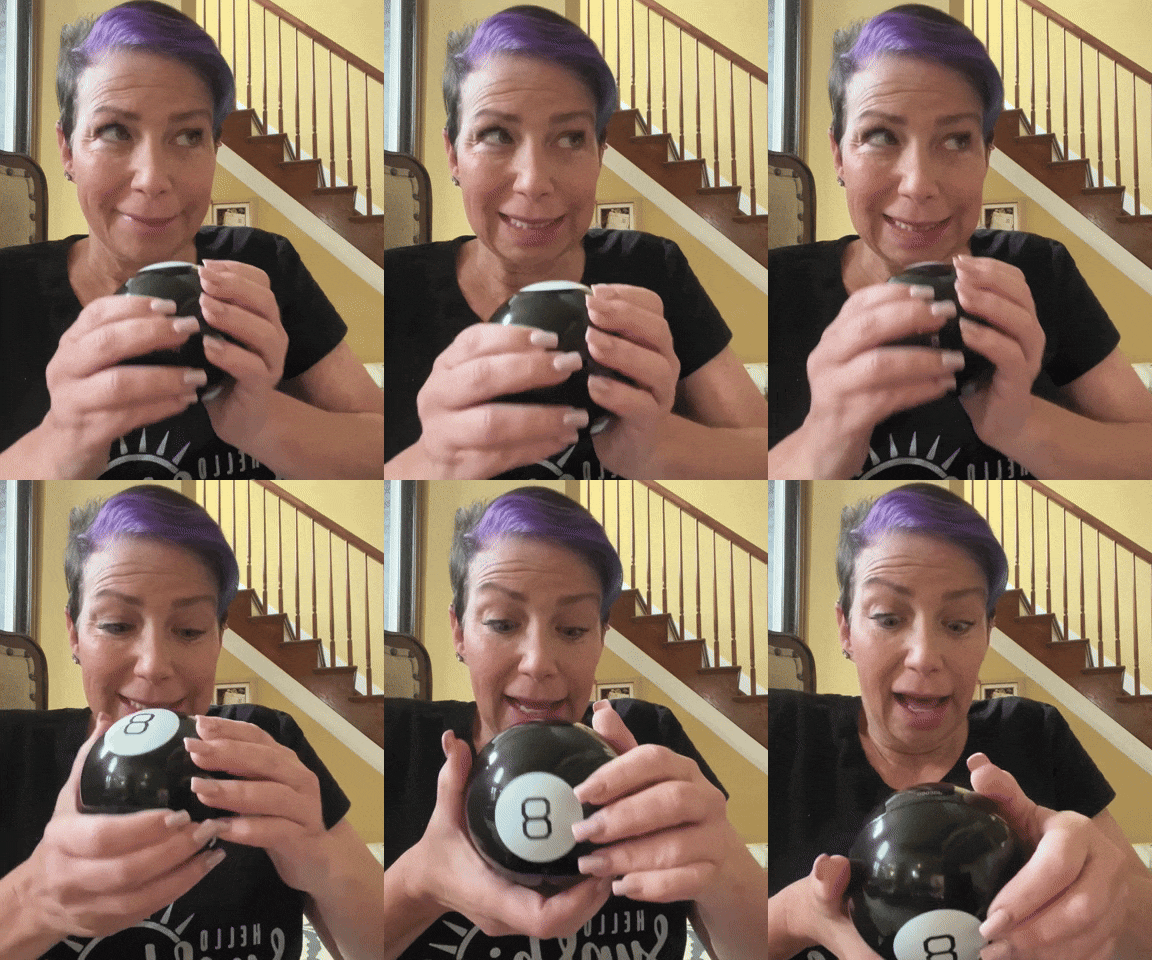
Inside Scoring Package: Yes Definitely
Outside Scoring Package: Very Doubtful
Passing/Ball-Handling Package: Signs Point to Yes
Defensive Divination
For as much as Tarris Reed Jr. has improved on offense over his four-year college career, his defense has always been his calling card. It was one of the key parts of his repertoire that attracted college coaches when he was in high school, and it’s been the most consistent part of his play that’s kept him on the floor in college. Now, having closed out a senior campaign where he held down the eleventh-ranked defense by BartTorvik’s adjusted defensive efficiency rankings, it’s safe to say that Reed Jr.’s defense remains the main draw for his NBA future.
Let’s start at the rim, because that’s where Tarris Reed Jr. stops most possessions that come his way. At 6’10” with a reported 7’4” wingspan, Reed Jr. has the early measurables to be a strong rim protector. When combined with his 265-pound weight, strong frame, and quick feet, it’s no surprise that opponents struggle when trying to finish over Reed Jr. at the rim. They struggled, per Synergy, to the tune of a paltry 31.7% at the rim, which graded out as an “Excellent” rating.
It’s not just about getting blocks for Tarris Reed Jr., but that’s a fun place to start. He has a career blocks percentage of 7.5%, never dipped below 5.2% in a season, and posted a massive 8.4% this season for UCONN. Combined with his 2.9 fouls per game, showing his restraint to stay on the floor, Reed Jr. has a fearsome statistical perspective for his rim protection.
When swatting shots, Reed Jr. is just as good at dissuading shots as a weakside shot-blocker as he is when facing a driver head-on. Reed Jr. is strong enough to absorb contact when a player tries to score over him, and he has a nasty streak for players foolish enough to try. He’s just as light on his feet when coming over for a recovery block as he tracks plays well and lurks until the most opportune moment to emerge and send wayward shots into the first few rows of bleachers.
It’s not just about blocking shots for Reed Jr., however: just by being there and using his indomitable force at the rim, he can force misses with verticality and technique. It’s a skill that modern rim pivots need to have and that takes time to master, which speaks to the work that Reed Jr. has put in to get to this point in his development.
UCONN often played Reed Jr. in a deeper drop scheme, where he could use his rim-protection talents to their fullest, but he could hang in space long enough to make his defensive future more intriguing. It wasn’t the preferred option, given how many other perimeter players the Huskies had to use. Still, Reed Jr. showed just enough horizontal movement and agility for me to believe he could survive at the NBA level as a switchy defender.
Part of what helps Reed Jr.’s case to defend in space is that he has good hands for making things happen away from the rim. He is more of a judicious thief, but he gets his hands involved in actions, jumps passing lanes better than you’d expect for a player his size, and has cut down on his unnecessary fouls there. It’s not going to be as big a skill as his shot-swatting, but it’s certainly another tool in his kit that he can use to wreak defensive havoc.
Outside of his pure on-or-off ball defense, Tarris Reed Jr. is also a mountain of a defensive rebounder. He had a 24.5% defensive rebounding percentage this season, a great mark he clearly backed up on film. He was hard to displace, wasn’t scaled by other high leapers, and he often carved out space with technically sound boxouts to grab boards and end possessions.
Overall, when thinking about the needs of an NBA center on the defensive end, Tarris Reed Jr. checks almost all of the boxes. While he could stand to improve a bit as a perimeter defender, it’s much more important that he imposes his will on the interior and can patrol the paint for a good, winning team. It’s just the sort of role that teams will look for in their prospects toward the end of the first round, and what Reed Jr. can bring to his next team from the first practice.
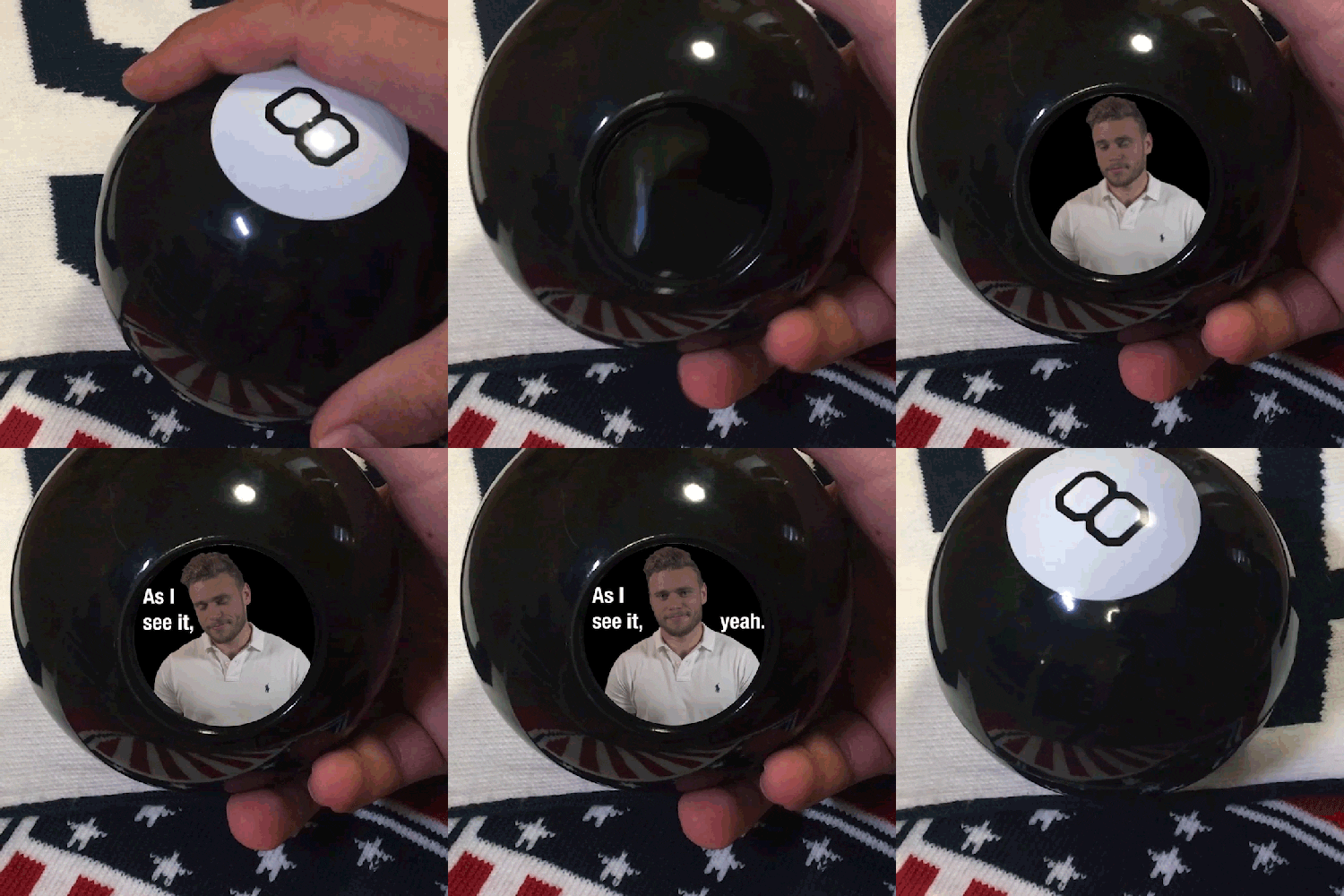
Perimeter Defense: Reply Hazy, Ask Again Later
Interior Defense: As I See It, Yes
Team Tasseography
When looking into Tarris Reed Jr.’s team contexts for his two different college squads, there’s a strong thesis that emerges from his emergence. By choosing to take his talents to a new destination with intention, Reed Jr. was able to wrest control of his career and shape his college playing experience to benefit his career directly. In that sense, he might be the blueprint to follow for any other fringe NBA prospect who wants to succeed in college and the NBA.
As a freshman at Michigan, it’s not shocking that Reed Jr. didn’t play enough to draw more buzz. He was behind a star center in Hunter Dickinson and playing with two top-15 picks in Jett Howard and Kobe Bufkin. Outside of that star trio, however, there wasn’t a ton of talent on that Michigan roster to warrant Reed Jr. only playing 12.6 minutes per game. Instead, while it wasn’t a poor choice to choose the Wolverines, Reed Jr.’s time behind Dickinson does highlight the importance of centers choosing a team that can play multiple bigs due to their respective versatility.
In Reed Jr.’s sophomore season, the wheels fell off the team while he found his footing. Outside of Dug McDaniel, Olivier Nkamhoua, Will Tschetter, and Nimari Burnett, there weren’t any other players who played major roles for teams after this year. Sure, some of this was due to Jaelin Llewellyn’s knee injuries derailing his spot on the team that could’ve turned some games around, but it’s somewhat of a marvel that Reed Jr. had so much success given the poor product around him.
Despite interest from Kansas State and Ole Miss, to name a few, Tarris Reed Jr. chose to head to play for a championship coach in Dan Hurley. It couldn’t have hurt to see both Donovan Clingan and Adama Sanogo drafted after their run to titles, but it’s just as important for Reed Jr.’s development that he had a clear role in playing time and development. Although he split time with senior Samson Johnson, he actually played equal minutes to him during his junior season.
All of that is to say that Reed Jr.’s patience paid off for him in a major way. He anchored a team that fell one game short of a title, made the All-Big East First Team, and cemented himself as a draft prospect. It wouldn’t be rude to say that, while Reed Jr.’s own development was a key part in his ascension, so too was the fact that he started playing with better players on better teams. Having success next to Liam McNeeley, Alex Karaban, Braylon Mullins, Solomon Ball, and Silas DeMary Jr., to name a few teammates, likely meant more to evaluators than being the big fish in the small Michigan pond that season.
Thus, when examining how different team contexts have helped or hindered Tarris Reed Jr., it’s pretty clear that he used the transfer portal exactly as it should be used. His choice was informed, his patience over multiple years was rewarded, and he contributed to winning while developing his own game. If every fringe NBA prospect followed his example, college basketball and the draft as a whole would be even more improved than it’s been the past few years.
The Final Shake
While he may not have been a headline-maker when he transferred to UCONN, Tarris Reed Jr. has grown his game year after year into a good 2026 NBA Draft prospect. He’s a dominant force on both ends, has the athleticism necessary to hack it well on an NBA court, and still has the physical chops to keep rounding out his game to help his team.
It may not have come with the same hoopla as even his initial transfer did at the time, but Reed Jr.’s decision to stick out multiple years on multiple teams in college basketball has made him into the prospect he is today. He’s a sturdy rim defender who could play minutes in the playoffs, holding his own. He also has grown his playmaking to such a degree that he’s now not just a rim-running big man with limited appeal.
That growth is what’s most exciting for a player like Reed Jr. from an evaluation perspective. If he can improve so drastically upon one of his worst attributes as a young player, what’s to say he can’t do that again? While it would be a massive gap to cross to become a league-average shooter, the work ethic and patience that Reed Jr. has already shown are just what teams would want to see from a supposedly “low ceiling” player.
That’s what makes me all about Tarris Reed Jr. as a first-round talent in this draft class. He’s ready to play meaningful minutes in the NBA from the first game, doesn’t need a ton of touches to be impactful on either end, and has shown he can play whatever role necessary while developing his game to lead to winning basketball.
I had him as the 2nd highest Net Wins player in the draft. The Spurs absolutely stole him and his game complements what they want to do with the 2nd unit when Wemby is off the floor. Really enjoyed this piece