


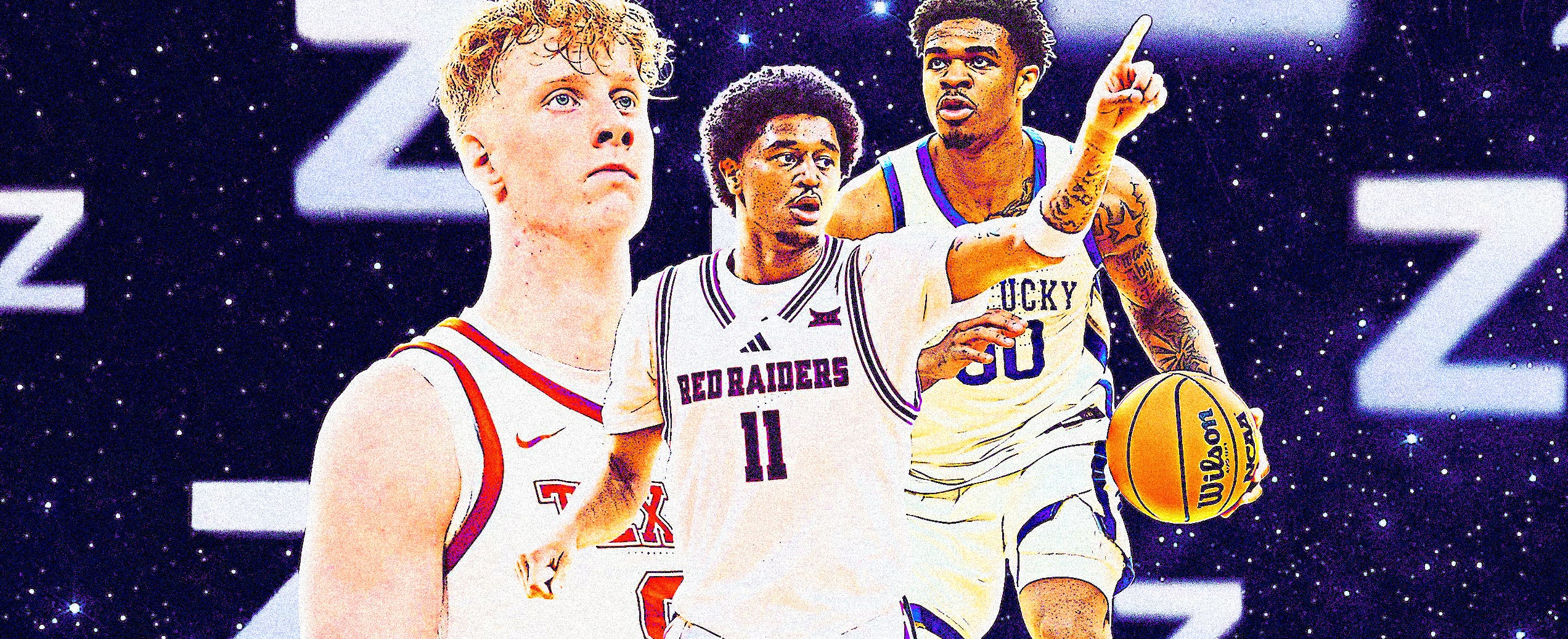
A ton of eyes will gravitate to the stars. Stephen Gillaspie offers up the standout 2026 NBA Draft sleepers of THE tournament.
We’re all mad here.
(Names submitted prior to the Saturday games)
Terrence Hill Jr. | VCU | Guard | Sophomore | 6’3” | 180
Terrence Hill Jr. is a player who has been mentioned in this series before. Back in January, Hill earned Sleeper Prospects of the Week honors for Week 10. Since that time, Hill played in 13 more regular-season games, averaging 13.4 PPG, 3.5 APG, 2.8 RPG, and 0.6 SPG, with shooting splits of 38/29/86. That stretch wasn’t quite the level of play we saw earlier in the season, but he was able to recapture some of that form during the Conference Tournament.
In three games against Duquesne, Saint Joseph’s, and Dayton, Hill averaged 17.3 PPG, 3.0 APG, 1.3 RPG, and 0.7 SPG, while shooting 53.8% from the field. He carried that momentum into VCU’s upset victory over North Carolina, where he delivered one of the most impressive performances of the opening round. Hill scored 34 points on 13-of-23 shooting, including 7-of-10 from deep. His explosive second half was the catalyst for the Rams’ win over the Tar Heels.
Hill has shown consistent confidence as a shooter throughout the season, converting over 37% from three on 13.9 attempts per 100 possessions. His value offensively is largely tied to that shooting gravity, particularly as a movement shooter who can navigate screens and generate clean looks. The swing skill remains his ability to hit shots off the bounce—he shot just over 28% on pull-up threes this season—but against North Carolina, he was able to punish defenders in those situations when given space.
As a decision-maker, Hill remains steady. He recorded five assists against UNC, showing the same composed processing he displayed earlier in the year. He projects more as a secondary creator than a primary initiator, but his ability to keep the offense flowing without forcing reads is a positive indicator for a potential guard rotation role.
There are still limitations that will factor into his projection. Hill’s frame shows up defensively, particularly at the point of attack, where stronger guards can dislodge him or force switches. That can make him a target in certain matchups and limit his scheme versatility early on. His non-three-point scoring also remains more functional than dynamic. That said, finishing with five rebounds against UNC was an encouraging sign in an area where he has been inconsistent.
With Illinois up next, those weaknesses will likely be tested. Still, Hill’s shooting profile and offensive feel give him a pathway as a potential floor-spacing guard who can fit into movement-heavy systems at the next level.
Matas Vokietaitis | Texas | Big | Sophomore | 7’ | 255
Like the aforementioned Terrence Hill Jr., Matas Vokietaitis has appeared in this series before, most recently in the Week 6 edition back in mid-December. Since then, Vokietaitis has averaged 15.9 PPG, 7.1 RPG, 0.9 BPG, and 0.8 APG during the regular season, shooting 64% from the field and 71% from the free-throw line. His Conference Tournament performance was more uneven, where he averaged 12.5 PPG and 7.0 RPG on 33% shooting from the field.
Texas drew BYU in the opening round of the NCAA Tournament—a matchup that drew attention for other reasons—but Vokietaitis worked his way into the spotlight. He finished with 23 points on 10-of-17 shooting in the win.
Throughout the season, Vokietaitis has consistently embodied the “wrecking ball” archetype. That identity was fully on display against BYU, where he pulled down 16 rebounds, including nine on the offensive glass. His season-long rebounding production—12.5% offensive rebound rate and 19.6% defensive rebound rate—translates directly to his impact in games. He generates extra possessions through sheer physicality and motor.
That same physical presence shows up as a play finisher. Vokietaitis thrives in pick-and-roll situations and on the interior, where he can convert through contact or draw fouls. His 11 free throw attempts against BYU reflect a season-long trend, as his 97.8 free throw rate highlights just how frequently he forces defenses into compromising positions. Even without floor spacing, his screening, rim pressure, and activity level give him a clear offensive role.
The concerns are equally clear. Vokietaitis went just 3-of-11 from the free throw line against BYU, reinforcing ongoing questions about his touch. More broadly, his offensive game is heavily concentrated around finishing, with limited self-creation or shooting versatility.
Defensively, his projection will hinge on mobility and discipline. While he can hold up physically in the paint, questions remain about his ability to defend in space and avoid foul trouble against quicker, more dynamic offenses. Without shooting or defensive versatility, his margin for error tightens significantly.
Vokietaitis projects as a role-dependent interior big whose value will be tied to rebounding, physicality, and play finishing. If he can stay on the floor defensively and improve at the free-throw line, there is a pathway to a situational rotation role.
Otega Oweh | Kentucky | Guard/Wing | Senior | 6’4” | 220
This player may feel like I’m cheating a little bit, but Otega Oweh has not consistently been a focal point in the public-facing draft space this season. Back in September, I included him as a nominee for the inaugural “Ryan Kalkbrenner Pre-Season Award”—an honor aimed at upperclassmen who play their way into legitimate draft consideration. On the year as a whole, Oweh has delivered, averaging 18.2 PPG, 4.6 RPG, 2.6 APG, and 1.8 SPG on 46/34/73 splits.
Oweh embraced a go-to scoring role for Kentucky throughout the season, and that continued into the SEC Tournament. In three games against LSU, Missouri, and Florida, he averaged 18.0 PPG and 5.3 RPG. He followed that with a statement performance against Santa Clara in the NCAA Tournament, scoring 35 points on 11-of-24 shooting.
Oweh’s appeal starts with his physical tools and downhill ability. He consistently generates rim pressure, using his strength and explosiveness to finish through contact, even against larger defenders. That same athletic profile translates to the glass, where he has been a reliable rebounder for his position, including an eight-rebound performance against Santa Clara.
What stood out most in that game, however, was his playmaking. Oweh recorded seven assists—his second-highest total of the season—showing improved comfort operating in pick-and-roll and making reads on the move. While that level of passing consistency hasn’t been the norm, flashes like this suggest some untapped upside as a secondary creator.
Defensively, Oweh brings real value. His combination of length, strength, and timing allows him to generate events, as reflected in his two “stocks” against Santa Clara. He projects as a capable multi-positional defender who can guard wings and some guards, which strengthens his case for an NBA role.
The swing skill remains the shooting. Oweh has shot just under 34% from three this season on moderate volume, and defenses will likely test that at the next level. For a player in his archetype, becoming a reliable catch-and-shoot threat is critical. Without that, he risks being slotted into a narrower, defense-first role.
Oweh’s pathway is relatively clear: if the shot stabilizes, he fits as a two-way wing who can defend, attack closeouts, and provide secondary playmaking. If not, he will need to lean heavily on his defense and rim pressure to carve out a role.
Jaylen Petty | Texas Tech | Guard | Freshman | 6’1” | 168
It’s taken some time, but Jaylen Petty has earned his way into this series as one of the more intriguing under-the-radar freshmen in the country. Petty arrived at Texas Tech after being named the 2024–2025 Gatorade Player of the Year in Washington, following a dominant high school career where he averaged 24.5 PPG, 5.9 RPG, 5.5 APG, and 3.2 SPG while leading his team to a state championship.
Petty began his freshman season in a reserve role, averaging 7.2 PPG, 3.2 RPG, and 1.7 APG across his first 11 games on 32/35/100 shooting splits. After moving into the starting lineup in late December, his production and efficiency both took a step forward. As a starter, he averaged 10.8 PPG, 4.3 RPG, and 2.3 APG on improved splits of 45/39/72.
Texas Tech drew a difficult opening matchup against Iowa State, where Petty struggled to find his shot, finishing with eight points on 3-of-10 shooting. However, he rebounded in a major way in the next game for the Red Raiders, leading them to a win with 24 points on 9-of-14 shooting, including 5-of-7 from three.
Shooting is the foundation of Petty’s appeal. He has converted nearly 39% of his threes this season on 10.9 attempts per 100 possessions, giving him real offensive gravity. That shooting threat opens up his ability to create advantages, particularly when he can force defensive rotations and make plays out of them. In his standout performance, he consistently drew multiple defenders and found open teammates, finishing with four assists.
Defensively, Petty competes. He plays with energy, generates occasional events, and shows a willingness to disrupt actions, including digging down into the post and creating turnovers.
The long-term question revolves around his physical profile. Listed at under 170 pounds, Petty’s frame shows up both on film and in his statistical profile. He ranks in the ninth percentile in at-rim frequency and the 29th percentile in at-rim efficiency, while posting a modest 17.0 free-throw rate. Those indicators point to limitations in his ability to consistently pressure the rim against stronger, more physical defenders.
Defensively, that same lack of strength can impact his ability to contain at the point of attack and hold up against switches. His rebounding and overall defensive metrics remain modest as a result.
Petty projects as a longer-term development play. If he adds strength and continues to build out his on-ball game, his shooting and feel give him a foundation to grow into a viable rotation guard.
Killyan Toure | Iowa State | Guard | Freshman | 6’3’ | 205
It’s somewhat surprising that it has taken this long for Killyan Toure’s debut in this series. A product of Brewster Academy with additional experience playing for ASVEL in the French ProA U21 League, Toure entered college with a reputation as a physical, defense-first guard. That reputation was reinforced when he earned Defensive MVP honors at Basketball Without Borders Europe in 2023.
Toure stepped into an immediate role at Iowa State, starting throughout the season and averaging 8.1 PPG, 3.2 RPG, 2.2 APG, and 1.4 SPG on 45/30/70 shooting splits. His production dipped slightly during the Big 12 Tournament, but he delivered a strong bounce-back performance in the NCAA Tournament.
With Joshua Jefferson limited to just three minutes, Toure took on a larger offensive role and led the Cyclones to a blowout win over Tennessee State. He finished with 25 points on 8-of-12 shooting, showcasing a more aggressive scoring approach.
Toure generated offense in a variety of ways. He contributed on the offensive glass—something that aligns with his 6.3 Offensive Rebound Percentage—and found opportunities through timely cuts and physical finishes, including flashes of guard post play. While he has not been a consistent perimeter shooter this season, he was able to capitalize on open looks from beyond the arc in this game. As a passer, he tied a career-high with six assists, showing improved willingness to move the ball and make reads within the flow of the offense.
Defensively, Toure’s impact extends beyond the box score. His strength and physicality allow him to hold up well at the point of attack, and he plays with a level of awareness that fits within a structured defensive scheme. Even without recording a stock in this game, his ability to contain, disrupt actions, and execute team concepts was evident.
There are still clear areas for development. Toure matched his six assists with six turnovers, highlighting ongoing inconsistencies as a decision-maker. His offensive role remains somewhat undefined, as he currently projects as an off-guard without high-level shot creation or consistent perimeter shooting—exemplified by Toure’s shooting under 32% from three on 5.3 attempts per 100 possessions.
That combination makes his projection more complex. However, Toure’s physical tools and defensive foundation give him a pathway as a potential defense-first guard. If the shooting and decision-making continue to develop, he has the upside to grow into a complementary rotation piece at the next level.
Honorable Mentions
Corey Camper Jr. | Nevada
Isaac Celiscar | Yale
Amani Lyles | Akron
Adlan Elamin | Utah State
Follow me on Twitter: StephenGHoops
Catch me on BlueSky: StephenGHoops
Catch the Draft Sickos show LIVE on the No Ceilings NBA channel: