


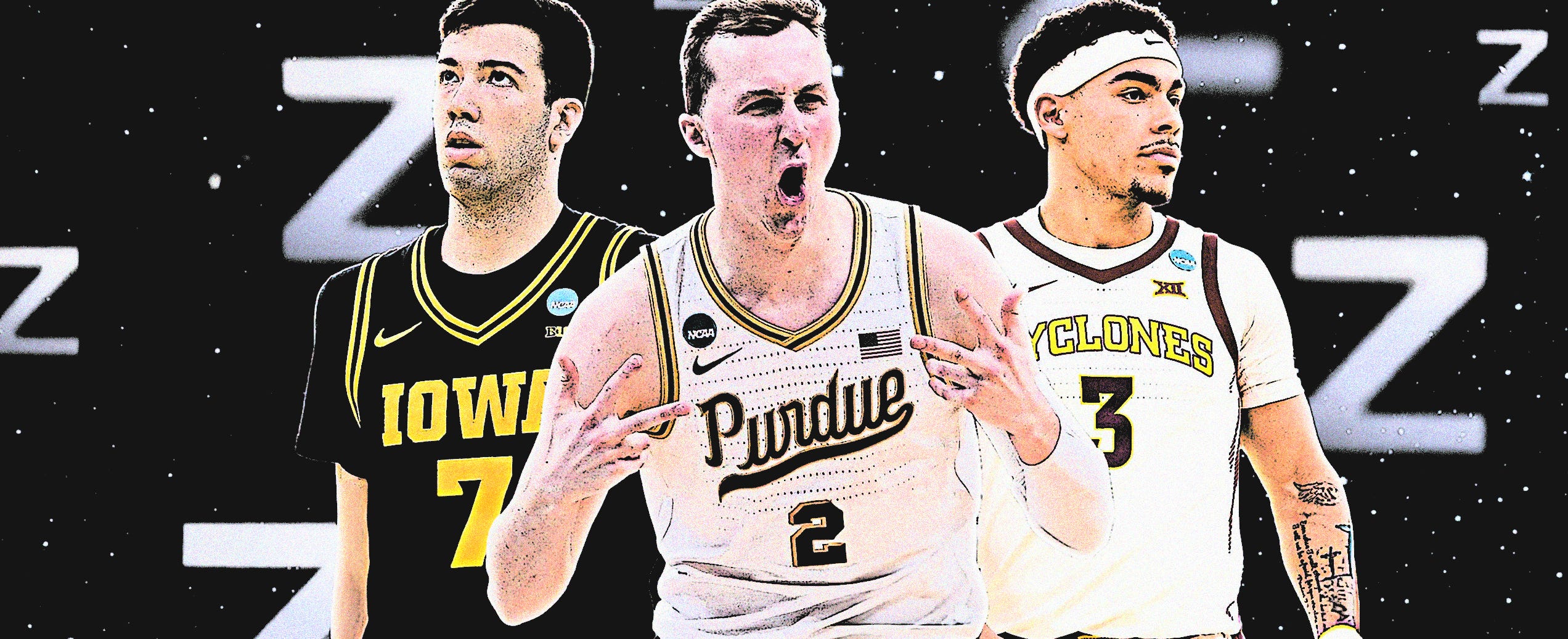
In the FINAL edition of this column for the season, Stephen Gillaspie offers up the standout 2026 NBA Draft sleepers of the tournament.
Last Call for Sleepers!
(Names submitted prior to the Saturday games)
Alvaro Folgueiras | Iowa | Wing/Forward | Junior | 6’10” | 220
It’s been a less-than-ideal season for Alvaro Folgueiras, as he has struggled to find consistency after transferring up from Robert Morris. What initially appeared to be cause for concern, however, has started to shift into renewed optimism about what Folgueiras could become moving forward.
Following a breakout sophomore season with the Colonials, Folgueiras opted to follow Coach Ben McCollum—and one of last year’s March Madness standouts in Bennett Stirtz—to Iowa. At 6’10”, he profiled as an ideal frontcourt complement to a dynamic, ball-dominant guard. After nearly averaging a double-double at Robert Morris, Folgueiras saw his role shift significantly with the Hawkeyes, coming off the bench and posting 8.7 PPG, 3.8 RPG, 2.3 APG, and 0.9 SPG on 51/34/77 shooting splits. Across the board, his production dipped as he adjusted to a higher level of competition.
Once Iowa reached the NCAA Tournament, though, Folgueiras began to show signs of settling in. In three games against Clemson, Florida, and Nebraska, he has averaged 14.7 PPG, 3.7 RPG, 1.3 APG, and 1.7 SPG, while shooting an efficient 60/42/94 from the field. He delivered one of the more memorable moments of Iowa’s season, knocking down a game-winning three against Florida—in one of only three collegiate games his mother has attended.
Coming into the year, Folgueiras’s appeal centered around his dribble-pass-shoot skill set. While the shooting has been inconsistent overall, there are indicators of long-term viability. He has converted over 41% of his uncontested three-point attempts, and at his size, the ability to step into open jumpers with a quick release is a valuable offensive trait. He also shows a willingness to shoot, attempting 9.0 threes per 100 possessions—an encouraging indicator of confidence and scalability.
As a passer, Folgueiras continues to provide value as a connector. He has posted a 20.8 assist percentage this season, marking his second consecutive year above the 20% threshold. He processes quickly, keeps the ball moving, and fits naturally within motion-based offensive systems. Defensively, he is most effective when operating from a position of awareness. His length allows him to disrupt passing lanes and generate deflections, particularly when reading the floor from the weak side. While his raw rebounding numbers have declined, his 18.3 defensive rebounding percentage suggests he can still hold his own on the glass.
There are still clear areas of concern. Despite his late-season surge, Folgueiras shot just 43/23/74 from January through early March, highlighting the volatility in his offensive profile. Physically, he can struggle with strength, which shows up both as a finisher and on the defensive end. He recorded 39 total stocks (steals + blocks) compared to 71 fouls, raising questions about discipline and defensive reliability. Additionally, while he functions well as a connector, his limitations as a live-dribble creator cap his offensive ceiling.
Folgueiras projects as a skill-based frontcourt connector whose value will depend on shooting consistency and defensive viability. If the jumper stabilizes and he proves capable of holding up physically, his passing feel and offensive versatility give him a pathway to a rotation role in a movement-oriented system.
Fletcher Loyer | Purdue | Guard/Wing | Senior | 6’5” | 180
Fletcher Loyer is a player who is seldom discussed in NBA Draft circles, but he has been a steady and reliable contributor on a Purdue team that consistently contends for deep postseason runs. Loyer has started all 148 games of his four-year collegiate career, and this season has represented some of his most efficient and productive work—averaging 14.2 PPG, 2.3 RPG, 2.1 APG, and 0.7 SPG on 45/44/87 shooting splits. Notably, this marks his third consecutive season shooting around 44% from three-point range.
In what has been a career-best scoring year, Loyer has eclipsed the 20-point mark on five occasions. He carried that production into the conference tournament, averaging 15.3 PPG on 45/43/71 splits while helping lead Purdue to a conference championship. His play has reached another level in the NCAA Tournament, where he has averaged 18.7 PPG on an impressive 59/60/100 shooting line.
The appeal with Loyer is straightforward—he is an elite shooter. He is converting nearly 42% of his guarded catch-and-shoot three-point attempts and approximately 47% when left open. Beyond that, he has shown the ability to knock down shots off the bounce at a respectable rate of around 35%. This has come on significant volume, with Loyer attempting 14.0 threes per 100 possessions. His shot mechanics are clean and repeatable, featuring a quick, high release that allows him to get attempts off in tight windows. He is also constantly in motion, working off screens and relocating to create opportunities—traits that translate directly to off-ball roles at the next level.
Beyond his shooting, Loyer has shown growth as a decision-maker. He has posted an Assist-to-Turnover Ratio of 2.1 this season, a notable improvement from 1.5 a year ago. While he projects primarily as a connective passer, he has flashed improved comfort making reads off the bounce—an important development when defenses run him off the three-point line.
The concerns are relatively clear and tied to his archetype. Loyer lacks ideal size and strength for a wing, which could make him a target defensively. His rebounding impact is minimal, and with fewer than 15% of his attempts coming at the rim, his 33.1 free-throw rate reflects limited rim pressure and overall offensive versatility.
That said, players in this mold have carved out meaningful NBA roles. Names like Sam Merrill and AJ Green come to mind—shooters who were not viewed as complete prospects, but have stuck by providing a high-level, translatable skill. Loyer fits a similar archetype. If placed in the right environment, his shooting gravity, movement, and steadily improving decision-making give him a pathway to a rotation role as a floor-spacing specialist.
Shelton Henderson | Miami | Wing/Forward | Freshman | 6’6” | 240
There may not be another returning prospect whose draft stock is as volatile as the stock of Shelton Henderson. The freshman forward entered the season as an RSCI Top 25 recruit and was originally expected to commit to Duke before ultimately choosing to play for Jai Lucas and the Hurricanes. On the year, Henderson has averaged 13.8 PPG, 4.9 RPG, 2.1 APG, and 1.1 SPG, with shooting splits of 57/26/58.
Despite playing on a roster with a number of upperclassmen, Henderson maintained a consistent offensive presence. He scored in double figures in all but seven regular-season games, with some of his strongest performances coming against Virginia, Clemson, Florida State, and Ole Miss. In the conference tournament, he averaged 10.5 PPG, 5.5 RPG, and 1.5 BPG on 50/0/60 shooting splits. He followed that with an impactful NCAA Tournament showing, posting 16.5 PPG, 7.0 RPG, 4.0 APG, and 1.5 SPG in games against Missouri and Purdue, even as his shooting splits (62/0/20) highlighted ongoing efficiency concerns.
Henderson’s appeal begins with his physical profile. At 6’6” with a strong frame, high-level explosiveness, and excellent balance, he already possesses one of the more NBA-ready bodies in the freshman class. That physicality translates directly to his ability to generate rim pressure. He has recorded 44 dunks this season—19 of which have come in the halfcourt—and consistently gets downhill through a combination of strength, burst, and functional ball-handling. His 27 and-one conversions and 47.2 free-throw rate further reinforce how frequently he forces defenses into compromised positions.
That same athleticism shows up on the offensive glass. Henderson ranks in the 63rd percentile in putbacks per Synergy, using his vertical pop and motor to generate second-chance opportunities. While much of his scoring comes from physical advantages, he has also shown flashes of being able to navigate defenses with the ball, using controlled handle and body positioning to create angles.
The concerns are centered around his shooting and overall offensive polish. At this stage, there is limited statistical evidence to project him as a reliable perimeter shooter. His mechanics can appear compact and somewhat elongated, which creates a narrow margin for error in both timing and release. Combined with low three-point volume and a sub-60% free throw mark, the indicators point to a long-term swing skill that will be critical to his development.
There are also questions surrounding his playmaking. Henderson posted an assist percentage of 11.8 with a 1.2 assist-to-turnover ratio, suggesting that his current offensive impact is more scoring-driven than creation-oriented. Some of that context can be attributed to role and roster construction, but continued growth as a passer—particularly on the move—will be important in expanding his offensive versatility.
Henderson projects as a tools-driven wing whose upside is tied to skill development. His physical profile, rim pressure, and defensive potential provide a strong foundation, but his long-term trajectory will depend on whether the shooting and decision-making take meaningful steps forward. If those areas improve, he has the upside to emerge as a high-impact two-way wing in the next draft cycle.
Pryce Sandfort | Nebraska | Wing/Forward | Junior | 6’7” | 210
One of the more unheralded prospects in the 2026 NBA Draft cycle is Nebraska’s Pryce Sandfort. The younger brother of current NBA player Payton Sandfort, Pryce spent his first two collegiate seasons at Iowa before transferring to Nebraska to play for Fred Hoiberg. After operating primarily as a role player with the Hawkeyes, Sandfort stepped into a significantly larger role with the Cornhuskers, averaging 18.1 PPG, 4.9 RPG, 2.0 APG, and 1.0 SPG on efficient 48/42/86 shooting splits. He started all 35 games this season, a notable jump from just two starts across 65 appearances at Iowa.
Sandfort carried that production into postseason play. In Nebraska’s conference tournament appearance, he finished with 15 points, four rebounds, and two assists. He elevated his play further in the NCAA Tournament, averaging 21.0 PPG, 5.0 RPG, and 2.0 APG across matchups with Troy, Vanderbilt, and Iowa, while shooting an impressive 57/57/88 from the field.
Sandfort’s appeal is rooted in his scoring ability. At 6’7”, he offers a combination of size and shot-making that is difficult to contest. He ranks in the 95th percentile in off-the-dribble jump shooting and has converted over 45% of his pull-up three-point attempts. His release is quick and compact, allowing him to get shots off in tight windows, and he shows a strong ability to reposition and create separation with minimal space. As a catch-and-shoot threat, he has been equally effective, converting over 41% of his attempts while taking on a high-volume role (15.9 threes per 100 possessions). That blend of movement, shot versatility, and confidence gives him real offensive gravity.
Beyond scoring, Sandfort has shown incremental growth as a passer. While he is not a primary offensive hub, he has demonstrated the ability to make reads on the move and find cutters when defenses overcommit to his shooting. That level of feel adds value within a complementary offensive role. Defensively, he competes and shows a willingness to execute within a team structure, though his impact is inconsistent. His 59 fouls reflect some of the challenges he faces in staying disciplined on that end.
The concerns are tied to his overall offensive versatility and physical profile. Sandfort’s shot diet is heavily perimeter-oriented, and he generates limited rim pressure. Despite solid efficiency at the basket, he rarely gets there and does not seek out contact, as reflected in one of the lowest free-throw attempt rates on his team. Defensively, he is likely to be targeted, particularly against quicker or more physical opponents, and his ability to hold up on the glass is also a question.
Sandfort projects as a scoring specialist whose value will be driven by shooting and shot-making versatility. His ability to generate offense from the perimeter—both off the catch and off the bounce—gives him a clear pathway to a role. However, his long-term viability will depend on whether he can provide enough defensive resistance and secondary value to stay on the floor. In the right context, he fits the mold of a movement shooter and perimeter scorer capable of spacing the floor and punishing defensive mistakes.
Tamin Lipsey | Iowa State | Guard | Senior | 6” | 200
This will be the final breakdown included in this piece—no honorable mentions this time.
In a draft cycle where smaller point guards have begun to re-enter the conversation, Tamin Lipsey remains somewhat underdiscussed. A four-year player at Iowa State, Lipsey has developed into the undisputed leader of the Cyclones. In his final season under T.J. Otzelberger, he has averaged 13.3 PPG, 5.1 APG, 3.9 RPG, and 2.3 SPG on 46/32/66 shooting splits.
Lipsey maintained that level of production in postseason play. Across three conference tournament games against Arizona State, Texas Tech, and Arizona, he averaged 13.0 PPG, 5.0 APG, and 2.0 SPG. In Iowa State’s first three NCAA Tournament games, he elevated his play further, posting 15.7 PPG, 5.7 APG, and 3.0 SPG while shooting 44/36/72 from the field.
Lipsey’s value is driven by his ability to organize an offense. He recorded three or fewer assists in just four regular-season games, reflecting both his consistency and playmaking responsibility. With a 27.8 assist percentage and a 3.4 assist-to-turnover ratio, he operates as a steady initiator who processes quickly and consistently delivers the ball to advantageous spots. That extends to his work in pick-and-roll, where he ranks in the 82nd percentile—an important indicator for projecting lead guard functionality at the next level.
Despite his size, Lipsey is not easily displaced. His strength allows him to get into the paint and generate opportunities, ranking in the 77th percentile in at-rim frequency and the 82nd percentile in finishing on layups. That downhill ability has translated into over 100 free throw attempts this season, the second-highest mark on his team. Defensively, he provides real value. Lipsey is highly active and instinctive, consistently generating events through digs, deflections, and well-timed pressure at the point of attack.
The concerns are tied to both physical profile and shooting projection. At 6’1”, Lipsey will face inherent limitations, particularly defensively, where he is likely to be targeted despite his activity level. Offensively, the jumper remains the swing skill. He has shot under 32% from three this season on moderate volume, and while the form is functional, it is inconsistent—particularly in his base and release point. He has only surpassed 33% from deep once in his career, and his free-throw percentages do little to alleviate long-term concerns about shooting scalability.
Lipsey projects as a role-dependent lead guard whose value will hinge on his ability to compensate for physical limitations with decision-making, defense, and pace control. His combination of processing, toughness, and defensive instincts gives him a foundation. Without meaningful shooting improvement, though, his margin for error remains thin. As it stands, those limitations likely place him in the second-round range, particularly among returning prospects.
Follow me on Twitter: StephenGHoops
Catch me on BlueSky: StephenGHoops
Catch the Draft Sickos show LIVE on the No Ceilings NBA channel:
Thank-you for doing this work. It is very helpful for organizing my thoughts on potential Raptors’ picks.
Love Shelton Henderson and was surprised to learn he is a freshman after watching him about a month ago. He should get to Michigan where he can develop into next year’s Yaxel Lendeborg, and get picked in the top half of the 2027 lottery.
After watching the most recent version of Raptors-Pelicans featuring (?) Gradey Dick and Jordan Hawkins, every observer has to be cautious about guys like Fletcher Loyer and Pryce Sandfort. I would rather have the latter than the former, but both are great in college and both could become the latest versions of Dick/Hawkins. Very sobering.