


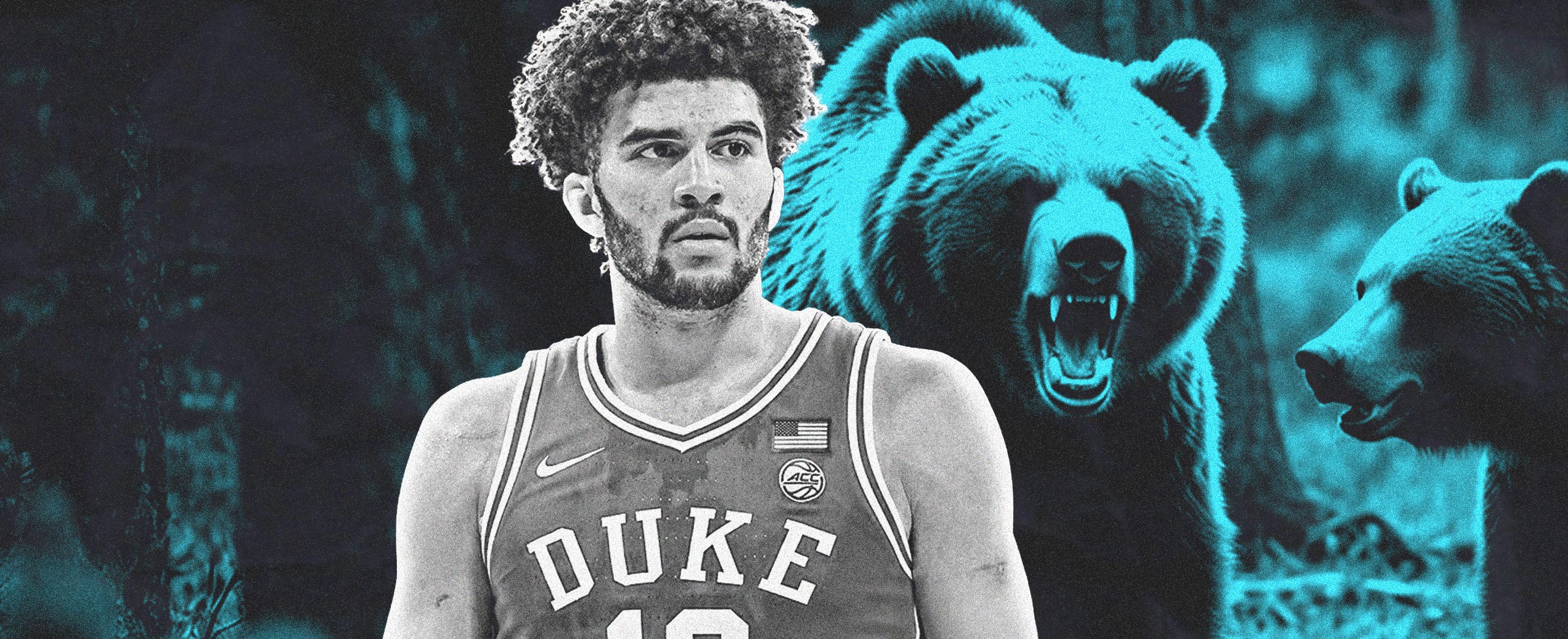
As we get closer to the 2026 NBA Draft, the consensus opinion by those who project, evaluate, and report on the prospects at large is that Cameron Boozer is destined to go third overall to the Memphis Grizzlies.
While not everyone may have him as the third-best prospect on their respective big boards or in front office war rooms, it’s becoming clearer that the race at the top is primarily between AJ Dybantsa and Darryn Peterson.
So if Boozer is in fact taken at the No. 3 slot (and possibly underdrafted), what would the Grizzlies be getting out of the 6’9” forward from Duke University?
Let’s dive deep into his game and contextualize his potential fit with the Grizzlies in the 2026 draft!
Cameron Boozer’s Evaluation
Cameron Boozer embodies modern NBA offense perfectly in this day and age because he combines strength, mental processing, and versatility both on and off the ball as a 6’9” 250-pound forward.
Few players who have entered the league in recent years match his skill set at his size, but none have matched his body of work this century outside of Luka Doncic in terms of accolades and winning impact.
Boozer has won essentially everything there is to win pre-college, and even took Duke within an incredible buzzer-beater of the Final Four. Boozer won FOUR consecutive high school state championships, THREE consecutive Nike EYBL Peach Jam titles, TWO gold medals for the US FIBA U16 and U17 teams, and has many accolades past that, including two Gatorade National Player of the Year Honors.
Some may not care about what a player has done before they set foot in the NBA from an awards/championship standpoint, and care much more about the game they present on film and in the numbers. I would push back on that as a scout and add that every single time I’ve had meaningful, lengthy discussions with those who work in the game, be it a scout or a coach, I've been asked what the player actually accomplished. Have they been a consistent winner? Do they know how to play well with others? Are they leaders on and off the court?
Everything about winning, especially at the level that Boozer has, is difficult. It requires extreme focus, daily habits, and a mindset that doesn’t change with ups or downs. The bedrock of winning is consistency, and it’s a skill that needs to be learned to reach one’s full potential, both in individual impact and team success. Boozer sets the table as a culture setter for everyone around him because he’s proven he puts in the work to improve every offseason.
Each year in high school, Boozer continued to add different elements to his already diverse game, be it improving handling and scoring with both hands, shooting from three-point range, and developing post footwork that allows him to operate as an offensive hub on the block.
If people haven’t watched Boozer earlier in high school, I would encourage them to go back and find some of his games, because he wasn’t always a post-up frontcourt anchor on offense. Boozer’s game has evolved as he’s gotten better at handling the ball and facing up mismatches to the point where he’s a real-deal pick-and-roll threat in the halfcourt.
And that level of work and dedication carried over to his time at Duke; per Synergy Sports, Boozer was almost unstoppable in every facet of the game. No matter whether it was on or off the ball, Boozer rated “Very Good to Excellent” on essentially every play/shot type one could think of, which is utter nonsense if you think about it. How can a 250+ pound forward be able to operate so effectively as an operator in ball-screen offense, as he would on the block against opposing forwards and bigs?
This versatility stems from his superpower as a basketball player: Boozer’s ability to read the court, map out everyone, and process solutions is unique for someone who is only 18 years old.
Part of being able to solve any problem in front of him on offense is having the ability to run almost any offensive action asked of him. In college, there were two areas where Boozer wasn’t a rockstar: mid-range scoring and three-point shooting off the dribble. Given where he ended his high school career, I would expect both of those to improve, as he showed meaningful flashes of creating those looks and converting on them at lower levels.
But even with those two stark weaknesses for someone who is being projected as one of the top picks in the 2026 draft, Boozer proved he had all of the other answers to the test as far as breaking down college defenses. If Boozer had a larger player covering him, he could either take them off the bounce and score around them or draw a foul. Boozer even spaced the floor and knocked down 40.8% of his catch-and-shoot threes. When he pulled a big covering him away from the basket, that meant the perfect opportunity to either knock down that perimeter shot, or call for a screen to create another mismatch on a smaller player that he could either drive through or post on the block.
There’s a considerable number of evaluators and fans who perceive Boozer as this bang-in-the-post forward who will have trouble scoring at a high level against players who can match his strength and physicality because he isn’t an explosive leaper from a standstill. As for those concerns, they’d be correct for someone who doesn’t have the skill set and problem-solving abilities that Boozer does. Yes, he struggled at times scoring over size right around the basket, especially in traffic. Now, Boozer will get much, much stronger given how young he is, but let’s take that weakness into account and project that it doesn’t change in the NBA.
Even with that barrier to low-post scoring (which I’m still saying didn’t fully exist because Boozer posted 1.12 points per possession on post-ups, including passes which rated “Excellent” per Synergy), Boozer can bring his man out on the perimeter and mismatch hunt to his heart’s content because of his ball-handling and shooting acumen. You can’t leave Boozer open from deep. Players have to get up on him because of how good he is as a distance shooter. That gives every opportunity to call for screens and get the matchup he wants to go to work. If defenses choose to blitz/blow up those actions, he’s such an excellent passer when he’s shown two or more defenders. It doesn’t just lead to direct assists either. Boozer makes the right read EVERY SINGLE TIME and is known as much for his skips that lead to hockey assists as he is for his direct assists.
Every player isn’t perfect. Boozer certainly isn’t either. Even in situations I’ve described where Boozer can get looks that are more appealing to him on offense, teams figured out how to pre-switch and put players on him who were good at poking the ball free and forcing turnovers. He’s an excellent ball handler for his size, but he’s not a true guard, so he’s more prone to pressure away from the basket than someone like Cade Cunningham, for example.
But even with all of the weaknesses on the table offensively, Boozer has so much that he can go to and lean on because of his versatility. Boozer knows how to move without the basketball, establish position, and even box out on the offensive glass. I haven’t even touched on his rebounding ability, which was top-notch in college basketball and at lower levels. Boozer’s lower base is crazy strong, and he’s got great technique, actually boxing out opposing forwards to gain advantages on the glass that lead to putback buckets or fouls to get to the line.
I trust Boozer fully as a paint scorer/foul drawer, rebounder, passer, and mismatch hunter. If he’s able to develop a few more counters in the post and get back to creating some more shots in the midrange when he has the space to do so, there’s just no true way to guard Boozer outside of forcing the ball out of his hands on a steal or pass out. No other player has as many answers to the test on offense in this draft as Boozer does.
As much as I love to discuss Boozer’s offensive impact, however, this game is played on both ends of the floor. And in college, Boozer’s defense was poor at times and downright awful at others. I want to be very clear: I DO NOT believe Boozer is a bad defender and is a target on that end of the floor by any means. But there needs to be some open and honest discussion about where Boozer is as a defensive player and why that matters for projecting his best positional outcomes in the NBA.
Boozer has good length and reach, as was measured out at the 2026 NBA Draft Combine. There’s optimism from some that he can play in different small-ball lineups as a five-man, which, given his offensive outlook, blends creativity and free-flowing five-out sets with Boozer at the helm. But we have to come back to his lack of verticality from a standstill. Boozer isn’t a threat to bother the shots of any 7-footer with a legitimate post game. True centers can score over Boozer with length and touch, even if they can’t abuse him from a positioning standpoint because of how strong he is. I don’t want Boozer playing defense in the post against 7-footers because that’s not a recipe for success.
So then one can say, well, if he’s a power forward, he can play off another big and roam as a defender along the baseline in help position. That’s fine, but if Boozer is called into different actions on the perimeter where he has to travel a considerable distance on the court, there’s ample opportunity to get a shooter a clean look away from the ball by putting Boozer in a foot-race blender.
In one-on-one situations, even away from the basket, Boozer gets lower in a stance than given credit for and is as strong as an ox. You can’t push Boozer around, and he does have a good understanding of how he needs to play certain matchups as far as hedging against speed/quickness. But if he’s in a pseudo drop-coverage situation, or put into different movement actions off the ball, there are ways to take advantage of his lack of elite quickness.
I’ve laid out several ways to attack him defensively, which matter at the next level. Again, put him in a direct defensive situation where he can guard one-on-one or pre-switch against certain matchups, and I don’t find him the same target as others do. But in terms of his overall ability to thrive as a defender, it will matter entirely around the system he’s going into at the next level. Team defense requires communication, positioning, and understanding more than anything. Boozer passes those tests with flying colors.
But at the end of the day, especially in the playoffs, defense comes down to matching the opposing offense's overall physical effort and leaving everything you have on the court. There were times at Duke when Boozer didn’t step out to contest shooters or play drives a bit harder, which led to layups. He would show on the court that conserving his energy to play on the other end of the floor was more important to his success as a talent, and it drove me absolutely crazy as a scout. Perimeter playmakers and offensive engines can get away with taking some plays off because of how much they need to do on one end for their team to win. IF Boozer doesn’t have the same level of responsibility on offense in the NBA as he has at lower levels, then he will be expected by ANY coaching staff to give more effort on defense.
Memphis Grizzlies Current Roster Fit
So now we get to how Cameron Boozer would actually fit on the court with the Memphis Grizzlies.
What’s fascinating about his potential fit in Memphis is that this is a team that’s almost like a blank canvas. Given the potential Ja Morant trade on the horizon, this franchise doesn’t have a clear direction on either end of the floor at the moment.
And before we move into what that looks like and means for Boozer’s potential arrival, I can hear the Grizzlies fans in the back yelling the name of Zach Edey like I’m forgetting about a franchise cornerstone at the center position.
I’ll be blunt here: Edey hasn’t proven he can actually stay on the court to warrant a team’s overall direction to be skewed in his favor as far as constructing a roster.
There hasn’t been a player in the last two drafts who has been as dominant on a per-minute basis as Edey has. That’s a statistical fact. Edey changes games on both ends of the floor in similar ways as other unicorn bigs in the NBA, even if it doesn’t quite look the same. It’s why there were plenty of smart scouts who had Top 5 grades on him in the 2024 NBA Draft, and some even had him at No. 1 overall. Dominant talents deserve to be drafted very, very high in the league.
But he hasn’t even played in 50% of his available games over his first two NBA seasons. How can a team point its entire direction in the way of a player who may not be able to stay healthy or play a lion’s share of the minutes that are required to win at a high level?
IF Edey is healthy and on the court next to a player like Boozer, it’s an offensive match made in heaven. I just discussed how Boozer is a threat to post up and draw defensive attention in the form of a double team, but I don’t want Boozer banging down low against true fives the entire length of a game on either end of the floor.
That’s where Edey comes in. Zach is a truly dominant post player against one or multiple defenders. At 7’3” and 305 pounds, there’s no one else like him in the sport, let alone the NBA. His touch, footwork, and strength are unmatched even at a position of giants. Boozer would have endless opportunities to serve as a playmaker from the top of the floor, as a handoff hub around the foul line, or even as a play finisher in the dunker spot off the gravitational force that is Edey.
Talk about making the life easier of one of the most gifted offensive problem solvers I’ve scouted in a long time. Boozer’s offensive game could be focused much more as a bigger wing or true power forward as opposed to a big man, and every double drawn by Edey would only put defenses in critical binds with another passer like Boozer on the floor. The high-low game of those two would open up so much for talented shooters on the roster like Cedric Coward, Jaylen Wells, Ty Jerome, and Cam Spencer.
Speaking of those perimeter talents…Boozer would be awesome to work with on any of them in inverted pick-and-roll actions. One of Duke’s best offensive sets last year was running a high-ball screen with Boozer and Isaiah Evans working together. Evans would slip the screen and put defenses in a real-time blender. Do you chase over and follow Evans, giving Boozer the mismatch he’s looking for as a driver? Do you show two on the ball and leave a shooter like Evans open in a big spot?
Imagine Boozer running those actions with Spencer or Wells. How do you choose to stop them if you’re an NBA defense? It depends entirely on who is guarding Spencer or Wells. Still, even if that matchup isn’t favorable, Boozer can keep the ball, pass to another man, and then move off the ball to either spot up or work in the post for another look, depending on who the other big is that he’s occupying the floor with.
What about in smaller lineups with someone like Santi Aldama sharing the court with Boozer for some five-out offense? Boozer/Aldama pick-and-pops would offer so much optionality and spacing for other players to cut and move off of. What about if Boozer and Aldama ran double-screen actions for players like Jerome, Spencer, Javon Small, and Coward to play off of? Everything Boozer does well, he can do as a screener. Boozer knows how to set screens to catch players and roll off of them. He can work out of the short roll, catch, and direct traffic. He can roll hard and draw a foul or finish at the basket. He can pop for a more athletic guard like Small to get downhill and have a bailout option at the top of the key.
Grizzlies fans have long appreciated what a player like Aldama has brought to the frontcourt. This is a team that also employed Jaren Jackson Jr. for several years. Imagine a player with the shooting talent of both of them, with a ball-handling/passing combo that neither quite lives up to the way that Boozer does from that power forward position. Now put him in an offense that prioritizes off-ball movement, screening, and creating certain mismatches with one of the best post-up talents the league has seen this decade?
Enough of me fantasizing about Boozer’s offensive fit in Memphis. He could fit in any offensive structure, but the Grizzlies have done an excellent job of acquiring shooters who know how to play off the ball, screen for others (I’m looking at you in some of those inverted actions, too, Coward), and cut to the basket.
Defensively, I would admittedly have some concerns.
Yes, Boozer would be able to share the floor with true size at center, relieving him of those low-post duties. But before we completely rule out my concerns with Boozer as a small-ball five, there isn’t a lot of size past Edey on the roster right now as it stands. This team needs to find another big man in the worst way, because otherwise it will be more Boozer at center than I’d want to see at the next level. Boozer with guys like GG Jackson or Taylor Hendricks would be fun on offense, but not on defense.
Even with Edey next to Boozer, there are real opportunities for teams to feast on drop coverage. Boozer can only help so much with the space potentially created if a great ball handler gets Edey in that dance. And once that space is created, even if Edey can come up and contest a potential shot, there’s a pass-out opportunity that’s put in focus for that offensive player, and if it’s a kick-out, and swing to the next guy, that could put a player like Boozer in a bind if he has to play in space to close out on a shooter.
Opposing offenses that have ball-handling fours could put Boozer and Edey in PnR at the same time, which could be a bit disastrous depending on the matchup. That didn’t happen much at all at the college level with Boozer and Pat Ngongba sharing the court, but the NBA is an entirely different story. The skill gap at that forward spot between college and the pros is immense, so it’s something to think about for the Grizzlies.
I don’t want to sound completely doom and gloom on defense, because there’s one distinct advantage those Boozer/Edey lineups would have over teams, even with the in-space concerns: rebounding. What team wants to box out both Edey and Boozer on the boards? If teams weren’t able to create and knock down open shots, how many squads are getting offensive rebounds over those two towers? Being able to control the defensive glass, while even opening up opportunities to grab offensive rebounds with Edey, Boozer, and a great rebounding wing like Coward, would be a massive advantage in Memphis’ favor moving forward.
Creating and ending possessions are what swing the tide in high-level NBA games. It always has, and is even more paramount in today’s game, where the smallest details can lead to epic losses. If I were the Grizzlies, I’d say the team was already off to a great start defensively with one of the best on-ball wings in Coward, next to another player who has shown some defensive metal in Wells, working with a low-post stalwart in Edey that does control the types of looks teams can get directly around the basket. Continuing to solidify the defense at the point of attack with guards like Walter Clayton Jr. or Small (or someone who isn’t on the roster yet) would be one of my focus areas after drafting Boozer to cement the infrastructure on that end of the floor to limit penetration into the lane. The Grizzlies can just put “chasing over screens” as a requirement in the guard’s job description!
Memphis could be in an interesting position with the drafting of Boozer because of everything he takes care of offensively as a point forward in a more non-traditional sense. He can see the floor and make plays better than even some guards can, depending on the action, which means the Grizzlies don’t have to find the type of point guard that needs to run 30 ball screens a game to generate clean offense. Finding that caretaker lead guard who chases over screens, can switch a bit on defense, and knocks down threes at a great clip is the type of player I’d want to find in the backcourt alongside Boozer, and there are already a few of those candidates on the roster. That means that drafting a point guard with the 16th pick in this draft isn’t a necessity for Memphis. If there’s another center on the board at that selection, I’d jump on that opportunity while still hitting the FA market to find another frontcourt mate to pair with Boozer/Edey/Aldama and the rest of the combo forwards.
IF Memphis can put these pieces together, along with health and internal development from its young talent, there’s a world where the Grizzlies are much more competitive next year than some may perceive, given the recent deconstruction of the JJJ/Ja Morant/Desmond Bane Grizz.
Conclusion
Look, I’ve had Cameron Boozer at the top of my draft board since the preseason. To me, there’s no better player in this draft to step in and play modern offense than Boozer. Both AJ Dybantsa and Darryn Peterson have athletic scoring talent that sounds great, and could take a team incredibly far if optimized correctly. But do either of them match up pound-for-pound with the best players the league is putting out there from a strength perspective, while also possessing the dribble/pass/shoot skill set teams covet from every non-center position?
I’ve illustrated the concerns I have with Boozer on defense, and where he needs to improve on offense to finish rounding out his game as one of the most complete players on that end of the floor the league has seen this decade. Even with his faults, no one in this draft maximizes possession advantages the way Boozer does, especially when factoring in his passing, rebounding, and multi-level scoring.
If the Memphis Grizzlies drafted Boozer, it would be a match made in heaven on offense. This coaching staff and roster are ready to make the most of what Boozer does well, and his strengths are exactly what this team needs more of.
Boozer has proven at every level that he is a false ceiling prospect the likes of which we haven’t seen since Luka Doncic. I’m not saying he’s Luka, but these are the waters we find ourselves in, given his historic accomplishments pre-NBA and his most dominant statistical season in college basketball over the last 30+ years.
Some players are built to shatter perceived ceilings with their blend of skills and mental aptitude. Boozer is next in line and could lift Memphis to even greater heights than it’s seen recently in the last two iterations of the Grizzlies.
This rocks!
Couldn’t agree more