


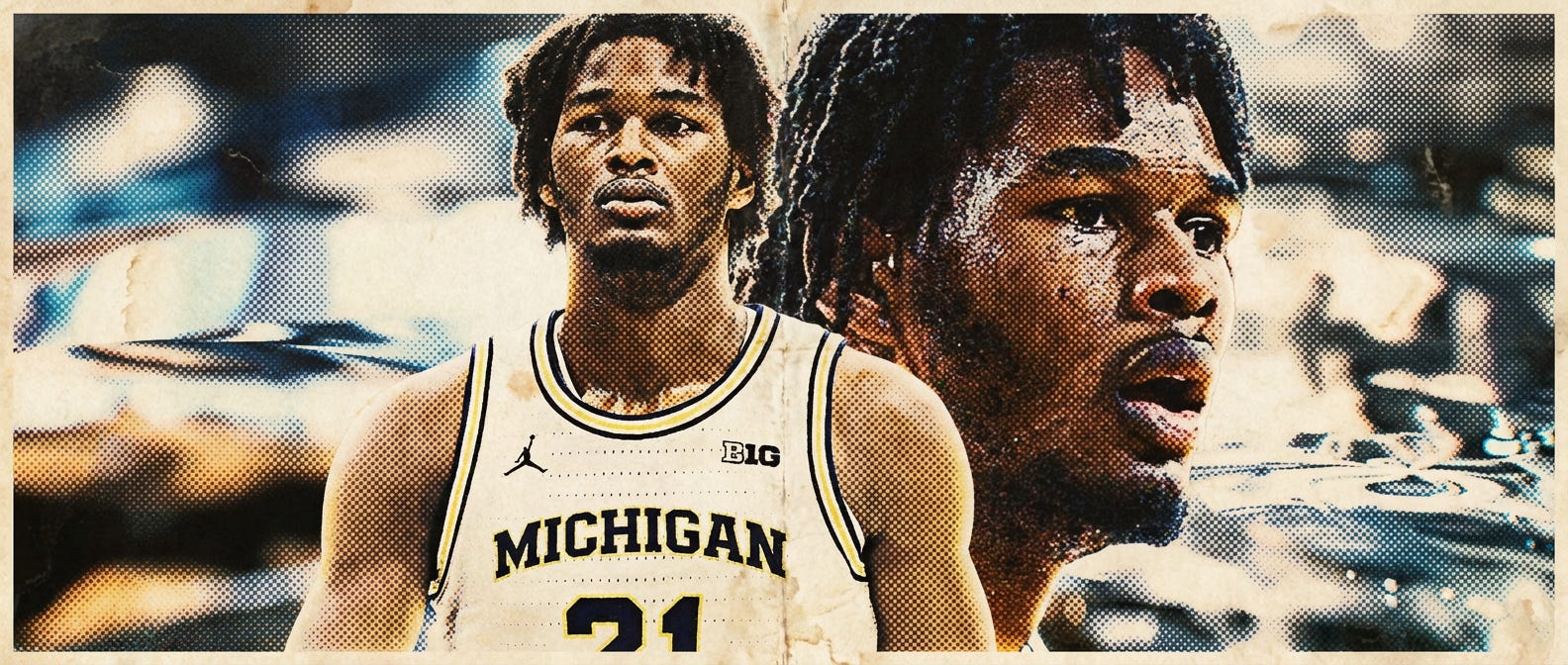
Bias and first impressions are impossible to avoid, but that doesn’t mean that they can’t be overcome. Some prospects immediately show us who they are, while others take a little more time to discover their nuances. That later group often goes underrated and ends up as some of the biggest steals in the draft. Despite whatever preconceived notions we have about their game, they simply produce winning basketball. Michigan sophomore forward Morez Johnson Jr. firmly falls into that bucket as not only one of the most underrated prospects in the 2026 NBA Draft, but as one of the most intriguing big man prospects.
My first exposure to Johnson was at Nike Hoop Summit a few years ago, and frankly, I didn’t get it at all. His motor, rebounding, and lower body strength stood out, but that was about it. I didn’t think he was very skilled, I didn’t buy the shot, and I chalked him up as just another undersized center who would play a long time in college, finding success through sheer force of will.
When he got to Illinois, though, I started to change my tune. His work rate was infectious as he chased every loose ball, rebound, and block attempt like his life depended on it. His impact was instant and undeniable the second he stepped on the court. He wasn’t the most skilled or versatile player on the court, but his will to win ensured that his presence was always felt. What really made me buy in, though, was when I got to see him in person and witness how much his shot had improved in such a short time. I was able to see a glimpse of what his off-the-court work ethic could lead to and what that could mean for his sophomore season, which is a big reason why I entered the year with a first-round grade on him.
This year at Michigan, Johnson has carried over his chaotic energy while also improving on the margins. His scoring touch has improved, we’re seeing him start to space the floor a bit, his passing flashes have become more prominent, and his defensive and rebounding impact haven’t been diluted at all. Johnson is in a great context on one of the best teams in the country, but he is a driving factor for the team’s success.
What stands out the most with Johnson’s game is his defense. Michigan spends a lot of the game playing three bigs at the same time in Johnson, Yaxel Lendeborg, and Aday Mara. Mara is one of the elite rim protectors in the country, and Lendeborg is very disruptive off the ball. At first glance, this seems like a highly conducive environment for anyone to thrive in, and it is. However, what allows Michigan to frequently employ this lineup is Johnson’s versatility. He has the strength to battle with bigs on the interior, the awareness to roam as a weak side rim protector, and the footwork and agility to switch mostly everything on the perimeter. At 6’9” and 250 pounds, Johnson’s ability to sit down in a defensive stance and slide his feet with guards is special. We rarely see that intersection of physical tools and fundamental execution.
If Johnson didn’t move the way that he does, this three-big lineup would be incredibly clunky and difficult to deploy. Johnson also racks up defensive events as he has a block rate of 5.5 and a steal rate of 1.8, per Bart Torvik. Only 16 other freshmen/sophomores of his size in the country can say the same, and only three others from true high major conferences. His defensive playmaking pairs brilliantly with his defensive rebounding rate of 19.6 (22.5 last season). Johnson continues to show that he can end possessions in myriad ways.
Regardless of what metric you look at, Johnson is a driving force for Michigan’s elite defense. When he’s on the court, Michigan has a defensive rating of 90.1 (1st), which jumps to 98.1 (19th) when he’s off, per Hoop Explorer. Additionally, opponents have an effective field goal rate of 41.5 (1st) compared to 46.3 (18th) and a turnover rate of 18.2 compared to 16.4. Even last year with Illinois, Johnson had a similar impact as their defensive rating was 98.8 (17th) compared to 108, and the opposing effective field goal percentage was 43.5 (1st) compared to 49.8. Whether it’s individual metrics or defensive events created or big picture team impact, Johnson has an incredible track record of elevating his team’s defense into elite status.
The reason that these numbers matter is because they are largely translatable as players scale up in competition. Rebounding is one of the most translatable skills, and Johnson has been an elite rebounder for two years now, with offensive rebounding rates of 12.3 and 17.3, along with 19.6 and 22.5 on the defensive end. Additionally, steal and block rates tend to be strong predictors of defensive translation. We can check that box again. What ties it all together is that we can see Johnson’s impact on the defensive end of the floor when we just watch him. He effectively covers all three areas of the court and produces film that is just as impressive as the numbers. Even though his physical measurements may not suggest he’s an easily translatable defender to the NBA, multiple years of elite data and film say otherwise.
The bigger question with Johnson’s translation, though, is his offense. This year is the first time that Johnson has ever really shot threes, and he’s shooting a blistering 41.7%. Elite floor spacer. OK, I may be exaggerating a bit since he’s only taken 12 attempts, but it’s an encouraging sign since just two years ago I didn’t think he’d ever be able to shoot. Aside from the eye test, there are other highly encouraging indicators for long-term success, or at least competency. Johnson has also seen his free-throw percentage, a widely used indicator of scoring touch and shooting potential, jump from 61.8% on 3.0 attempts per game last season to 79.2% on 3.9 attempts per game this season. Additionally, Johnson’s field goal percentage on layups has improved from 60.3% to 69.8%. The game is slowing down for him, and he’s not rushing as much, but the improvement in his scoring touch in a very short time suggests that there are very realistic outcomes for his floor spacing potential, even if it is on just low volume.
That last bit is the key, though. I’m not suggesting that Johnson is going to turn into an elite floor spacer. However, I think he’s much closer to breaking through the threshold as a low-maintenance and low-volume versatile play finisher than people may think. Johnson is still very far away from being able to create his own shots. His handle needs a lot of work, and he can be goaded into unnecessary charge calls. That isn’t really a problem, though, because Johnson rarely plays outside of himself. Instead, he’s grown into one of the most reliable play finishers in the country with an effective field goal rate of 70.9.
Per Synergy, Johnson ranks in the 98th percentile in overall points per possession (PPP). He also ranks in the 81st percentile on cuts, the 96th on post-ups, the 71st as the roll man, 94th in transition, the 71st in offensive putbacks, and the 92nd at the rim. His composure in traffic and processing of the situation has improved tremendously. Not only has his scoring touch improved, but his footwork and patience have as well. It’d be great if Johnson could break down defenders in isolation and hit pull-up jumpers, but it doesn’t matter because those skills aren’t applicable to who Johnson is as a player. He’s a low-maintenance play finisher and one of the best in the country at it.
Since he is an undersized big, Johnson will ultimately have to improve as a shooter to be more malleable in NBA lineups. That or be paired with a legitimate stretch five. I think that development is already well underway for him, but it still needs to happen. The other area of his offensive game that needs substantial work is his passing. It’s great that his assist rate has jumped from 2.7 to 9.1, but that still isn’t a figure to get overly excited about. Also, this isn’t to suggest that Johnson should be a creator, but his connective passing out of offensive rebounds and out of the short roll needs work. Johnson is terrific at finding open pockets to settle into on cuts, rolls, and rebounds, and if he can continue to broaden his vision away from just the rim, his offensive impact will skyrocket. We’re getting more flashes of that this year, but it’s still a crucial part of the game for him to unlock.
I can wax poetic about Johnson’s game all day long, but it doesn’t change the fact that he’s still a tricky archetype to fully buy in on translating to the NBA. We see highly physical undersized bigs fizzle out all the time. There are crucial developments in his game that have to be made. However, his profile this year at Michigan is reminiscent of a lot of bigs who have gone on to have excellent NBA careers. When we look at Johnson’s scoring efficiency, rebounding, and defensive impact figures, he’s in some pretty fun company.
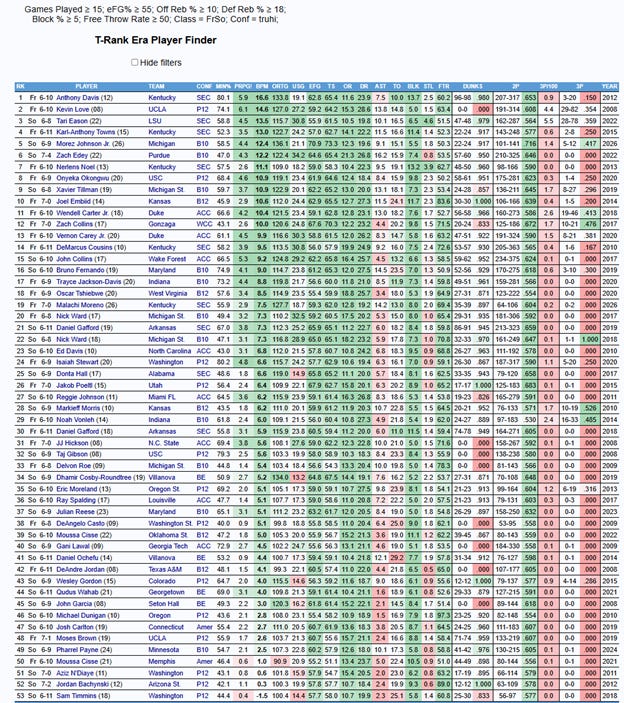
Among that group, Johnson has one of the highest BPMs and the highest effective field goal rate. It also shows us that Johnson tends to play a lot bigger than he is and that there are some very realistic above-average outcomes—and no, Anthony Davis is not one of them. Someone like Isaiah Stewart is one of my favorite comparisons I’ve used all season, and we can see how similarly they line up. At first glance, Johnson feels like an archetype that historically has struggled to translate to the NBA, but when we dig a little deeper into how dominant some of his numbers really are, we find a lot of players with a pretty good track record.
Even if we just look at the other bigs in the 2026 class, Johnson is outperforming nearly all of them. Hannes Steinbach is a draft darling because of his elite rebounding, but he isn’t that much more prolific than Johnson and doesn’t come close in terms of defensive impact or scoring efficiency. Jayden Quaintance has unfortunately not been healthy this year and is a more explosive athlete, but if he were doing what Johnson has been, people would be making a Top 3 argument for him. In terms of short-term development and impact on winning, there aren’t many other bigs who can rival what Johnson has done this season.
Morez Johnson has been one of my favorite players all season. I started the year with him in my 20s and moved him into my top ten about a month ago. I don’t think he has superstar upside, but his elite skills are those that tend to convey across competition levels. He’s an excellent defender, a tremendous rebounder, has an elite motor, and has improvement areas that we’re already seeing take a major leap in a short time. He may not have the sexiest game, but nearly everything Johnson does on the court leads to winning basketball.