


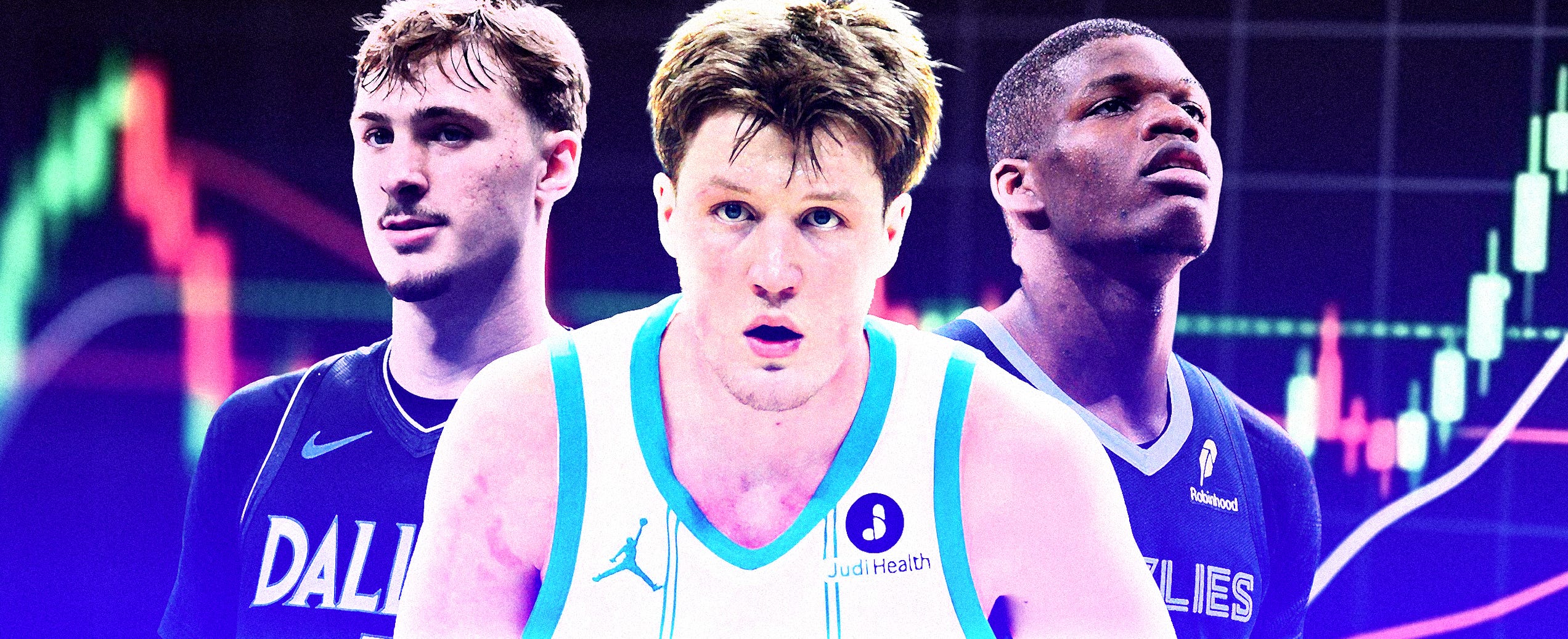
Cooper Flagg was a heavy favorite to win the NBA’s Rookie of the Year Award before the season started. That narrative shifted against him, however, as he and the Dallas Mavericks struggled to find footing early in the year. Flagg was tasked with taking on point guard duties, and struggled as expected to run and balance an offense as an 18-year-old forward-sized player in the league.
While Flagg was figuring out his place in Dallas as a young player, both Cedric Coward and Kon Knueppel were taking the league by storm with their impressive stretches as rookies that still, in large part, have carried through to now.
And other first-year players have thrown their names in the ring, such as Derik Queen and Jeremiah Fears of the New Orleans Pelicans, and others across the NBA.
I’ve been covering this NBA rookie class week-to-week for No Ceilings, and it’s about time for a quarter poll! Who have been the best rookies in the NBA through about 20 games of the regular season? And who are some guys knocking on the doorstep to be considered for All-Rookie honors?
Let’s zoom out and take a look at the class as a whole in this week’s edition of the NBA Morning Dunk!
*All stats referenced are as of 12/7/2025 and are courtesy of Basketball-Reference, Synergy Sports, Cleaning The Glass, and Dunks and Threes*
NBA Rookie Rankings Quarter Poll
1. Cooper Flagg, Dallas Mavericks
2025-26 Season Stats: 17.3 PPG, 6.3 RPG, 3.3 APG, 2.0 STKs, 47.5/25.3/82.2 Shooting Splits
Up until about a week and a half ago, the NBA’s Rookie of the Year race was in the hands of Kon Knueppel of the Charlotte Hornets. Knueppel has done nothing to drop from the top spot; rather, Flagg has risen back to his preseason projected slot due to his brilliant play of late.
Now, Flagg has been good all season defensively; there’s been no “off night” for him on that side of the ball. Flagg covers an immense amount of ground as an off-ball defender, and he has been willing to take on any matchup thrown at him, depending on the coverage. There are still certain quicker guards that can give him trouble at the point of attack, but Flagg has adapted as well as anyone could’ve hoped as a help defender and rebounder.
Offensively, Flagg has found his rhythm as a secondary creator/scorer for the Dallas Mavericks. Now that Dallas is routinely playing one or two guards alongside Flagg who can bring the ball up the floor and take pressure off initiating the entire cadence of the offense, Flagg is in a position more often than not to catch and either drive, shoot, or pass. Rarely does Flagg have to pull the ball back out, reorganize the offense, and create from nothing.
That’s helped Flagg a ton in terms of inside-the-arc efficiency, as a lot of his driving lanes are cleaner with only one man to beat to the rim. And if help has come his way, he’s been able to make the next read and kick the ball back out, or go to one of his favorite counters and post/spin for a fadeaway jumper.
Flagg’s transition offense is still where he does the most of his damage, especially as he’s struggled as a catch-and-shoot player from distance. But overall, his process has been much improved as a secondary or tertiary handler, and the Mavericks have been winning games due to his play, along with getting Anthony Davis back in the lineup plus the addition of one other rookie who I’ll highlight a bit later on.
Overall, the only other rookies who have been as or ever so slightly more productive are Knueppel and Cedric Coward. But when factoring both ends of the floor and responsibility within the hierarchy of the team’s structure, I’ve put Flagg right back atop my rookie rankings and would vote him NBA Rookie of the Year as of today.
2. Kon Knueppel, Charlotte Hornets
2025-26 Season Stats: 18.2 PPG, 5.5 RPG, 3.2 APG, 0.9 STKs, 46.2/41.4/90.6 Shooting Splits
As I stated above, Kon Knueppel has done NOTHING to fall from the top spot in these rankings. Knueppel has been my favorite rookie to watch across the NBA because he embodies everything I look for in a basketball player.
Knueppel takes nothing off the table for the Charlotte Hornets on offense. He’s as snappy of a processor and decision-maker as you’ll find among wing scorers, and always seems to be one or two steps ahead of what the defense is doing to react to his movements and tendencies. That level of preparation, processing, and vision is a rare combination for such a young player.
To that point, the only real area Knueppel has struggled in defensively is getting to the rim at a higher frequency. He wasn’t a high-volume driver in college, but that’s part of his process and self-awareness as a scorer. When he does find himself at the basket off a catch-and-rip or cut along the baseline, Knueppel plays with patience, operates off two feet, and finds a way to convert. He was a better finisher by percentage at Duke last season, but he’s not poor by any means around the basket as a scorer so far in the league.
What’s impressed me the most about Knueppel has been his poise as a primary offensive option without LaMelo Ball and Brandon Miller in the lineup. Through a decent stretch this year where both missed time, Knueppel played a lion’s share of his minutes alongside one or both of Ryan Kalkbrenner and Sion James, both fellow rookies. In those three-rookie lineups, the Hornets were, for a long time, a POSITIVE net rating group per 100 possessions, courtesy of Cleaning The Glass. As of today, the group is a slight negative, but still a remarkable accomplishment given the fact that young players generally don’t drive winning early in their careers.
Yes, a decent portion of that is testament to the defense of both Kalkbrenner and James, but Knueppel’s playmaking and lights-out shooting from all over the floor carried Charlotte offensively to even remain relevant in more than a handful of games. Knueppel can run some pick-and-roll, work off handoffs, play off screens, and even rates as “Excellent” per Synergy Sports as a screener/slipper.
Defensively, there are matchups that certainly expose Knueppel as an on-ball defender, but he doesn’t back down on drives. He does his best to wall guys off and contest using his frame and strength. Knueppel can absorb a bump and stay balanced, meaning one can’t attack him in the same ways as they can other guards who aren’t as big and also lack some lateral mobility.
Knueppel’s anticipation and overall competitive streak are fun to watch on a nightly basis. I would encourage anyone who hasn’t paid much attention to the Hornets to flip on some Knueppel tape, as he’s a player I would point to as an example of how kids coming up in the game of basketball should approach it.
3. Cedric Coward, Memphis Grizzlies
2025-26 Season Stats: 13.4 PPG, 6.2 RPG, 4.7 APG, 0.9 STKs, 45.2/32.7/86.2 Shooting Splits
Cedric Coward has regressed back to the mean in recent weeks from a shooting perspective.
Coward was off to an incredible start with his shooting from anywhere outside of the paint, but he is in the midst of a cold spell as a spot-up scorer.
Despite the recent struggles, the start he was off to as a rookie, coupled with his passing ability and defensive impact, has still allowed him to hold onto this spot in the rankings.
Coward is the Memphis Grizzlies’ best defensive wing by a considerable gap, he rebounds well, and knows how to make timely reads/cuts to free up his teammates or create easy opportunities for himself.
If it weren’t for Cooper Flagg’s offense coming around or Kon Knueppel’s all-around offensive brilliance, Coward would be several open jump shots away from holding onto the top spot in this class. He just fits the mold similar to Knueppel of a player coaches want in the lineup. He takes nothing off the table defensively, and he has clear pathways to manufacturing efficient offense while also flashing upside as more of an on-ball wing.
I would expect Coward’s shooting to swing back in the other direction and even out to a larger degree in his favor. And should that happen, along with his productivity in other areas, consider Coward as near of a lock as one can make in December to finishing First Team All-Rookie by season’s end.
4. VJ Edgecombe, Philadelphia 76ers
2025-26 Season Stats: 14.3 PPG, 5.7 RPG, 4.1 APG, 1.9 STKs, 41.5/36.7/75.0 Shooting Splits
Speaking of shooting/scoring slumps, VJ Edgecombe is a far cry in that department from where he was to start the year during the first few weeks of Philadelphia’s season.
The 76ers have managed to hold onto a middling record in the Eastern Conference despite boasting one of the worst defensive scorecards in the NBA. That’s due in large part to the blistering offensive efforts of Tyrese Maxey and company, with Edgecombe having played a large part to those metrics early in the year.
That’s not to say Edgecombe hasn’t found ways to positively impact winning—even if his shot hasn’t gone in. He’s still a relatively low turnover player given how many minutes he’s played, and has had some games where he’s really shone, making the easy pass or extra skip to an open shot and assist.
Defensively, Edgecombe has some incredible highlights, getting his hands on the ball and even offering some rebounding support out of the backcourt.
Edgecombe’s athletic profile meshes perfectly with the tempo that Maxey and Nick Nurse want the 76ers to play at. His transition-heavy attack is the perfect complement to a bevy of outside shooters. And as Edgecombe continues to round out some of his on-ball skill set, albeit not his strength right now as a pseudo backup point guard, he stands to make another push up near the top of these rankings where he sat not too long ago.
Edgecombe is another rookie I’d be fairly surprised if he didn’t finish on All-Rookie First Team by the time it’s all said and done.
5. Jeremiah Fears, New Orleans Pelicans
2025-26 Season Stats: 15.8 PPG, 3.4 RPG, 3.0 APG, 1.7 STKs, 44.1/36.6/79.8 Shooting Splits
I thought long and hard about putting Jeremiah Fears over VJ Edgecombe for that fourth spot in the rankings, but decided to still reward VJ for how he started the year.
That being said, Fears has been much more consistent offensively over the last few weeks, and he has quietly put together one of the more efficient stat lines in the class for a player who has had as much on-ball responsibility as anyone.
Fears is such a delightful rookie surprise, as young point guards often see their fair share of adversity manning such a difficult position in the NBA out of the gate. But Fears’ explosiveness as a driver, combined with his swift ball handling, has allowed him to create virtually any shot or pass he’s wanted to for the New Orleans Pelicans.
Now, not all of the advanced metrics would point to Fears as the type of guard that my eyes and the tape have told me he’s been to start his career. Still, I don’t hold as much weight early on in regards to advanced metrics because we’re stacking guys who are four weeks in against established veterans who have a clear experienced foothold over them. I tend to not overreact to average or below-average ratings, but choose to call out and reward young players if they’re standing out in a certain area.
For Fears, he’s been a pretty good pick-and-roll guard to start his career, and has made a healthy amount of his pull-up jumpers both inside the arc and from behind the three-point line. That combination of burst, change of gears, and pull-up shooting has lent itself to star ceilings in recent years, and Fears most certainly has that upside for New Orleans.
I’m as curious as anyone to see how this race plays out for First Team All-Rookie, but as of today, I’d give the nod to Fears, who has taken on a heavier usage burden than most in the class while delivering for the Pelicans from a productivity standpoint.
6. Derik Queen, New Orleans Pelicans
2025-26 Season Stats: 12.0 PPG, 6.3 RPG, 3.6 APG, 1.7 STKs, 48.0/11.8/78.9 Shooting Splits
Derik Queen’s play for the New Orleans Pelicans has been a nice little wrinkle to this NBA season, given how consequential the trade was for the franchise to acquire him.
But I’m not here to litigate that trade for the thousandth time. I’m here to praise Queen for what he’s done on both sides of the ball as an active playmaker.
Queen just has that knack for knowing where to be and how to catch players off guard. If Queen is anywhere near the basket defensively, he communicates and anticipates well to rotate and use his quick hands to create a deflection or a blocked shot. And if he’s pulled out away from the basket in a one-on-one situation, Queen is much better than advertised at reading the ball handler’s movements and predicting their next move, and in turn sliding his feet to match said driving pattern.
On offense, Queen’s grab-and-go game is really fun to watch, especially when he makes the decision to attack and go at his man in transition. Queen’s herky-jerky nature can really throw defenders off balance, as he goes to a variety of spins, step-throughs, and fakes to create space and get off some impressive shots.
In terms of what I’d like to see from Queen as we progress through this season, I’d love to see more out of him as a short-roll passer, more than he already is. Queen in the middle of the floor is an ideal handoff partner, and I’d like to see him and Jeremiah Fears continue building chemistry while having a cutting force like Zion Williamson off the ball along with a sharpshooter like Trey Murphy III.
Overall, Queen has looked the part of a foundational building block for the Pelicans along with Fears, and is firmly in the mix for All-Rookie First or Second Team honors.
7. Dylan Harper, San Antonio Spurs
2025-26 Season Stats: 12.8 PPG, 3.1 RPG, 3.8 APG, 1.0 SPG, 46.0/27.6/73.8 Shooting Splits
Dylan Harper has missed a considerable amount of games already as a rookie, but that hasn’t stopped me from ranking him appropriately as an All-Rookie Second Team performer.
Harper just has that “it” factor when he steps on the floor. His driving ability and scoring arsenal in the paint are nearly unmatched by any other rookie in this class. He knows how to draw contact, split defenders, and find passing angles that aren’t there for normal guard operators. His unique combination of first-step quickness, strength, and touch offers him ways to manufacture offense even when his outside shot isn’t falling.
To this point in the season, his jumper hasn’t been there for him. He’s subpar on any type of jump shot this year, and most of his scoring has come from transition opportunities. But I’ve still been impressed with his pacing and passing in halfcourt situations out of pick-and-roll. Harper has a great command and knows how to find teammates even when defenses key in on him and make his life difficult.
As Harper’s shooting likely evens out a bit in his favor, and he gets more reps underneath him as a team defender once Victor Wembanyama and Stephon Castle are back in the lineup, I’d expect Harper’s case to continue to rise as a potential All-Rookie First Team candidate. For now, he’s done enough in my eyes to warrant this ranking, and we’ll see how his game continues to evolve on both sides of the ball as he progresses through his rookie campaign.
8. Ryan Kalkbrenner, Charlotte Hornets
2025-26 Season Stats: 9.1 PPG, 6.7 RPG, 0.5 APG, 2.7 STKs, 80.0/0.0/75.6 Shooting Splits
There’s a pretty clear argument one can make that Ryan Kalkbrenner has been the best rookie center in the class and deserves an All-Rookie First Team vote.
I honestly wouldn’t put up much of a fight against that case, as Kalkbrenner has been the best play finisher in the NBA, and has metrics that back up how much of a deterrent he’s been to opposing drivers, not just a force blocking shots.
Outside of those things, Kalkbrenner hasn’t offered much more YET. There are still some promising touch indicators that Kalkbrenner could stretch the floor and start launching some threes with more regularity. Also, he hasn’t really been used as a passer in handoff or two-man situations up to this point. Primarily, Kalkbrenner has operated as a screener, hard roller, and finisher. When he’s had time to operate on the block, unless it’s been a half-second catch and dunk, Kalkbrenner has turned the ball over at a relatively high rate if defenses have chosen to double him off that action.
Still, for the role that Kalkbrenner has been asked to play for the Hornets, he’s played it arguably better than any other traditional big man across the NBA. And he’s just a rookie. The Rudy Gobert-esque ceiling is very much in play for Kalkbrenner as he expands his game, further improves his strength and conditioning, and becomes more involved in the team’s offensive schemes away from the basket. Kalkbrenner was as dominant of a big man as one could find in college basketball for years, and that ability has translated seamlessly to the NBA.
9. Ace Bailey, Utah Jazz
2025-26 Season Stats: 10.1 PPG, 3.4 RPG, 1.6 APG, 45.3/36.4/77.3 Shooting Splits
Ace Bailey came into the NBA known for his shot-making ability, and he has lived up to that billing already for the Utah Jazz.
The Jazz are primarily using Bailey as a catch-and-shoot threat, but he’s already been so effective in that role. As a jump shooter, Bailey has hit nearly 36% of his catch-and-shoot threes and 43% of his three-point attempts off the dribble. And when Bailey has been able to cut to the rim or run out in transition, Bailey has finished almost 70% of his looks at the basket.
Now, there hasn’t been much other utility to Bailey’s game as a more well-rounded offensive player up to this point. But he’s used his length well defensively to contest shots and make life more difficult for opposing wings, and has stepped into a defined offensive role and made the most of it.
At some point, I’ll want to see more from Bailey as an on-ball decision maker as he progresses towards his star ceiling. His ball-handling was a question mark in college despite showing some flashes as a really nice passer. He’s been positive in terms of his assist-to-turnover ratio up to this point, but I am curious how that might play out if more of his offense was skewed towards more reps as a drive-and-dish threat rather than an immediate shooter off the catch.
Regardless, Bailey stands to rise up these rankings as he gets more minutes and starts with the Jazz despite a rocky start to his career. Bailey is so naturally talented, and he’s fun to watch within Will Hardy’s offensive system that prioritizes ball and player movement.
10. Egor Demin, Brooklyn Nets
2025-26 Season Stats: 8.3 PPG, 3.3 RPG, 3.7 APG, 1.1 STKs, 38.0/35.1/85.7 Shooting Splits
I’ve yet to write words about or discuss much of Egor Demin’s rookie campaign, but better late than never!
The rookie guard has put together a very solid campaign for the Brooklyn Nets outside of raw field goal percentage. His two-point scoring has most certainly been a concern, as he hasn’t found his footing much of anywhere inside the arc.
But, we’ve seen some great shooting performances from Demin as a three-point shooter, and the passing is as good as advertised, albeit not leading to as many assists as are on the table when Demin is at the controls.
Demin’s creativity as a passer is the main trait that stood out for him as a prospect, and he’s maintained a 76th percentile rating in terms of possessions plus assists per Synergy Sports. Few players at his size are able to deliver passes on target like Demin from a variety of angles, and his vision even as a stationary playmaker is a great pairing with other Nets players like Danny Wolf, Nic Claxton, Michael Porter, and Noah Clowney.
Defensively, Demin has actually been really solid for a perimeter player. Demin can stick with opposing guards, as he slides his feet well and has great size and length for containing other backcourt opponents. He reads the floor well as well, and knows how to rotate and use said length to contest shots around the rim.
As more of Demin’s game comes together, it’s not crazy to suggest he may end up being one of the best players to come from this draft class in the vein of Josh Giddey. Now Giddey has had the time to become stronger and further develop as a driver and scorer at the rim. Should Demin make those same strides over the coming years, along with his similar passing ability and better defensive chops, he could come up in All-Star conversations at some point in his career.
Honorable Mentions
Collin Murray-Boyles, Toronto Raptors
2025-26 Season Stats: 7.4 PPG, 3.3 RPG, 1.3 APG, 1.0 STKs, 55.7/48.0/66.7 Shooting Splits
Collin Murray-Boyles has been pretty great in his first NBA season so far; I more so wanted to reward the unsung Egor Demin with the last All-Rookie Second Team spot in my rankings. But if someone wanted to argue CMB as a deserving candidate for those honors, I wouldn’t stop them.
With Murray-Boyles, he’s very much been the player I expected early on. I didn’t rate him as highly in my preseason awards picks because it was my humble opinion that he wouldn’t pop as much in the raw numbers as some of the other members in the rookie class. Outside of his three-point percentage, that’s largely been the case.
But if you watch the tape and take note of all the different things Murray-Boyles does on the floor, it’s clear that he’s as sound as his peers from a vision and awareness standpoint on both ends of the floor.
There’s real upside for CMB as a ball-handler and halfcourt initiator, given how he can create off the bounce. He’s so powerful as a driver, and he should develop into someone who commands double teams, given how strong he is—which naturally opens up passing opportunities for a creative lefty disher.
If the spot-up improvements are real for Murray-Boyles, there’s a sleeping offensive giant waiting to further explore more of his game as he gets healthy and more minutes for a competitive team in the Toronto Raptors.
One thing to keep an eye on: the Raptors haven’t been able to tread water defensively with CMB as a five in the team’s scheme. A selling point for Murray-Boyles pre-draft was supposed to be that one might be able to get away with him as a small-ball five due to his length and strength combination. If he’s going to skew more towards the perimeter as a forward, the shooting becomes more important for him to maintain at least at a league-average level, despite how good he is as a downhill finisher.
Will Richard, Golden State Warriors
2025-26 Season Stats: 7.9 PPG, 2.6 RPG, 1.1 APG, 1.0 SPG, 53.0/38.2/77.4 Shooting Splits
Will Richard’s athletic, skill, and competitive profiles suggested he could come into the NBA and play a role right out of the gate coming out of Florida. To those who believed this could happen, kudos because it has.
Richard has had some really bright moments already for the Golden State Warriors, stepping right in and playing his part, cutting, moving without the ball, and shooting within Golden State’s motion-heavy offense.
And defensively, Richard just has another gear that he can hit as a team defender. It’s one thing to see him get into a stance on the ball, but he reads passing lanes well and is lethal when he gets out in transition.
Even if there isn’t a ton more to unlock with Richard on the ball, he’s tailor-made to play a role off the bench or even as a fifth starter for a long time in the league, for good teams too. He’s been one of the best rookies in the NBA, and is someone I’m keeping an eye on for a potential All-Rookie spot.
Sion James, Charlotte Hornets
2025-26 Season Stats: 6.6 PPG, 3.1 RPG, 1.5 APG, 1.2 STKs, 41.6/38.0/85.7 Shooting Splits
Sion James is another one of those awesome rookies who’s playing for the Charlotte Hornets, and he’s gone about his business differently than Kon Knueppel and Ryan Kalkbrenner.
Similar to Kalkbrenner, his best moments have been on the defensive end of the floor, carving out a starting spot when one or both of Brandon Miller and LaMelo Ball have missed time for the Hornets.
I’ve never seen a defender the size of James with his 6’6” 220-plus pound frame navigate and get over screens so effectively, but it’s what makes him a jack-of-all-trades defensively. He’s got great hands, boxes out well for rebounds, knows how to position himself off the ball, and really gets after it as a one-on-one defender.
What Kalkbrenner has done for Charlotte defensively around the basket, Sion has made similar strides away from it on defense. He’s been so good on tape, that I can’t imagine a scenario where James falls out of the rotation despite him being a bit streaky from a shooting standpoint over the last few weeks. After a blazing start, he’s still at a 38% clip from downtown, and has been useful as a spot-up shooter and attacker of closeouts given his secondary passing chops.
There’s absolutely a world where James ends up on an All-Rookie team, giving the Hornets three performers for those honors, which would be the most since the Cleveland Cavaliers had four rookies on the teams back in 1999.
Tre Johnson, Washington Wizards
2025-26 Season Stats: 11.5 PPG, 3.0 RPG, 1.3 APG, 0.9 STKs, 44.5/39.5/81.3 Shooting Splits
For what it’s worth, I actually think Tre Johnson should be higher than an honorable mention in my rankings.
The issue is that the Washington Wizards haven’t unleashed Johnson enough to play to more of what he’s capable of doing offensively. As of now, Johnson’s value on the court is tied in large part to whether he’s making or missing shots as a spot-up scorer or transition hit-ahead threat.
As the season has gone on, he’s gotten more reps as a pick-and-roll scorer and actually has done well on those looks. So much so, I want that number to keep going up! His efficiency drops when factoring in passes in pick-and-rolls, but he has the ability to move the ball after coming off that initial screen. Tre was an underrated passer at Texas because he didn’t take as much advantage of finding guys, given his nature to score the basketball.
The only way for him to improve as a distributor is to provide him with more opportunities to do so. Bub Carrington hasn’t separated himself as the long-term point guard answer for the Washington Wizards, and we don’t know how much longer CJ McCollum will be on the team. So, outside of Kyshawn George and AJ Johnson potentially getting more run as lead initiators, I’d love to see the Wizards go to Tre more often, or at least get a bit more creative with utilizing him off movement as a shooter rather than relying on him to sprint to the corner.
Ryan Nembhard, Dallas Mavericks
2025-26 Season Stats: 8.9 PPG, 1.6 RPG, 4.8 APG, 0.3 SPG, 56.3/53.6/66.7 Shooting Splits
He hasn’t played in many games yet for the Dallas Mavericks, but Ryan Nembhard could drastically rise in my rankings by the time I do a midseason check-in. He’s had that level of impact on Dallas’ offense over the last few games.
Most importantly, he’s the best guard on the roster at actually probing the defense off a ball screen and taking advantage of any space the defense affords him. His mid-range game is lethal; should defenders play up more at the level of the screen and bring pressure, Nembhard has the vision to make the right pass, and the ball-handling craft to split defenders and still knife his way into the paint.
Nembhard’s poise as a lead guard has been impressive, to say the least. Where he’s doing more damage than I expected is as a three-point shooter. He’s not likely to shoot over 50% from deep over the course of the season, but even if he regresses to a league-average mark, that’s a nice step forward for a player who was a streaky shooter through most of his college career.
Dallas should’ve given Nembhard more opportunity earlier on, but I digress. His partnership with Cooper Flagg looks legitimate, as those two on the floor over the last several games have generated league-best PPP ratings per Synergy Sports if those numbers were over a full-season sample. Granted, this entire season right now is small sample size theater, but still, it’s impressive given where this Mavericks team has been offensively so far this year.
Obviously, I need a longer runway from Nembhard in order to bump him into territory currently manned by guys who have played significantly more minutes. But in terms of the quality of play from Nembhard so far, he’s been as good as any rookie over the last week.
Wolf is gonna be ROY
No mention of Asa Newell seems like a big miss…