


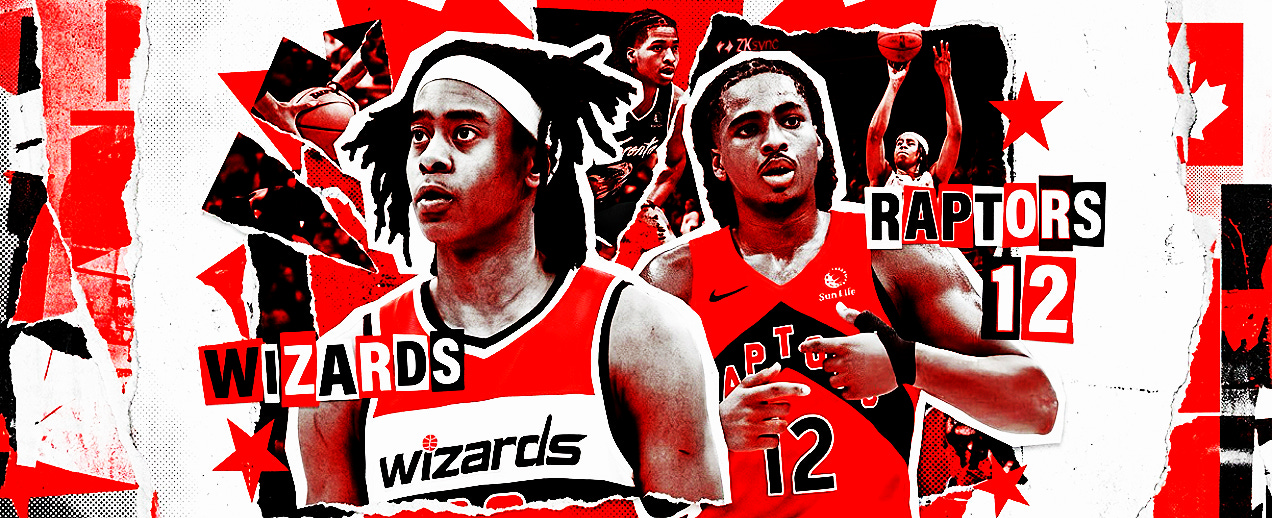
Tre Johnson and Collin Murray-Boyles have jumped off the page in the NBA over the last month as the All-Rookie and Rookie of the Year races round into shape.
We’re at a halfway point in the NBA, fighting through the “dog days” of January on the way into G League call-ups, trade deadline buzz, and the All-Star break. End of January/beginning of February is always a busy time across the league, but what comes after also brings with it a lot of excitement for die-hard fans of the youngest talent.
Post All-Star breakouts happen every year for NBA rookies and sophomores, which means it’s a great time to take inventory on where we stand today in the award races, but also mention some names who could really “pop” from this first-year class over the coming months.
I’m here to provide an updated look at my latest rookie rankings, offer some notes on select players from the class, and provide some players who should be on the “post All-Star leap” list for fans.
Let’s get started with a shake-up at the top of my rookie rankings, and dive specifically into the games of Johnson and Murray-Boyles!
NBA Rookie Rankings
1. Kon Knueppel, Charlotte Hornets
2. Cooper Flagg, Dallas Mavericks
3. VJ Edgecombe, Philadelphia 76ers
4. Derik Queen, New Orleans Pelicans
5. Cedric Coward, Memphis Grizzlies
6. Dylan Harper, San Antonio Spurs
7. Collin Murray-Boyles, Toronto Raptors
8. Tre Johnson, Washington Wizards
9. Maxime Raynaud, Sacramento Kings
10. Jeremiah Fears, New Orleans Pelicans
NBA Rookie Notebook
Tre Johnson: All-Rookie First Team Dark Horse
Don’t look now, but Tre Johnson has been heating up since December in the NBA’s All-Rookie race.
After not seeing as much time/usage on the court to start his career, the Washington Wizards have been putting the ball in his hands more often, be it pick-and-roll attempts or getting him shots off movement, and the offense is benefiting in a big way.
Everyone is familiar with Washington’s struggles on the court, given the team’s overall record. A lot of that has to do with their youth and inexperience, causing lineups to get obliterated on the defensive end of the floor. We won’t discuss how much of that is by design in this piece, but the only way to attempt to counteract poor defense is with excellent offense.
That’s where Johnson comes in as one of the best shooting prospects we’ve seen enter the NBA in quite some time. On the season, Johnson is at 39% from deep on 10 3PA per 100 possessions, which is a very healthy mark for a rookie perimeter scorer. To add further context, Johnson has connected on 41.5% of his jump shots overall, hitting 39% on his catch-and-shoot threes while also nailing 38.5% of his threes off the dribble! Not to mention 48.5% of 66 pull-up twos isn’t a bad mark either. Bottom line, Johnson was billed as a shooter’s shooter coming in, and he’s lived up to all of the hype in that regard.
On the season, Johnson is now up to 35% of his possessions spent in pick-and-rolls including passes per Synergy Sports, generating almost a full point per possession within that play type, which is fairly strong for someone who hasn’t been viewed as much of an on-ball playmaker in his pre-college career.
To be clear, those prior evaluations (at least from many of us at No Ceilings) didn’t suggest that Johnson COULDN’T pass. Rather, he’s been so hard-wired to score first, where we didn’t see some of Tre’s best passing craft until it was the only thing left for him on the table in said offensive possessions.
However, upon re-watching more Wizards tape, Johnson has become a bit more willing to find those reads, even if, more often than not, his usage ends up in a shot attempt. I’m still a bit concerned with where his turnover rate in those play types sits (14.7% on the year), but he’s displayed enough craft when running ball screens to where I want to see the volume uptick as we move into February in large part because the Wizards don’t have a great option at point guard with Trae Young continuing to (and likely will for the forseeable future) miss games.
Where Johnson’s profile gets the messiest isn’t actually on the defensive end, but rather still with one particular aspect on offense. Johnson doesn’t frequently get all the way to the rim (ninth percentile in at-rim frequency), which, in my humble opinion, isn’t the end of the world given his ability to make shots from everywhere else. However, he’s only making 41.8% of his layups at the basket, which is an incredibly low number for any NBA player.
I don’t particularly love how adverse Johnson is to contact when he’s going at the rim. He doesn’t look to take angles that could reward him with free throws in his efforts to absorb contact. That leads to his layup attempts looking a bit “acrobatic” out there, which is problematic as he’s making those attempts much more difficult than they need to be (see: LaMelo Ball).
Now that doesn’t mean he can’t improve that part of his game. When he attacks the basket with one man to beat, he has the touch to kiss the ball off the glass on runners, or even finish on reverse attempts. It’s when he drives in traffic that these issues arise, either due to lack of contact or an unwillingness (inability?) to use his off hand.
I’ll be monitoring that part of his game in particular, as it’s the main thing on offense other than not recognizing more advanced passing reads in pick-and-roll that’s holding him back from borderline top-tier production on a per-minute basis in the league even as a rookie.
Defensively, Johnson has actually been better than I expected, contesting shots on the ball using his length. There are most certainly lapses where he gets caught on screens, doesn’t recognize a screen coming, loses his man off the ball, or falls short in help defense. When he’s on an island against an opponent, though, Johnson has the tools and length to battle and make his man’s life more difficult than one would expect from a rookie.
Even with all of these shortcomings laid out, I’ve been super impressed with where Johnson is as a rookie. If he can continue to trend upward in terms of offensive production, he’ll have a real case as an All-Rookie First Team winner. As it stands today, the Wizards are already +5.0 points better per 100 possessions when Johnson is on the floor, meaning his shot-making and effort on the ball defensively are making a difference. Washington isn’t a good team either way, but these are meaningful signs to see from a lottery pick in just his first season.
We don’t have enough lineup data around Alex Sarr, Kyshawn George, and Johnson to know just how good this trio can be with the help of another high-level lottery pick and a veteran steering the ship in Young. But the individual results from all three this season leave me very optimistic about the future in Washington. As we move out of January and into the last few months of the season, don’t be surprised if Johnson starts popping into one of those five All-Rookie First Team spots in published rankings (including mine).
Collin Murray-Boyles Is Turning Heads On Both Ends
Currently this season, there are only two other players matching Collin Murray-Boyles’s production in terms of True Shooting efficiency and rebounding, assist, steal, and block rates. Those two players are Paul Reed (half the minutes of CMB) and Walker Kessler (out for the rest of the season).
That’s the list.
What this “query” illustrates is just how unique Murray-Boyles’s game is. Draft evaluators already were aware of this, as few 6’7” forwards have the ball-handling, passing, and defensive playmaking chops in one package. Murray-Boyles has outlier strength and handling abilities as a combo forward that tie his game together quite nicely, but his mind is his superpower in terms of his overall reaction time and how quickly he can slide in and out of plays on both ends of the floor.
Murray-Boyles has spent most of his time on the move offensively, be it in transition or as a cutter/roller in the halfcourt. Not only does CMB shoot a high percentage on those play types, but what he offers as a live-dribble passer is even more enticing to the Toronto Raptors offense.
I witnessed several of those dimes live this season, where he would make plays few at his size in the NBA can make. It’s not just the recognition and court mapping from CMB, but the pass placement and delivery through tight windows that’s unusual for a forward.
Looking at Murray-Boyles, he appears upon first glance as a bruising bulldozer who lives around the basket. To an extent, that’s actually a fair evaluation. 67% of his total field goal attempts have come at the rim this season, which shouldn’t be a shock to anyone, considering he’s making 65% of those looks. CMB knows who he is and where he’s best at on the court, and it’s attacking downhill and leveraging his strength, coordination, and live-dribble passing to his advantage. If teams double or stack defenders on his side of the floor, he’ll make that skip read, which leads directly to an assist or “hockey assist” on the play. Should Murray-Boyles get the opportunity to cut to the rim or attack one man, more often than not, he’ll have an advantage over that sole defender due to his strength profile or ball-handling/footwork going against bigger forwards and even centers.
What hasn’t happened much for CMB up to this point in his NBA career is working out of the post. Per Synergy, Murray-Boyles has registered only EIGHT possessions in post-ups, including passes, which is a far cry from his days at South Carolina in college, where he spent almost 33% of his time in said play type during his pre-draft season.
Now, there are obvious answers as to why he’s been featured more as an off-ball, secondary or sometimes tertiary option on the court. Star players like Brandon Ingram and Scottie Barnes love to operate in similar spots from the high or low post, not to mention the tendencies of a driver like RJ Barrett when they share the floor together. CMB doesn’t have full command over this team’s offense like he did at USC, so he’s had to adapt and find other ways to contribute.
Enter the shooting improvements from Murray-Boyles in just his rookie season. CMB attempted 39 threes TOTAL in two years at college, but has attempted 43 already THIS SEASON for the Raptors and has made 35% of those looks! Defenses have (rightfully so) given Murray-Boyles oodles of space to work with at times, sagging off him in favor of double-teaming the aforementioned offensive focal points of the team. Even if the attempts haven’t been quite as plentiful in recent weeks, CMB overall on the year has been willing to step into those shots and fire with confidence. The mechanics don’t look broken, the release point is solid, and the shot gets off at a decent speed, even if it could use more repetitions to quicken up a smidge.
If CMB is emerging as a reliable three-point shooter in the NBA, it changes the dynamic around him completely on offense. Defenders having to respect his shot from distance is bad for them because giving CMB any advantage to attack that closeout and muscle his way to the rim OR find that next man on a skip pass bends defenses in ways that create advantageous possessions for the team’s more polished scorers. Murray-Boyles could even attack, get off the rock, re-post depending on floor balance, and attack matchups one-on-one on the block. These are the types of ways in which his game can evolve rather quickly, depending on the continued progression of his outside shot.
Here’s the fun part with Murray-Boyles: I haven’t even gotten to how he completely blows up opposing offenses as a defender yet. In college, CMB was known for being a one-man wrecking crew, able to switch out and pick up an opposing perimeter player one possession while defending a big in the post the next.
His “superpower” on the floor, apart from his mental processing, is his lateral agility moving side-to-side at his size with the weight he’s carrying. CMB has incredible feet for a forward, which allows him to stick with several matchups and switch all over the floor. Combine that with his feel and lightning-quick reflexes, and all of a sudden, he’s not only guarding opponents one-on-one, but also playing passing lanes and rotating to block shots and create deflections as a help defender. CMB’s 7’2” wingspan most certainly helps in that regard, but he just sees things evolving over time within possessions quicker than most players in the league.
Where I’ve seen the most improvement from CMB in the league defensively so far has been from the center position. Per Cleaning The Glass, the Raptors are +2.5 points per 100 possessions BETTER when CMB is not only on the floor, but playing center. He’s spent 93% of his minutes operating as a small-ball five, so seeing Toronto trust him with those minutes and responsibilities is refreshing, especially considering those lineups were getting blown off the floor in November into early December when he was the sole big on the floor.
The best news for CMB’s future outlook with the Raptors is that he’s benefiting from and helping the Raptors win their minutes when he shares the floor with both Barnes and Ingram. Both established stars appear locked in for the long term in Toronto, so it’s excellent to see the team’s best young prospect meshing well on both ends of the floor with that pair.
And the success makes complete sense. Murray-Boyles doesn’t need to command top-tier usage to impact the game on offense, and he offers versatility as a switchable small-ball five who can play some of those gaps and make up for shortcomings from the other players on the floor defensively.
I may very well be too low with CMB’s rookie ranking as it stands. The counting numbers won’t blow anyone away outside of the aggressive uptick in his shooting compared to his collegiate profile. That was my exact sentiment preseason when I ranked Murray-Boyles on my All-Rookie Second Team. I didn’t think his numbers would put him in the running for a First Team spot, but if you actually watched the games, CMB would stand out as one of the ten most impactful rookies on both ends of the floor without question.
Don’t rule out a greater rise from me in terms of CMB’s rookie ranking as this season progresses, regardless of how ballots shake out for awards voting at the end of the year. Collin Murray-Boyles is DAMN GOOD at basketball.
Cooper Flagg vs. Kon Knueppel: Ultimate Duke Rookie Rivalry
Admittedly, I still don’t know where to end up in the NBA Rookie of the Year race with my rankings between Cooper Flagg and Kon Knueppel.
On one hand, Flagg has maintained his defensive presence while consistently getting better on offense as he’s gotten more help from his backcourt mates. Sliding down to the small forward position is what’s worked best for Flagg, especially when he’s shared the floor with Anthony Davis and PJ Washington.
Per CTG, a Dallas Mavericks lineup with Flagg, Davis, Washington, and Ryan Nembhard is +29.2 points per 100 possessions with a defensive rating of 91.0. That’s a pretty staunch defensive mark that makes complete sense given the size, length, and versatility of that frontcourt with a lead initiator who can take a lot of pressure off Flagg on offense.
That being said, Davis looks out for an extended amount of time and may not be on the roster after the trade deadline altogether, so I do wonder how that will impact Flagg moving forward. Does Dallas experiment with some more creative frontcourt lineups, further sliding Flagg down and going a bit smaller? Or will Flagg keep getting reps as a primary ball handler despite mixed success in those minutes?
No matter which way you shake it, Flagg has handled a higher scoring load for the Mavericks incredibly well, especially when he’s gotten looks in the halfcourt where he’s been able to come off another action, catch, and immediately attack off the bounce. His three-point shot continues to be the swing skill that will eventually unlock more of his output on that end, but even as it stands, Flagg just turned 19 years old and is producing in ways NBA teams could only dream of from a rookie that young.
In the month of December, Flagg averaged 23.5 PPG, 6.2 RPG, and 4.8 APG with a 59.5% true shooting mark in almost 36 minutes a game. He hasn’t matched that line through seven games in January, but that’s quite the progression from where he was to start his career in October and November. Significant growth in a short amount of time is a welcome sign for Flagg, who is very much a contender for Rookie of the Year.
On the other hand, Knueppel has been freaking awesome basically the entire season with no lulls in his production, even when both LaMelo Ball and Brandon Miller were out of the lineup. In such games where he basically shared the floor with Miles Bridges and a bunch of other rookies, Knueppel steadied the ship so that the Charlotte Hornets were still respectable in those outings.
Since Ball and Miller have been in the starting lineup with Kon full-time, Charlotte is +11.5 points per 100 possessions with an offensive rating of 130.5. Regardless of where the defense currently sits (which isn’t great, but progressing with more Ryan Kalkbrenner and Sion James), that offensive output is pretty bonkers. Turns out surrounding Ball with TWO dynamic shooters and one of the best at-rim finishing combos at center in the league in Kalkbrenner and Moussa Diabate is a great way to manufacture offense! Who could’ve predicted that!
Let’s not take credit away from Knueppel, though. NO other rookie in the history of the league has made as many threes as quickly as he has. On the season, Knueppel has made 43.6% of 411 total jump shot attempts, including 41.5% of his catch-and-shoot threes AND 47.1% of ALL jump shots off the dribble, from inside and outside the arc. That’s not just a heater; that’s like Top 5 shooter in the NBA type output from Knueppel.
Kon has manufactured efficient offense on or off the ball, no matter what part of the floor. Even on shots at the basket, a spot where he doesn’t frequent often, he’s still almost 61% shooting. As a ball handler, short-roll threat, pop guy, or movement shooter, Kon just makes almost everything he looks at while contributing as a high-level playmaker and effort giver on defense.
I’ve moved Knueppel back ahead of Flagg in my rankings because he’s just been so consistent. Every single night, you know what you’re getting from Kon, no questions asked. Does he have as much on his plate each time out as Flagg? No, but he’s also had to play stretches without his best teammates as outlined prior, and really held his own in a role not many expected him to play at different points in his career pre-draft, let alone right away in his first season.
It’s a close race with the spot open to still be claimed by either Flagg or Knueppel, but at this moment in time, I’m rewarding Knueppel with the top spot in my rankings.
Honorable Mentions/Rookies To Watch Post All-Star
Egor Demin, Brooklyn Nets
Will Richard, Golden State Warriors
Caleb Love, Portland Trail Blazers
Ryan Kalkbrenner, Charlotte Hornets
Danny Wolf, Brooklyn Nets
Hugo Gonzalez, Boston Celtics
Walter Clayton Jr., Utah Jazz
Ryan Nembhard, Dallas Mavericks