


The 2026 NBA Draft class is widely regarded as potentially one of the best ever.
The Top 3 are all viewed as franchise-changing talents; several guards are believed to have all-star potential, and the older prospects are expected to make day-one impacts on competitive teams.
We are still years away from learning if that’s true.
In fact, many watching the youngsters for the first time in their debuts would find that to be ludicrous.
Most of the class struggled to score the ball in their first taste of NBA action. Yet most found ways to adjust the next time out.
What’s clear is that all the rookies who’ve got some burn so far have flashed what made franchises invest millions in them.
With that in mind, I wanted to take a look at how the lottery picks have fared in their first tastes of NBA action.
For clarity, these aren’t projections of what they’ll become; a few haven’t even played, but rather extensions of my pre-draft scouting reports, with one or two measly NBA data points to see how their strengths and weaknesses have translated to the next level so far.
Important Note: Writeups were completed before the games on 10/24. All stats are as of 10/23.
Let’s discuss.
#2. Utah Jazz — Darryn Peterson
Peterson made an early impact in his debut vs. the Grizzlies with three decisive possessions. He played with pace, got to his spots, and finished through contact for and-ones.
Then for much of the second half, he just disappeared.
He passed up open threes against Memphis drop coverage, as if he wanted to defer to others or was reluctant to shoot.
Defensively, he struggled to navigate screens and chase, and it didn’t help that the Jazz ran drop coverage while Ty Jerome got high ball screens and made shots like he was Stephen Curry.
On Friday night, he took five more shots, but he still didn’t feel like the ultra-aggressive scorer we’ve come to know.
But he didn’t need to, especially this early in his career.
The Jazz have three other mouths to feed. Peterson was more assertive than in the second half of the Grizzlies game, and all of his buckets came within the flow of the offense. He was best off the ball. The rookie cut to the basket, crashed the offensive glass, filled lanes in transition, and spotted up for catch-and-shoot threes.
This guard-to-guard screen action was my favorite play from Peterson vs. the Pelicans.
Peterson can be more aggressive as a pull-up three-point shooter; his 15.7% three-point attempt rate is far too low, but this pull-up was a step in the right direction. He missed it badly, but his ability to catch and fire with even a sliver of space was one of his main selling points coming into the league. Going forward, he should lean into that more.
I also thought Peterson improved defensively in his second outing. He still got caught on some screens, but he shaded and recovered better. Dejounte Murray scored on the rookie as he heated up in the second half, but down the stretch he helped the Jazz get crucial stops to secure the win in their home opener.
Despite his passivity in his debut and willingness to scale into a complementary role, I thought it was notable that in the game's biggest moment, Will Hardy trusted Peterson with the ball—and he delivered.
#3. Memphis Grizzlies — Cameron Boozer
Neither Cameron Boozer’s poor shooting nor his incredible plus/minus told the story of his debut.
Boozer shot poorly and struggled to score over Lauri Markkanen and Jaren Jackson Jr.
But most of his looks came in rhythm and within the flow of the offense. He missed shots, but his process wasn’t poor.
Boozer rebounded the ball well, made quick decisions, and his screening created opportunities for Jerome to get shots.
However, in 26 of his minutes, he intertwined with Jerome as the guard put on one of the best displays of tough shotmaking I’ve seen this season, and the Grizzlies blew out the Jazz with Boozer on the court, though he wasn’t always making impact plays.
He struggled and had some learning moments at five on defense, but the box score was deceiving on both fronts.
In his second outing, water met its level.
I don’t think Boozer changed much in his process. He played within the flow of the offense and took shots that came to him. He crashed the glass and made quick decisions as a distributor.
The shots just fell, especially from three.
His biggest areas for improvement so far are scoring inside the arc and operating in traffic or tight spaces. Boozer is shooting 26.7% from two-point range through two games, which should improve—he won’t miss many looks like the shot below.
However, I think Boozer’s handle and footwork against pressure and in traffic are bigger concerns that date back to his time as a Blue Devil.
That plagued him down the stretch in his first high-leverage moments as a Grizzly.
Yet I was impressed by his ability to stay resilient, rise to the occasion, and get his first game-winning bucket—from two, might I add—to help Memphis start the season 2-0.
#4. Chicago Bulls — Caleb Wilson
Wilson debuted against one of the NBA’s strongest wing defender duos, and it went as expected.
The rookie struggled mightily, finishing 7-for-21 from the field and turning the ball over nine times as he tried to handle the ball and operate in tight spaces.

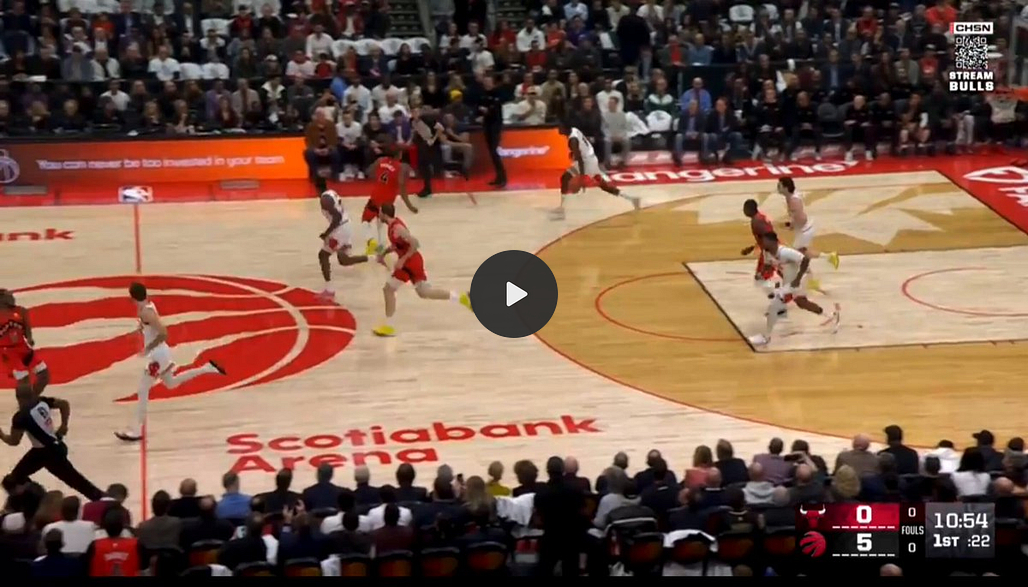
When the Bulls got him moving in open space, or when he got out in transition, he succeeded, and his athleticism popped. Wilson still has a ton to learn defensively, can tend to be undisciplined and unsound, and that hurt him in his debut. However, he was one of the few Bulls to crash the boards hard, show any fight, or make any defensive highlight plays in the rout.
Friday night, the competition was lighter, and Wilson led Chicago with 21 points, six rebounds, and three steals as the Bulls completed a comeback win over the Bucks.
The forward was quiet in the first half but exploded for 12 points in the second quarter and made clutch plays to help the Bulls avoid a 0-2 start.
More importantly, when Chicago needed a bucket down the stretch, he looked to score and was unfazed from the free-throw line late.
Wilson still struggled to create off the bounce. His handle is the most pressing facet of his development, and his scoring process can be rough at times. The rookie remains undisciplined on the perimeter and has had lapses off the ball.
But his highs have been high. His display of athleticism has been tantalizing, and he has the mentality of a player who knows he needs to be the face of a franchise.
#5. Los Angeles Clippers — Keaton Wagler
While most rookies struggled to get the ball in their debuts, Wagler scored 15 points efficiently and added five assists. Though it was against the Sacramento Kings, one of the league’s worst defenses, his process was sound and should translate against tougher competition. The rookie played within the flow of the offense, making quick 0.5 decisions as scorer and decision-maker off of the catch.
Watch him attack Emanuel Sharp’s top foot off the catch, drive past him, and finish at the rim.
Even on this fourth-quarter airball, he correctly read the drop defender coming off a handoff and got to a pull-up three.
In Wagler’s second outing, he couldn’t maintain his efficiency and turned the ball over more, but the guard didn’t struggle to score or make decisions.
However, he struggled defensively. Wagler got caught sleeping or over-helping off-ball a few times and conceded drives; both Austin Reaves and Colin Sexton showed why he needs to keep adding to his frame.
Overall, it’s been an encouraging start to Wagler’s career. In a period where Clippers fans don’t have much to look forward to, their rookie looks like he can be a key contributor to a serious team, whenever that may come.
Among rookies, he leads the league in free-throw rate, three-point makes, and three-point percentage.
#6. Brooklyn Nets — Mikel Brown
After a lone season at Louisville and a reported September ankle injury, the main takeaway from Mikel Brown’s debut was that he looked healthy.
Of course, he was erratic and sometimes a little out of control. But viewers got a taste of the Mikel Brown experience.
He took a few incredibly deep threes, tried to dunk on a seven-footer, and made wow passes. He looked as athletic and creative as he did last season when he was healthy, and that should excite Nets fans.
Brown ran the two-man game with Randle well, found his big in the pick-and-roll twice, and the Nets used him in Chicago actions twice to create runways for his drives.
By contrast, I think Brown could have played with more pace, been more poised, and probed more on his drives to the rim. He had a player he could have risen for an open middy, and another he missed on an open lob. Overall, I thought his defense was good, but he did concede a few drives to Dennis Schröder that led to fouls or buckets.
#7. Sacramento Kings — Darius Acuff Jr.
Over two games, Darius Acuff Jr. is redefining what the phrase “green light” means.
Literally.
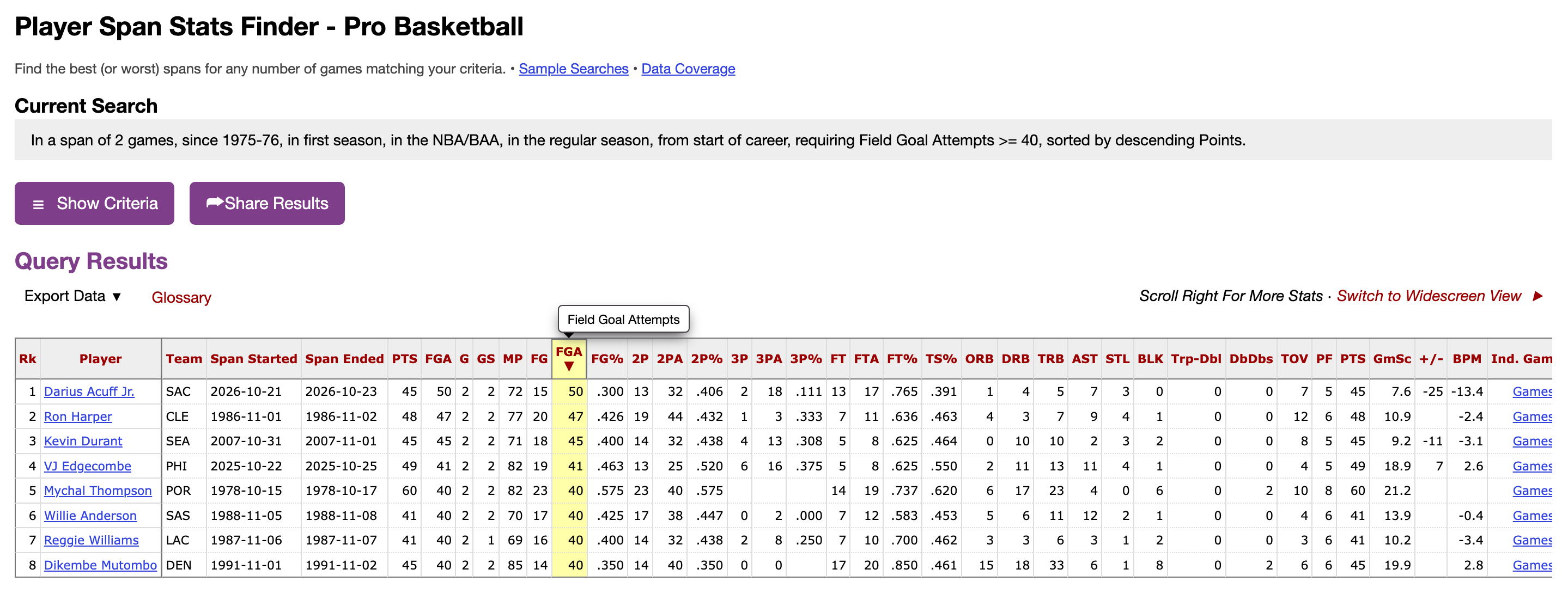
His 50 field-goal attempts are the most by a rookie in their first two games since at least 1976.
However, he’s made only 30% of his shots, the lowest among rookies who have taken at least 40 field goal attempts in that span.
The only real takeaways from his first two outings are that he’s an incredibly confident player, which we knew coming in, and that the Kings coaching staff has given him full reign to experiment, learn, make mistakes, and develop.
Acuff has struggled from the field, but we should expect some level of positive regression. He won’t shoot 11.1% from three and 44.4% at the rim in the half-court for a full season.
His efficiency is lagging behind his process. For the most part, Acuff has made fine decisions as a handler. He’s established chemistry with Sabonis in the pick-and-roll and has diagnosed those actions well, snaking ball screens, putting defenders in jail, or getting to his pull-ups with bigs playing drop coverage.
There have been various wide-open looks that he’s generated that have missed, and they will be less frequent over the course of the season. The two below were especially brutal.
The common response to any critique of Acuff so far is that he’s getting to his spots and his shots aren’t falling, and that holds some merit. A ton of the misses have been quality shots.
But as expected of a rookie in his first few outings, he's also had learning moments where he could have been more patient, gone downhill against the bigs in a deep drop, or shifted his approach to creating for others when his shot wasn’t falling. I’d tend to agree with Domantas Sabonis’s assessment after the Kings opener.
A few of the shots below are attempts Acuff can make, but they’re either rushed, or there are better options within the possession.
I don’t disagree with the Kings giving Acuff the vast majority of on-ball reps, because he needs them to become Sacramento’s franchise player, but I’d like to see him used off-ball as well, like he was last season. The Kings need to balance giving him opportunity with building good habits, and he needs to balance being a scorer and a playmaker.
Among 22 players with 30% usage or higher, Acuff’s 16.7% assist rate ranks 17th.
#8. Atlanta Hawks — Kingston Flemings
Kingston Flemings has been as advertised. That includes the strengths and improvement areas.
Pre-draft, I believed he was one of the best processors I’ve ever scouted, and he’s made a bevy of plays to validate that thought.
Just look at how quickly he turned Grayson Allen’s head, flashed to the middle of the floor, and then, in an instant, found Aaron Wiggins in the corner.
How many 19-year-olds read the floor that quickly? As to be expected, Flemings has been an elite per-possession playmaker. The rookie is averaging 9.45 assists per 75 possessions and boasts a 2.2 assist-to-turnover ratio.
But just as I thought his playmaking would translate immediately, I knew his scoring was still far away.
Over two games, Fleming is shooting 20% from the field, 12% from two, and hasn't drawn a shooting foul. Those figures will certainly improve as the season progresses, but his inability to finish through contact, draw fouls, or generate pull-up threes at volume in college spelled concern. I hope he can show growth in those areas this season.
Atlanta should be extremely patient with him. It’s going to be a journey. He needs to put on weight and improve as a three-point shooter, but his intelligence and athleticism make him a good bet.
#9. Dallas Mavericks — Morez Johnson
Morez Johnson hasn’t thwarted an alien or gone toe-to-toe with one of the best offensive players ever, like his former teammates, but he’s been rock solid.
Johnson has played with a relentless motor off the bench, rebounding and finishing around the rim effectively. He has room to grow as a short-roll decision-maker and scorer, but more reps should help.
Defensively, he had a few quality reps on Ivica Zubac, who has a ton of size and was once one of the league’s premier post scorers. He defended Alperen Şengün well, though Şengün eventually returned the favor.
I want to see Dallas play him at a higher level and weaponize his mobility and recovery skills, because he had some intriguing switching reps.
#10. Milwaukee Bucks — Brayden Burries
Brayden Burries joined Wagler as one of the few rookies to debut efficiently.
Like his classmate, he did it playing complementary basketball. Burries attacked in transition, scored off spot-ups with minimal dribbles, and rebounded well.
His biggest area for improvement has been his defensive discipline. He got his first welcome-to-the-NBA moments in the Bucks thriller trying to guard Norman Powell and Tre Jones. Powell ran off screens with Burries trailing and caught his hands in the cookie jar; then he fouled him while closing out. The rookie tried to contain a drive from Jones by putting his hands near his midsection, but the veteran blew past him for an and-one.
Through two games, he’s averaging 13.3 fouls per 100 possessions.
Milwaukee waived Kevin Porter Jr., clearing the way for Burries to take on a significant role, and if he wants to maximize this opportunity, the first step is bucking this minor trend.
#11. Golden State Warriors — Yaxel Lendeborg
Yaxel Lendeborg’s spat with Luka Doncic in his debut and his refreshingly transparent post-game interviews were one of the biggest storylines of opening week. It’s not a data point, but it’s impressive that he didn’t back down.
Doncic definitely got in his head, leading him to commit undisciplined fouls, but when he wasn’t falling victim to one of the league’s greatest grifters, he played tight defense—high hips and all.
I believe Yaxel let the game inside the game make him miss the forest for the trees. Winning your matchup, if that’s what he thinks he did, comes secondary to team defense and the overall goal of winning the game.
Friday night, he was just as assertive and fearless. He still had a bone to pick, this time with Jerami Grant.
Yaxel started slowly through the first two quarters, struggling to finish over Zach Edey's size and length and even getting stifled on a rim attempt against Quentin Post.
But he kept at it. He kept attacking, and getting to the free-throw line got him in rhythm. He hit a big three in the corner to put the Warriors up nine in the clutch and dominated the glass.
The Warriors blew the lead, falling victim to the Booze-Edey-Jerome dominance, but Yaxel’s performance was an impressive bounce-back from his debut.
For better or worse, his on- and off-court actions will likely be the most entertaining part of the Golden State Warriors this season.
#12. Oklahoma City Thunder — Aday Mara
Aday Mara got thrown into the fire in his debut, rose to the occasion, and came away victorious.
His block on Victor Wembanyama, which led to an alley-oop slam, was the night's highlight, but he also made multiple big plays in high-leverage situations.
He worked well with Cason Wallace in their two-man game, flashed on the baseline when the floor tilted toward Shai, and even pulled off his best Isaiah Hartenstein impression on a 10-foot floater.
Defensively, he altered multiple shots at the rim and stopped Wembanyama on a drive.
Mara had a few small hiccups in drop coverage, getting stuck between committing to the ball-handler and staying home.
#14. Charlotte Hornets — Hannes Steinbach
With Ryan Kalkbrenner and Moussa Diabate in the lineup, Steinbach hasn’t had much opportunity to play, but he got some burn in Charlotte’s blowout loss to the Hawks.
Though it was garbage time, Hannes did what Hannes does: clean the glass.
One of the best rebounding prospects of the last had five rebounds (two offensive) in 12 minutes, good for a 16.5 offensive rebounding percentage and a 29.6 defensive rebounding percentage.
Steinbach made the most of his stint, eagerly crashing the glass and securing contested rebounds.
He also finished with six points and shot 60% from the field, showing mobility and touch around the rim.
Defensively, he continued to show he’s probably best at the four. On a few possessions, he rotated late and didn’t affect shots at the rim.
In his first action, he showed what makes him an appealing prospect, as well as the areas where he needs to grow.
Good breakdown of Darryn. I agree he has shown some timidness, and it isn't all explained by the Jazz having less shots for him, he has passed out of opportunities he can attack a few times in these first 2 games. On the positive angle, he seems to really excel at finding cutting lanes and rebounding for his position, he has a really great feel for where holes are on the floor for attacking, cutting and rebounding, something he showed at Kansas as well.