


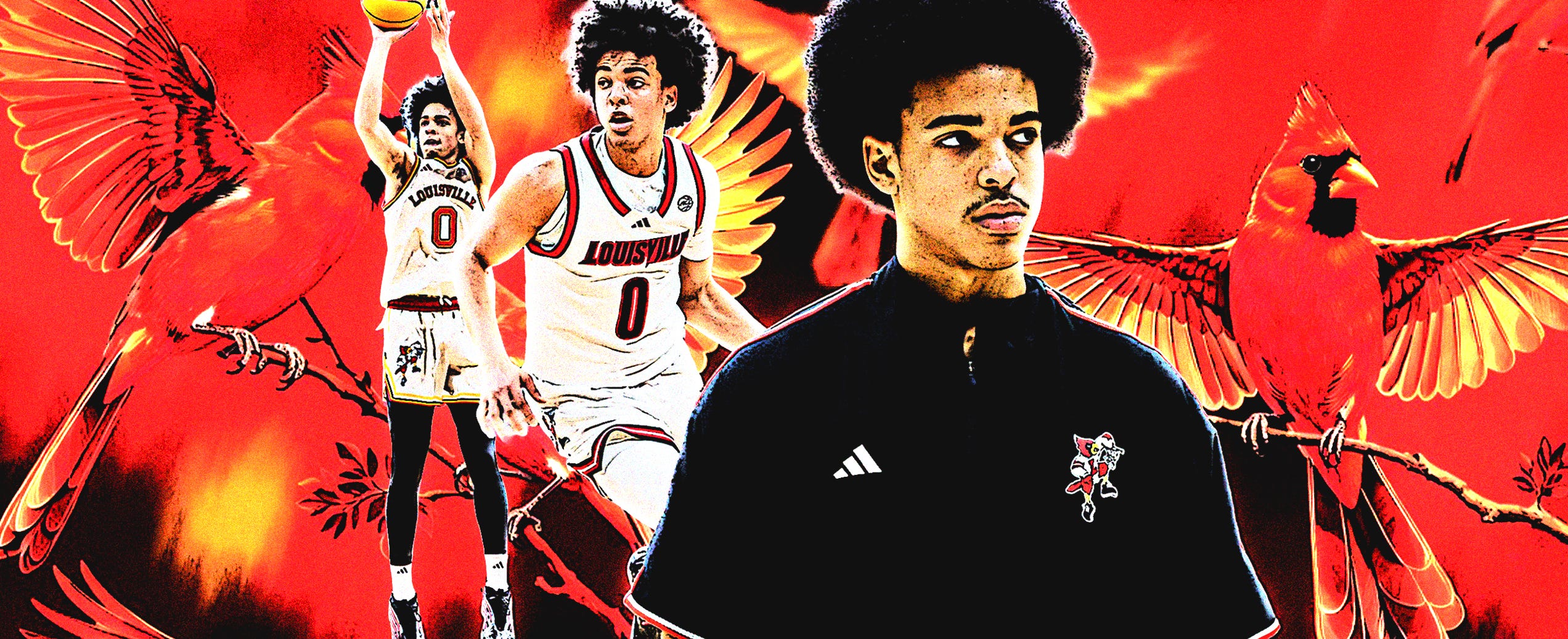
The 2026 NBA Draft class features several talented guards at the top. Sure, the consensus Top Four prospects are some combination of AJ Dybantsa, Cameron Boozer, Darryn Peterson, and Caleb Wilson—two power forwards, a small forward, and one shooting guard.
However—after those four—this class is riddled with players like Darius Acuff Jr., Kingston Flemings, Brayden Burries, Keaton Wagler, and one player who has been lumped into this glut of guards, Mikel Brown Jr.
Standing at nearly 6’5”, Brown entered this cycle as a player who stood just as much of a chance to upset the apple cart among the top players. A gold medalist, a McDonald’s All-American, and a Five-Star recruit, Mikel—son of collegiate basketball athletes—moved in such a way that it became easy to envision his translation to the NBA. Size, length, a tight handle, impeachable imagination, and a blossoming jumper—all of these strengths screamed future NBA star.
The freshman guard committed to play for the Louisville Cardinals coming out of DME Academy in Florida—reporting to campus fresh off of a great showing for Team USA in the FIBA World Cup. Aligning himself with Ryan Conwell and Isaac McNeeley in the backcourt, it felt as if Mikel put himself in position to show off all facets of his game: playmaking, scoring, and even some defensive promise.
On paper, the runway was clear. In a class where guard play has been abundant, Brown had both the pedigree and the skill set to separate himself with sustained production.
But his season never quite unfolded that way.
From November 3rd to December 13th, Mikel played in every game and started in every one for Louisville. In this non-conference stretch for the Cardinal that featured games against Arkansas, Kentucky, Indiana, and Cincinnati, he averaged 16.6 PPG, 5.1 APG, 3.0 RPG, and 0.8 SPG. Those numbers are great at face value, but his shooting splits during that time equated to 38.1% from the field, 26.8% from deep, and 83.8% from the free-throw line. These moments of inefficiency weren’t what many were expecting.
Then injuries crept into the picture.
Mikel injured his back in a game against Memphis on December 13th, which led to him missing 8 games. His return would be on January 24th in a game against Virginia Tech. During the warmup before the game, the cameras revealed that he would be playing with a back brace. Many expected a tempered ramp-up for the budding star guard, but he had one of his best performances of the season.
Against the Hokies, Mikel scored 20 points in 29 minutes on a 7-of-11 scoring night, where he also chipped in six assists, three rebounds, and a steal. He seemed to be his normal self. In fact, an argument could be made that he was better post-injury than he was pre-injury.
From January 24th to February 23rd, Mikel averaged 21.1 PPG, 4.4 APG, 3.8 RPG, and 1.6 SPG. What stood out during that stretch was his improvement in efficiency. In those 10 games, he posted shooting splits of 45/43/85. During that stretch, he put up a 45-point game against North Carolina State—going absolutely nuclear from deep on a 10-of-16 night from distance. This was the version of the young guard that optimists had envisioned. He was finally becoming the dynamic guard that was foretold.
Unfortunately, his back began to bother him again.
On a night where Mikel was scoring 24 points against the North Carolina Tar Heels, he would reaggravate his thought-to-be-healed back. After a couple of hard falls, his availability would come back into question. He played in just 21 minutes against the Clemson Tigers just five days after the North Carolina game, but it was clear he wasn’t himself.
He entered another stretch where he couldn’t separate himself from the rest of the 2026 NBA Draft Class, not participating in the ACC Conference Tournament, nor in March Madness.
And that is ultimately what makes Brown so difficult to evaluate. His season came in fragments—but within those fragments were stretches that showed exactly why he was once viewed as a potential headliner in this class.
The Case on Film
When you turn on the film from those stretches, it’s easy to see why Mikel Brown remains a compelling bet. His athletic profile is quietly exceptional—combining bounce, length, and speed with the kind of balance and bend that allow him to operate comfortably in tight spaces. He’s not just explosive; he’s controlled. That control shows up in his ability to generate advantages off the dribble, rise into jumpers, and find passing windows on the move—flashes that point toward a versatile offensive engine.
Advantage Creation
In many ways, scouting can become complicated. Projection and production don’t always align, and that tension can push evaluators toward betting on traits. But sometimes, the evaluation is more straightforward. Sometimes, it comes down to how a player moves.
He clears that bar easily.
His athleticism isn’t just about vertical pop or straight-line speed—it’s how those tools function within possessions. His balance and core strength allow him to stay on line through contact, adjust mid-air, and extend plays that would otherwise break down. That combination of bend and control shows up when he turns the corner, slips through tight gaps, or re-centers himself after initial contact.
The result is consistent advantage creation. Not always spectacular—but certainly repeatable.
These advantages aren’t limited to audacious offensive possession; Mikel can leverage his athleticism to force defensive events.
Brown’s anticipation and ability to read developing actions allow him to generate defensive events and quickly turn stops into transition opportunities. Even in tight spaces, he shows the ability to stay in bounds, maintain balance along the margins, and finish with creative angles at the rim.
Shooting Projection
One of the areas projected to be a clear strength for Mikel Brown entering the season was his shooting. During FIBA play, he led Team USA in scoring while shooting nearly 49% from deep, and he connected on over 37% of his threes at DME.
That consistency didn’t fully carry over to the start of his freshman season. He struggled to find a rhythm early, but showed meaningful improvement during his January and February stretch, where he shot over 40% from three.
For Brown’s long-term projection, the key question isn’t just whether he can shoot—but how he shoots. Most non–top-three guards entering the NBA will need to function both on and off the ball, underscoring the importance of catch-and-shoot reliability.
That’s where the inconsistency shows up most clearly.
His catch-and-shoot profile has fluctuated across contexts. He shot nearly 70% on those attempts during FIBA play (23 attempts, per Synergy), but that came in a limited sample. At DME, he converted just over 28% on 32 attempts, and at Louisville, he finished just under 33% on 76 catch-and-shoot threes.
However, that full-season number masks his late-season improvement. From January 23rd to February 28th, Brown shot over 38% on catch-and-shoot threes, suggesting growing comfort and confidence within that role.
Mechanically, there is reason for optimism. Mikel shoots with a compact motion and a high release, both largely repeatable. While there are minor quirks—such as a slight inward bend as his hands and feet converge—they don’t appear to impact his outcomes meaningfully. Much of the inconsistency stems more from shot selection and degree of difficulty than from foundational flaws.
He looks far more comfortable operating into pull-ups, where he can control timing and rhythm. Off the catch, there is a level of immediacy required; off the bounce, Brown dictates cadence. That control shows up in both his confidence and efficiency.
For the season, he shot nearly 36% on off-the-dribble threes (84 attempts), but during his January/February stretch, that number jumped to over 42% on 47 attempts. That aligns more closely with what he showed at DME, where he shot nearly 46% on similar attempts.
All of these points point to a shooting profile that is still developing rather than fundamentally broken. While he hasn’t yet consistently matched the expectations of a high-end shooting prospect, the combination of prior sample, late-season improvement, and functional pull-up ability provides a credible pathway for growth.
Playmaking
One of the clearest requirements for a high-level NBA guard is the ability to organize offense and create for others. Mikel Brown enters that conversation with a strong foundation. While he is a capable scorer, his processing, touch, and athletic profile all point toward high-level playmaking upside.
At Louisville, Brown was heavily utilized as a pick-and-roll ball handler—already operating within NBA-style actions. He ranked in the 89th percentile in scoring in those situations, and when including passing possessions, remained in that same percentile. That dual efficiency signals an ability to punish defenses both as a scorer and a facilitator.
A foundational element of that success is his ability to deliver the lob. As the freshman turns the corner and forces the low man to step up, he consistently creates windows to reward his big with above-the-rim opportunities. That baseline competency is critical for any guard tasked with running offense at the next level.
But Brown’s playmaking ceiling extends beyond the requirements.
His most distinctive trait as a passer is his ability to manipulate defenders with his eyes. Paired with his burst and ability to collapse the defense, Mikel can shift help positioning before delivering the pass—often while still in the air. At times, he operates like a Jedi, moving defenders with subtle look-offs and creating passing angles that wouldn’t otherwise exist. The result is a steady diet of clean looks for teammates that begin as compromised possessions.
There are moments where that creativity can tilt into over-dribbling or an inclination toward the spectacular over the simple. But even within that risk profile, Brown’s ability to deliver the ball into tight windows stands out. Few guards in this class can match his capacity to create and capitalize on narrow passing lanes.
The production supports the film. Mikel ranked fourth among freshmen with a BPM of at least 5 in Assist Percentage (30.3), placing him ahead of players like Keaton Wagler and Cameron Boozer. He paired that with a 1.5 assist-to-turnover ratio—an indicator of both usage and relative control.
The question isn’t whether Brown can create for others. It’s how consistently he can balance creativity with efficiency—and whether that balance becomes a point of separation in a crowded guard class.
Taken together, the film paints a clear picture. He has the tools, creativity, and flashes of a player capable of driving the offense at a high level.
The challenge is that those flashes never came across a sustained runway—and in a class this deep at the guard position, consistency becomes just as important as capability.
The Evaluation
That leaves his evaluation in a narrower band.
Within that band, Mikel Brown presents one of the more compelling talent cases among the guards in this class. On tools, flashes, and translatable skills, there’s a real argument for him to be near the top of the point guard group. That may sound ambitious given the production of players like Darius Acuff Jr., Keaton Wagler, or Kingston Flemings—but evaluation extends beyond résumé. It requires weighing projection alongside production, and Brown’s profile offers a blend of athleticism, shot-making upside, and passing creativity that is difficult to replicate.
At the same time, the lack of continuity in his season makes it difficult to place him at the top of that group firmly. Rather than separating, he settles into a compressed tier—one that likely falls somewhere in the 5–10 range overall, depending on how teams prioritize upside versus consistency and potential injury concerns.
Missed time may introduce hesitation among some teams. For others, it may create an opportunity—an opening to bet on traits, development, and long-term upside in a class where many guards offer similar levels of present-day production. And in an oversaturated class, that distinction carries weight.
Follow me on Twitter: StephenGHoops
Catch me on BlueSky: StephenGHoops
Catch the Draft Sickos show LIVE on the No Ceilings NBA channel: