


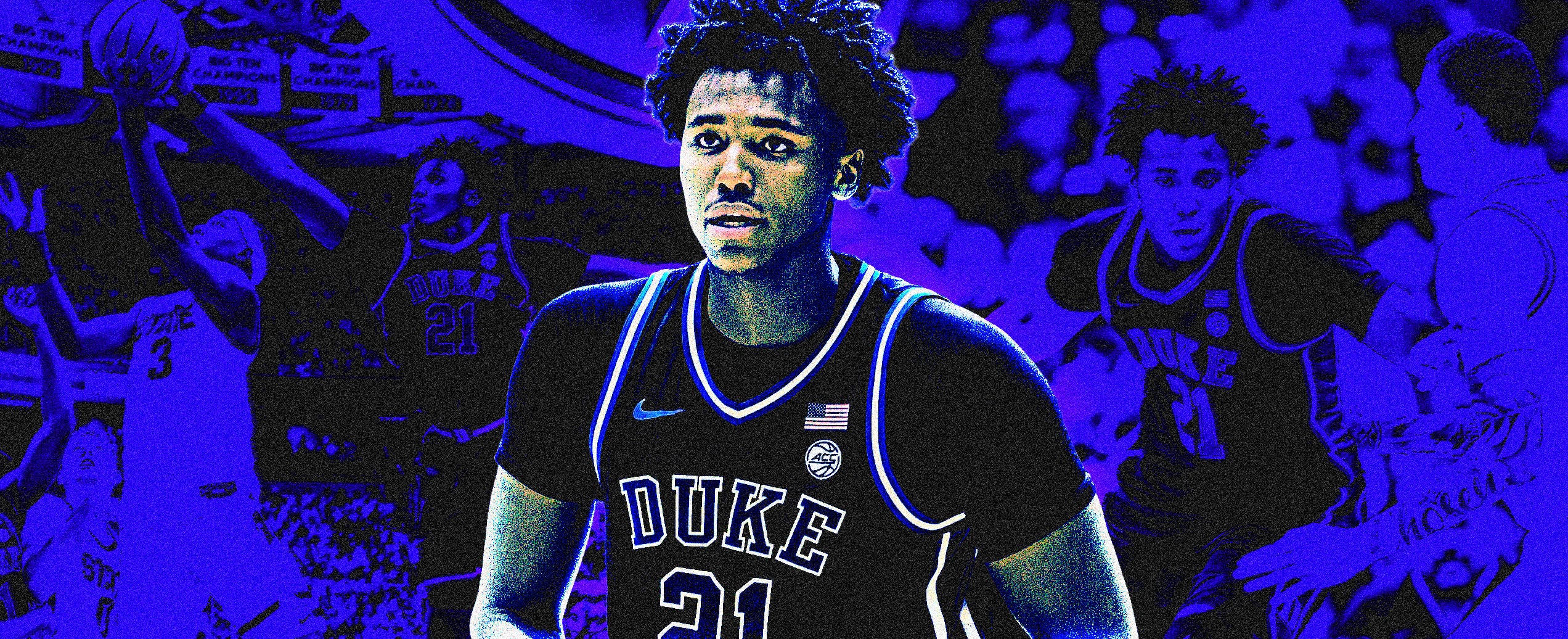
When it’s all said and done, Duke sophomore Patrick Ngongba II might be one of the most complete players to come out of the 2026 NBA Draft. That’s a big statement, I get it. But I believe his ability to thrive at the basics, age-relative production, size, and feel give him both a safe floor and a high ceiling at the next level.
Big Man Basics
Before we can get into the elements of Ngongba’s game that make him distinctly modern and exciting, I want to start with the basics. As much as the sport of basketball has evolved, the basics have remained the basics because if you can’t do the necessities, the other stuff is simply fluff. When evaluating big men, I always like to ask myself two questions along the way. First, “Can he score at the basket?” Second, “Can he stop other guys from scoring at the basket?” Let’s start with the offensive side of that coin.
To say that Ngongba is a good finisher would be like saying, “McDonald’s has sold a few hamburgers over the years.” So far this season, Ngongba has converted 86.2% of his half-court rim attempts per Synergy. If you want to quibble with that because he hasn’t gotten to conference play yet, that would be understandable. But then you have to consider that last year, he made 78.1% of his half-court rim attempts. The bottom line is that Big Pat has a stellar track record as a finisher. At 6’11” with a reported 7’4” wingspan, Ngongba has a big catch radius when functioning as a lob target. He also knows how to position himself in the dunker spot for easy looks. Ngongba is also a good offensive rebounder (11.7 ORB% between this year and last), so he can generate high-efficiency shots for himself on the boards. Plus, he’s got a good touch. He’s not a guy who's screwed if he can’t just slam it home. Ngongba ranked in the 99th percentile in post-up efficiency last season and he’s in the 95th percentile this season. While Ngongba might not have the most dynamic back-to-the-basket arsenal, he’s strong, patient, and releases the ball from a high point. I would like to see Ngongba develop a deeper bag of interior counters and get more comfortable going to his left hand inside, but the starting point here is exceptionally strong. The first basics box has been affirmatively checked.
Coming into the year, I was skeptical about Ngongba’s defensive impact. It wasn’t that Duke was bad on the floor with him or anything, but his 5.6 BLK% was nothing to write home about, he wasn’t the best mover, and I thought his instincts left something to be desired. When you’re talking about scaling those issues to the NBA, it’s problematic. This season, I’ve been far more intrigued. To stick with the post-up thing, he can more than hold his own on the block defensively. He’s a strong interior defender who holds his ground well, doesn’t get suckered by counters, and can contest well while staying vertical. So far this season, he’s surrendered only eight points on 18 post-up possessions, per Synergy. But modern basketball is about a lot more than just posting up. Ngonga does a great job of monitoring man and ball. Even if his man tries to pull him to the opposite dunker spot, or if he lifts up to the elbow, Ngongba stays aware of the situation. He’s been much more eager to rotate to the rim this season. In drop coverage, he does a great job of using angles to minimize favorable options for the ball handler. Ngongba also has fast hands, which allows him to quickly pinpoint the ball for rejections (7.6 BLK% on the year). Again, add in his size at 6’11” with a 7’4” wingspan at 250 pounds, and he has the traits of an NBA rim protector. Now, the second big box has been checked. Let’s get into the exciting stuff.
The Modern Components
We’re going to cover two elements of Ngongba’s game here. One is actualized, and one is more theoretical. Let’s start with the item I feel more secure about before we start to dream big.
I say this all the time, but it bears repeating. Generally speaking, the assist rates for big men drafted now are significantly higher than those drafted a decade ago. There are two factors at play here. One is that modern basketball has seen the positional lines blurred, and it’s now much more common for taller players to be a part of the playmaking process, if not the ones downright orchestrating it. The second is that as the first thing happens, the playmaking threshold for big men now is much higher than it was in the past. This makes two things true. The first is that it’s now more important than ever for a big man to be able to make plays on the ball, and the second is that since teams are more willing to run offense through a big man, there’s an increased level of value that should be placed on those who thrive in that respect.
This is a big part of why I’m so intrigued by Patrick Ngongba II. The man is a great passer for his age and size. He has a 16.7 AST% so far this season, which is a tremendous mark for a center. For context, that’s around where players like Santi Aldama, Day’Ron Sharpe, and Jaylin Williams were during their pre-draft seasons. Most of his deliveries come from the top of the key. He sees the floor well and does a great job of wiring on-target passes to cutters. He’s also become a bit more comfortable putting the ball on the floor and making clever interior passes through tight windows. While he’s undoubtedly most comfortable acting on script, the fact that he’s started to show more instances of making improvisational reads is exciting. These abilities are pretty rare for a rim-rocking finisher and potent rim protector, and I’m a big believer in the concept of “draft the guys that don’t come around often and/or are going to come at a hefty price tag down the road.” That’s what Patrick Ngongba is looking like at this stage in the process.
Here’s where it gets scary. Ngongba might become even more dangerous, as I believe he has a real chance to space the floor. The touch indicators have long been there. He’s been effective on his non-dunks on the interior throughout his career. He’s good at the free-throw line, too. His 72.4% mark from the charity stripe through two seasons is an above-average mark relative to his position. But we’re not dealing entirely in theoretical circumstances at this point. We’ve now seen Ngongba take the space when defenders give it to him beyond the arc and hit an open three a few times this season. The results haven’t been jaw-dropping, as he’s gone 4-for-15 on the year, but it’s not a bad start. If the shot does actualize in a meaningful way down the road, he could become frighteningly complete.
Pushing Back
Whenever I wrap up an evaluation, I like to ask myself, “if I get this wrong, why will that be?”
The elephant in the room here is that Ngongba has dealt with a number of foot injuries over the years, which is always a scary proposition when you’re talking about a bigger, heavier player. Given how injury-prone it feels like the entirety of the NBA is currently in a movement-heavy era, that’s far from ideal. Plus, Ngongba doesn’t have a ton of room for error in terms of mobility. He’s a guy who you hope can hold his own in space rather than a player you can count on to be a switchable defender at the next level. He also rarely gets out and runs in transition due to his lack of end-to-end speed. That’s already troubling as NBA teams look to push the tempo and get high-efficiency buckets early in the clock, but it can be daunting when you think about the problem potentially becoming compounded by future foot problems. While Ngongba has shooting potential, it’s far from being a bankable skill at the next level. And as good as his passing has been, it largely comes from a standstill. Comparing him to players in last year’s draft, Ngongba doesn’t have the bend, burst, or creativity that a player like Derik Queen had, nor is he as fluid with his handle as someone like Danny Wolf. Ngongba might be able to find and exploit openings, but he’s not that type of advantage creator.
Conclusion
Even with the concerns noted in the section above, I’m a big fan of Patrick Ngongba, and I believe he will scale his game successfully to the NBA level so long as he remains healthy. Even if he doesn’t fully develop as a shooter, the fact that he’s an outstanding finisher and passer is more than enough. Defensively, he’s really started to find his place in drop coverage. And still, I wouldn’t totally write off some of the higher-end outcomes. A few years back, I was complaining about a player to a scout, and he cut me off mid-sentence to say, “You know these guys get better in the league, right?” While it can be foolish to assume an aggressive growth trajectory or tell yourself every player will turn their weaknesses into passable traits, it’s a fair thing to keep in mind. Ngongba has a great set of “boring outcomes.” If he ends up being in more of a Jakob Poeltl or Day’Ron Sharpe type of mold, that’s still good value for where he’s projected on most boards. If he can become something of a respectable three-point shooter and hit the occasional trailer three to give his offensive game some transition equity, then we’re really cooking. Either way, Patrick Nnongba is becoming complete. He does the things that big men have always, and will always need to do well, well. But his high-feel, high-execution passing game and the possibility that he could space the floor make him one of my favorite prospects in the 20206 class. At this point in the process, he’s a definite Top 20 guy for me.
SUBSCRIBE TO NOCEILINGS ON YOUTUBE:
Quick Hits
-I will continue to buy any and all Ryan Conwell stock. Does he have the most advanced handle? No. Does he miss passing reads from time to time? Yes. But Louisville’s 6’4” is averaging a career-high assist rate and a career-low turnover rate. He knows how to connect the dots really well, and that’s going to be his NBA role. Oh, and don’t forget that he’s made 41.1% of his threes on high volume and a versatile long-range shot diet over the past few years. But what really separates Conwell from other “undersized wing snipers” is his physical strength. The way he plowed Tucker DeVries backwards against Indiana in particular caught my eye. It’s not a one-time thing, though—he has a .480 free-throw rate on the year. Conwell’s elite shooting, physicality, and snap decision-making have him as a first-round guy for me.
-I’ve also got to shine more light on another No Stone Unturned alumnus in Tarris Reed Jr. UConn’s first two offensive possessions against Florida stood out to me. On the first, the 6’11”, 265-pound read bullied Rueben Chinyelu for a shockingly easy bucket. The next trip down court, Reed beat him instead with finesse, getting to the rim after putting the ball on the floor and besting Chinyelu with his crafty interior counter game. He’s just so big with so many ways to win. Defensively, he’s a great drop coverage anchor who is still light enough on his feet to guard in space. He’s also an elite rebounder and a solid playmaker. He was a first-round guy entering the year for me, and nothing has happened to change that. As conference play approaches, I’m eager to see if he can stay out of foul trouble. That was a big issue for him last year, and he had four fouls against both Illinois and Florida.
-Keaton Wagler had a big week! Illinois’ 6’6” freshman wing wasn’t really doing it for me out of the gate, but it feels like the game has slowed down for him in a big way. He has great speed and shake to him, but everything felt sped up early in the season. Against Ohio State and Tennessee, Wagler did a much better job of changing speeds and playing under control. The more he can leverage his stop-start abilities, the easier it will be for him to generate separation. Even when he doesn’t, though, he’s been more than willing to get physical and draw fouls. Wagler’s comfort from distance, ability to get to his spots inside, and rock-solid floor vision from the paint are the types of traits that make him a potential one-and-done prospect. His defense leaves a lot to be desired, though. He’s on the skinny side, gets caught ball watching, and provides lackluster second efforts. He has quick and active feet at the point of attack, though. I think he’s Illinois’ most interesting 2026 prospect at this point in time.
-Don’t forget about KJ Lewis! Just when I thought he was out, he pulled me back in. The 6’4” junior guard drew some interest for his potential Switchblade Guard (credit Chuck) skillset at Arizona. He transferred to Georgetown this offseason, and while that may be a lower-profile destination, I believe it actually presents a prime developmental opportunity for him. He’s carrying a career-high usage rate and wearing it well. He’s showing more assertiveness from deep, hitting ankle-breaking dribble moves, finishing inside, and making good reads as a passer. What’s particularly astounding though is that despite his giant creation burden, Lewis is still doing all of the role player stuff and then some. He’s got a 4.6 ORB%, 17.0 DRB%, 4.7 STL%, and 2.7 BLK%. All of those are exceptional for his archetype. His consistency from long range remains a big question (career 25.7% from deep, though 30% this year), but at a certain point, I can live with swinging on that. Whether it’s 2026 or 2027, I’m intrigued.
-There are a million small guards and the hit rate on them is low…but are we like, 100% positive that Bruce Thornton won’t be an exception? Make no doubt about it, Thornton’s 6’2” height, stubby appearance, and lack of vertical pop are serious issues. But he’s also a 45.7% shooter from three between this year and last. His range is ridiculous, and if defenders don’t pick him up early in a possession, he’ll pull the trigger without mercy. When run off the line, he’s powerful enough to hold his line and play through contact on his way to the rim, leading to a high free-throw rate (.415). He’s also a low-mistake playmaker. Defensively, his strong frame can help him to body up opponents, but he also knows when to pull the chair against mismatches. Don’t write him off!
-Akron’s Amani Lyles caught my eye this past week. The 6’7”, 240-pound forward does a little bit of everything. He can relocate into his three (47.1% from deep on 3.1 attempts per game) or finish inside (67.2% on twos). While his handle isn’t remarkable, he can win from a face-up due to his strength, and he sees the floor pretty well on the move. He’s a great rebounder on both ends of the floor. Defensively, he covers ground like a pro, uses his physicality well on the ball, and has a great event-creation track record (career 2.4 STL%, 5.8 BLK%). Mid-major production has perhaps never been met with more skepticism. But Lyles is the type of dude I’d love to see in the Portsmouth mix, because his size and well-rounded production are fascinating to me.
Hey, this column isn’t over! No Ceilings+ subscribers get an additional bonus section every week! This week, I wrote about Labaron Philon, as well as my thoughts on the draft outside of the tippy top! There is no better way to support the work that we do at No Ceilings than by subscribing to NC+. I believe our track record of consistent, thoughtful work over the past four years speaks for itself. It’s only $8/month or $80/year, so please consider supporting the work that we do. You’ll get our pre-season draft guide, access to our Discord, this extra section of my column each week, bonus columns from our entire team, live scouting reports, and MUCH MORE!
