


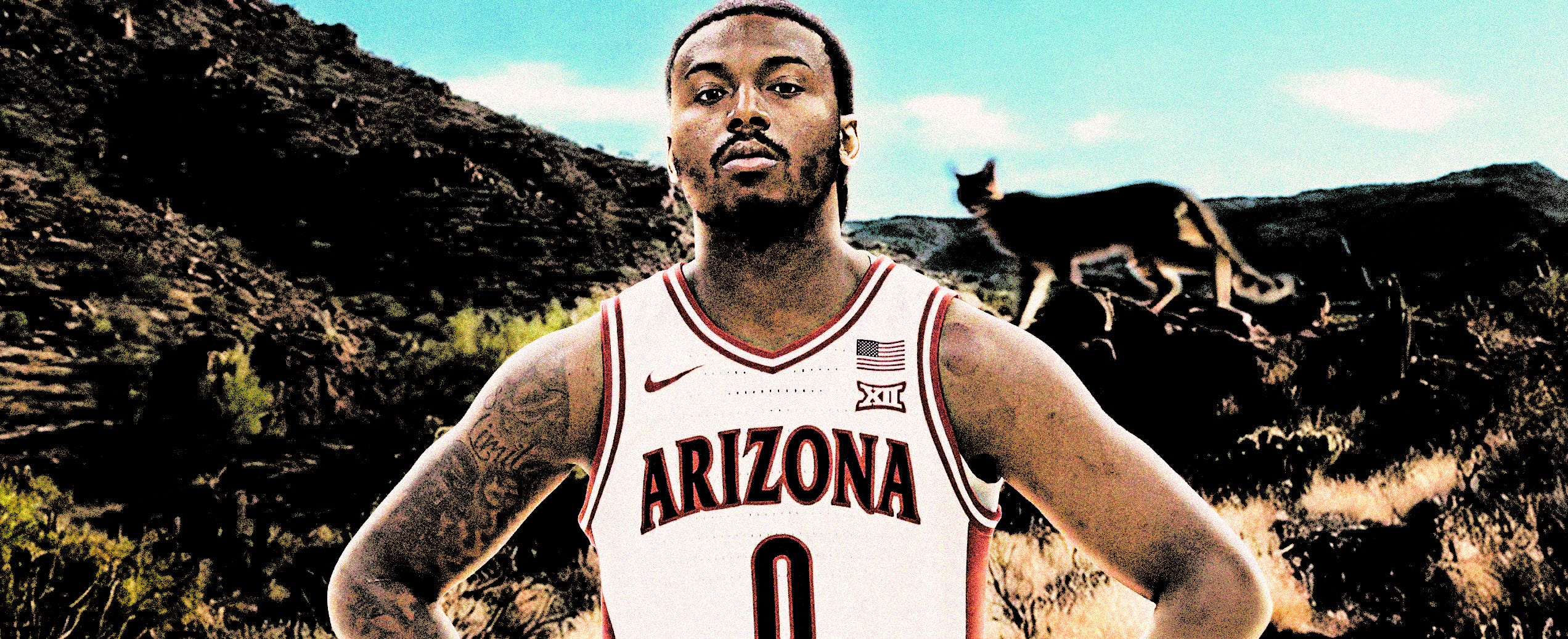
I feel like a lot of different guards have gotten their moment in the 2026 NBA Draft spotlight this cycle. It makes sense. This has been one of the best guard groups in recent memory. Freshmen like Kingston Flemings, Darius Acuff Jr., Mikel Brown, and Brayden Burries are hot commodities. Returners such as Labaron Philon, Christian Anderson, Bennett Stirtz, and Tyler Tanner have all been ultra-productive. There’s only so much oxygen in the room at any given time. But today, I’m going to ask you to spare some of your breath for Jaden Bradley. The 6’3” senior out of Arizona isn’t the freshest name, nor is he the flashiest player. But he is the starting point guard for college basketball’s best team, and given how he goes about his business, I think it’s time we give him some respect.
Smashmouth Offense
At 6’3” and 205 pounds, Jaden Bradley has good size for the point guard position. He acts like it, too, preferring to get downhill as often as he possibly can. He’s not just a brute, though. Bradley has a good handle, clever footwork, and quickness at his disposal. He can string together multiple dribble combinations while changing speeds, which is often enough to shake defenders loose and open up a driving lane for him. His first step, paired with that NBA-level slither, helps him to weave his way through traffic. Still, he’s not afraid to put his head down and simply play through his man if the situation calls for it. This physicality helps him a great deal once he’s in the paint. Bradley loves initiating contact, rises well through it, and doesn’t lose his coordination if he gets bumped mid-air by a rim protector. In total, these traits help Bradley to pressure the rim, with 31.3% of his shots in the halfcourt coming there, per Synergy. Additionally, this rugged approach enables him to draw heaps of fouls, as evident by his elite .569 Free Throw Rate on the season.
This approach is not without its drawbacks. While Bradley does a great job of playing through contact, doing so still isn’t the easiest task in the world for a 6’3” guard. It’s particularly tricky this year, as Arizona’s lack of spacing has the paint far more crowded than he’s used to. On top of that, Bradley isn’t the world’s most explosive vertical athlete, having registered only one dunk on the season. In totality, these issues have made him a subpar finisher on the year. While volume and efficiency tend to have a push-pull relationship, Bradley’s 48.9% mark on half-court rim attempts (per Synergy) is quite poor, particularly for an upperclassman. There’s hope, though. In a better spacing context last year, he made 56.8% of his half-ourt rim attempts. Still, he’s historically been a subpar finisher, which could be problematic for his NBA translation.
Crafty Playmaking
The good news is that Bradley doesn’t just play for himself when he gets into the paint. He keeps his eyes up on the move and reads the floor well. Bradley is quick to make simple needle-threading dump-offs to his big men against aggressive ball screen coverages, setting up 4-on-3 predicaments that put his team at an advantage. He understands basic perimeter help coverages, which allows him to hit open shooters when defenders come to help or dig on his drives. His best trait is his mental fluidity. Bradley doesn’t premeditate his decisions, and as a result, he’s able to quickly punish lapses in coverage or reward teammates who find spontaneous openings. Plus, Bradley operates with an awesome level of deception. He knows how to disguise his deliveries, utilize head-and-eye fakes to get defenses off his scent, and can whip the ball at unexpected angles to maximize scoring opportunities for his teammates. While his 24.6 AST% isn’t anything out of this world, his 2.65 assist-to-turnover ratio grades out exceptionally well and shows how calculated and efficient Bradley is as a decision-maker.
Can Jaden Bradley Shoot?
The headline here raises the biggest question about Jaden Bradley—can he shoot? It may seem odd to ask about a guy who’s made over 40% of his threes on the year, but it’s a fair question to ask. I believe the reason that I am higher on Bradley than the consensus is because I’m optimistic about his jumper. Before I get into my reasoning for that, I’ll make the opposite case first. Jaden Bradley is a low-volume shooter. Often, volume is a better indicator of future shooting output than a raw percentage. And it’s not just that he’s a low-volume shooter by guard standards, it’s that he’s an extremely low-volume shooter by guard standards, taking only 3.2 threes per 100 possessions. As a result, it’s hard to take the percentages seriously. For one, the sample is small, but second, defenses treat Bradley like a non-shooter. Many of the shots he does take are wide open. Now, let’s take a look at the other 6’3”-and-under upperclassmen in the BartTorvik era who were drafted and were also “super low volume” shooters.
Elfrid Payton
Armon Johnson
Tyshawn Taylor
Kadeem Allen
Peyton Siva
The first thing that stuck out to me was how long ago most of these guys played college basketball. The second thing was that, well, none of them were very good in the NBA. In an era where three-point attempt rates, particularly among role players, are higher than ever, this does not bode well for Bradley.
But please, let a calculator boy cook a little here. All of these numbers are coming from our good friends at Synergy, by the way. Let’s start by broadening the sample. As I write this, Bradley has taken 113 catch-and-shoot threes over the course of his college career. He’s made 43.4% of them, which would grade out well relative to most long-term NBA guards. The pull-up numbers haven’t been as pretty historically, but Bradley may be turning a corner here. While his 5-for-11 on pull-up threes is certainly a small sample, his mid-range touch is outstanding. He’s sunk 48.5% of his off-the-twos on the year, and he’s already taken 68 attempts, showcasing both impressive volume and efficiency in that area of the floor. The tape looks great, too. Bradley is awesome at getting his legs under him with total balance the moment he gets space before elevating into a clean-looking shot. He’s also an 81.3% free throw shooter on the year, which again, is an above-average mark for a guard prospect. When a player is above average at the charity stripe on high volume while also being a prolific and efficient mid-range scorer, they typically end up finding a level of respectability from beyond the arc in the NBA.
There’s no question that Jaden Bradley’s shot diet will need to change at the NBA level. It will be harder for him to draw whistles at the rim the same way; he’s not the best rim finisher, and he’s not a willing three-point shooter. Front offices typically aren’t holding meetings where they try to pinpoint which second-round pick they can select to live in the mid-range for them the following season. The two questions are whether Bradley is willing to adapt and whether or not he’ll be good enough off of a shooter if he does. I can’t speak to the first question at all. But I have a pretty firm degree of confidence that if he does adapt his shot diet, his stellar indicators as a pull-up scorer in the mid-range and the broader sample of his catch-and-shoot efficiency could lead to a favorable long-term outcome from three-point range.
Pesky Defense
Given that Arizona has one of, if not the best, defenses in college basketball, it should come as no surprise that Bradley provides value on that side of the ball. For starters, there’s his powerful, long frame for a point guard, which helps him to apply smothering pressure to ball-handlers. He can bully similar or smaller-sized players into dribble-pickups before overwhelming them with his activity. Bradley’s knack for getting in on the ball with his hands stands out time and time again. He’s capable of taking long, lateral strides to contain his man in a more conventional, fundamental context. Off-ball, he has sharp instincts for when it’s time to gamble. If he catches a sloppy handler putting it on the deck or putting their back to him, he’ll swipe the rock in a heartbeat. Bradley’s tremendous 3.5 STL% and contributions to an elite defense are great feathers in his cap. There’s still some work to do, though. His effort guarding the ball can wax and wane. At times, he’s too content to get beat off the dribble or call it a day after getting caught on a screen. He’ll need to give better efforts and multiple efforts more consistently at the next level.
Conclusion
It’s easy to understand why evaluators aren’t head-over-heels for Jaden Bradley. For starters, there’s the issue I mentioned up top, which is that there are a ton of extremely talented guard prospects eligible for the 2026 NBA Draft. Then, there are fair nits to pick. Sure, he gets in the paint a lot, but he’s been a subpar finisher this year. His three-point percentage is great, but he seems afraid to shoot. His shot diet is antiquated. He’s capable of being a good defender, but sometimes, he takes his foot off the gas.
There are two things that I want to start my rebuttal with. The first is that in an era where talent has concentrated at the top of college basketball like never before, Jaden Bradley has been one of the very best team’s offensive engines while also contributing to an elite defense. Second, at a certain point on any draft board, you do have to start betting on something. Jaden Bradley has been a winner all year. He’s a hard-nosed guard who eats up contact and gets deep into the heart of the paint at will. Still, he has real polish, maximizing his burst by blending in speed changes and mesmerizing dribble combinations. He’s also a selfless, deceptive passer who knows how to trick defenses and reward teammates when they get open. Defensively, his physicality and feel have made him a productive player. And while I understand concerns about his volume from long-range, his outrageous indicators from the middle of the floor give me hope that he can maintain his three-point efficiency on higher volume at the NBA level.
I’m not telling you that you have to fall in love with Jaden Bradley, or that you need to rank him above any of the guards who commonly appear in the first-round of mock drafts. But I am telling you that it’s a good time to start respecting him. His winning ways, toughness, playmaking, touch indicators, and defensive output give him a real chance to carve out a long-term NBA career.
QUICK HITS
-It’s gone a bit under the radar, and his struggles against more prominent teams have diminished his buzz, but Bennett Stirtz has generally scaled up to the high-major level well. He’s remained lethal from three-point land while increasing his volume thanks to his devastating pull-up jumper. The playmaking stuff is still there. While he’s not a bursty separator, his ability to manipulate ball screens, see the floor quickly, and thread needles as a passer still makes him a viable lead guard. His added bulk has helped him remain an effective finisher and foul drawer, too. Defensively, I don’t love his lateral agility, how well he shifts directions, or his speed on closeouts. Still, he’s intelligent and knows when to pick his spots to generate steals. I need a clever name for this archetype, but recently, sharpshooting guards who take care of the ball and get steals have both found a lot of success and gone undervalued on draft night. Teams shouldn’t make the same mistake with Stirtz.
-I’m still a fan of Alex Karaban, for those who were curious. UConn’s 6’8” redshirt has long been renowned for his blend of sharpshooting, turnover aversion, snap decision making, bulk, and length. One thing I’ve been monitoring this year has been his play downhill. In the past, his lack of bounce and tendency to play at one speed downhill plagued him inside. This year, Karaban is both getting to the rim more often and finishing at a more efficient clip inside. He’s shown real craft here, utilizing pace and keeping his man in jail with a hostage dribble on occasion to force rim protectors into tougher decisions. This style of play has been far more effective for him than simply dribbling right into a big man inside before trying to sneak a layup around them. One question I always ask myself with older prospects is, “Are they still improving?” Karaban is, and he’s got a very plug-and-play game on top of that. He’s still a first-round dude for me.
-I think Rylan Griffen is a dude who deserves some love. He was always sort of a guy who sat on the cusp as a theoretical three-and-D wing prospect. This season, in Texas A&M’s Bucky Ball system, he’s been an absolute monster. His role is to press, create events on defense, and shoot a ton of threes, and he’s awesome at it. He’s got a 3.6 STL%, a 1.6 BLK%, and he’s made 44.6% of his threes. He’s older, and he’s skinny, which isn’t a favorable combination for wing prospects. Still, his ability to play at a high tempo, making things happen, and space the floor should warrant consideration on draft night.
-6’10” Kansas freshman Bryson Tiller isn’t the most polished prospect in the world. His assist-to-turnover rate is way under water, and he generates alarmingly few steals for a player with his size and mobility. But man, I cannot help but be intrigued with him long-term. He’s got a pretty jump shot, and he’s capable of attacking a closeout with a great first step and giant strides to the basket before violently finishing above the rim. His size 7’3” wingspan and 240-pound frame, paired with his athletic traits, give him the tools to be an impactful defender, too. Tiller has yet to find consistency from long range, and as previously mentioned, there’s a lot of connective tissue that needs to be developed here. That said, the framework here is super intriguing to me.
-What if I told you that there’s a high assist rate big man who can guard on the perimeter and is averaging a nation-leading 4.1 dunks per game? Sounds cool, right? His name is Cooper Bowser, and he’s a 6’11” junior from Furman. He’s a potent rim-runner who gets off the floor super easily and jams everything. As a result, he’s shooting a comical 80% from the field on the year. He can also act as a facilitator (12.1 AST%) from the post and top of the key, finding cutters and shooters alike for open looks. Defensively, he’s playing more on the wing this year after leading the SoCon in block rate last year. He can protect the rim in the traditional sense, but he’s also long and agile enough to swallow up smaller players. His rebounding rates are quite poor (8.5 ORB%, 14.5 DRB%), but they’re better than they’ve been in the past. That’s going to be the swing skill for him. But as a guy who loves passing big men, Bowser is one of my favorite sleepers right now.
This column still isn’t over! No Ceilings+ subscribers get an additional bonus section every week! This week, I wrote about Brayden Burries! There is no better way to support the work that we do at No Ceilings than by subscribing to NC+. I believe our track record of consistent, thoughtful work over the past four years speaks for itself. It’s only $8/month or $80/year, so please consider supporting the work that we do. You’ll get our pre-season draft guide, access to our Discord, this extra section of my column each week, bonus columns from our entire team, live scouting reports, and MUCH MORE!