


Although I love the NBA Draft, I’ve got a host of other hobbies that call for my attention. To start, I play basketball (poorly), volleyball (a bit better), rock climb, snowboard (not too poorly), and Ultimate Frisbee (fairly okay), along with other writing projects outside basketball. Another hobby that takes up a solid portion of free time is Dungeons and Dragons, which shares little crossover with writing about basketball. In that way, it’s a fun, social escape with old college friends I’ve kept up with for the better part of a decade.
It would be a stretch to compare any aspect of either passion to the other, but as the game master of my own campaign, I do find the concepts of character creation akin to building one’s game in basketball. There are roles for players who want to be a jack-of-all-trades, filling gaps in their party or team. There are also more specialized roles meant for specific purposes, like dealing a ton of damage or protecting their turf. Finally, there’s a subsection of character archetypes that are built around “min-maxing”, a specific idea that’s taken hold of other similar role-playing games as well.
Min-maxing is a term from Dungeons and Dragons, not the manosphere of the interwebs, that refers to an imbalanced allocation of resources for one’s character. Specifically, the idea behind the mechanic is to put your eggs into a few baskets at the expense of others to maximize efficiency in a few key areas. While it comes at the cost of versatility, a min-maxed player can master a few key skills to a level few others could match.
In many ways, there are basketball prospects who gear their games to operate in the same vein. The days of pure specialists in the NBA are over, as the demands for players on both ends to raise their team’s floor have become too great to be that poor on one end or another. That doesn’t mean, however, that there aren’t very specific role players who exist within their lanes in the modern NBA landscape. Shooting specialists with frills still exist, defensive stoppers with some latent creativity are around, and limited big men can still make a mark if they’re good enough in a few particular areas.
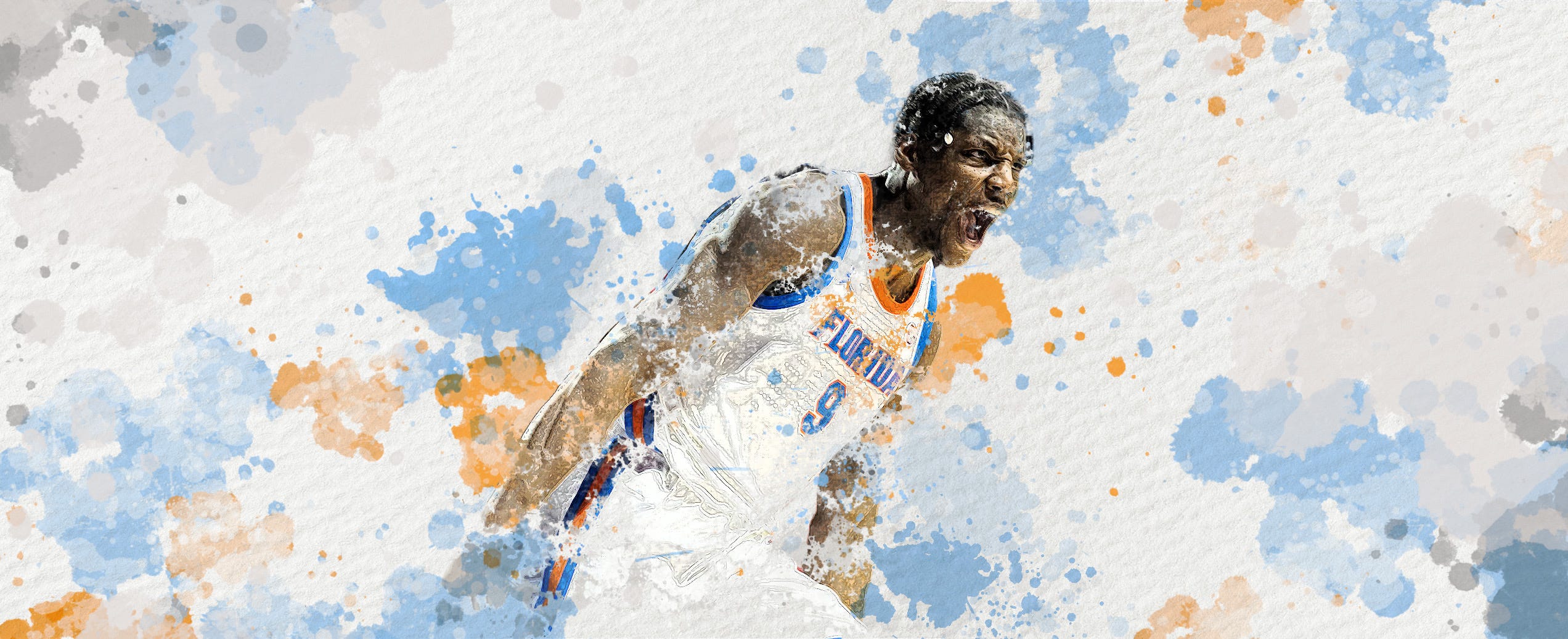
That’s the case for Florida’s Rueben Chinyelu, who transferred to the Gators after a solid, if unassuming, year at Washington State. Since transferring, Chinyelu has grown into a key contributor for a title-winning team, all while working to fit into his distinct role as well as he could. Chinyelu’s game isn’t built around versatility; instead, he makes the type of plays that add incremental advantages to his team’s chances of winning, even if they aren’t flashy or highlight-worthy. In that way, with his zeal and focus, Rueben Chinyelu has “min-maxed” his game to the point that NBA teams at any stage of their process would have a role for him.
Skills with Proficiency
To briefly break down Rueben Chinyelu’s game, it’s a positive example of the benefits of the transfer portal. Chinyelu came to Pullman with plenty of room to grow and averaged a modest 4.7 points and 5.0 rebounds in a smaller role. Once he transferred to play for Todd Golden at Florida, Chinyelu steadily improved as a key big man on an elite team. He’s averaged 8.3 points and 8.7 rebounds over his Florida career, upping those numbers this season, and doing so while playing his heart out in his specified role as one of the team’s key pivots in the middle of the floor.
It’s worth mentioning, as I start with Chinyelu’s rim protection, that he’s a massive pivot with great athleticism. At 6’10”, a reported 250 pounds, and a gargantuan reported 7’8” wingspan, Chinyelu fits into the unofficial size requirements for an NBA pivot. There are certainly a few players without similar physical characteristics who also do a great job with their interior NBA duties. Still, it will help Chinyelu’s case that his frame and run-and-jump athleticism is so good for his positional archetype. He gets off the floor with ease, has fluid hips for a player his size, and runs the floor with abandon.
As a player, Rueben Chinyelu fits quite well into the rim-runner mold of old. He does all his damage around the basket on both ends, controlling the paint to impose his will. That starts on defense, as he formed a potent frontcourt tandem with Alex Condon over the past few years to great effect. Florida has ranked 13th and 6th over the past two seasons, per BartTorvik, in adjusted defensive efficiency, with much of that due to Chinyelu shutting teams’ water off at the rim. He’s averaged about a block per season, but had a 4.2% block percentage this season, which is an above-average number for a big man.
I’m more interested in that number alongside the percentage that Chinyelu holds opponents to at the rim, which is 38.1% on 63 attempts, per Synergy. That number, alongside his pure blocks production, shows up on film, as Chinyelu’s length and mobility are big factors in his rim defense. He can recover as well as anyone in the country to get a swat, pins plays off the top of the backboard without much effort, and is never truly out of a play. He also uses his verticality principles well to elevate for his blocks, whether as a weakside defender or when attacked directly.
I’m also a fan of how Chinyelu chooses his spots to use his athleticism, while also relying on his technique and timing to protect the rim. Given his wide wingspan, Chinyelu doesn’t need to jump to contest every shot. He’s happy to use grounded verticality principles to avoid silly fouls while obstructing attempts at the basket. Chinyelu also has a great nose for breaking up lobs at the rim, which isn’t an official stat other than a steal, but is a key marker of how good he is at reading a pick-and-roll from a defender’s perspective.
On the other end, Rueben Chinyelu has maximized his output at the rim despite most other offensive areas of his game. He took 172 of his 256 shot attempts this season at the rim, although that doesn’t include Chinyelu’s 66 baby and grown-up hook shots that he took. While it’s an added boon that Chinyelu took that many hooks and canned them at a reasonable 49.2% clip, it won’t be a tool he’ll deploy often at the NBA level, given post offense has gone the way of the flip phone and dinosaurs alike.
Instead, I’m more interested in two subsections on how Chinyelu got his points: cuts and transitions. The way that Synergy codes both of these types of plays is a bit of a doozy, as cuts encompass a wide range of “cut-like” plays, while transition opportunities exist in a grey area as well, albeit less grey than others. The “cuts” that Chinyelu does within Florida’s offense are more of duck-ins, where he takes his time to slip behind a distracted defender and receive a pass in an optimal zone in the paint. There are fewer long streaks from the perimeter and more of the subtle dives to the rim from just outside the restricted area.
In transition, Chinyelu runs the floor better than most other big men did in the SEC this season and last. He has long strides, solid body control at full speed, and doesn’t even need to jump much to use his length to finish at the rim. One of the ways that Chinyelu was effective in transition, alongside purely sprinting out for a breakaway slam, was a delayed action where, after a guard like Xaivian Lee or Boogie Fland would pull the ball back on the break before hitting a late streaking Chinyelu on the way to a better look at the basket. Either type of transition play will be effective at the next level, although Chinyelu’s athletic advantages will be somewhat offset by the size advantage there.
Overall, Rueben Chinyelu has min-maxed his way into being a great rim-running center already. He competes hard on both ends, uses his outlier length to buttress his shot-blocking technique, and finishes well around the rim without needing the ball in his hands. Chinyelu could step onto an NBA court and go toe-to-toe with other players his size on the inside. Luckily, there are a few key areas where Chinyelu has a bit more game, which makes his min-maxed abilities even more appealing.
Bonus Actions
In addition to the main actions Rueben Chinyelu successfully performs for his team, he also performs bonus actions that generate latent value for his squad. They come on both ends of the floor for him, which bolsters Chinyelu’s appeal as a two-way player, and neither are skills that require him to have the ball in his hands. Instead, both are impactful ways that Chinyelu himself can take to earn bonus possessions for his team.
On the offensive end, Chinyelu is a warming presence on the boards. It helps that he did play on one of college basketball’s best jumbo frontlines, but it wouldn’t be the same without his utter insistence on grabbing offensive rebounds. He averaged just under four offensive rebounds a game this season, with a 17.4% offensive rebounding percentage, both of which are great marks for a board man. It’s just as fun as it sounds in person, as Chinyelu is just as likely to out-leap an opponent as he is to out-muscle or out-run them to grab a loose ball.
Generating extra possessions has quickly become a market inefficiency for modern offenses; Chinyelu both does that with aplomb and puts a ton of those extra chances back on his own. This year, Chinyelu shot 60.6% on his putback attempts, earning a “good” rating from Synergy on that type of finish. What I liked on film was that Chinyelu had a lot of variety in how he got his putbacks. Some were due to an immediate second jump that was quicker and higher than his opponents’. Others were a patient, pump-fake-filled extravaganza under the net that led to a bucket.
Away from the rim, Rueben Chinyelu also keeps his offense moving without the ball by setting bone-crunching screens for his guards. His massive frame and base strength certainly help, but it takes a good amount of dexterity for him to rescreen as quickly as he does. Chinyelu only took 20 shots as a roll man for the Gators, which seems perilously low for a player of his skill set. However, the space that he opened up as a screener still struck me as something he can do right away for a team at the next level. If he starts to increase his volume and efficiency as a rolling lob threat, that would add to his maximum utility.
On the other end of the floor, Chinyelu affects possessions in two key ways: he secures defensive boards to keep the other team from getting another chance to score, and uses his hands to jab in for steals. A 1.7% steals percentage isn’t an indicator that he will be a major steal artist at the NBA level, but it does speak to the consistent pressure Chinyelu can put on an offense with his fast hands. He uses his great length and timing to jar the ball loose on post-ups and digs on drives, all of which will be helpful for his team in the rare times he does so.
It’s Chinyelu’s work as a defensive rebounder that is much more of a bonus for his team, as it’s hard to uproot him once he sets his mind to nabbing a board. His colossal 30.7% defensive rebounding percentage comes from both effort and technique. Chinyelu is quick to throw his body onto another, set up, and box out, before tracking the carom and scampering after it faster than everyone else. He also uses the same leaping skills that he does for his blocks and finishes to high-point rebounds.
While they are more of icing on the cake, the little ways that Rueben Chinyelu affects the margins of the game are important nonetheless. NBA games often come down to a few possessions, which can make a seemingly mundane offensive rebound or a well-set screen slip under the radar despite its inherent value. Chinyelu won’t always make the flash dunk or block, but he’ll continue to be a pest on the glass on both ends and set hard screens, which will keep a team’s offense flow going. That’s worth more than just some cursory glances in this draft class, especially if the transfer portal vacuums up other late-round projected prospects.
At a Disadvantage
As a min-maxed player, Rueben Chinyelu is certainly good at a few things on the court. At the same time, he has some clear deficiencies that keep his ceiling relatively contained as a draft prospect. No prospect is perfect, as the NBA still has a ton of room for development in specific skills across different players’ games. Still, I’m less confident in Chinyelu to either have the space to grow his game in meaningful ways, nor would it benefit him to try to be more all-around than min-maxed.
Right now, Rueben Chinyelu rules his roost in the paint. He will certainly step out to set screens or facilitate dribble hand-offs on the perimeter, but he’s rarely making any active decisions with the ball in his hands anywhere but the inside. He’s even further removed as a shooting threat, as he barely takes any looks outside of the paint at all. Synergy does tab some of his takes as “jump shot” field goal attempts, but a quick review of those proved to be more of jump hooks that were taken in the lane instead of a pure jumper.
Chinyelu’s shooting form, as seen in his rare looks or free throws, is a slow, choppy motion that leads to high variability. He doesn’t get the proper snap on his wrist, can’t elevate quickly into his shot, and doesn’t have great shooting touch indicators from his free-throw shooting. While he has improved as a free-throw shooter by about 10 percentage points each season, he still hasn’t shown the consistency or touch to indicate that he could evolve into any stretch big man.
The passing tape for Chinyelu isn’t much better, though it’s worth considering that it wasn’t his role to facilitate Florida’s offense. That’s on the guards like Walter Clayton Jr. or Xaivian Lee, to name a few, while Alex Condon also has more passing chops to play off the high post and keep the ball moving.
Still, it’s not a great sign for Chinyelu to add any passing value in the future. His 4.5 assists percentage is astronomically low, even for a big man, and he barely found his teammates for dimes this season. I’m less concerned about his turnovers as a raw number and more about them as a ratio with his assists, as he’ll need to keep creating turnovers or possession on defense to make up more for his travels, double-teamed turnovers, or lazy passes.
As a final note, Chinyelu doesn’t provide much added value, and his perimeter defense leaves a bit to be desired. This isn’t the worst thing in the world, as the primary appeal of Chinyelu’s maximum potential will be focused on the rim. Still, only the most elite interior anchors can get away with being a poorer perimeter defender in today’s NBA.
Luckily, I wouldn’t label Chinyelu a “poor” perimeter defender. Instead, he’s average at best and often shows a mixed bag of skills and deficiencies. He was slower to rotate out to shooters and made some risky closeouts, but he was often in these situations due to someone else’s busted switch. When he switched out on the perimeter and had to isolate against a smaller player, Chinyelu could be taken advantage of due to his slower lateral slide. Still, his length kept him in the fight despite some tough makes over him.
Given what he brings on the defensive end overall, I’m not too caught up in what Chinyelu can’t do for a team on that end. He’s going to swat shots, contest at the rim, and control the glass without needing to set foot out of the paint. If he gets any better at his perimeter stopping, he’s suddenly a much more versatile defender who already was providing value on that side of the ball. That’s enough for me to keep his min-maxed profile in consideration still this draft season.
Role For Initiative
While it’s a term from a much different type of hobby than basketball scouting, I find it fitting to think of Rueben Chinyelu as a min-maxed player. He’s supremely focused and talented in a few key areas that can help his team win, making great plays on the margins of the game to set his team up for success in Florida. On the other hand, there are clear areas of his game where he is well below the standard required to play at the NBA level.
For someone who already provides so much utility, I’m less concerned about what Chinyelu can’t do and more about what he can. There isn’t going to be an NBA squad that sees him play and wonders what he can do with the ball in his hands a dozen times a night. Any team that goes out of its way to bring Chinyelu in for a workout, a summer league spot, or a late-round selection will do so knowing exactly what he is supposed to be for them.
In that way, it’s almost a positive that Rueben Chinyelu plays his specific role so well. Other, more well-rounded prospects can get lost in the shuffle of an NBA rotation if they don’t stand out in one area or another, or if their game is too evenly diluted. That won’t be the case for Chinyelu, who might not profile as a long-term starter at center, but is the type of rugged big man that every team needs off its bench.
Whether it’s a contending team that could use a reliable big man or a rebuilding team that still needs some punch on the interior, Chinyelu is just the type of monstrous interior presence to deserve a serious look. It’ll help his draft stock for a handful of raw jacks-of-all-trades to head back for NIL money. Still, even without the early declarations, I’d have Chinyelu firmly slotted in my second-round tier of prospects who will make their team quite happy in the short and long-term futures.