


A common occurrence I’ve noticed over my years of consuming NBA draft media is the heavy weight scouts put on the sophomore season. This trend comes about in both the NBA and NCAA. Terms such as “sophomore slump” or “sophomore surge” are often thrown around as buzzwords to describe the kinds of second seasons these players have. Why? Well, for players drafted high or ranked at the top in high school, the answer is easy: expectations are high.
Some players, likely the top recruits, arrive locked and loaded. They meet, perhaps even exceed expectations, and hear their name called in June. So when a highly touted prospect returns for another college season, people naturally have questions.
“Has he reached his ceiling?”
“Was it his fault? Was it the programs?”
“Can he be the player he once was?”
Simply put, they have to justify the hype now—a true fork-in-the-road situation.
That’s where Miami sophomore Shelton Henderson currently lands. From Bellaire High School in Texas, Henderson was a five star recruit ranked anywhere from 12 to 25 in national composite rankings. Initially, Henderson was part of the loaded Duke 2025 recruiting class alongside the Boozer twins and Nik Khamenia. As we know, though, college sports are the Wild West. When Jim Larranaga stepped down as Miami’s head coach, Duke assistant Jai Lucas took the reins and brought Henderson with him.
Henderson had a solid inaugural campaign for the Hurricanes, starting all 35 games, averaging 13.8 PPG and 4.9 RPG. While it didn’t generate enough draft buzz, Henderson showed a strong foundation for what he can be. Now, he has to build on it.
Transition
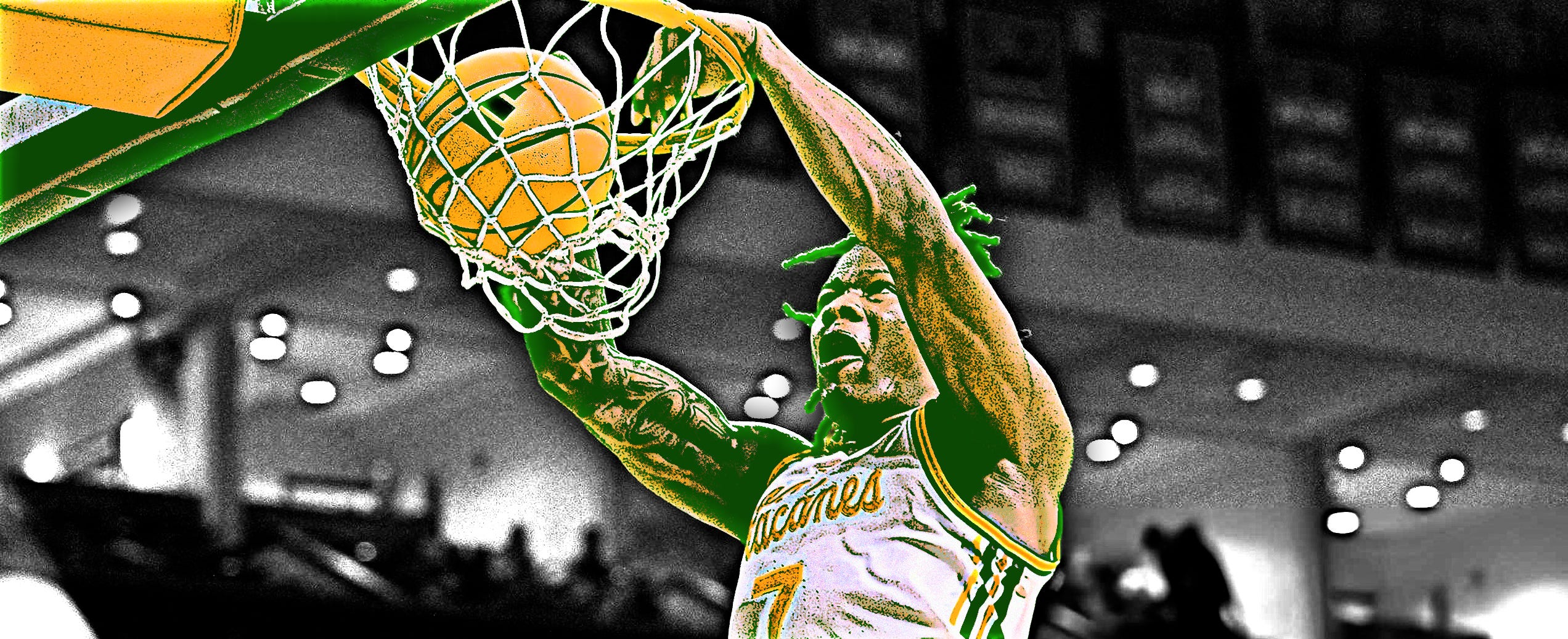
If there is one thing Shelton Henderson is built for, it’s transition. What’s always stood out about Henderson is his staggering 6’6” build. He’s also up to 239 pounds after this offseason. His build may remind you of a football player, but he flies down the court like one, too.
The moment the ball turns over and the pace picks up, he’s down the court with a full head of steam. He flies down the lanes, fills lanes at a wide angle, and gets downhill.
Henderson doesn’t care who is waiting for him at the rim. If a bigger, more physical defender gets in his way, Henderson willingly digs his shoulder into their chest and times his bump to rise into contact. His ability to draw fouls in transition may be the biggest contributor to his exceptional 47.2% FTr. More than one in five open-court opportunities ended with Henderson at the charity stripe. When Henderson got open looks, he went 51-for-74 (68.9%).
Close to a quarter of Henderson’s offensive possessions were transition plays. However, there is a slight concern here. Given that he graded out in just the 65th percentile, Henderson has polishing to do. For starters, his rim attacks are often predictable. He almost always goes to the one-two-dribble-bump, even if the lanes are clogged. Henderson usually commits to the basket early, so he puts his head down and rams into the paint. This also leads to missed opportunities to create for others on the table. Multiple times, Henderson missed quick dump-offs or open shooters to finish in transition. That full head of steam also makes some of his touch shots in the open floor too strong.
The good thing is none of these concerns are physical. He is a positive track-and-field athlete with a high motor. Everything he currently has issues with can be developed. I want Henderson to improve significantly in advantage reads, consistently hitting trailers and secondary cutters, and employing diverse counters.
Pick-and-Roll Ball-Handler
Perhaps the most surprising development for Shelton Henderson in his first year was how he handled the pick-and-roll. He graded out as one of the country’s most efficient pick-and-roll ball-handlers, in the 94th percentile. For a wing with a lackluster isolation game, that’s impressive.
Based on his transition game, you’d think Henderson would be full speed all the time. However, he’s got a nice pace to his game. He may not be the twitchiest, but he uses his strength to control his pace. Henderson loves snaking the screen, using his brute upper body to bump his defender off his hip and take off in the paint. He paired well with Ernest Udeh Jr. last year, an NBA-sized screener. Screen setting may have been Udeh’s marquee skill, but his craft did the rest. Most NBA bigs are more skilled than Udeh, so Henderson is familiar with the action he thrived in. If Henderson can put up similar production with incoming Georgia transfer Somto Cyril, it can be assumed his pick-and-roll numbers were a product of him, not his screeners.
Henderson’s touch flashes most once he penetrates off a screen. Turning the corner, he’ll stop from the free-throw line extended and float one over the hedging defender. His pull-up game is still streaky, but his runners (1.00 PPS) and hooks (1.14 PPS) have been real weapons. This is likely the strongest indicator of jumpshot development, though it still looks like a long road. His jumpers off screens usually fell flat or were hard misses.
Where I rate Henderson higher than most evaluators is his passing out of the pick-and-roll. While he doesn’t see the floor at an advanced level, he usually makes the right pass once he gets into the paint. He finds open pockets between the help defender and rollman and threads those tight windows with either hand for easy assists. Out of his ball screens, Miami scored at an 85th percentile rate. The next step is being a bit more consistent and diverse with his reads. When his initial snake works, he’s a natural passer. When it doesn’t, he usually finds himself in awkward spots inside the lane. This leads to late, difficult kick-outs or him plainly missing open skip passes. If he can make that second read more consistently, his passing can become a really nice complement.
Spotting Up
Spot-up shooting is, without a doubt, what’s holding back Henderson. Right now, it’s in a dreadful place. Last year, on catch-and-shoots, he shot an overall 30.6% (27th percentile). On guarded attempts, he shot 31.3% (31st percentile). However, the real concern is on unguarded attempts, where he shot just 30.3% (21st percentile).
Henderson isn’t even being bothered by closeouts initially; his jumper just consistently falters. It shows even at the free-throw line, where he shot just 57.6%.
The ripple effects were felt. Henderson barely shot the ball, letting defenses sag off him and pack the paint. Only one in seven of his attempts came from three. When he was off the ball, he tended to stay in the corner or relocate inside the arc.
Now, I understand that Henderson’s current shot makes him virtually unplayable at the next level. But he does do a good job of turning that weakness into a strength. On spot-ups, Henderson attacks the closeout instead of shooting over it. The skills so valuable in his transition game show up here, as he attacks off one or two hard dribbles, shoulders into defenders, and finishes strong. Every so often, he’ll even hit a one-two dribble pull-up in the midrange, and it’ll look clean!
As a left-hander, Henderson tends to attack that direction. He is less comfortable converting on the right side, where his handle is looser, with a 22.2% turnover rate when he drives right. When a defender takes away his lift side, he usually defaults to forcing shots or passes rather than countering.
That is why developing a jumper, or showing any signs of progression this season, will mean so much to Henderson. If it becomes even a tiny bit respectable, every closeout becomes runway for an easy drive. Until then, defenses will take away his left hand and dare him to shoot.
Off-Ball Plays
Despite not having a jumper, Henderson has still found ways to affect the offense positively. While he’s not a great relocator on the perimeter, he finds opportunities cutting into the paint, especially along the baseline. The moment the weak side collapses, he times his cut and slips into angles for easy finishes.
Henderson was also a real force in BLOB actions. Jai Lucas often used him as an inbounder, cutting straight to the rim for easy buckets right after the pass. Cutting was one of his most dependable ways to score, at 1.2 PPP. The one flaw I found is that Henderson flailed a bit when bigger help-side defenders rotated toward him. It almost seems as if he is surprised a defender got to him in time, causing him to falter mid-shot.
His energy also translated towards the offensive glass. If nobody put a body on him, he crashed into the paint, made first contact, and used that momentum to snag the ball, grading out as a 63rd percentile offensive rebounder, an impressive mark for a wing.
A trend that runs through his game is putting the ball up too strong. It shows up on putbacks and cuts. The splits around the rim clearly depict that. On dunks, he went 44-for-47. On layups, where touch is significant, he shot just 58%.
Miami rarely used Henderson as a roll-man screener last year, but on the few screens he set, he mostly ghosted. Whether that was intentional is beyond my expertise. Learning to set physical, hard screens is a skill worth adding, as he projects to be a connective piece and already has the frame to do so.
Defense
Shelton Henderson is a mixed bag on defense, with real tools and fixable habits. Analytically, he graded pretty average. As a primary defender, Henderson allowed 0.901 PPP on 233 total possessions. That stat hides two different players.
Henderson displayed real prowess as a point-of-attack defender. Miami ran a heavy switch-and-hedge scheme last season, which boded well for Henderson. He used his strong upper body and hands to disrupt ball handlers while plowing through screens. He ranked in the 75th percentile on ball screens, allowing 0.69 PPP. On those 75 possessions, Henderson forced 16 turnovers.
That same defensive intensity carries inside. At the rim, Henderson holds his ground, willingly absorbs contact, and usually times out his rotations right, though he can get wider.
The real concerns begin guarding in space. Henderson relies on his upper body to bail him out, so quicker players often counter in the opposite direction for easy looks once they bump off him. He’ll wall off more often than change direction fluidly. Even though a small sample size, his isolation defensive numbers were’t pretty, as players shot 47.1% when guarded on an island by him. He also has a knack for sagging off shooters and gambling in passing lanes. Spot-up shooters made him pay, scoring 1.09 PPP against him.
However, Henderson’s motor did bail him out. When beat, Henderson does his best to stay in the play. He even made some impressive recovery blocks and steals few wings his age could make.
Final Thoughts
Heading into the cycle, Henderson likely projects as a mid-second round pick. Some traits are extremely translatable. His physicality and strength are near NBA level, and so is the motor.
What’s really holding me back on Henderson is his ceiling in terms of fitting into multiple schemes. The game works best for him when it’s built around him: lanes are open, he can attack off ball screens, and has the space to cut to the basket. For a college player, that’s a functional role. However, early in his NBA career, teams will need him to space the floor and make quick decisions- something he must develop now. Without a jumper, defenses can simply sag off and run a predictable downhill attack; he’s easy to gameplan for.
On the positive side, these are all skills that can be taught. That’s why this fork in the road matters so much to Henderson. If he can show increased polish, he stops being a hyper athlete who needs the right lineup around him to succeed and becomes a plug-and-play wing who goes beyond being a specialist.