



It’s time for Sleeper Prospects of the Month, January Edition! Let’s check out which of the unheralded 2026 NBA Draft prospects have stood out!
Allen Graves | Santa Clara | Forward | Freshman (RS) | 6’9” | 225
I love getting to go back and look at how some of the lesser-known prospects have both performed and have been discussed over the course of a few weeks. The narrative around Allen Graves has led to a wider acknowledgement of his talent, with many reputable draft outlets working Allen into their second round range. It’s easy to see why. Over this past month, he has averaged 12.4 PPG, 6.8 RPG, 1.4 APG, 2.0 SPG, and 1.1 BPG. That came on shooting splits of 55/38/71.
Graves was named a Sleeper Prospect of the Week in Week 10’s edition (released January 17th) of this series. Since then, he’s scored in double figures in each game, had a five-block performance, and had a three-steal/three-assist performance. The versatility has been ever-so-prevalent. To this point of the year, Graves has a BPM of 9.8, which ranks 38th among all college players who have a Minutes Percentage of at least 50. Among all freshmen, he ranks seventh—above players like Brayden Burries, Darius Acuff Jr., Amari Allen, Koa Peat, and Nate Ament. His physical nature of play shows up in his Offensive Rebounding Percentage of 14.4, which ranks 33rd in all of college basketball. He also uses his frame and touch around the basket to be a consistent finishing threat. His decision-making has been solid as of late, having 11 assists to just four turnovers in January. His Assist-to-Turnover Ratio (ATO) of 2.2 is tied for 12th among all college players who are 80 inches tall (his listed height on Bart Torvik).
I did touch on some minor shooting concerns with Graves in that Week 10 piece he was mentioned in. In his last three games, Allen is shooting 2-of-6 from deep. However, his free-throw percentage has slightly improved this month. He isn’t the best of athletes in terms of run/jump athleticism, which does show itself on defense in specific situations. I mentioned this before, but his creation off the bounce still needs some work. While he still has some work to do, Allen is very skilled and is making a case to be considered in the 2026 NBA Draft.
Jamier Jones | Providence | Forward | Freshman | 6’6” | 218
If you believe that physicality has to be some sort of a prerequisite in how a prospect translates to the next level, you must be high on Jamier Jones. I wrote about Jamier back in the Week 9 (January 11th) edition of this series, and he has really hit his stride. On the season as a whole, Jones has averaged 12.8 PPG, 4.4 RPG, and 1.5 APG—with splits of 64/55/69. In the month of January, those numbers have looked more like 17.9 PPG, 6.3 RPG, and 1.4 APG—on 60/54/69 splits. Since he was mentioned in my series, Jamier has scored in double digits in each game—going for 20 or more points in two games.
The physicality continues to be the first thing you notice about Jamier’s game, and it is the foundation upon which his game is built. Among all college players with a Minutes Percentage of at least 50, Jones is ninth on the year in total dunks with 40. If you apply the “Freshman” filter, he ranks second—behind only Caleb Wilson. Especially for a player at his position, Jamier has already demonstrated a propensity to get to the rim at will. He ranks in the 85th percentile in at-rim efficiency, and in the 92nd Percentile in at-rim frequency. This is ridiculous for the position he plays—and even more so when considering he is in his first season of college. His strength has also translated to other aspects of his game, such as him being second on his team in offensive rebounds and third in free-throw attempts.
One of the first things that can attract the eyes of evaluators is the three-point percentage of a freshman like Jones. That’s where things get a little weird for him. While yes, the near-55% from deep is fun, he is doing so on just 2.6 attempts per 100 possessions. Much like the numbers, the shooting motion is also a little tricky to parse through. There is touch, but the follow-through can be inconsistent—with enough moments of “snake biting” that you have to wonder how this shot matures. He also has a bit of a “knee knock”, and the base can be skinny. These are nit-picks, but these components to the mechanics could be reason for some to think the shooting efficiency can be a bit of fool’s gold. When you look at the decision-making and defensive consistency, there are some reasons to be a bit apprehensive to buy Jamier as a “this year” guy. The ATO of 1.1, and the 19 Stocks (Steal + Blocks) to 48 Fouls Committed are not the best of indicators. Still, there is a lot to like. As of now, I don’t believe Jones comes out this season—which could lead me to be very high on him for the 2027 Draft Class.
Jimmie Williams | Duquesne | Guard /Wing | Junior | 6’5” | 210
Jimmie Williams is the lone junior within the Sleeper Prospects of the Month for January. To be honest, Jimmie is a player I was not very familiar with coming into the season. The former JUCO product has found a home in Pittsburgh, and he has thrived. When looking at his season averages, Williams has averaged 15.8 PPG, 4.7 RPG, and 2.6 APG—on splits of 50/37/78. In the month of January, those numbers have looked more like 17.7 PPG, 4.7 RPG, and 3.1 APG—with splits of 48/38/83. He has also averaged 1.9 SPG this month.
Jimmie brings a lot of neat skills to the table as a wing player. On the season, Williams is one of 21 players who have a Steals Percentage of 3.0, and have connected on at least 35% on their three-pointers while attempting at least 10 three-pointers per 100 possessions. So, he’s truly a 3-and-D prospect. What’s been fun to see with Jimmie is that, while he is a 3-and-D guy, he can connect on his dribble jumpers. In fact, Williams ranks in the 93rd percentile on dribble jumpers, and has made 40% of his dribble jumper threes. Jimmie’s Assist Percentage of 18.7 isn’t earth-shattering, but he has an ATO of 1.7. Williams does show the ability to be at least “connective” as a passer, but there appears to be a little more to his playmaking. He can dribble and attack, which inherently creates passing windows. His total of 52 assists is second on his team.
The projection may not be the sexiest with Jimmie. For one, he doesn’t profile as an “on-the-ball” player. This makes the 6’5” listed height not the strongest for an off-ball guy. His ability to shoot does give him some utility, but the fact that he isn’t the strongest defender—at least, right now—also comes with concern. He does have an awesome Steals Percentage, but his 29 Stocks to 41 fouls committed does highlight the film, which shows inconsistencies. There is no public age listed for Jimmie, which raises a legitimate question regarding his upside. Still, Williams has a strap from distance, and he does show defensive cognition, which gives him a real runway to turn heads next season.
Dayan Nessah | Cleveland State | Wing/Forward | Sophomore | 6’7” | 218
Just like the aforementioned Jimmie Williams, Dayan Nessah was also mentioned on the Week 9 edition of this series. Those two also share another similarity in that I didn’t know a whole heck of a lot about Nessah coming into the season. After playing a brief role for George Washington, Dayan found a place where he could flourish with Cleveland State. On the season, Nessah has averaged 15.4 PPG, 6.2 RPG, and 2.1 APG—on splits of 56/37/76. January has been a great month for him, with his averages being strong across the board. Over the course of this month, Dayan has averaged 17.7 PPG, 7.2 RPG, and 2.7 APG—that’s on shooting splits of 62/67/79.
Nessah’s physique has allowed him to be a wrecking ball in the paint—something you love to see from a fluid perimeter player. Dayan ranks in the 81st percentile in at-rim frequency and in the 71st percentile in at-rim efficiency. It’s also worth noting that Nessah ranks seventh in Free Throw Rate among players who have a Minutes Percentage of at least 60. Putting his ability to draw contact in another perspective: He is first on his team in free-throw attempts—more than 50 attempts more than the next-highest on his team. He also has shown the ability to mix it up on the boards as this sort of wing-forward-hybrid. He has a Defensive Rebounding Percentage of 18.2 and an Offensive Rebounding Percentage of 7.1. Dayan has also shown off a lot of defensive playmaking over the course of the season. He has a Steal Percentage of 2.0 and a Block Percentage of 3.0.
This isn’t new among players in this article, but there could be a bit of a false floor underneath the shooting numbers for Nessah. Though he is shooting nearly 37%, he has only attempted 2.0 three-pointers per 100 possessions. His shot is a little unconventional, as the arms have this sort of tilted “V” action going on at the top. The hands can sometimes go opposite directions on the follow-through, as well. But the form isn’t being repeated frequently—even relative to the volume, which leads me to think there is a lack of confidence in the shot. Beyond the shooting, we will need to see Dayan do more as a creator—even if only a slight uptick in volume and efficiency. He has an ATO of 0.8 and has 40 assists to 54 turnovers. Though the Stock to Fouls Committed numbers aren’t great (32:54), Nessah has shown the ability to read lanes and play with smart hands. Some tweaks to positioning and use of technique could really help Nessah become a more reliable defender.
Leroy Blyden Jr. | Toledo | Guard | Freshman | 6’1” | 170
If you haven’t caught on yet, the Week 9 edition of this series has had some real bangers for the month of January. At this point of the season, Leroy Blyden Jr. has averaged 16.3 PPG, 4.1 APG, and 3.5 RPG. He has done this with shooting splits of 45/42/85. January saw Blyden Jr. average 17.0 PPG, 4.6 RPG, and 3.9 APG—posting splits of 46/43/89. In those games, he dropped 20 or more points on three occasions, and 19 points twice.
Leroy has settled in as a starter by this point in the year. I’ve truly appreciated the mature approach that Blyden Jr. has proven to be a leader on his team, despite being a shorter and thinner guard. Among all freshmen who have a Minutes Percentage of at least 60, Leroy is 11th in ATO—with an ATO of 2.4 This ranks above Amari Allen, Isaiah Johnson, Neoklis Avdalas, Ebuka Okorie, and Brayden Burries. If you wanted to apply an additional filter, apply at 40% from three filter, and you will see that Leroy Blyden Jr. is one of only 12 players doing what he’s doing! He is in the same company as Darius Acuff Jr., Kingston Flemings, Keaton Wagler, and Isaiah Johnson.
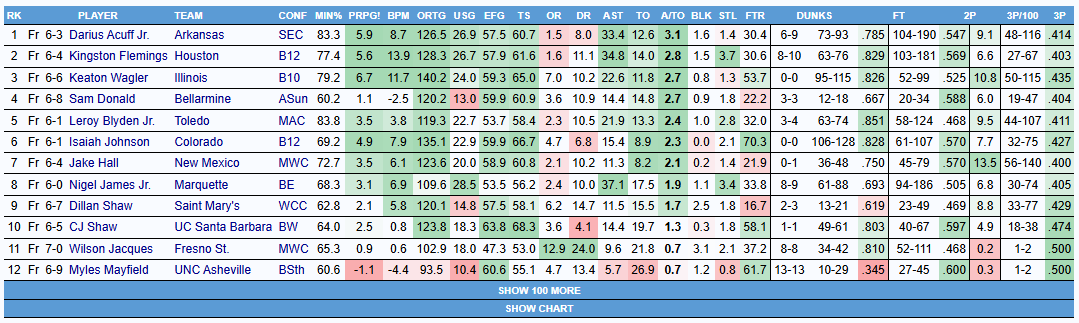
Blyden also has a Steal Percentage of 2.8 and a Block Percentage of 1.0. That’s as a 6’1”, 170-pound guard! His ability to impact several areas on the floor, while also ranking in the 45th Percentile in at-rim finish, is highly encouraging for his future development and production.
As much as I have been encouraged by his skill at his size, the size needs to improve. Sure, Blyden might not necessarily grow in terms of height, but some incremental improvements in strength could do wonders for Leroy’s stock. His rebounding numbers are actually okay, but the Free Throw Rate needs a little bit of work. He also is on a team with Sonny Wilson—who does serve as Toledo’s primary. Blyden will need to show the same sort of output on more usage to work his way into the draft conversations. Still, as a lower-major guard, Leroy is laying the foundation to potentially be the next Ajay Mitchell or Ryan Rollins in the NBA.
Honorable Mentions
Eian Elmer | Miami (OH)
Ben Defty | Boston
Jelani Hamilton | Georgia State
Anton Bonke | Charlotte
Follow me on Twitter: StephenGHoops
Catch me on BlueSky: StephenGHoops
Catch the Draft Sickos show LIVE on the No Ceilings NBA channel: