


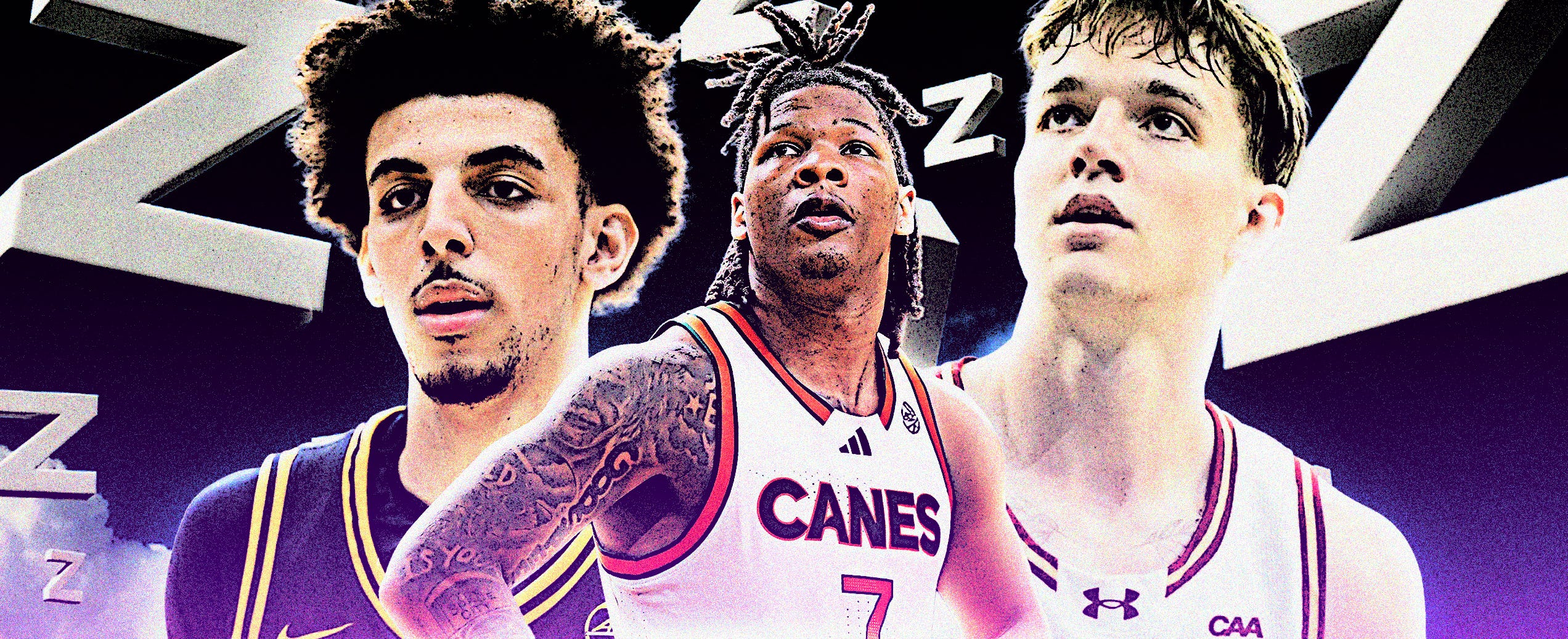
Get your Valentine something special this year: A Sleeper Prospect!
Shelton Henderson | Miami | Wing/Forward | Freshman | 6’6” | 240
It wouldn’t be an edition of this series if we didn’t include some freshmen! Kind of joking, here, but not really—we’ll discuss a few today, actually. Let’s kick things off with Shelton Henderson out of Miami. Shelton entered this season as a consensus Top 30 talent by most reputable grassroots scouting entities. He averaged around 23 PPG, 8 RPG, 4 APG, and 3 SPG playing in the state of Texas. He made it to the 6A Division One State Championship game while playing at Bellaire. He also played a sizable role for the 2024 FIBA U18 AmeriCup team. While he is playing for the Hurricanes this season, we were incredibly close to seeing him play alongside Cameron Boozer at Duke. In April of 2025, Henderson decommitted from the Blue Devils and committed to Miami soon after that.
Shelton Henderson hasn’t gotten a lot of the recognition that some of the other freshmen prospects within this class have received, despite playing a sizable role for Miami. For the Hurricanes, Henderson is on a Usage Rate of 21.5 and has averaged 14.4 PPG, 4.7 RPG, 2.0 APG, 1.1 SPG, and 0.4 BPG. That has been on shooting splits of 60/32/59. In this past week of games against Boston College and North Carolina, he averaged 15.5 PPG, 5.5 RPG, 1.0 APG, 1.5 SPG, and 2.0 BPG. The shooting splits in those two games were 52/0/63. While those numbers are concerning, Shelton has shown a ton on the tape to be excited about.
Shelton immediately pops on the film, as he simply looks like an NBA athlete. He is very strong, with wide and thick shoulders. His lower frame looks to be filled out well. He is surprisingly fluid, but powerful, and is able to get off the floor well. What stands out with Henderson is that he moves well with the ball in his hands for a player that is likely not an on-ball initiator—at least, based on the current indicators. In transition, Shelton is able to attack off of the bounce—giving some crosses and spin moves to get past recovering defenders. Due to his leaping ability, he is able to get in the air and adjust his shot based on what his man is doing. He is also capable of initiating and playing through contact. There are some excellent flashes of touch around the basket for Henderson as well, which could be something to look out for in terms of his long-term shot progression. Thanks to his physical gifts (to include what appears to be a solid, plus wingspan), Shelton is able to be a positive force on the glass. This is impressive considering the fact that Malik Reneau and Ernest Udeh Jr. are also in the frontcourt on this Miami squad. While there are moments of inconsistent defense and times when he lacks fundamental technique, Shelton is a disruptor at heart defensively. His leaping helps him to make some jaw-dropping rotation blocks, and his explosiveness allows him to gun down the ball in passing lanes. As one could imagine, his strength and length also allow him to be a hard-to-move obstacle for his assignment when he is on the ball.
Tale as old as time: Shelton Henderson, in his freshman season, is one of the preeminent “if he shoots it” prospects. He is shooting sub-60% from the free-throw line—a number many will often look to for shot projection. For the volume-truthers out there, he is only getting up three three-pointers per 100 possessions. Neither of those numbers is invoking a ton of confidence that Henderson’s shot could get there. It is worth noting, however, that Shelton is shooting over 50% on his far two-pointers—so maybe there is a little bit of a heartbeat to the shot projection. I briefly touched on it, but Shelton is a bit rambunctious on defense. He can sometimes try to be a hero in terms of playmaking, instead of simply being a stand-up citizen. That sort of thing can be coached, so it’s nothing I would be uber-concerned with. The big area I would like to see improvement in would be his processing. His assist-to-turnover ratio (ATO) is fine at 1.2, but his creation volume isn’t spectacular; he is more tilted to being a scorer, and his processing with a live dribble is a step behind. While Shelton does have clear areas of his game to work on, the physical gifts and downhill ability are things that will create a margin for error that few freshmen will have.
Lazar Djokovic | VCU | Forward/Big | Junior | 6’11” | 235
We’ll transition from a freshman to a well-traveled junior in Lazar Djokovic. It seems like I could say this in almost every edition of this series, but Lazar could easily have been mentioned by now. The Serbian big man first played for Xavier back in the 2023-2024 season. Prior to playing for the Musketeers, Djokovic participated in the FIBA U19 World Cup. In that series, Lazar averaged 14.9 PPG, 7.3 RPG, and 3.1 APG. In his first collegiate season, Djokovic played in 28 games (started seven), and played under 15 MPG. Likely due to an inconsistent role and adjusting to a different league, Djokovic had shooting splits of just 30/25/65. After his Freshman season, Lazar transferred to College of Charleston. He saw more playing time (23.9 MPG and 19 starts). This led to averages of 7.9 PPG, 6.3 RPG, 1.1 BPG, 0.7 APG, and 0.7 SPG. His Sophomore shooting splits came out to be 53/13/67. Following his season at Charleston, he tranferred up to playing for VCU.
In his first season with the Rams, Djokovic has taken a big step in his production. He has started in 23 of the 24 games he has played, and has averaged 26.9 MPG. At this point of the season, he has put up 14.0 PPG, 5.7 RPG, 1.3 BPG, 1.0 APG, and 0.5 SPG. His shooting splits have all improved, as they currently lie at 55/38/76. In this week of play, Lazar has put up 26 points against La Salle. This has been his sixth 20-point performance of the season. In that game, he also grabbed eight rebounds, dished out two assists, and logged two Stocks (Steals + Blocks).
The sell with Djokovic is pretty simple: he is big, and he is skilled. It’s hard to just go and find big men who can be ranked in the 76th Percentile in at-rim efficiency on 72nd percentile frequency—while also shooting almost 38% from deep. Lazar has a good knack for setting screens and immediately pushing the smaller defender who switched on to him to the paint quickly, in order to draw the help and contact. He leads VCU in free-throw attempts by nearly 60, and he is 15th in free-throw rate (81.5) among all college basketball players with a Minutes Percentage of at least 60. While having true size, Djokovic is able to handle the ball well enough to take his man off the bounce from outside, which gives him such versatility on offense. That bears out in the play type splits. He is shooting almost 38% out of spot-ups, and he ranks in the 76th percentile in scoring as the “Roll Man”. As a rebounder, he is solid overall, but he stands out on the offensive boards (9.3 Offensive Rebounding Percentage). There are some things to like about Djokovic on defense, too. He is very adept at moving with his man—keeping on their hip. On top of that, Lazar plays well vertically. While he isn’t hunting blocks for the sake of blocking shots, there is clear hand-eye and timing with him, which gives him some utility on defense.
One of the things that stands out to me with Lazar is some strength-related concerns. And this is not in the stereotypical “soft” label that European players have received over the years. I feel like there is clear strength and assertiveness with Djokovic, but there seems to be some work for him to do with his lower half. This allows opponents to get lower and into him, which can cause him to lose out on the defensive glass. While he has shown some nice on-ball defensive work, I would like to see him improve on his rotations and the timing of when to rotate. Some improved lower-body strength should help with some explosiveness, which could, in turn, help give him a boost in his side-to-side mobility. The A:TO for Lazar is below 1.0, which isn’t what you want to see with a player who can play inside-out at his size. This could improve, but this number has been around the same in all three seasons of college ball. Even if this improvement is relegated to some stationary/DHO looks, that could really bode well for Djokovic’s NBA projection. Even with his weaknesses, Lazar has to be a name to monitor for the 2027 class, as his skills project well for a stretch-forward.
Justin Pippen | California | Guard | Sophomore | 6’3” | 190
Justin Pippen is the lone prospect within this group who has been covered previously within this series. Justin was mentioned back in the Week 6 edition of this series, which was released on December 14th. Since that date, Justin has averaged 14.8 PPG, 4.5 APG, 4.0 RPG, 2.0 SPG, and 0.5 BPG—with splits of 36/36/83. In this week’s slate of games against Clemson and Syracuse, Pippen put up stats of 15.0 PPG, 6.5 RPG, 4.5 APG, 2.5 SPG, and 0.5 BPG. What stands out about Justin’s production since December 14th is that he hasn’t had fewer than three assists in a single game, and he has only had one game without a steal.
Justin has continued to have some impressive performances, as we have laid out, and it has continued to come on very high usage. Pippen’s movement—particularly with the ball—has been very impressive. There is some intriguing cadence shifting that takes place with his attacking, which has allowed him to draw contact. Justin has been second on this team in And-Ones and is first on the Golden Bears in free throw attempts by nearly 30. Beyond the free-throw drawing, Justin has continued to be a high-volume three-point shooter. Shooting about 35% from deep on the season, Pippen is launching about 10 threes per 100 possessions. This sort of volume is a very strong indication that his shot will translate to higher levels of basketball. The shot continues to look quick, and he is decisive on shooting off the catch. His dribble jumper three looks serviceable, too. On the defensive end, Justin’s disruption ability has continued to look stellar. When comparing Pippen to other players who have a Minutes Percentage of at least 70, he is tied for 55th place in Steals Percentage (3.3). Not only is he the steals leader on his team, but he is second on Cal in blocks. He also has more Stocks (59) than fouls committed (52). Justin has plus-speed, underrated athleticism, and good length to be able to cause chaos on defense.
Some of the concerns that I wrote about roughly two months ago have continued to show—with some pretty much impossible to improve upon at this point. The strength concerns have continued to show in his at-rim efficiency. He ranks in the 17th percentile in at-rim efficiency and in the 29th percentile in at-rim frequency. This is likely due to him just being contact-adverse—which could improve over time as he continues to add strength. Justin is fairly functional as a rebounder, but he isn’t necessarily additive. Something worth pointing out, here, is that it feels like the playmaking and decision-making have improved. His ATO is at 1.9, and his Turnover Percentage is at 16.5. His timing and synergy with his teammates appear quicker on the film, and it has been shown in the numbers.
Adlan Elamin | Utah State | Forward | Freshman | 6’9” | 185
We’re in the latter stretch of prospects here, and we’ll get back on the Freshman train. While many have been focusing their Utah State film to scout Mason Falslev, Adlan Elamin has been a very impressive watch in his own right. Adlan came into this season as a Four-Star coming out of Virginia. In his 2023-2024 season, he helped his school earn a #1 national ranking and win a state championship. In his last year of high school, his team finished in the Top 10 in the country. Despite not being ranked in the Top 100 among most reputable outlets, he came out of a basketball-rich area of the country as a consummate winner. Coming out of St. Paul VI Catholic High School, Elamin was recruited by Penn State, Iowa, Arizona State, and Old Dominion, but he opted to play for the Aggies of Utah State.
To be completely honest, it has taken a bit of time for Elamin to grow comfortable in a higher level of competition. Adlan debuted with a 12-point game in 13 minutes played, but went scoreless in his next two games. Since conference play has picked up, Adlan has averaged 9.6 PPG, 4.5 RPG, 1.3 APG, 1.1 SPG, and 0.4 BPG. This has come on splits of 50/34/75. In his two most recent games against Wyoming and Fresno State, he has had splits of 55 & 40, with no free throws to speak of.
Putting on the tape can quickly get someone down a rabbit hole of “What if?” with Adlan Elamin. He is very tall and lanky, and he moves very well on the court. There are some encouraging flashes of him hitting spot-up threes. He isn’t hitting this magical threshold of 35% from deep, but Elamin has connected on 34% of his shots from deep on 7.8 attempts per 100 possessions. The jumper is aesthetically pleasing—fluid motion, high release, repeatable motion. Just beautiful. Adlan is a quick and intellectual mover. He is a real transition threat, but he can also make timely cuts away from the ball in the halfcourt. With his speed and length, Elamin loves to throw the ball down whenever he can. Despite his slimmer frame, Adlan ranks in the 72nd Percentile in at-rim finishing. He’s also a solid rebounder, again, despite being a little bit thin. Defensively, Adlan has a lot of tools. He has length to poke out, tip, and intercept the ball. He moves his feet well, too, and can time shots well.
It should go without saying that Adlan has areas of his game to clean up, but let’s hash it out. His frame—as of now—isn’t elevating his game or production. NBA teams will want to either: 1) See him bulk up. 2) See him play higher levels of competition to see how he holds up. 3) Both. While he has the tools to be a good defender, there have been moments when Elamin has been overpowered. Even though he has shown that he still has good recovery skills, he needs to be able to hold up. This would also help his decent-but-not-plus rebounding. The decision-making—particularly with the ball—needs to get better, and he could also even stand to improve his ball skills for his own scoring. Yeah, Elamin is going to be a longer-term prospect, but the tools are very tantalizing to build upon.
Keith McKnight | Quinnipiac | Wing/Forward | Freshman | 6’7” | 205
Let’s wrap things up with another, lesser-known Freshman. This time, we’ll take a look at Keith McKnight out of Quinnipiac. On many scouting outlets, McKnight was certainly not on Top 100 lists. Some didn’t even have him in the Top 150. Coming out of high school, the three-star prospect was recruited by College of Charleston, Fairfield, Iona, and Manhattan, but he ultimately opted to commit to the Bobcats.
What’s interesting about Keith’s Freshman campaign is that there have been several serious performances from him. His debut came in a loss against St. John’s, where he scored 19 points on 7-of-11 shooting. He also had three boards and two steals in that game. He also dropped 11 points on 4-of-7 scoring overall against UCF—along with two Stocks and one rebound. In his last 13 games (consecutive conference play), Keith has averaged 10.4 PPG, 6.5 RPG, 1.7 APG, 1.2 SPG, and 0.8 BPG. This has come on splits of 54/0/61. In his most recent game against Niagara, McKnight dropped 11 points. He also chipped in seven rebounds, one assist, and two Stocks.
Keith is a very talented player, and it starts with the physical gifts. He is long and very bouncy. Like the aforementioned Adlan Elamin—but to a slightly higher degree—McKnight has a keen knack for his off-ball movement, leading to some above-the-rim finishes. Quinnipiac will run actions with him in the dunker spot and will hit him with some dump-off passes. Keith will, in turn, either throw it down or finish through contact. While he isn’t a big man, or even a four, Keith is very active on the offensive glass. He ranks in the 61st percentile on putbacks, and he has an Offensive Rebounding Percentage of 10.8. That percentage ranks 10th among all freshmen with a Minutes Percentage of at least 60. When it comes to defense, McKnight brings a lot to the table. His quick hands and feet have allowed him to be second on his team in steals while playing the fourth-highest MPG on the team. Opponents cannot simply assume that a “next pass” will meet its mark with Keith lurking around. His length and twitch allow him to block shots—even if he is playing fundamentally and vertically to just contest a shot. His closeout technique (and speed) is pretty polished for a Freshman, too. Something cool that McKnight has going for himself: He is the only Freshman with a Minutes Percentage of at least 60, who has a Block and a Steal Percentage of at least 3.0.
The current areas of McKnight’s game begin with the shooting touch. He is barely shooting over 27% from deep on just one attempt per 100 possessions. On top of that, he’s only shooting about 33% on his far two-pointers, and under 64% from the free throw line. That lack of touch will put some sort of a cap on him as a shorter-term prospect. He’ll need to take some steps as a connective passer, too. As he gets older, he should fill out, but that isn’t a guarantee. If he can keep stacking some strength while maintaining his bounce, that defensive acumen could be his “special” that could allow teams to overlook some of his shooting shortcomings. The deficiencies with McKnight are more concentrated as opposed to being more widespread, but they are significant. It just so happens that shooting, handling, and decision-making are the most important areas of today’s game. Should Keith make strides in those areas over time, it would accentuate his defensive prowess and high motor.
Honorable Mentions
Francis Folefac | Siena
Rolyns Aligbe | Southern Illinois
Ade Popoola | Tulsa
Collin Parker | Austin Peay
Follow me on Twitter: StephenGHoops
Catch me on BlueSky: StephenGHoops
Catch the Draft Sickos show LIVE on the No Ceilings NBA channel: