


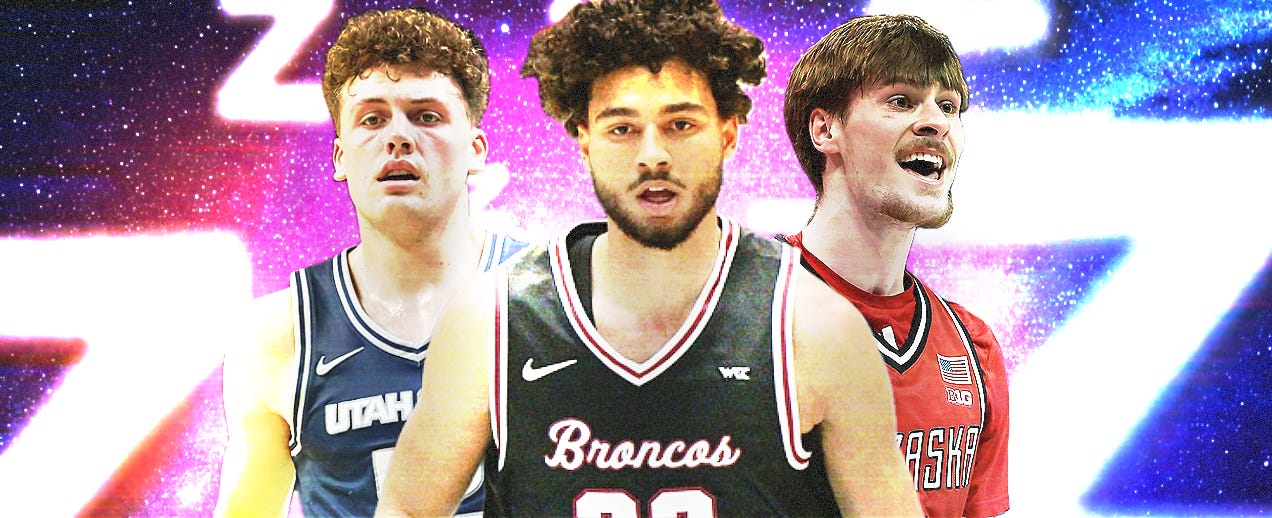
Another week, another set of sleeper prospects!
Allen Graves | Santa Clara | Freshman (RS) | Forward | 6’9” | 225
Allen Graves probably could have made an appearance in this column by now, but he makes his debut after a strong sample of good play for Santa Clara. I mentioned this just last week when discussing Allen’s teammate, Christian Hammond, but Santa Clara just continues to bring in incredibly talented players. Graves fit this description, too. He was named Louisiana’s Gatorade Basketball Player of the Year. He is also a high school state champion—something that continues to be a common denominator in college success despite consensus grassroots rankings. In his senior year of high school, Graves averaged about 21 PPG and 12 RPG—to go along with 2.8 APG, 2.6 BPG, and 1.6 SPG.
Allen redshirted last season, and came into the 2026 NBA Draft cycle ready to be a contributor with the Broncos. Graves has only started four games this year—starting three games in a row against Minnesota, Utah State, and New Mexico in late November/early December. In those games, Allen averaged 11.7 PPG, 5.7 RPG, 3.7 APG, 1.7 SPG, and 1.3 BPG. That was with shooting splits of 52/44/25 (1-of-4 FT attempts). This past week, Graves had one game against Pacific, where he dropped 17 points on 7-of-14 shooting from the floor. He also had eight boards and six stocks (steals + blocks).
Graves is a very fun player who can mix it up on both ends of the floor. He is a threat from multiple areas on the floor. Allen can start from the perimeter—making cuts and spot up—to give Santa Clara unique lineups they can roll out. He can get to the rim, as evidenced by his 56th Percentile in at-rim scoring frequency. His frame allows him to absorb contact while looking to score, and to give his team second-chance points. He has shown that he can be somewhat of a shooting threat, as he is shooting around 38% on 5.5 attempts per 100 possessions. Graves isn’t shy about letting the three-ball fly, as he has shown confidence in pulling up from deep in transition or right off the catch. The form is solid, but does showcase a bit of a dip and takes a little bit of time to get off. Still, he is very active as a rebounder on both sides of the ball (15.4 Offensive Rebounding percentage, and 21.0 Defensive Rebounding Percentage). Rebounding is a strong translation indicator, which bodes well for Graves.
Allen does offer plenty on defense. That length and effort are very much there on defense, as Graves moves his feet well, and he does get vertical on his contests. He has smart hands and makes well-informed digs at the ball. On the season, Allen has a Steals Percentage of 5.3 and a Block Percentage of 5.8. He is able to defend multiple areas of the frontcourt, which is what makes him so tantalizing as a longer-term prospect to keep an eye on as a future NBA bet.
He has his flaws. Allen isn’t the most bursty of athletes. He does have six dunks within the halfcourt, per Synergy, but he does need a bit of a runway. The one lob finish he has in such sets, he barely clears the rim and doesn’t look confident that the ball is going to make it. Those dunks have all come off of two feet, for what it’s worth. Still, his Free Throw Rate is solid, but nothing extraordinary. I touched on the percentage from deep earlier—and the volume—and I think there may be a bit of a false floor there with Graves. There is also the question of his ability to do more with the ball—particularly off of the bounce. Being able to show more there would provide clarity on how versatile he can be positionally on offense.
Mason Falslev | Utah State | Junior | Guard | 6’4” | 200
I liked what I watched from Mason Falslev last year, and he has continued to impress in his junior season at Utah State. Mason has started in all 84 games he has played for the Aggies since he reported to campus. The worst he has shot from the floor across all three seasons he has played in (so far) is the 49.7% he produced last season. This came after a productive high school playing career, where he earned consecutive 4A MVP awards. As a Senior, Falslev averaged 20.1 PPG, 8.4 RPG, 5.8 APG, and 1.6 SPG.
Coming into this season, there was little doubt as to what Falslev’s role would be at Utah State. He has only had two games this year where he failed to score in double figures. The first came in a 110-54 win over Westminster in the first game of the season, where he played only 16 minutes. The second came in the 94-60 win over Davidson, where he played just 26 minutes. His most recent game came against Nevada on the 14th. That was his best scoring game of the season, where he dropped 26 points on 9-of-14 scoring from the floor.
Mason plays a very fun game. He’s what you would imagine as the proverbial “coach’s dream”, as he does traditional point guard stuff, while also rebounding, defending—even setting screens. He has a good frame to mix it up in the paint, and has some craftiness to finish with nifty and tough finishing angles. Falslev ranks in the 63rd percentile in at-rim finishing and in the 68th percentile in at-rim frequency. He puts a healthy amount of pressure on the rim with his drives—which make up for almost 14% of his offense. His handle and ability to navigate in traffic have resulted in him ranking in the 68th percentile in scoring out of the pick-and-roll. Mason is very good at leveraging his scoring to get his teammates open. He has a lot of confidence in his ability, passing off drives and on jump passes. At 6’4”, he can layer some passes over the top of the defense, too. He is capable of making quick reads. All of this makes him a dual threat as both a scorer and facilitator.
Something that serves as a distinction for Mason compared to other sleeper guards is activity on defense. He has some sneaky length on that side of the floor, and he gives a ton of effort. His size and strength—while not overly “plus”—do give him utility as a point-of-attack backcourt defender and irritant. Teams simply cannot attempt lax passes around him, or he’ll turn them into points. He even has some recovery stuff to his game—which is handy because Utah State will often give him some tough assignments that he likely wouldn’t have to take on for a higher-major school. He’ll reject and contest shots, too, as he has 46 stocks (steal + blocks) to just 33 fouls committed.
Falslev is going to be “dinged”, so to speak, due to being a bit of an “older” prospect. For his size, you would like to see him be more of a reliable shooter—especially off the bounce, as he ranks in the second percentile on dribble jumpers. That isn’t just a “this year” thing with him, either. With those two factors, Mason would need to be elite at a lot of things. He isn’t at that level yet, but he does play very hard. His rebounding has always been solid-to-very good across all years of his college career. He also hasn’t been on the top shelf of playmakers, though being solid in that area. There is a shot that he could do more if the resources surrounding him improve, however that might happen.
Braden Frager | Nebraska | Freshman (RS) | Wing/Forward | 6’7” | 215
The Nebraska Cornhuskers have gotten off to a blistering start to their season, and there have been a number of reasons for that. Pryce Sandfort has been the headlining player for the team (rightfully so), but Braden Frager has attracted a lot of attention in his own right. Frager is a redshirt freshman for the Huskers, coming from within the state of Nebraska. He wasn’t a Player of the Year in Nebraska—nor was he a state champion—but the former three-star prospect was incredibly solid in high school. He was an honorable mention for being an All-State performer, where he averaged 18.3 PPG, 7.0 RPG, 1.2 APG, and 1.2 SPG. Though he wasn’t the premier prospect, he did attract attention from schools like Iowa State and Creighton.
For Nebraska this season, he’s played in all 17 games for the team—as they have gone undefeated. For the year, Braden has averaged 12.3 PPG, 4.1 RPG, 1.0 APG, and 0.6 SPG—with shooting splits of 53/38/83. He has gone scoreless in two games, against Oklahoma and Illinois. But he has also three games where he has scored over 20 points. His most recent performance came against Oregon, where he dropped a season-high 23 points on 8-of-13 shooting from the floor. He also chipped in three rebounds, one assist, and a steal.
Braden ranks in the 98th Percentile in all scoring possessions. The lefty has played well within Nebraska’s system, showing off reliable floor spacing, with the ability to score at the rim. Frager runs off multiple screens within the flow of the offense and has very good footwork to get into his shot. What’s good with him is that he can utilize screens, but he isn’t afraid to shoot over the top of his man, either. Frager is shooting over 38% from deep on over 11 attempts per 100 possessions. Defenses can sort of be lulled to sleep from the threat of him shooting, but Braden can attack the basket and throw down at the rim. His pump fake can cause defenders to freeze, which gives Frager the ability to attack the paint. He ranks in the 97th percentile scoring at the rim, and in the 43rd percentile in at-rim frequency. He does have some passing feel as well.
Braden has done well to be impactful for his team, but there are reasons to consider him as a longer-term prospect. He is a little slighter of frame, which hasn’t really impacted him in a crazy way. He is a fine rebounder. Frager’s vision was touched on earlier, but the volume of playmaking isn’t anything substantial to project. His Assist Percentage is low (8.2), but so is his Turnover Percentage (10.1). Defensively, there is some work that needs to be done. He has a tendency to bite hard on pump fakes. When he is behind on a play, there is a probability that he stays behind. There are moments where he can be solid on defense, but the strength deficit tends to show up more on that side of the floor. Still, Braden has shown a lot of positive features on offense, and has the tools to improve defensively.
Terrence Hill Jr. | VCU | Sophomore | Guard | 6’3” | 180
There are a lot of guards who are drawing a lot of attention this season. Notably, these are “this year” guys that are all over big boards, but even in the “lower” ranks of guards, there are a number of sleepers who have been producing as well. Terrence Hill Jr. is one such guard. After playing just 143 minutes for the Rams last season, Hill has stepped into a larger role. He reported to VCU after being named First Team All-State and to the 6A All-Tournament First team in high school. As a senior, he put up 21.9 PPG, 5.7 RPG, and 4.9 APG.
After having more of an inconsistent role at VCU last season, Terrence has played about 21 MPG to this point. In that time, he’s averaging 14.6 PPG, 2.4 RPG, 2.3 APG, and 0.6 SPG. That’s on shooting splits of 51/41/88. Despite all of that production coming off the bench, Hill is putting up a BPM of 9.8—ranking 41st in all of college basketball.
Hill is a threat from any spot on the floor, regardless of whether he is initiating a possession or not. VCU will run offense through him on pick-and-roll looks, where he ranks in the 89th percentile scoring out of such sets. He plays with such good pace and knows how to “downshift” to create ample separation for him to get to a shot. When Terrence hits his decel, he is capable of getting to a mid-range bucket or even getting to the rim at times. Where he can truly shine is playing off of others. Terrence is about as good as it gets as a floor spacing guard, as he has connected on over 47% on his catch-and-shoot three pointers. Though he doesn’t get to the rim a whole heck of a lot, he gets there more than some other highly-regarded guards, and ranks in the 96th Percentile in scoring once he gets there. As a decision maker, Hill is very sound. More often than not, he knows where he wants to go with the ball before he even gets it. He’s more than capable of doing some driving-and-kicking, and some more creative looks.
Terrence isn’t hitting jumpers consistently off the bounce, which is something we discussed as nearly a must with guards earlier. He ranks in the 54th percentile on dribble jumpers—which is fine—but he has only hit about 27% of his dribble jumper three pointers. There are some frame concerns, which show in his at-rim frequency, but also in the rebounding numbers. It also shows on the defensive side of the court. He’ll need to tack on a bit more strength to be given real looks at the next level. Truthfully, his role right now is a bit of a hindrance as well. He isn’t starting for his own team, which will inherently come with questions.
Ben Defty | Boston | Sophomore | Big | 7’ | 255
Everyone loves a big man, right? This has to be exceptionally true when it comes to sleeper bigs. Well, we have one here in Boston’s Ben Defty. Defty is in his second season with the Boston Terriers. Prior to college, Ben played in Germany, playing for multiple club teams. He was a key part of the German U18 National, which finished third in the FIBA U18 European Championship. After showing promise overseas, Defty elected to commit and play for Boston last season, where he played in all 32 games for the team—albeit on under 12 MPG.
This season, Ben has started and played every game for the Terriers. There have only been three games where Defty failed to score in double figures. One game came against Penn State, but he was able to log eight rebounds, three assists, and a block. Over the last eight games, Ben has averaged 16.3 PPG, 7.0 RPG, 1.1 APG, and 1.3 BPG. He’s done all of that while converting on almost 69% on all of his shot attempts. He’s also connected on about 72% from his free throws.
Ben is a little bit of a throwback big man. He hasn’t attempted a single three-pointer on the season, with him ranking in the 80th percentile in at-rim frequency. What makes him such an interesting, long-term big man prospect is the touch he shows around the rim. He loves to back his man down, put up some fun flick shots and push shots. His footwork is pretty solid, which has allowed him to give himself the room he needs to get those shots up. On non-dunk finishing numbers, Ben ranks in the 94th percentile. When one hears of a non-shooting big man who is effective around the rim, it’s easy to imagine a plodding center who may or may not be a little heavy. That’s not Defty. He moves well, and he is capable of running the floor. He also has some good mass that comes with some definition. This combination of size, movement ability, and strength all play a part in Defty’s stellar rebounding numbers and Free Throw Rate (53.9).
While Ben has a lot of projectable traits, the lack of three-point shooting gives him a glass ceiling of sorts. His mid-range shot isn’t showcased a lot, either, and it’s not necessarily all that effective. While his free-throw percentage is climbing a bit, it’s not a high enough number to favorably project his shot. The only indicator that you could be hopeful for is the touch around the rim. Defty has size and strength, but he isn’t particularly “bursty” or “poppy” athletically. Considering all of this, the one area he needs to improve that is most likely to happen is the passing. He’s shown some flashes of finding cutters and working in DHO, but it’s not consistent. If he is pressured, the passing can be erratic. He also needs to work on protecting the ball when he gets deep position. That isn’t there yet, but it very well could be.
Honorable Mentions
Kevair Kennedy | Merrimack
Leroy Blyden Jr. | Toledo
Sam Lewis | Virginia
Isaac Asuma | Minnesota
Follow me on Twitter: StephenGHoops
Catch me on BlueSky: StephenGHoops
Catch the Draft Sickos show LIVE on the No Ceilings NBA channel: